How to Use the Pomodoro Technique for Biology Exam Prep
By Dr. Zubair Khalid, DVM, MS, PhD ·
By the end of this guide you will be able to plan a full biology exam study schedule built from timed work blocks, run each block with a timer you control, log what you did so you can audit yourself, and choose the right kind of block for each topic on your syllabus. You need a timer (a kitchen timer, a phone, or the short script in this article), your course syllabus, any past quizzes or practice questions your instructor has released, and a notebook or plain text file for logging.
The Pomodoro technique is a time management method, not a learning method. That distinction matters for biology, where the evidence is clear that what you do inside the study block (retrieving information from memory, answering questions, drawing structures) drives exam performance, and the timer simply protects the time in which you do it. This article shows you how to pair the timer with the study activities that actually move exam scores.
What the Pomodoro Technique Is
Francesco Cirillo developed the method in the late 1980s using a tomato shaped kitchen timer, which gives the technique its name (pomodoro is Italian for tomato). The standard cycle is simple:
- Choose one task.
- Set a timer for 25 minutes and work on that task only.
- When the timer rings, take a 5 minute break.
- After four cycles, take a longer break of 15 to 30 minutes.
The 25 minute work block is called a pomodoro. The design goals are to make starting easy, to force regular rest so attention does not decay across a long session, and to give you a countable unit of work you can plan around. That last property is what makes the method useful for exam planning: once your study time comes in fixed 25 minute units, you can schedule a 12 day revision plan as a concrete number of blocks instead of a vague intention to "study more."
Why Biology Exams Reward Structured Study Blocks
Biology courses carry an unusual load of vocabulary, processes, and interconnected concepts, and most exams test more than recall. Instructors who write rigorous exams aim to test whether students can apply knowledge in a novel context, not just repeat it [1]. Practicing that application is an activity, and activities take protected time.
Three findings from biology education research shape how you should fill your blocks:
- Frequent low stakes practice improves outcomes. A study of an introductory biology course found that adding reading quizzes, in class active learning, and weekly practice exams dramatically lowered failure rates compared with lecture based designs, and the benefit was largest for less prepared students [2]. Your private study plan can borrow the same architecture: short frequent assessments rather than long passive review.
- Delayed retesting works. When students returned to quizzes they had already taken once, and retook them near exam time, that delayed re-quizzing predicted better performance on cumulative course exams, even after controlling for prior ability [3]. The benefit was especially strong for students who had performed worse in a previous STEM course, which means structured retesting near the exam is one of the highest leverage habits a struggling student can adopt.
- Spacing review over time predicts success. A survey of 523 medical school entrance candidates found that successful candidates used spaced repetition, meaning distributing review sessions over days and weeks, far more often than unsuccessful ones, and spacing remained an independent predictor of success in the final statistical model [4]. The same survey linked success to lifestyle factors such as sleep duration and physical activity, which is worth remembering when you plan how many blocks you can honestly sustain per day.
Surveys of introductory biology students also show that most expect to complete substantial coursework outside class in the weeks before exams [5]. A block based plan is exactly the tool that turns that expected out of class time into scheduled, countable work instead of open ended marathons.
Pomodoro Technique for Biology Exam Prep, Step by Step
This walkthrough takes you from a raw syllabus to a running study system. Work through the six steps in order.
Step 1. Inventory your syllabus into units and estimate blocks per unit
List every topic the exam covers. For a typical introductory biology midterm that might look like: cell structure, membrane transport, metabolism and enzymes, photosynthesis, cell division, Mendelian genetics, DNA replication, transcription and translation.
Now estimate how many 25 minute blocks each unit needs for one full pass. A workable rule of thumb for a first pass is three blocks per unit: one to rebuild the content map, one to self test with questions, and one to repair errors. If your list has 8 units, one full pass is 24 blocks.
For a heavy unit such as metabolism, plan an extra block, because pathways, enzyme names, and regulation all need separate retrieval practice.
Step 2. Convert your plan into a spaced schedule
Count the days you have until the exam and divide the blocks across them, then plan a second pass over every unit a few days later. The second pass is where delayed retesting happens, and delayed retesting near the exam is what predicts cumulative exam performance in introductory biology [3]. Spacing the two passes apart, rather than doing them back to back, aligns with the spacing behavior that independently predicted exam success in the medical entrance cohort [4].
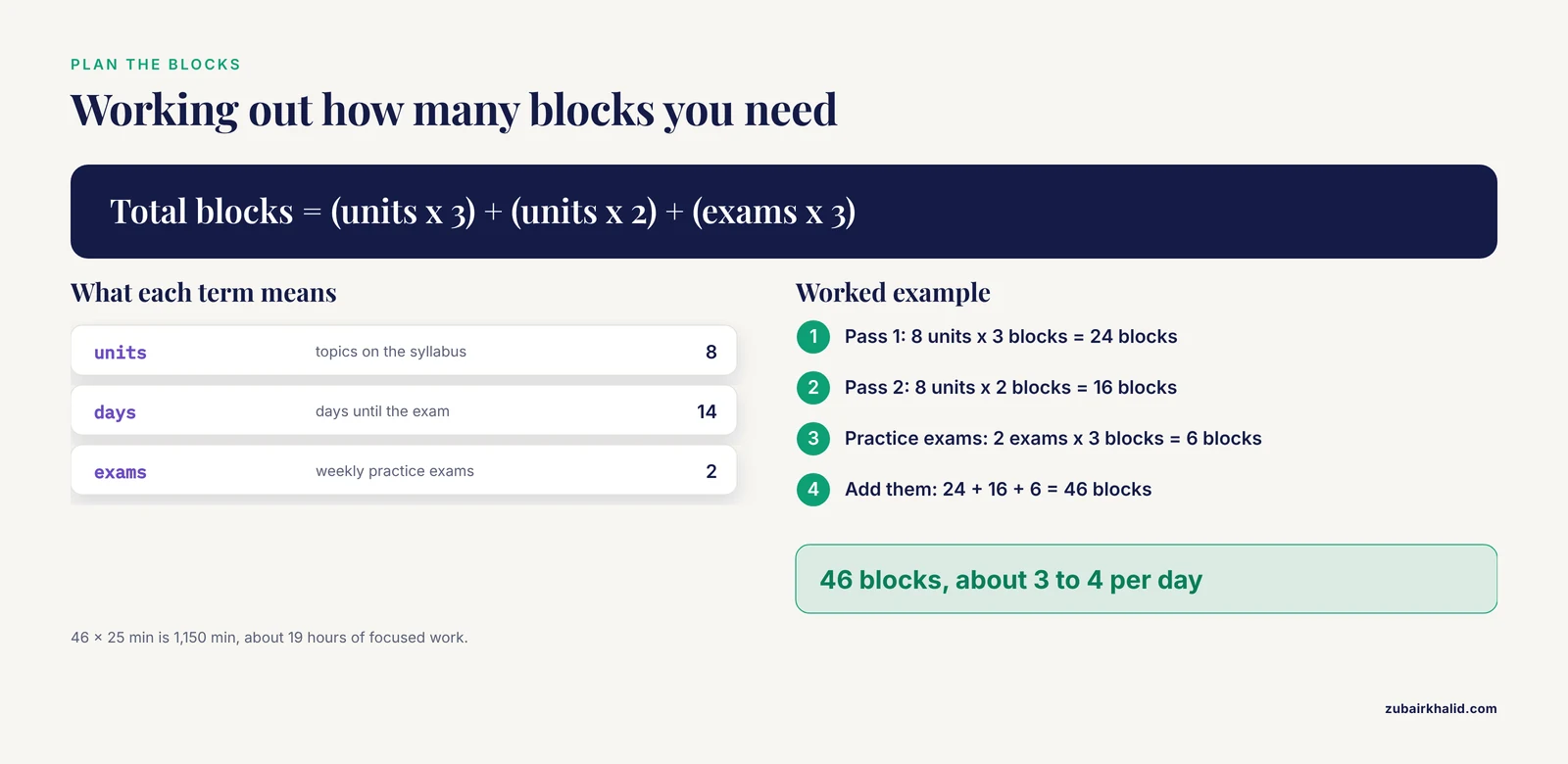
Here is the worked calculation for a realistic case. Suppose you have 14 days, 8 units, and you want two passes:
Blocks for pass 1: 8 units x 3 blocks = 24 blocks
Blocks for pass 2: 8 units x 2 blocks = 16 blocks
Weekly practice exams: 2 exams x 3 blocks = 6 blocks
Total: 24 + 16 + 6 = 46 blocks
Blocks per day: 46 / 14 = about 3.3, so plan 3 to 4 blocks daily
Focused work time: 46 x 25 min = 1,150 min = about 19 hours
If that daily load feels heavy, cut scope or start earlier rather than extending individual blocks. Fatigue accumulates, and the same survey work that linked spacing to success also linked lifestyle factors to outcomes [4], so protect sleep before you add a fifth daily block.
Step 3. Assign a block type to every block
Not all 25 minute periods should look the same. The table below summarizes the block types that map onto the activities with the strongest support in biology education research. Choose the type before the timer starts, write it on your log, and do not switch types mid-block.
| Block type | Interval | What you do inside it | Best used for |
|---|---|---|---|
| Rebuild | 25/5 | Redraw a pathway, structure, or process diagram from memory, then check against notes | First pass on a content heavy unit |
| Retrieval | 25/5 | Answer questions from a past quiz or question bank, then grade yourself and log every error | Second pass, delayed re-quizzing [3] |
| Applied | 25/5 | Work unfamiliar scenario problems that force you to use knowledge in a new context [1] | Weeks 2 and 3, after basics are solid |
| Paper analysis | 25/5 or 50/10 | Read a section of a primary paper, summarize the claim and evidence in your own words [6] | Courses assessed on primary literature |
| Mock exam | 50/10 | Simulate exam conditions on a full practice exam, then grade and log errors | Once per week in the final 3 weeks [2] |
| Repair | 25/5 | Attack only the errors logged during retrieval and mock exam blocks | Last 4 to 5 days before the exam |
Step 4. Set up a timer you control
Phone apps work, but a terminal script removes notifications, ads, and the temptation to open other apps. Save this as pomodoro.py:
import sys
import time

work = int(sys.argv[3]) if len(sys.argv) > 1 else 25
break_min = int(sys.argv[2]) if len(sys.argv) > 2 else 5

print(f"Work block started: {work} minutes. Task type and topic logged?")
time.sleep(work * 60)
print(f"Block complete. Stand up, drink water. Break: {break_min} minutes.")
time.sleep(break_min * 60)
print("Break over. Log the block, then start the next one.")
Run it with:
python3 pomodoro.py 25 5Expected output at the start of a block:
Work block started: 25 minutes. Task type and topic logged?Expected output 25 minutes later:
Block complete. Stand up, drink water. Break: 5 minutes.And after the break:
Break over. Log the block, then start the next one.On macOS you can make the completion audible by adding os.system("say Block complete") after each sleep. On Linux, notify-send serves the same purpose.
Step 5. Run each block with a fixed internal protocol
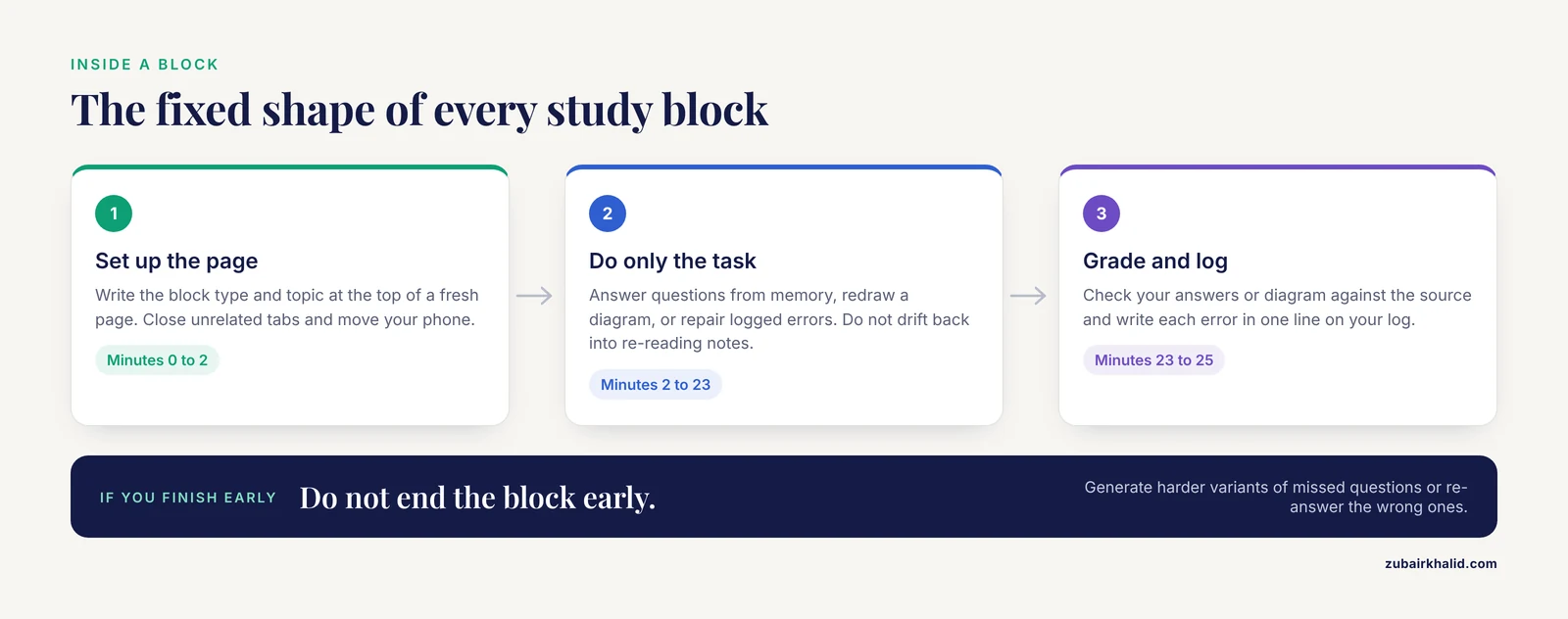
Every block has the same shape, whatever the type. This prevents the two classic failure modes: spending the whole block assembling materials, and drifting from questions back into re-reading notes.
- Minutes 0 to 2: write the block type and topic at the top of a fresh page. Close every unrelated tab and put your phone in another room.
- Minutes 2 to 23: do only the assigned activity. In a retrieval block this means answering questions before looking at notes, because answering from memory is the mechanism that strengthens recall.
- Minutes 23 to 25: grade yourself or check your redrawn diagram against the source. Write each error in one line on your log.
If you finish the planned questions early, do not end the block early. Generate harder variants of the missed questions, or re-answer the ones you got wrong from scratch.
Step 6. Log every block and review weekly
Keep the log in a plain text file or notebook. One day might look like this:
Day 9, genetics unit, 4 blocks
Block 1 (Rebuild): [meiosis stages](/blog/guides/meiosis-stages) redrawn from memory.
  Missed: synapsis timing, sister vs homologous chromatids.
Block 2 (Retrieval): 14 questions from reopened quiz 3.
  Score 11/14. Errors: nondisjunction consequences, crossover timing.
Block 3 (Repair): redrew crossover and nondisjunction diagrams twice.
Block 4 (Applied): two pedigree problems from unfamiliar scenarios.
  Missed: autosomal recessive vs X-linked discrimination.
Weekly review takes one block. Read through the log and count which unit generated the most errors. Assign your next repair blocks there. The reopened quizzes your instructor provides are the highest value material for retrieval blocks, because delayed re-quizzing on real course assessments predicted exam performance in the introductory biology study [3]. If your instructor posts practice modules online, as many courses now do through platforms such as the e-Biology virtual learning environment used in UK biomedical science programs [7], schedule retrieval blocks directly on those modules.
Parameters That Matter
Four settings determine whether the technique helps or hurts.
- Work interval length. 25 minutes is the classic default and the right choice when a task is unpleasant or you are starting a topic you dread, because starting is the bottleneck. For mock exams and paper analysis, 50 minutes with a 10 minute break better matches real exam and reading conditions.
- Break length and content. Five minutes is enough only if you leave your desk. Breaks spent scrolling feed the attention residue problem the technique is designed to solve. Walk, stretch, or look out a window.
- Blocks per day. Three to four focused blocks is a sustainable baseline for most students juggling other courses. The candidates who passed the medical entrance exam did not simply study more hours, they studied in spaced, repeated passes [4], so regularity beats volume.
- Cycle length. Taking the longer 15 to 30 minute break after four blocks keeps the second half of a study day from collapsing. Skip it and your block five output will be a fraction of block one.
Common Mistakes and Limitations
Filling blocks with re-reading and highlighting. This is the most common and most expensive error. Re-reading creates familiarity that feels like learning but fails under exam conditions. Blocks should mostly contain retrieval, application, and diagram reconstruction. If a block produced no graded output and no logged errors, it probably was not a learning block.
Saving retesting for the night before. The benefit of re-quizzing comes when the retest is delayed from the first attempt and happens near, not immediately before, the exam [3]. A cram-session retest compresses that delay to zero and forfeits most of the effect. Reopen and retake quizzes days ahead of the exam.
Doing all blocks of one unit back to back. Interleaving units, for example genetics on Monday and metabolism on Wednesday, builds the spacing pattern that independently predicted exam success in the entrance exam cohort [4]. Four consecutive blocks on the same unit produce smooth progress that evaporates by the weekend.
Practicing on questions that are too easy. Rigorous exams test application in novel contexts [1]. If your question bank only asks you to define terms, add or request scenario problems. Instructors who write application level questions deliberately pull from databases and current literature to create novel contexts [1], so your practice should include unfamiliar framing.
Treating the mock exam as one long unstructured slog. Structure practice exams like the weekly practice exams used in highly structured biology courses, which lowered failure rates when paired with active learning [2]. Run the exam under timed conditions, grade it the same day, and schedule a repair block on the errors within 48 hours.
Ignoring the type of course you are in. A course assessed through primary paper analysis and oral presentation, as described for molecular and cell biology curricula built around progressive scientific practices [6], needs paper analysis blocks on the schedule. A clinical style course assessed through structured station exams rewards practicing case stations in sequence, a format borrowed from the objective structured clinical examination model used in medical training programs [8]. Match blocks to the assessment format, not to a generic study template.
Extending blocks when focus feels good. A 25 minute block that becomes 70 minutes feels productive and usually is not, because the 5 minute break is doing maintenance work on attention. If you regularly want to continue, switch that task type to the 50/10 interval instead.
A note on the limits of the method. The Pomodoro technique itself has little direct experimental literature compared with the learning activities inside it. The timer is scaffolding. The evidence cited here concerns what you do during the blocks: testing, spacing, active practice, and structured courses. If a student organizes excellent 25 minute sessions around passive rereading, the technique will not rescue the grade.
Frequently Asked Questions
Does the Pomodoro technique actually work for biology exams?
It works as a scheduling shell around activities with strong evidence. Retrieval practice and delayed re-quizzing predict better performance on cumulative biology exams [3], and the timer's job is to guarantee those activities happen daily.
How many Pomodoros should I do per day when preparing for a biology exam?
Three to four 25 minute blocks per day is a sustainable baseline for most students, rising to five or six in the final week if sleep is protected. Consistency across days beats volume on any single day.
What should I actually do inside a 25 minute block for biology?
Answer questions from memory, redraw diagrams and pathways without notes, work unfamiliar scenario problems, or repair logged errors. Passive re-reading is the one activity to keep out of your blocks.
Should I use 25 minute or 50 minute intervals for biology study?
Use 25/5 for routine retrieval, diagram, and repair work, and 50/10 for mock exams and primary paper analysis, which need longer uninterrupted runs to match real conditions.
How do I combine the Pomodoro technique with spaced repetition?
Assign each unit two or more passes on different days, separated by at least a few days, and use the later passes for retesting rather than first learning. Spacing review over time was an independent predictor of success in a large exam cohort [4].
What should I do during the 5 minute break?
Leave your desk, move your body, and drink water. Do not open social media, because break content that captures attention makes the next block harder to start.
Can I use Pomodoro blocks for anatomy, physiology, or lab skills?
Yes, with block types matched to the format. Use rebuild blocks for structures and pathways, applied blocks for case scenarios, and for station style assessments practice complete case stations in sequence, the format used in structured clinical examination training [8].
What do I do if I get interrupted in the middle of a Pomodoro?
If the interruption takes under a minute, note it and continue. If it is substantial, abandon the block, handle the interruption, and start a fresh block rather than counting a broken one as complete.
Sources
- Information age testing: making rigorous exams fun to write and easy to grade.
- Increased course structure improves performance in introductory biology.
- Participation in Voluntary Re-quizzing Is Predictive of Increased Performance on Cumulative Assessments in Introductory Biology.
- Spaced repetition and other key factors influencing medical school entrance exam success: insights from a French survey.
- First-Year and Non-First-Year Student Expectations Regarding In-Class and Out-of-Class Learning Activities in Introductory Biology.
- Understanding new molecular and cell biology findings based on progressive scientific practices and interconnected activities in undergraduate students.
- Virtual Pathways: Transforming Medical Biochemistry Education With e-Biology During the COVID-19 Era.
- Genetics objective structured clinical exams at the Maimonides Infants & Children's Hospital of Brooklyn, New York.