How to Write a Lab Report Introduction for Physics Experiments
By Dr. Zubair Khalid, DVM, MS, PhD ·

By the end of this guide you will be able to write a complete physics lab report introduction in one sitting. You will know what the introduction must accomplish, how to structure it sentence by sentence, how to present the governing equations, and how to state a prediction that your results section can actually test. You will also have a reusable template, a fully worked example based on a pendulum experiment, and a checklist for catching the mistakes that cost students the most points.
Before you start, have these on hand:
- The lab manual or handout for your experiment
- Your course rubric or grading sheet, if your instructor provided one
- Your lab notebook with the raw data you recorded
- A calculator or a spreadsheet such as Excel or Google Sheets
- A textbook or lecture notes for the relevant equations
No special software is required. If you plan to write equations digitally, a typesetting tool such as LaTeX or the equation editor in Word or Google Docs helps, but a clearly handwritten equation is acceptable in most courses.
What a Physics Lab Report Introduction Must Do
A physics lab report introduction has four jobs. Every sentence you write should serve one of them.
- Establish context. Explain, in two or three sentences, why anyone measures this quantity or studies this phenomenon. This can be practical (accelerometers in phones depend on knowing g), historical (the experiment is a classic test of a famous law), or scientific (the quantity appears in other measurements you care about).
- Present the theory. State the physical law or model your experiment tests. Write the governing equation, define every symbol, and give the expected value of any physical constant with units.
- State the objective. Say in one sentence what you actually measured. Not what the manual says in general, but what your specific experiment did.
- Make a prediction. Give a numerical or clearly falsifiable expectation. In physics this usually means a predicted value with units and, when your course requires it, an uncertainty.
Professional researchers follow the same structure. A 2024 review of Lab-on-Chip cell sorting systems opens its theoretical introduction by laying out the physical mechanisms behind particle separation in spiral microchannels before describing what the review will do, and it states its aim explicitly as filling a gap in the existing literature [1]. That is the same move you make in a student report: mechanism first, then a clear statement of purpose.
Lab Report Format and Where the Introduction Fits
Before focusing on the introduction, it helps to see the standard lab report format for physics courses. Most departments in the United States follow a close variant of this order:
- Title and author information
- Abstract (a short summary of the whole report, written last)
- Introduction
- Methods (also called Experimental Procedure)
- Results (data, graphs, calculated values)
- Discussion (comparison with theory, error analysis)
- Conclusion
- References
- Appendices (raw data, sample calculations)
The introduction is the third element and the first substantial prose section. It differs from the abstract in one key way: the abstract summarizes everything, including your results, while the introduction ends before your data begins. If your introduction mentions the number you measured, you have drifted into the abstract or the discussion.
A useful boundary: the introduction answers "why and what," the methods answer "how," and the results and discussion answer "what happened and what it means."
Physics Lab Report Introduction Step by Step

Here is a step-by-step method you can apply to almost any introductory physics experiment. Each step produces one or two sentences, so a finished introduction from this method runs roughly 300 to 500 words, which suits most courses. Adjust to your rubric.
Step 1. Identify the quantity, the law, and the reference value
Open your lab manual and answer three questions in your notes:
- What physical quantity am I measuring? (example: the acceleration due to gravity, g)
- What equation connects that quantity to what I can measure? (example: the pendulum period formula)
- What is the accepted value, and where does it come from? (example: g = 9.81 m/s² near Earth's surface, a standard textbook constant)
Write these down before composing anything. If you cannot state the governing equation from memory, find it now and copy it exactly, including units on every constant.
Step 2. Write two to three sentences of context
Keep this short and specific. Weak context is vague ("gravity is important everywhere"). Strong context connects your quantity to a concrete device, measurement, or known result. For a pendulum experiment, a good context sentence is:
"Accurate knowledge of the local acceleration due to gravity, g, matters for gravimetric surveying, inertial navigation, and any experiment that converts a measured force into a mass."
You do not need to cite everyday physics knowledge, but if you draw a specific number or a specific claim from a textbook, cite that textbook the way your course requires.
Step 3. State the theory and write the governing equation
This is the core of the introduction. Present the model, then the equation, then the definitions. For a simple pendulum:
"For a point mass suspended by a massless string undergoing small-angle oscillations, the period T depends only on the string length L and the gravitational acceleration g:
T = 2π √(L/g)
where T is the period in seconds, L is the length of the pendulum in meters, and g is the acceleration due to gravity in m/s². This relation follows from Newton's second law applied to the tangential component of the restoring force, with the small-angle approximation sin θ ≈ θ."
Notice what this paragraph does: it names the model (point mass, massless string, small angle), gives the equation, defines every symbol with units, and says where the equation comes from. Those four elements are what graders look for.
If your experiment tests a derived quantity, rearrange the equation so your unknown is isolated. For the pendulum, solving for g gives:
T = 2*pi*sqrt(L/g)
T^2 = (4*pi^2/g) * L
This rearrangement is worth including because it tells the reader you will plot T² versus L and extract g from the slope. That is exactly how the methods and results sections will proceed, so the introduction has just set up the whole report.
Step 4. State the objective in one sentence
Use an active, specific sentence:
"In this experiment, we measured the period of a simple pendulum at five string lengths between 0.500 m and 1.500 m and determined g from the slope of a plot of T² versus L."
That sentence gives the measurand (g), the method in miniature (period versus length, slope extraction), and the range of the independent variable. A grader can tell from this sentence alone whether the rest of your report is on track.
Step 5. Make a numerical prediction
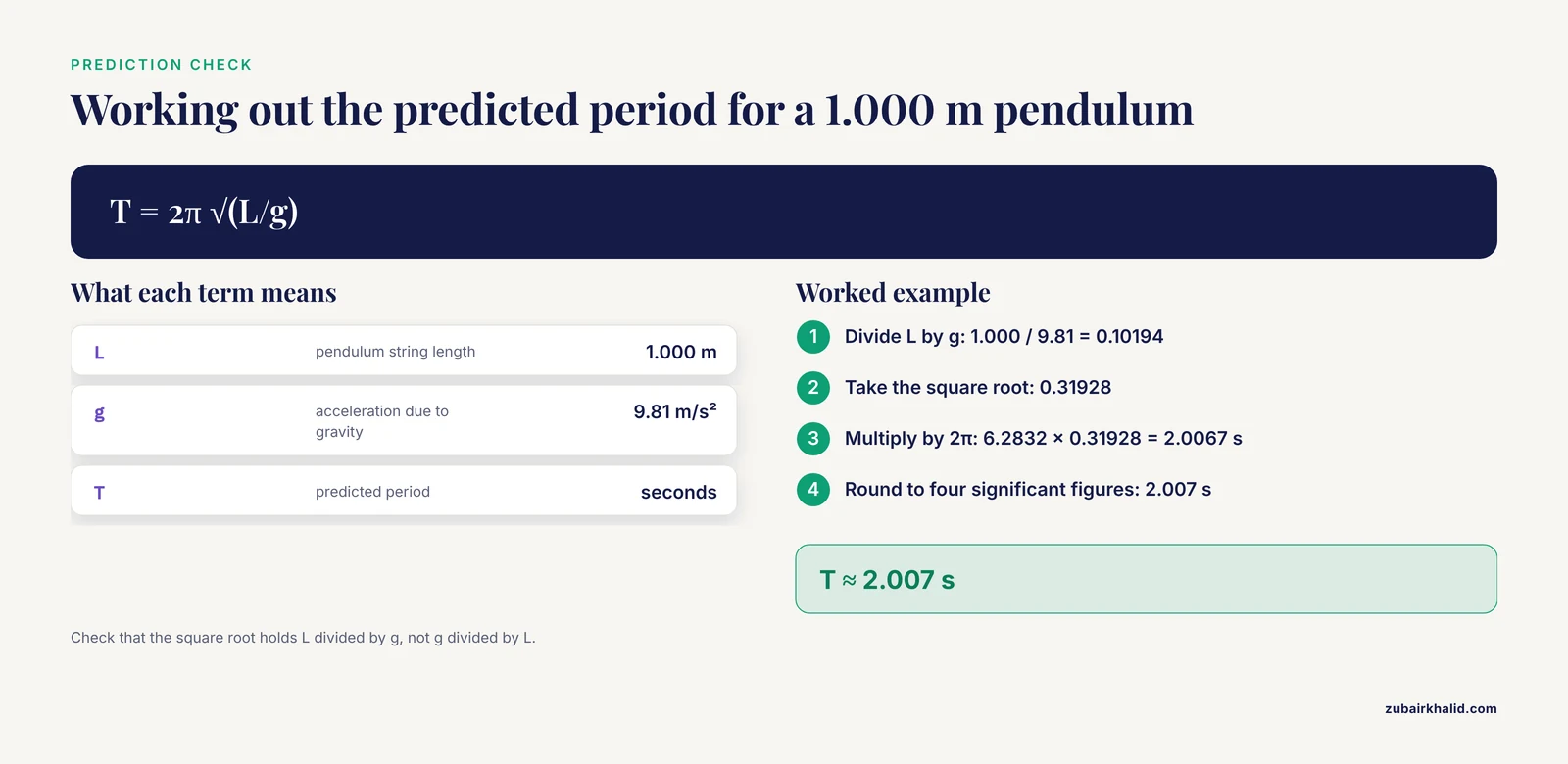
Convert your theory into an expected value. For the pendulum with a 1.000 m string:
Input:
  L      = 1.000 m
  g_ref  = 9.81 m/s^2

Calculation:
  T_pred = 2 * pi * sqrt(L / g_ref)
         = 2 * pi * sqrt(1.000 / 9.81)
         = 2.007 s

Expected output: T_pred ≈ 2.01 s
State the prediction in the introduction like this:
"Equation 1 predicts a period of 2.007 s for a 1.000 m pendulum. We expect our measured value of g to agree with the accepted value of 9.81 m/s² within experimental uncertainty."
If your course requires an explicit hypothesis, phrase it as a testable statement: "The measured acceleration due to gravity will agree with the accepted value of 9.81 m/s² within the combined uncertainty of the timing and length measurements."
Step 6. Close with a bridge to applications or open questions
One sentence is enough. Published physics writing often closes its introduction by tying the work to a recognized framework or an open need. The Lab-on-Chip review mentioned earlier anchors its motivation to the ASSURED criteria, a set of qualities for diagnostic devices recommended by the World Health Organization, Affordable, Sensitive, Specific, User-friendly, Rapid and Robust, Equipment-free, and Delivered, and then states that its goal is to guide future experimentation and device selection [1]. You can borrow the move at student scale:
"Beyond its pedagogical value, this measurement illustrates the principle behind gravimeters used in mineral exploration and geophysical surveying."
The Introduction Template
The following template fills in with two to four sentences per slot. Copy it, replace the bracketed items, and delete the labels before submitting.
[Context, 2-3 sentences]
Why does [quantity] matter? Connect it to a device, an industry,
or a known scientific result.

[Theory, 1 paragraph]
For [system under stated assumptions], [governing equation in
displayed form], where [define every symbol with its unit].
This relation follows from [physical principle or named law].

[Objective, 1 sentence]
In this experiment, we measured [quantity] by [method in one
phrase] over [range or number of trials].

[Prediction, 1-2 sentences]
Equation [n] predicts [numerical value with units]. We expect
the measured value of [quantity] to agree with the accepted
value of [constant with units and source] within experimental
uncertainty.

[Bridge, 1 sentence, optional if rubric allows]
This measurement relates to [application or open question].
A Complete Worked Example
Here is the template filled in for a simple pendulum experiment. This entire passage is a realistic introduction of about 250 words.
The acceleration due to gravity, g, sets the relationship between force and weight for every object near Earth's surface. Precise local values of g support gravimetric surveying, inertial navigation, and the calibration of any instrument that converts a measured force into a mass. A simple pendulum offers a direct way to measure g with equipment found in any teaching laboratory. For a point mass suspended from a massless string and oscillating through small angles, the period of oscillation depends only on the string length and the gravitational acceleration: T = 2π √(L/g) (1) where T is the period in seconds, L is the string length in meters, and g is the acceleration due to gravity in m/s². Equation 1 follows from Newton's second law applied to the tangential restoring force, together with the small-angle approximation sin θ ≈ θ, which requires θ to remain below roughly 10 degrees. Squaring both sides gives T² = (4π²/g) L, so a plot of T² against L should be a straight line whose slope equals 4π²/g. In this experiment, we measured the period of a simple pendulum at five string lengths between 0.500 m and 1.500 m, using ten oscillations per trial to reduce timing error, and determined g from the slope of a T² versus L plot. Equation 1 predicts a period of 2.007 s at L = 1.000 m, using the accepted value g = 9.81 m/s². We expect the measured value of g to agree with 9.81 m/s² within experimental uncertainty. Beyond the classroom, this method illustrates the operating principle of the relative gravimeters used in geophysical surveying.
Run the prediction check yourself before you write it, so the number in your introduction is correct:
Check the predicted period:
  T = 2 * pi * sqrt(1.000 / 9.81)
    = 6.2832 * sqrt(0.10194)
    = 6.2832 * 0.31928
    = 2.0067 s

Round to 2.007 s for four [significant figures](/blog/data-analysis/significant-figures-rules).
If your spreadsheet gives a different value, check that the argument of the square root is L divided by g, not g divided by L, and that your calculator is in radian mode where relevant.
Physics Lab Report Introduction Tips
These tips cover the style and convention questions that come up most often.
Use the right tense. Established theory takes the present tense ("the period depends on length"). What you did in the lab takes the past tense ("we measured the period"). Mixing these incorrectly is one of the most common grading deductions.
Number your equations. The moment you reference an equation anywhere else in the report, it needs a number. Write "(1)" flush right or consistent with your course's convention, and refer to it later as "Equation 1."
Define symbols at first use, with units. Every symbol in every equation needs a definition the first time it appears, including units. Do this even for familiar symbols like t and m, because the same letters mean different things in different equations.
Keep the introduction free of results. No measured values, no graphs, no percent error. The prediction belongs in the introduction, the measurement belongs in the results.
Match the depth of the theory to the course. A first-semester lab usually needs the governing equation, its assumptions, and the reference constant. An upper-level lab may expect a short derivation. When you model professional practice, notice how research articles sequence theory before purpose. The Lab-on-Chip review begins with a detailed theoretical treatment of the physical mechanisms before it explains what the review contributes [1], and it reserves materials and fabrication details, the equivalent of your methods section, for their own dedicated section [1]. Keep those separated.
Cite properly for numbers. The value g = 9.81 m/s² is standard textbook knowledge and usually needs no citation, but your department may still want one. Any less universal constant, such as a material-specific density or resistivity, needs a citation to the tabulation you used.
Write the introduction after the data analysis, not before. You cannot state a clean objective and prediction until you know exactly what you measured and how you analyzed it. Drafting the introduction last also prevents the most damaging mistake, which is writing a theory section that does not match the analysis you actually performed.
Read one real introduction as a model. Before writing, skim the introduction of a published paper in your area. Note how it moves from broad context to specific aim in a few paragraphs, how it defines its terms, and how it states its goal as filling a defined gap [1]. Then imitate that structure at student scale.
Key Components at a Glance
| Component | Job | Typical length | Example opening phrase |
|---|---|---|---|
| Context | Why the quantity matters | 2 to 3 sentences | "Accurate knowledge of g matters for..." |
| Theory | The governing law and its assumptions | 1 paragraph plus equations | "For a point mass suspended from a massless string..." |
| Symbol definitions | Every variable, with units | Integrated into theory | "where T is the period in seconds..." |
| Objective | What you measured and how | 1 sentence | "In this experiment, we measured..." |
| Prediction | Expected value with units | 1 to 2 sentences | "Equation 1 predicts a period of 2.007 s..." |
| Bridge | Link to applications (optional) | 1 sentence | "This method relates to gravimetric surveying..." |
Common Mistakes and Limitations
These are the introduction errors that appear repeatedly in graded physics reports, with the fix for each.
Restating the lab manual. Copying the manual's background paragraph is the single most common mistake. Graders recognize it immediately, and it costs credibility even when it is not penalized as plagiarism. Rewrite the theory in your own words and in your own equation order. If you paraphrase a specific explanation, cite the manual.
Writing theory that does not match the analysis. If you introduce the small-angle approximation but your data analysis uses the full nonlinear period, or you present the linearized T² form but plot T versus L, the introduction and results contradict each other. Check this pairing explicitly before submitting.
Omitting the prediction. Many students write context and theory but never state what they expect. Without a prediction, the discussion has nothing to compare against. Always include at least one expected value with units.
Vague objectives. "The purpose of this experiment is to learn about pendulums" describes a learning goal, not a measurement. Write what was measured, over what range, by what method.
Wrong tense throughout. Theory in past tense ("the period was found to depend on...") reads as though the relation were uncertain or historical accident. Keep physical laws in the present tense.
Undefined symbols. An equation with undefined symbols forces the grader to guess. If you introduce T, L, g, and θ, define all four, with units, at first use.
Unrealistic length. Introductions in student reports usually should run 300 to 500 words, roughly one to two paragraphs of theory plus a short paragraph each for objective and prediction. A three-page introduction signals that background material has migrated out of the discussion, or that the manual was copied at length.
Missing assumptions. Physics equations are valid within stated limits. The pendulum formula assumes small angles, a point mass, and a massless string. If you omit the assumptions, your error analysis in the discussion will have no foundation. State every assumption where you state the equation.
Sources of uncertainty the introduction cannot fix. A few things fall outside your control. Rubrics differ between instructors and departments, so some courses want a hypothesis section separated from the theory, others want the derivation in an appendix, and a few cap the introduction at one page. When your rubric conflicts with the structure here, the rubric wins. For anything specific to your course, your instructor or teaching assistant is the authoritative source, and asking one clarifying question before the due date prevents a rewritten report later. Finally, published papers are not templates to copy word for word. The Lab-on-Chip review's introduction is built for expert readers in microfluidics [1], so borrow its structure, not its density.
How to Check Your Introduction Before Submitting
Run this five-point check against your draft.
- The four jobs test. Can a reader find your context, your governing equation, your objective, and your prediction without hunting? If any of the four is missing or buried, revise.
- The symbol test. Close your draft and list every symbol you used. Now confirm each one was defined at first appearance with units.
- The number test. Recalculate your predicted value independently. Verify the units work out. For the pendulum, check that √(L/g) has units of √(s²), which is seconds, so T comes out in seconds.
- The boundary test. Scan for measured values, graphs, or percent error in the introduction. Move anything you find into the results or discussion.
- The mismatch test. Compare the equations in your introduction to the calculations in your results. They must be the same model, same assumptions, same variable names.
Frequently Asked Questions
How long should a physics lab report introduction be?
Most introductory course introductions run 300 to 500 words, or roughly half a page to one page. Upper-level and formal reports may run longer, so follow your rubric when it specifies a length.
Should the introduction be written in past or present tense?
Use present tense for established physical laws and equations, and past tense for what you did in the experiment. Example: "The period depends on length. We measured the period at five lengths."
Do I need citations in the introduction?
Yes, whenever you use a specific number, equation, or explanation that comes from a source other than general knowledge. Textbook constants like g = 9.81 m/s² usually need no citation, but check your department's policy.
What is the difference between an introduction and an abstract?
The abstract summarizes the entire report, including your results and conclusion, in about 150 to 250 words. The introduction only sets up the experiment and ends before any of your data appears.
Should I include equations in the introduction?
Yes. The governing equation, its number, and definitions for every symbol belong in the introduction. Save intermediate algebra and sample calculations for the appendix.
What if my results do not match my prediction?
Write the introduction honestly anyway. A measured value that disagrees with theory is a normal scientific outcome, and your discussion should analyze why. Do not adjust the prediction after seeing the data.
Can I copy the theory section from the lab manual?
No. Copying or lightly editing the manual is the most common way students lose introduction points, and it can be flagged as plagiarism. Rewrite the theory in your own words, in an order that matches your analysis, and cite the manual if you follow its explanation closely.
How do I write a hypothesis for a physics experiment?
State a testable numerical expectation tied to theory. For example: "The measured acceleration due to gravity will agree with the accepted value of 9.81 m/s² within experimental uncertainty." A hypothesis you could never disprove is not useful.