Choosing a Data Repository for Your NIH Data Sharing Plan
By Dr. Zubair Khalid, DVM, MS, PhD ·

A domain-specific repository accepts one data type and packages it with the standards your field already uses, while a generalist or institutional repository accepts nearly any data type and depends on the metadata you supply to make the dataset findable. The rule of thumb is simple: if an NIH-supported, subject-focused repository accepts your data type, deposit there first, and fall back to a well-run generalist or institutional repository when no subject repository fits your data.
This guide walks through the main NIH data sharing repositories options, compares them side by side on the criteria that actually decide the choice, works through realistic scenarios, and flags the mistakes that cause the most trouble during DMS Plan review.
Why the Repository Choice Matters Under the 2023 DMS Policy
Since January 2023, the NIH Data Management and Sharing (DMS) Policy requires most NIH-funded researchers to submit a DMS Plan describing how scientific data will be managed and shared, and to deposit the data in an acceptable repository. Choosing the repository is one of the hardest steps for many applicants. In a survey of 155 researchers at an academic medical center, 67 percent understood the DMS Policy, but only 47 percent felt comfortable developing a DMS Plan and just 40 percent felt confident identifying an appropriate repository [1]. The same survey found that 68 percent of respondents viewed executing a data management and sharing plan as burdensome, and that researchers wanted centralized consultation and discipline-specific guidance from their institutions [1].
The repository decision is consequential for two reasons. First, your DMS Plan must name the repository and commit you to it, so switching later creates administrative friction. Second, the repository determines how useful your data will be to others. A meta-research study of aging research funded by the Nathan Shock Centers found that of 400 included articles, half had no data availability statement at all, and among articles claiming open data, the material could actually be located for only 63 percent [2]. Vague sharing commitments fail in practice, and the repository you name is where those commitments either succeed or quietly disappear.
The Main NIH Data Sharing Repositories Options
Most researchers choosing between NIH data sharing repositories face three realistic categories, plus a fourth that applies to large consortium projects.
Domain-Specific (Subject) Repositories
These repositories accept a defined data type and enforce community standards. A genomics repository, for example, requires specific file formats, controlled vocabularies, and sample metadata that other genomics researchers already know how to use. The National Cancer Institute illustrates how domain-focused stewardship works at scale. Its Office of Data Sharing, established in 2018, coordinates policy, program, and process across the cancer research portfolio, supports programs that identify high-value research outputs, and designs user-centered processes for submission to NIH controlled-access repositories [3]. Domain repositories tied to NIH institutes often provide this kind of submission support, which generalist repositories cannot replicate.
The main advantage is built-in discoverability and reuse. Researchers in your field search these repositories first, and the data arrive in formats their pipelines expect. The main disadvantage is coverage. If your data type, such as a novel assay or a mixed qualitative dataset, does not map to any subject repository's scope, you cannot force it in.
Generalist Repositories
Generalist repositories accept data across all disciplines. They are the fallback when no subject repository fits, and NIH explicitly recognizes them as an acceptable option in that situation. Their strength is flexibility, and their weakness is that reuse depends heavily on the depositor, because there is no field-specific schema enforcing complete metadata.
Institutional Repositories
Many academic medical centers now run their own repositories to support DMS compliance. Washington University School of Medicine in St. Louis launched Digital Commons Data@Becker in 2023 as a generalist institutional repository offering both open and restricted access [4]. Its defining feature is a fully mediated curation workflow. Library staff guide researchers through consultation, metadata capture, documentation, and quality control, issue draft DOIs once the access type is determined, and publish the final DOI after curation. Restricted datasets require Human Research Protection Office review and Data Transfer and Use Agreements (DTUAs), which are contracts governing how a second party may use the data [4].
The Wash U repository captured persistent identifiers including ORCID iDs for people, ROR IDs for organizations, and DOIs for datasets, alongside the DataCite metadata schema. Since launch it has published 30 datasets spanning biomedical imaging, sequencing, quantitative assays, flow cytometry, and qualitative survey data, with more than 4,000 file downloads and 13 access requests against restricted datasets, three granted through DTUAs [4]. For researchers without local support, an institutional repository like this can remove much of the burden, because the curation team effectively co-writes the metadata and documentation.
Consortium and Program Data Hubs
Large NIH programs sometimes build their own centralized repositories. The RADx Data Hub, developed for the NIH Rapid Acceleration of Diagnostics initiative, enables secure access and secondary analysis of curated, de-identified data across all RADx programs, assembled through coordinated multiteam collaboration [5]. Similarly, the Urban Environment and Childhood Asthma study shared data with the Environmental Influences on Child Health Outcomes program and the Children's Allergy and Asthma Data Repository, and the pooled analyses produced findings, such as links between asthma incidence and residence in historically redlined census tracts, that no single cohort could have supported [6]. If your award sits inside a program with a designated data hub, that hub is usually your required destination, and your DMS Plan should say so.
Side-by-Side Repository Comparison
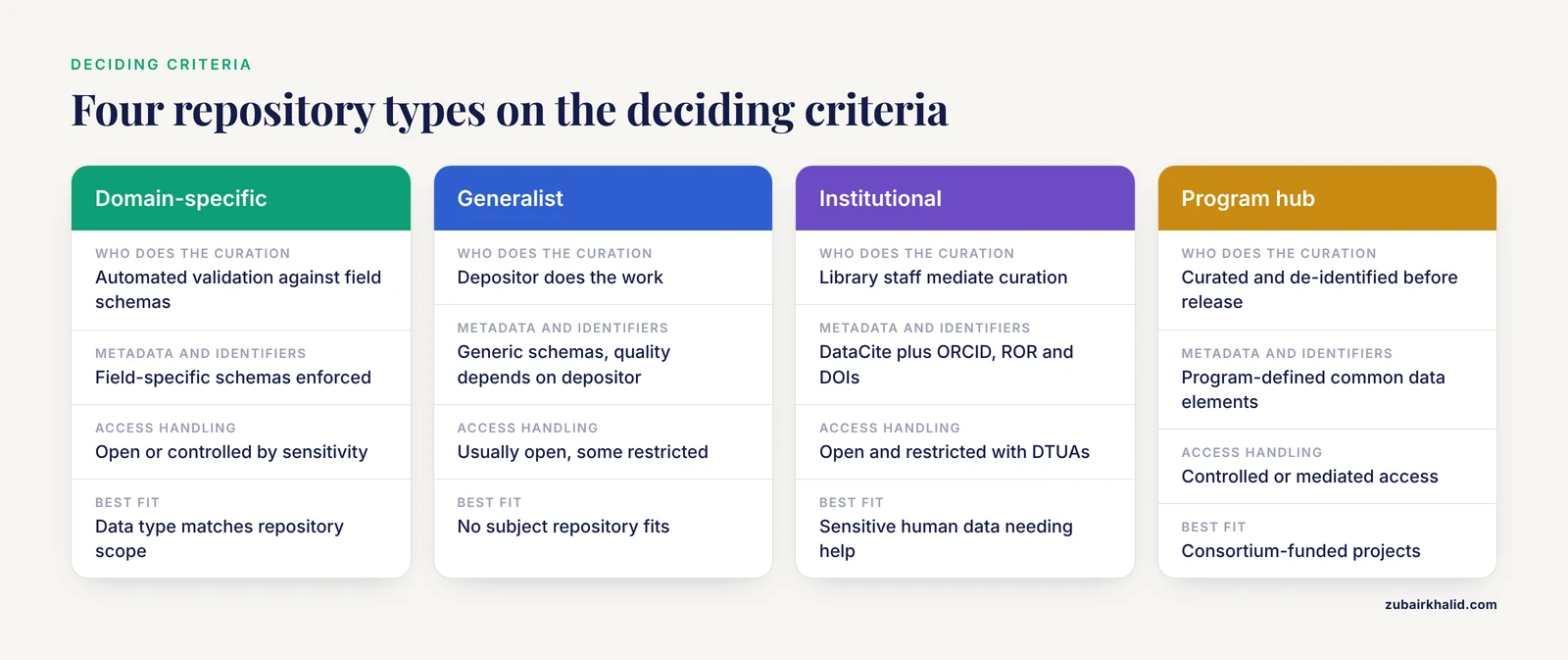
| Criterion | Domain-specific repository | Generalist repository | Institutional repository | Program data hub |
|---|---|---|---|---|
| Data types accepted | One defined type with strict formats | Almost any data type | Broad, often biomedical focus | Data from funded program projects only |
| Access model | Open or controlled, depending on sensitivity | Usually open, some support restricted | Both open and restricted [4] | Usually controlled or mediated access [5] |
| Curation and QC | Automated validation against schemas | Limited, depositor-driven | Often fully mediated curation [4] | Curated and de-identified before release [5] |
| Metadata standards | Field-specific schemas enforced | Generic schemas, quality depends on depositor | DataCite plus custom fields, persistent IDs [4] | Program-defined common data elements |
| Discoverability | High within the field | Broad but shallow | Growing through DOIs and indexing | High within the program community |
| Best fit | Data type matches repository scope | No subject repository fits, data fully shareable | Sensitive human data needing hands-on help | Consortium-funded projects |
NIH Data Sharing Repositories Pros and Cons
Domain-Specific Repositories
Pros:
- Your data arrive in formats and vocabularies your field's researchers already use, which maximizes reuse.
- Submission validation catches formatting and metadata problems before they become permanent.
- Program-level support exists. NCI's Office of Data Sharing, for example, provides expert consultation across scientific domains and manages submission processes for controlled-access repositories [3].
- Field-specific repositories make meta-research possible. The Consortium for Electrocardiographic Imaging built a shared repository so that competing algorithms could be evaluated on identical datasets, which is how the community standardized method comparison [7].
Cons:
- Strict scope means many data types have no matching repository.
- Formatting requirements can demand substantial upfront work, especially for legacy datasets.
- Controlled-access domain repositories involve governance steps that take time.
Generalist Repositories
Pros:
- They accept nearly anything, which resolves the coverage problem.
- Deposits are typically fast and the interface is simple.
Cons:
- No one enforces field standards, so reuse quality reflects your own documentation effort. In single-cell genomics, only around 40 percent of publicly available 10x Genomics-based studies deposited in Gene Expression Omnibus provided readily usable processed count matrices, and fewer than 10 percent included author-provided cell-type labels, even though most had raw sequencing files available [8]. Depositing raw files alone is not the same as enabling reuse.
- Generalist deposits can become scientific orphans if the metadata do not connect the dataset to its publication.
Institutional Repositories
Pros:
- Mediated curation transfers metadata and documentation work to trained staff [4].
- Built-in handling of restricted access, including HRPO review and DTUAs for human data [4].
- Local support addresses a documented gap. Researchers in the academic medical center survey wanted centralized consultation and budget guidance, and 87 percent requested tailored templates [1].
Cons:
- Institutional repositories vary in maturity and indexing, so an unindexed dataset may be harder for outsiders to find.
- Capacity limits mean some institutions triage which datasets they can curate deeply.
Program Data Hubs
Pros:
- Curated, de-identified data with structured access requests, built for rapid secondary analysis [5].
- Pooled analyses across cohorts produce findings impossible in single studies [6].
Cons:
- Only available to projects within the funded program.
- Access rules and governance can be slower than open deposit.
How to Compare Repositories: The Criteria That Decide Real Choices
A good data repository comparison comes down to six questions. Ask each one before you commit in your DMS Plan.
1. Does the repository accept your data type and enforce useful standards? Standards are what make data reusable. Agricultural genomics researchers found that informal sharing networks hampered collaboration, and that adopting shared reference SNP identifiers, rsIDs, across databases was needed to make variant data interoperable, with roughly 220 million rsIDs introduced into the Gramene database as part of that effort [9]. The lesson generalizes: a repository that enforces community identifiers and vocabularies protects your dataset from becoming unreadable.
2. How are access and sensitivity handled? Match the access model to your data's risk level. Fully de-identified data can usually go open access. Human data with residual identifiability risk generally belongs in a controlled-access repository, where the NCI describes its role as designing and managing user-centered processes for cancer data access and submission to NIH controlled-access repositories [3]. Restricted access through an institutional repository is another route, with formal agreements like DTUAs governing each request [4]. For genomic data specifically, ethical, legal, and social concerns, including consent scope and community expectations, should shape the access decision, particularly in international collaborations where benefit-sharing expectations may apply [10], [11]. Cloud-based genomic repositories add a further layer: a scoping review of genomic data sharing literature emphasizes responsible data stewardship, meaning ethical and secure management of data so that authorized access aligns with agreed ethical use throughout the data lifecycle [12].
3. What persistent identifiers and metadata schemas does it use? A dataset without a DOI or accession number is hard to cite and hard to find. The Washington University repository issues DOIs, links ORCID iDs and ROR IDs, and applies the DataCite schema [4]. If you are preparing structured metadata for any repository, modeling frameworks can help. LinkML is an open data modeling framework for authoring and validating data schemas that supports FAIR compliance, meaning data that are Findable, Accessible, Interoperable, and Reusable [13]. Similarly, the NIH Common Data Elements (CDE) Repository exists to standardize data collection and sharing, and myositis researchers recently built expert-consensus CDEs for their outcome measures using it as a foundation [14]. If your field has CDEs, collecting data against them from day one makes any repository deposit dramatically easier.
4. Does the repository support FAIR-compliant deposit? FAIR principles are now the baseline expectation for research data sharing. Perspectives on machine learning-ready data, for example, call for expanding FAIR-compliant repositories with standardized metadata and shared ontologies so that datasets support reproducible computational workflows [15]. When a repository claims FAIR support, check whether that means real validation of your metadata or just a web form.
5. What curation support exists, and who does the work? Curation ranges from automated format checks to a librarian walking through your documentation with you [4]. The difference matters most for sensitive or complex datasets.
6. What does deposit cost in money and time? Sources do not publish standard repository fee schedules, so treat pricing as something to verify directly with candidate repositories. What the evidence does show is that budgeting anxiety is real. In the academic medical center survey, only 38 percent of researchers felt confident budgeting for DMS activities [1]. The DMS Policy allows justification of costs related to depositing and curating data, so request a fee estimate from the repository early and put it in your Plan's budget justification.
Worked Scenarios: Matching Data Type to Repository
Scenario 1: Human genomic data from an international collaboration. Genomic sequence data with any re-identification risk belongs in an NIH-supported controlled-access repository. Plan for the governance steps: consent documentation, data access committee review, and, where samples or communities originate outside the United States, attention to ethical, legal, and social obligations around consent and benefit sharing [10], [11]. If your data will live in a cloud platform rather than a traditional repository, build your DMS Plan around documented stewardship outcomes, such as how authorized access is matched to ethical use over time [12].
Scenario 2: MRI data from a neuroimaging study. Imaging data benefits from community formats. The Brain Imaging Data Structure (BIDS) format organizes MRI data in a standard directory layout that analysis pipelines can consume directly, and newer platforms support automated upload, anonymization, and BIDS classification with quality control views before preprocessing [16]. A repository or platform that validates BIDS compliance at deposit will save every future user, including you, hours of reformatting.
Scenario 3: Single-cell RNA-sequencing data. If you deposit raw sequencing files, also deposit processed count matrices and cell-type annotations. The evidence shows that current practice falls short: fewer than 10 percent of public 10x-based scRNA-seq studies included author-provided cell-type labels, and only about 40 percent offered usable processed data, which the study's authors tie directly to weak submission requirements at repositories [8]. Be the depositor who includes the processed, annotated data, and name the annotation method in your metadata.
Scenario 4: Longitudinal behavioral data on children. Sensitive data on vulnerable populations need restricted access and standardized documentation. Motor development researchers facing exactly this problem built the MO|RE data repository and the COMBINE Project, which pair structured data-sharing frameworks with standardized assessment protocols so that datasets remain comparable across sites [17]. Your DMS Plan should name a repository that supports gated access with documented approval, such as an institutional repository with DTUA handling [4], and describe your de-identification steps.
Scenario 5: Analysis code that goes with your data. The DMS Policy covers scientific data, but sharing the code that produced your results strengthens the whole package. Depositing a versioned, environment-specific code release in a companion code repository lets readers and reviewers verify your results directly, and this practice aligns with NIH's Gold Standard Science emphasis on transparency and reproducibility as well as FAIR and TRUST principles [18]. A companion code repository complements, rather than replaces, your data repository, so name both in your Plan.
Scenario 6: A mixed dataset from a small lab with no obvious subject repository. This is the textbook institutional repository case. Digital Commons Data@Becker accepted qualitative survey data, flow cytometry, imaging, and sequencing under one roof, with curation staff handling metadata and quality control [4]. If your institution has an equivalent service, a consultation early in grant writing will tell you exactly what your Plan can promise.
Writing the Repository Section of Your DMS Plan
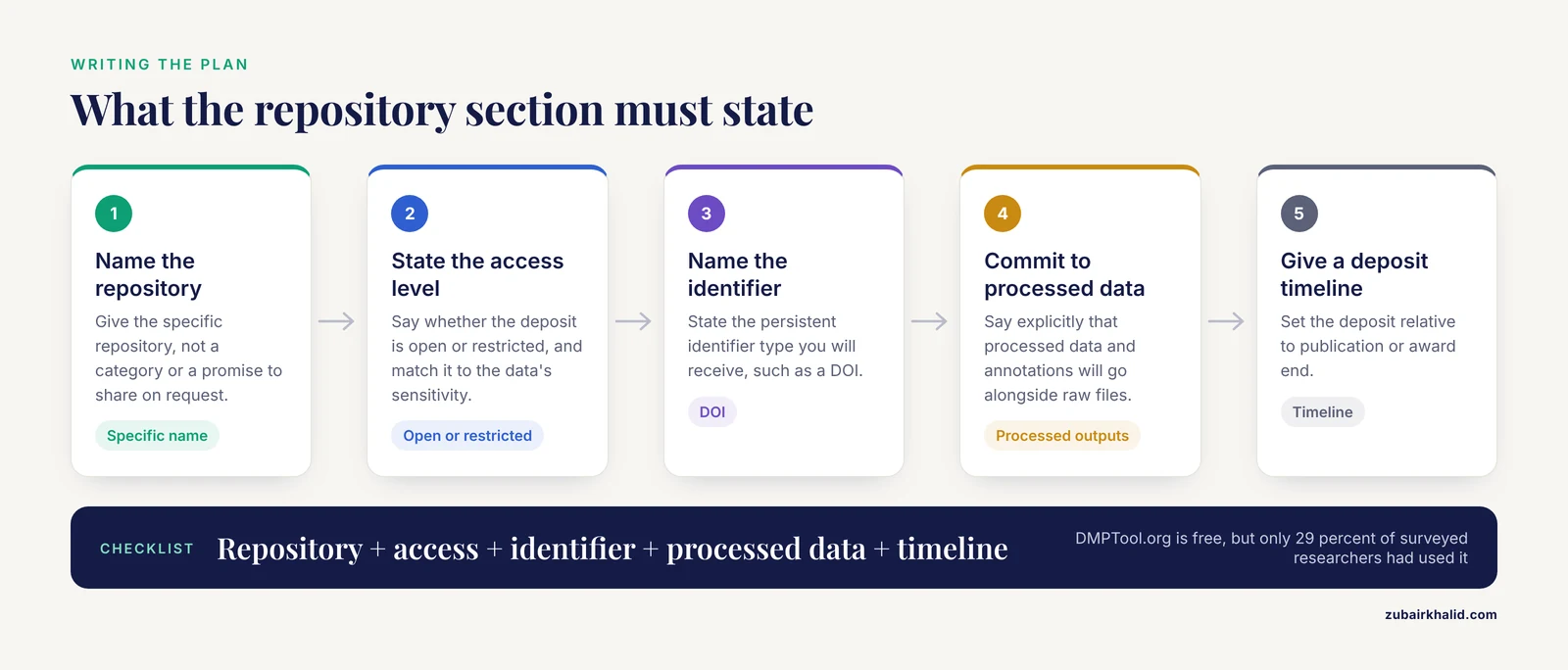
Once you have chosen, the repository section of your Plan should be concrete. Name the specific repository, state the access level, name the persistent identifier type you will receive, and give a timeline for deposit relative to publication or award end. If your field has NIH Common Data Elements, state that you will collect data against them [14]. If you will deposit processed data alongside raw files, say so explicitly, because that commitment is what separates reusable deposits from storage [8].
Two practical supports reduce the friction. First, DMPTool.org is a free web tool for drafting data management and sharing plans, but only 29 percent of surveyed researchers had used it, while 87 percent wanted tailored institutional templates [1]. If your institution offers a template or a librarian consultation, use it. Second, for NIH institute-specific portfolios, the institute's data sharing office can be a legitimate source of guidance. NCI's Office of Data Sharing, for instance, consults and provides expert data sharing guidance across scientific domains and engages the community on data sharing issues [3]. A short email to the relevant office early in planning can prevent a Plan that promises things the repository cannot deliver.
Common Mistakes and Limitations
- Naming "available on request" as your sharing mechanism. The DMS Policy expects data in a repository, not a promise to respond to emails. The Nathan Shock Centers analysis shows why: "available on request" appeared in 14 percent of data statements in their sample, and even among claims of open data, materials could be located for only 63 percent [2]. Requests go unanswered when the person who holds the data moves on.
- Depositing raw files without processed data or annotations. Raw files alone rarely support reuse, as the single-cell genomics assessment demonstrated with its 40 percent usability figure [8]. Include the processed outputs, the codebook, and the annotation methods.
- Choosing the repository after the data are collected. Retrofitting legacy data to a repository schema is far more painful than collecting against the schema from the start. Collect against your field's common data elements or BIDS-style structures early, [14].
- Assuming any repository satisfies the Policy. The repository must be appropriate to the data, and for human data that means the access model must match the sensitivity. An open-access deposit of re-identifiable human data is a compliance failure, not a sharing success.
- Ignoring versioning and identifiers for code and derived data. Pair your data deposit with a versioned code release so results can be verified and extended [18], and use reference identifiers, like rsIDs in variant data, so your dataset interoperates with others [9].
- Underestimating the administrative load. Two-thirds of surveyed researchers understood the DMS Policy, but fewer than half felt comfortable writing a Plan, and most found execution burdensome [1]. Start the repository conversation during grant writing, not at award end.
- A limitation of this guide: repository policies, fee schedules, and submission interfaces change, and no article can substitute for the current instructions at the repository you choose. Verify details directly with the repository before finalizing your Plan.
Frequently Asked Questions
Can I just state in my paper that data are available from the author on request?
No. The DMS Policy requires deposited data in an acceptable repository, and "available on request" has a poor track record, with materials locatable for only 63 percent of open-data claims in one audit [2]. Name a repository in both your DMS Plan and your data availability statement.
What is the difference between open and restricted access?
Open access means anyone can download the dataset. Restricted access means requests are reviewed, and approved users sign an agreement such as a Data Transfer and Use Agreement before receiving data, an approach institutional repositories like Digital Commons Data@Becker implement with HRPO review for human data [4].
Do I have to use an NIH-funded repository specifically?
Not always. NIH accepts repositories that are appropriate to the data, including quality generalist and institutional repositories when no subject repository fits. Domain-specific repositories tied to your field generally offer better standards enforcement and discoverability, and NIH institute offices such as NCI's provide guidance on matching data to their controlled-access repositories [3].
How do I handle human data that cannot be fully de-identified?
Use a controlled-access or restricted-access route. That may mean an NIH controlled-access repository, with submission processes designed by institute data sharing offices [3], or a restricted-access institutional repository where each request triggers review and a formal use agreement [4]. Cloud-based genomic platforms add stewardship controls that tie authorized access to ethical use throughout the data lifecycle [12].
Can repository fees be included in my NIH budget?
Yes, costs related to depositing and curating data can be justified in your DMS budget, though specific fee schedules vary by repository and are not published in standard sources. Budgeting for data sharing is a recognized weak point, with only 38 percent of surveyed researchers reporting confidence in it [1], so request a written fee estimate during grant preparation.
Can I deposit the same dataset in more than one repository?
Usually yes, and sometimes you should. A common pattern is depositing processed, annotated data in a generalist or institutional repository while raw files go to a domain repository, with a companion code repository for analyses [18]. Just make sure your DMS Plan names one primary repository and describes the relationships, with a DOI or accession at each deposit point [4].
Sources
- Supporting researcher compliance: assessing institutional readiness for the 2023 NIH Data Management and Sharing Policy.
- An assessment of data and code sharing in research funded by the Nathan Shock Centers, 2017-2022: a meta-research study.
- NCI's Office of Data Sharing builds momentum to advance cancer research and care.
- A generalist institutional data repository offering both open and restricted access to support NIH data sharing compliance.
- Harnessing Multiteam Systems in the Development of a Multifaceted Data Repository for Emergency Public Health Response.
- Scientific advances from sharing Urban Environment and Childhood Asthma study data in collaborative analyses.
- Overcoming Barriers to Quantification and Comparison of Electrocardiographic Imaging Methods: A Community-Based Approach.
- Persistent hindrances to data re-use in single-cell genomics.
- Adoption of Standard Reference SNP Identifiers in Agricultural Genomics for Interoperability and Data Reuse.
- Context of data sharing practices in collaborative human genomic research in low and middle income countries: A systematic review.
- From Acceptable Profit to Fair Return: Operational Benefit-Sharing Models for Induced Pluripotent Stem Cell Research Using Legacy Samples from Low- and Middle-Income Countries.
- Characterizing core outcomes of responsible stewardship for human genomic data in the cloud.
- LinkML: an open data modeling framework.
- Standardized Interoperable Data Collection for Myositis Research: Developing Expert Consensus on Common Data Elements for Myositis Outcome Measures.
- Challenges and Vision for Standardization of Biopolymer Data Sets for Machine Learning.
- Democratizing data sharing and processing of routine MRI data acquired for neuroimaging research.
- Beyond Boundaries: Data Sharing in Motor Development Research-Best Practices, Challenges, and Opportunities.
- Research Code Sharing in Support of Gold Standard Science.