What Columns Should a Literature Review Matrix Include?
By Dr. Zubair Khalid, DVM, MS, PhD ·

A literature review matrix is a spreadsheet where each row is one source and each column is one piece of information you extract from it, so the difference between a useful matrix and a bloated one comes down to what you put in those columns. The rule of thumb is simple. Start with a small core of columns that every review needs, then add topic-specific columns only when they answer a question your review actually asks. If a column would never feed a sentence in your final paper, it does not belong in the table.
This guide walks through the core literature review matrix columns, the optional columns that systematic reviews add, the pros and cons of three common matrix sizes, and worked scenarios that show how the choice plays out in practice.
What a Literature Review Matrix Is and Why the Columns Matter
The matrix method is a structured way of organizing published research during a review. The best-known formal version is described in the health sciences literature as the Matrix Method, where reading notes are converted into table entries that can later be synthesized into a written review [1]. The idea transfers directly to any field, including biology, ecology, and the biomedical sciences.
The basic anatomy never changes:
- Rows are sources. One row equals one paper, or one study if a paper reports several.
- Columns are the fields you extract. Citation details, methods, findings, and your own notes each get their own column.
- Cells hold short, factual entries. Phrases beat paragraphs.
The columns matter because they force you to read analytically rather than passively. When you cannot fill in the "study design" cell, you have not understood the paper. When two papers sit side by side with their sample sizes and outcome measures in aligned columns, patterns and contradictions surface that you would miss reading one PDF at a time. This is also where the matrix earns its place in the broader process of how to write a literature review. The matrix is the drafting tool between your systematic literature search and your synthesis paragraphs, not a substitute for either.
The Core Columns Every Matrix Should Have
If you ask what columns should a literature review matrix include at minimum, the answer is a set of five to eight fields that apply to almost any research question in the life sciences. Each column below is explained on its own terms.
1. Citation and Source ID
Record the author, year, and a short identifier you can trace back to your reference manager. Many reviewers add a row number (S1, S2, S3) so they can refer to studies in their notes. A Digital Object Identifier (DOI), the persistent web address assigned to most modern journal articles, belongs here too so you never lose track of which exact paper a row describes.
2. Research Question or Aim
In one line, state what the authors set out to answer. This column lets you sort your sources by which part of your own review question they address. Published reviews show why this matters. A systematic review of coping after violent loss stated its aim as organizing the literature on coping strategies and outcomes, and every later step of the synthesis followed from that framing [2]. A data-driven review of building management systems similarly defined four explicit aims up front, which then determined what it extracted from each paper [3].
3. Study Design or Methods
Record the design in standardized shorthand: randomized controlled trial, cohort study, qualitative interview study, in vivo experiment, systematic review, computational modeling, and so on. Add the key techniques if your field requires them. This column is what allows you to weigh a meta-analysis against a single small study instead of treating all rows as equal.
4. Sample, Study System, or Data
In the life sciences this column usually captures the organism, cell line, population, sample size, tissue type, or dataset. Write the number when you have it, for example "n = 42 qualitative interviews" or "three field sites". If a number is essential to your synthesis, it belongs in this column, not buried in your memory of the paper.
5. Key Findings
Summarize the main result in one or two sentences, in your own words. Keep directional language precise. "Treatment group improved significantly" is useful. "Interesting results" is not. If the paper reports an effect with a statistic your review needs, record the statistic and its direction here or in a dedicated results column.
6. Limitations
Note what the authors acknowledge and what you observe yourself, such as small samples, short follow-up, lack of a control group, or a single study population. This column feeds directly into the critical voice of your written review.
7. Notes, Quotes, and Relevance
Reserve one column for page-referenced quotations you might cite and one line on why this paper matters for your question. Some reviewers merge these. Keeping quotes page-referenced from the start saves hours during writing.
8. Theme or Category Tags
A short tag or keyword column lets you sort the whole matrix by theme later. This is the column that turns the matrix from a reading log into a synthesis tool. Two published reviews show the power of a well-chosen analytical column. A review of coping after violent loss extracted coping strategies from 80 studies and organized them into three dimensions, engagement, disengagement, and socially-supported coping, through thematic analysis of the extracted content [2]. A review of self-organizing teams in long-term care categorized its findings using four constructs drawn from organization theory, centralization, specialization, formalization, and functional concentration [4]. In both cases the analytical column was the bridge between reading and synthesis.
Topic-Specific Columns for Systematic and Scoping Reviews
A systematic literature search followed by a formal review demands more columns than a course paper. Several of these extras are standard practice in published systematic reviews.
Screening and Inclusion Columns
Formal reviews, especially those following the PRISMA reporting framework, the Preferred Reporting Items for Systematic Reviews and Meta-Analyses, document how many records were identified, screened, and included, along with reasons for exclusion [5]. Practical columns for this stage include:
- Decision (include, exclude, maybe)
- Reason for exclusion, using a fixed code such as wrong population, wrong outcome, or wrong study design
- Screening stage (title, abstract, full text)
A review of circular economy adoption in the building sector used the PRISMA approach to screen papers published between 2008 and 2023 before analyzing barriers and enablers [5]. That screening record is separate from the matrix you use for synthesis, but the two must link cleanly, which is why the decision columns matter.
Selection and Prioritization Scores
When your search returns far more papers than you can fully extract, a scoring column helps. One systematic review of interoperability in green building information modeling complemented existing review methods with a multicriteria decision analysis method to aid the selection of relevant papers [6]. A simple version for your own matrix is a numeric relevance score from 1 to 5 with a one-line justification column beside it.
Quality Appraisal Columns
Formal reviews record a quality judgment for each study using a published checklist. The integrative review of self-organizing teams in long-term care appraised empirical studies with the Mixed Methods Appraisal Tool (MMAT) and used Joanna Briggs Institute (JBI) checklists for systematic reviews and for text and opinion studies [4]. Your matrix column can simply hold the tool name and the resulting rating, for example "MMAT, met 4 of 5 criteria".
Effect Direction and Outcome Columns
Reviews that compare results across studies benefit from separate columns for each outcome of interest, the direction of effect (positive, negative, mixed, no effect), and the measure used. This structure makes contradiction visible at a glance.
Framework and Typology Columns
If your review aims to build a framework, add columns that position each source within it. A review of self-organizing logistics synthesized 15 characteristics of self-organizing systems into a typology and placed the literature along two axes, autonomy and cooperativity [7]. Each included paper could then be tagged against those axes, which turned the matrix into the raw material for the framework itself.
Side-by-Side Comparison of Core Literature Review Matrix Columns
The table below compares the most useful column options, with their pros and cons. This comparison is the heart of choosing the best literature review matrix columns for your project.
| Column | What you record | Pros | Cons | When to skip it |
|---|---|---|---|---|
| Citation and source ID | Author, year, DOI, row label | Prevents lost references, enables sorting | Takes minutes to format early on | Never skip this |
| Research question or aim | One-line statement of what the study asked | Lets you group sources by purpose | Authors sometimes state aims vaguely | Rarely skip |
| Study design and methods | Design type, key techniques, analysis approach | Enables weighting of evidence quality | Design labels require background knowledge | Skip only for very short comment pieces |
| Sample or study system | Organism, population, dataset, sample size | Makes comparability obvious, surfaces contradictions | Requires care with heterogeneous fields | Skip for purely theoretical reviews |
| Key findings | One- to two-sentence result summary | The raw material of your synthesis | Easy to drift into copying abstracts | Never skip this |
| Limitations | Author-stated and reviewer-observed weaknesses | Feeds critical analysis directly | Tempts over-criticism of small studies | Skip only in annotated reading logs |
| Theme tags | Short keyword codes per row | Enables sorting and thematic synthesis | Tags need revision as themes evolve | Skip for under 10 sources |
| Notes and quotes | Page-referenced quotes, personal observations | Saves writing time, preserves provenance | Can bloat into a second document | Skip quotes for papers you will only cite once |
| Screening decision and reason | Include or exclude, exclusion code | Required for PRISMA-style reporting | Meaningless outside formal reviews | Skip in course papers and theses without formal screening |
| Relevance or quality score | Numeric rating with justification | Prioritizes limited reading time | Scores are subjective without a rubric | Skip when you will read everything anyway |
| Quality appraisal result | Checklist name and rating, for example MMAT | Standard in formal reviews, supports evidence grading | Adds workload, needs checklist training | Skip in narrative reviews |
| Outcome-specific columns | One column per outcome of your review question | Makes cross-study comparison mechanical | Rigid if your question shifts | Skip when exploring a new topic openly |
Three Matrix Options Compared
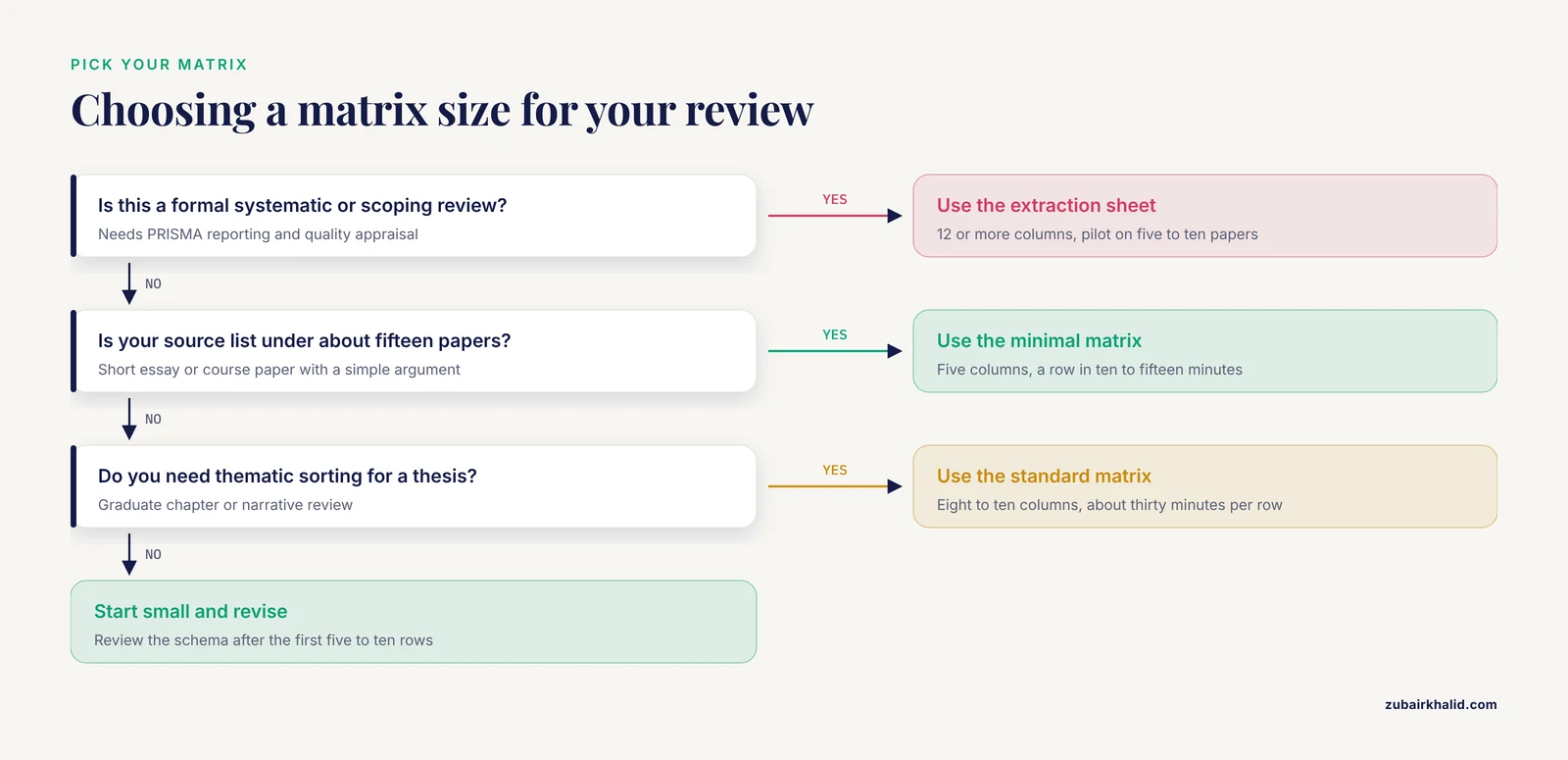
Rather than debating individual fields, most reviewers choose among three ready-made packages. These are the practical literature review matrix columns options, with pros and cons for each.
| Option | Typical column count | Best for | Pros | Cons |
|---|---|---|---|---|
| Minimal matrix | 5 to 6 | Course papers, short essays, quick scans | Fast to fill, low friction, easy to maintain | Weak support for synthesis, loses methodological detail |
| Standard matrix | 8 to 10 | Theses, dissertations, narrative reviews | Balances depth and workload, supports thematic sorting | Requires discipline to keep entries short |
| Systematic extraction sheet | 12 or more | Systematic reviews, scoping reviews, meta-analyses | Supports PRISMA reporting, quality appraisal, and reproducibility | Heavy workload, risks paralysis, needs piloting |
Option 1: The Minimal Matrix
Five columns carry a minimal matrix: citation, aim, methods, key findings, and relevance notes. The pros are speed and sustainability. You can fill a row in ten to fifteen minutes, which means you will actually keep the matrix current. The cons appear the moment you try to write. Without a limitations column and theme tags, your synthesis depends on memory, and memory is exactly what the matrix exists to replace. Choose this option only when your review is short, your source list is under about fifteen papers, and the argument is straightforward.
Option 2: The Standard Matrix
The standard matrix adds limitations, theme tags, and sample details to the minimal set. This is the best default for graduate students and most research projects. Its main advantage is that the columns map onto the sections of a written review. Theme tags become your thematic paragraphs, the methods column becomes your "strength of evidence" commentary, and the limitations column becomes your critique section. The cost is time. A row in a standard matrix can take thirty minutes to complete well, and the temptation to copy-paste abstracts into the findings column grows as the workload mounts.
Option 3: The Systematic Extraction Sheet
Formal systematic reviews treat the matrix as a data extraction instrument. Columns expand to cover screening decisions, exclusion reasons, quality appraisal results, per-outcome findings, and framework positioning. The payoff is rigor and reportability. Reviews following PRISMA can document their screening flow and their extraction decisions because those fields were captured in structured form from the start [5]. Reviews in applied fields show how far this can go. A review of social inclusion indicators for smart cities not only extracted indicators systematically but verified the resulting set with practitioners to suit local contexts [8]. A review of digital twins for building energy efficiency combined its systematic review with a bibliometric analysis to identify trends and research gaps, which required structured fields that could feed bibliometric software [9].
The cons are real. Extraction sheets take planning, a pilot round on five to ten papers to check that the columns work, and often two independent extractors for formal reviews. For a course assignment, this machinery is overkill.
How Published Reviews Choose Their Columns
Looking at how working researchers structure their extraction is the fastest way to refine your own choices, and it answers the question of which are the best literature review matrix columns in practice. The pattern across published reviews is consistent. Columns follow directly from the stated aims of the review.
A review with four explicit aims, such as identifying main topics, identifying recent methods, understanding architecture, and understanding features, designed its extraction around exactly those four targets [3]. A review that wanted to explain varying team success built its categories from established theory before reading began, extracting findings against the four pre-defined structure characteristics rather than inventing categories afterward [4]. A review that wanted to map a sprawling, interdisciplinary field used its matrix to develop a typology and a two-axis framework, with the matrix columns mirroring the eventual framework dimensions [7]. And a review that faced an oversized candidate list added a structured selection step, using multicriteria decision analysis to decide which papers earned full extraction.
The lesson generalizes. Write your review question first. Derive two to four things you must be able to say at the end. Give each of those things a column. Everything else is optional.
One further caution comes from work on analytical matrices in adjacent contexts. Reviews sometimes use secondary matrices for analysis, such as the co-occurrence matrix used to examine interdependence among barriers in the circular economy review [5], or the comparative evaluation of multiple model-quality metrics in the topic modeling review [10]. These analytical tools are downstream of your extraction matrix. Keep them separate. Mixing a screening log, an extraction matrix, and an analytical matrix in one spreadsheet is a common source of confusion.
Worked Scenarios
Scenario 1: Undergraduate Term Paper on Antibiotic Resistance
A student writing a 3,000-word essay has read 12 papers. The minimal matrix fits. Columns: citation, aim, methods, key findings, relevance. Each row takes minutes, and the relevance column tells the student which three papers anchor each section of the essay. Adding a systematic extraction sheet here would consume more time than the assignment deserves.
Scenario 2: Master's Thesis Chapter on a Wetland Restoration Method
A graduate student has 45 papers spanning field experiments, modeling studies, and policy documents. The standard matrix fits, with two topic-specific additions. A "restoration context" column records the wetland type and climate, because findings from tidal marshes may not transfer to freshwater bogs. A "measured outcome" column records whether each study measured vegetation cover, sediment accretion, or faunal return, since the thesis question concerns all three. Theme tags let the student sort the matrix into the three thematic sections of the chapter.
Scenario 3: A Systematic Review Intended for Publication
A lab team reviewing biomonitoring methods runs a formal systematic literature search across multiple databases, then needs a full extraction sheet. The columns include screening decision and reason, study design, quality appraisal rating, per-outcome effect direction, and framework tags. The published precedent is clear. The coping-after-violent-loss review screened records from six databases, ERIC, Google Scholar, PsycINFO, PsycNET, PubMed, and Web of Science, and included 80 studies whose coping strategies it then organized into three dimensions through thematic analysis [2]. The long-term care review searched four databases, PubMed, CINAHL, Business Source Complete, and Web of Science, appraised quality with MMAT and JBI tools, and included 41 articles [4]. Both workflows depend on structured, per-study extraction of exactly the kind a systematic matrix provides.
Scenario 4: A Review of Methods Rather Than Outcomes
Some life science reviews compare techniques rather than effects. A review of high-performance liquid chromatography (HPLC), an analytical method for separating and quantifying compounds in biological samples such as plasma and serum, extracted sample preparation techniques, column selection, mobile phase, detector type, and validation parameters across 18 journals, then concluded on the relative strengths of specific detectors at low concentrations [11]. The matrix columns there were the method components themselves. When your review question is "which method performs best", your columns should be the performance and validation attributes you will compare.
Common Mix-Ups
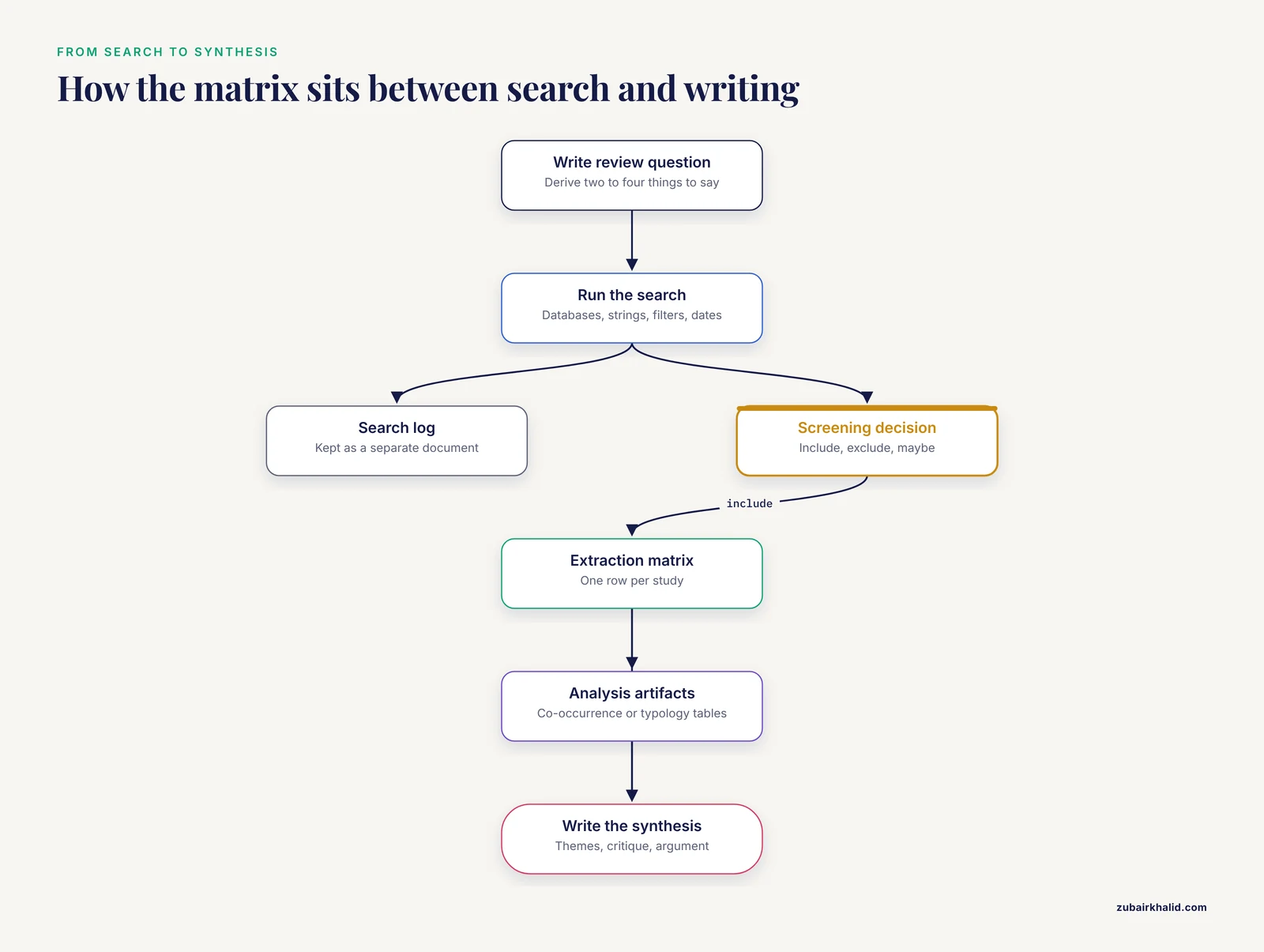
Confusing the matrix with the search log. Your search log records databases, search strings, filters, and dates from your systematic literature search. Your matrix records what each included paper contains. Keep them as separate documents that link by source ID.
Copying abstracts into the findings column. Abstracts emphasize what is novel, not what answers your question. Write findings in your own words, tied to your review question.
One row per paper when you mean one row per study. A single paper can report several experiments. If your comparison depends on study-level details, give each study its own row or expand the row with sub-entries.
Adding columns because they might be useful. Every empty or barely filled column is a maintenance cost. If a column stays empty for a full reading session, delete it.
Confusing the review matrix with analytical matrices. A co-occurrence matrix showing how often barriers appear together, as used in the circular economy review [5], is an analysis product built after extraction. It is not a substitute for a well-designed extraction table.
Common Mistakes and Limitations
- Designing columns before writing the review question. The question determines the columns, not the reverse. Reviews that stated explicit aims up front, like the four-aim building management systems review [3], could justify every field they extracted.
- Over-filling cells with paragraphs. A cell that holds a paragraph is a hidden draft. Keep entries to phrases and short sentences, and push long thoughts into a separate notes document linked by source ID.
- Treating all rows as equal weight. A matrix aligns a meta-analysis with a two-participant case series in adjacent rows. Without a design or quality appraisal column, visual adjacency falsely implies equal credibility. Formal reviews solve this with checklist-based appraisal, as in the use of MMAT and JBI tools in the long-term care review [4].
- Freezing the schema too early. Themes evolve. Published thematic syntheses, including the three-dimension organization of coping strategies [2], refined their categories through analysis. Plan one scheduled revision of your theme tags after the first ten rows.
- Assuming one matrix serves the whole review. Large projects need a screening log, an extraction matrix, and analysis artifacts such as bibliometric outputs or typology tables [9],. Plan for separate files with a shared identifier system.
- Expecting the matrix to write the review for you. The matrix supplies organized evidence. Synthesis, argument, and critical voice still come from you, guided by your review question and the quality of the underlying studies.
A final limitation applies to every column set described here. The right choice depends on your review type, your field's reporting norms, and your timeline, and if you are preparing a formal systematic review, follow the reporting standards your target journal requires and seek methodological guidance from your institution or an experienced reviewer on your team.
Frequently Asked Questions
How many columns should a literature review matrix have?
Most projects work well with 5 to 10 columns. Use about 5 for a course paper, 8 to 10 for a thesis or narrative review, and 12 or more for a formal systematic review with screening and quality appraisal fields.
What is the difference between a literature review matrix and an annotated bibliography?
An annotated bibliography is one entry per source in list form, while a matrix aligns the same information across sources in columns so you can compare studies side by side. The matrix is better for synthesis because patterns appear across aligned cells.
Should I include my own critique in the matrix?
Yes, but put it in a dedicated limitations or notes column, clearly separated from what the authors actually reported. Keeping author findings and your evaluation in distinct columns protects you from misattributing claims later.
What columns do systematic reviews require?
Systematic reviews typically require screening decision and exclusion reason columns aligned with PRISMA reporting, detailed study and participant columns, per-outcome findings, and a quality appraisal column based on a published checklist such as MMAT or JBI tools.
Can I change my columns after I start extracting?
Yes. Review your schema after the first 5 to 10 rows, add or remove columns, and revise theme tags as themes emerge. Just be consistent from that point forward and note any retroactive changes you make to earlier rows.
What tools can I use to build a literature review matrix?
A spreadsheet application such as Excel, Google Sheets, or LibreOffice Calc is sufficient for most projects. Reference managers with table or note features can supplement them, and formal systematic review teams often use dedicated screening and extraction software.
Sources
- Health Sciences Literature Review Made Easy The Matrix Method
- Coping After Violent Loss: A Systematic Literature Review and Organizing Model
- Smart Buildings: A Comprehensive Systematic Literature Review on Data-Driven Building Management Systems
- Failure or success of self-organizing teams in long-term care organizations: an integrative systematic literature review on the role of the organization structure
- Barriers and Enablers to the Adoption of Circular Economy Concept in the Building Sector: A Systematic Literature Review
- A systematic literature review of interoperability in the green Building Information Modeling lifecycle
- Towards self-organizing logistics in transportation: a literature review and typology
- Social Inclusion Indicators for Building Citizen-Centric Smart Cities: A Systematic Literature Review
- Leveraging Digital Twins for Enhancing Building Energy Efficiency: A Literature Review of Applications, Technologies, and Challenges
- Quality indices for topic model selection and evaluation: a literature review and case study
- Literature Review: Analysis and Validation of the Effectiveness of Antidiabetic Drugs in the Biological Matrix Using the HPLC (High Performance Liquid Chromatography) Method