Literate Programming for Reproducible Research
By Dr. Zubair Khalid, DVM, MS, PhD ·

Literate programming for reproducible research is the practice of writing analysis code and the prose that explains it in a single document, so that running the document regenerates every number, table, and figure in the report. The finished file becomes an executable record that reviewers, collaborators, and your future self can inspect, rerun, and reuse.
The push toward this way of working comes from open science. As journals and funders increasingly expect authors to provide the source code and data behind published results, researchers have found that sharing those materials reproducibly is genuinely hard, and a whole class of publishing infrastructure has grown up to support executable analyses alongside articles [1]. This guide explains what literate programming is, why reproducible research needs it, how the main tools work, and how to check your own project before you submit.
What Is Literate Programming for Reproducible Research?
The term literate programming was introduced by the computer scientist Donald Knuth in 1984. His argument was that programs should be written primarily for humans to read, with the computer as the second audience. In a literate program, explanation and code live together in one source file, and tooling can produce both a readable document and runnable code from that same file.
Reproducible research is the complementary goal. An analysis is reproducible when another person, or you several months later, can rerun it on the same data and obtain the same results. A related term, replicability, describes a new study with new data reaching the same conclusion. The two are different problems, and this article is about the first one.
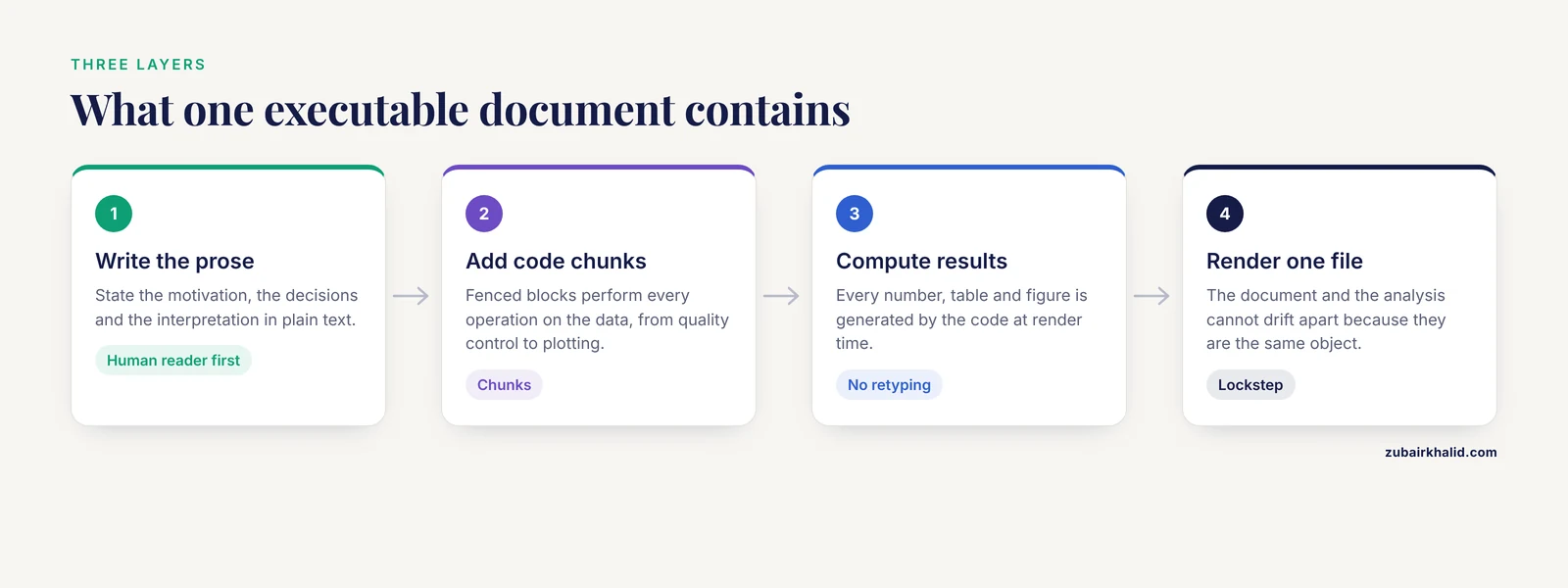
Put the two ideas together and a literate, reproducible document has three layers:
- Prose that states the motivation, the decisions, and the interpretation.
- Code that performs every operation on the data, written in fenced blocks called chunks.
- Computed results, meaning every number, table, and figure, generated by that code at render time.
The discipline that makes this work is simple to state. No result is ever retyped by hand. If a sentence reports a mean, that mean is produced by a line of code. If a figure appears, a chunk drew it. The document and the analysis cannot drift apart, because they are the same object.
This matters in biology because most modern analyses are pipelines. A typical RNA-seq or metabolomics workflow runs quality control, filtering, normalization, statistics, and plotting, and the paper reports the outputs of those steps. When the pipeline and the narrative live in separate files, the connection between them depends on memory and goodwill. A literate document keeps them in lockstep.
Three audiences benefit at once. A collaborator who needs to adapt your pipeline can read the reasoning next to the code. A reviewer who wants to check a number can find the exact lines that produced it. And you, six months later, when the journal requests a revision, can rerun the analysis exactly as it was written.
Why Reproducible Research Needs More Than Shared Files
The default workflow in many labs still looks like this. Analyze the data in R or Python, copy a p-value into a word processor, export a figure as an image, and email the pieces to a co-author. Six months later, nobody can say which version of the data produced which figure, or which script ran last.
Hand assembly also hides small failures. A swapped column, a stale figure, or a copied value from an earlier run can survive all the way to print, because nothing forces the document and the data to reconcile.
Health research shows the cost of this habit clearly. A review of studies using electronic health records (EHR), meaning data collected and generated during routine clinical care, found that a substantial proportion of findings are potentially not reproducible because the implementation details of preprocessing, cleaning, phenotyping, and analysis are not systematically made available or shared. Phenotyping here means the rules that decide which patients count as having a condition. The same review notes that reporting guidelines such as RECORD and STROBE, which specify the items researchers should report for observational studies using routinely collected health data, already set a solid foundation, but that researchers often lack the technical tools to put those recommendations into practice efficiently [2].
Reporting discipline is not unique to code-based research. Systematic reviews apply the same logic to evidence synthesis by pre-specifying eligibility criteria and extracting data with structured templates, so that another team could retrace every inclusion decision [3].
The data-sharing side has improved. The FAIR principles, originally written for data (findable, accessible, interoperable, reusable) and later extended to research software and workflows, have pushed raw data into public archives across many fields. In untargeted LC-MS/MS metabolomics, where liquid chromatography-tandem mass spectrometry is used to measure thousands of small molecules without a predefined target list, depositing raw files into archives such as MetaboLights or Metabolomics Workbench is now routine. What remains difficult to share, audit, and reuse is the analysis that turns raw files into reported feature tables, the tables of detected molecular signals that the paper actually presents [4]. That gap between the deposited data and the reported result is exactly where literate programming sits.
Publishers have noticed. Because open science increases the pressure on authors to provide code and data, and because sharing materials reproducibly is challenging, several projects have built infrastructure specifically to support the release of executable analyses alongside scholarly articles [1].
How Literate Programming Works in Practice
Two formats dominate. A review of publishing infrastructure found that 10 of the 11 applications it examined accept Jupyter Notebooks or R Markdown documents, which makes these two formats the practical standard for submitting executable analyses [1]. The table compares the main options.
| Format or platform | What it combines | Typical files | Strengths | Watch-outs |
|---|---|---|---|---|
| R Markdown | Prose, code chunks, rendered output | .Rmd | Fresh-session rendering keeps results honest | Requires attention to chunk options |
| Jupyter Notebook | Markdown cells, code cells, saved outputs | .ipynb | Interactive exploration, broad language support through kernels | Out-of-order execution leaves hidden state |
| Quarto | Language-agnostic rendering of prose and code | .qmd | One toolchain for R and Python documents | Newer ecosystem, fewer legacy examples |
| Executable paper platforms | Article, code, data, and cloud reruns | Notebooks or R Markdown | Readers can regenerate results themselves | Hosting and format requirements vary by publisher |
R Markdown
An R Markdown file (extension .Rmd) mixes prose written in Markdown with code chunks. A chunk opens with a fenced header naming the language, like this:
samples <- read.csv("data/plate_counts.csv")
batch_mean <- mean(samples$cfu_ml)
Later, in the prose, the same value can be inserted with inline code:
The mean count across batches was r round(batch_mean, 1) colony-forming units per milliliter.
When you render (or "knit") the document, each chunk executes in a fresh session, in order, and its output, whether printed values, tables, or figures, flows into the final HTML, PDF, or Word file. Chunk options control behavior, so a chunk can run silently while its figure still appears, or be shown for teaching while its output is suppressed. The number in that sentence and the number in the data are connected by execution, not by typing.
Jupyter Notebooks
A Jupyter Notebook (extension .ipynb) is built from cells. Markdown cells hold prose, code cells hold code, and the kernel, the running engine such as Python or R behind the notebook, executes code cells on demand and stores their output beneath each cell. Notebooks are excellent for exploration and teaching. For a final analysis document, they need more care, because cells can be run out of order and leave hidden state behind.
A newer system, Quarto, renders both R and Python documents from a single toolchain and is worth knowing as the ecosystem consolidates.
A worked example from metabolomics
Metabonaut, an open educational resource for untargeted LC-MS/MS metabolomics, shows what a mature literate workflow looks like in a working field. Built on the R for Mass Spectrometry and Bioconductor ecosystems, it provides executable example workflows that run from raw mzML files, an open standard format for mass spectrometry data, all the way to annotated feature tables. After a brief tour of the software ecosystem and of literate programming itself, its vignettes, which are guided executable documents, teach visual inspection and quality control, reuse of public archives at scale, and interoperability across programming languages [4]. A student can open a vignette, run it top to bottom, and watch the entire pipeline produce its own figures and tables.
A Reproducibility Checklist You Can Run Before You Submit
A checklist turns good intentions into steps. The items below combine the reporting logic of guidelines such as STROBE and RECORD [2], the FAIR extension to software and workflows [4], and the practical expectations of executable-publishing platforms [1]. Run it twice, once while the analysis is being written, and again the week you submit.
- Data. Raw data are deposited in a suitable archive with persistent identifiers, or a documented route to access them exists.
- Generated results. Every number, table, and figure in the manuscript is produced by a chunk in the document. Nothing is pasted by hand.
- Fresh run. The document executes top to bottom in a clean session without errors.
- Environment. Software versions are recorded, for example with sessionInfo() in R or an environment file in Python.
- Randomness. Seeds are set for any stochastic step, such as set.seed(1) before resampling, so reruns match.
- Cleaning. Every exclusion, transformation, and threshold is described in prose, aligned with the reporting items your study design requires [2].
- Paths. File paths are relative to the project folder, with no machine-specific directories.
- Sensitive content. No credentials, direct identifiers, or confidential outputs are embedded in the shareable document [2].
- Handoff. A short setup section tells a newcomer which packages to install and what command reruns everything.
- Publication route. You have chosen where the executable analysis will live, whether a repository, a notebook service, or a publisher platform [1].
A checklist does not certify the science. It certifies that the record is complete enough for someone else to check the science.
Publishing Executable Analyses
The infrastructure for executable publication is further along than most researchers realize. One review identified 11 applications, actively maintained and connected to the scholarly publication process, that support publishing executable code and data, and compared them across 19 criteria including deployment options and features for authors and readers [1].
The headline findings are practical. Eight of the applications let publishers self-host the system for free, while three provide paid services. All of them provide features to help readers study the materials, such as one-click reproducible results, where a reader reruns the analysis in the cloud and watches the outputs regenerate [1].
For an author, this changes what a submission looks like. Instead of mailing a compressed archive of scripts and hoping a reviewer can run them, you submit a literate document that the platform builds and serves. For a reviewer, the gain is direct. Rather than trusting that the code probably runs, a reviewer can trigger the run and compare the regenerated figures with the ones in the manuscript. Because most platforms accept the two standard formats, keeping your analysis in R Markdown or Jupyter form keeps the widest range of publication routes open [1].
Where AI Assistants Fit, and Where They Break
AI chatbots have moved into this workflow quickly. Reviews of tools such as ChatGPT describe real capabilities across writing code, debugging, and guiding installation and updates, alongside research tasks from design through manuscript preparation [5]. The same reviews document the concerns, including plagiarism risk, reliability, and the need for professional oversight to confirm accuracy and originality [5].
For reproducibility specifically, the risks have names. A stage-specific review of AI across the research workflow found that large language models paired with statistical environments can perform regression modeling and generate auditable code, and that specialized architectures support tasks such as image segmentation and histopathology analysis. The matched failure modes are specific: reproducibility is threatened by model versioning and run-to-run variability, hallucination (the confident generation of false content) produces fabricated citations and errors, and over-reliance can erode trainee competencies in critical appraisal and biostatistical reasoning [6]. The review's central recommendation is that oversight be matched to the stage of work, because each stage fails in its own way.
In a literate workflow, the practical stance is straightforward. Let an assistant draft a chunk. Then run it yourself, verify the output against the data, and record in the document which tool assisted and at what version. The chat transcript is not the record. The executed document is.
Common Mistakes and Limitations
- Out-of-order cells. Notebook state persists between runs, so cells executed twice or out of order can produce outputs that no longer match the code. Restart the kernel and run all cells before sharing.
- Hand-patched results. Editing a number or figure after generation silently breaks the link between code and report. If a value must change, change the code and rerun.
- Environment drift. A package updates, an argument changes its behavior, and last year's document fails this year. Record versions at render time.
- Hidden randomness. Unseeded resampling or train-test splits make two honest reruns disagree. Seed every stochastic step.
- Confusing transparency with validity. A clean, executable document can encode the wrong model or the wrong denominator. Literate programming improves transparency, not correctness. High-stakes analyses still need review by a statistician or a domain expert who knows the methods.
- Sensitive data. Embedding patient-level outputs in a shareable document can leak information even when identifiers are removed. EHR research needs governance layered on top of reproducibility tooling [2].
- One giant notebook. Mixing scratch exploration with the final analysis makes the polished document unreadable. Keep exploratory work in a separate file and curate the analysis document.
What Is Still Uncertain
Adoption is the open question. The infrastructure for executable publication exists and is documented [1], but whether it becomes routine depends on journal policies, funder requirements, and career credit, all of which are still settling.
Governance of AI assistance is younger still. Stage-specific oversight frameworks have been proposed [6], and norms for disclosing and recording AI involvement in analyses are not yet standardized.
Interoperability is improving but not solved. Resources such as Metabonaut demonstrate analyses that cross programming languages [4], and making that the default rather than the exception remains active community work.
Frequently Asked Questions
What is literate programming for reproducible research?
It is the practice of combining analysis code, its computed results, and explanatory prose in one executable document, so the entire analysis regenerates from a single file.
What is the difference between reproducibility and replicability?
Reproducibility means rerunning the same analysis on the same data and getting the same result. Replicability means a new study with new data reaches the same conclusion.
Which tools should I use, Jupyter Notebooks or R Markdown?
Choose by your language ecosystem. Jupyter suits Python-centered work, R Markdown and Quarto suit R-centered work, and both formats are accepted by most executable-publishing platforms.
Do I have to share my raw data for the work to count as reproducible?
Full reproducibility needs the data, but when privacy or consent prevents sharing, document every processing step and provide a synthetic or subset dataset so the code path can still be tested.
What belongs on a reproducibility checklist?
Data availability, code that regenerates every result, recorded software versions, seeded randomness, documented cleaning steps, and a chosen publication route for the executable analysis.
Can AI chatbots write my analysis code?
They can draft and debug code, but you must run and verify every result yourself and record the assistance, because model outputs vary between runs and can contain confident errors.
What is an executable paper?
A publication that bundles the manuscript with the code and data needed to regenerate its results, so readers can rerun the analysis themselves.
How do I convert an existing project to a literate workflow?
Move your analysis script into an R Markdown or Jupyter document, make every figure and table generate from a chunk, record package versions, and confirm a full rerun works from a clean session.
Sources
- Publishing computational research - a review of infrastructures for reproducible and transparent scholarly communication.
- Methods for enhancing the reproducibility of biomedical research findings using electronic health records.
- Rapid-access arrhythmia care as an integrated model: A RE-AIM guided systematic review.
- Metabonaut: an open educational resource for learning reproducible, script-based untargeted LC-MS/MS metabolomics.
- Application of artificial intelligence chatbots, including ChatGPT, in education, scholarly work, programming, and content generation and its prospects: a narrative review.
- Artificial Intelligence Across the Surgical Research Workflow: A Stage-Specific Framework for Benefits, Failure Modes, and Oversight.