How to Link a Data Paper to a Research Article
By Dr. Zubair Khalid, DVM, MS, PhD ·

By the end of this guide, you will be able to connect a data paper (a publication whose main scholarly output is a described dataset) to the research article that interprets that data, in both directions, using persistent identifiers that journal editors, reviewers, and readers can actually follow. You will know where each link belongs in the manuscript, how to cite a dataset correctly, how to verify that every link resolves, and which mistakes cause broken or unverifiable links after publication.
To follow the walkthrough, you need three things on hand: the final version of your dataset (or a sample of it if access must be controlled), an account on a data repository, and your research article manuscript in a state close to submission. No software installation is required for the basic workflow. A terminal with curl is useful for the verification step.
Why Linking Data Papers to Research Articles Matters
A research article summarizes, interprets, and defends claims derived from experiments. A data paper describes the dataset itself: what was measured, with which instruments, under which conditions, and how the files are organized. The two documents serve different functions, and the scholarly record works best when each one points explicitly at the other.
The pressure to make these connections comes from the broader movement in research data sharing. Publishing findings in a peer reviewed journal implies confidence in the underlying interpretation, and that confidence is testable only when others can reach the raw data behind the claims. When researchers contacted 29 corresponding authors of original research articles in the British Medical Journal to request their underlying data, only one released it, most were reluctant, and some demanded clarification, further information, or authorship as conditions for sharing [1]. Explicit, formal links between an article and a deposited dataset reduce that friction because the data becomes part of the publication itself rather than something a reader must request privately.
The mismatch between publications and raw data is acute in data intensive fields. Modern high throughput structural biology laboratories produce vast amounts of raw experimental data, while the published paper contains only a concise compilation of the most important results derived from experiments that may have spanned years, with methods and results increasingly pushed into supplementary materials that may receive less thorough review [2]. In genomics, the question of whether raw DNA sequence data release should be required of the scientific community was already being argued in the 1990s, with the eventual consensus landing firmly on rapid, public release through community repositories [3]. A formal link between the data paper and the research article is the mechanism that makes this release usable, because a deposited file nobody can trace back to the paper that used it adds little value.
Links also protect you as an author. Journal editors do not have access to raw data when they evaluate a manuscript and must rely on clues within the submitted paper, looking for inconsistencies in reported results [4]. A clean, resolvable link to your deposited data lets reviewers and editors check numbers directly, which prevents exactly the kind of error hunting that manuscript editors otherwise have to perform from statistical inconsistencies alone [4].
What a Link Actually Is
When researchers talk about linking a data paper to a research article, they usually mean one or more of the following connections:
- A data availability statement in the research article, declaring where the data resides and how to access it.
- A formal dataset citation in the reference list of the research article, treating the data paper or dataset record as a cited work with its own persistent identifier.
- In text pointers at specific claims, tables, or figures, tying individual results to specific files.
- A reciprocal link inside the data paper's repository record (often called a related identifier), pointing back at the research article's DOI.
The identifier that powers all four connections is usually a DOI (digital object identifier), a persistent string that resolves to the resource no matter where the hosting URL changes. Persistent identifiers matter because journal websites get redesigned and institutional servers get retired, while a DOI resolution service updates its target.
Machine readable linking has a history worth knowing, because it shapes what editors expect today. Early work on biomedical data integration used structured markup to link clinical and research data sets so that both humans and software could traverse the connections between them [5]. The Linkitup project explored automated link discovery for research data, enriching deposited datasets with links to publications, people, and terms so the data would not sit in isolation from the literature [6]. The Annotation for Transparent Inquiry (ATI) approach goes further for qualitative research, allowing authors to connect specific passages in a publication to annotations that carry additional context and, when possible, links to the data sources underlying a claim, with those sources housed in a repository [7]. The common principle across all three is that the link should be specific, persistent, and machine readable, not a vague sentence promising that "data are available on request."
Choose Where the Data Lives Before You Link Anything
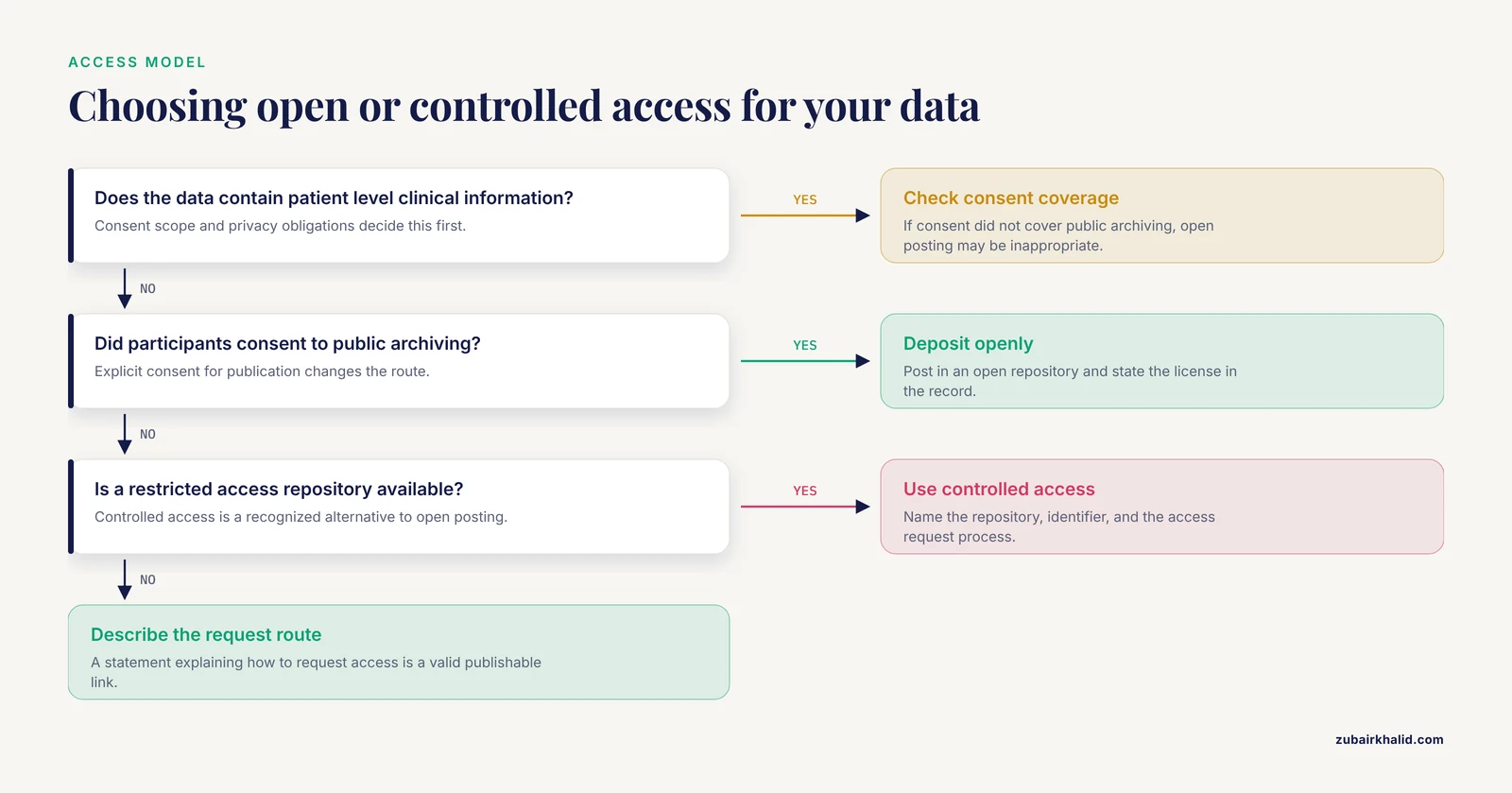
The quality of the link depends entirely on the stability of the thing it points to. That is why repository selection comes first. Here is a data repository comparison for the most common situations:
| Repository | Best suited for | Identifier issued | Typical access model |
|---|---|---|---|
| Zenodo | Generalist datasets, code, any file type, EU funded projects | DOI per record and per version | Open by default |
| Dryad | Data underlying peer reviewed research articles in any discipline | DOI | Open, often with submission fee |
| figshare | Generalist datasets, figures, media, negative results | DOI | Open |
| GenBank | Nucleotide sequence data with annotation | Accession number | Open |
| Sequence Read Archive (SRA) | Raw high throughput sequencing reads | Accession number | Open or controlled |
| ICPSR | Social and behavioral science data, survey archives | DOI or study number | Open or restricted |
| Journal or funder mandated clinical repositories | Patient level clinical trial data | Repository specific identifier | Often controlled or restricted access |
Two principles should drive the choice. First, prefer a domain repository when one exists for your field, because domain repositories enforce community metadata standards and reviewers know them. GenBank and the SRA exist precisely because the sequence community decided decades ago that rapid public release of raw data through shared archives serves the field better than case by case negotiation [3]. Second, match the access model to the data's sensitivity. For clinical trial data, patient privacy is a central concern, and unless explicit consent for publication has been obtained, open posting may be inappropriate, which is why restricted access repositories are recognized as a legitimate alternative to journal publication of raw clinical data [8]. A link to a controlled access dataset is still a valid link as long as the data availability statement explains the approval process a requester must follow.
Step by Step: Link a Data Paper to a Research Article
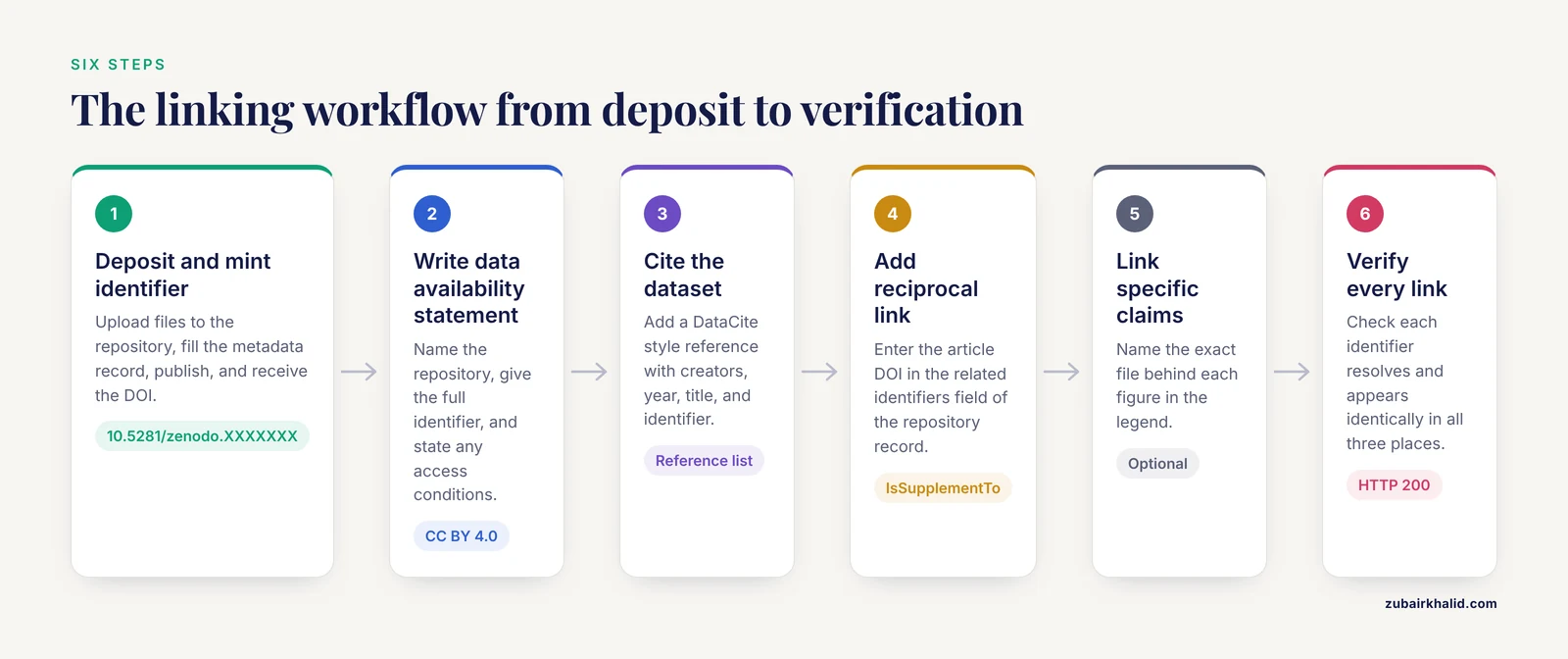
Step 1: Deposit the dataset and mint the persistent identifier
Create an account on your chosen repository, prepare a metadata record (title, creators, abstract, methods, file inventory, license), and upload the files. Most repositories mint a DOI at upload time.
Worked example on Zenodo:
- Log in, click New upload.
- Fill in the metadata fields. Give the dataset a descriptive title such as "Raw flow cytometry files and gating templates for [study short name]".
- Upload the files.
- Choose a license (CC BY 4.0 is common for data).
- Click Publish. The repository issues a DOI in the pattern
10.5281/zenodo.XXXXXXXwhere the digits are unique to your record.
If you plan to link a standalone data paper as well, deposit the dataset first, then write the data paper around the deposited record. The data paper cites the dataset DOI in its own methods section, and the repository record gains a reciprocal link in Step 4.
Step 2: Write the data availability statement in the research article
Every journal that supports data sharing provides a place for this statement, usually just before or after the acknowledgments. A strong statement names the repository, gives the full identifier, and states any access conditions. Here is a worked example for open data:
Data availability statement
All raw flow cytometry files, gating templates, and the analysis
notebook used to generate Figures 2 through 5 are openly available
in Zenodo at https://doi.org/10.5281/zenodo.XXXXXXX (DOI:
10.5281/zenodo.XXXXXXX), under a CC BY 4.0 license. Sequence reads
are deposited in the Sequence Read Archive under accession
SRPnnnnnnn.
For controlled access data, model the statement on the restricted access pattern that the clinical trial publishing community has outlined as good practice when open posting conflicts with patient privacy or consent limitations [8]:
Data availability statement
Deidentified participant level data cannot be shared openly because
the consent obtained from participants did not cover public
archiving. Data are available through the controlled access
repository [repository name and identifier]. Access requests are
reviewed by [data access committee] and require a data use
statement. Requests should be sent to [contact].
Both patterns are far stronger than the phrase "data are available from the corresponding author on reasonable request," which puts the burden of data sharing back into private email exchanges, the very mechanism that produced such poor response rates when researchers tested it directly [1].
Step 3: Cite the dataset in the reference list of the research article
A dataset citation follows the same logic as any citation: creators, year, title, identifier. Using the DataCite style, the citation looks like this:
Okafor, L., & Ramirez, T. (2025). Raw flow cytometry files and
gating templates for a study of B cell activation markers [Data
set]. Zenodo. https://doi.org/10.5281/zenodo.XXXXXXX
Then cite this reference in the text wherever the data is discussed, exactly as you would cite a methods paper. For example: "The full gating strategy is provided in the archived dataset." This is the step most authors skip. A URL in the data availability statement makes data findable, but a citation in the reference list makes it part of the scholarly credit system, which changes how repositories, publishers, and tenure committees count the work.
If a standalone data paper exists (for example, a data descriptor describing the cohort, instruments, and file structure), cite the data paper in the reference list as well, and cite the dataset record separately if it has its own DOI. Two references, each with its own identifier, give both objects independent credit.
Step 4: Add the reciprocal link in the data paper record
Linking is bidirectional. Open the repository record for your dataset, find the field named Related identifiers, Related works, or relatedIdentifiers (the exact label varies by repository), and add an entry with these parameters:
| Parameter | Value to enter | Meaning |
|---|---|---|
| Relation type | IsSupplementTo (or IsDerivedFrom for data generated from another study) | How the dataset relates to the article |
| Related identifier | The article's DOI, for example 10.1234/example.journal.2025.001 | The thing being linked to |
| Identifier type | DOI | The scheme of the related identifier |
If the journal has not yet assigned the article DOI at deposit time, deposit the data first with a placeholder note in the record, then edit the record once the article DOI exists. Most repositories allow post publication edits to metadata without minting a new DOI, which is one reason versioned repository records are safer than journal supplement links.
At the same time, make sure the data paper manuscript itself cites the research article. If a reader starts from the data paper, the loop should close: data paper to article to dataset record and back again.
Step 5: Link specific claims, not just the whole dataset (optional but valuable)
For work where individual claims rest on identifiable subsets of the data, passage level linking raises transparency another notch. The ATI approach shows how this works in practice, letting authors connect specific passages in a publication to annotations that include the context behind a claim and, where possible, direct links to the underlying data sources in a repository [7]. In quantitative fields, the equivalent habit is simpler: in each figure legend, name the exact file in the deposit that generates the figure.
Figure 3 legend: Dose response curves fitted with a four parameter
logistic model. Source data: plate reader exports in
raw_data/plate_runs_2024-09-12_to_2024-11-04/ and the fitted
parameters in analysis/fit_results.csv, all within the archived
dataset [9].
This habit echoes the structured linking explored in earlier biomedical integration work, where the goal was for both humans and software to traverse connections between data sets and publications without manual reconstruction [5].
Step 6: Verify that every link resolves
Before you sign off on the proofs, check each identifier from a clean browser session and from the command line. A DOI that resolves correctly returns a redirect to the hosting page and then a success status.
curl -I -L https://doi.org/10.5281/zenodo.XXXXXXXExpected output looks like this:
HTTP/2 302
location: https://zenodo.org/records/XXXXXXX
...
HTTP/2 200
The 302 is the DOI resolver redirecting to the repository, and the final 200 confirms the landing page exists. If the final status is 404, the record is unpublished, embargoed, or the DOI was mistyped.
For a dataset registered with DataCite, you can inspect the machine readable metadata to confirm the reciprocal link from Step 4 was saved:
curl -s "https://api.datacite.org/dois/10.5281/zenodo.XXXXXXX" \
  | python3 -m json.tool | grep -A 6 "relatedIdentifiers"
Expected output shows the article DOI listed with its relation type:
"relatedIdentifiers": [
    {
        "relatedIdentifier": "10.1234/example.journal.2025.001",
        "relatedIdentifierType": "DOI",
        "relationType": "IsSupplementTo"
    }
]
Finally, search the article PDF for every identifier you promised and confirm each one appears identically in the data availability statement, the figure legends, and the reference list. A single mistyped accession character breaks the chain.
Link Data Paper to Research Article Tips
These tips address the questions that come up most often during submission.
- Cite the dataset, not just the repository homepage. A link to
zenodo.orgtells a reader nothing. The identifier must point to your specific record or version. - Deposit before submission, not after acceptance. Reviewers can only evaluate data they can reach. Depositing during review also lets you fix metadata issues while changes are still cheap.
- Version instead of overwriting. If you must correct a file after publication, publish a new version of the record so the original DOI keeps working and the correction history stays visible.
- Match the access model to the ethics. For human subject and clinical data, consent scope and privacy obligations come before openness, and controlled access through a repository is the accepted route when open posting is not possible [8].
- Put accession numbers where scanners will find them. Include repository accession numbers in the manuscript body or abstract where the journal allows it, since automated pipelines and reviewers often scan those sections first.
- Keep the license on the data compatible with the journal's policy. Some journals require a specific license for deposited data. Check before you publish the record, because changing a license on a published record is messy.
- Use one canonical DOI for the dataset across all documents. Do not list three URLs for the same deposit in different places. Pick the DOI and use it everywhere.
- Enrich the record with contextual links. Tools and services built for link discovery in research data show that connecting deposits to publications, people, and concepts makes the data dramatically more discoverable than a bare file listing [6].
Common Mistakes and Limitations
These are the errors that cause the most problems after publication, followed by the honest limits of the linking workflow itself.
- Promising data that is not actually there. The most damaging failure is a data availability statement describing data that was never deposited or is still embargoed. Editors and reviewers check. Depositing first, then writing the statement from the live record, prevents this.
- Citing the repository or the funder instead of the record. "Data are available at Zenodo" or "data were generated with support from [funder]" are not links. The reader needs the record level identifier.
- Ignoring reciprocal links. An article pointing at a dataset is half a bridge. If the repository record has no related identifier for the article, readers arriving from the data side find a dead end.
- Treating controlled access as no access. If privacy or consent limits open sharing, the answer is a restricted access route with a described application process, not silence [8]. A statement that explains exactly how to request access is a valid and publishable link.
- Relying on supplementary files as the only data home. Supplements hosted by a journal often lack DOIs and can vanish in platform migrations. They are fine as convenience copies, but the archival link should point at a repository record.
- Inconsistent identifiers across the manuscript. An accession number that appears in one format in the abstract and another in the methods will fail automated crosschecking. Copy and paste, never retype.
- Assuming the link substitutes for clear reporting. A dataset DOI does not excuse weak statistical reporting. Editors still need a detailed section on statistical analyses, appropriately precise numbers, correct dispersion statistics, confidence intervals for main outcomes, and cautiously interpreted P values [4]. The data link lets readers check these claims, so the claims need to be stated properly in the first place.
- Overestimating what a link proves. A resolved DOI proves the record exists, not that the files match the methods or that the analysis is correct. Verification of scientific content still requires a human to open the files.
One limitation applies to the whole workflow. Specific datasets, consent terms, and repository policies vary by project, so check your target journal's data policy and your repository's guidance before the deposit, and adapt the templates above to your situation.
Frequently Asked Questions
What is the difference between a data paper and a research article?
A data paper describes a dataset itself, including how it was produced and how the files are organized, while a research article uses the data to answer a scientific question and defend an interpretation. The two are separate publications, often in different journals, and each should cite the other.
Do I need a DOI to link a data paper to a research article?
A DOI is strongly recommended because it is persistent and machine resolvable, but some repositories and archives issue other stable identifiers such as accession numbers. What matters is that the identifier is persistent, unique to your record, and resolvable by the reader.
Where exactly does the link go in the research article?
The link lives in three places: the data availability statement, the reference list entry for the dataset, and any figure legends or results passages that draw on specific files. All three should carry the same identifier.
Can I link to data that is not openly available?
Yes. Controlled or restricted access repositories are a recognized route when privacy, consent, or ownership limits open sharing, and your data availability statement should name the repository, the identifier, and the process for requesting access.
What should I do if my repository does not issue DOIs?
Use whatever persistent identifier the repository provides, such as a stable accession number or archive study number, and cite it in the same structured format you would use for a DOI. Avoid bare URLs, which break when the hosting site changes.
How do I cite a dataset in the reference list?
Cite it like any other work, with authors, year, dataset title, repository name, and the DOI or other persistent identifier, and mark it as a data set so citation counters route the credit correctly.
Should the data paper cite the research article too?
Yes. Bidirectional linking is the standard, and most repositories provide a related identifiers field where you can record the article's DOI with a relation type such as IsSupplementTo. A reader starting from either document should be able to reach the other in one click.
When should I deposit the data relative to submitting the article?
Deposit before submission whenever the journal policy allows it, because reviewers can then evaluate the data during peer review, and you can add the article's DOI to the repository record as soon as the journal assigns it.
Sources
- Data sharing in medical research: an empirical investigation.
- Data management in the modern structural biology and biomedical research environment.
- Should non-peer-reviewed raw DNA sequence data release be forced on the scientific community?
- Statistical Data Editing in Scientific Articles.
- Biomedical data integration: using XML to link clinical and research data sets
- Linkitup: Link Discovery for Research Data
- Annotation for transparent inquiry: Transparent data and analysis for qualitative research
- Towards agreement on best practice for publishing raw clinical trial data.