Lean Principles for Research Projects
By Dr. Zubair Khalid, DVM, MS, PhD ·
Lean principles for research projects are a set of methods, borrowed from manufacturing and refined in healthcare, that help you deliver more scientific value with less wasted time, material, and effort. The core idea is simple: map every step of your project, remove the steps that add no value, standardize the ones that do, and keep improving through small, measured changes.
Researchers lose enormous amounts of time to rework, waiting, hunting for reagents, and unclear handoffs between team members. Lean gives you a structured way to find and fix those losses. This guide explains what lean principles for research projects are, how the main tools work, and what published studies show about their real-world impact.
What Is Lean for Research Projects?
Lean began as the Toyota Production System, a manufacturing philosophy built on two pillars: respect for people and continuous improvement. Standard textbooks describe it as a systematic approach to identifying and eliminating waste while maximizing customer value. In research, the "customer" is whoever depends on your output, such as a funding agency, a review board, a downstream collaborator, or the scientific community that will use your published data.
Lean principles for research projects, explained plainly, come down to five questions you ask about your own work:
- What does the end user of this project actually value?
- Which steps in my workflow create that value?
- Which steps only create waiting, rework, or confusion?
- How do I make the valuable steps flow without interruptions?
- How do I keep improving once the fixes are in place?
The same framework has been applied far outside the factory. A systematic review of Lean Six Sigma projects in United States healthcare settings found that interventions designed around waste reduction and defect minimization improved patient satisfaction while reducing inefficiencies in scheduling, wait times, and discharge processes [1]. Studies in construction showed that lean tools could cut waste generation by 25 to 50 percent while improving resource productivity [2]. These are complex, high-stakes environments with highly trained staff, which is exactly the situation most research laboratories face.
The Five Core Lean Principles Applied to Research
Define Value From the Perspective of the End User
Value is defined only by the recipient of the work, never by the person doing it. For a research project, this means asking what the funder, the journal, or the end user of your data actually needs. A grant deliverable, a validated dataset, or a reproducible protocol has value. A beautifully formatted internal spreadsheet nobody reads does not.
A practical exercise: write down the single deliverable your project must produce, then list everything your team currently does that does not move that deliverable forward. Common examples include duplicate data entry, meetings with no agenda, and experiments run "just in case" without a clear analysis plan.
Map the Value Stream
Value stream mapping means drawing every step between the start of your project and the finished deliverable, including the steps where nothing happens. In research project management, the value stream often looks like this: literature review, protocol drafting, ethics or biosafety approval, sample collection, assay runs, data cleaning, analysis, writing, and revision.
The map usually reveals that the actual hands-on experimental work occupies a small fraction of total elapsed time. Most of the calendar is consumed by waiting, for approvals, for equipment access, for reagent deliveries, for feedback from collaborators. Documenting this is often the single most eye-opening step in a lean project.
Make the Work Flow
Flow means arranging work so that each step moves smoothly to the next without queueing. In a laboratory, flow problems show up as batched samples waiting for a machine, instruments booked solid for one day a week, or manuscripts sitting in a supervisor's inbox. Fixes include scheduling equipment blocks in advance, splitting large batches into smaller ones that move through the pipeline continuously, and setting explicit turnaround expectations for reviews.
Establish Pull
Pull means work is started in response to actual demand rather than pushed through on a fixed schedule. In research, pull applies to consumables and to tasks. A pull system for reagents means you restock when inventory hits a defined minimum level, instead of discovering mid-assay that a critical antibody expired two months ago. A pull system for analysis means you process each completed experiment's data as it arrives, rather than letting a backlog build until the end of the grant period.
Pursue Perfection
Perfection in lean does not mean flawlessness on the first attempt. It means treating every project as a cycle of small, measured improvements. A five-year longitudinal case study of a French public hospital showed that lean initiatives in operating rooms, sterilization services, discharge units, and clinical laboratories accumulated over time into an integrated lean system, and identified five drivers of that sustainability: visible leadership commitment, patient focus, cross-functional team and portfolio design, step-by-step conversion, and staying close to the frontline work [3]. Research groups can adopt the same logic by reviewing workflows at the end of every project and carrying the lessons into the next one.
The Eight Wastes in Research Work
Lean thinking classifies waste into recognizable categories. In a research setting, the most common ones are:
- Waiting. Samples queued for a sequencer, ethics paperwork sitting in an inbox, data waiting for analysis.
- Rework. Repeated assays because a control failed, manuscripts rewritten because requirements were unclear, data re-entered from paper to spreadsheet.
- Overproduction. Running more replicates, preparing more solution volumes, or generating more data than the analysis plan requires.
- Motion and transport. Walking between distant storage areas, moving samples between buildings, searching multiple freezers for a mislabeled box.
- Inventory. Expired reagents, hoarded consumables that tie up budget and cold-storage space, unread papers piled on a desk.
- Overprocessing. Redundant quality checks, excessively detailed reports nobody reads, duplicate documentation required by overlapping policies.
- Defects. Contaminated cultures, mislabeled samples, transcription errors, failed runs traced to skipped calibration.
- Unused human potential. Trained staff whose skills are not being tapped when the team redesigns its workflow.
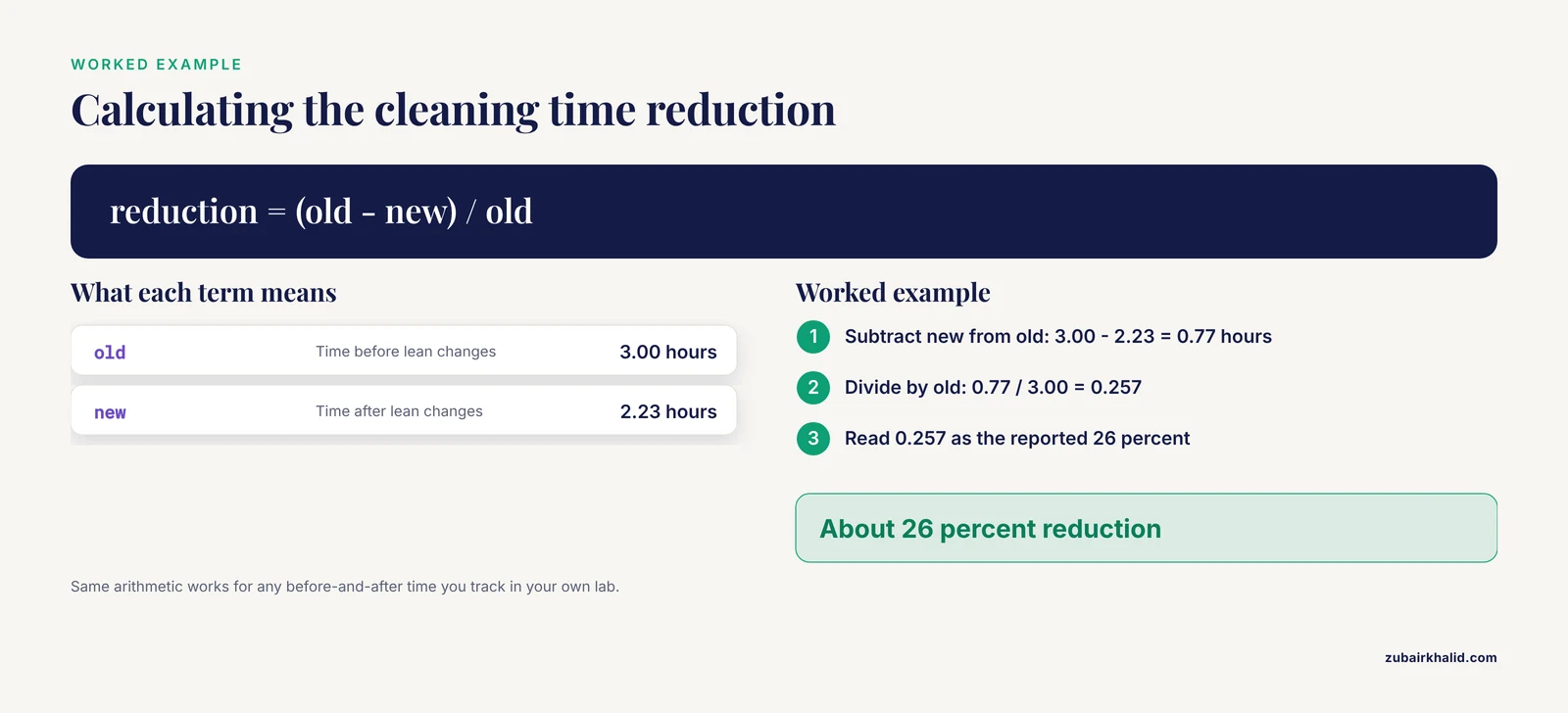
A study of robotic surgical instrument cleaning at a Chinese hospital illustrated how much waste hides in routine technical work. After a lean reorganization that included real-time instrument recovery, refined classification, enhanced ultrasonic cleaning, and an intelligent inventory system, average cleaning time fell 26 percent, from 3.00 hours to 2.23 hours per batch, while cleaning quality measured by protein residue and ATP biofluorescence detection improved [4]. Instrument reprocessing is operationally similar to core laboratory work: repetitive, quality-critical, and full of hidden waiting time.
The Main Lean Tools and How Researchers Use Them
Value Stream Mapping
Draw the current state of your workflow on paper, step by step, with the time each step takes and the time between steps. Then draft a future state that removes or merges wasteful steps. Even a rough map made in an afternoon usually identifies one or two changes you can make the same week.
Standard Work
Standard work means documenting the best-known way to perform a recurring task so that everyone does it the same way and improvements build on a stable baseline. Standardization gets a bad reputation among scientists who fear it stifles creativity, but the evidence points the other way. In a pediatric intensive care unit, rounding patterns differed across attending physicians and created variability. A multidisciplinary committee evaluated the patterns and adopted the most efficient one for all physicians. Transfer and discharge order entry improved by 45 minutes per patient, medication order entry improved by 89 minutes per order, staff satisfaction rose on 9 of 12 survey items, and time spent per patient on rounds actually increased by 20 percent, meaning standardization freed time for higher-value interaction [5]. The lesson for research project management is direct: standardize the routine so you can invest attention in the novel.
DMAIC
DMAIC stands for Define, Measure, Analyze, Improve, Control. It is the structured problem-solving cycle at the heart of Lean Six Sigma. In a day-care chemotherapy unit treating gastrointestinal cancer patients, a multidisciplinary team used DMAIC to collect baseline data, identify bottlenecks, and implement targeted solutions including fast-track and normal-track pathways based on laboratory readiness and standardized diagnostic processes. Mean waiting time for chemotherapy fell from 188.4 minutes to 128 minutes [6]. A research team can run the same cycle on any recurring pain point, for example the turnaround time from sample arrival to extracted nucleic acid, defining the target, measuring the current distribution of times, analyzing root causes, piloting changes, and then holding the gains with checklists.
Rapid Improvement Events
A rapid improvement event (RIE), sometimes called a Rapid Process Improvement Workshop (RPIW), gathers frontline staff for a focused stretch of days to redesign one process and implement changes immediately. At a Veterans Affairs emergency department, an RPIW in January 2014 standardized and streamlined evaluation and hand-off processes, clarified nursing and physician roles, improved bed utilization, and strengthened team communication. Door-to-doctor time fell by 12.6 minutes compared with contemporaneous control sites [7]. In a Dublin hospital, a system-wide rapid improvement event underpinned by person-centered principles helped the institution resume full routine activity after the first COVID-19 lockdown while staying compliant with infection prevention regulations [8]. A research group can run a miniature version: one afternoon, one persistent problem, everyone who touches the process in the room, and at least one change implemented before the meeting ends.
5S
5S is a workplace organization method with five steps: Sort, Set in order, Shine, Standardize, and Sustain. In a laboratory this translates to removing unneeded items from benches, assigning fixed labeled locations for shared reagents and equipment, cleaning and inspection routines, written placement standards, and periodic audits. 5S sounds trivial until you calculate the minutes a five-person lab loses each week searching for misfiled stocks and shared pipettes.
Real Examples of Lean in Scientific and Technical Settings
The strongest argument for applying lean principles to research projects is that the methods have already delivered measurable results in technically demanding, scientifically staffed environments.
| Setting | Lean approach | Key change | Reported outcome |
|---|---|---|---|
| Emergency cardiac care [9] | Waste elimination, supply chain streamlining, standard work | Frontline staff led rapid improvement events | ECGs within 10 minutes of triage rose 37.4 percent, physician assessment within 60 minutes rose 12.1 percent, median ECG-to-interpretation time reached 3 minutes, all with existing staff |
| Pediatric intensive care rounds [5] | Lean Six methods, standard work | Standardized attending physician rounding patterns | Discharge order entry 45 minutes faster per patient, medication orders 89 minutes faster, satisfaction up on 9 of 12 items |
| Chemotherapy day care unit [6] | DMAIC, pathway redesign | Fast-track versus normal-track pathways, workflow standardization | Mean waiting time fell from 188.4 to 128 minutes |
| VA emergency department [7] | Rapid Process Improvement Workshop | Standardized handoffs and role clarity | Door-to-doctor time fell 12.6 minutes versus control sites |
| Surgical instrument reprocessing [4] | Lean management optimization | Real-time recovery, refined classification, intelligent inventory | Average cleaning time down 26 percent (3.00 to 2.23 hours) |
| Construction waste management [2] | Lean tools for material flows | Waste-focused process redesign | Waste generation reduced 25 to 50 percent |
| Post-COVID service resumption [8] | Rapid improvement event, person-centered principles | Hospital-wide workflow redesign | Routine activity resumed while meeting infection prevention requirements |
Two details in these cases matter for researchers. First, the cardiac care improvements were achieved using existing staff and resources [9], which addresses the most common objection in academia, that there is no budget for process improvement. Second, the improvements in the cardiac study continued to grow over time [9], showing that lean changes compound rather than plateau immediately.
Building a Lean Research Project Plan
A lean-informed research project plan template has the same skeleton as any plan in research project management, with lean checkpoints built in. A usable template contains these elements:
- Value statement. One sentence describing the deliverable and who receives it.
- Value stream map. Every step from project start to deliverable, with estimated elapsed time and touch time for each.
- Waste log. Identified waiting, rework, and inventory risks, each with a proposed countermeasure.
- Standard work documents. Written protocols for every recurring task, versioned and dated.
- Pull triggers. Reorder points for consumables and rules for when each analysis or writing task starts.
- Visual management. A shared board or digital equivalent showing task status so nobody waits for information.
- Measurement plan. The two or three metrics that define success, for example sample-to-result time, first-pass assay success rate, or days from draft to submission.
- Improvement cadence. A recurring short review where the team logs what worked, what failed, and one change for the next cycle.
Filling this template takes a day. Keeping it current takes minutes per week. The payoff is that new team members can contribute within days instead of months, because the standard work documents carry the institutional knowledge.
Sustaining Lean Beyond a Single Project
The most common failure mode in any improvement effort is the one-off project that fades when its champion moves on. The Veterans Affairs health system addressed this directly by launching a Lean Enterprise Transformation pilot, designed to embed lean principles as a collective mindset across whole facilities rather than applying tools piecemeal, with a national evaluation combining site visits, interviews, employee engagement surveys, and quality metrics across ten sites [10]. For a research group, the parallel is clear: run individual improvement projects, but also build the habits, such as standard work documents, visual boards, and regular review meetings, that survive staff turnover.
Training matters too. A systematic review of quality improvement training for surgeons found that programs typically combine didactic teaching with hands-on delivery of a real improvement project, and that collaborative approaches such as learning communities support successful implementation [11]. A student or early-career researcher who wants lean skills should therefore pair reading with a real project, ideally with a mentor or peer group reviewing the work.
Common Mistakes and Limitations
- Applying tools without principles. Buying a kanban board app or running one 5S event does not make a project lean. The principles of value definition and continuous improvement have to drive the tools, a distinction the Lean Enterprise Transformation framework was specifically designed to address [10].
- Mapping the process you wish you had. Value stream maps must reflect what actually happens, including the workarounds. Map by observing, not by recalling.
- Standardizing before understanding. Locking in a protocol that contains hidden waste standardizes the waste. Understand the process first, then standardize.
- Ignoring the people doing the work. The cardiac care improvements succeeded because frontline staff led the rapid improvement events [9]. Process changes imposed from above without frontline input typically fail or get quietly reversed.
- Measuring nothing. Every case in the table above succeeded because someone counted a specific metric before and after. If you cannot measure the problem, you cannot demonstrate the fix, and you cannot hold the gain.
- Expecting instant transformation. The French hospital case showed lean capabilities accumulating over five years [3]. Plan for iterative gains, not a single dramatic overhaul.
- Confusing lean with cost cutting. Lean aims to maximize value, and the intensive care study showed that standardized rounds actually increased value-added time per patient [5]. Framing lean as budget reduction will lose you your team's goodwill.
- Overgeneralizing results. Most published lean studies are single-site, before-and-after designs without randomized controls, and the surgical training review noted that many studies lacked clarity on framework, setting, and content [11]. Treat published effect sizes as encouraging evidence, not guarantees for your specific workflow.
One honest limitation deserves plain language: individual research projects differ enormously in scale, regulation, and team structure, so the specific magnitude of improvement any one group can expect varies. What the published evidence supports is the general direction, that structured waste reduction and standardization reliably improve flow and quality in complex technical settings.
Frequently Asked Questions
What are lean principles for research projects in simple terms?
They are a method for running your project so that every step either adds value for the end user or gets removed. You map your workflow, cut waiting and rework, standardize what works, and improve continuously through small measured changes.
Do lean methods work outside of manufacturing?
Yes. Published studies show measurable gains in emergency departments, intensive care units, chemotherapy day care units, hospitals, and construction projects, including faster door-to-doctor times, reduced waiting, and 25 to 50 percent waste reduction.
What is DMAIC and when should I use it?
DMAIC means Define, Measure, Analyze, Improve, Control, and it is the structured improvement cycle from Lean Six Sigma. Use it when you have a recurring, measurable problem such as slow sample turnaround or repeated assay failures, and you want a disciplined path from baseline data to a durable fix.
How do I find waste in my own research workflow?
Draw a value stream map of your project from start to deliverable, recording how long each step takes and how long you wait between steps. The gap between touch time and elapsed time is where the waiting, rework, and inventory waste hide.
Will standardizing my methods make my science less creative?
No. Standardizing routine tasks such as reagent preparation, documentation, and handoffs frees attention for the genuinely novel scientific decisions. In the intensive care study, standardizing rounds increased value-added time per patient by 20 percent while raising staff satisfaction.
What is a rapid improvement event?
A rapid improvement event is a short, focused workshop where the people who actually do a process redesign it together and implement changes immediately, rather than waiting for a long-term plan. The emergency department and post-COVID hospital cases both used this format successfully.
How long does it take to see results?
Individual changes can produce measurable results within weeks when a clear metric is tracked before and after. Building a lasting lean culture takes longer, with the French hospital case documenting accumulation over five years.
Do I need special training or software to start?
No. You can start with paper, a whiteboard, and one afternoon mapping your workflow. Formal training helps, and evidence suggests combining instruction with a real improvement project works best, but the entry point is simply observing your own process and counting something.