How to Structure the Discussion Section of a Lab Report
By Dr. Zubair Khalid, DVM, MS, PhD ·
By the end of this article you will be able to write a discussion section that interprets your data, connects it to published work, acknowledges its limits, and earns full marks under a standard rubric. You will need three things on hand before you start: your completed results section with tables and figures, the assignment prompt or grading rubric, and two or three key references your instructor expects you to engage with (lecture notes, a textbook chapter, or a primary paper).
The discussion is the section of a lab report where you answer the question your experiment was designed to ask. Everything before it documents what you did and what you measured. The discussion explains what the measurements mean. When researchers analyzed student discussion sections with a qualitative content analysis method called the Mayring methodology, they treated the discussion as the place where critical thinking and creativity become visible in writing, distinct from the calculation and procedural content that fills earlier sections [1]. That is why the discussion usually carries more grading weight than any other part of the report, and why instructors often list it as a separately scored item alongside figures, citations, and supporting bibliography [2].
What the Discussion Section Does
A discussion has four jobs, in this order:
- State your main finding in plain language, backed by your numbers.
- Explain the finding using the scientific principle the lab was designed to teach.
- Compare your result with expected values or published work and account for any difference.
- Acknowledge limitations and propose a specific next experiment.
Notice what is missing from that list: repeating your results. The results section already presents data. The discussion is where data becomes an argument. A common framing in scientific writing instruction is that a discussion should move beyond "how" questions (what procedure produced what numbers) into "why" questions (what mechanism, what assumption, what alternative explanation) [3]. Instructors grade that move heavily. In one study of how discussion content is scored, the interpretive and creative content of student discussions was what distinguished strong reports from mechanically adequate ones [1].
Lab Report Discussion Structure Step by Step
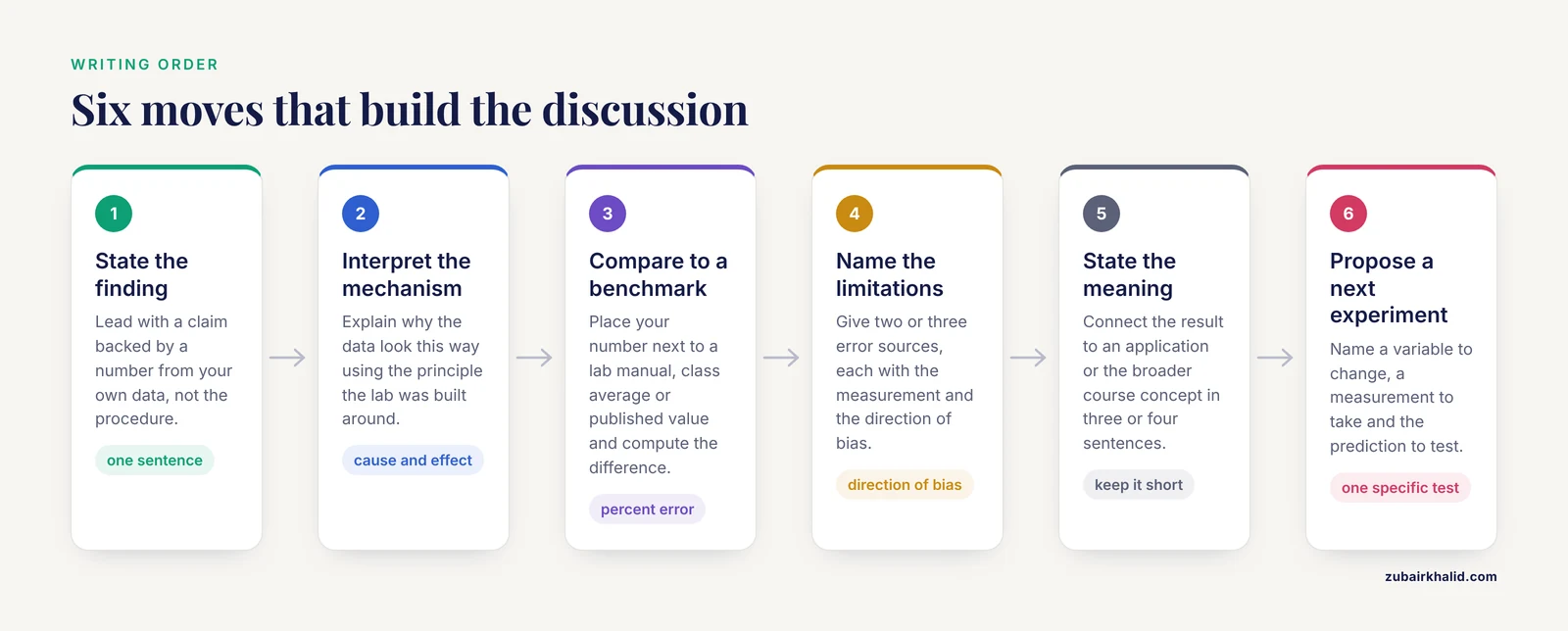
The structure below works for a one-experiment report of any length. Each numbered move becomes one paragraph, or one clear block of text, in the order shown. If you follow the moves in sequence, you produce a discussion without writer's block, because each paragraph has a defined job.
Step 1: Open with your main finding in one sentence
Lead with the answer, not with a restatement of the procedure. The first sentence of your discussion should be a claim supported by a number from your own data.
A useful pattern is: "The experiment showed that [independent variable] [direction of effect] [dependent variable] by [magnitude]." For a classic intro biology experiment measuring photosynthesis in the aquatic plant Elodea, that sentence reads:
Oxygen production rose from 12 bubbles per minute at 60 cm from the lamp to 41 bubbles per minute at 20 cm, then plateaued near 44 bubbles per minute at the closest distance.
That single sentence contains a direction (rising then plateauing), a magnitude (roughly a threefold increase), and the specific conditions. A reader who stops here already knows what you found.
Step 2: Interpret the finding with the relevant principle
The second paragraph answers why the data look the way they do, using the concept the lab was built around. For the Elodea example, the principle is the light-dependent reactions of photosynthesis: as photon input rises, the light reactions run faster until another factor (here, CO2 availability or the capacity of the Calvin cycle) becomes limiting, which is why the curve plateaus instead of climbing forever.
Write this paragraph as a cause-and-effect chain, one link per sentence. If you cannot state the mechanism in your own words, reread the textbook section the lab was attached to before writing. Students who build their conceptual explanation through guided inquiry tend to use more precise terminology and produce more analytical writing than students who follow procedural steps, a difference that shows up directly in discussion quality [4].
Step 3: Compare with expected or published values
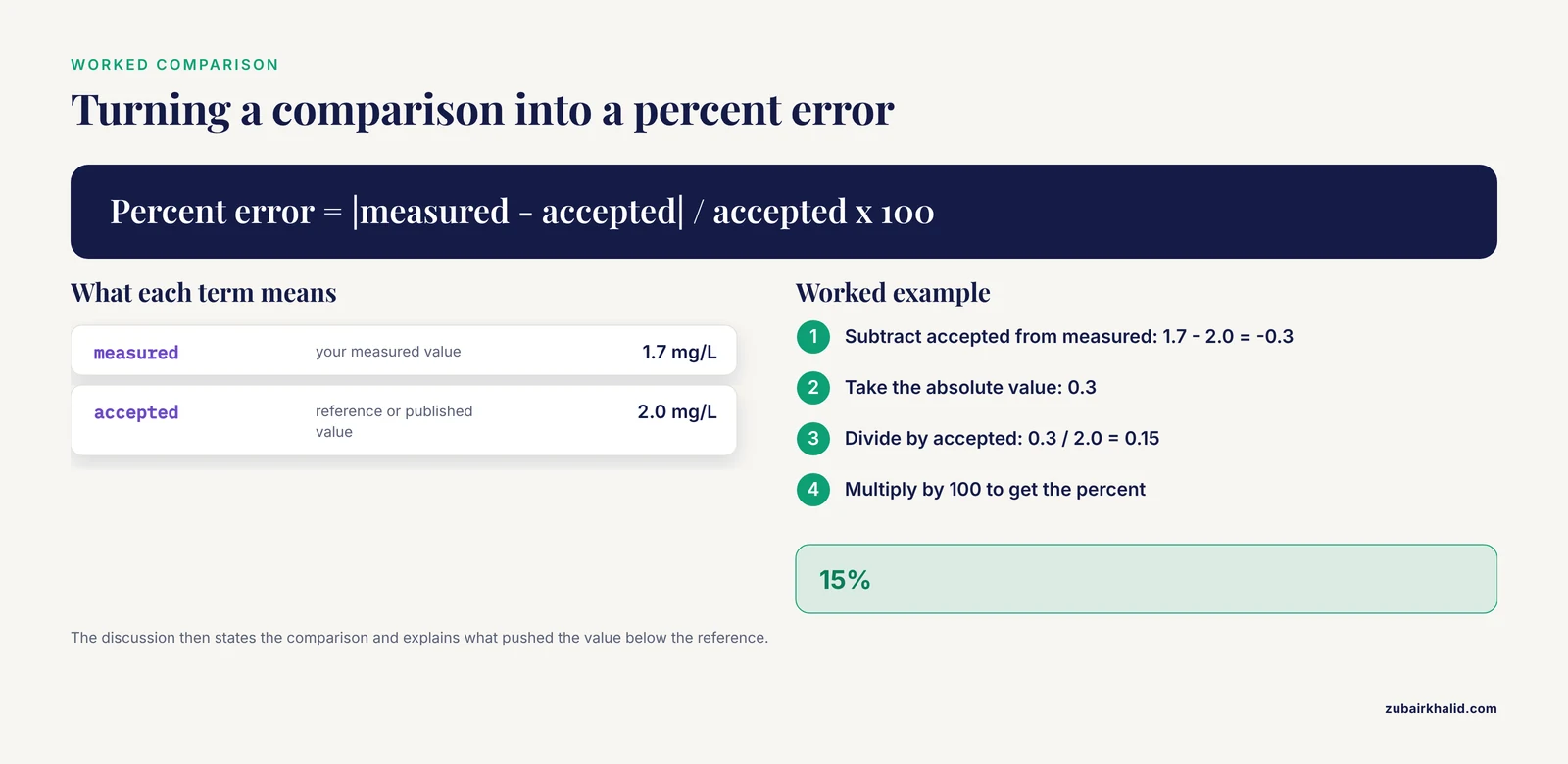
Now place your number next to a benchmark. The benchmark can be a value from your lab manual, a class-wide average, or a published figure. Calculate the size of the difference so your comparison is quantitative rather than vague.
For a percent error calculation, the standard formula is:
Percent error = |measured value - accepted value| / accepted value x 100

Example: accepted chlorophyll concentration = 2.0 mg/L
         measured chlorophyll concentration = 1.7 mg/L

Percent error = |1.7 - 2.0| / 2.0 x 100 = 0.3 / 2.0 x 100 = 15%
Expected output: 15%
The discussion then states the comparison and explains it: "Our measured concentration was 15 percent below the accepted value, which is consistent with partial loss of pigment during the extraction step described in the limitations below." If your result matched expectations, say so explicitly and explain the agreement. Agreement is a finding too.
Step 4: Account for error and limitations
Identify the two or three most consequential sources of uncertainty in your data and explain the direction each one pushes your result. Generic phrases like "human error" score zero because they explain nothing. Specific statements score well:
- "Bubble counting undercounts small bubbles, so our oxygen production values are likely underestimates at every light intensity."
- "The lamp warmed the water bath over the 30-minute trial, so the two highest-intensity treatments ran warmer than the lowest, which independently raises metabolic rate."
The second sentence is the level of specificity that separates an adequate discussion from a strong one. Notice that each limitation names the measurement, the direction of bias, and the affected condition. That is the template to copy.
Step 5: State what the finding means
One short paragraph connects your result to a real application or to the broader concept of the course. For the photosynthesis example: "The plateau suggests that simply increasing light intensity has diminishing returns once another factor becomes limiting, which matters for greenhouse lighting design and for interpreting shade versus sun adaptation in plants." Keep this to three or four sentences. You are closing the loop, not starting a new essay.
Step 6: Propose one specific next experiment
End with a follow-up that follows logically from your limitation or your anomalous data. "Repeat the 20 cm treatment with a water jacket to hold temperature constant" is a specific proposal. "More research is needed" is filler and costs you credibility. The best next-step proposals name a variable to change, a measurement to take, and the prediction the new experiment would test.
The full worked example
Here is the complete six-move discussion assembled, compressed to fit the page. In your report each move expands to a full paragraph.
1. FINDING:     Oxygen production in Elodea rose from 12 to 41 bubbles per
                minute as lamp distance fell from 60 to 20 cm, then
                plateaued near 44 bubbles per minute at the closest
                distance tested.
2. INTERPRET:   This pattern matches light-dependent photosynthesis,
                where reaction rate increases with photon flux until a
                second factor, most plausibly CO2 availability, becomes
                limiting.
3. COMPARE:     The plateau is consistent with the light-response curves
                in the course text. Our low-intensity values ran about
                15% below the manual's reference rates, likely from
                bubble undercounting.
4. LIMITS:      Bubble counting underestimates oxygen output, and lamp
                heat raised water temperature at short distances,
                confounding light intensity with temperature.
5. IMPLICATION: Increasing light beyond a saturation point yields
                diminishing returns, which is relevant to greenhouse
                lighting and shade adaptation.
6. NEXT:        Repeat the 20 cm trial with a temperature-controlled
                water bath to separate light effects from heat effects.
Expected output: a discussion of roughly 300 to 500 words for an introductory course, or 800 to 1,200 words for an upper-level course with multiple references per move.
Lab Report Discussion Structure Tips
These tips address the craft issues that cost students the most points after the basic skeleton is in place.
Use one paragraph per move. The six-move structure maps cleanly onto paragraphs. A reader, including a grader working through forty reports, can verify each required element when each element owns a paragraph.
Choose precise terminology over everyday wording. Vocabulary precision is one of the measurable differences between strong and weak analytical writing in lab reports [4]. Write "photon flux" where you mean it, "plateau" where the curve actually flattens, and "limiting factor" only where the data support limitation. Precision does not mean jargon stacking. It means each technical term you use carries its exact meaning.
Ask why, then why again. A discussion that stops at "how" (the procedure, the numbers) reads as a summary. Push one level deeper on your central interpretation. When researchers set up reflective, discussion-oriented processes, the deliberate shift from how questions to why questions was itself treated as a learning goal [3]. Your discussion should show that same shift.
Cite where you compare. Any claim about what "should" have happened needs a source: the lab manual, the textbook, or a primary paper. An uncited expectation reads as an assumption.
Manage your tenses. Past tense for what you did and observed ("oxygen production rose"). Present tense for established science ("the light reactions require photon flux") and for what your figure shows ("Figure 2 shows the plateau").
Use calibrated peer feedback before submission. In a controlled study in an environmental engineering course, students who completed a peer-review module focused specifically on the discussion earned higher grades on the final lab report than students whose peer-review training covered the abstract and introduction instead, and the peer-review training also improved their ability to judge report quality accurately [5]. Before submitting, swap discussions with a classmate and check each other against the six moves. If your reader cannot find your main finding in the first two sentences, revise.
Check your rubric first. Grading criteria vary by course. One analysis of practicum reports found discussion scored as a distinct assessment category alongside figures, question responses, and bibliography [2], and your own rubric likely lists the discussion's required elements explicitly. Write to the rubric, not to a generic template.
Instructors continue to experiment with how to teach the analysis part of lab work itself, from traditional write-ups to alternative formats [6], so expectations can differ between courses. When in doubt, ask your instructor whether they want the discussion and conclusion merged or separate.
Common Mistakes and Limitations
These are the lab report discussion structure common mistakes that appear on real graded reports, in rough order of frequency.
Restating results instead of interpreting them. The most common failure is a discussion that narrates the data again. In a study comparing instructional supports for lab report writing, students with strong procedural structure still produced surface-level analysis when their support emphasized procedure over concept [4]. If a sentence in your discussion could be moved into your results section without breaking anything, it belongs there instead.
Introducing new data in the discussion. All numbers appear first in results. If you discover an unreported measurement while writing the discussion, add it to the results section with its table or figure, then reference it from the discussion.
Vague error attribution. "Human error" and "equipment malfunction" explain nothing. Name the specific measurement, the mechanism, and the direction of bias, as modeled in Step 4.
Ignoring anomalous data. A point that does not fit the trend is the most interesting datum you have. Either explain it mechanistically or propose the follow-up measurement that would resolve it. Deleting it or hoping no one notices are the two responses graders penalize.
Overgeneralizing from one trial. One replicate in one plant under one lighting regime supports a claim about that plant under those conditions. Scope your claims accordingly.
Comparing without a number. "Our results were close to the expected value" is not a comparison. Compute the percent difference and report it.
Writing the discussion before the results are final. The discussion interprets a finished dataset. If your figures are still changing, wait.
Assuming every lab wants the same discussion. Disciplines differ. A physics teaching-lab discussion may emphasize quantitative uncertainty propagation, while a biology discussion may emphasize mechanism and literature comparison. The content-analysis work on student discussions itself had to adapt its coding categories to the specific course context [1], which is a reminder that discussion conventions are course-specific. Read your rubric and, if available, an example of a graded strong report from the same course.
How the Discussion Fits the Standard Lab Report Format
For readers asking how to write a lab report as a whole, the standard lab report format is IMRaD: Introduction, Methods and Materials, Results, and Discussion, often followed by a separate Conclusion and the reference list. Each section feeds the next.
- The Introduction poses the question and states the hypothesis your discussion will return to.
- The Methods document the procedure in enough detail for replication.
- The Results present data with tables, figures, and statistical summaries, with no interpretation.
- The Discussion interprets, compares, and qualifies.
The discussion is the only section whose job is judgment. That is also why it is disproportionately graded. In the peer-review study cited above, the discussion and methods training modules produced larger improvements in final report grades than modules covering sections that are generally easier to write. Budget your writing time the same way. A report with a polished discussion and a plain abstract will usually outscore a report with a polished abstract and a thin discussion.
Two structural questions come up constantly. First, whether to merge Discussion and Conclusion. Check your rubric. If they are separate, the conclusion is typically a short, standalone statement of the main finding and its significance, free of new interpretation. Second, whether the discussion should be organized by move or by research question. For a multi-part lab with three distinct questions, organize by question and run the six moves within each question block, then close with an overall paragraph.
A Five-Point Self-Check Before You Submit
Run this check on your draft before submission. Each item maps to a grading criterion that appears in real rubrics.
- Is your main finding stated with numbers in the first two sentences?
- Does a mechanism explanation follow, in your own words, without copying the manual?
- Is there a quantitative comparison to an expected or published value?
- Are two or three limitations named with direction of bias, and no generic "human error"?
- Does the final paragraph propose a specific, testable next experiment?
If any answer is no, the fix is localized: revise that paragraph, not the whole section.
Frequently Asked Questions
How long should the discussion section of a lab report be?
For an introductory course, 300 to 500 words is typical. Upper-level courses usually expect 800 to 1,200 words with multiple references. Your rubric or page limit overrides any general guideline.
What tense should I use in the discussion?
Use past tense for your own actions and observations, and present tense for established scientific knowledge and for statements about what your figures show.
Should the discussion and conclusion be separate sections?
It depends on your rubric. Many courses merge them. When they are separate, the conclusion is a brief standalone statement of the main finding and its significance.
Can I include new data in the discussion?
No. All data belongs in the results section first. If a measurement matters to your interpretation, add it to results with its table or figure, then reference it.
How do I handle results that do not match my hypothesis?
Report the mismatch plainly, propose the most plausible mechanism, and design the follow-up experiment that would test it. A well-explained negative result scores better than a forced positive one.
Do I need citations in the discussion?
Yes, wherever you compare your results to expected values or published findings, and wherever you invoke an established mechanism. The lab manual and textbook count as citable sources in most courses.
What is the difference between discussion and results?
Results present what you measured without interpretation. The discussion explains what the measurements mean, compares them to expectations, and states their limits.
How do I write about error sources without just saying "human error"?
Name the specific measurement, the mechanism that disturbed it, and the direction the bias pushes your result. For example, state that bubble counting underestimates gas production rather than citing generic human error.
Sources
- Qualitative content analysis of lab report discussion in introductory physics for engineering and technology students
- Analyzing Practicum Reports Made Using Posters for an Animal Structure Course
- Developing a living lab in ethics: Initial issues and observations.
- Evaluating generative AI-assisted inquiry-based learning and metacognitive scaffolding for enhancing scientific vocabulary, content comprehension, and lab report writing
- Promoting equitable achievement in STEM: lab report writing and online peer review
- MEASURING THE EFFECTIVENESS OF ALTERNATIVE METHODS OF LAB WORK ANALYSIS IN AN AP ENVIRONMENTAL SCIENCE CLASS