Lab Equipment Booking Software: 7 Tools to End Scheduling Conflicts
By Dr. Zubair Khalid, DVM, MS, PhD ·
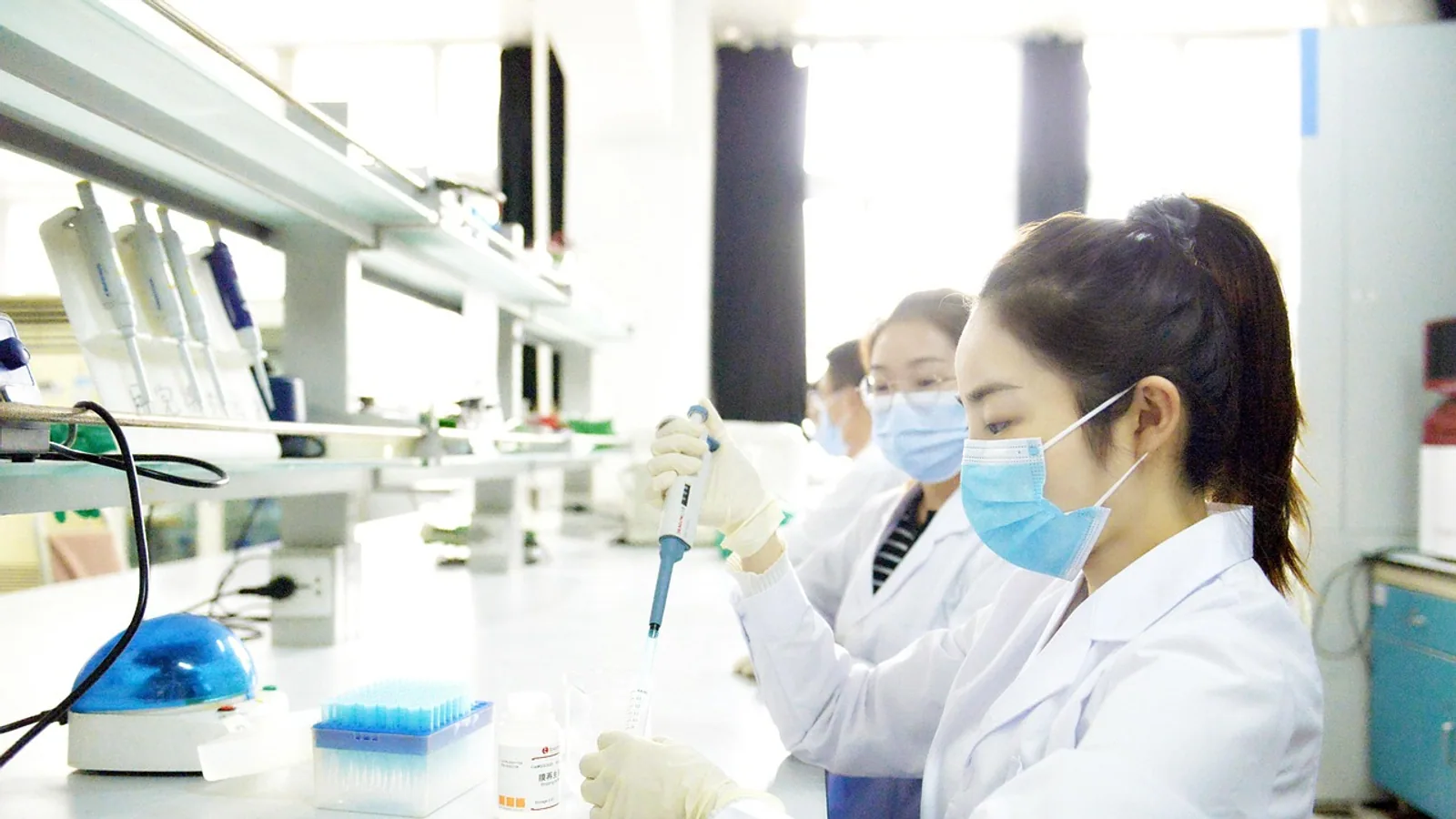
Lab equipment booking software assigns instrument time to named users at named times, while a workflow scheduler assigns compute tasks to machines. That distinction decides everything, because most scheduling conflicts in a wet lab involve people and physical instruments, while most conflicts in a computational lab involve processors and data queues. The rule of thumb: if your recurring problem is two postdocs and one confocal microscope, start with a booking-centered platform that combines calendars, approvals, and data capture. If your recurring problem is hundreds of samples competing for cluster time, start with a workflow scheduler built for parallel execution.
This article walks through seven systems drawn from the peer-reviewed literature, compares them on the criteria that actually decide a purchase or adoption decision, and shows how booking fits into research project management as a whole.
Why Scheduling Conflicts Are a Scientific Problem, Not Just an Administrative One
A double-booked instrument does more than annoy people. It can corrupt data. In dissolution testing with the USP paddle method, researchers measured vibration on the dissolution vessel plate across three axes and found that root mean square acceleration values above 0.01 g, in either the vertical or horizontal direction, typically affected dissolution results [1]. That vibration came from laboratory equipment running nearby, building construction, and even the analysts themselves. Two experiments running side by side on a shared bench are not just competing for space. They can be physically interfering with each other's measurements.
A well-designed booking system prevents this class of conflict by making co-occupancy visible before it happens. If the booking record shows that a vibration-sensitive dissolution run occupies the room from 9:00 to 11:00, the system can block or flag a request for a vibrating shaker incubator in the same window. No shared paper sign-up sheet can do that, because nobody reads the whole sheet before writing their name in a blank box.
Scheduling conflicts also carry a human cost. Constant digital notifications raise workload, degrade heart rate variability, and reduce task accuracy under dual-task demands, and a field intervention that batched notifications cut notification volume by roughly half and lowered self-reported stress while improving morning heart rate variability [2]. A booking system that fires an email for every calendar event recreates that problem. A well-configured one batches its confirmations and reminders so the calendar helps concentration instead of destroying it.
What Lab Equipment Booking Software Actually Does
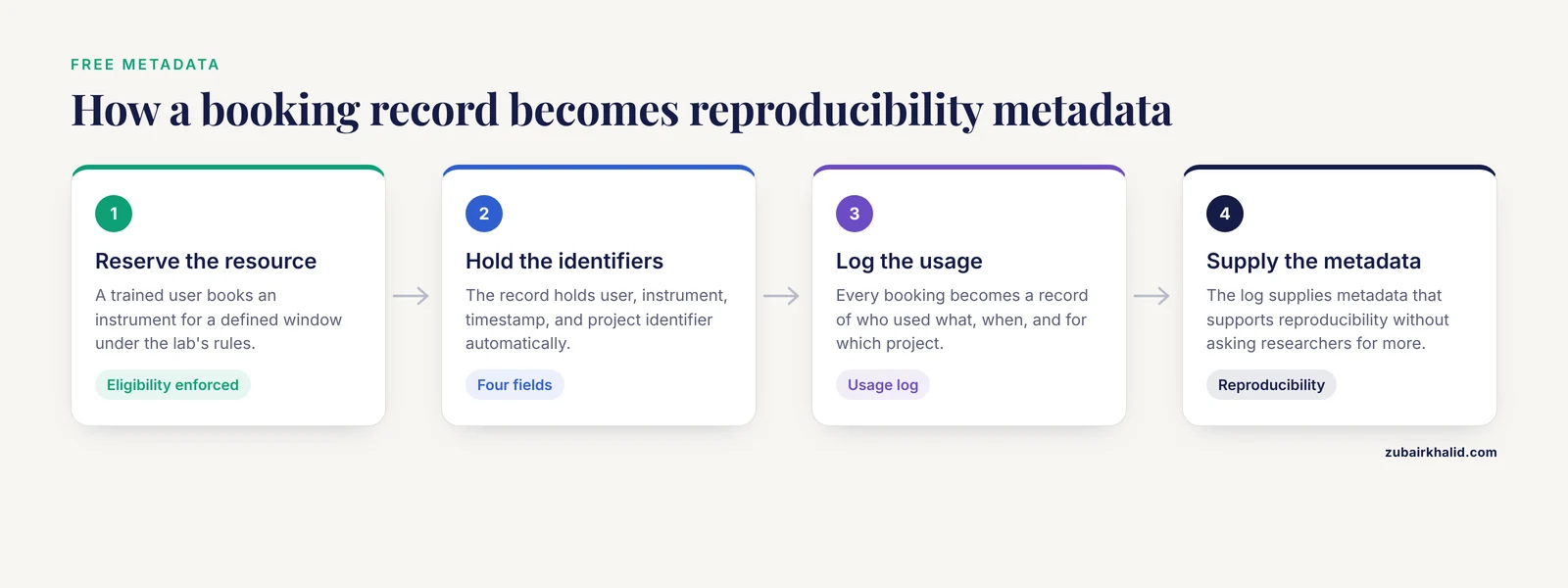
At minimum, a booking system does four things:
- It holds a live inventory of resources, whether those are microscopes, dissolution baths, mass spectrometers, cluster nodes, or biosafety cabinet time slots.
- It lets users reserve those resources for defined windows, with rules such as maximum session length, minimum advance notice, and cancellation deadlines.
- It enforces eligibility, so only trained and authorized users can reserve a given instrument.
- It logs usage, which turns every booking into a record of who used what, when, and for which project.
The fourth function matters more than most labs realize. Comprehensive collection of metadata, meaning all information about the experiment, the data, and the preprocessing steps applied to the data, is a central requirement for reproducibility, yet researchers are often overburdened by documentation demands and produce records that are incomplete or ambiguous to outsiders [3]. A booking record that automatically captures user, instrument, timestamp, and project identifier is metadata you get for free.
The 7 Tools at a Glance
| Tool | What it schedules | Best suited for | Deployment model | Main limitation |
|---|---|---|---|---|
| openBIS | Instrument workflows plus data capture in one platform | Analytical and spectroscopy labs that need FAIR-compliant data management | ELN and LIMS platform developed at ETH Zurich | Adoption requires institutional commitment to data management practices |
| LabBase | End-to-end laboratory workflow | Labs that want scheduling embedded in structured workflow management | Database-driven laboratory system | Designed as a workflow backbone, not a standalone calendar |
| EOS (Experiment Orchestration System) | Tasks, devices, and full experiment campaigns | Automation-ready labs in chemistry and materials science | Open-source framework with YAML definitions and Python plugins | Requires equipment that can be controlled by software |
| Swift/T | Parallel compute workflows across clusters | Genomics facilities running large variant calling batches | Parallel scripting language portable across PBS Torque, SLURM, and Cray aprun | Suits computational pipelines, not bench instruments |
| BioWorkflow | Parallel bioinformatics tasks, GPU-accelerated | High-throughput sequencing analysis groups | Interactive workflow management toolkit | Focused on bioinformatics, GPU infrastructure required for full gains |
| Kubernetes with Argo and Kueue | Hybrid compute resources under one orchestration layer | Institutions combining CPUs, GPUs, and emerging quantum hardware | Cloud-native, containerized | Steep infrastructure expertise requirement |
| SigWin-Detector in a virtual laboratory | Interactive analysis workflows for gene expression | e-Bioscience collaborations sharing analysis pipelines | Virtual laboratory environment | Analysis-focused, limited role for physical instrument booking |
Tool by Tool
openBIS
openBIS is an Electronic Laboratory Notebook (ELN) and Laboratory Information Management System (LIMS) developed at ETH Zurich. An ELN is a digital replacement for the paper notebook, and a LIMS is a system that tracks samples, instruments, and results across a laboratory. When Empa, the Swiss materials science research institution, needed a data management platform compliant with the FAIR principles, a set of guidelines holding that scientific data should be findable, accessible, interoperable, and reusable, it adopted openBIS and adapted it to integrate the laboratory data workflow in chemical analysis and spectroscopy instruments [4]. Documented case studies there include a data pipeline and a complex dashboard for data collection, visualization, and interaction.
For booking purposes, openBIS represents the integrated end of the spectrum. Instrument reservations live next to the sample records and measurement data they generate, so the question of who ran what on which instrument never requires cross-referencing three separate systems. The trade-off is scope. A lab that only wants a shared calendar will find openBIS heavier than it needs, while a lab drowning in disconnected spreadsheets will find it solves several problems at once.
LabBase
LabBase, described by Stein, Rozen, and Goodman, is a system for managing laboratory workflow, and it makes a specific architectural argument: scheduling should not be a separate layer bolted onto the lab, it should be part of the workflow record itself [5]. In practice this means a reservation is not an isolated calendar entry. It is a step inside a structured process that connects reagents, samples, procedures, and instruments.
Labs evaluating lab equipment booking software options often discover this pattern late. They install a standalone calendar, then wonder why the calendar knows nothing about the experiment the booking serves. A workflow-embedded approach answers that question by design. The limitation is equally clear: this approach asks the lab to model its processes in the system, which takes more upfront effort than typing names into time slots.
EOS (Experiment Orchestration System)
EOS is an open-source software framework and runtime for laboratory automation built around a central orchestrator that communicates with and controls laboratory equipment to execute tasks. Users define labs, devices, tasks, experiments, and optimization criteria using YAML, a human-readable configuration format, and Python plugins. The system implements autonomous experiment campaigns, parameter optimization, task scheduling, and result aggregation [6].
EOS matters for booking because it changes who does the booking. In an automated lab, software reserves the instrument. A researcher submits an experiment, and the orchestrator slots it into the equipment queue based on availability and optimization criteria. This removes the human negotiation step entirely, which is the most reliable way to end scheduling conflicts, but it only works where instruments can be driven by software. A lab with manually operated equipment cannot use this model yet.
Swift/T
Swift/T is a parallel scripting language built for scientific workflows, and its flagship application is managing genomic variant calling with the GATK Best Practices pipeline, a multi-step workflow with branching and conditional logic that becomes difficult to manage when running hundreds or thousands of samples in parallel [7]. Swift/T wraps the pipeline with built-in flexibility to split work by chromosome, continue past faulty samples, and analyze multiple samples in parallel within each cluster node.
Two features are directly relevant to scheduling. First, Swift/T operates transparently across multiple cluster scheduling environments, including PBS Torque, SLURM, and the Cray aprun environment, so a single workflow moves between clusters without rewriting [7]. Second, its modular design separates a workflow into stages and requests resources optimal for each stage. For a core facility, that means the scheduler, not a human queue manager, decides which compute allocation runs when.
BioWorkflow
BioWorkflow is an interactive workflow management system that automates bioinformatics analyses, with the capability of scheduling parallel tasks using GPU-accelerated and distributed computing [8]. A GPU, or graphics processing unit, is a processor originally designed for graphics that excels at running many small computations at once, which suits the arithmetic behind sequence analysis. In a case study of a complex workflow with branching, the system reported gains of about 2.89 times from GPU use and average speed gains of about 2.83 times across evaluated runs [8].
For a genomics or proteomics group, BioWorkflow sits in the middle ground between a manual booking calendar and a fully autonomous lab. Researchers still compose their analyses interactively, but the system handles the scheduling of parallel tasks behind the scenes.
Kubernetes with Argo Workflows and Kueue
This option is not a single product but a stack. Kubernetes is a container orchestration system that manages application workloads across many machines. Argo Workflows runs multi-step pipelines on Kubernetes, and Kueue manages quotas and queues for compute resources. A cloud-native framework combining these three unifies CPUs, GPUs, and quantum processing units under a single orchestration layer, enabling multi-stage workflows with dynamic, resource-aware scheduling. Researchers demonstrated it with distributed quantum circuit cutting executed across heterogeneous nodes.
Most biology labs will never need the quantum part. The relevant lesson is architectural: when an institution runs many labs on shared compute, a quota-aware queueing layer prevents the classic conflict in which one heavy job starves everyone else. That is the compute-side equivalent of blocking a vibrating shaker during a dissolution run.
SigWin-Detector in a Virtual Laboratory
The SigWin-Detector tool for gene expression analysis runs inside a virtual laboratory for e-Bioscience, an environment where distributed research collaborations compose and execute analysis workflows interactively. Its inclusion on this list is deliberate. Many "equipment" conflicts in modern biology are really analysis conflicts, where several researchers need the same specialized pipeline or compute service at once. A virtual laboratory makes those services schedulable and shareable across institutions, which a bench-top calendar cannot address.
Lab Equipment Booking Software Pros and Cons
Weighing lab equipment booking software pros and cons honestly requires separating booking platforms from workflow schedulers, because their strengths land in different places.
Pros of booking-centered platforms such as openBIS and LabBase:
- Conflicts become visible and preventable before anyone walks to the instrument.
- Usage logs accumulate into metadata that supports reproducibility [3].
- Authorization rules keep untrained users off delicate or hazardous equipment.
- Usage data supports fair cost allocation across groups in a shared facility.
Cons of booking-centered platforms:
- They model human reservations, not actual task dependencies, so a booking can be honored in full while the experiment still fails for unrelated reasons.
- Adoption requires discipline. An unenforced calendar degrades back to a suggestion box within weeks.
- Notification settings need thought. Poorly configured alerting reproduces the interruption burden that degrades cognitive performance, while batched releases measurably reduce stress [2].
Pros of workflow schedulers such as Swift/T, BioWorkflow, EOS, and Kubernetes-based stacks:
- They schedule against real dependencies and real resource capacity.
- Portability and fault tolerance come built in. Swift/T runs unchanged across PBS Torque, SLURM, and Cray environments and can continue past faulty samples [7]. The R-DEAR strategy goes further, adding replication-based fault tolerance and load balancing so that scientific workflows in cloud environments survive task failure while managing power consumption [9].
- They scale without adding human coordination overhead.
Cons of workflow schedulers:
- They require infrastructure expertise that many wet labs lack.
- They do nothing for physical instruments that cannot be software-controlled.
- Scheduling algorithm choice is a research problem in itself. Surveys of heuristic, meta-heuristic, and reinforcement learning methods show meaningful differences in makespan and energy consumption, meaning the scheduler you pick embodies trade-offs you did not explicitly choose [10].
How to Choose: The Criteria That Decide Real Choices
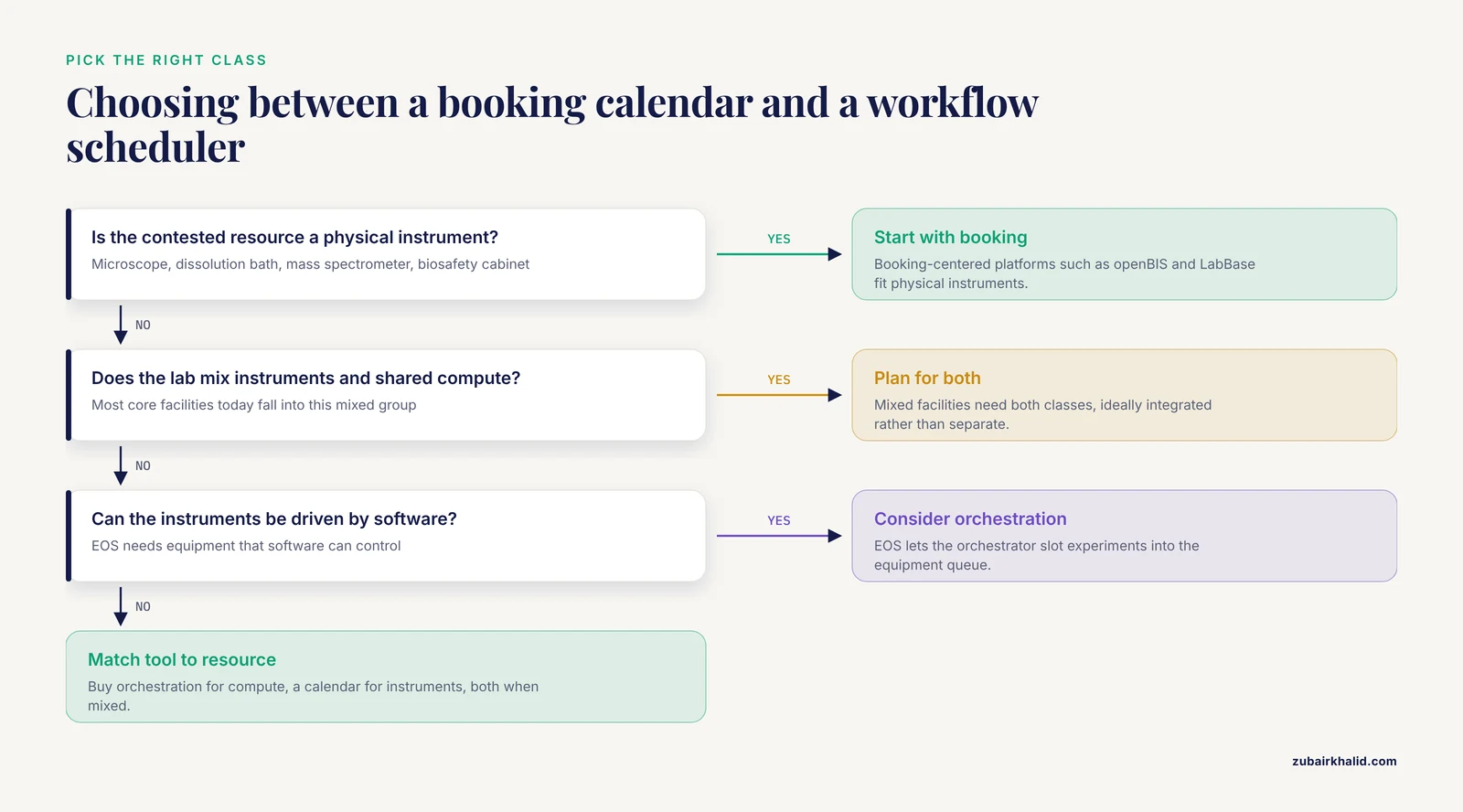
Nature of the resource. Physical instruments need booking platforms. Compute needs workflow schedulers. Mixed facilities, which describe most core facilities today, need both, ideally integrated.
Who does the scheduling. If humans make reservations, prioritize a clean interface, authorization controls, and batched notifications [2]. If software makes reservations, prioritize an orchestration layer with documented APIs and a runtime, which is exactly what EOS provides with its YAML and Python plugin model [6].
Data integration. Ask where the booking record goes. In openBIS, the reservation connects to sample records and instrument data under FAIR principles [4]. In a standalone calendar app, the reservation connects to nothing. For labs where reproducibility audits are routine, integration wins.
Portability. A core facility serving multiple institutions should weight portability heavily. Swift/T's transparent operation across multiple cluster scheduling environments is the benchmark here [7].
Failure behavior. Ask what happens when a run fails mid-workflow. Swift/T can continue analysis past faulty samples [7]. R-DEAR handles failures through replication-based fault tolerance [9]. A calendar does not ask this question at all, which is itself an answer.
Degree of automation you are ready for. The trajectory of the field runs from manual scheduling toward autonomy. Agentic AI frameworks use multi-agent reinforcement learning to coordinate triage, laboratory, imaging, and transport operations in hospitals through decentralized decision-making [11]. Autonomous laboratories already manage instrumentation, formulate experiment-specific procedures, and serve multiple user requests concurrently without human intervention. Few labs should start there, but few should ignore it either, because booking software purchased today sets the ceiling for automation tomorrow.
Worked Scenarios
Scenario 1: The shared dissolution lab. A pharmaceutical sciences department runs three dissolution baths. A graduate student's prednisone dissolution run on the USP paddle method is drifted out of specification because a neighbor's centrifuge ran for an hour on the same bench, and vibration above 0.01 g RMS is enough to affect dissolution results [1]. Afterward, the lab adopts a booking-centered platform and adds a room-level rule. Vibration-generating equipment and vibration-sensitive assays cannot be reserved in overlapping windows. The conflict never recurs because the system surfaces it at booking time, not at data-analysis time.
Scenario 2: The genomics core facility. A core facility receives 500 tumor-normal sample pairs per month for variant calling. Managing the GATK pipeline by hand across clusters creates a queue managed by email, which is the worst of all scheduling systems. The facility adopts Swift/T, which splits work by chromosome, runs samples in parallel within each node, tolerates faulty samples without stopping the batch, and moves between the PBS Torque cluster and the new SLURM cluster without rewriting the workflow [7]. Human scheduling effort drops to reviewing exceptions.
Scenario 3: The analytical chemistry service lab. A service lab tracks spectroscopy instruments on a whiteboard and sample data in scattered spreadsheets. Auditors cannot reconstruct which measurement came from which instrument run. The lab deploys openBIS, integrating its instrument data workflow and building a dashboard for data collection and visualization [4]. Booking, sample tracking, and raw data now share one record, and the whiteboard is retired.
Fitting Booking into Research Project Management
Booking software is one component of research project management, the practice of planning, resourcing, and tracking scientific work as a project rather than as a stream of ad hoc requests. A reservation that is not tied to a project plan is administrative noise. A reservation tied to a milestone is a commitment.
A practical research project plan template for a lab experiment contains these sections:
- Objective and hypothesis, stated in one or two sentences.
- Milestones with dates, such as pilot complete, full cohort collected, analysis locked.
- Resource requirements, listing every instrument, its required session length, and any constraints such as vibration isolation or required operator certification.
- Personnel and training status, since eligibility rules in the booking system must match who is actually trained.
- Data management plan, naming where raw data, metadata, and processed results will live and who can access them.
- Risk register, covering equipment downtime, reagent delays, and analysis failures, with the booking buffer that absorbs each risk.
- Approval chain, identifying who signs off on milestones and who arbitrates booking disputes.
Fill this template once per project, then let the booking system enforce it. The resource requirements section becomes booking rules, the training section becomes authorization lists, and the data management section becomes your metadata capture plan. Labs that document procedures in shared electronic systems see improved day-to-day access to those procedures, a benefit documented early on when pathology laboratories replaced paper operation manuals with PC-based intranet systems [12]. Booking rules, training records, and procedure manuals belong in the same accessible digital layer, not scattered across a whiteboard, a binder, and someone's inbox.
Common Mistakes and Limitations
Treating the booking system as the whole solution. A calendar prevents time collisions. It does not prevent physical interference, and it does not validate that a run was performed correctly. Vibration effects on dissolution testing demonstrate why spatial and physical constraints belong in the scheduling logic, not just in the booking record [1].
Configuring notifications naively. Default notification settings in most systems fire on every event. The evidence on notification batching shows that rate reduction carries measurable physiological and self-report benefits, and that benefits scale with the intervention [2]. Set confirmations and reminders to batch, and put an allow-list behind urgent messages.
Letting bookings float free of projects. A reservation unlinked to a project identifier cannot feed your metadata or your cost allocation. The reproducibility literature is explicit that metadata collection fails when it overburdens researchers, so capture it automatically inside the booking record rather than asking for it later [3].
Buying orchestration when you need a calendar, or the reverse. Kubernetes-based orchestration solves quota conflicts across shared compute. It does not help two labs share a microscope. Match the tool class to the resource class.
Underestimating adoption cost. Every system on this list, from openBIS's institutional deployment [4] to EOS's YAML-defined experiments [6], requires someone to model the lab's real processes. Budget that person's time.
A general limitation. The evidence base here comes from specific deployments and specific domains, from analytical chemistry to genomics to clinical operations. Results transfer as design principles, not as guarantees. Any individual laboratory's choice needs evaluation against its own instruments, staff skills, and institutional infrastructure.
Frequently Asked Questions
What is lab equipment booking software?
It is software that lets trained users reserve instrument time in defined windows while enforcing eligibility rules and logging usage. The logs double as metadata linking users, instruments, and projects.
Which is the best lab equipment booking software for a small academic lab?
For a small lab whose conflicts are over physical instruments, an integrated platform such as openBIS offers the most durable value because reservations, sample records, and instrument data live together. For a small computational lab, a workflow scheduler such as Swift/T fits better.
Do I need booking software if my lab has fewer than ten people?
You need it when conflicts cause rework, data quality problems, or access disputes, not at a headcount threshold. Even a three-person lab running vibration-sensitive assays benefits from blocking conflicting reservations, because vibration above 0.01 g RMS can alter dissolution results.
How do booking systems relate to research project management tools?
Booking systems enforce the resource commitments that a project plan makes. The resource requirements, training, and data management sections of a project plan translate directly into booking rules, authorization lists, and metadata capture settings.
Can scheduling software improve data reproducibility?
Yes, indirectly. Scheduling systems automatically record who used which instrument and when, and comprehensive metadata collection is a recognized requirement for improving reproducibility in experimental science.
What is the difference between a booking calendar and a workflow scheduler?
A booking calendar manages human reservations for fixed time slots. A workflow scheduler manages task execution against real resource capacity and task dependencies, as seen in systems like Swift/T and BioWorkflow. Large facilities often need both.
Sources
- Vibration effects of lab equipment on dissolution testing with USP paddle method.
- Managing Digital Notifications and Stress: Evidence from a Hybrid Laboratory and Field Study on Cognitive Load, HRV, and Well-being
- Handling Metadata in a Neurophysiology Laboratory
- The openBIS Digital Platform for Instrumentation and Data Workflow in the Analytical Laboratory.
- MANAGING LABORATORY WORKFLOW WITH LABBASE
- The Experiment Orchestration System (EOS): Comprehensive Foundation for Laboratory Automation
- Managing genomic variant calling workflows with Swift/T
- Managing Complex Workflows in Bioinformatics: An Interactive Toolkit With GPU Acceleration
- Replication-Based Dynamic Energy-Aware Resource Provisioning for Scientific Workflows
- Evaluating Scheduling Efficiency for Complex Scientific Workflows in Cloud Infrastructures
- Autonomous Agentic AI for Clinical Workflow Orchestration: Self-Managing Healthcare Operations
- Intranets: virtual procedure manuals for the pathology lab.