How to Write the Discussion and Conclusion of a Literature Review
By Dr. Zubair Khalid, DVM, MS, PhD ·

By the end of this article you will be able to plan, draft, and quality-check the two hardest sections of any literature review: the discussion, where you interpret what your synthesis of the literature means, and the conclusion, where you state what the field should take away and do next. You will work through an eight-step walkthrough, a fill-in template for each discussion paragraph, a worked example, a repetition check you can actually run, and a list of the errors that reviewers most often flag.
Have on hand before you start:
- Your final study set from the systematic literature search, with the PRISMA flow diagram or equivalent search documentation
- Your extraction or synthesis table (one row per study, with design, sample, findings, and quality rating)
- The review question exactly as written in your methods section
- Any quality-appraisal results, such as risk-of-bias or GRADE ratings, if your review used them
What the Discussion Section Actually Does
The body of a literature review organizes and reports what studies found. The discussion interprets. It answers three questions the body alone cannot answer: what does the combined evidence show, how confident can anyone be in that answer, and what should happen next.
Published reviews make this division visible. A narrative review of artificial intelligence policies in medical publishing organized its entire discussion around three labeled findings: core consensus, major disagreements, and policy gaps [1]. A scoping review of autoethnography in medical education used its discussion to map where the literature is concentrated, where it is thin, and which methodological questions remain open [2]. A narrative review of research supervision in the health sciences spent its discussion naming recurring tensions in the literature and proposing design responses to them [3]. None of these discussions simply summarized earlier sections. Each one converted a body of described studies into an argued position.
A practical way to think about it: the body of the review is organized by topic or chronology. The discussion is organized by claim. Each paragraph advances one claim about the evidence, supports it with the studies already reviewed, and addresses the strongest counter-evidence.
How the Discussion Differs From the Body
Three differences matter in practice.
First, coverage. The body must cover every included study. The discussion does not. It cites studies selectively, only where a study supports, limits, or complicates the claim being made. A systematic review of pulmonary rehabilitation in idiopathic pulmonary fibrosis included eight studies in its synthesis, but its conclusions rested on the pooled effects and the subgroups that answered the duration question, not on restating every study [4].
Second, voice. In the body, the reviewer reports. In the discussion, the reviewer judges: which findings are stronger, which conflicts are real, which gaps matter.
Third, direction. Body sections can end anywhere. Every discussion paragraph must move toward the answer to the review question, and the conclusion must land on it.
Preparing to Write the Discussion
Draft the discussion only after the body is stable. Rewriting the body after drafting the discussion almost always breaks the discussion's claims.
Build a one-page findings ledger before writing anything. For each major finding of your synthesis, list:
- The finding, stated in one sentence
- The studies that support it, by author and year
- Studies that contradict or qualify it
- The quality of the underlying evidence
- Whether prior reviews reached a similar or different answer
The fourth and fifth rows are what separate a graduate-level discussion from an undergraduate summary. A meta-analysis of kidney-tonifying prescriptions for male infertility with sperm DNA fragmentation graded its outcome evidence with the GRADE system and therefore stated its conclusion as "low to moderate-quality evidence" supporting benefit [5]. A systematic review of pressure-monitoring technologies in flexible ureteroscopy appraised risk of bias with RoB 2, ROBINS-I, and the JBI checklist, then graded certainty with GRADE before characterizing outcomes [6]. Those appraisal steps are performed in the methods, but their consequences are argued in the discussion.
How to Write the Discussion and Conclusion of a Literature Review, Step by Step
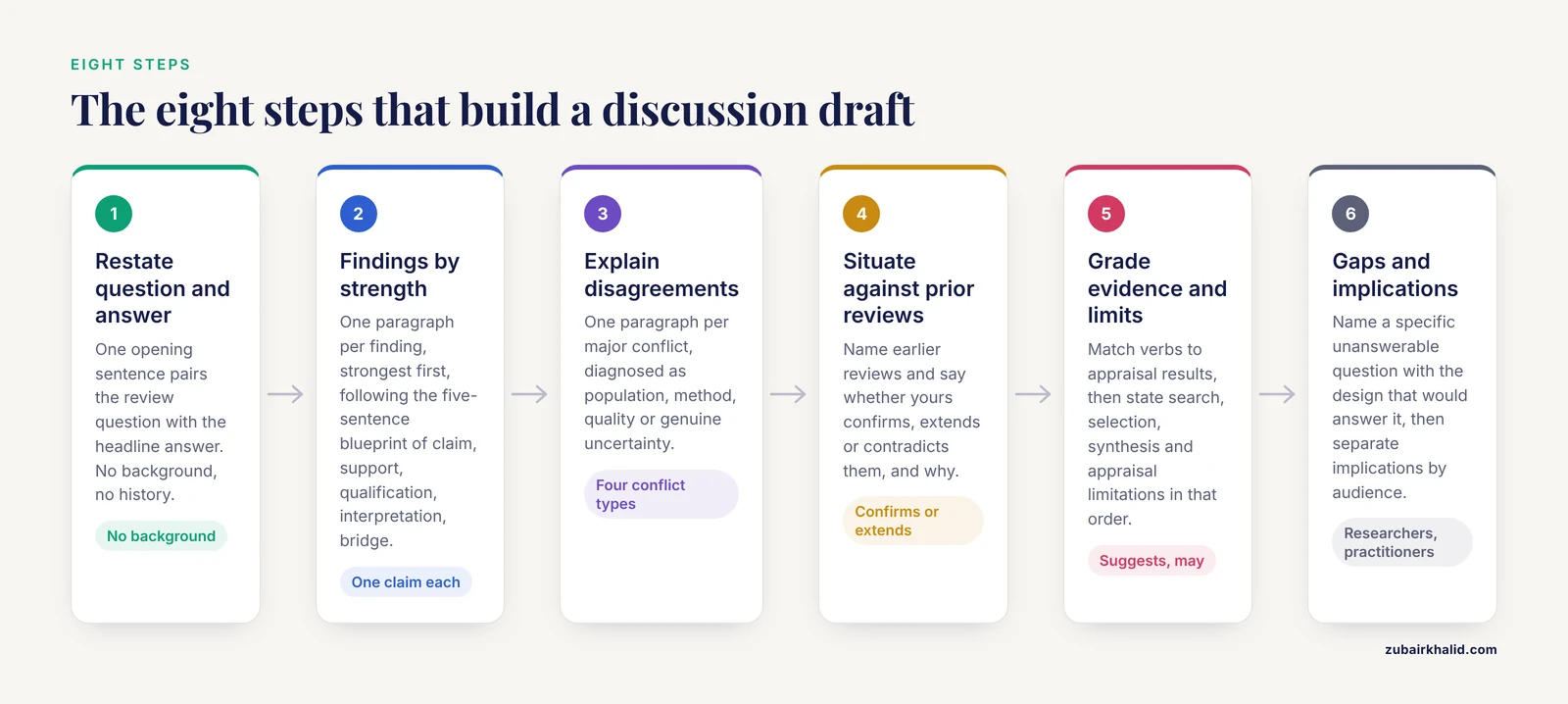
The following eight steps produce a complete discussion draft of roughly 800 to 1,500 words for a standard journal-length review, scaled up for systematic reviews with meta-analyses.
Step 1: Restate the Question and the Answer in One Sentence
Open the discussion with a single sentence that pairs your review question with your headline answer. No background. No history of the topic. The reader has just finished 6,000 words of body text and needs an anchor.
Template:
[Question restated compactly] was addressed by synthesizing [N] studies
published through [date]. The evidence indicates [headline answer].
Filled example:
Whether literary arts-based interventions raise empathy in healthcare
populations was addressed by synthesizing 14 studies totaling 1,593
participants. The evidence indicates a possible benefit, with five of
14 studies reporting statistically significant increases in
self-reported empathy and six reporting no change [7].
That example is deliberately honest about mixed results. A discussion that opens with a clean answer the data do not support will lose reviewers in the first paragraph.
Step 2: Present the Main Findings in Order of Strength
List your synthesis findings in descending order of evidentiary support, one paragraph each. For each, follow the five-sentence blueprint below.
Paragraph blueprint
1. Claim: one sentence stating what the synthesis shows.
2. Support: the pattern across studies, with citations.
3. Qualification: exceptions, subgroups, or disagreements.
4. Interpretation: the most plausible explanation for the pattern.
5. Bridge: one sentence linking to the next claim.
If your review pooled numbers, the claim sentences carry the pooled estimates with confidence intervals. A meta-analysis of androgen priming before in vitro fertilization reported its key outcomes as mean differences with 95 percent confidence intervals and analyzed randomized and non-randomized trials separately [7]. If your review is narrative or scoping, claim sentences carry counts and patterns instead, as the autoethnography review did when it reported that collaborative autoethnography accounted for 51 percent of 53 included studies and that publication volume rose sharply after 2020 [2].
Step 3: Explain the Disagreements
Conflicting findings are not a weakness to hide. They are the raw material of the discussion. Spend a full paragraph on each major conflict, and diagnose it as one of four types:
- Population or context differences. The studies asked their question in different settings, so both results can be correct.
- Methodological differences. Different designs, comparators, or outcome measures produce non-comparable estimates.
- Quality differences. Weaker studies cluster on one side of the conflict.
- Genuine uncertainty. The conflict persists after accounting for the first three, and the honest answer is that the field does not know.
Real reviews model this diagnosis. The meta-analysis of needlestick and sharps injuries among dental health care workers pooled a prevalence of 44.11 percent (95 percent CI 38.01 to 50.30) across 56 studies and 21,481 participants, then had to confront heterogeneity of I squared equal to 98.77 percent [8]. A responsible discussion of that review explains that country-level prevalence ranged from about 11.6 percent to 89.2 percent, so a single global figure describes the spread of the literature more than any true shared rate, and that subgroup analyses by occupation exist precisely to manage this problem [8]. A scoping review of psychedelic-assisted psychotherapy took a parallel route, attributing variable clinical response partly to individual, relational, and contextual factors rather than treating outcome variation as noise [9].
Step 4: Situate Your Findings Against Prior Reviews
Name the reviews that came before yours and state plainly whether your synthesis confirms, extends, or contradicts them. If prior reviews disagree with yours, explain why: newer studies, a broader search, different inclusion criteria, or a different synthesis method. This paragraph tells editors that you know the field's existing synthesis landscape and that your review earns its place in it.
Step 5: Assess the Strength of the Evidence
This is where appraisal results pay off. State, for each main finding, how much the evidence can bear. Use the vocabulary of your appraisal framework if you used one. An integrative review of trauma-informed care after intimate partner violence appraised its 12 included studies with the CASP framework and synthesized nine qualitative, two quantitative, and one mixed-methods study, which shaped exactly what its discussion could claim [10]. An integrative review of generative AI in nursing education assessed methodological quality with the MMAT across 119 included studies before interpreting dominant themes [11].
Two principles govern this step:
- Match conclusion strength to evidence quality. If your appraisal found serious risk of bias or GRADE ratings of low or very low, your discussion verbs should be "suggests," "may," and "is consistent with," never "demonstrates" or "proves."
- Name the design ceiling. When a body of evidence is mostly cross-sectional or non-randomized, say so, and say what design would settle the question.
Step 6: State the Limitations of Your Review
Every discussion needs a limitations paragraph, and reviewers read it closely. Cover, in this order:
- Search limitations. Databases omitted, languages excluded, gray literature not searched, and the search date.
- Selection limitations. Single-screening decisions, exclusion of study designs, publication bias risk.
- Synthesis limitations. Inability to pool data, high heterogeneity, small numbers of studies per comparison.
- Appraisal limitations. Quality problems in the included studies that constrain interpretation.
A review of smart technology for medication adherence in older adults framed its scope with an explicit Population, Concept, and Context definition and searched six databases from 2014 to 2024, which lets its discussion state limitations precisely because the boundaries were precise [12]. Reviews registered in PROSPERO and reported under PRISMA 2020 can cite their own protocols when explaining why certain questions fall outside their evidence [6].
Be specific. "Some studies were of low quality" is a weak limitation. "Six of the eight included studies did not report allocation concealment, so effect estimates may be inflated" is a limitation a reviewer can respect.
Step 7: Identify Gaps and Future Directions
Gaps are not "more research is needed." A gap is a specific, answerable question that the existing literature cannot answer, plus the study design that would answer it. Strong reviews generate several:
- Population gaps. Groups never or rarely studied.
- Intervention or exposure gaps. Variations never compared, as when the pulmonary rehabilitation review directly compared roughly 12-week, 26-week, and 52-week intervention durations because the literature had not settled the question [4].
- Methodological gaps. Outcome measures, blinding standards, or reporting practices that vary too much for synthesis.
- Translation gaps. Findings established in one setting that have not been tested in practice.
The narrative review of research supervision turned its identified tensions directly into three named design measures, negotiated expectations and milestones, developmental feedback processes, and scaffolding for writing and methodological decisions, which is exactly the conversion of gap into proposal that Step 7 asks for [3].
Step 8: State the Implications
Close the discussion with one or two paragraphs on implications, separated by audience. Implications for researchers describe what should be studied and how. Implications for practitioners describe what current evidence does and does not justify doing. Implications for policy or education, when relevant, describe what guidelines or curricula should absorb. Do not invent quantitative recommendations here. If your synthesis supports a qualitative statement, make the qualitative statement.
Writing the Conclusion
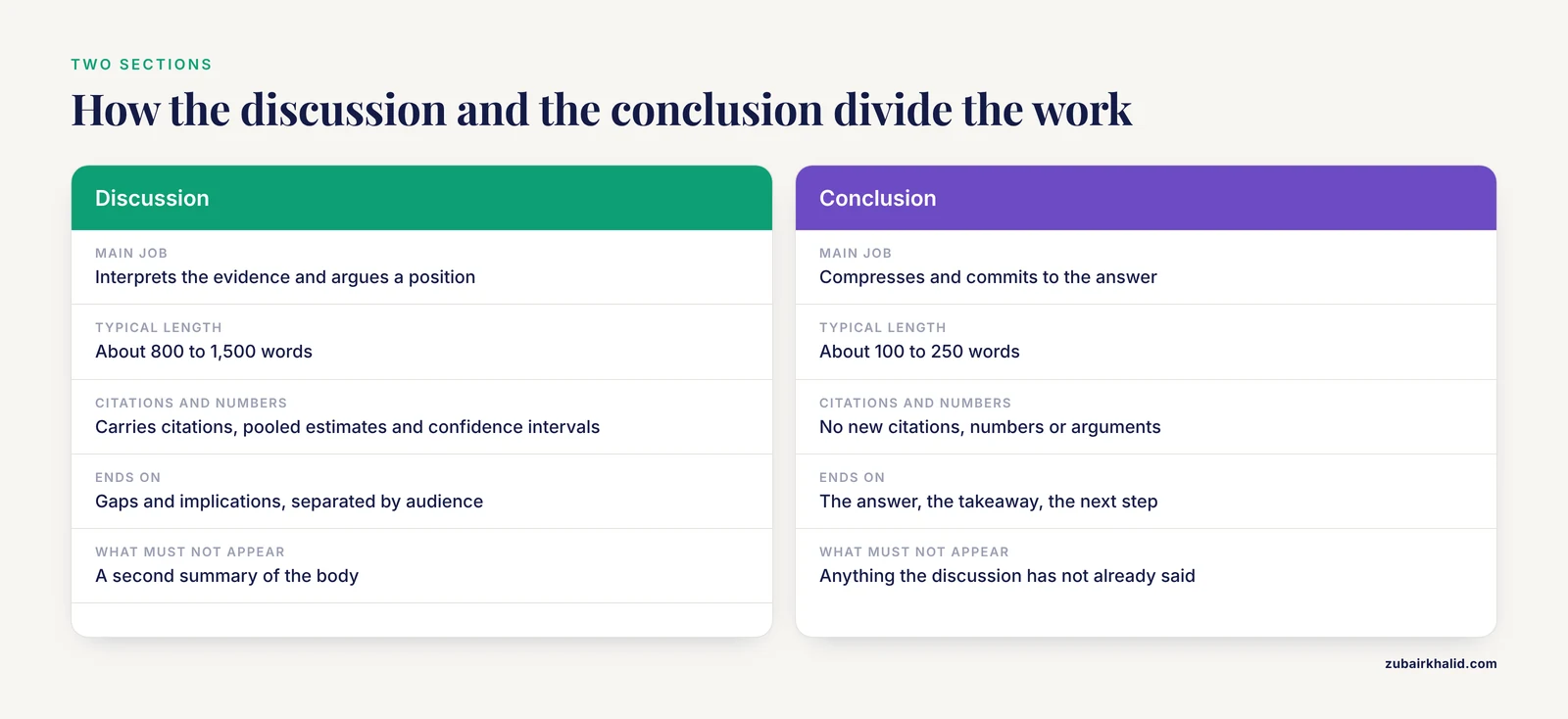
The conclusion is short, typically 100 to 250 words, and it contains nothing new. Its job is compression and commitment.
Structure it in three moves:
- The answer. One to two sentences restating the main answer to the review question, at the confidence level the evidence supports.
- The takeaway. One to three sentences on the most important implication for the field.
- The next step. One sentence naming the single most important gap or the first study someone should run.
Some reviews merge the conclusion into the final discussion paragraphs, which is acceptable when the journal allows it. When they are separate, the conclusion must not repeat the discussion's citations or numbers. Compare a published model: the review of silicone rubber direct ink writing closed on a synthesized organizing insight, that high-fidelity printing depends on coordinated control of material behavior and process parameters, rather than on restating technique-by-technique results [13]. That is what a conclusion sounds like when it compresses rather than repeats.
A common and effective variant in clinical reviews is the take-home framing used in how-to articles, where the authors end by telling readers exactly which standards to apply when they next encounter the material [14].
A Worked Example, From Extraction Row to Discussion Paragraph
Suppose your extraction table contains a row like this:
Study: Winter et al., 2026
Design: Systematic review and meta-analysis, 14 studies, n = 1,593
Finding: 5 of 14 studies showed significant empathy gains, 3 mixed,
         6 no change
Quality: Risk of bias rated with ROB-2 and ROBINS-I, evidence graded
         with GRADE
Run the paragraph blueprint from Step 2:
1. Claim:  Literary arts-based interventions show inconsistent but
           partly positive effects on empathy in healthcare populations.
2. Support: Of 14 studies with 1,593 participants, 5 reported
           statistically significant increases in self-reported
           empathy, 3 had mixed findings, and 6 reported no change [7].
3. Qualification: Only 6 of the 14 studies used a randomized design,
           and risk of bias was rated high in part of the evidence
           base [7].
4. Interpretation: The variability may reflect differences in
           intervention format, dose, and the sensitivity of the
           self-report instruments used.
5. Bridge: Whether the same inconsistency appears in other
           soft-skill outcomes is addressed next.
The paragraph that results reads as interpretation grounded in description, which is the register a discussion requires.
A Command You Can Run to Catch Repetition
The most common structural defect in draft discussions is recycling sentences from the body. You can detect this mechanically. Save the body text of your review in body.txt, the discussion in discussion.txt, one sentence per line, then run:
from difflib import SequenceMatcher

body = [s.strip() for s in open("body.txt").read().split(".") if s.strip()]
disc = [s.strip() for s in open("discussion.txt").read().split(".") if s.strip()]

for d in disc:
    for b in body:
        ratio = SequenceMatcher(None, d.lower(), b.lower()).ratio()
        if ratio > 0.80:
            print(f"REPEAT {ratio:.2f}")
            print("  discussion:", d[:70])
            print("  body      :", b[:70])
Expected output for a clean draft:
(no output, exit code 0)Expected output for a draft with a recycled sentence:
REPEAT 0.87
  discussion: exercise-based pulmonary rehabilitation at 12 weeks improved six-minute
  body      : pooled effects favored pulmonary rehabilitation at 3 months/12 weeks
Any pair above roughly 0.80 similarity should be rewritten in the discussion so that it interprets rather than reports.
Reference Table: Sentence Functions in a Discussion Paragraph
| Sentence slot | Function | Starter patterns | Trap to avoid |
|---|---|---|---|
| Claim | States what the synthesis shows | "The reviewed studies indicate that..." | Restating a single study as if it were the synthesis |
| Support | Cites the pattern across studies | "Across N studies, ... converged on..." | Listing citations without a pattern |
| Qualification | Names exceptions and limits | "This pattern was not uniform, however..." | Burying the exception that breaks the claim |
| Interpretation | Explains the pattern | "The most plausible explanation is..." | Speculating beyond what any cited study supports |
| Quality | Grades confidence | "Given the low to moderate quality of the evidence..." | Using "proves" with low-certainty evidence |
| Bridge | Moves to the next claim | "A second question concerns..." | Ending a paragraph on a new topic sentence |
Common Mistakes and Limitations
These are the errors that most often draw reviewer criticism, in rough order of frequency.
1. The discussion is a second summary. If a paragraph in your discussion could be moved into the body without changing a word, it does not belong there. Every discussion paragraph must contain at least one judgment sentence that only you, the synthesizer, could have written.
2. Conclusions outrun the evidence. Reviews built on low-quality or heterogeneous evidence frequently still conclude with confident recommendation language. The corrective is procedural, not stylistic. Grade or appraise first, then write conclusions at the appraised level, as the GRADE-based reviews cited above did [5] [6].
3. Unverifiable or fabricated references appear late in the draft. The discussion is where writers, under deadline pressure, sometimes cite papers from memory, and generative AI tools make this failure mode worse by producing plausible but false citations. Reference fabrication is now documented as a specific integrity risk of AI-assisted writing, and the recommended safeguards are verification of every reference and transparent disclosure of any AI assistance [15]. If you used AI at any drafting stage, check your target journal's policy. Published policy analyses show that disclosure of AI use and human verification attract broad consensus across publishers and journals, while permitted uses for tasks such as manuscript writing remain contested [1].
4. Heterogeneity is acknowledged but never interpreted. Naming a high I squared value and moving on is not a limitations section. Explain what drives the heterogeneity, using subgroup or sensitivity analyses where available, and state what the pooled estimate can and cannot mean as a result [8].
5. The methods and discussion do not match. If your methods promised a systematic search of named databases with defined eligibility criteria, the discussion cannot frame findings as an impressionistic survey. Narrative, scoping, systematic, and integrative reviews each support different kinds of claims, and published examples make the match visible, from PRISMA-ScR-guided scoping reviews [2] [9] to Whittemore and Knafl integrative reviews [10] [11] to interpretive narrative syntheses [3].
6. New studies appear in the discussion that the search never found. Introducing uncited-in-the-body studies in the discussion breaks the audit trail from your systematic literature search to your conclusions. If a key paper genuinely surfaced late, either rerun the inclusion process on it transparently or mention it in the limitations as evidence the field is moving.
7. The conclusion introduces new citations or numbers. A conclusion with citations is a discussion paragraph in the wrong place. Cut and merge.
8. Gaps are phrased as vague calls for more research. "Further studies are warranted" tells a reader nothing. State the unstudied population, the untested comparison, or the missing outcome measure, and name the design that would resolve it.
A note on scope. A discussion can only be as strong as the review behind it. The steps above assume a completed, documented search and an honest extraction table. If those are incomplete, fix them first, because no writing technique can rescue a synthesis with holes in it.
Frequently Asked Questions
How long should the discussion and conclusion of a literature review be?
For a typical journal review, the discussion runs about 800 to 1,500 words and the conclusion about 100 to 250 words. Scale with the size and complexity of your evidence base rather than with a fixed rule, and let each main finding get one full paragraph.
Can I cite studies in the discussion that were not part of my review?
No, not as support for your findings. The discussion interprets the studies your search actually included. If a newly found study changes your argument, add it through your inclusion process or flag it in the limitations.
What is the difference between the discussion and the conclusion?
The discussion interprets the evidence, weighs disagreements, grades confidence, states limitations, and identifies gaps. The conclusion compresses the discussion into the answer, the takeaway, and the next step, with no new citations, numbers, or arguments.
How do I handle studies that disagree with each other?
Diagnose the disagreement as a difference in population or context, in methods, in study quality, or as genuine residual uncertainty. Write one paragraph per major conflict and say plainly which explanation the evidence supports.
Does a systematic review or meta-analysis need a different kind of discussion?
Yes, in two ways. The findings sentences should carry pooled estimates with confidence intervals and heterogeneity statistics, and the confidence statements should follow your formal appraisal, such as GRADE certainty ratings and risk-of-bias assessments.
Can I use AI tools to draft the discussion and conclusion?
Policies vary and are still evolving. Broad consensus exists that AI use must be disclosed, that humans must verify all content, and that AI cannot be an author, while permitted uses for drafting and writing remain actively disputed, and reference fabrication is a documented risk. Check your target journal's policy and verify every citation against the source.
Do short literature reviews in case reports need the same structure?
The same functions, compressed. A case report with a literature review uses its discussion to place the case among published cases and its conclusion to state the clinical lesson, as published case reports with brief literature reviews routinely do, but on a scale of one to three paragraphs rather than eight steps.
How do I know my discussion is ready to submit?
Run a self-audit. The first paragraph answers the question, every paragraph advances one claim, each claim matches the appraised quality of evidence, limitations are specific, gaps name a design, the conclusion adds nothing new, and a repetition check against the body returns no high-similarity sentence pairs.
Sources
- Policy consensus, disagreements, and gaps regarding the use of artificial intelligence in authors, reviewers, publishers, editors, readers, and scholarship dissemination: a narrative review focus on medical scholarly publishing, analyzing attitudes of 6 institutions, 8 publishers, 139 journals and hundreds of articles.
- A scoping review of autoethnographic approaches in medical education research.
- Supervision as pedagogy in health sciences: a narrative review.
- Effects of different durations of exercise-based pulmonary rehabilitation intervention in patients with idiopathic pulmonary fibrosis: A systematic review and meta-analysis.
- [[Systematic review and meta-analysis of tonifying kidney prescriptions for the treatment of male infertility with sperm DNA fragmentation].](https://pubmed.ncbi.nlm.nih.gov/43012264/)
- Intrarenal Pressure Monitoring and Control Strategies Using Suction in Flexible Ureteroscopy: An EAU Endourology Systematic Review of Technologies and Clinical Outcomes.
- The improvement effect of androgen priming on fertility in patients with diminished ovarian reserve and its impact on in vitro fertilization outcomes: a systematic review and meta-analysis.
- Global prevalence of needlestick and sharps injuries among dental health care workers: A systematic review and meta-analysis.
- Psychedelic assisted psychotherapy (2020-2025): a scoping review of clinical evidence, mechanisms, safety, and ethics.
- Person-centered, trauma-informed care and support for resilience after intimate partner violence: an integrative review through a neurobiological lens.
- From Academic Integrity to Professional Formation in Generative AI-Supported Nursing Education: Integrative Review.
- A scoping review of the application of intelligent technology in medication adherence among older adults with chronic diseases.
- Advances in direct ink writing of silicone rubbers: toward high-fidelity architectures and multifunctional integration.
- How I Do It: Writing, Reviewing, and Reading Standard and Pragmatic Clinical Trial Protocol Papers.
- Scientific Writing, Peer Review, and Artificial Intelligence: Navigating a New Era.