How to Write a Research Question for Your Lab Report
By Dr. Zubair Khalid, DVM, MS, PhD ·

By the end of this guide you will be able to turn a broad lab topic into one narrow, testable research question, screen that question against established feasibility criteria, connect it to a hypothesis and an analysis plan, and place it correctly in your lab report format. You will need your lab manual or grading rubric, your notebook or class dataset, and about an hour of focused work. No special software is required, although one worked example below uses R to show how a good question points directly at a statistical test.
A research question is the load-bearing beam of a lab report. The introduction builds toward it, the methods answer it, and the results present the evidence for it clearly enough that a reader could follow the case even before any interpretation begins [1]. When the question is vague, every section downstream wobbles. When the question is sharp, writing the report becomes mostly a matter of filling in evidence.
What a Research Question Actually Is
A research question is a single, specific, answerable question that your experiment or observation is designed to resolve. It is not a topic (enzymes), not a title (Temperature and Catalase), and not a hunch (catalase probably works better when warm). Those three items are raw material. The question converts them into something data can settle.
A hypothesis is the predicted answer to the question, stated before you look at the results. In planning frameworks used across research fields, defining the issue and developing the research questions and hypotheses comes before selecting methods and outcomes, because everything else in the study inherits its shape from that step [2]. If you write your question after collecting data to fit whatever happened, you are no longer answering a question, you are narrating an accident.
Two terms you will meet in this guide:
- Operationalize means defining an abstract concept in terms of something you can actually measure. "Enzyme activity" is abstract. "Rate of oxygen foam production in milliliters per minute in a 3% hydrogen peroxide solution" is operational.
- Variable means any quantity that can take different values in your experiment. The variable you deliberately change is the independent variable. The variable you measure in response is the dependent variable. Everything else you hold constant is a controlled variable.
Where the Question Fits in the Lab Report Format
Most biology and chemistry courses use the same standard lab report format: title, abstract, introduction, methods and materials, results, discussion, and references, sometimes with appendices for raw data or calculations. The research question appears in the introduction, usually in the final paragraph, right before or together with the hypothesis.
Each section has a defined job relative to the question:
- Introduction moves from broad context to the gap your experiment fills, and states the question and hypothesis.
- Methods and materials describes exactly what you did, in enough detail that another student could repeat the experiment and answer the same question. This is a learnable skill, and structured practice measurably improves it.
- Results reports the findings objectively, with tables, figures, and statistics, and no interpretation. Well-organized reporting here constructs the case for the research question even without interpretive commentary [1].
- Discussion returns to the question, states whether the data support the hypothesis, explains mechanisms, acknowledges error sources, and proposes next steps.
If your instructor supplies a rubric, read it before drafting the question. Rubrics in project-oriented science courses commonly grade how well the report's purpose, methods, findings, and conclusions align, and misalignment usually traces back to a question that was never properly formed in the first place [4].
How to Write a Research Question for a Lab Report, Step by Step
The walkthrough below uses a running example from a classic introductory biology lab: measuring catalase activity in yeast. Catalase is an enzyme that breaks hydrogen peroxide into water and oxygen, and the oxygen produces visible foam whose height or volume can be measured with ordinary lab equipment. Substitute your own topic as you go.
Step 1: Start with a topic and narrow it in three passes
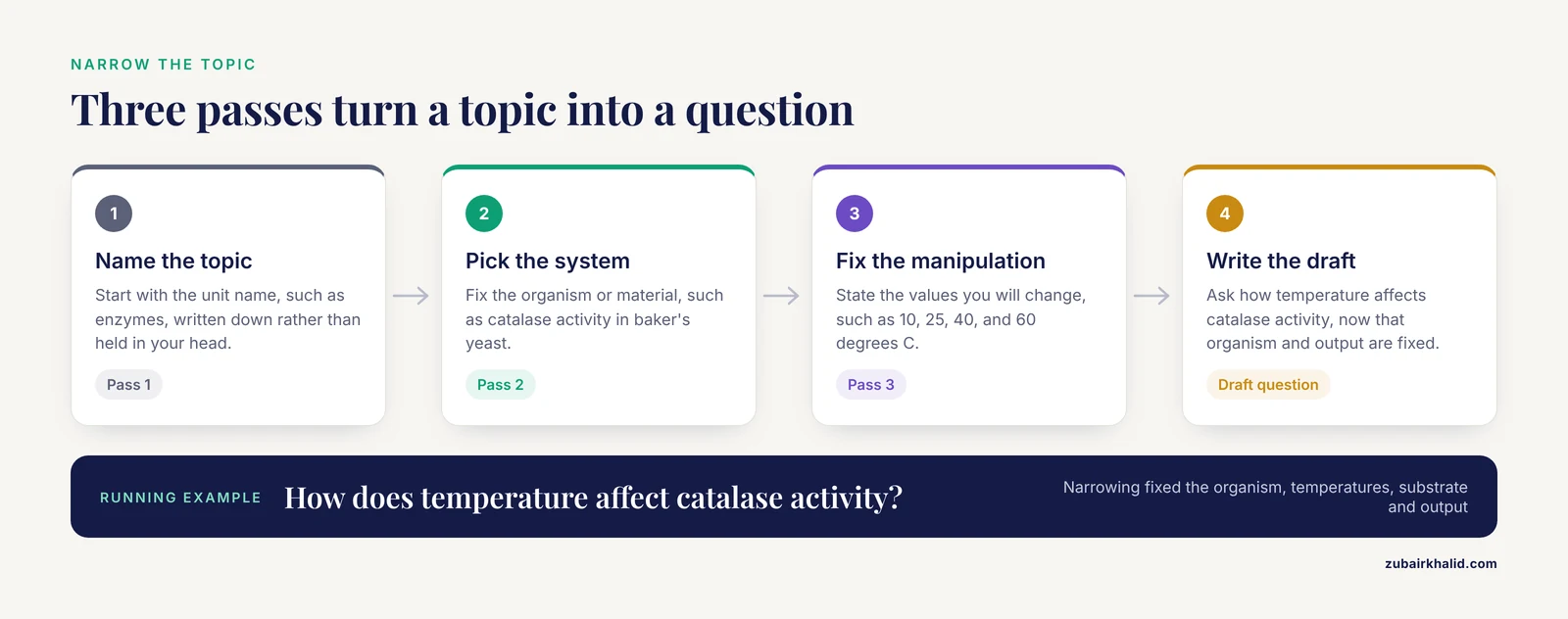
Move from the unit name, to a specific system, to a specific manipulation you can perform. Write each pass down rather than holding it in your head.
Pass 1 (topic):      enzymes
Pass 2 (system):     catalase activity in baker's yeast (Saccharomyces cerevisiae)
Pass 3 (manipulation): yeast suspensions incubated at 10, 25, 40, and 60 degrees C
                     before measuring oxygen production in 3% hydrogen peroxide

Draft question:      How does temperature affect catalase activity?
The draft question is already usable, but notice what the narrowing did. It fixed the organism, the temperature values, the substrate concentration, and the measured output. Those specifics are what separate a question from a topic.
Step 2: Decide what kind of question you are asking
Different question types demand different designs and different statistical tools. Choosing the type first saves you from writing a question your data cannot answer.
| Question type | Signal words | Typical design | Common analysis |
|---|---|---|---|
| Descriptive | what, how much, how many | Single condition, repeated measurement | Mean, standard deviation, confidence interval |
| Comparative (difference) | does X differ between groups | Two or more treatment groups | t-test or ANOVA |
| Correlational (association) | is X related to Y | Measure both variables, no manipulation | Correlation coefficient, regression |
| Causal (effect) | does X cause a change in Y | Manipulate X, control everything else, randomize | Inferential test on group means |
The catalase example is a comparative question across four temperature groups. If you also recorded temperature continuously and let it vary naturally, it would be a correlational question instead, and that difference changes your entire analysis.
Step 3: Screen the question with the FINER test
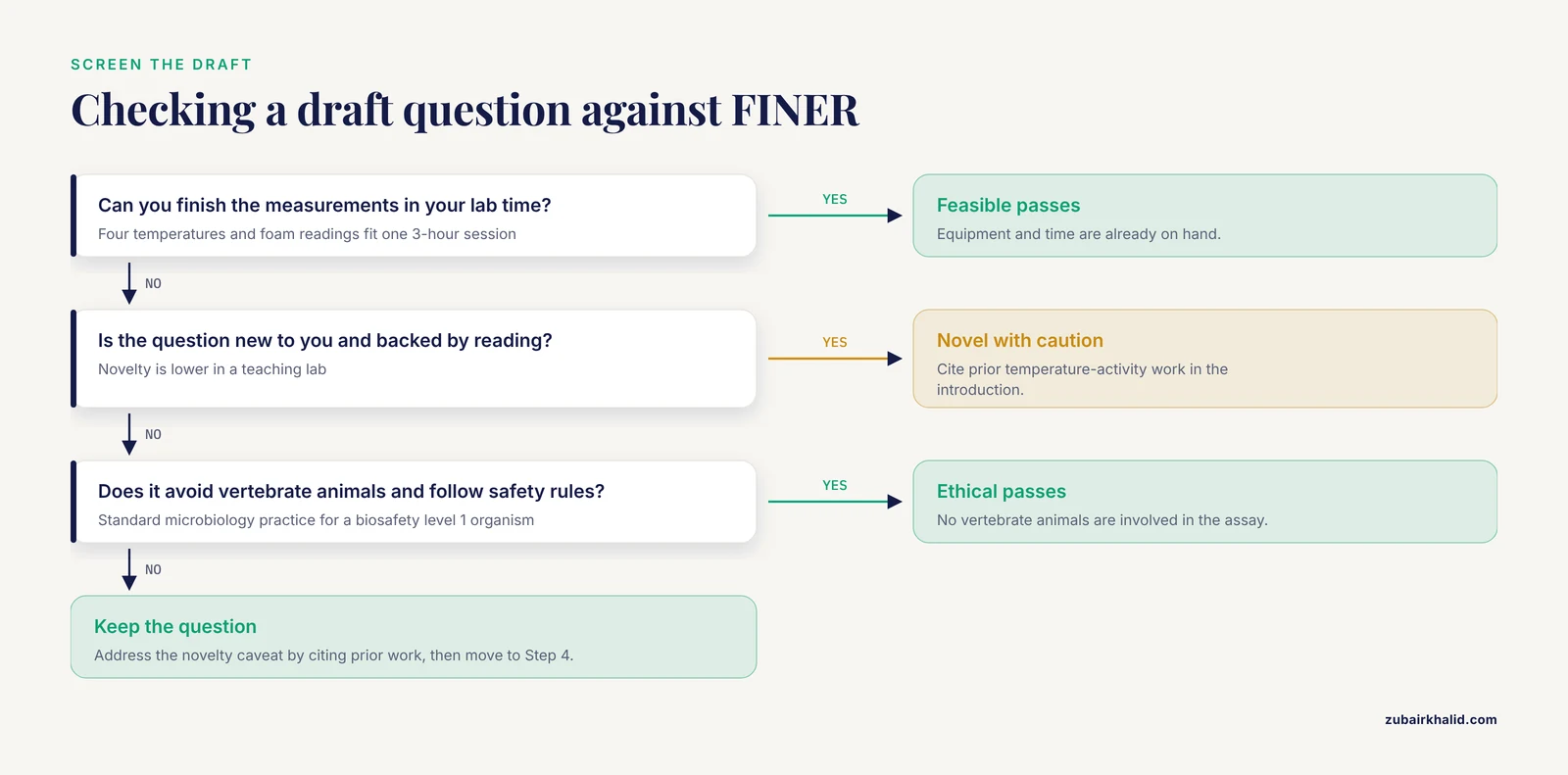
FINER is a widely used screening checklist from research methodology. A question should be Feasible, Interesting, Novel, Ethical, and Relevant. Run your draft through it explicitly. Here is what that looks like as a written record in your notebook, with the verdict for the catalase question:
$ finer_check "Does incubation temperature change the rate of oxygen
               production by catalase in yeast?"

Feasible      PASS     four incubation temperatures and foam measurements fit
                       inside one 3-hour lab session with existing equipment
Interesting   PASS     connects enzyme kinetics to food storage and cooking
Novel         CAUTION  new to me, checked against the assigned background
                       reading on enzyme denaturation
Ethical       PASS     no vertebrate animals, standard microbiology safety
                       practices for a [biosafety level](/knowledge/diagnostics/emerging-tech/biosafety-levels-1-4-a-comparative-framework-for-diagnostic-laboratory-design) 1 organism
Relevant      PASS     supports the current course unit on [protein function](/blog/guides/protein-function)

Verdict: keep the question, and address the novelty caveat by citing
prior temperature-activity work in the introduction
The novelty bar is lower in a teaching lab than in a research program, and it is acceptable for your question to be novel mainly to you. In large research-consensus exercises, submitted questions are deliberately distilled and reworked before the final set is adopted, which is a useful reminder that first drafts of questions are meant to be improved, not defended [5].
Step 4: Operationalize every variable in the question
Take each noun in your question and define how it gets measured. Breaking a broad concept into concrete, measurable domains is exactly how measurement instruments get built, and a validated questionnaire project may define several domains and iterate on wording until each item measures what it claims to measure [6].
For the catalase example:
Independent variable: incubation temperature (10, 25, 40, 60 degrees C),
                      held for 10 minutes before assay
Dependent variable:   oxygen production rate, measured as foam height in
                      millimeters at 60 seconds, averaged over 3 trials
Controlled variables: yeast concentration (10% w/v suspension, 5 mL),
                      hydrogen peroxide concentration (3%, 10 mL),
                      reaction vessel size (50 mL beaker),
                      time from peroxide addition to reading (60 s)
If you cannot fill in a row of that table, your question is not yet answerable, and the gap tells you exactly what to decide next.
Step 5: Pair the question with a hypothesis and an analysis plan
State a null hypothesis (no effect) and an alternative hypothesis (the effect you predict). For the catalase example:
H0 (null):        incubation temperature has no effect on the mean oxygen
                  production rate of catalase in yeast
H1 (alternative): at least one incubation temperature yields a different
                  mean oxygen production rate than the others
Because the question compares four groups, the natural first analysis is a one-way ANOVA, possibly followed by pairwise comparisons. Here is how the question translates directly into code in R, with illustrative output showing the shape of the result:
# Question implies: do mean oxygen production rates differ across temperatures?
temp <- factor(c(rep("10C",5), rep("25C",5), rep("40C",5), rep("60C",5)))
rate <- c(4.1, 3.8, 4.4, 4.0, 3.9,    # mm foam at 60 s, 10 degrees C
          9.2, 8.8, 9.6, 9.0, 9.4,    # 25 degrees C
         12.1,11.6,12.8,11.9,12.3,    # 40 degrees C
          1.2, 0.9, 1.4, 1.1, 1.0)    # 60 degrees C

fit <- aov(rate ~ temp)
summary(fit)
Illustrative output:
            Df Sum Sq Mean Sq F value   Pr(>F)
temp         3  517.3   172.4   412.6  2.4e-14 ***
Residuals   16    6.7     0.4
The point of this exercise is diagnostic, not statistical. If you cannot write the test that would answer your question, the question is not yet specific enough. When you do the real analysis, keep your code and data organized, because archived, readable analysis code improves reproducibility, reduces error, and documents exactly how your results were produced.
Step 6: Stress-test the wording
Small wording choices change what a question measures. In survey methodology, two differently worded measures of the same concept can show very high agreement overall, with a weighted kappa of 0.9081 for gender identity items, and cognitive interviews can still uncover problems with how participants understand each item [7]. The lesson for lab reports is that a question can look fine and still be read three ways. Apply these tests:
- Read the question aloud to a classmate and ask them to state the hypothesis it implies. If they produce a different hypothesis than you intended, reword.
- Replace every vague noun (activity, health, growth, quality) with its operational definition from Step 4.
- Split any question containing "and" or "or" into separate questions. "How does temperature and pH affect catalase activity?" is two experiments pretending to be one.
- Delete hedged phrasing. "Does temperature possibly seem to affect..." is not a question, it is a disclaimer.
Step 7: Treat the question as a draft that can legitimately change
Researchers revise questions in response to data and practical constraints all the time, and doing so openly is normal science. At an interdisciplinary datathon, teams discussed potential questions and then reformulated their queries in real time as they explored the data [8]. In a long-running field study of seabirds at an artificial colony, the researchers revisited their original questions a decade in and found that several major insights had arrived as surprises, driven by new measurement technology, and that entirely new questions had emerged from the work [9].
For a lab report, the honest version of this is simple: if your question shifted between your proposal and your final data, say so in the discussion and explain why. Hiding the change is the only unacceptable option.
Tips for Writing a Strong Research Question
Pick a question you will still care about in week six. In a survey of 768 life sciences undergraduates in research experiences, half of the respondents had considered leaving their research experience, and students who reported enjoying their everyday research tasks were more likely to stay [10]. In a course context, genuine curiosity about your own question shows up as a better written introduction and a more careful discussion.
Choose the subject when you are allowed to. Project-oriented labs that let students pick their own proteins, organisms, or datasets report higher engagement, partly because the student owns the question from the start [4]. If your instructor offers a menu of options, pick the one you can explain to a friend at dinner.
Anchor the question in a real gap. Large collaborative projects show the value of framing questions around genuine needs. In one environmental horizon-scanning exercise, scientists submitted 100 candidate questions for Latin America, then worked through a structured workshop to identify 20 priority research questions on contaminant identification, lab-to-field extrapolation, and risk prediction [5]. Your version of the workshop is rereading the assigned background literature and asking what the class discussion left unanswered.
Write the methods section early. Because the methods exist to answer the question, drafting them before the experiment ends exposes holes in the question while you can still fix them. Structured, linked writing assignments focused on methods have been shown to improve student methods writing across a semester [3].
Get outside your own head. Research internships that embed students in real, practice-based projects develop academic and professional skills precisely because students must communicate their work to people outside the assignment context [11]. Your cheapest version of this is a five-minute question interview with your lab partner.
Be transparent about any AI assistance. If you use generative AI while drafting, follow your course policy and disclose it. In meta-research on systematic reviews with explicit AI disclosure statements, 75% of those reviews reported using large language models, and only 42% referenced a pre-registered protocol, which illustrates how disclosure practices vary and why your instructor wants the question to be yours [12]. The same principle applies to data images and citations, where responsible-conduct training emphasizes accurate treatment of images and proper attribution [13].
Aim your question at something someone needs to know. Even in a teaching lab, connecting the question to a stated need (a course concept, a campus problem, a published controversy) gives your discussion section somewhere to go.
Common Mistakes and Limitations
These are the errors instructors flag most often, with the fix for each.
The topic disguise. "Enzymes and temperature" is a topic, not a question. If your draft has no question mark and no verb, restart at Step 1.
The double question. Two questions in one sentence means two experiments, and your word count cannot support both. Split them and pick the one your data actually address.
The unmeasurable abstraction. "How does temperature affect enzyme health?" cannot be answered because "health" has no operational definition in this context. Every failed measurement search points back to a word that needs defining.
The design mismatch. Asking a causal question ("does temperature cause denaturation") with a correlational design (temperatures that varied on their own) overclaims. Match the question type to what you actually manipulated, using the table above.
The impossible timeline. A question is not feasible if the measurements need equipment, time, or sample sizes you do not have. Feasibility is a feature of good questions, not a compromise. In implementation-research methodology, defining the questions comes before selecting methods precisely so that feasibility problems surface early [2].
The silent pivot. Changing the question after seeing the results, without disclosure, misrepresents the work. State the original question in your introduction, and if it evolved, explain the evolution in your discussion.
The rubric override. Your instructor's rubric outranks any generic advice, including this article. Course rubrics differ in whether they want the question stated as a question, as a hypothesis, or both, and in where each must appear.
One honest limitation. A lab report question is scoped to your conditions, your organism or system, and your sample. Confidence in your conclusion is limited to that scope, and overgeneralizing beyond it is the most common criticism in discussion sections.
Checking Your Question Before You Write the Report
Run this five-item check on your final question. Every "no" is a revision you will be glad you made now rather than during grading.
- Can the question be answered completely with the data you will collect in the time you have?
- Does every noun in the question have an operational definition written down?
- Does exactly one question remain after you split any compound phrasing?
- Does your planned analysis (t-test, ANOVA, regression, or descriptive statistics) actually answer the stated question type?
- Does the question appear in your introduction, worded the same way you will echo it in your discussion?
A question that passes all five is ready. The next concrete step is to draft your methods section around it, because writing the methods is where most remaining ambiguities in the question surface and get fixed [3].
Frequently Asked Questions
How long should a research question be in a lab report?
One sentence, typically 15 to 30 words. If it needs two sentences, you probably have two questions, and you should split them.
Can a research question be a yes/no question?
Yes, grammatically, but a bare yes or no is usually a thin answer. Prefer questions phrased as "how," "to what extent," or "does X change Y," because these force you to report magnitude and direction rather than a single word.
What is the difference between a research question and a hypothesis?
The question asks, and the hypothesis answers in advance as a testable prediction. You state both in the introduction, the question first, and the data then decide whether the hypothesis survives.
Where does the research question go in a lab report?
At the end of the introduction, usually the last paragraph, immediately before or alongside the hypothesis. The discussion then returns to the same wording when you interpret your results.
How many research questions should a lab report have?
One for a standard course lab report. Two is the practical maximum, and only if your design and word count genuinely support both. Professional studies sometimes list several, but each one still maps to its own analysis.
Can I change my research question after collecting data?
Yes, if you disclose the change. Explain in your discussion what prompted the revision, such as a measurement problem or an unexpected preliminary result. Rewriting the question silently to match your results is the version to avoid.
How do I write a research question if my results came out negative?
Frame the question around what you actually compared, and report the comparison honestly. A clear question with a null result is a successful report, and your discussion can propose what a better-powered or differently designed follow-up would test.
Can I use generative AI to help write my research question?
Follow your course policy, and treat AI output as a brainstorming draft at most. The question must reflect a gap you understand and a design you can execute, and any permitted AI assistance should be disclosed per your instructor's rules.
Sources
- How to Write an Effective Results Section.
- Ten recommendations for using implementation frameworks in research and practice
- Linked assignments to teach the writing of scientific methods while exploring the limits and benefits of generative AI
- Design of a TSR-based project learning strategy for biochemistry undergraduate teaching and research labs: a case study
- Toward sustainable environmental quality: Identifying priority research questions for Latin America
- Development of a Self-Report Measure of Prediction in Daily Life: The Prediction-Related Experiences Questionnaire
- Transgender-inclusive measures of sex/gender for population surveys: Mixed-methods evaluation and recommendations
- Datathons and Software to Promote Reproducible Research
- Technological Evolution Generates New Answers and New Ways Forward: A Progress Report from the First Decade at the Karlsö Auk Lab
- Factors that predict life sciences student persistence in undergraduate research experiences
- Student perceptions of Living Lab research internships in the COVID-19 pandemic - a Dutch case study
- Bibliometric, methodological and reporting characteristics of systematic reviews with explicit AI disclosure statements: an exploratory meta-research study.
- A dramatized method for teaching undergraduate students responsible research conduct.