How to Write a Research Project Plan: A Step-by-Step Guide
By Dr. Zubair Khalid, DVM, MS, PhD ·

A research project plan is a written blueprint that states what your study will do, how it will do it, who will do the work, when each stage happens, and what resources and safeguards are needed. You write one by working through a fixed sequence, define the question, justify it with literature, specify the methods, break the work into scheduled tasks, assign resources and risks, and add the ethics, data, and dissemination sections that funders and ethics committees require.
This guide walks through that sequence in order. It explains what a research project plan is, how a plan differs from a proposal, what belongs in each section, and how modern research project management tools, including artificial intelligence and agile methods, change the way plans are written and executed.
What Is a Research Project Plan?
A research project plan, sometimes called a research protocol or research proposal depending on the context, is the detailed plan or blueprint for an intended study. When the plan is complete, the research itself should flow smoothly, because every major decision has already been made on paper before data collection begins [1].
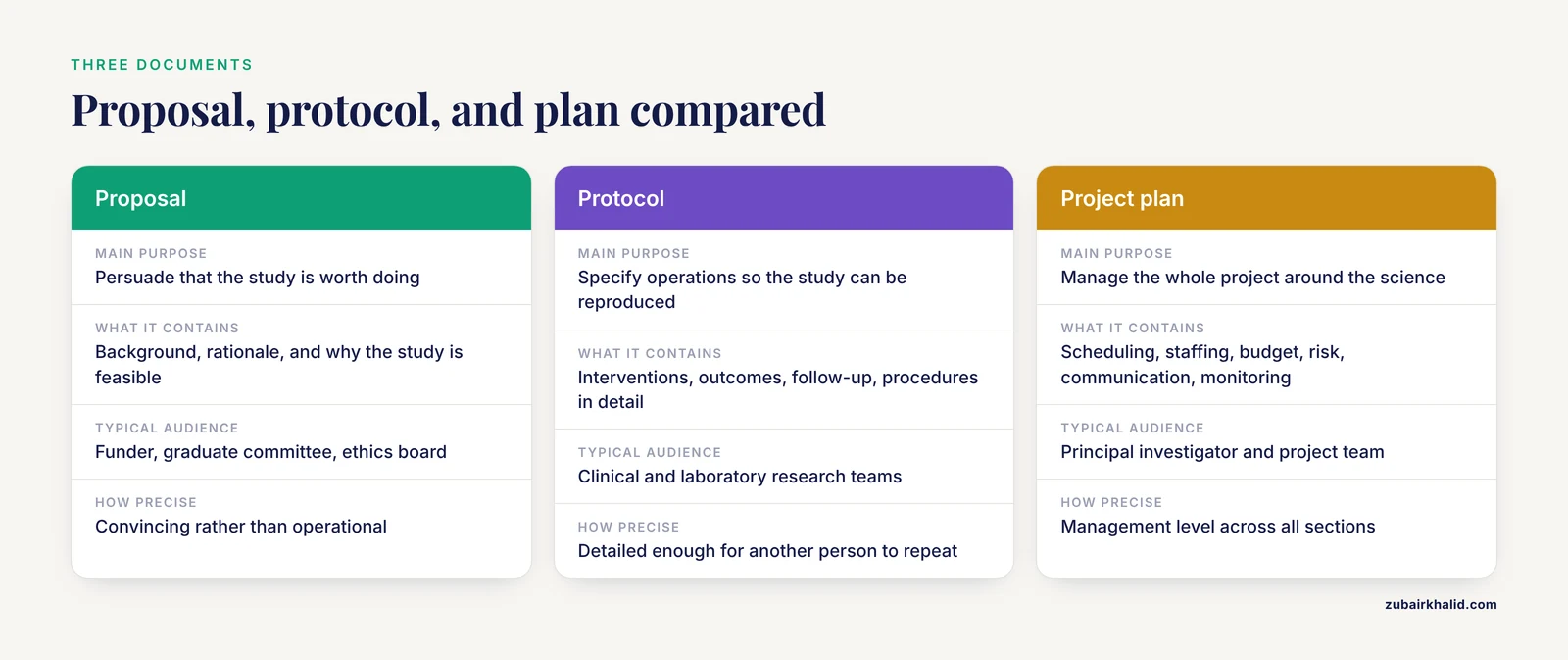
Three related documents cause confusion, so here is how they differ:
- Research proposal. A persuasive document written to win approval, either from a funding body, a graduate committee, or an ethics board. It argues that the study is worth doing and feasible.
- Research protocol. A precise operational document, common in clinical and laboratory science, that specifies procedures in enough detail that another person could reproduce the study. Surgical clinical research, for example, relies on protocol documents that standardize interventions, outcomes, and follow-up across sites [2].
- Research project plan. The broader management document that wraps around either of the above. It covers scheduling, staffing, budgeting, risk, communication, and monitoring, not just the science.
In practice, one document often serves all three roles, especially for a student thesis or a small grant. The sections below build a plan that can be adapted to any of these audiences.
A plan also differs from a protocol for a specific study type. A systematic review or meta-analysis protocol, for instance, is a narrow document that specifies the search strategy, inclusion criteria, and extraction plan for synthesizing published evidence, and there are dedicated guides for writing one [3]. The same planning logic applies, but the content shifts from experiments to literature searching.
Why a Written Plan Matters
Several bodies of evidence point to the same conclusion. Studies of researchers learning to plan projects show that structured training changes outcomes. In one action research study, seven science teachers pursuing postgraduate degrees had insufficient knowledge about preparing a research project before a 14-week training program. By the end, they reported competency in the stages of a project, what originality means, and the criteria of a good project, and they identified planning as one of the most important elements [4].
Planning also matters at the level of whole research programs. A five-year federal autism services research program used scoping review methods to map the 31 published studies it had funded, which allowed the program to identify evidence gaps and set priorities for future work. That kind of program-level accounting is only possible when individual projects were planned and documented consistently from the start.
Finally, the field of project planning and control itself has a large research literature. A review of methods and techniques for project planning and control found increasing attention to the uncertain, stochastic nature of projects, plus a shift from long-term scheduling toward short-term, reactive decision-making as data collection becomes automated [5]. A good plan anticipates that reality by building in checkpoints rather than assuming the original schedule will hold.
How to Write a Research Project Plan, Step by Step
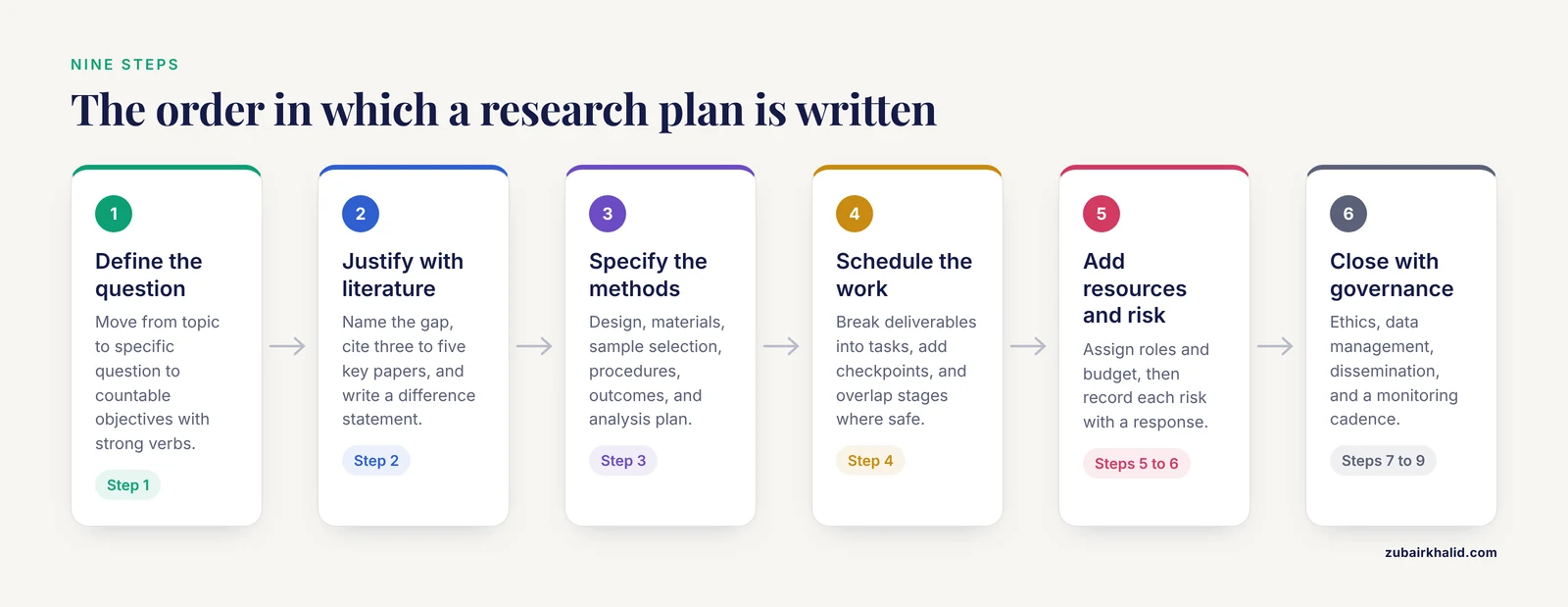
Step 1: Define the Research Question and Objectives
Start with a question that is specific, answerable, and worth answering. A useful habit is to distinguish three levels:
- Topic. The general area, for example antibiotic resistance in hospital wastewater.
- Research question. The specific uncertainty, for example whether a defined treatment process reduces concentrations of a defined resistance gene class.
- Objectives. The concrete, countable things you will deliver, for example sampling four treatment stages monthly for twelve months and quantifying gene copies per liter with a stated assay.
Experienced research methodologists emphasize moving from an interesting topic to a workable question as the single most consequential early decision, because every later section of the plan inherits its scope. If the question is vague, the methods section cannot be precise, and the timeline cannot be realistic.
Write objectives so that completion is verifiable. "Explore" and "investigate" are weak verbs. "Measure," "compare," "validate," and "characterize" are strong ones, because each implies a defined output.
Step 2: Justify the Study With a Literature Review
The background section has two jobs. It shows the gap your study fills, and it demonstrates that you know the methods already in use. Systematic, well-structured reviews carry the most weight. An analysis of 40 literature review articles published in Project Management Journal between 2008 and 2024 found that systematic reviews were the most cited and methodologically rigorous review type, while integrative and narrative reviews offered flexibility for complex or fragmented topics.
For your plan, you do not need to write the full review, but you should:
- Identify the three to five key papers that define the current state of the question.
- State explicitly what remains unknown or contested.
- Name the methodological approach you will follow and cite one precedent.
- If your review strategy matters to the study, specify your search plan the way a systematic review protocol would, including databases, search strings, and inclusion criteria [3].
Originality is a frequent stumbling block. The science teachers in the training study mentioned above reported that determining the originality of their project was the single most difficult step [4]. A practical fix is to write a one-sentence "difference statement": no prior study has done X in Y population with Z method. If you cannot write that sentence, either the literature search is incomplete or the question needs narrowing.
Step 3: Specify the Methods
This is the technical core of the plan. Reviewers read it looking for one thing, whether the design can actually answer the question. Guidance on writing surgical clinical research protocols stresses that methods must be specified in operational detail, covering interventions, outcomes, and follow-up, so that the study can be executed and reproduced exactly as planned [2].
For a life science project, cover the following:
- Design. Experimental, observational, computational, or synthesis-based, with the rationale for that choice.
- Materials and reagents. Organisms, cell lines, antibodies, kits, and instruments, identified precisely enough for reproduction.
- Sample selection. Inclusion and exclusion criteria, sample sizes, and how you will handle attrition or contamination.
- Procedures. The protocol in chronological order, including controls and replicates.
- Outcomes and measurements. Primary and secondary endpoints, assay types, and acceptance criteria.
- Analysis plan. Statistical tests, software, and how missing data will be treated.
For qualitative or mixed-methods work, state the analysis approach with the same precision. A review of project-based learning research between 2016 and 2023 shows the spread of designs used in that literature, with quantitative work at 35.29 percent of 34 Scopus-indexed studies, qualitative work at 26.47 percent, descriptive work at 17.65 percent, mixed methods at 8.82 percent, action research at 5.88 percent, and development research at 5.88 percent [7]. Whatever design you choose, name it and justify it rather than leaving the reader to infer it.
Step 4: Build the Timeline With a Work Breakdown Structure
A work breakdown structure (WBS) divides the project into deliverables, then into tasks, then into subtasks small enough to estimate and assign. From the WBS you derive the schedule. Standard project planning practice covers project representation, scheduling, resource allocation, risk analysis, and time and cost performance evaluation as the core decision problems, and modern approaches increasingly treat schedules as probabilistic rather than fixed [5].
A simple timeline for a twelve-month master's project might look like this:
| Months | Stage | Key deliverable |
|---|---|---|
| 1 to 2 | Literature review and protocol finalization | Approved protocol, ethics submission |
| 2 to 3 | Method setup and validation | Validated assay or instrument workflow |
| 4 to 9 | Data collection | Completed sample set per the plan |
| 8 to 10 | Analysis | Analysis outputs and draft figures |
| 10 to 12 | Writing and dissemination | Submitted thesis or manuscript |
Notice that analysis begins before collection ends. Overlapping stages, called fast-tracking in project management, protects the end date when early stages run long. Build explicit checkpoints, monthly at minimum, where you compare actual progress against the plan and adjust.
Step 5: Assign Resources, Roles, and Budget
List every resource the plan assumes, then verify each one exists. The list typically includes:
- Personnel. Principal investigator, co-investigators, students, technicians, and external collaborators, each with named responsibilities.
- Equipment and facilities. Instrument access, animal facilities, field sites, computing, and storage.
- Consumables and services. Reagents, sequencing costs, fees.
- Budget. Line items matching the resource list, with any funder-specific categories.
Scale deserves explicit attention here. A synthesis of 172 project management papers found that the literature overwhelmingly addresses large-scale projects and megaprojects while giving little guidance for small- to medium-scale projects, and that scale categories carry real managerial implications [8]. The practical takeaway for an early-career researcher is to plan deliberately for your own scale. A two-person, twelve-month project does not need megaproject governance, but it does need a clear decision rule for who decides what when the plan meets reality.
Step 6: Plan for Risk
For each major assumption in the plan, ask what happens if it fails. Common life science risks include reagent lots that fail validation, animal or patient recruitment falling short, instrument downtime, key personnel leaving, and data loss. For each risk, record the likelihood, the impact, and a specific response, such as a backup supplier, a recruitment contingency, or a data backup schedule.
The project planning literature treats risk analysis as one of the core recurring decision problems in planning and control, alongside scheduling and resource allocation [5]. Writing risks down in the plan converts them from surprises into managed events.
Step 7: Address Ethics, Data Management, and Governance
Ethics review is a gate, not a formality. State how participants, animals, or sensitive data will be protected, name the committee that will review the work, and build the review timeline into the schedule. Because approval cycles can take weeks to months, ethics milestones belong on the Gantt chart from Step 4, not in a separate parallel universe.
Data management is the second gate. Specify where raw data will live, how it will be backed up, how it will be documented so others can interpret it, and when and how it will be shared. If your funder or institution requires a data management plan, cross-reference it from the main document.
Increasingly, funders also require a lay summary, a plain-language description of the project for non-specialist readers. Many researchers find these difficult because they are trained to write for specialists. A structured response is to co-create the lay summary with stakeholders rather than drafting it alone. A protocol developed for Canada's AGE-WELL research network lays out six steps for this process and enrolls 24 funded researchers to apply it, reflecting a wider trend of funding bodies requiring accessible project summaries [9].
Step 8: Plan Dissemination From the Start
Name the target outputs, journal articles, conference presentations, datasets, theses, and the realistic timeline for each. Early-career researchers benefit from making these targets explicit and mutual. In one medical elective, a student and supervisor set defined objectives at the outset, one first-author publication and one co-authored output, then worked through them by writing a poster abstract, co-writing a research protocol, finalizing a manuscript, and completing two peer reviews and two critical appraisals during a four-week placement [10]. The lesson generalizes: named deliverables with deadlines produce more than open-ended intentions.
Step 9: Choose a Management Approach and Monitoring System
Decide how the plan will be run. The traditional approach, sometimes called waterfall, fixes scope up front and manages change formally. Agile approaches, rooted in software development, use short iterative cycles and continuous stakeholder feedback. A comprehensive review of agile methodologies in project management found that agile methods significantly enhance project performance, particularly in dynamic and uncertain environments, fostering collaboration and continuous improvement, while also noting persistent challenges such as resistance to change, lack of skilled personnel, and difficulty scaling the practices [11].
For research projects, a hybrid is often realistic. Use a fixed protocol and ethics approval as the backbone, but manage laboratory execution, analysis, and writing in short cycles with regular check-ins. Whatever you choose, define the monitoring cadence from Step 4, the metrics you will track, and who reviews them.
A Reusable Research Project Plan Template
The following research project plan template collects the sections above into a single outline you can copy and adapt. Sections can be expanded or collapsed depending on the audience.
| Section | What it contains | Common pitfall |
|---|---|---|
| Title and lay summary | Plain-language description of the project [9] | Jargon-heavy summary a non-specialist cannot follow |
| Background and rationale | Gap statement supported by literature | Describing a field instead of naming the gap |
| Research question and objectives | Specific, verifiable objectives [6] | Objectives that cannot be marked complete |
| Methods | Design, materials, procedures, analysis plan [2] | Missing controls or undefined outcomes |
| Work breakdown and timeline | Tasks, milestones, dependencies, checkpoints [5] | No slack time and no review points |
| Resources and budget | Personnel, equipment, consumables, costs [8] | Unverified equipment access |
| Risk register | Likelihood, impact, and response per risk [5] | Listing risks without responses |
| Ethics and governance | Committee, approvals, participant protections [1] | Ethics treated as an afterthought |
| Data management | Storage, backup, documentation, sharing | No named data steward |
| Dissemination | Named outputs with target venues and dates | No writing time in the schedule |
| Monitoring and communication | Meeting cadence, metrics, decision rules | Plan filed away after approval |
Two structural notes on using any template. First, order matters less than completeness, some funders mandate their own section order. Second, keep the operational protocol separate from the management plan when the study is complex, since clinical research conventionally maintains a detailed standalone protocol alongside the administrative documents [2].
How to Write a Research Project Plan, Explained Through a Worked Example
To make the abstract steps concrete, here is a compressed example plan for a hypothetical master's project.
Title. Characterizing bacterial contamination in a university teaching laboratory before and after a revised cleaning protocol.
Question and objectives. Does the revised protocol reduce surface bacterial counts? Objectives: sample ten defined bench sites before and after the change, quantify colony-forming units with a standard plating method, and compare paired counts.
Background. Cite the standard disinfection literature, state that local baseline data do not exist, and specify the counting method with one methodological precedent.
Methods. Paired pre-post sampling design, ten fixed sites, sampling with sterile swabs onto defined agar, incubation under stated conditions, enumeration, and a paired statistical comparison with a defined significance threshold chosen before data collection.
Timeline. Month 1, protocol and ethics. Month 2, baseline sampling. Month 3, protocol change implemented. Month 4, post-change sampling. Months 5 to 6, analysis and write-up.
Resources. Access to the teaching laboratory on agreed dates, one supervisor, agar plates and swabs within the departmental consumables budget, and access to an incubator.
Risks. Schedule conflicts with teaching use, addressed by pre-booked access windows. Low counts preventing detection, addressed by including a positive-control surface.
Ethics and data. Environmental sampling with no human participants, institutional risk assessment filed, and results stored in the department's shared drive with a dated read-me file.
This example shows the core discipline of planning. Every sentence either commits to a decision or justifies one. If a sentence does neither, cut it.
Where AI and Automation Fit Into Research Project Management
Artificial intelligence tools are entering research project management in three areas. A systematic review of AI and automation in research project planning found that machine learning models, including Random Forest, Support Vector Machines, Artificial Neural Networks, and XGBoost, have improved cost estimation, scheduling, and risk assessment, while deep learning models such as Convolutional Neural Networks and Recurrent Neural Networks have supported dynamic scheduling and real-time decision-making [12]. Automation platforms such as Slack AI, Microsoft Power Automate, Tableau AI, and Apache Airflow have streamlined task scheduling, compliance tracking, and progress monitoring, reducing administrative workload [12].
The same review identifies real limits. Algorithmic bias, lack of transparency, and limited accessibility for smaller institutions remain significant barriers, and areas such as stakeholder management, communication, and procurement remain underdeveloped [12]. In construction project management specifically, a comprehensive review found that AI is affecting project planning, time and cost management, and resource optimization, yet practical applications lag well behind the volume of published research [13].
For someone writing a first research project plan, the sensible posture is targeted adoption. Use automation for repetitive coordination, such as calendar reminders and progress dashboards, and treat any AI-generated schedule or cost estimate as a draft to verify, not a deliverable. The core planning decisions, question, design, ethics, and risk, remain human judgments.
Common Mistakes and Limitations
These are the failures reviewers and supervisors see most often.
- Question drift. The study described in the methods answers a different question than the one in the introduction. Reread both sections side by side before submission.
- Methods too thin to reproduce. If a colleague cannot follow the procedure section without asking you questions, a reviewer will flag it.
- Timelines with no slack. Probabilistic thinking about project duration is now standard in the planning literature, and a schedule with zero contingency is a schedule that will fail [5].
- Unverified resource assumptions. Confirming instrument access and reagent availability belongs before submission, not after funding.
- Ethics sequenced last. Approval timelines are part of the critical path. Build them into the schedule.
- Risks listed without responses. A risk register with no mitigation column documents worries rather than managing them.
- Inaccessible summaries. Lay summaries written in specialist language defeat their purpose. Co-creation with stakeholders is one tested remedy [9].
- Over-adopting megaproject practices. Scale-specific management matters, and small projects burdened with large-project governance lose agility [8].
- Over-trusting AI outputs. Bias, transparency, and accessibility problems are documented, so automated estimates need verification [12].
One broader limitation applies to any plan. A plan is a set of documented assumptions, not a guarantee. Studies get revised, and the plan's job is to make revision deliberate rather than chaotic. A related trap is aiming for originality you cannot establish. Even trained researchers report that judging a project's originality is the hardest planning step [4], so budget real time for the literature search rather than treating it as paperwork.
Frequently Asked Questions
What is a research project plan?
It is a written blueprint covering what a study will do, how, when, with what resources, and under what safeguards. When it is complete, the research itself should flow smoothly because the major decisions are already documented [1].
How long should a research project plan be?
It depends entirely on the audience. A student thesis plan may run a few pages, a funding application follows the funder's page limits, and a clinical protocol can be lengthy because it must specify procedures in full operational detail [2]. Match length to the decisions the reader must make.
What is the difference between a research proposal and a research protocol?
A proposal persuades, arguing the study is worth doing and feasible, typically for a committee or funder. A protocol specifies operations, describing methods precisely enough for reproduction, as is standard in clinical research [2]. Many projects combine both functions in one document.
Do I need a research project plan template?
No single template is mandatory, but using a consistent section structure prevents omissions. The eleven-section template in this article covers the elements that recur across funding, ethics, and academic requirements, and you can trim or reorder sections to match a specific funder's instructions.
How detailed should the timeline be?
Detailed enough that progress is checkable. Break the work into tasks with named deliverables and dates, add dependencies, and set explicit review points where actual progress is compared against the plan, which reflects standard practice in project planning and control [5].
Can I use AI tools to help write my plan?
Yes, within limits. AI and automation tools have demonstrated value in cost estimation, scheduling, risk assessment, task coordination, and compliance tracking, but documented challenges include algorithmic bias, limited transparency, and reduced accessibility for smaller institutions [12]. Use them for drafts and coordination, and verify every substantive claim yourself.
How do I write a plan for a qualitative study?
The same structure applies, with methods sections replaced by sampling strategy, data collection procedures, and a named analysis approach. Qualitative and mixed-method designs are well established in the research literature, so name your design explicitly and justify it rather than describing it loosely [7].
When should I involve stakeholders or the public?
Early. Funding bodies increasingly require lay summaries and stakeholder engagement, and co-creating plain-language summaries with stakeholders is a documented, structured practice rather than an afterthought [9]. If your project affects a community, involving its members during planning improves both the questions asked and the final plan's credibility.
Sources
- How to write a research proposal?
- How to write a surgical clinical research protocol: literature review and practical guide.
- How to write a systematic review or meta-analysis protocol
- Science teachers' experiences in preparing a scientific research project: An action research
- A review of methods, techniques and tools for project planning and control
- The Essential Guide to Doing Your Research Project
- A systematic literature review of project-based learning: research trends, methods, elements, and frameworks
- Scale in Project Management: A Review and Research Agenda
- A protocol for co-creating research project lay summaries with stakeholders: guideline development for Canada’s AGE-WELL network
- Research Based Elective Placement - A First-hand Student Review
- COMPREHENSIVE REVIEW OF AGILE METHODOLOGIES IN PROJECT MANAGEMENT
- Leveraging AI and Automation in Research Project Planning and Execution: A Systematic Literature Review
- A Comprehensive Literature Review of Research Trends of Applying AI to Construction Project Management