How to Write a Fair and Constructive Peer Review Report: A Template
By Dr. Zubair Khalid, DVM, MS, PhD ·

By the end of this guide, you will be able to write a peer review report that a journal editor can act on and that an author can use to improve a manuscript. You will have a reusable template, a worked example showing how to phrase a criticism, a table for choosing a recommendation, and a final checklist for catching the errors reviewers most often make.
Have these on hand before you start:
- The manuscript file and any supplementary material
- The journal's reviewer guidelines, which usually state the journal's criteria and the recommendation options
- A reporting checklist that matches the study type, such as PRISMA (Preferred Reporting Items for Systematic Reviews and Meta-Analyses) for systematic reviews
- A plain notes file for tracking page and line numbers as you read
- The review form or submission portal, open in a browser
Peer review means that qualified researchers evaluate a manuscript for validity, clarity, and significance before publication. The report you write is a professional document. It enters a record that editors, authors, and sometimes the public will read, and its quality affects the reliability of the published literature.
What a Peer Review Report Is For
A review report has three jobs. First, it tells the editor whether the study's conclusions are supported by the methods and data. Second, it tells the authors, in specific and actionable terms, what must change. Third, it protects the integrity of the record, because peer review is one of the main safeguards the research system has against error and overclaiming.
That third job deserves emphasis. Reviews of ethical failures in professional science and medicine repeatedly identify weak or absent peer review as a recurring vulnerability, alongside loss of independence, over-certainty, deficient documentation, and disclosure failures [1]. Peer review is a pillar of the responsible conduct of research, not a favor to a journal. When you review, you are exercising a duty of care to readers who cannot check the work themselves.
Think of your audience as three distinct readers at once:
- The editor, who needs a clear recommendation and a short justification.
- The authors, who need numbered, specific, respectful comments they can act on.
- The future reader of the published paper, who benefits from every error you catch and every overclaim you temper.
Before You Accept the Invitation
Check four things before agreeing to review.
Competence. You should understand the core methods well enough to judge them. You do not need to match the paper's exact topic. A methods expert, a topic expert, and a statistician are all legitimate reviewers of the same paper, and each sees different problems. If the paper leans heavily on a method you cannot evaluate, say so in your report and focus on what you can judge.
Conflict of interest. Decline or disclose if you have a recent collaboration, a close personal relationship, a competing project, or a financial stake in the result. Most journals ask you to declare conflicts in the review portal. Declare even borderline cases and let the editor decide.
Time. Most journals expect a review in two to four weeks. If you cannot meet the deadline, decline promptly so the editor can find someone else. A late review harms authors more than a declined invitation.
Confidentiality. The manuscript is confidential. Do not circulate it, discuss identifying details of the work, or use its ideas in your own research. This rule is a core part of research ethics in publishing.
The Standard Peer Review Report Format
Most journals accept the same general structure, whether the form is free text or boxed. The format below works for research articles across the life sciences and adapts easily to reviews, case series, and methods papers.
PEER REVIEW REPORT TEMPLATE

1. SUMMARY OF THE MANUSCRIPT
   Two to four sentences in your own words: what the authors did,
   what they found, and what they claim it means.

2. GENERAL ASSESSMENT
   One short paragraph: is the question important, is the approach
   appropriate, and are the conclusions supported?

3. SIGNIFICANCE AND FIT
   Is the advance large enough and is the scope right for this journal?

4. MAJOR COMMENTS (numbered)
   Issues that must be fixed before the paper can be published:
   flaws in design, analysis, interpretation, or claims.

5. MINOR COMMENTS (numbered)
   Clarifications, presentation issues, typos, reference problems.

6. COMMENTS TO THE EDITOR (optional, separate field)
   Anything you would not put in front of the authors, such as
   suspicion of misconduct or a competing manuscript.

7. RECOMMENDATION
   Accept / Minor Revision / Major Revision / Reject, with a
   one-sentence justification.
Two structural conventions make reports easier to use. Number every comment, because authors respond point by point and editors track which issues were addressed. Separate major from minor comments, because that separation is what turns a list of opinions into a decision tool.
How to Write a Peer Review Report: Step by Step
The walkthrough below takes you from opening the file to submitting the report. Each step produces a concrete output.
Step 1. Skim the whole manuscript first
Read the title, abstract, figures, and conclusion before you read anything else. Write one sentence stating what the paper claims. This sentence becomes the anchor for your summary and lets you detect overclaiming later.
Expected output, in your notes file:
CLAIM: "Larval exposure to compound X reduces adult fecundity
in Drosophila by about 40 percent at the highest dose tested."
Step 2. Read the methods before the results
This ordering is the single most useful habit in peer review. The methods determine whether the results could mean what the authors say. As you read, note the design, the sample, the controls, the endpoints, and the statistical plan. Flag anything that would block reproduction: missing reagent details, undefined grouping, unclear blinding, or absent handling of missing data.
Step 3. Read the results against the methods
Check that every result answers a question the methods can support. Check that figures match the text, that units and sample sizes appear in legends, and that error bars are defined. If a statistical test is named, ask whether its assumptions were plausible and whether the comparison matches the design.
Step 4. Read the discussion for overreach
Compare each conclusion sentence in the discussion against the result that supports it. Watch for three classic moves: generalizing beyond the study population, dressing an association up as causation, and citing the paper's own results as if they were external confirmation.
Step 5. Draft the summary and general assessment
Write the summary in your own words without looking at the abstract. If your summary drifts from what the paper claims, that gap is itself a finding worth reporting, because it means the abstract or title misleads.
Worked example of a summary paragraph for a fictional manuscript:
The authors tested whether a 12-week resistance training program
changed knee extensor strength in adults aged 60 to 75 with knee
osteoarthritis. They randomized 84 participants to supervised
training or a attention-control stretching group and measured
isometric strength at baseline and 12 weeks. They report a
larger strength gain in the training group and conclude that
supervised resistance training is an effective conservative
option for this population.
Step 6. Write major comments as questions or requests, with locations
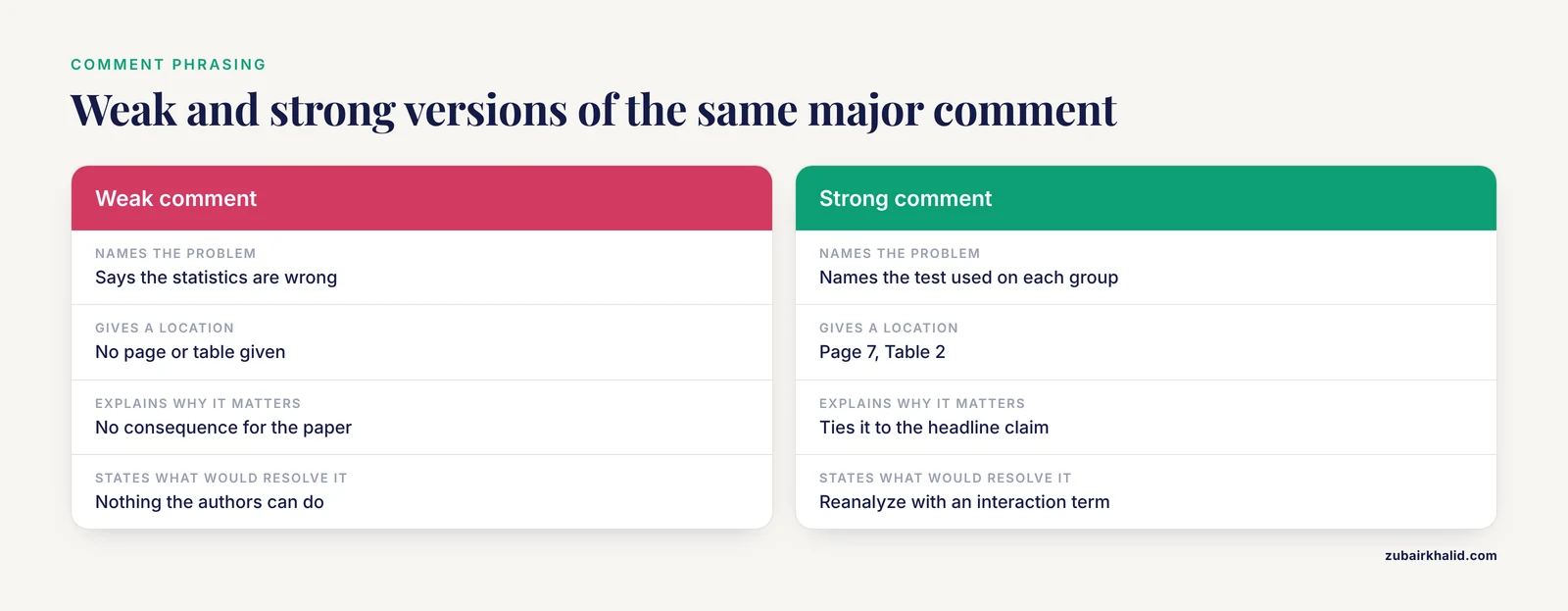
A major comment names the problem, gives its location, explains why it matters, and states what would resolve it. Compare these two versions of the same comment:
WEAK:
"The statistics are wrong and the sample is too small."

STRONG:
"Comment 1 (page 7, Table 2): The authors compare change from
baseline between groups using a test performed on each group
separately. This does not test the between-group difference in
change. Please reanalyze using an interaction term in a linear
model, or explain why the current approach is appropriate.
This affects the headline claim in the abstract."
The strong version is actionable, located, and tied to a consequence. The weak version gives the authors nothing to respond to and gives the editor nothing to weigh.
Worked example of an interpretation comment:
Comment 2 (page 12, Discussion, paragraph 2): The abstract states
that the intervention "improves function," but the primary outcome
was strength, not a function measure. Please either restate the
conclusion in terms of strength, or move the function discussion
into clearly labeled speculation supported by cited external
evidence.
Peer review can and does reshape analysis in legitimate ways. In one published cross-sectional study of more than 10,000 students, the authors explicitly noted that their statistical model was re-specified during peer review, and the revised model was reported with its full paths and bootstrap confidence intervals [2]. Asking for a justified, fully reported reanalysis is a normal and productive reviewer request. Asking for a different answer is not.
Step 7. Write minor comments as a compact list
Minor comments should not require paragraphs. Group them by page or by element:
MINOR COMMENTS
1. Page 3, line 14: define "SSFD" at first use.
2. Figure 3 legend: state what the error bars represent.
3. Page 9: "significant" appears three times without a p value.
   Either give the statistic or remove the word.
4. Reference 22 appears to be mismatched with its in-text citation.
5. Abstract: "novel" appears twice. Delete both.
Step 8. Check compliance with the right reporting guideline
If the manuscript is a systematic review, pull up the PRISMA checklist and verify the flow diagram, the search strategy, the risk of bias assessment, and the synthesis method. Published systematic reviews in the life sciences routinely describe their PRISMA-guided searches across multiple databases with defined date cutoffs, and reviewers should confirm those elements are present and complete rather than assumed [3]. The same principle applies to other study types, where a checklist exists for the design. When a review appraises included studies, look for an explicit methodological quality or risk of bias assessment that the authors actually used in interpretation, not just mentioned [4]. For qualitative work, check that ethical approvals and consent processes are reported, an element that surveys of qualitative health research show is often underreported [5].
Step 9. Choose a recommendation
Match the recommendation to the repair work, not to your enthusiasm. Use this table.
| Recommendation | When to choose it | What the editor expects from you |
|---|---|---|
| Accept | The paper is publishable with copyediting only | Rare. Say so plainly and briefly |
| Minor revision | Valid study, small fixes only, no reanalysis needed | A short list of defined edits |
| Major revision | Valid question, fixable flaws, reanalysis or new detail needed | Numbered major comments with resolutions stated |
| Reject | Fatal flaw in design or data, or unsalvageable overclaim | A clear, respectful, evidence-based rationale |
Explain the recommendation in one or two sentences addressed to the editor. "I recommend major revision because the primary analysis does not test the stated hypothesis, but the underlying data appear adequate for a corrected analysis."
Step 10. Write the comments to the editor
Use the editor-only field for anything the authors should not adjudicate themselves: suspected image duplication, possible plagiarism, a concern about ethics approval, or a conflict you became aware of. State facts and observations, not accusations. The editor, not the reviewer, investigates. An ethics-grounded narrative analysis of professional failures across forensic and laboratory medicine found that transparency of documentation and disclosure duties were central safeguards against error going unchallenged [1], and the same logic applies to what you pass to the editor.
What to Evaluate, Section by Section
Title and abstract. Does the title state what was studied and in what population? Does the abstract contain only claims the paper supports? Abstracts are where overclaiming concentrates, because they are the only part most readers see.
Introduction. Is there a clear gap and a stated question or hypothesis? A review does not need a hypothesis for descriptive work, but it needs a question.
Methods. This is where you spend most of your effort. Check sampling, randomization or matching, blinding, outcome definitions, reagent and instrument identification, exclusion rules, and the statistical plan. For reviews, check that the search covered the relevant databases and that inclusion criteria were applied consistently, as reporting standards require [3].
Results. Are all outcomes preplanned ones reported, including unflattering ones? Are numbers internally consistent between text, tables, and figures? Do the figures stand alone?
Discussion. Do the authors distinguish what the data show from what it might mean? Do they acknowledge limitations honestly? Conceptual precision matters here. A well-received narrative review can earn its place simply by separating concepts that the field has conflated, as one orthopedics evidence map did when it distinguished artificial intelligence functions from robotic execution and mapped evidence for each separately [6]. If a discussion blurs such distinctions, that is a fair target for a major comment.
References. Spot check citations that carry key claims. Confirm that cited studies say what the manuscript says they say.
Fairness, Tone, and Research Ethics During the Review
Fair review is a set of behaviors, not a mood.
Judge the work, not the person. Never write "the authors clearly do not understand." Write "the manuscript does not explain how X was controlled." The first is an insult. The second is a finding.
Do not demand your favorite method. If the authors' approach answers the question, it does not need to be your approach. Reserve criticism for choices that threaten validity.
Separate what is wrong from what you would have done. "I would have used a crossover design" is opinion. "A parallel design cannot answer the carryover question raised on page 6" is criticism. Only the second belongs in a major comment.
Be honest about uncertainty in your own judgments. A thematic analysis of documented failures in forensic pathology and laboratory medicine identified over-certainty as a recurring pattern, alongside the use of technical language to obscure uncertainty [1]. Reviewers are not immune. If you are unsure whether a statistical choice is wrong, phrase the comment as a question and say what would resolve it.
Keep the manuscript confidential and do not extract value from it. Using a reviewed idea in your own work before it is published violates research ethics and most journals' reviewer agreements.
Declare what you cannot judge. A review that says "I am not able to evaluate the genomic pipeline, and a specialist should check it" is more valuable than silent omission.
Review the paper the authors wrote, within the journal's scope. Rejecting a solid descriptive study for not being mechanistic enough, when the journal publishes descriptive work, is unfair and wastes everyone's time.
Common Mistakes and Limitations
- Summarizing instead of evaluating. A report that retells the paper adds nothing. Every sentence after the summary should contain a judgment or a request.
- Unnumbered, unlocated comments. Without page and line numbers, authors cannot respond point by point, and editors cannot verify fixes.
- Burying the recommendation. Put your recommendation where the form asks for it, and justify it in prose. Never make the editor infer your view from tone.
- Tone that escalates. Sarcasm, exclamation points, and words like "inexcusable" change nothing about the science and change everything about how your substantive points are received.
- Reviewing the references you wish were cited. Suggesting one or two genuinely relevant omissions is helpful. Insisting that the authors cite your own papers is a conflict of interest and editors recognize it.
- Demanding more data when the claim should shrink. Often the right fix is a narrower conclusion, not another experiment. Offer the cheaper fix when it is adequate.
- A single review cannot certify truth. Peer review reduces error, it does not eliminate it, and post-publication scrutiny continues. Write as if your review is one filter, not the last one.
- Assuming a checklist equals quality. A completed PRISMA flow diagram does not prove a review was done well, only that it was reported. Read the actual search terms, the risk of bias judgments [4], and the synthesis logic.
- Individual cases need domain judgment. This template cannot substitute for your own expertise on a specific manuscript, and journals' own reviewer instructions take precedence where they differ.
A Final Checklist Before You Submit
Run this list against your draft report. Each item should take seconds to verify.
FINAL CHECK
[ ] Summary is in my own words and matches the paper's claims
[ ] Every major comment has a location and a requested resolution
[ ] Major and minor comments are separated and numbered
[ ] Statistics comments state the problem, not just discomfort
[ ] Reporting guideline checked where one applies (for example
    PRISMA for systematic reviews)
[ ] No personal remarks, no sarcasm, no all-caps emphasis
[ ] No demand to cite my own work
[ ] Conflict of interest declared
[ ] Confidentiality maintained, nothing shared or reused
[ ] Recommendation stated with a one-sentence justification
[ ] Editor-only concerns placed in the editor field, not the
    author-visible comments
The expected output of this checklist is a report you would be comfortable signing, whether or not you do. Many reviewers also find it useful to read the report once as if they were the author. If a comment would feel like an attack rather than a request, rewrite it.
Frequently Asked Questions
How long should a peer review report be?
Most useful reports for a typical research article run between one and three pages, with two to six major comments and a compact minor list. Length should follow the number of real problems, not a target word count. A short, precise report beats a long vague one.
What is the difference between major and minor revision?
Major revision means the flaws threaten validity or the claims require reanalysis, new analyses, or substantial rewriting before the paper could be accepted. Minor revision means the study is sound and only localized fixes remain, such as clarifications, legend details, and typos.
Should I recommend rejection if the study is sound but not novel?
No, if the journal publishes confirmatory or incremental work. Novelty standards are the editor's call and depend on the journal's scope. Your job is validity. Say in the significance section that the advance is modest, and let the editor weigh fit.
How do I review a paper outside my exact specialty?
Review the parts you can judge, usually the framing, logic, presentation, and general inference, and state explicitly which parts need a specialist. Editors routinely combine reviewers with complementary expertise, and an honest scoping statement helps them do that well.
Can I share the manuscript with a colleague or student?
Only with the journal's permission. Many journals allow co-reviewing if you tell the editor and the colleague abides by the same confidentiality rules. The colleague should not be someone with a conflict, and you remain responsible for the report.
What should I do if I suspect data fabrication or plagiarism?
Report your specific observations in the comments-to-editor field, describing exactly what you noticed, such as duplicated panels or identical text across papers. Do not accuse, investigate, or contact the authors. Handling suspected misconduct is the editor's and institution's responsibility.
How do I review a systematic review or meta-analysis differently?
Follow PRISMA item by item, verify that the search strategy is reproducible with dates and databases stated, and check that risk of bias assessment actually shaped the conclusions rather than appearing as decoration. Published reviews in the life sciences provide worked examples of what complete reporting looks like [3].
Do I sign my review or stay anonymous?
Follow the journal's model. Both open and anonymous review are legitimate under current publishing norms. If you sign, hold yourself to the same tone standard, because your name attaches to every sentence. If the journal is anonymous, do not write in a way that reveals your identity through self-citation demands or internal references.
Sources
- When Forensic Pathology Fails: Ethical Lessons From International Regulatory, Judicial, and Historical Human-Rights Cases.
- Peer victimization and family dynamics in the association between childhood abuse and adolescent non-suicidal self-injury: a cross-sectional moderated mediation study.
- The palliative care needs of adolescents and young adults with a life limiting condition: a systematic review.
- Prevalence, determinants, and consequences of workplace violence in emergency departments - a systematic review.
- A scoping review of autoethnographic approaches in medical education research.
- Distinguishing artificial intelligence from robotic execution in total knee arthroplasty: a narrative review and evidence map.