How to Form a Biology Study Group That Actually Works
By Dr. Zubair Khalid, DVM, MS, PhD ·
By the end of this article you will be able to form a biology study group from scratch, run sessions that use proven active-learning methods, and avoid the failure patterns that dissolve most groups within a month. You do not need special software. You need four to six classmates, one shared document, a fixed weekly time slot, and a plan for what each session will actually accomplish.
Biology rewards this format more than most subjects. The discipline layers vocabulary, process, and mechanism on top of each other, from molecule to cell to organism to ecosystem. Explaining a mechanism out loud, drawing a pathway from memory, and arguing about a case problem are all stronger biology study methods than rereading slides alone. The evidence for working in a group is concrete, and the steps below turn that evidence into a routine you can start this week.
Why a Study Group Works for Biology
The strongest direct evidence comes from a cohort-based peer-learning program in undergraduate science courses. Researchers invited high-scoring students (mentors) and lower-scoring peers (protégés) to form study groups after the first assessment of a course. Participants scored significantly higher on subsequent assessments than non-participants. Two further findings matter for anyone deciding whether to join or lead a group. Mentors and protégés benefited roughly equally, so being the strongest person in the room does not cost you academically. And mixing members of different ability levels did not reduce the benefit, which means you do not need to handpick people with identical grades [1].
Group work also changes how you engage with material. In a postgraduate immunology course, students worked in small groups to analyze research papers and build domain-specific mind maps, then merged them into one class-wide map. On feedback forms, 87 percent said small-group activities encouraged idea sharing, 83 percent said the integration step boosted their confidence, and 80 percent said the exercise improved problem-solving skills. Notably, 90 percent valued the guidance of a facilitator, a point that matters later when we discuss structure [2].
Peer interaction during assessment itself also helps. A study of collaborative group exams across 13 undergraduate biology courses found that discussing answers with peers during exams created consistent learning opportunities while still measuring individual performance, and it improved student well-being alongside outcomes [3].
Finally, collaboration is itself a learnable skill. A quasi-experimental study of pre-service biology teachers compared a collaborative, action-oriented learning model against problem-based learning and regular instruction. The collaborative model produced the highest adjusted scores for collaboration skills alongside environmental literacy and creative thinking, with statistically significant effects across all three outcomes [4]. In other words, practicing structured collaboration in a study group builds a competency that biology programs and employers explicitly assess.
How to Form a Biology Study Group Step by Step
This walkthrough assumes you are a student in an undergraduate or early graduate biology course. Everything here works for in-person or remote groups.
Step 1: Define the goal before recruiting anyone
Write one sentence that states what the group exists to do. Vague goals produce vague sessions. Compare these two examples.
Weak goal:  "Study biology together."
Strong goal: "Master the mechanism questions on the BIO 201
             midterm on March 14, focusing on membrane
             transport, enzyme kinetics, and signal
             transduction."
The strong goal names the exam, the date, and three content areas. That specificity lets you recruit the right people, size the sessions correctly, and end the group when the goal is met. A group formed around one high-stakes assessment can then decide whether to continue into the next unit.
Step 2: Recruit three to five committed members
Groups of four to six total members, including you, are the practical sweet spot. Small enough that everyone speaks in every session, large enough to survive one absence. Evidence supports moderate heterogeneity in ability: the study buddy program found that differences in members' initial academic performance did not reduce anyone's benefit from participation, so do not screen out people who scored lower on the first exam [1].
Recruit with a specific ask rather than a general one.
Message to send:
"Hi, I'm putting together a study group for BIO 201
focused on the midterm mechanism questions. We'd meet
Thursdays 6 to 7:30 pm in the library, 4 to 5 people,
one shared notes doc, every session has a written
output. Want in? First meeting is this Thursday."
Three recruitment tips that prevent early collapse:
- Ask people who showed up to office hours or asked questions in lecture. Attendance behavior predicts commitment better than stated interest.
- State the time and place in the first message. "Let's find a time" conversations kill more groups than content ever does.
- Cap the group at six. Beyond that, quiet members stop contributing and the session turns into a lecture.
Step 3: Write a one-page charter
Groups fail over unspoken expectations. Fix that with a charter everyone signs off on. Save it as the first page of your shared document.
BIO 201 STUDY GROUP CHARTER

Members:      Amara, Ben, Chloe, Dev, Elena
Goal:         Master midterm mechanism questions (Mar 14)
Schedule:     Thursdays 18:00-19:30, Library Room 2B
              plus one 30-min remote check-in before the exam
Roles (rotate weekly):
  Facilitator - keeps session on agenda, calls time
  Scribe      - updates the shared doc during session
  Questioner  - brings 3 practice questions
Absent rule:  Miss 2 unannounced sessions and we
              re-check membership. Tell the group in
              the chat if you will be late or out.
Output rule:  Every session ends with one artifact
              (mind map, question set, or summary) posted
              to the shared folder before we leave.
Phones:       In bags. Laptops open only for the shared doc.
The artifact rule is the single highest-leverage clause. In the immunology small-group study, sessions that ended in a concrete shared product, like an integrated mind map, were associated with high reported confidence and engagement [2]. A session with no output leaves nothing to review later.
Step 4: Set up minimal shared infrastructure
You need exactly three things:
- A shared document folder for notes, mind maps, and question sets. Any cloud-doc tool works.
- A group chat for logistics only, never for content questions. Content questions belong in sessions where everyone benefits from the answer.
- A recurring calendar event with the room booked. If your campus requires room reservations, book the whole semester in the first week.
Avoid tool sprawl. One document system, one chat, one calendar. Every additional app adds a place where content gets lost.
Step 5: Run each session with a fixed structure
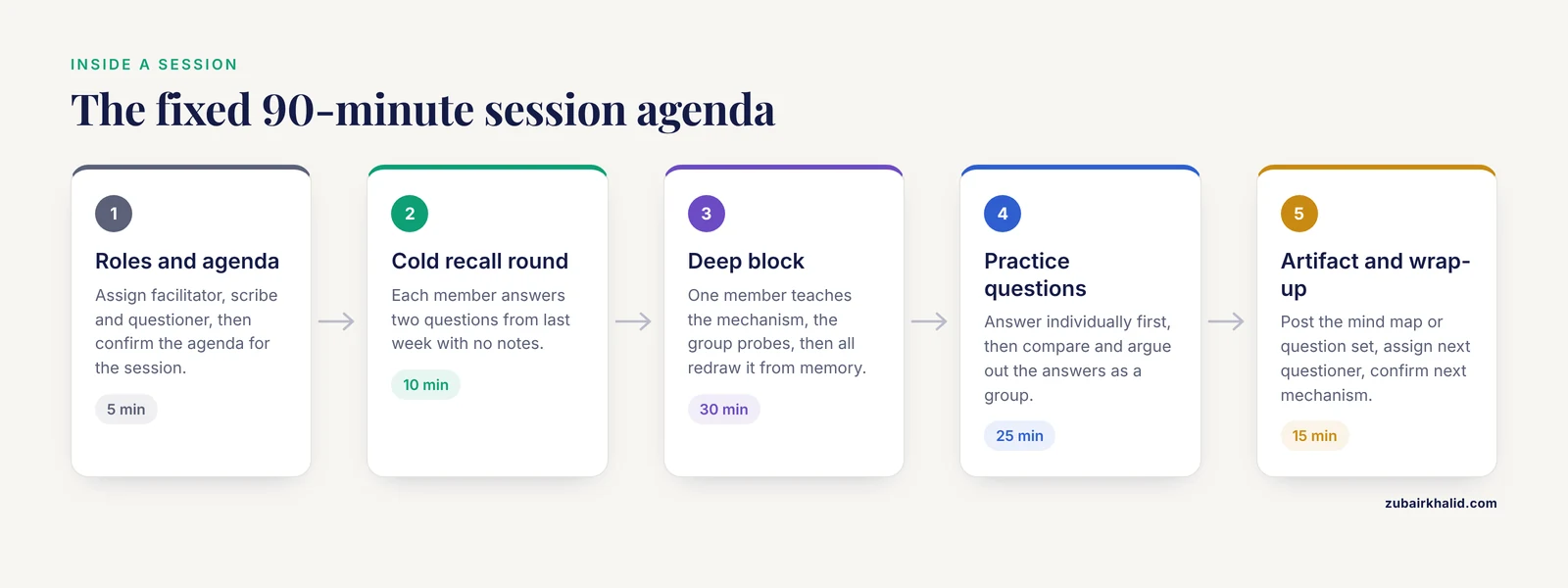
Unstructured sessions drift into complaint sessions or single-person lectures. A 90-minute session with a fixed agenda avoids both.
Standard 90-minute session agenda

00:00-05:00  Roles assigned, agenda confirmed
05:00-15:00  Rapid recall round: each member answers
             2 questions from last week's material,
             cold, no notes
15:00-45:00  Deep block: mechanism of the week.
             One member teaches it for 5 minutes,
             group questions the teacher, then the
             group redraws the pathway from memory
45:00-70:00  Practice questions, done individually
             first, then compared and argued out
70:00-85:00  Artifact build: group mind map or
             question set, posted to shared folder
85:00-90:00  Assign next week's questioner and
             confirm the mechanism of the week
The cold-recall opening is deliberate. Retrieval practice, meaning pulling content from memory rather than rereading it, is one of the most consistently supported study techniques in cognitive psychology and standard study-skills references. The individual-first questioning block prevents the strongest member from answering everything and gives you an honest picture of what you actually know.
Step 6: Match the method to the biology topic
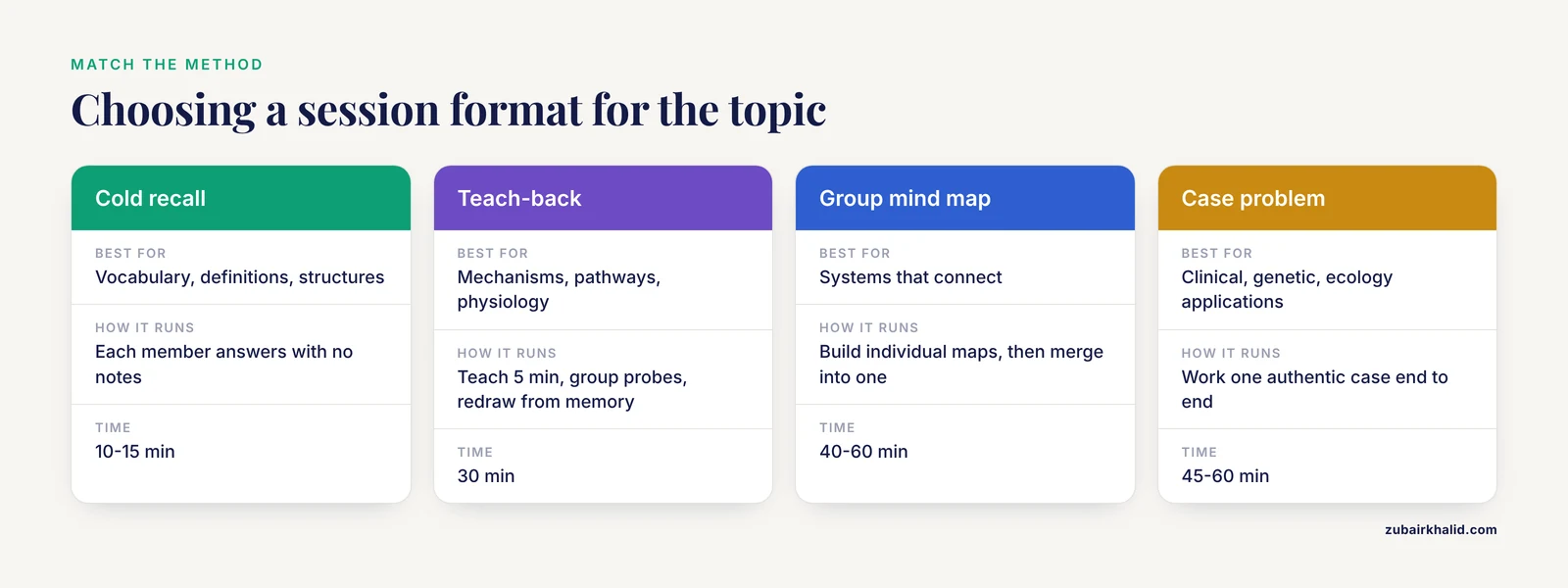
Different content types call for different session formats. Rotate among them so the group does not stagnate.
| Session format | Best for | How it runs | Time |
|---|---|---|---|
| Cold recall round | Vocabulary, definitions, structures | Each member answers questions with no notes | 10-15 min |
| Teach-back | Mechanisms, pathways, physiology | One member teaches for 5 min, group probes, then all redraw from memory | 30 min |
| Group mind map | Systems that connect (immune response, metabolism) | Members build individual maps, then merge into one group map | 40-60 min |
| Case problem | Clinical, genetic, or ecology applications | Group works one authentic case end to end | 45-60 min |
| Mock group exam | Exam preparation | Individually answer, then discuss answers as a group before submitting | 60-90 min |
Two of these formats have direct biological-course evidence. Group mind maps in the immunology course drove the engagement and confidence gains described earlier, especially because individual maps were later integrated into a class-wide map, forcing members to reconcile differences [2]. Collaborative group exams, where students discuss questions with peers during the assessment, consistently created peer-learning opportunities across 13 biology courses while preserving individual accountability [3]. If your instructor does not run group exams, run your own mock version in session three or four before a midterm.
For case-based work, the value is well documented. In a biochemistry laboratory course, students who worked through clinical case scenarios using safe synthetic patient samples scored significantly higher on written exams than peers in traditional instruction, and reported gains in learning interest, self-learning habits, critical thinking, and teamwork [5]. Your group can replicate the core dynamic without lab access by working published case problems from your textbook or course materials, one case per session, each member responsible for one analytical step.
Step 7: Track progress with a spaced-review schedule
After each session, schedule reviews of that session's artifact at increasing intervals. A simple spaced-repetition cadence looks like this.
from datetime import date, timedelta

def review_schedule(built_on):
    """Return review dates for an artifact built on a given date."""
    gaps = [1, 3, 7, 14]  # days after the session
    return [(built_on + timedelta(days=g)).isoformat() for g in gaps]

print(review_schedule(date(2026, 11, 12)))
Expected output:
['2026-11-13', '2026-11-15', '2026-11-19', '2026-11-26']Post these four dates in the group chat when the scribe uploads the artifact. Each review takes ten minutes: one member opens the mind map and asks the group to reproduce its branches from memory. This converts every session into four additional retrievals at nearly zero extra cost.
How to Study Biology Together: Methods That Match the Subject
Biology study methods differ from problem-set subjects like physics because much of the content is mechanistic and hierarchical. Three group-tested approaches fit that structure.
Mechanism chains. Pick a process, for example the sliding filament model of muscle contraction, and have the group build the full causal chain out loud, one link per member, no notes. Any break in the chain marks the exact study gap. This is faster than solo rereading because a broken link is immediately visible to five people rather than one.
Cumulative mind maps. Build individual maps first, then merge them. The individual-first sequence matters. Members who see someone else's map before drawing their own skip the retrieval step, which is where most of the learning happens. The merged map then exposes genuine disagreements, for example whether an intermediate belongs upstream or downstream in a pathway, and resolving those disagreements is where the strongest learning occurs [2].
Problem-first sessions. Start with a question or case rather than a chapter. In postgraduate immunology education, groups that analyzed research papers and solved problems around them reported stronger problem-solving development than lecture-based formats, with facilitator guidance rated valuable by 90 percent of participants [2]. For your group, that guidance role can be filled by a textbook chapter assigned in advance, an instructor's posted key, or office hours scheduled as a group after the attempt. The sequence is attempt first, guidance second. Reversing that order converts the session back into passive listening.
Case-based formats deserve a specific note for anatomy, physiology, and biochemistry courses. Working a full case, from patient presentation to lab values to mechanism to intervention, forces integration across chapters that lectures keep separate. The laboratory course that used safe synthetic samples alongside case scenarios saw gains in exam scores and in self-reported critical thinking and teamwork, confirming that the case discussion itself, not the physical samples, carried the learning benefit [5].
Building Belonging and Keeping Every Member Engaged
Study groups have a social function as well as an academic one, and the social function feeds back into learning. In gateway biology and chemistry courses, students from underrepresented racial and ethnic groups and first-generation students described active, collaborative learning as promoting belonging, confidence, and mattering, and identified peer and near-peer support as central to that effect [6]. Three practices translate that finding into your group.
- Assign every member a named role every session. The facilitator, scribe, and questioner rotation means no one can be a passenger. Roles also give quieter members a defined, low-risk way to contribute.
- Institutionalize the teach-back so the "weakest" member teaches too. Because both high-scoring mentors and lower-scoring protégés benefited equally in the study buddy program, and ability heterogeneity did not dilute anyone's gains, you should not sort speaking opportunities by perceived ability [1]. The member who struggles most with a mechanism often learns most from teaching it a week later.
- Keep feedback behavioral, not personal. "You skipped the regulatory step" is useful. "You are bad at this" ends participation. Groups where members fear judgment lose the quiet members first, and those are often the members who need retrieval practice most.
If your course offers structured peer support, use it. Learning assistants, meaning undergraduates who facilitate collaborative work in the courses they previously completed, measurably improved belonging and confidence for many student groups in gateway science courses [6]. Ask whether your institution has such a program and whether an LA can sit in on one session per unit.
Going Beyond the Exam: Group Projects and Field Work
A study group built for one course does not have to dissolve at the final. The same collaborative structure scales to research-style work. A student-led campus project at Macalester College showed how undergraduates can run a genuine collaborative research effort, measuring campus land cover with geospatial data, adapting an accessible ecosystem model to quantify changes in ecosystem services, and delivering land-management recommendations through a multi-office campus partnership [7]. The transferable lesson for study groups is the division of labor: the student team split data collection, analysis, and stakeholder communication across members and met against a fixed timeline, exactly the charter structure described above.
If your group continues past the exam, look for a shared project with a real output. Examples include a group literature review on a topic from your course, a campus ecology survey, or a co-authored set of practice exams donated to next year's cohort. Collaboration skills themselves improve under structured, action-oriented group models, as the pre-service teacher study demonstrated with significant gains in collaboration alongside content outcomes [4].
How to Form a Biology Study Group: Quick Tips
These are the compact rules that experienced groups converge on, drawn from the practices above.
- Recruit after the first assessment, when motivation is concrete and exam stakes are visible.
- Never schedule a session without naming the content area in the calendar entry.
- Rotate all three roles weekly, in writing, so rotation actually happens.
- Open every session with cold recall, close every session with an artifact.
- Work questions individually before discussing them as a group.
- Assign spaced review dates the moment the artifact is posted.
- Book rooms for the full semester in week one.
- Keep chat logistics-only, and route content questions into sessions.
- Invite the person who scored lower on the last exam. The evidence says they benefit, and so do you.
- End the group on the stated goal, then reform with a new charter for the next unit. Open-ended groups drift. Goal-bounded groups finish strong.
Common Mistakes and Limitations
Most failed study groups fail in predictable ways. Here are the patterns to watch for, in rough order of how often they end a group.
Mistake 1: Forming before the first exam. Groups founded in week one, before anyone has a stake, have the highest drop-off. The study buddy program deliberately formed groups after the first assessment, when both strong and struggling students had a concrete reason to commit [1]. Copy that timing.
Mistake 2: Letting sessions become note-comparison sessions. If the dominant activity is reading each other's notes, no retrieval is happening. If your session produces no memory errors, no arguments, and no corrected drawings, it was too passive. A good session should feel slightly uncomfortable.
Mistake 3: One person teaching while everyone listens. This recreates the lecture, at worse quality. The fix is the teach-back rotation and the individual-first question block, which force every member through retrieval.
Mistake 4: Skipping the facilitator role. In the immunology small-group study, students overwhelmingly valued facilitator guidance [2]. Your group cannot borrow an instructor, but it can borrow the function. The weekly facilitator, armed with a printed agenda and a timer, replaces that structure. Groups without a timekeeper routinely spend 70 of 90 minutes on the first two agenda items.
Mistake 5: Recruiting only similar-ability friends. It feels safer, and it is unnecessary. Heterogeneous groups performed just as well, and mentors gained as much as protégés [1]. Also, socially homogeneous groups tend to socialize instead of study, because the social norms are already established.
Mistake 6: No artifact rule. Sessions that end with "same time next week" produce no retrievable record. If your shared folder is empty after three sessions, the group is socializing with a study label.
Mistake 7: Ignoring attendance problems until the group dies. Enforce the charter's absence rule early and kindly. A group of three reliable members beats a group of six on paper and two in the room.
Limitations to keep in mind. The study buddy program measured grade outcomes but could not observe what happened inside the sessions, so the exact mechanism of benefit remains uncharacterized [1]. The collaborative exam and mind-map studies report engagement and perception data alongside outcomes, but they were conducted in specific institutional contexts, and effects in your course may differ in size. Group study is a supplement to, not a replacement for, individual retrieval practice, because exams are taken alone. Finally, if you are struggling in a course despite consistent group work and solo spaced practice, that is a signal to visit office hours or your campus academic support center, not to extend group hours.
Frequently Asked Questions
How many people should be in a biology study group?
Four to six total members. That size keeps everyone speaking in every session while tolerating one or two absences, and it stays small enough to run the teach-back and cold-recall formats.
When should we start the group relative to the semester?
Form the group shortly after the first major assessment, when motivation is concrete and you can see who is committed. Starting before the first exam is one of the most common reasons groups dissolve.
Do strong students benefit from tutoring weaker classmates?
Yes. In the peer study buddy program, mentors gained grade benefits similar to those of the protégés they supported, so teaching is not a sacrifice of your own performance [1].
How long should each study session last?
Ninety minutes is the practical maximum for focused group work. Use a fixed agenda with a cold-recall opening, one deep block, individual-then-group questions, and a ten-minute wrap-up that assigns the next artifact and roles.
What if our schedules never line up?
Anchor one fixed weekly slot for the whole semester and protect it, then use short remote check-ins for everything else. If even one fixed slot is impossible, the honest answer is that the group cannot function and you should recruit a different cohort, such as the other section of the same course.
Should the group include someone who is struggling in the course?
Yes, deliberately. Groups with mixed initial performance showed no loss of benefit for any member, and lower-scoring participants gained significantly from participation [1].
What do we actually do in a session besides review notes?
Run a cold-recall round, teach a mechanism back to each other and redraw it from memory, work practice questions individually before comparing answers, build a merged mind map, and work one case problem per session. Every session should end with a posted artifact.
How do we keep the group from becoming purely social?
Write the charter, enforce the artifact rule, keep the chat logistics-only, and rotate roles so contribution is structured rather than voluntary. If three sessions pass with no shared document updates, revisit the charter at the start of the next meeting.
Sources
- Study buddy learning is associated with academic success in undergraduate science courses.
- Enhancing adult learning through problem-based learning and knowledge scaffolding: a case study from postgraduate immunology education.
- Faculty can use collaborative group exams to facilitate peer interactions that enhance learning opportunities and increase student well-being in their classrooms.
- Environmental Action-Based Learning for Sustainability Competencies: EMKONTAN Model on Environmental Literacy, Creative Thinking, and Collaboration among Pre-Service Biology Teachers.
- Application of synthetic patient samples in biochemistry laboratory case-based learning course to improve biosafety.
- Maximizing the Value of Learning Assistants for Students' Belonging, Mattering, and Confidence in Gateway STEM Courses.
- Sustainable Landscaping and Sustainability Education on a College Campus: A Case Study in Place-Based, Collaborative Ecosystem Science.