How to Cite a Lab Manual in APA, CSE, and Chicago
By Dr. Zubair Khalid, DVM, MS, PhD ·

By the end of this article you will be able to build a complete, correctly formatted reference for any lab manual in APA (7th edition), CSE (8th edition), and Chicago (17th edition), produce the matching in-text citations, and place both in a lab report format that a grader or journal will accept. You need the manual itself, its title page and back of the title page (or the first page if it is a PDF), and your course syllabus. If you use citation software, have Zotero, Mendeley, or EndNote open, because two of the three styles trip up the automated importers in ways you will learn to fix by hand.
Lab manuals sit in an awkward corner of every citation style. They are books written by committees or departments, published by universities or course coordinators, often without a named author, sometimes without a clear year, and increasingly distributed only as PDFs on a learning management system. Each of the three major styles handles those wrinkles differently, and the differences are exactly where students lose points. This guide walks through each style step by step, shows the finished citation the way it should look on your page, and flags the errors that show up most often in graded work.
Why Lab Manuals Are Hard to Cite
A lab manual is a course material, not a trade book. Three features create most of the trouble.
Authorship is usually corporate. The "author" is often a department, such as "Department of Biological Sciences," or a rotating list of teaching assistants. APA and CSE both allow an organization to stand in the author position. Chicago handles the same case with a slightly different convention.
The publisher and the author are sometimes the same entity. When a university department writes and distributes its own manual, APA asks you to use the university as publisher only when the author is genuinely different, and to omit the publisher when it is the same as the author. Getting this rule backwards is one of the most frequent errors in student reference lists.
The date can be ambiguous. Some manuals are reprinted every semester with no stated year. Some are compiled from older editions. Each style has a defined placeholder for an unknown or inferred date, and using the wrong placeholder signals to a grader that the reference was guessed rather than looked up.
What You Need on Hand Before You Start
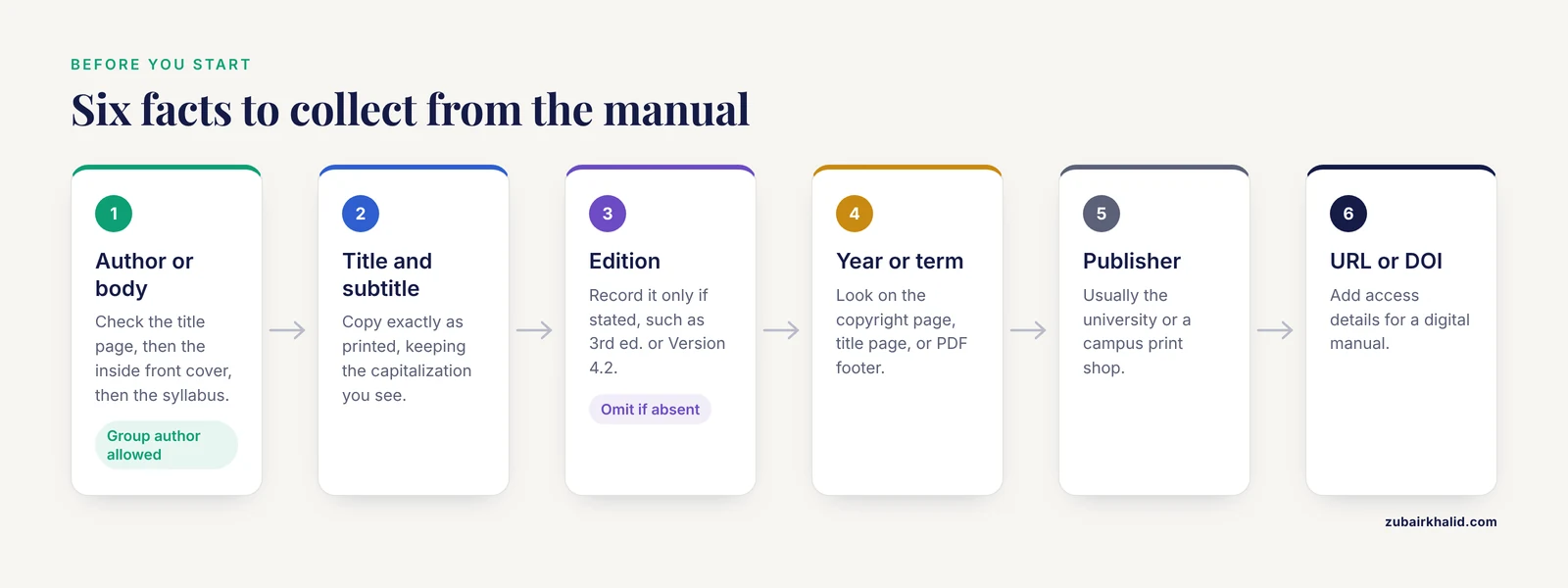
Collect these six facts from the manual before writing any citation. If one is genuinely missing, each style provides a substitute, covered later.
- Author or issuing body. Check the title page, then the inside front cover, then the syllabus.
- Full title and any subtitle, exactly as printed, including capitalization as written.
- Edition, if the manual states one, such as "3rd ed." or "Version 4.2."
- Year of publication or the academic term of use, found on the copyright page, the title page, or the PDF footer.
- Publisher. For course manuals this is usually the university or a campus print shop.
- URL and access details for a digital manual, or the DOI if the manual was published as a formal document.
With those facts in a single line of a scratch note, you can assemble any of the three styles in under a minute.
How to Cite a Lab Manual in APA, CSE, Chicago: The Core Skeletons
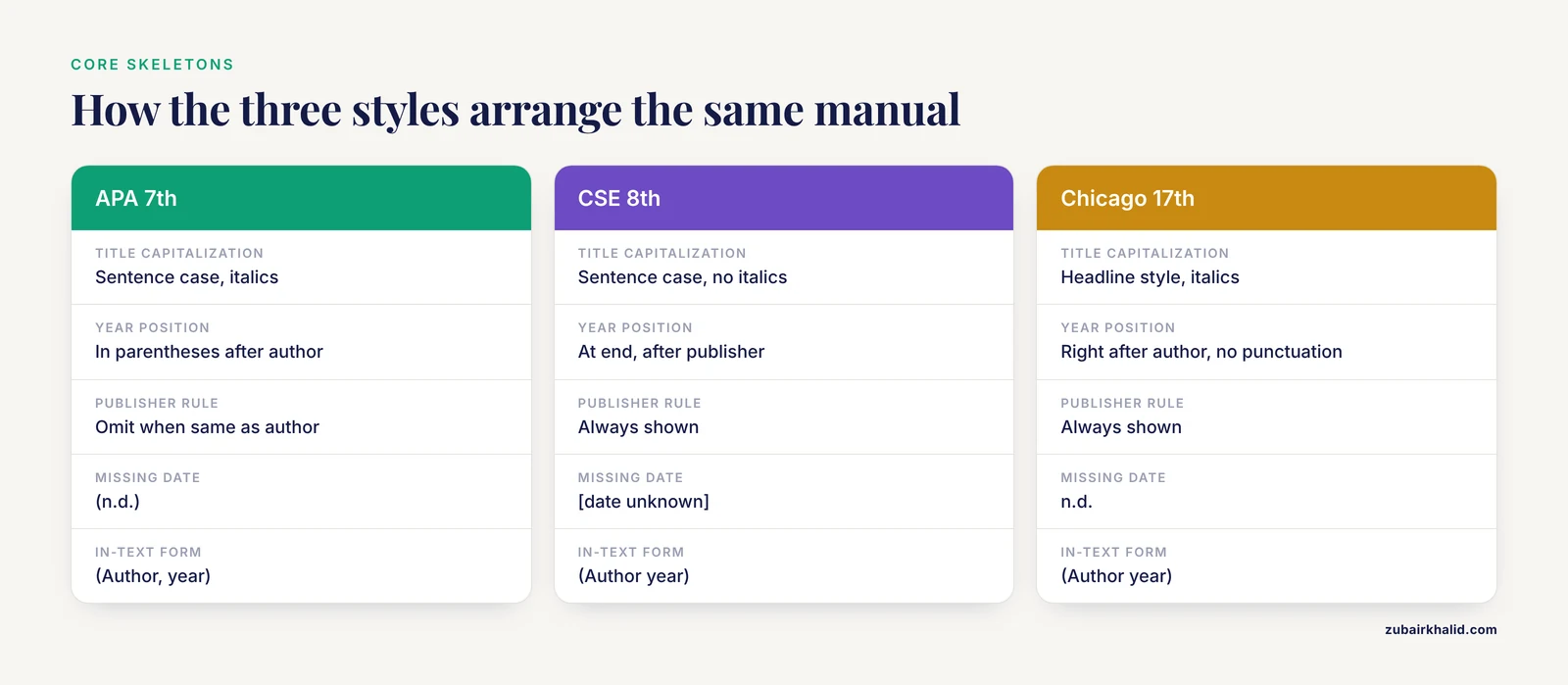
The fastest way to understand the three systems is to see the same hypothetical manual formatted in each one. Suppose the manual is titled General Biology Laboratory Manual, 3rd edition, written by the Department of Biological Sciences at State University, published in 2024, in print.
APA 7th edition:
Department of Biological Sciences. (2024). General biology laboratory manual
    (3rd ed.). State University.
In-text: (Department of Biological Sciences, 2024)
CSE 8th edition, name-year:
Department of Biological Sciences. General biology laboratory manual. 3rd ed.
    [location unknown]: State University; 2024.
In-text: (Department of Biological Sciences 2024)
Chicago 17th edition, bibliography:
Department of Biological Sciences. General Biology Laboratory Manual. 3rd ed.
    City: State University, 2024.
Footnote: 1. Department of Biological Sciences, General Biology Laboratory Manual, 3rd ed. (City: State University, 2024), 42.
Notice three structural differences. APA lowercases the title in sentence case and puts the year in parentheses right after the author. CSE puts the year at the very end and separates the publisher and year with a semicolon. Chicago capitalizes the title in headline style and, in notes-bibliography style, replaces the reference list with footnotes plus a bibliography.
Now work through each style properly.
Citing a Lab Manual in APA (7th Edition)
APA treats a lab manual as a book when it is formally published, and as an unpublished manuscript or course material when it is compiled for a single class. Pick the branch that matches your manual.
Step 1. Identify the Author
Use a named author if one appears on the title page. If not, use the department or university as a group author. Group authors are written out in full in the reference and in the first in-text citation.
Rodriguez, M. T. (2022). Microbiology lab exercises for allied health students.
    Coastline Community College.
If the department wrote it, the department goes first:
Department of Chemistry. (2023). Organic chemistry laboratory techniques (2nd ed.).
    State University.
Step 2. Add the Year in Parentheses
The year goes immediately after the author, in parentheses, followed by a period. For a semester-compiled manual with no year, APA's substitution rules apply: use (n.d.) for no date, and if you know the approximate date, write (ca. 2022) or, for a work in progress with a known year, give that year. Do not invent a year from the copyright page of an unrelated older edition.
Step 3. Write the Title in Sentence Case and Italics
APA uses sentence case for book and manual titles. Capitalize only the first word, the first word after a colon, and proper nouns. Scientific names keep their standard capitalization, so E. coli stays E. coli.
Department of Biological Sciences. (2024). General biology laboratory manual:
    Exercises for BIOL 101 (3rd ed.). State University.
The edition goes in parentheses right after the title, outside the italics, abbreviated as "(3rd ed.)" or "(Version 4.2)" for a software-numbered edition.
Step 4. Handle the Publisher Rule
This is the rule students get wrong most often. When the author and the publisher are the same organization, APA says to omit the publisher entirely. The university name you see after the title in the examples above is serving as the publisher because the author is the department, a different part of the institution. If a commercial publisher produced the manual, name it normally.
Campbell, A. M. (2021). [Molecular genetics](/blog/careers/molecular-genetics) lab manual (5th ed.). Access Science Press.Step 5. For an Online Manual, Add the URL
If you retrieved the manual from a course site, institutional repository, or publisher page, end the reference with the URL. APA does not require a retrieval date for a stable document, but adds one in parentheses when the content is designed to change over time, which describes many living course manuals.
Department of Biological Sciences. (2024). General biology laboratory manual (3rd ed.).
    State University. https://biology.stateu.edu/courses/biol101/manual.pdf
For a manual hosted on a learning management system that requires a login, cite it as an unpublished course document instead:
Department of Biological Sciences. (2024). General biology laboratory manual
    [Laboratory manual]. BIOL 101, State University. Course site (login required).
Step 6. Build the In-Text Citation
APA in-text citations are (Author, year). For a group author with a long name, spell it out the first time with the abbreviation in brackets, then use the abbreviation afterward.
(Department of Biological Sciences [DBS], 2024)
...
subsequent mentions: (DBS, 2024)
A direct quotation needs a page number as well: (DBS, 2024, p. 37).
Citing a Lab Manual in CSE (8th Edition)
CSE, the standard of the Council of Science Editors documented in Scientific Style and Format, is the citation system you will encounter in many biology and environmental science courses. It has two variants, and your instructor will usually name which one to use.
Step 1. Choose Name-Year or Citation-Sequence
In the name-year system, in-text citations appear as (Author year) and the reference list is alphabetized. In the citation-sequence system, references are numbered in the order they first appear in the text, cited in-text by superscript or bracketed numbers, and listed in that numerical order. The reference entry format itself is nearly identical in both variants, so build the entry once and use it in either list.
Step 2. Assemble the Entry
CSE book order is: author, title, edition, place of publication, publisher, year. CSE is the most compressed of the three styles, and it is strict about punctuation. The place-publisher and publisher-year boundaries are separated by semicolons, and a colon separates place from publisher.
Department of Biological Sciences. General biology laboratory manual. 3rd ed.
    Boston (MA): State University; 2024.
Two CSE conventions matter here. First, the state or country in parentheses after the city is standard when the city alone might be ambiguous. Second, when the place of publication is unknown, CSE's placeholder is "[place unknown]" placed where the city would go, in square brackets.
Step 3. Handle a Missing Author or Date
Without an author, begin with the title, then alphabetize by the first significant word of the title in the reference list.
General chemistry laboratory experiments. [place unknown]: Meridian College; 2021.Without a date, CSE uses the bracketed placeholder "[date unknown]" in the year slot.
Department of Physics. Introductory physics laboratory manual. 2nd ed. Dayton (OH):
    Meridian College; [date unknown].
Step 4. For an Online Manual, Add Access Information
CSE asks for the citation version, which for an online document means adding "[Internet]" after the title, the update or citation date in square brackets, and the URL with an "[accessed Date]" note.
Department of Biological Sciences. General biology laboratory manual [Internet].
    3rd ed. Boston (MA): State University; 2024 [cited 2025 Sep 12]. Available from:
    https://biology.stateu.edu/courses/biol101/manual.pdf
The "[cited]" date is the day you actually consulted the file, written as year month day with the month abbreviated to three letters.
Step 5. Build the In-Text Citation
Name-year in-text citations put the author and year together without a comma between them:
(Department of Biological Sciences 2024)Citation-sequence in-text citations are numbers, as superscripts or in brackets, matching the numbered reference list:
...as described in the course manual.³
...as described in the course manual [3].
Citing a Lab Manual in Chicago (17th Edition)
Chicago offers two systems. Notes-bibliography uses numbered footnotes plus a bibliography and is common in history of science courses. Author-date uses parenthetical citations plus a reference list and appears in some natural science contexts. Most science instructors asking for Chicago mean author-date, but check your syllabus.
Step 1. Build the Bibliography Entry
Chicago capitalizes manual titles in headline style, meaning most major words take a capital letter. The bibliography entry reads: author, italicized title, edition, place, publisher, year.
Department of Biological Sciences. General Biology Laboratory Manual. 3rd ed.
    Boston: State University, 2024.
When no person is named as author, Chicago allows a corporate author here exactly as shown. Chicago does not shorten the title to sentence case, and it spells out the publisher's name rather than abbreviating it.
Step 2. Build the Footnote
A full note reverses the bibliography punctuation and adds the cited page:
1. Department of Biological Sciences, General Biology Laboratory Manual, 3rd ed.
   (Boston: State University, 2024), 42.
A shortened note after the first citation uses the author's last name, a shortened title, and the page:
2. Department of Biological Sciences, Laboratory Manual, 87.Step 3. For Author-Date, Build the Reference Entry
The author-date reference entry looks nearly identical to the bibliography entry, with one change: the year moves to a position immediately after the author, and there is no punctuation between them.
Department of Biological Sciences. 2024. General Biology Laboratory Manual. 3rd ed.
    Boston: State University.
Step 4. Build the In-Text Citation
Author-date in-text citations are (Author year), with no comma between the elements:
(Department of Biological Sciences 2024)A quoted passage adds the page after a comma: (Department of Biological Sciences 2024, 42).
Step 5. Handle Missing Information
Chicago uses "n.d." for no date, placed where the year would go. Without an author, the bibliography entry begins with the title and the note uses the title in place of the author. Without a place of publication, write "n.p." in the place slot, though for university manuals the institution's city almost always appears on the title page or its website.
Step-by-Step Walkthrough: Three Styles, One Manual
Work through this concrete example end to end to check your process. The manual is a PDF titled Vertebrate Anatomy Dissection Guide, compiled by Dr. Elena Marsh and the Department of Biology at Lakeside University, no edition stated, dated Fall 2024 on the cover, hosted on the department's public website, and you read it on October 3, 2025.
Step 1. Extract the facts. Author, Marsh, E. Title, Vertebrate Anatomy Dissection Guide. Edition, none stated, so omit it. Publisher, Department of Biology, Lakeside University, which shares an institution with a departmental author, so the publisher reduces to the university. Year, 2024. URL, the department's public address for the PDF.
Step 2. Write the APA entry. For an authored online document, APA wants the author, year, italicized sentence-case title, publisher, and URL.
Marsh, E. (2024). Vertebrate anatomy dissection guide. Lakeside University.
    https://biology.lakeside.edu/undergrad/anatomy/dissection-guide.pdf
In-text: (Marsh, 2024)
Step 3. Write the CSE entry. CSE asks for the internet designation, the accessed date, and the URL.
Marsh E. Vertebrate anatomy dissection guide [Internet]. [place unknown]:
    Lakeside University; 2024 [cited 2025 Oct 3]. Available from:
    https://biology.lakeside.edu/undergrad/anatomy/dissection-guide.pdf
In-text, name-year: (Marsh 2024)
Step 4. Write the Chicago author-date entry.
Marsh, Elena. 2024. Vertebrate Anatomy Dissection Guide. Lakeside University.Note that Chicago prefers the full first name in the bibliography where APA and CSE use initials. In-text: (Marsh 2024).
Step 5. Verify punctuation against the style's own examples. Every style publishes worked examples for books, and a lab manual citation is a book citation with a corporate author. Compare your entry against the official manual's book example element by element. If every element and every mark of punctuation matches, the citation is correct.
Quick Reference Table
| Feature | APA 7th | CSE 8th (name-year) | Chicago 17th (author-date) |
|---|---|---|---|
| Reference list name | References | References or Cited References | References |
| Title capitalization | Sentence case, italics | Sentence case, no italics | Headline style, italics |
| Year position | In parentheses after author | At end, after publisher | Immediately after author, no punctuation |
| Edition | "(3rd ed.)" after title | "3rd ed." after title | "3rd ed." after title |
| Place of publication | Not required | Required, state in parentheses | Required |
| Missing date | (n.d.) | [date unknown] | n.d. |
| Online access | URL at end | [Internet], [cited date], URL | DOI or URL at end |
| In-text form | (Author, year) | (Author year) | (Author year) |
| Hanging indent | Yes, 0.5 in | Yes, 2 em or hanging | Bibliography yes, reference list hanging |
| Alphabetized list | Yes | Name-year yes, citation-sequence no | Author-date yes, notes-bibliography yes |
Citing a Lab Manual Inside a Lab Report
Knowing how to write a lab report means knowing where citations belong, because a manual citation that floats in the wrong section reads as padding. A standard lab report format has six parts: title, abstract, introduction, methods, results, and discussion, followed by the references. The manual earns citations in three of them.
Introduction. When your introduction states background facts, cite the primary literature, not the manual. The manual is secondary for background, and instructors notice when an entire introduction leans on it.
Methods. This is the manual's home territory. Standard practice in scientific writing is to summarize the procedure in your own words and cite the manual as the source of the full protocol. Write a sentence such as, "Serial dilutions and plate counting followed the course protocol (Department of Biological Sciences 2024)," rather than copying the manual's numbered steps verbatim. If your instructor permits direct reproduction of a table or figure, the caption must cite the manual and the page.
Discussion. Cite the manual when comparing your results to expected values the manual provides, for example when a theoretical yield or a reference absorbance range comes from the manual rather than from published literature.
References. The citation appears in the reference list in the style your course specifies, alphabetized by author in APA, CSE name-year, and Chicago author-date, or numbered by first appearance in CSE citation-sequence and Chicago notes-bibliography. Every in-text citation must have exactly one matching entry, and every entry must be cited at least once in the text.
One practical tip for lab report writing: decide your citation style before you draft the methods section, not the night before submission. Retrofitting parenthetical citations into footnotes, or converting name-year into numbered citations, touches every sentence that cites a source, and errors multiply under time pressure.
Using Citation Software Without Regret
Zotero, Mendeley, and EndNote all import lab manuals poorly, because the databases they pull from have no "lab manual" item type. The fix is manual and takes about two minutes.
- Create the entry manually with the item type "Book" or "Report," depending on the software.
- Enter the department or professor in the author field exactly as it should appear.
- Put the edition in the edition field, not the title field, so the software can position it correctly.
- Check the generated citation against the skeletons in this article, because importers routinely add a fictional publisher or strip the "[Internet]" tag that CSE requires.
- Verify the in-text form separately. Some default settings render (Author, Year) for every style, which is wrong for CSE and Chicago author-date, both of which omit the comma between author and year.
Common Mistakes and Limitations
These are the errors that cost points most often, with the specific fix for each.
Using sentence case in Chicago or headline case in APA. The two styles pull title capitalization in opposite directions. APA: general biology laboratory manual. Chicago: General Biology Laboratory Manual. Check which style you are in before typing the title.
Omitting the publisher when you should, or including it when you should not. In APA, if the author and publisher are the same organization, the publisher is left out. In CSE and Chicago, the publisher appears even when it matches the author. Applying APA's rule to CSE entries is a common cross-contamination error in mixed-science programs where students switch styles between courses.
Dropping the semicolons in CSE. CSE's punctuation pattern, "Place (ST): Publisher; year," is not decorative. Graders trained in CSE read missing semicolons as a sign the entry was improvised.
Citing the manual for facts that belong to the original literature. If the manual states that DNA polymerase adds nucleotides in the 5' to 3' direction, that fact traces back to the primary literature, and your introduction should cite a textbook or review instead. Cite the manual only for the protocol and for values specific to the course.
Guessing the year. A manual reprinted without a new copyright date still counts as the original publication year. Using n.d. or [date unknown] when a year is actually printed on the page is an unforced error, and so is inventing a year that matches the current semester. Look at the copyright page and the file metadata before settling.
Formatting the list wrong. APA requires a hanging indent of 0.5 inches and double spacing. CSE and Chicago bibliography entries also hang, but single or double spacing depends on your instructor's guidelines. A reference list with centered, bold, individually indented entries fails on format even when every element is correct.
Citing a lab handout as if it were a manual. A one-page procedure sheet is an unpublished course document, not a book. In APA it is cited with a bracketed description such as "[Lab handout]" and the course details. Only multi-page, bound, or formally posted manuals take the book treatment described in this article.
One limitation to keep in view. Style manuals are revised roughly every seven to ten years, and universities issue their own local addenda, so an individual course or journal can legitimately require a variation on anything written here. When your syllabus and a style guide disagree, the syllabus wins. Individual assignments also carry their own constraints, and when you are unsure what a specific instructor expects, asking the instructor or the campus writing center resolves it faster than guessing.
Checking Your Work
Run this four-point check on every lab manual citation before submission.
- Element order. Does every element appear in the order the style requires, with nothing extra? Extra elements are as penalized as missing ones.
- Punctuation marks. Walk the entry mark by mark. APA relies on periods, parentheses, and italics. CSE adds semicolons, colons, and square brackets. Chicago uses commas inside notes and periods in the bibliography.
- In-text to reference match. The name in the in-text citation must be the first element of the reference entry, and the year must match. A mismatch between "(DBS, 2024)" in the text and an entry alphabetized under "Department" will be flagged.
- Case and italics. Confirm sentence case versus headline case, and confirm italics appear where the style wants them. In CSE, titles are not italicized at all, which surprises students coming from the other two styles.
If your citation passes all four checks against the style's own book example, it will pass a grader's check.
Frequently Asked Questions
How do I cite a lab manual with no author in APA?
Use the title in the author position, move the title to the front of the entry, alphabetize by the first significant word of the title, and use the title in place of the author in in-text citations, shortened to a few words in quotation marks with the year. If a department or university is identifiable as the issuing body, prefer that as the group author instead.
Can I cite a lab manual in CSE with a numbered in-text citation?
Yes, in the citation-sequence variant. The first time you cite the manual, it gets a number matching its position in the reference list, and every later citation uses the same number, either as a superscript or in brackets, depending on your course's convention.
What is the difference between Chicago notes-bibliography and author-date for a lab manual?
Notes-bibliography puts full publication details in a numbered footnote and repeats them in a bibliography, while author-date puts (Author year) in the text and a full entry in a reference list. The underlying information is the same, so you can convert one to the other by rearranging punctuation and moving the year.
How do I cite a lab manual I only accessed through my course's LMS?
Cite it as an unpublished course document in APA, naming the course, the institution, and noting that access requires a login, or in CSE and Chicago by treating it as unpublished material with the institution as publisher. Use the URL only if the document is publicly reachable.
Where does the lab manual citation go in my lab report?
The in-text citation belongs in the methods section where you reference the protocol, and possibly in the discussion where you compare results to expected course values. The full entry goes in the reference list at the end of the report, formatted in whatever style the course requires.
Do I need to cite the lab manual every time I mention it?
Yes, whenever you draw specific information from it, such as a protocol step, an expected value, or a safety instruction, a citation is required in every style. General references to "the course manual" in running prose do not need a citation, but any fact taken from it does.
What edition information goes in the citation if the manual has none?
None. If the manual does not state an edition, leave the edition out of all three styles. Do not substitute a version number from the course website or guess from the syllabus, because a citation that invents an edition is a factual error, not a formatting one.
Is a lab manual citation different from a lab handout citation?
Yes. A lab manual is a multi-page, formally produced document and is cited as a book in all three styles. A lab handout is a short, informal, often single-page document and is cited as unpublished course material, with a bracketed description and the course details in APA, or as unpublished material in CSE and Chicago.