Funder Data Sharing Policies Compared
By Dr. Zubair Khalid, DVM, MS, PhD ·

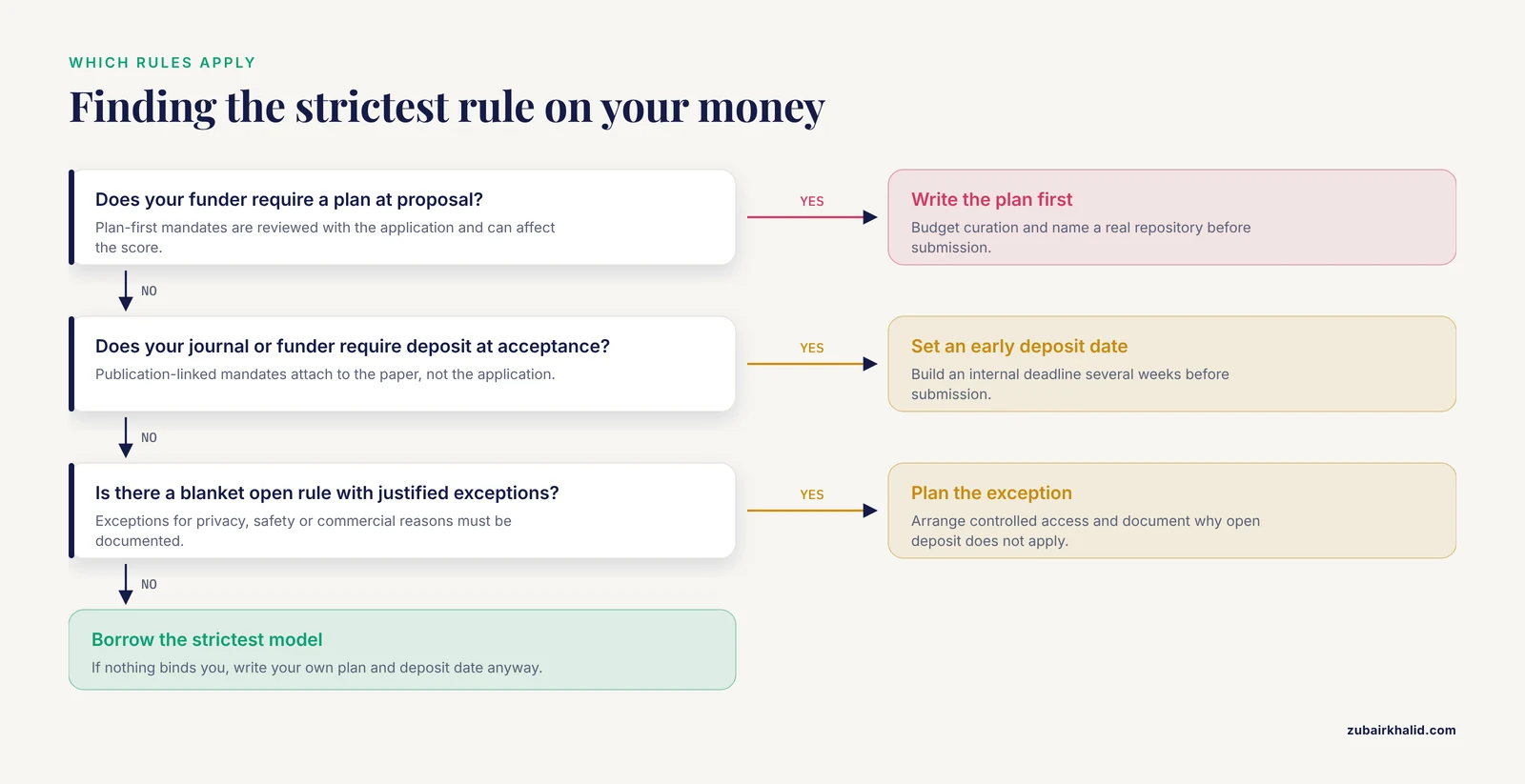
The core difference between funder data sharing policies is timing and binding force. Some funders require a written data plan before they will fund you at all, some only require data release when your paper appears, and some simply encourage sharing without enforcing anything. The rule of thumb is simple: match your planning effort to the strictest policy attached to your money, not the loosest. If your grant requires a data management and sharing plan at submission, that document shapes your budget, timeline, and repository choice from day one, and treating it as an afterthought is the most expensive mistake a researcher can make.
This guide compares the main funder data sharing policy models in use today, explains the pros and cons of each, walks through repository selection, and shows how the choice plays out in realistic grant scenarios. The comparison draws on published research into how funders behave and on large-scale evidence about what sharing actually does for a paper.
Why Funders Care About Research Data Sharing
Research data sharing means making the underlying data from a study available to others, usually through a public repository, so that results can be checked, reused, and built upon. Funders push it for three reasons. First, publicly funded results should be verifiable by the public. Second, shared data let other teams reuse expensive datasets instead of duplicating the work. Third, funders want the science they buy to have the widest possible downstream impact.
Funders are widely seen as the strongest lever for changing researcher behavior. A qualitative interview study of sixteen German funding representatives and research data experts found that funders are perceived as important promoters and facilitators of data sharing, even where their actual policies remain weak [1]. The same study found that German funders' policies lag behind the international standard, and that experts inside and outside those funders debated how to make requirements more binding [1]. That gap between encouragement and enforcement is exactly what separates the policy models described below.
There is also a direct professional incentive. In an analysis of roughly 122,000 publications using the Open Science Indicators dataset built by PLOS and DataSeer, papers that released a preprint showed an average citation advantage of about 20.2 percent, and papers that shared data in an online repository showed a smaller but still positive citation advantage [2]. The same study found that adoption of these open science practices varies substantially across scientific disciplines [2]. These are correlational findings, meaning shared practices go along with more citations rather than proving cause and effect, but they give individual researchers a concrete reason to favor funders and venues that reward sharing.
The Four Main Funder Policy Models
Almost every real policy you will encounter fits one of four archetypes. Understanding the archetypes makes any specific funder document easier to read, because you immediately know which obligations are structural and which are negotiable.
Model 1: The Plan-At-Proposal Mandate
Under this model, you cannot submit a competitive proposal without a data management and sharing plan. The plan describes what data you will produce, what standards and metadata you will use, where you will deposit it, and when it will become available. The National Institutes of Health operates this way through its Data Management and Sharing Policy, which took effect for applications submitted on or after January 25, 2023, and applies to the data generated in NIH-funded research [3 of the policy itself is not in the packet, so treat specifics qualitatively]. The National Science Foundation has required a data management plan as a supplementary document with proposals since 2011.
The defining feature is that sharing is decided before money changes hands. Reviewers and program officers can see your plan, and in some systems the quality of the plan affects the score. The advantage for you is that costs for curation and deposition can be written into the budget up front. The disadvantage is that you commit to a repository and timeline before you know exactly what your data will look like.
Model 2: The Publication-Linked Mandate
Here the requirement attaches to the output rather than the application. The funder, or the journal the funder expects you to publish in, requires a data availability statement and deposit of the underlying data when the paper is accepted. PLOS journals, for example, require authors to state where the data behind each paper are available, and the PLOS and DataSeer indicators work uses exactly this kind of publication-level tracking [2].
This model is easier to comply with late in a project, which is also its weakness. By acceptance day, the data may be disorganized, the postdoc who understood them may have left, and the deadline is immediate. Publication-linked mandates produce real deposits, but the quality and completeness of what gets shared are typically lower than under plan-first models.
Model 3: The Blanket Open Requirement
Some large foundations and multilateral funders go further and require that data be open by default, either immediately at publication or within a defined embargo period, with exceptions granted only for privacy, safety, or commercial reasons. These policies usually bundle data sharing with open publication requirements and expect FAIR compliance. FAIR stands for findable, accessible, interoperable, and reusable, a set of principles for describing data so that machines and other researchers can locate and work with it.
Blanket policies are the strongest form of the mandate because exceptions must be justified rather than assumed. They work well for funders with large, diverse portfolios who want a single rule instead of case-by-case negotiation. For the researcher, the main burden is anticipating which data cannot be open and documenting why.
Model 4: Encouragement Without Enforcement
The fourth model is a written preference for sharing with no operational teeth. There may be a statement on the funder's website, occasional workshops, or voluntary badges, but no requirement in the grant terms and no consequence for keeping data closed. The German study mentioned above is the clearest documented example of this landscape, where experts described funders as aware of the issue and supportive in principle, yet running policies that lag internationally, and identified general barriers that keep those funders from imposing binding requirements [1].
Researchers funded under this model face no compliance obligation. The tradeoff is that there is also little infrastructure support, little money earmarked for curation, and no external pressure that helps you resist the inertia that keeps data in lab folders.
Funder Data Sharing Policies Compared Side by Side
The table below is the core of this comparison. Read it against your own situation: the row that describes your funder tells you which planning decisions you must make this month.
| Criterion | Plan-at-proposal mandate | Publication-linked mandate | Blanket open requirement | Encouragement only |
|---|---|---|---|---|
| When the duty starts | At application | At manuscript acceptance | Usually at publication, sometimes at award | Never formally |
| How binding | Very, funding can depend on the plan | Moderate, tied to publication | Very, exceptions must be justified | Not binding |
| Written plan required | Yes, reviewed with proposal | Usually just a statement in the paper | Often yes, plus periodic updates | Rarely |
| Budget for curation | Can be requested in the proposal | Seldom provided | Often provided or expected | Usually absent |
| Repository expectation | Named or FAIR-compliant repository in the plan | Deposits at or near acceptance | Deposit within a defined period | Whatever the lab chooses |
| Typical enforcement | Compliance checked before funds or at reporting | Journal or funder checks the statement | Regular reporting and audits | None |
| Where policies of this type are common | Large public agencies | Journals and some funders | Major private foundations | Funders still building policy, for example those described in the German study [1] |
| Best fit | Researchers who can plan data outputs in advance | Labs with predictable publication pipelines | Consortia and large programs | Researchers who want to share voluntarily |
Two things in this table deserve emphasis. First, the models are not mutually exclusive. A funder can require a plan at proposal and a deposit at publication, which effectively combines models 1 and 2. Second, the models describe enforcement, not quality. A motivated lab under an encouragement-only policy can share better data than a resentful lab under a blanket mandate, but the policy determines what happens on average, not in your specific case.
Pros and Cons of Each Model
Plan-at-proposal mandates
The strong point of this model is leverage. Because the plan is reviewed before the award, you can budget for a repository, a data curator, or restricted-access hosting, and you can negotiate the terms while you still have negotiating power. Interview evidence from the funding side suggests that experts see exactly this kind of structured measure as the main way funders can move from encouragement to effective promotion [1].
The costs are front-loaded work and rigidity. Writing a credible plan takes days, and if your project pivots, the plan may no longer match reality. Many agencies allow plan amendments, but you must initiate that yourself.
Publication-linked mandates
The strength is low friction at the application stage and a clear, single deadline tied to a milestone you are already managing. The weakness is that everything compresses into the busiest week of the project. Teams rushing to satisfy an acceptance-day requirement tend to deposit whatever is at hand, with thin metadata, which undercuts the reuse value that the policy exists to create. If your funder or target journal works this way, build an internal deadline for data deposit several weeks before submission.
Blanket open requirements
These policies give the clearest expectations and usually the best support, because the funder has already decided the default and funded the infrastructure. The burden is on the exception process. If any of your data involve identifiable human participants, proprietary licensed material, or dual-use concerns, you must document the restriction and arrange controlled access rather than open deposit. Plan for that conversation early, because retrofitting access controls onto a public dataset is not possible.
Encouragement-only policies
The obvious advantage is freedom. The obvious disadvantage is that you are on your own for infrastructure, cost, and timing. The German expert interviews show that researchers in such systems recognize the gap and generally want more concrete measures from funders, but also that funders face real barriers in imposing binding rules, including administrative burden and the diversity of disciplines they support [1]. If you sit in this environment, the practical move is to borrow the stricter model voluntarily: write yourself a plan, pick a repository, and set a deposit date, because the citation and reuse benefits documented for shared data do not depend on which funder made you do it [2].
How Funders Enforce the Rules
Enforcement varies more between funders than the written policies suggest, and it is worth understanding the mechanisms before you assume a rule has no teeth.
Under plan-first mandates, enforcement typically happens at two checkpoints: reviewers assess the plan at proposal stage, and program officers confirm compliance at annual reporting or at the closeout of the award. Missing or superficial plans can hold up continued funding.
Under publication-linked mandates, the journal is usually the enforcement agent. Editors check the data availability statement, and some routinely verify that the linked repository actually contains the promised files.
Under blanket mandates, funders may audit deposits, require data management plan updates at reporting milestones, and make future funding conditional on past compliance.
Under encouragement-only regimes, there is no formal enforcement, and the German study illustrates how that absence shapes day-to-day behavior, with data sharing remaining uncommon practice even where everyone agrees it is beneficial [1].
A practical consequence: when you compare funders, do not just read the policy page. Ask current grantees what actually happens at reporting time.
Choosing a Repository: A Practical Data Repository Comparison
Your policy tells you to deposit your data. The next decision is where. Repository choice matters more than most researchers expect, because the repository determines whether your data are findable, preserved, and citable.
Generalist repositories accept data from any field. They assign a digital object identifier (DOI), a permanent citable link, and they handle basic curation and long-term storage. They are the right default when no domain repository exists for your data type or when your funder simply requires FAIR-compliant deposit.
Domain-specific repositories serve one scientific community and enforce community standards for format and metadata. Sequence data for nucleic acids go into archive databases maintained through the International Nucleotide Sequence Database Collaboration, which includes GenBank at the National Center for Biotechnology Information (NCBI). Protein structures go to the Protein Data Bank. Social and behavioral survey data traditionally go to curated archives that specialize in sensitive de-identification. Domain repositories add real value because the metadata standards are set by people who understand the data, which makes reuse far easier.
Institutional repositories are run by universities. They work well for theses, negative results, and small datasets, but policies that name specific repositories generally do not accept them as substitutes, and their long-term funding is less predictable.
When comparing repositories, evaluate five things:
- Persistence. Does the repository issue DOIs and commit to long-term preservation?
- Metadata standards. Will other researchers in your field find the data usable, or will they get a folder of unlabeled spreadsheets?
- Access model. Does it support controlled access with a data use agreement for human-subject or sensitive data, not just open download?
- Licensing. Can you apply a clear reuse license, such as CC BY 4.0 for most scholarly data?
- Funder recognition. Is the repository on your funder's list of acceptable options, if the funder maintains one?
A common sequence works for most projects: check whether your funder names required repositories, then check whether your data type has a domain repository, and only then fall back to a generalist option.
Worked Scenarios
Scenario 1: Applying to a plan-first funder
A postdoctoral researcher applies for a federal grant covering a five-year longitudinal study. The funder requires a data management and sharing plan with the proposal and permits requests for data-related costs. Because the requirement exists at submission, she budgets for repository deposit fees, writes the plan around a domain repository she verifies accepts her data type, and specifies a six-month post-publication deposit window. The plan becomes a scored part of her application rather than an attachment nobody reads. When the award arrives, her curation costs are already covered.
Scenario 2: Publishing under a publication-linked mandate
A small lab works under a funder with encouragement-only language, but the target journal requires a data availability statement at acceptance. Because the funder never forced early planning, the data live in three instruments' native formats and one departed student's hard drive. The team spends two rushed weeks reformatting files and writing metadata so the statement is not false. The lesson: journal enforcement reaches labs whose funders do not enforce anything, and it reaches them at the worst possible moment.
Scenario 3: Working under a soft national policy
A mid-career researcher in a country where funders have not adopted binding requirements, a situation documented in detail for Germany through expert interviews [1], wants to share anyway because a collaborator abroad needs the dataset. He follows the stricter model voluntarily: he drafts a plan, deposits in a generalist repository with a DOI, applies a CC BY license, and cites the dataset in his paper. Nothing in his grant terms required this, and the deposit costs him a modest fee from his own discretionary funds. The reuse benefit accrues to his field, and the citable dataset becomes part of his record.
Scenario 4: Handling sensitive human data under a blanket mandate
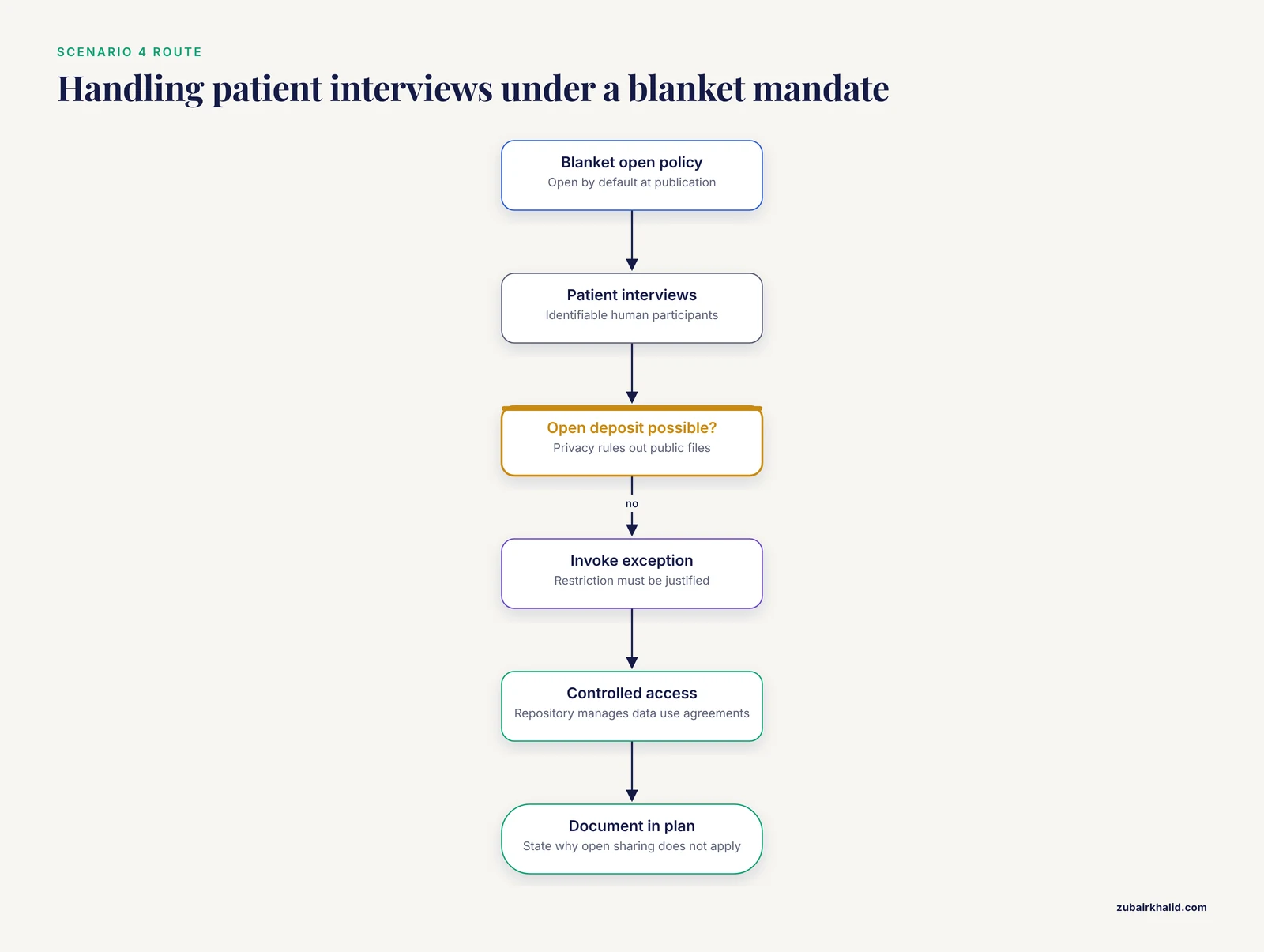
A consortium funded under a foundation's blanket open policy generates interviews with patients. Open deposit is impossible, so the team invokes the policy's exception process, arranges controlled access through a repository that manages data use agreements, and documents in the data management plan why open sharing does not apply. The blanket framework does not force harmful disclosure. It forces the team to justify the restriction explicitly, which is precisely the behavior open policies are designed to produce.
Common Mistakes and Limitations
Confusing journal policy with funder policy. A data availability statement satisfies the journal. It may not satisfy the funder's requirement to deposit in a specified repository within a specified period. Track the two obligations separately.
Assuming silence means freedom. If your funder has no policy, your institution, your journal, and your collaborators' funders may still impose requirements. Check all three before you plan the project.
Writing the plan as paperwork. Reviewers under plan-first systems read these documents, and reporting officers check them later. A plan that names a real repository, real formats, and real timelines is both more competitive and more useful to you two years in.
Depositing on a lab website instead of a repository. A download link on a lab page is not preservation, has no DOI, and dies when the server does. Funders that name repositories do so for this reason.
Forgetting that exceptions must be planned. Human-subject data, licensed third-party material, and proprietary datasets usually require controlled access rather than open deposit. Arranging a data use agreement takes months in some repositories, so start early.
Overreading the citation evidence. The large observational analysis showing citation advantages for preprints and for repository deposits is correlational by design [2]. It compares practices across publications with statistical controls, not a randomized trial. Sharing your data is well supported as good practice, but no one can promise your paper a specific citation bump.
Ignoring discipline norms. The same study found that adoption of open practices differs substantially across fields [2]. A repository or timeline that fits genomics may make no sense for ethnographic fieldwork. Adapt the policy to your data, not the reverse.
One general limitation applies to individual situations: every grant has its own terms, and the specific text of your award agreement always overrides general guidance. Read your actual award conditions and ask your program officer when the two conflict with anything written here.
Frequently Asked Questions
What is a funder data sharing policy?
It is a set of rules from a research funding organization that determines whether, when, where, and how you must make the data from funded work available to others. Policies range from requiring a detailed plan with the proposal to merely encouraging sharing with no enforcement.
Which funders have the strictest data sharing policies?
Blanket open-data foundations and large public agencies with plan-at-proposal requirements are the strictest, because obligations attach at award or at publication with limited exceptions. Policies in some countries remain weaker by international standards, as documented for German funders in expert interviews [1].
Do I have to share all of my data?
Almost never. Every serious policy includes exceptions for privacy, human-subject protections, proprietary or licensed material, and safety concerns. The usual requirement is controlled access or a documented justification rather than open deposit.
What goes into a data management and sharing plan?
Standard plans describe what data the project will produce, what formats and metadata standards you will use, where you will deposit the data, who can access them, and when. The plan is the document reviewers and reporting officers use to judge your compliance approach.
Does sharing data improve citations?
Evidence from a large publication-level analysis links repository data sharing and preprinting with higher citation counts, with preprinting showing the larger advantage [2]. The relationship is correlational, so treat it as a favorable signal rather than a guarantee.
How do I choose between a generalist and a domain-specific repository?
Use the domain repository if one exists for your data type, because its metadata standards make your data genuinely reusable. Use a generalist repository with a DOI when no domain archive fits, and always confirm the repository is acceptable under your funder's policy before you commit.
Further Reading
- Clinical evaluation of General Electric new Swiftscan solution in bone scintigraphy on NaI-camera: A head to head comparison with Siemens Symbia.
- Evaluation of the sensitivity and specificity of a novel line immunoassay for the detection of criteria and non-criteria antiphospholipid antibodies in comparison to established ELISAs.
- How to improve research capacity strengthening efforts: learning from the monitoring and evaluation of four research consortia in Africa.
- A quality management system aiming to ensure regulatory-grade data quality in a glaucoma registry.