Why Your ELN Audit Trail Is Incomplete
By Dr. Zubair Khalid, DVM, MS, PhD ·

The most common reason an electronic lab notebook (ELN) audit trail comes up incomplete is that the trail is only logging one narrow slice of the record, usually the text inside the notebook entry, while every other object in the system (attachments, instrument imports, metadata fields, sample registrations) changes silently in the background. The first thing to check takes about five minutes: open any existing entry, change a word in the body, upload a new attachment, edit a metadata field such as sample ID or experiment date, and then open the audit history for that entry. Compare what you just did against what the trail actually recorded. Whatever did not appear in that history is your gap, and in most systems the attachment and metadata gaps are far larger than the text gap.
This article walks through why audit trails end up incomplete, the mechanism behind each failure, a diagnostic sequence you can run in an afternoon, and the fixes that survive a regulatory inspection. The audience is bench scientists, lab managers, QA staff, and anyone building a career in regulated research or biotech operations.
What a Complete Audit Trail Actually Has to Do
An audit trail is a system-generated, time-stamped record of who changed what, when they changed it, and why. In regulated environments, that definition is sharpened by two frameworks. The first is 21 CFR Part 11, the US Food and Drug Administration regulation covering electronic records and electronic signatures, which requires secure, computer-generated, time-stamped audit trails that cannot obscure previously recorded information [1]. The second is ALCOA+, the pharmaceutical data quality standard holding that data must be Attributable, Legible, Contemporaneous, Original, and Accurate, plus Complete, Consistent, Enduring, and Available [2].
A complete ELN audit trail therefore needs to capture, for every data object in the system:
- Who made the change (a named individual, never a generic account)
- What changed (the previous value and the new value, not just "entry edited")
- When it changed (a server-side timestamp, not a client-side one)
- Why it changed (an electronic signature reason or change comment where required)
Regulators increasingly expect automated timestamping, cryptographic integrity controls, and end-to-end audit functionality as the technical baseline for ALCOA+ compliance, not as optional extras [3]. When any of those elements is missing for part of your data, the trail is incomplete even if the notebook text itself is perfectly logged.
The practical consequence of an incomplete trail is not abstract. Data integrity failures in pharmaceutical manufacturing are typically detected after audit inspections, and they carry consequences that include fines, increased costs, and production delays [2]. In clinical research, quality assurance processes that verify data integrity directly determine whether trial results are accepted as reliable evidence of safety and efficacy [4].
The Seven Causes, From Most Common to Rarest
Cause 1: The trail only covers entry text
Most ELNs are built around a central object, the notebook entry or experiment document. Vendors often ship with the audit trail enabled for that object and for little else. Attachments, comments, embedded spreadsheets, sample registrations, and custom metadata fields may live in separate data stores with their own change-tracking behavior, or with none at all.
The mechanism is architectural. An ELN is rarely one database. The rich-text body, the file store, the sample registry, and the instrument integration layer are frequently separate services. When the audit trail implementation only hooks into the entry service, everything else in the platform changes without a recorded who, what, or when. This is why the five-minute test in the introduction almost always surfaces gaps in attachments and metadata first.
This failure matters because a record is not just prose. An experiment whose text is fully audited but whose raw data file was silently replaced two weeks later is not an ALCOA+ record. Completeness is one of the ALCOA+ principles, and a partial trail fails it by definition [2].
Cause 2: Generic and shared accounts
When multiple people log in through a shared account, a departmental login, or a "lab admin" credential, the audit trail can be technically perfect and still be useless. It will faithfully record that "lab_admin" changed the data. It cannot attribute the change to a person, which breaks the Attributable principle at its root.
This problem is well documented in manufacturing execution system deployments, where generic account usage is called out as a recurring compliance risk addressed through a combination of procedural and technical controls [1]. The same pattern appears in academic and small-company ELN deployments where licenses are scarce and teams share logins to save money. Every saved license is paid for later in attribution gaps.
The fix has two parts. Technically, each user needs an individual account with individual credentials. Procedurally, the organization needs a policy that account sharing is a data integrity deviation, not a convenience. Where cost is the driver, an electronic lab notebook comparison done on a per-seat basis should weight the audit trail cost of shared accounts heavily enough that the cheaper-per-seat option often becomes the more expensive overall.
Cause 3: Instrument data imported as flat copies
When an instrument export is dragged into an ELN, the file that lands in the notebook is a copy. The trail records that a file was uploaded and by whom. What it does not record is anything that happened upstream: which instrument produced it, when the run actually happened, whether the export was regenerated, and whether the version in the notebook still matches the source.
The mechanism here is a broken chain of custody for data provenance. A complete trail follows data from generation to final record. A partial trail starts at the upload event. Modern pharmaceutical IT architectures address this by integrating systems so that data flows carry their timestamps and integrity controls with them across platform boundaries [3]. When your ELN integration simply copies files, the upstream half of that chain is invisible.
Ask your ELN vendor one specific question: when instrument data is imported, does the integration capture the instrument identity, the acquisition timestamp, and a source-system reference, or only the file upload event? The answer tells you how much of your trail is missing before any human touches the data.
Cause 4: Copy, paste, and bulk edits that rewrite history
Some ELN operations quietly bypass normal change tracking. Copying an entry, restoring an old version, bulk-editing metadata across many records, or moving entries between notebooks can create or overwrite data without generating individual audit events for each affected value. The result is a record whose current state cannot be reconciled with its history.
The mechanism varies by platform. In some systems, version history is stored per entry, so a bulk operation that touches fifty entries produces one log line or none. In others, the copy operation creates a new entry that inherits no history at all, so a researcher can appear to have originated data that was actually copied from a colleague's work.
Test this directly. Perform a bulk metadata edit on a set of test records. Check whether each record shows its own change event with a before and after value. Perform a copy of an entry and check whether the new entry's history shows its origin. Whatever the answer is, that is your gap.
Cause 5: Retention windows, log rotation, and storage limits
Audit trails are data, and data gets deleted on schedules. Some platforms rotate audit logs after a fixed period. Some cloud storage tiers expire older log records. Some organizations set retention policies on log storage to control costs without checking whether those policies conflict with the retention requirements for GxP records, which generally require data to remain available for the full lifecycle of the product or study they support.
The mechanism is simple: the trail existed and then stopped existing. This cause is rarer than the first four but more dangerous, because the gap is invisible. Nobody can inspect a log line that was rotated away, and a periodic review that only samples recent records will not catch it.
Confirm your vendor's audit log retention default in writing. Confirm your organization's own retention policy for electronic records. The two must be compatible with the longest retention period any of your records requires. Enterprise data governance work consistently identifies unclear retention policies and unowned data quality standards as root causes of exactly this kind of silent loss [5].
Cause 6: Integration gaps and data silos
When an organization runs an ELN alongside a LIMS, a chromatography data system, a plate reader application, and a spreadsheet farm, the complete record of an experiment is spread across all of them. If data moves between systems through manual re-entry or uncontrolled exports, each transfer point is a place where provenance can be lost, values can be mistyped, and timestamps can shift.
Digital transformation work in the pharmaceutical industry identifies legacy systems, data silos, and the validation of computerized systems as core obstacles to data integrity, and treats system integration as a primary strategy for closing those gaps [6]. The audit trail implication is direct: a complete trail has to span the systems where the data actually lives, or it has to span the controlled transfers between them. A trail that covers only the ELN and not the handoffs is structurally incomplete.
This is also where cybersecurity enters the picture. Unauthorized access through weak controls can modify data in ways the trail does capture, or in ways it does not if the modification happens in a connected system with weaker logging. Proactive security measures including encryption, multi-factor authentication, and real-time monitoring are part of keeping the integrity of the record and its trail intact [7].
Cause 7: Untested or unvalidated trail configuration
The rarest and most consequential cause is that nobody ever verified the audit trail works as configured. Configuration drift, vendor patches, custom scripts, and permission changes can disable or truncate audit logging without anyone noticing. A validated system with a documented, tested audit trail behaves predictably. An unvalidated one can lose trail coverage during an ordinary update.
Risk-based data integrity programs address this by identifying vulnerable points in data management processes and applying corrective actions before failures occur, supported by continuous monitoring rather than annual spot checks [8]. In manufacturing environments, audit trail functionality is treated as part of the validated system state, with risk-based assessments forming part of the implementation methodology.
Troubleshooting Table
This table is the core diagnostic tool. Work down the symptoms in order of how often they appear in real deployments.
| Symptom | Likely cause | How to confirm | Fix |
|---|---|---|---|
| Editing entry text shows in history, but attachments can be replaced with no log entry | Trail scoped to entry body only | Replace a test attachment, check history | Request vendor confirmation of attachment auditing, move critical files under audited storage, or document the gap as a known limitation with compensating controls |
| Metadata fields (sample ID, dates, conditions) change without log entries | Metadata stored outside the audited object | Edit a metadata field, inspect history | Enable metadata auditing if the platform supports it, otherwise restrict who can edit metadata and log changes manually |
| History shows a generic username instead of a person | Shared or generic accounts | Review user list, compare against staff roster | Issue individual accounts, prohibit credential sharing in SOPs, review trail attribution monthly [1] |
| Uploaded instrument files have no acquisition timestamp or instrument identity | Import copies files without provenance metadata | Compare a trail entry against the instrument's own log | Use an integration that carries timestamps and source references, or attach the instrument log alongside the export [3] |
| Bulk edit produced one history event or none for many changed records | Bulk operations bypass per-record auditing | Bulk-edit test records, inspect each one | Restrict bulk edit permissions, require QA review after any bulk operation, report to vendor |
| Old history entries cannot be found for records from previous years | Log rotation or retention expiry | Request vendor retention defaults in writing, search for records older than the window | Align log retention with record retention requirements, export trails for long-lived records |
| Same experiment's data differs between ELN and LIMS with no reconciling trail entry | Integration gap, manual re-entry | Trace one data point through both systems end to end | Control the transfer, eliminate manual re-entry, log every handoff [6] |
| Trail behavior changed after a system update | Configuration drift, unvalidated change | Compare a scripted test against a documented baseline | Add audit trail verification to the change control and periodic review process |
A Diagnostic Sequence You Can Run in One Afternoon
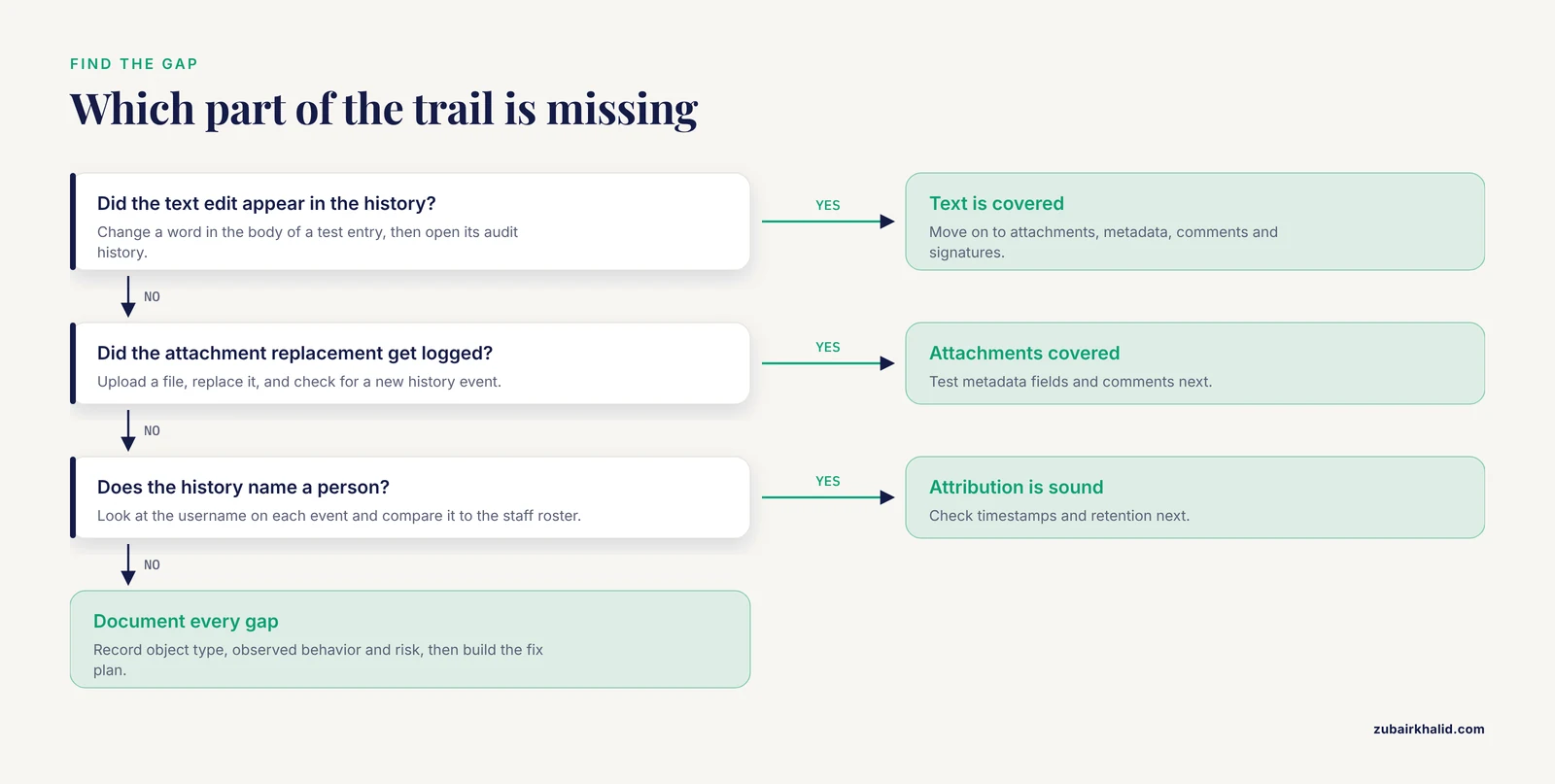
Work through this sequence on a non-production copy of your ELN, or on clearly marked test entries if you must work in the live system.
- Map your data objects. List every type of data your ELN holds: entry text, attachments, metadata, sample records, signatures, comments, instrument imports.
- Run the change test on each object type. Create a test entry. Modify the text. Upload and then replace an attachment. Change each metadata field. Add a comment. Apply an electronic signature. Record what appears in the trail after each action.
- Test attribution. Perform one action from your own account and, if policy allows, one from a secondary test account. Confirm the trail records the correct individual for each.
- Test timestamps. Compare a trail timestamp against a known reference clock. A trail that uses client-side time can be skewed by a user's device, which undermines the timestamp's reliability.
- Test bulk operations. Copy an entry. Bulk-edit five test records. Restore an old version. Check whether each affected record generated its own trail event.
- Test deletion and correction. Attempt to delete a test entry. Confirm the trail records the deletion attempt and that the original data cannot be silently obscured, which is a Part 11 requirement for audit trails [1].
- Check retention. Retrieve documentation of the audit log retention period. Compare it to the retention requirement for your longest-lived records.
- Document the gaps. For each failure, record the object type, the observed behavior, and the risk it represents. This document becomes the input to your fix plan and your risk assessment.
Risk-based approaches to data integrity use exactly this kind of structured assessment to identify vulnerable points and prioritize corrective actions [8]. The afternoon you spend testing is the cheapest data integrity investment your lab will make.
How to Fix an Incomplete Audit Trail
Fix the configuration first
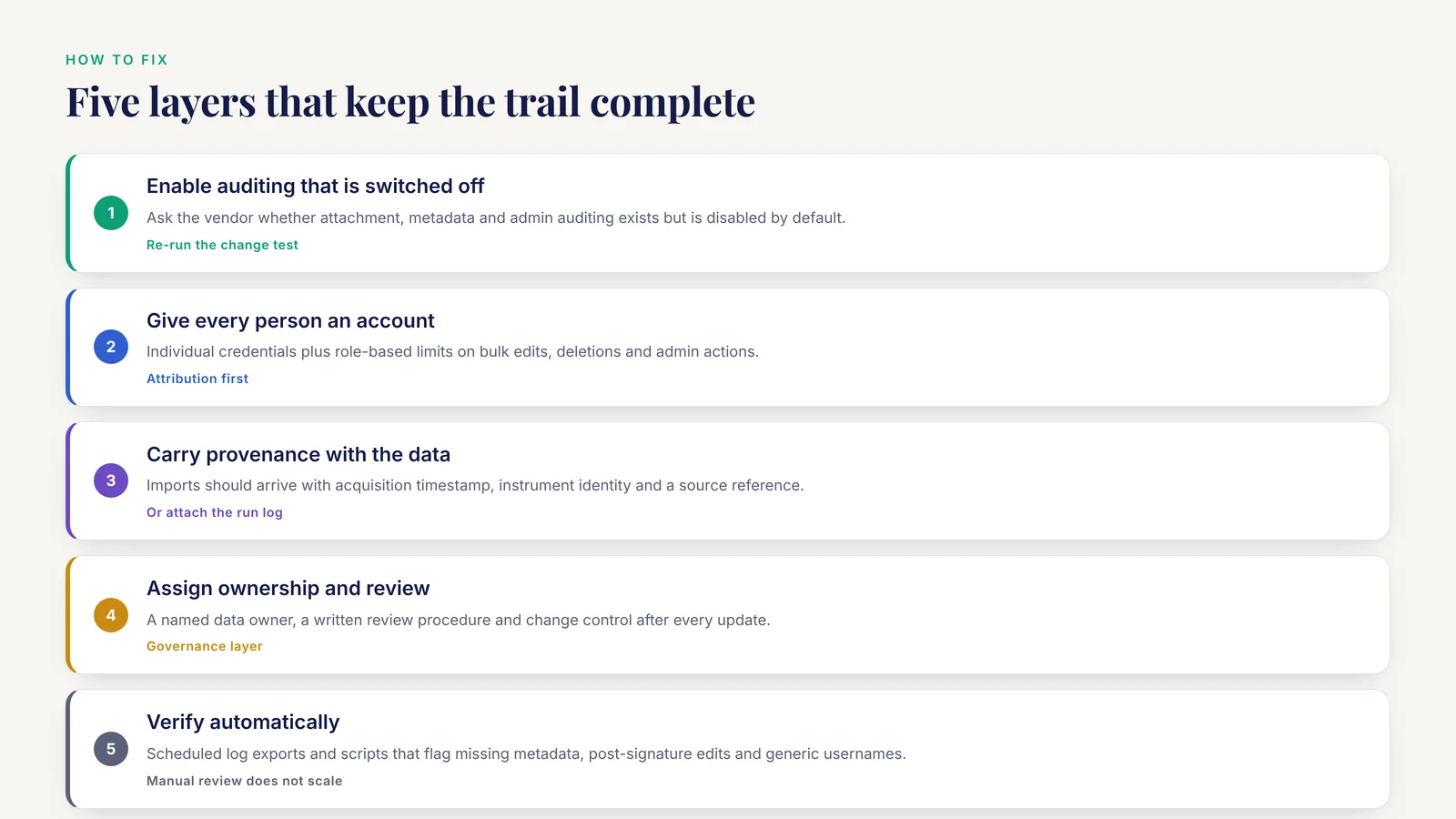
Most of the gaps found by the diagnostic sequence are configuration issues, not platform limitations. Before assuming your ELN cannot audit something, ask the vendor whether auditing exists for that object type and simply is not enabled. Audit trail settings for attachments, metadata, and administrative actions are frequently disabled by default. Enable them, then re-run the change test to verify the settings took effect.
Where the platform genuinely lacks a capability, document the gap and design a compensating control. For example, if custom metadata cannot be audited, restrict edit permissions to a small set of named users and require a change log for those fields. Compensating controls are standard practice in risk-based data integrity management [8].
Close the attribution gaps
Individual accounts are non-negotiable in any environment where the record matters. Configure role-based permissions so that administrative actions, bulk edits, and deletions are limited to the smallest set of users who need them. For manufacturing-adjacent workflows, match electronic signature configuration to process criticality rather than applying a single blanket setting, an approach shown to reduce compliance risk while keeping operations efficient [1].
Carry provenance with the data
For instrument integrations, require that imported data arrive with its acquisition timestamp, instrument identity, and a source reference. If your current integration cannot do this, attach the instrument's own run log to the entry so the upstream record travels with the downstream copy. This is a manual version of the end-to-end audit functionality that integrated pharmaceutical IT architectures are designed to provide [3].
Build the governance layer
Technical fixes decay without governance. An effective program assigns clear ownership for data quality standards, defines roles and responsibilities for record keeping, and establishes review routines that catch degradation before an inspection does [5]. In practice this means:
- A named data owner for the ELN deployment
- A written audit trail review procedure, with a defined frequency
- A change control process that re-verifies audit trail behavior after every update
- Training that teaches scientists why attribution matters, not just which buttons to press
Organizations that treat digital transformation as a governed program, with a roadmap, modern infrastructure, and a culture of continuous improvement, close integrity gaps faster than those that buy software and hope [6].
Verify automatically where possible
Manual trail review does not scale. Automated approaches exist for exactly this reason. A transformer-based model has been demonstrated that processes heterogeneous pharmaceutical manufacturing data, including raw sensor data and human-entered free text, to compute current and forecasted ALCOA+ compliance trends, catching declining data quality before inspections do [2]. Smaller labs without machine learning infrastructure can approximate the idea with scheduled automated exports of audit logs and simple scripts that flag entries with missing metadata, entries modified after signing, or trail events with generic usernames.
Consider tamper-evident storage for the trail itself
A remaining question in any audit trail design is whether the trail can be trusted. Conventional database logs are mutable and vulnerable to insider tampering, which fails the requirement for independently verifiable provenance. One demonstrated solution writes lightweight cryptographic hashes of records, rather than the records themselves, to a blockchain ledger, achieving complete tamper detection in a deployed healthcare records system [9]. Comparable hash-based integrity verification of audit logs is an emerging option worth evaluating with your vendor, particularly if your records support patent filings or regulatory submissions.
Common Mistakes and Limitations
- Assuming the demo proved the trail works. Vendor demonstrations run on curated data. Run your own change test on your own configuration before go-live and after every major update.
- Treating the audit trail as an IT problem. The trail fails in the ways users work, through shared logins, workarounds, copy-paste habits, and uncontrolled spreadsheets. The fix is procedural as much as technical, and data integrity culture is a recognized pillar of durable compliance [8].
- Comparing ELNs on features alone. An electronic lab notebook comparison based on checklists of audited object types misses what matters, which is whether the vendor can demonstrate the trail working on your data model during a proof of concept. Ask for that demonstration.
- Reviewing trails by sampling recent records only. Retention failures and configuration drift affect older records and long-running systems. Periodic review should include the oldest records your policy still requires you to keep.
- Copying templates without reviewing them. A lab notebook template copied from another lab often contains metadata fields nobody maintains and omits fields your integrity program needs. Audit the template itself. Every field in a lab notebook template is a potential untracked change if it is not covered by the trail.
- Believing one fix is permanent. Systems change, integrations change, people change. Continuous monitoring, not a one-time validation, maintains trail completeness over time [8].
One limitation on scope applies here. This article addresses the systems and process side of audit trail completeness. Individual regulated studies carry their own protocol-specific requirements, and the responsible quality unit or regulatory affairs function for your organization should confirm which requirements apply to your specific records.
Prevention Practices That Keep the Trail Complete
- Test the trail on every change. Any ELN upgrade, integration change, or permission change triggers a repeat of the change test on standard test entries.
- Individual accounts, always. Eliminate shared credentials and monitor for generic account usage in the trail itself, since a generic username appearing in your logs is itself a deviation to be reported [1].
- Review trails on a schedule. Define who reviews audit trails, how often, and what they look for: edits after signing, missing attribution, changes outside working hours, bulk operations.
- Keep the data model small. Every metadata field you add is another object to audit. Field sprawl in lab notebook templates is a quiet source of gaps. Prune fields nobody uses.
- Document compensating controls. Where the platform cannot audit something, write down the manual control that covers the gap, who performs it, and how it is verified. An audited, documented manual control is compliant. An undocumented one is not.
- Train for attribution, not for software. Scientists who understand that an unsigned, unattributed change can invalidate a record make different editing decisions than scientists who only know which menu to click.
- Align retention with record lifespan. Audit log retention must cover the full retention period of the records it protects, including records supporting marketed products or long-running studies.
- Integrate rather than re-enter. Every manual re-entry between systems is a provenance break. Favor controlled, logged data flows between the ELN and neighboring systems [6].
Frequently Asked Questions
What is an ELN audit trail supposed to record?
It should record who changed what, when, and why, for every data object in the system, with before and after values, individual attribution, and server-side timestamps. Under ALCOA+, the trail must be complete, not partial, so attachments, metadata, and signatures count as much as entry text.
Why does my audit trail show nothing when I edit an entry?
The most likely reason is that the specific field or object you edited sits outside the audited scope, which is common for attachments, comments, and custom metadata fields. Run the change test from the diagnostic sequence to map exactly which object types your trail covers.
Do attachments and instrument files need audit trails?
Yes. A record includes its raw data, so a replaced or modified attachment is a record change that must be captured. At minimum the trail should log who uploaded, replaced, or deleted each file and when, and ideally it should also preserve the acquisition timestamp and source of instrument-generated data [3].
What is ALCOA+ and how does it apply to ELNs?
ALCOA+ is a data quality standard requiring that data be Attributable, Legible, Contemporaneous, Original, and Accurate, plus Complete, Consistent, Enduring, and Available. An ELN audit trail is the mechanism that makes most of those properties verifiable, particularly attribution, contemporaneous recording, and completeness.
Can shared lab accounts cause audit trail gaps?
Yes, and they are among the most damaging gaps because the trail records activity under the shared username rather than the actual person, breaking attribution entirely. Generic account usage is a recognized compliance risk addressed through individual accounts plus procedural controls [1].
How do I test whether my audit trail is complete?
Create a test entry and perform every action category in it: text edit, attachment upload and replacement, metadata change, comment, signature, copy, bulk edit, and deletion attempt. Then inspect the trail after each action and record what was logged. Anything you did that does not appear is a gap.
Does moving to a new ELN preserve the old audit trail?
Only if the migration is designed to carry it. Audit history is data like any other, and migrations frequently transfer current record content while dropping historical trail events. Make trail migration an explicit acceptance criterion in the vendor contract and verify it with test records before decommissioning the old system.
What should a lab notebook template include for audit readiness?
Include only metadata fields your team will actually maintain, since unused fields create untracked change surface. Include a place for change rationale when corrections are needed, named owner fields rather than free-text author lines, and structure that keeps raw data files attached to the entry they belong to. Review the template itself whenever your audit trail configuration changes.
Sources
- 21 CFR Part 11 Compliance in MES: Electronic Signatures and Data Integrity
- Deep Transformers for Computing and Predicting ALCOA+Data Integrity Compliance in the Pharmaceutical Industry
- IT Systems in Pharmaceutical Operations: Ensuring Data Integrity, Compliance, and Public Safety
- The importance of quality assurance in clinical trials: Ensuring data integrity and regulatory compliance in the U.S. pharmaceutical industry
- Enterprise Data Governance : A Comprehensive Framework for Ensuring Data Integrity, Security, and Compliance in Modern Organizations
- Digital Transformation in the Pharmaceutical Industry: Ensuring Data Integrity and Regulatory Compliance
- The impact of cybersecurity on financial reporting: Strengthening data integrity and regulatory compliance
- Ensuring Data Integrity in Pharmaceutical Quality Systems: A Risk-Based Approach
- Ensuring Data Integrity in Healthcare Records through Hybrid Storage and Blockchain-Backed Audit Trails