Electronic Lab Notebooks for IP Protection
By Dr. Zubair Khalid, DVM, MS, PhD ·

A paper notebook proves what you did only as well as your ink, handwriting, and witnesses allow, while an electronic lab notebook (ELN) proves it with automatic timestamps, login records, and signed entries that cannot be quietly altered. The rule of thumb is simple: if your work might produce a patent application or a trade secret, choose a record-keeping system whose entries carry a verifiable date, an attributed author, a witnessing step, and an audit trail. Everything else about choosing a notebook is secondary to those four properties.
This article explains what electronic lab notebooks for IP protection actually do, lays out the main options in a side-by-side comparison, weighs the pros and cons of each, walks through worked scenarios, and gives you a lab notebook template you can adapt whether you write on paper or in software.
Why Lab Notebooks Matter for Intellectual Property
Intellectual property (IP) is legally protected creative or inventive work. In a research setting, the two forms that matter most are patents, which grant exclusive rights to an invention in exchange for a public disclosure, and trade secrets, which protect valuable information as long as you take reasonable steps to keep it confidential.
A lab notebook sits at the center of both. Patent practice uses notebook records to establish three things: conception (the moment the inventive idea was complete in the inventor's mind), diligence (continuous, reasonable effort to reduce the idea to practice), and reduction to practice (the actual working demonstration). In a derivation or inventorship dispute, dated, witnessed entries are the evidence that decides who contributed what. For trade secrets, the notebook is part of your "reasonable measures": a confidential document with access controls, signed confidentiality expectations, and a clear history of who saw what and when.
The United States moved to a first-inventor-to-file system under the Leahy-Smith America Invents Act, so the first patent filing usually wins. Even so, notebook records remain central because patents require named inventors, inventorship challenges are common, and the underlying evidence of who invented what still comes from contemporaneous records. A notebook cannot substitute for a filing, but it can make or break the filing.
Paper notebooks have a long tradition in this role. The classic standard is a bound book with numbered pages, entries in permanent ink, no blank gaps, dated and signed every day, and each page read and countersigned by a witness who understands the work but is not a co-inventor. This system works, and many labs still use it. Its weaknesses are practical: no backup, poor searchability, difficulty proving the exact time of an entry, vulnerability to loss or damage, and a heavy administrative burden when thousands of pages need review during patent preparation.
Electronic Lab Notebooks for IP Protection: The Main Options
An electronic lab notebook is software that replaces or supplements the paper notebook by capturing experimental plans, methods, raw data, images, observations, and analysis in a searchable, access-controlled digital record. Adoption in industry is not theoretical. A worldwide biopharmaceutical research firm implemented ELNs specifically to protect intellectual property while reducing paperwork, a decision reported in the health management technology literature in 2007 [1]. That case reflects a broader pattern: organizations with the most at stake in IP moved away from paper first.
The realistic options for a lab today fall into five categories.
Option 1: Traditional Paper Notebooks
The bound, page-numbered, ink-and-witness notebook. Nothing about it is electronic, but any honest comparison of electronic lab notebooks for IP protection starts here, because paper set the legal expectations that ELNs must meet.
Option 2: Hybrid Paper Plus Scanning
You keep the paper notebook as the primary record, then scan or photograph each signed page and upload it to a managed digital archive with dates and access logs. The paper original remains the legal anchor, and the digital copy adds search, backup, and remote access.
Option 3: In-House Built ELNs
Some organizations with strong software teams build their own ELN on top of internal databases and document systems. The advantage is exact fit with internal workflows and IP policies. The disadvantage is maintenance cost, and the burden of proving to outside counsel or a court that the system enforces integrity.
Option 4: Commercial Cloud ELNs
Vendor-hosted platforms delivered over the internet, often on a subscription basis. Modern commercial ELNs typically include automatic timestamps, individual user accounts, immutable audit trails that record every edit, electronic signature workflows, template libraries, and rich data types such as instrument files, images, and molecular structures. Vendors in regulated industries also design for audit readiness, since the same record-integrity features that satisfy quality regulators also strengthen IP claims.
Option 5: LIMS-Integrated ELNs
A laboratory information management system (LIMS) tracks samples, batches, instruments, and workflows. When an ELN is integrated with a LIMS, the notebook entry links directly to the physical sample record, the instrument run, and the quality data. For labs whose IP depends on reproducible sample handling, this linkage is a significant legal asset.
Side-by-Side Comparison
The table below is the core of this electronic lab notebook comparison. It evaluates each option against the criteria that decide real IP outcomes.
| Criterion | Paper Notebook | Paper Plus Scan | In-House ELN | Commercial Cloud ELN | LIMS-Integrated ELN |
|---|---|---|---|---|---|
| Contemporaneous timestamp | Manual date only | Manual date, scan date added | Automatic, if built correctly | Automatic, with time zone | Automatic, with time zone |
| Author attribution | Handwritten signature | Signature on original, uploader identified | Login-based | Login-based, often with multi-factor authentication | Login-based |
| Witnessing | Physical countersignature | Countersignature on original | Configurable e-signature workflow | Built-in e-signature routing | Built-in e-signature routing |
| Tamper evidence | Ink, glue, page numbering | Scan can be edited, original helps | Depends on design and audit log | Immutable audit trail of every change | Immutable audit trail, plus sample chain of custody |
| Search across years | None or minimal | Full-text if OCR is applied | Good | Excellent | Excellent, across structured data |
| Rich data (images, instrument files) | Pasted or referenced | Referenced | Variable | Strong native support | Strong, linked to sample records |
| Backup and disaster recovery | None, single physical copy | Digital copy after scanning | Organization-dependent | Vendor-managed, verify the terms | Vendor or IT-managed |
| Access control for trade secrets | Physical custody only | Physical plus folder permissions | Configurable | Granular roles and permissions | Granular, tied to sample level |
| Review burden for patent preparation | High, manual reading | Medium, searchable scans | Low to medium | Low, templates standardize entries | Low, structured data exports |
| Cost profile | Low unit cost, high labor cost | Paper cost plus scanning labor | High build and maintenance cost | Subscription fees, low setup effort | Highest, requires LIMS infrastructure |
| Best fit | Solo work, traditional labs | Small labs transitioning | Large organizations with unique needs | Most academic and biotech labs | Bioprocessing, QC, and production research |
No single column wins every row, which is why the choice depends on your situation rather than on a universal "best" product.
Pros and Cons of Each Option
Paper Notebooks
Pros. Universally understood by patent practitioners, cheap to start, requires no software validation, and works during power or network failures. A well-maintained paper notebook remains admissible and persuasive evidence.
Cons. One copy, one location. A fire, spill, or theft can destroy years of evidence. Dates are self-reported, so a skeptical party can challenge when an entry was truly made. Search means flipping pages. Handoffs between departing students and new lab members routinely lose context, and the paperwork burden grows with the size of the research program, which is exactly the problem that drove a major biopharmaceutical firm to adopt ELNs [1].
Hybrid Paper Plus Scanning
Pros. Preserves the legal familiarity of paper while adding backup and search. Good transition strategy for labs that cannot abandon paper immediately.
Cons. The scan inherits every weakness of the original, including unprovable dates. Scans can be edited unless you add integrity controls. The double record-keeping burden is real, since someone must scan, name, file, and verify every page.
In-House ELNs
Pros. Perfect alignment with internal IP policy, full control of data residency and retention, and no per-seat subscription fees at very large scale.
Cons. Development and maintenance costs are substantial. Your organization must document and prove system integrity, because an in-house tool has no independent track record. Staff turnover in the software team can leave orphaned systems, and a poorly built audit trail is worse than paper because it lends false confidence.
Commercial Cloud ELNs
Pros. Integrity features arrive out of the box: automatic timestamps, unique logins, locked version histories, and electronic witness signatures. Templates enforce consistent entries, which makes review for patent disclosure faster and more reliable. Search across years of experiments takes seconds. Backups and availability are the vendor's contractual responsibility. The industry evidence base is mature, since pharmaceutical companies adopted these systems early and specifically to strengthen IP protection while cutting paperwork [1].
Cons. Subscription costs scale with headcount. Data lives on someone else's infrastructure, so you must verify retention terms, export formats, and what happens to your data if you stop paying. Contract and procurement review takes time. Labs with poor internet connectivity need offline provisions.
LIMS-Integrated ELNs
Pros. The notebook entry connects to the physical sample, the instrument run, and the analytical result in one traceable chain. For IP built on biologics, cell lines, or manufactured batches, this chain of custody is powerful evidence.
Cons. Highest cost and complexity, and integration projects often take many months. Overkill for a small discovery lab whose IP questions never touch sample logistics.
What Makes an Electronic Record Credible for IP Purposes
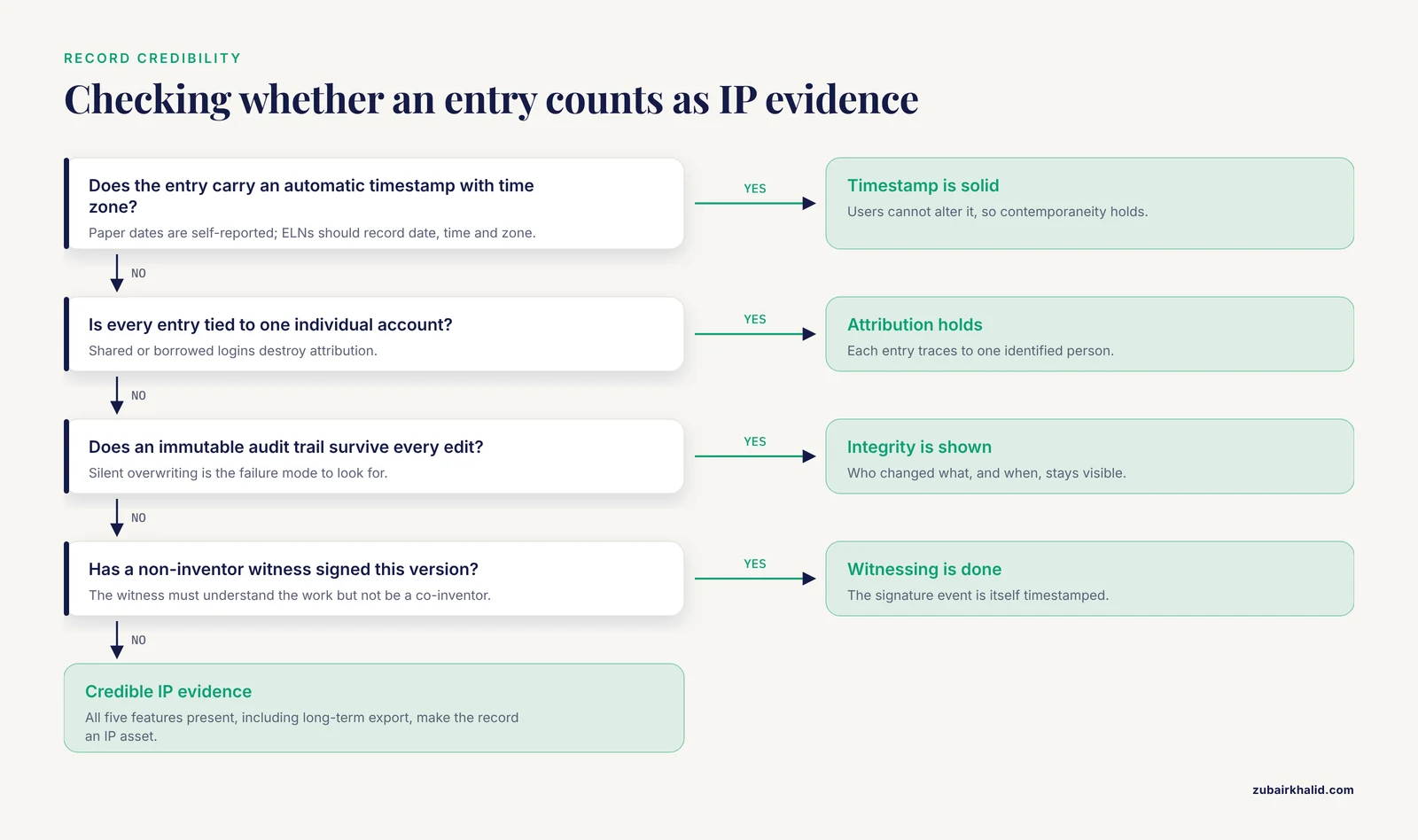
Whether an entry is a bound page or a database row, credible IP evidence has the same anatomy. Understanding it lets you evaluate any electronic lab notebook intellectual property protection claim a vendor makes.
Contemporaneity. The record must be created at the time of the work, not reconstructed later. Automatic timestamps with explicit time zones are the ELN's core advantage over paper, where the date is whatever the writer asserts.
Attribution. Each entry must be traceable to one identified person through a unique, non-shared account. Shared logins destroy attribution and are one of the fastest ways to weaken an IP record.
Integrity. The record must show whether and how it was changed. A credible ELN keeps an immutable audit trail: every edit is logged with who made it, when, and what changed. Editing is legitimate in research, but the history must survive. Silent overwriting is the failure mode.
Witnessing. A person other than the inventor, who understands the work without having contributed to the inventive concept, reviews the entry and signs. In an ELN this is an electronic signature tied to the witness's own account, applied to a specific version of the entry, with the signature event itself timestamped.
Retention. Records must survive for the relevant legal horizon, which for patents can stretch decades past the filing. Ask any vendor or IT department directly how records are preserved, backed up, and exported.
Access control. For trade secrets, access must be limited to people who need it, and the system must log who viewed what. Confidentiality is measured partly by your ability to demonstrate that access was controlled.
Choosing the Best Electronic Lab Notebook for Intellectual Property Protection
Rank candidates against the credibility features above before you consider convenience features. The best electronic lab notebook intellectual property protection is the one that satisfies all five features in your actual workflow, and a system that misses any of them is a documentation tool, not an IP asset.
Use this checklist during vendor evaluations or internal reviews:
- Ask for a demonstration of the audit trail. Edit an entry, then view the change history.
- Confirm that timestamps include the date, time, and time zone, and that users cannot alter them.
- Test the witness e-signature workflow end to end, including what happens when a witness declines or a version changes after signing.
- Verify that every user has an individual account and that multi-factor authentication is available.
- Review the contract for data ownership, export formats, retention after contract end, and backup schedules.
- Check how the system handles corrections. Good systems require a reason for change and preserve the original.
- Confirm the export path. Your records must be retrievable in a human-readable format years from now, even if the vendor disappears.
Worked Scenario 1: The Academic Lab
A university protein engineering lab with eight graduate students files one or two invention disclosures a year through its technology transfer office. Budget is limited and students rotate. Here a commercial cloud ELN on an academic subscription usually fits best. The automatic timestamps and e-signatures strengthen the disclosure record, templates make the tech transfer office's review easier, and departing students leave behind searchable, complete records instead of shelf-bound paper. The lab should still train students on the classic disciplines, including dated entries and witnessing of key results, because habits transfer to any system.
Worked Scenario 2: The Startup Preparing Patent Filings
A ten-person biotech startup is twelve months from its first patent filing and needs records that outside counsel can rely on without an archaeology project. A commercial cloud ELN with strong audit trails and e-signatures is again the typical fit, but the selection bar is higher: the startup should confirm export fidelity, because diligence reviews and potential acquisition mean its records must leave the platform cleanly. Leadership should also pair the ELN with basic trade secret measures, including role-based access and confidentiality agreements, since the notebook alone does not satisfy the "reasonable measures" requirement.
Worked Scenario 3: The Global Biopharmaceutical Organization
A large company with sites on several continents faces the combined problem the 2007 industry report captured: IP protection and paperwork reduction at scale [1]. Thousands of scientists, millions of pages, and patent portfolios worth billions make paper untenable. At this scale the realistic choice is between a commercial cloud ELN and a LIMS-integrated ELN, with many organizations running both, an ELN for discovery research and a LIMS-linked system for development and manufacturing data. The in-house option appeals only to organizations that can sustain a permanent software team and accept the burden of proving system integrity to auditors and courts.
Building a Lab Notebook Template That Protects IP
Whatever system you use, the entry itself must contain the information a patent attorney or a court will need years later. The following lab notebook template works equally well as a paper page layout and as a template configured inside an ELN. Consistency matters more than elegance, because reviewers scan hundreds of pages looking for gaps.
| Field | What to Record |
|---|---|
| Date and time | The real date and, in an ELN, the automatic timestamp. Never backdate or postdate. |
| Title and project identifier | A descriptive title plus the project or matter number so records can be tied to specific inventions. |
| Objective | One or two sentences on what the experiment is meant to test and why. |
| Materials and reagents | Identities, lot numbers, concentrations, and sources, in enough detail for someone else to repeat the work. |
| Methods | Step-by-step protocol actually followed, including deviations from the planned protocol, noted as they happen. |
| Raw data | Instrument outputs, images, and measurements attached directly, not referenced to a personal drive. |
| Observations | Unexpected results, failures, and anomalies. Negative results matter for diligence and prior art. |
| Analysis and conclusions | Your interpretation, clearly marked as interpretation. |
| Next steps | What follows, which documents diligence. |
| Signature | Author's signature and date, or e-signature. |
| Witness signature | A non-inventor who read and understood the entry, signed and dated. |
In an ELN, build this structure once as a reusable template. Standardized entries reduce the review burden dramatically, and consistency across a large organization is part of what made ELN adoption attractive to the biopharmaceutical firm documented in the industry literature [1].
Common Mistakes and Limitations
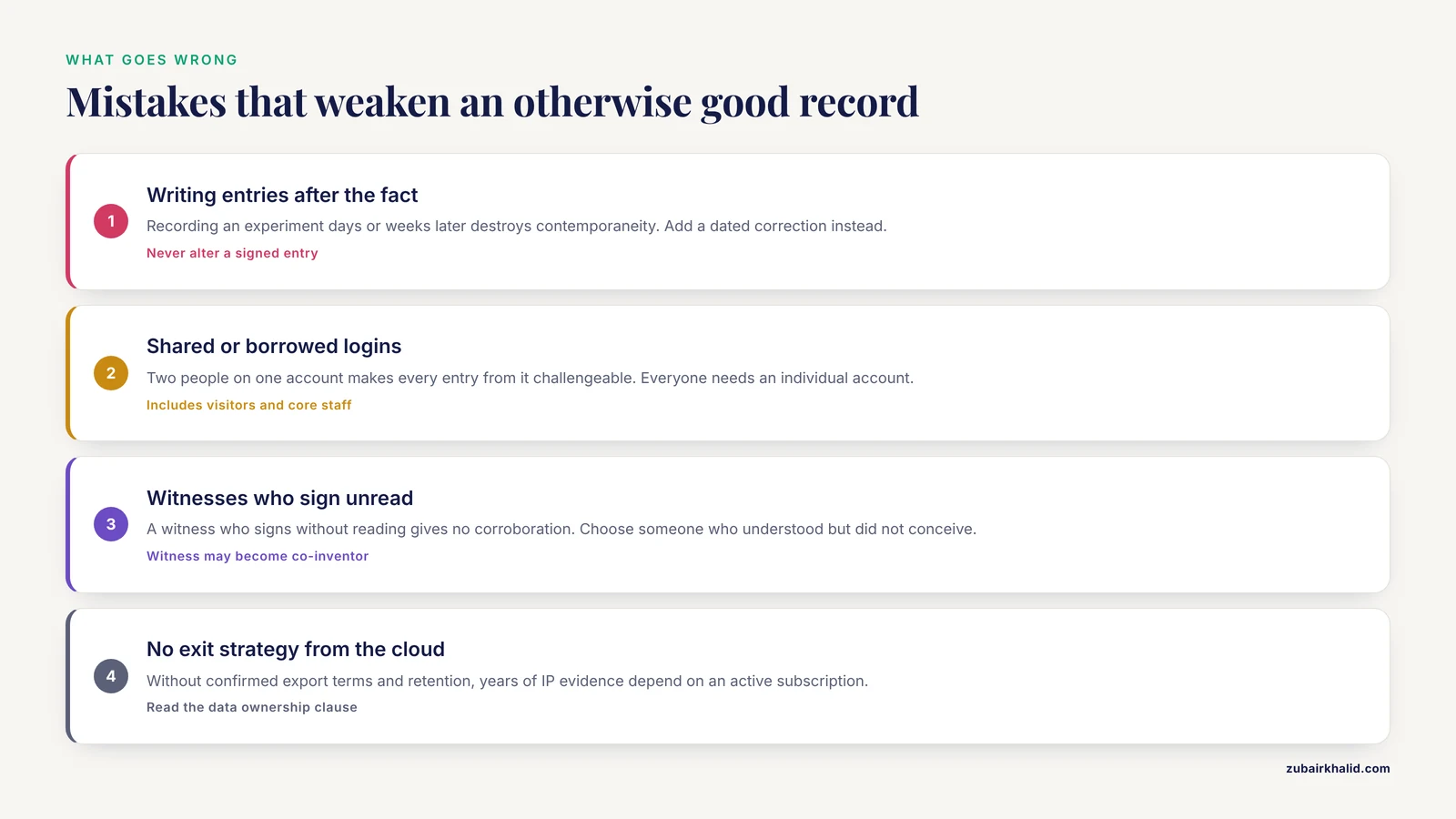
These are the errors that most often turn an otherwise good record system into a weak IP position.
Backfilling entries. Writing an entry days or weeks after the experiment destroys contemporaneity. If you must reconstruct, write a dated correction or supplement that states when the original work occurred and when you are recording it. Never alter an existing signed entry.
Shared or borrowed logins. If two people use one account, attribution fails and every entry from that account becomes challengeable. Every user, including visitors and core facility staff, needs an individual account.
Treating a scanned page as tamper-proof. An image file can be edited. The hybrid approach works only because the paper original exists. Do not discard originals after scanning unless legal counsel has explicitly approved it.
Witnessing as a rubber stamp. A witness who signs without reading provides no corroboration. Train witnesses to check that the entry makes sense, that data are attached, and that the date is correct. A witness who contributed to the inventive concept may become a co-inventor, which changes the patent's ownership picture, so choose witnesses who understood but did not conceive the work.
Ignoring the exit strategy. Signing a cloud ELN contract without confirming export terms and retention after cancellation risks holding years of IP evidence hostage to an active subscription. Read the data ownership clause before signing, not during a dispute.
Assuming the notebook is the patent. A notebook is evidence, not protection. IP rights arise from filings, agreements, and confidentiality measures. The notebook supports those instruments, it does not replace them.
Neglecting trade secret hygiene. Even a perfectly audited ELN leaves trade secrets exposed if employees email extracts freely, share screenshots, or keep broad access rights after project reassignment. Review access lists quarterly.
One limitation to keep in view. Notebook practice interacts with patent law, employment agreements, and institutional policy, and the right answer differs by jurisdiction and contract. For any specific invention, dispute, or disclosure decision, consult your technology transfer office or a qualified patent attorney, because general record-keeping practice cannot substitute for individual legal advice.
Frequently Asked Questions
Do courts and patent offices accept electronic lab notebooks?
Yes, electronic lab notebooks are accepted when their entries show clear authorship, reliable timestamps, tamper-evident change histories, and proper witnessing, and many patent practitioners now prefer well-audited digital records. The weight a record carries depends on those integrity features, not on whether the medium is paper or pixels.
What is the best electronic lab notebook for intellectual property protection?
The best choice is the one that provides automatic timestamps, individual user authentication, an immutable audit trail, electronic witness signatures, and guaranteed long-term export, and that fits your budget and workflow. Evaluate candidates against those five features rather than against feature-list length, and involve your technology transfer office or counsel in the final decision.
Can I still use a paper notebook?
Yes, a properly maintained bound paper notebook with permanent ink, daily signatures, and witness countersignatures remains valid IP evidence. Just understand the tradeoffs: no backup, no searchability, self-reported dates, and a heavy review burden, which is why many organizations have moved to electronic systems.
What should a lab notebook template include?
Every entry should capture the date and time, a title and project identifier, the objective, materials with lot numbers and concentrations, the methods actually followed, raw data as attached files, observations including failures, your marked interpretation, next steps, and dated signatures from both the author and a non-inventor witness. Configure this once in your ELN so every experiment starts from the same structure.
How does witnessing work in an electronic lab notebook?
The witness reviews a specific, locked version of the entry through their own individual account and applies an electronic signature, and the system records who signed, which version, and exactly when. The witness must be knowledgeable about the work but not a co-inventor, and the signature event itself becomes part of the audit trail.
Does an ELN protect trade secrets?
An ELN supports trade secret protection through access controls, view logs, and confidentiality attribution, all of which count toward the "reasonable measures" standard, but it is only one component. Complete protection also requires confidentiality agreements, access reviews, and exit procedures, so treat the ELN as the record-keeping layer of a broader confidentiality program.