The Impact of Data Sharing on Reproducibility
By Dr. Zubair Khalid, DVM, MS, PhD ·

Data sharing improves reproducibility because it lets other researchers inspect, reanalyze, and reuse the exact data behind a published result instead of trusting a summary in a paper. When the underlying data and code stay locked away, reproducibility depends on trust. When they are open, it depends on evidence.
This article explains what data sharing, reproducibility, and open science actually mean, what the evidence shows about their impact, where sharing breaks down in practice, and how you as a student, technician, or principal investigator can share data in a way that genuinely helps science.
What Data Sharing, Reproducibility, and Open Science Mean
These three terms describe different parts of the same goal, which is research that others can verify and build on.
Data sharing means making the raw or processed data underlying a publication accessible to others, usually through a public repository or a controlled-access archive. Reproducibility means that an independent researcher, given the same data and methods, can arrive at the same result. In computational life sciences, reproducibility usually requires three things together, the data, the code, and a description of the computing environment. Open science is the umbrella term for practices that make research transparent and accessible, including data sharing, open access publishing, code sharing, preprints, preregistration, and open peer review [1].
Reproducibility is not the same as replication. Reproducing a result means rerunning the same analysis on the same data. Replicating a result means repeating the experiment from scratch and seeing whether the finding holds. Data sharing directly supports the first and indirectly supports the second, because shared datasets let others test alternative analyses, check statistical assumptions, and design better replication attempts [2].
In the life sciences the stakes are high. Translational research across biomedicine has well-documented rigor and reproducibility problems, and open sharing of high-quality data is widely promoted as a countermeasure to those problems [3].
Why Sharing Data Improves Reproducibility
The mechanism is simple. A published paper is a compressed summary. It reports effect sizes, p values, and selected figures, but it cannot contain every data point, every processing step, and every analytical decision. Sharing the underlying data decompresses the research, and that produces several concrete benefits.
Verification. With the data and code in hand, a reviewer or reader can confirm that the numbers in the paper actually follow from the data. Studies of computational life science have long noted that the code and data behind large-scale analyses are often missing from publications, which makes verification impossible [1].
Error detection. Analysts make mistakes. Spreadsheet misalignment, swapped group labels, and silent failures in pipelines are common. Shared data and code let these errors surface before they propagate into reviews, meta-analyses, and clinical decisions.
Reuse and new questions. A dataset collected to answer one question can answer others. In pharmacometrics, the discipline of quantitative modeling of drug behavior, publicly shared individual-level data and models allow merged analyses across organizations, giving more precise answers to old questions and enabling entirely new ones [2].
Method development. Statisticians and computational biologists need real data to develop, validate, and refine methods. Access to actual trial datasets, rather than simulated ones, exposes methods to the messiness of real research, which is exactly where methods fail [4].
Training. Students learn analysis best on real, messy datasets. Shared data lowers the barrier for the next generation, and educational interventions built around open science platforms have been shown to improve both knowledge mastery and innovation capacity in medical trainees [5].
What the Evidence Shows
The case for data sharing rests partly on logic and partly on measurement. Measurement in this field means auditing data sharing statements, the short sections in papers that declare whether and how data are available. The picture that emerges across disciplines is consistent, statements are becoming more common but actual openness lags far behind.
In addiction medicine, a review of articles from the top 10 journals between 2018 and 2023 found that only about 23 percent of articles included a data sharing statement, though that figure rose to 52 percent by 2023. Clinical trials were more likely to include statements than cohort studies, and journals whose publishers required sharing had the highest statement rates. Even among authors who did include statements, most offered only conditional access, and only a minority used public repositories. When authors were contacted directly, 62 percent were willing to share data, but many imposed conditions related to ethics, privacy, or resources [6].
In anesthesiology, a cross-sectional study of five high-impact journals from 2020 to 2023 found that data sharing statement prevalence varied widely by journal and year, climbing from 15 percent to 30 percent in one journal while staying below 8 percent in another across the same period. Government funding predicted statement inclusion, and higher journal impact factor was actually associated with fewer statements [7].
In ecology and evolution, a survey of 275 journals found that 38.2 percent mandated data sharing and 26.9 percent mandated code sharing, with most mandates requiring deposition before peer review. Journals that only encouraged sharing saw far weaker compliance, confirming that policy strength drives behavior [8].
In materials science, a survey of research data policies across 171 journals from 17 publishers found clear progress, nearly all journals now have a data policy and most mention data availability statements. But enforceable requirements remain uncommon, public deposition is rarely mandatory, and expectations for research software lag well behind those for data, with little attention to versioning, persistent identifiers, or reproducible execution environments [9].
Large-scale monitoring of general medical journals is now possible with automated tools. One study analyzed 15,624 research articles in 10 leading general medical journals using automated detection of 13 core open science practices, validated against manual extraction, showing that article-level implementation of policies can finally be measured at scale [10]. A companion study validated a locally run large language model pipeline against a manual reference standard of 303 articles and found that performance was strong for practices reported in standardized statements but weaker for practices that require judgment, a useful reminder that automation helps audit open science without replacing human assessment [11].
Taken together, these audits describe the impact of data sharing on reproducibility from the supply side. The demand side, whether shared data actually get reused, is visible in repositories where reuse is tracked. OpenNeuro, a brain imaging archive, has seen more than 150 published reuses of its more than 600 shared datasets [12]. Reuse is the downstream payoff that makes upstream sharing worthwhile.
The "Available on Request" Problem
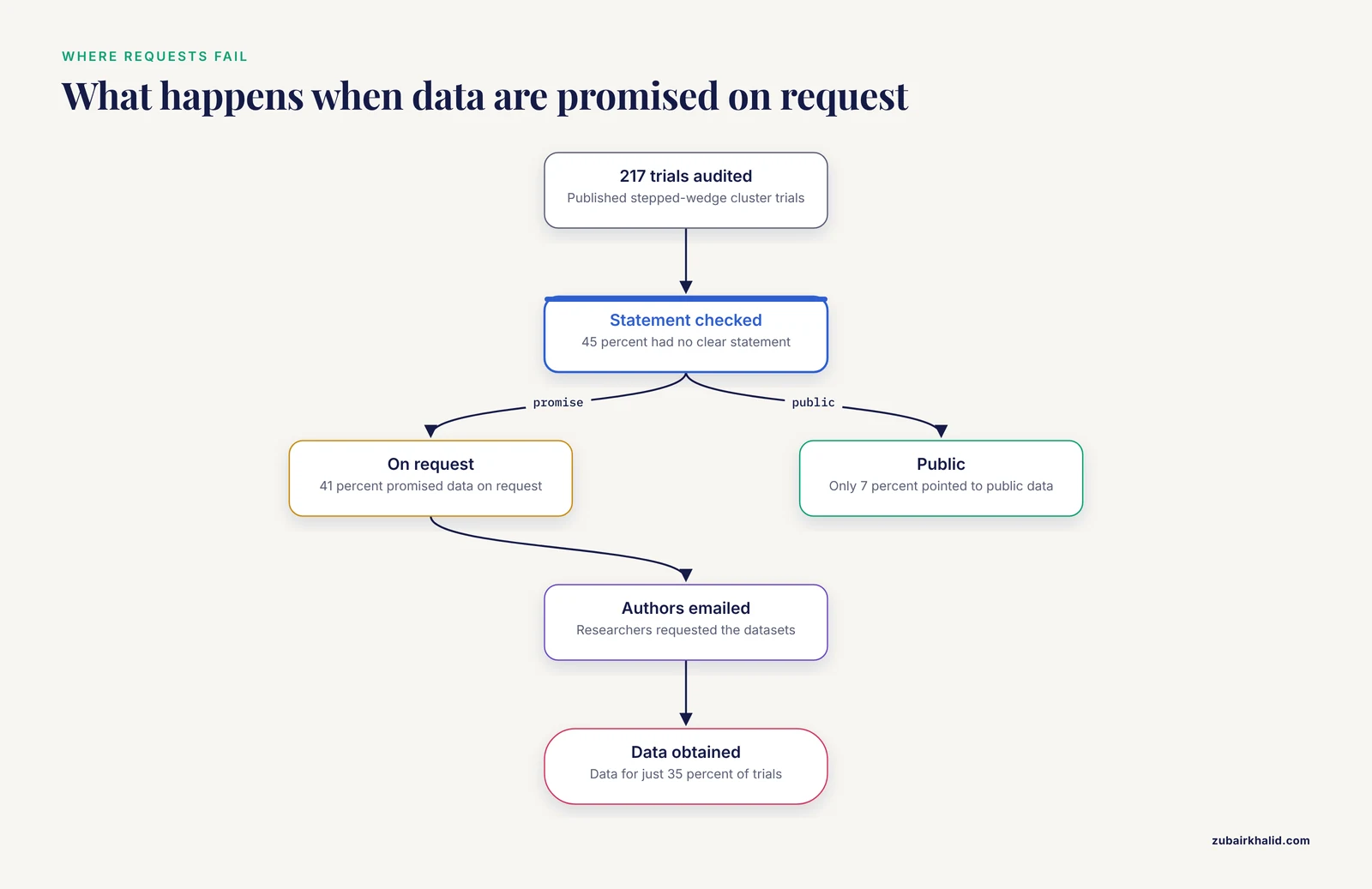
The most common form of data sharing statement in biomedical literature promises that data are available from the authors on reasonable request. Evidence shows this model largely fails.
A study of 217 published stepped-wedge cluster randomized trials, a trial design used in health services research, illustrates the gap starkly. Of these trials, 45 percent had no clear data sharing statement, 41 percent claimed data were available upon request, 7 percent said data were not available, and only 7 percent pointed to public availability. The researchers then emailed the authors to request the datasets. They ultimately obtained data for just 35 percent of trials, and data obtainment did not differ between trials with no statement at all and those promising data on request [4].
In other words, the promise of availability was about as informative as no promise at all. This is why journal editors increasingly argue for mandatory repository-based sharing. A practical framework published for biomedical journals recommends combining clear requirements, persistent data deposition, standardized availability statements, justified exemptions for legal or ethical constraints, and active editorial support, explicitly to reduce reliance on the ineffective request model [13].
Examples of Data Sharing Working in Practice
Examples of functioning research data sharing infrastructure show what good looks like and why domain-specific solutions matter.
OpenNeuro for brain imaging
OpenNeuro is a BRAIN Initiative data archive that openly shares brain imaging data following the FAIR principles, which are Findable, Accessible, Interoperable, and Reusable. A key to its success is the Brain Imaging Data Structure, a community standard for organizing neuroimaging data that enables effective curation, sharing, and reuse. The archive holds more than 600 datasets covering more than 20,000 participants across multiple species and measurement modalities, and its shared data have already generated more than 150 published reuses [12].
The Open Data Commons for Traumatic Brain Injury
The Open Data Commons for TBI, launched in 2018, is a researcher-led specialist repository for preclinical traumatic brain injury research. It is now the recognized repository for that field, listed on the National Library of Medicine recommended repository listing and supported by the National Institute of Neurological Disorders and Stroke. It forms part of the PRECISE-TBI interagency effort to promote data sharing, rigor, and reproducibility in preclinical TBI research. After broad outreach starting in 2022, the platform saw significant increases in users and datasets uploaded [3]. The lesson is that biomedical communities work best when they define their own data sharing requirements through specialist hubs that funders and journals can then reference.
Pharmacometrics and disease-specific databases
In pharmacometrics, several consortia have built disease-specific shared databases for drug-disease modeling, including databases for Alzheimer disease, malaria, oncology, Parkinson disease, and tuberculosis, alongside efforts by standards organizations to solve data format and exchange problems. A model repository for executable model code and associated information was developed because past sharing of models had been sparse [2].
Standards and ontologies
Heterogeneous data impede integration and analysis. In cancer vaccine research, a database of manually annotated vaccines was complemented by an ontology, a formal structured vocabulary that defines entities and their relationships, enabling systematic querying and integration across sources [14]. This illustrates a broader point. Sharing data is necessary but not sufficient. Shared data need shared definitions, formats, and metadata to be interoperable.
A tiered framework for trial data
Clinical trial data raise the hardest questions, because individual participant data are sensitive. A recent proposal frames trial data transparency as a three-tier framework matched to scientific purpose. Tier 1 comprises reduced datasets released at publication that support endpoint-level numerical reproducibility. Tier 2 comprises full reproducibility packages. Higher tiers support deeper reuse such as pooled analyses. The core idea is that the type of data released should match the scientific claims and reuse activities it is meant to support, which gives trialists a realistic path to transparency without requiring full raw data disclosure in every case [15].
Comparing Data Repositories
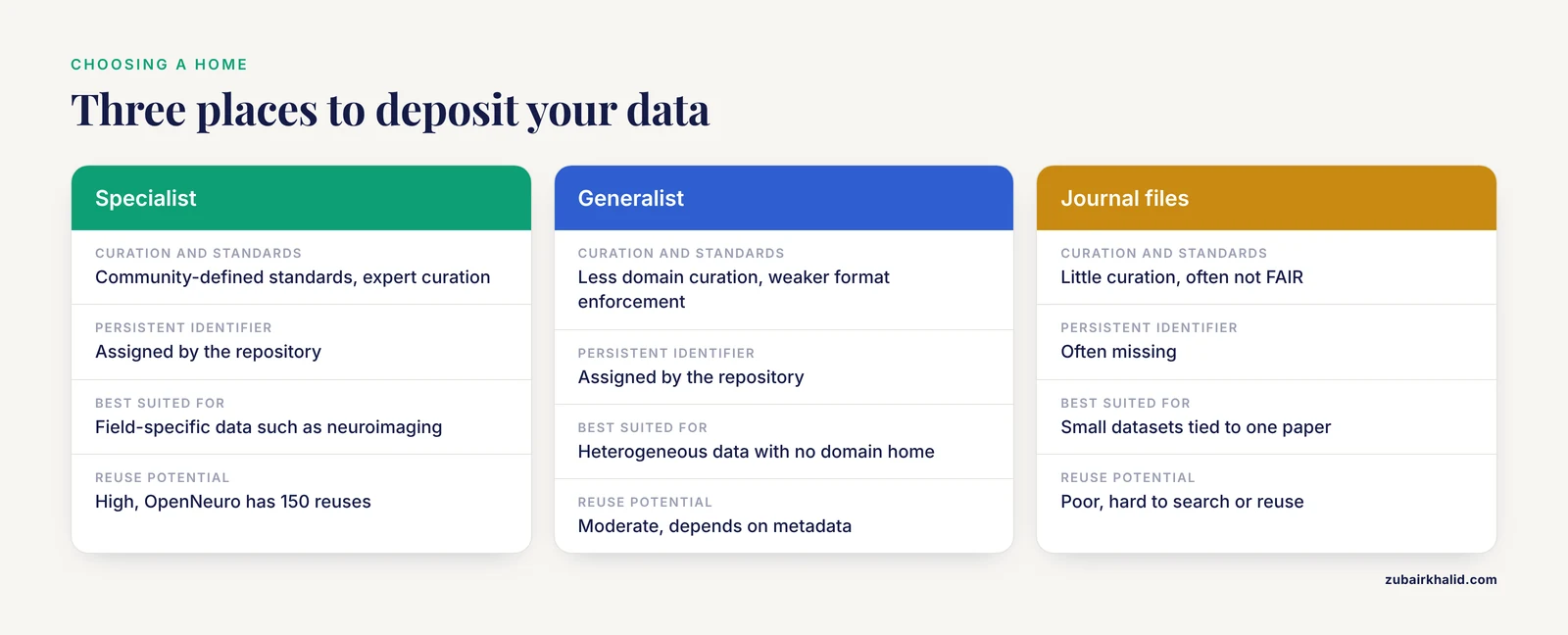
Choosing where to deposit data is one of the most consequential decisions in research data sharing. The right choice depends on data type, sensitivity, and community norms. The comparison below summarizes the main options.
| Repository type | Examples | Best suited for | Key strengths | Main limitations |
|---|---|---|---|---|
| Specialist domain repository | OpenNeuro [12], Open Data Commons for TBI [3] | Field-specific data types such as neuroimaging or preclinical TBI studies | Community-defined standards, expert curation, recognized by funders, high reuse potential | Limited to specific data types, may not cover every project |
| Generalist repository | Broad disciplinary and institutional repositories | Heterogeneous data without a domain-specific home | Accepts nearly any data type, assigns persistent identifiers | Less domain curation, weaker enforcement of format standards |
| Supplementary material with a journal | Journal-hosted files | Small datasets tightly bound to one paper | Simple, directly linked to the article | Often not FAIR, poor long-term preservation, hard to search or reuse |
| Controlled-access repository | Domain archives with governed access for sensitive human data | Human data with privacy or consent constraints | Protects participants, satisfies ethics requirements | Slower reuse, access committees add delay |
| "Available on request" | No repository, author contact only | Not recommended as a primary strategy | Requires no deposition effort | Demonstrably ineffective, data obtained for only about a third of requested trial datasets [4] |
When you compare repositories, evaluate five criteria. First, does the repository assign a persistent identifier such as a DOI. Second, does it support the metadata standards your community uses, such as the Brain Imaging Data Structure for imaging data [12]. Third, who curates the data and how. Fourth, how long is data retained and who funds that retention. Fifth, is it recognized by your funder or the recommended listing for your field, as the ODC-TBI is for preclinical TBI [3].
Funders, Journals, and the Rules That Drive Sharing
Policy shapes behavior in this field more than persuasion does, and the two main policy levers are funders and journals.
On the funder side, a scoping review of 12 members of the Global Cardiovascular Research Funders Forum examined 105 policy documents from 9 funders. Data sharing mandates appeared in 67 percent of the relevant documents and open access mandates in 58 percent, making these the most common requirements, followed by prospective registration and patient and public involvement at 50 percent each. Requirements for code sharing, reporting guidelines, preprints, and open peer review were uncommon. Compliance monitoring was inconsistent, with many funders specifying no mechanisms even for widely required practices [16]. This matters for reproducibility because mandates without monitoring produce statements on paper rather than data in repositories.
On the journal side, the ecology and evolution survey showed that mandates tied to peer review produce far higher compliance than mere encouragement [8], and the materials science survey showed that most journals still stop short of requiring public deposition [9]. The direction of travel is clear across fields, toward mandatory deposition, but the pace varies widely.
Barriers Researchers Actually Face
Understanding why researchers fail to share data helps explain the gap between policy and practice, and a large multidisciplinary survey of mostly European researchers provides direct evidence [17].
For data sharing, the leading barriers were lack of time, reported by 60 percent of respondents, and insufficient funding, reported by 44 percent. For code sharing, the barriers were lack of time to prepare documentation at 65 percent, publication pressure at 51 percent, and insufficient funding at 42 percent. The highest-ranked supporting measures were journal requirements and institutional incentives and rewards, which aligns with the policy evidence above.
The survey also revealed a demand-side problem. Among respondents, 28 percent had never tried to reproduce a study. When reproduction was attempted, researchers reported that open data, open code, and metadata were never, rarely, or only sometimes available in the publications they read, at rates of 70 percent, 71 percent, and 86 percent respectively [17]. So even researchers motivated to verify work often cannot.
Deeper structural barriers also exist. A critical review of the global open science movement describes a persistent gap between discourse and practice, driven by individual barriers such as lack of training and fear of misuse of shared data, and institutional obstacles related to publishing models, evaluation metrics, and financial constraints. Bridging the gap requires changes in research evaluation and a cultural shift toward collaboration and quality of output over publication volume [18].
In geoscience imaging research, the same pattern appears. Despite clear value in sharing experimental imaging data, restricted data accessibility remains a recognized challenge in porous media laboratories [19], showing that the problem crosses from biomedicine into physical sciences.
How to Share Your Data Well
Practical steps make the difference between a dataset that gets reused and a dataset that gets ignored. The recommendations below synthesize guidance from open data science literature [1] and journal implementation experience [13].
- Plan sharing before you collect data. Decide early which data can be shared openly and which need controlled access. Build the consent language and data management plan into grant applications, since funders increasingly expect this [16].
- Choose the right repository. Check whether your field has a specialist repository, such as OpenNeuro for neuroimaging [12] or the ODC-TBI for preclinical TBI work [3]. If not, use a reputable generalist repository that issues persistent identifiers.
- Use community standards. Adopt the data formats and metadata standards your field recognizes. Standardization is what makes shared data interoperable rather than merely available, [14].
- Deposit data at publication, not on request. Persistent deposition at publication time is the core recommendation of journals that have moved past the request model [13].
- Share code alongside data. For computational work, reproducibility requires code, dependencies, and environment information, not just the data [1]. Expectations for software sharing are still developing in most fields [9], so leading practice here sets you apart.
- Write a real data availability statement. Name the repository, the accession number or identifier, and any access conditions. Generic statements that promise data on request are widely viewed as ineffective [13], [4].
- Document enough for a stranger. Include a readme describing variables, units, processing steps, and software versions. Metadata gaps are one of the most common reasons shared data cannot actually be reused.
Common Mistakes and Limitations
Treating the data sharing statement as the finish line. A statement is a claim, not a deposit. Audits show statements often promise access that never materializes [4]. Deposit the data and cite the identifier.
Assuming shared means reusable. Data dumped without metadata, code, or documentation are technically open and practically unusable. The FAIR principles, which emphasize that data must be findable, accessible, interoperable, and reusable, exist precisely because bare availability is not enough [3], [13].
Confusing reproducibility with replication. Sharing data supports reproducing the published analysis. It does not guarantee that the finding replicates in a new sample. Both matter, and they answer different questions.
Sharing only cleaned data with no code. For computational results, the analysis pipeline is part of the method. Data without the code that processed them supports only partial verification.
Ignoring human-subject constraints. Patient-level data carry ethical and legal obligations. Conditional access models exist for good reasons, and most data sharing statements in clinical fields describe conditions rather than fully open files [6]. Legitimate exemptions for privacy, ethics, and commercial constraints are built into serious journal policies [13].
Assuming your institution will handle it. Time and funding are the dominant self-reported barriers [17], and institutional support varies. Budget data curation time into your project rather than hoping it appears at submission.
Overstating what policy achieves. Funder policies often lack monitoring mechanisms [16], and journal policies vary in enforceability [9]. A policy citation in your grant is not a guarantee of field-wide change.
Finally, a note on scope. This article addresses research practice at the level of studies, journals, and repositories. Whether any individual dataset can or should be shared depends on your specific consent agreements, contracts, and institutional rules, which you should confirm with your data steward or ethics office before depositing anything.
What Remains Uncertain
Several questions about data sharing and reproducibility remain genuinely open.
The causal effect of sharing on reproducibility is difficult to isolate. Observational audits show associations between stronger policies and more sharing [8], but few studies measure whether shared data actually lead to more reproductions of published findings, partly because reproduction attempts themselves are rare and undocumented [17].
Optimal policy design is unsettled. Funders mandate widely but monitor inconsistently [16], journals mandate at varying strictness [9], [8], and the balance between mandatory deposition and justified exemption is still being worked out in practice [13]. Whether tiered release models for trial data [15] become standard is an open question that depends on regulatory acceptance.
Equity is also unresolved. The benefits of open science depend on more equitable participation globally, and current access to infrastructure, training, and funding is uneven [18]. A system where well-resourced laboratories share data and under-resourced ones cannot would concentrate advantage rather than spread it.
Finally, the relationship between sharing and career incentives remains contested. Publication pressure was a leading reported barrier to code sharing [17], and reform of research evaluation is called for but slow [18].
Frequently Asked Questions
What does data sharing mean in open science?
Data sharing means making the data underlying a publication accessible to other researchers, most often by depositing files in a public or controlled-access repository with a persistent identifier. It is one of several open science practices, alongside open access publishing, code sharing, and preregistration.
How does data sharing improve reproducibility?
Shared data let independent researchers rerun analyses, check that reported results follow from the data, detect errors, and test alternative interpretations. Without the underlying data, verification depends entirely on trusting the authors' summary.
What are the FAIR principles?
FAIR stands for Findable, Accessible, Interoperable, and Reusable. The principles describe properties that make data useful beyond their original project, such as rich metadata, standard formats, and persistent identifiers.
Why is "data available upon request" considered ineffective?
Because requests frequently fail. In one audit of published trials, researchers who emailed authors obtained datasets for only about a third of studies, and success was no better for papers that promised availability on request than for papers with no statement at all.
What is the difference between a specialist and a generalist data repository?
A specialist repository serves one research community and enforces its data standards, such as OpenNeuro for brain imaging. A generalist repository accepts almost any data type and assigns identifiers but offers less domain-specific curation. Choose a specialist repository when your field has one.
Do journals require data sharing?
Many journals now have data policies, but strength varies. Some mandate deposition before peer review, some merely encourage it, and a large share still rely on availability statements. Mandates tied to peer review produce the highest compliance.
What are the main barriers to sharing research data?
Researchers most often cite lack of time, insufficient funding, and for code sharing, the effort of preparing documentation. Publication pressure and fear that data will be misused also matter, which is why incentives and institutional support are ranked as the most helpful remedies.
How do I start sharing my own research data?
Pick a repository appropriate for your data type, deposit the files with complete metadata and a readme at the time of publication, share the analysis code if the result is computational, and write a data availability statement that names the repository and identifier. Plan for this before data collection, especially if human subjects are involved.
Sources
- Recommendations for open data science.
- Open innovation: Towards sharing of data, models and workflows.
- The Open Data Commons for Traumatic Brain Injury: An Interagency Community Platform for Pre-Clinical Data Management and Sharing.
- Data sharing in stepped-wedge cluster randomized trials: suboptimal data availability despite "data available upon request".
- Open science practices and feedback-based pedagogy in nanomedicine education: a moderated mediation model of glioma treatment competency.
- A comprehensive review of data sharing practices in addiction research: Trends, challenges, and future directions.
- Data sharing statements in five high-impact anesthesiology journals (2020-2023): a cross-sectional study.
- From policy to practice: progress towards data- and code-sharing in ecology and evolution.
- Journal research data policies in materials science.
- Open Science Policies and Practices Among Medical Journals.
- Core open science practices in major medical journals: development of an automatized tool based on a Large Language Model.
- The OpenNeuro resource for sharing of neuroscience data.
- From "data available upon request" to repository-based sharing: A practical framework for biomedical journals.
- Empowering standardization of cancer vaccines through ontology: enhanced modeling and data analysis.
- Clinical trial data transparency should match data access to scientific purpose: a tiered framework for reproducibility and reuse.
- Funders' Expectations for Open Science in Cardiovascular Research: A Scoping Review of the Largest Cardiovascular Research Funders.
- Exploratory Insights into Barriers and Open Practices for Computational Reproducibility in Scientific Research.
- Implementing is necessary: the gap between discourse and practice in global open science.
- Trends in porous media laboratory imaging and open science practices.