Data Sharing Licenses for Research: What to Know
By Dr. Zubair Khalid, DVM, MS, PhD ·

A data sharing license is a legal statement attached to a dataset that tells other researchers exactly what they are allowed to do with it. The rule of thumb is simple: choose the most open license that your ethics approvals, funder rules, and privacy obligations allow, because openness drives citation, reuse, and reproducible research.
This guide walks through the main data sharing licenses research teams actually use, the pros and cons of each option, and how a license choice fits into the broader data management practices that make your work trustworthy and reusable.
Why Licensing Decides Whether Your Data Gets Used
Sharing data is now a routine expectation in the life sciences. Funding agencies increasingly require rigorous methodologies, comprehensive documentation, and widespread sharing of data, code, and other auxiliary resources, and publicly funded research carries an added responsibility for transparency and avoiding redundant data collection [1]. Well-managed, well-documented data allow other scientists to validate results and build on them, which strengthens scientific integrity and the credibility of everyone involved [1].
But a dataset without a clear license is a dataset nobody can safely use. A colleague who finds your deposition on a repository cannot legally know whether they may redistribute it, combine it with proprietary databases, or publish a derivative analysis. Ambiguity suppresses reuse. A clear license removes that friction in one line of text.
License choice also shapes trust beyond the lab. Public attitudes toward sharing health data for AI research show that people weigh risks and benefits individually, view anonymization as essential but fallible, and make pragmatic but conditional judgments about commercial access to their data [2]. The license you attach is part of the promise you make to data contributors, so it should match what participants actually consented to.
What a Data Sharing License Actually Controls
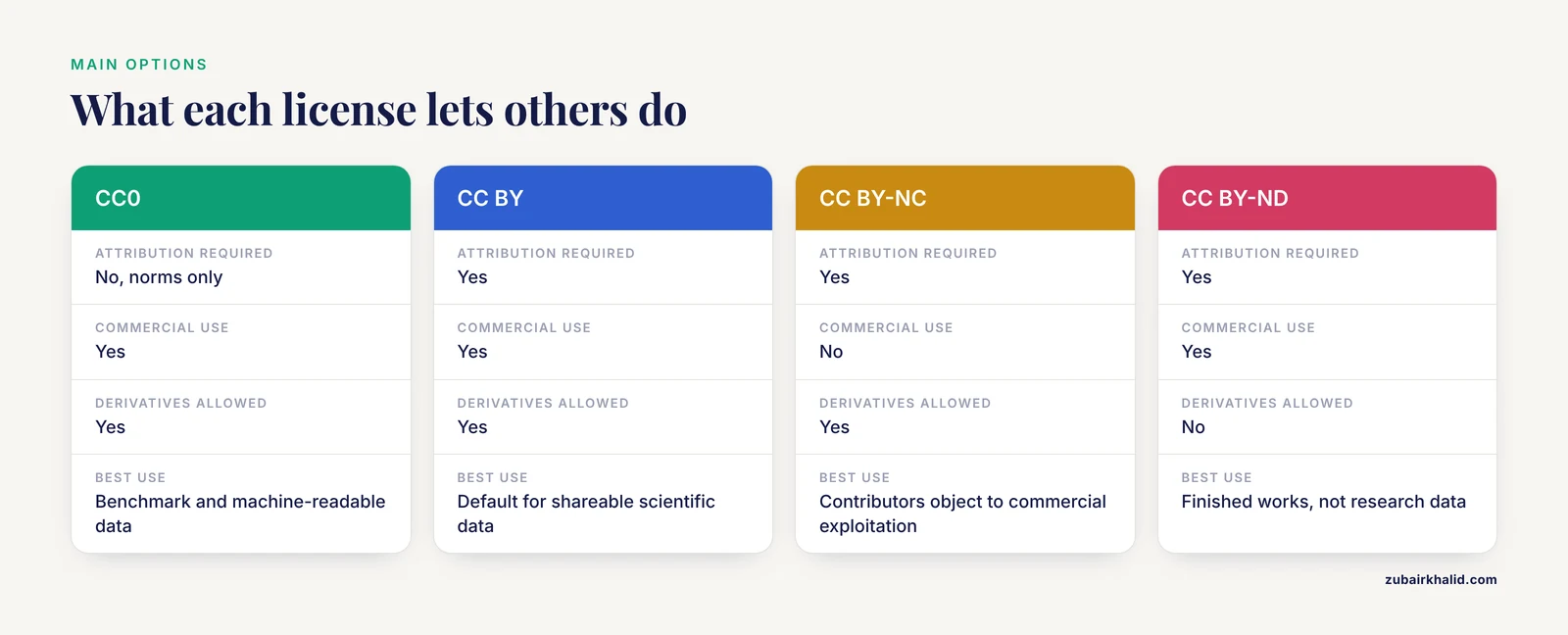
A license grants permissions. It does not transfer ownership, and it does not replace ethics approval or consent agreements. For research data, a license typically answers five questions:
- Attribution. Must users credit the dataset creators, and in what form?
- Share-alike. If users redistribute a modified version, must they apply the same license?
- Commercial use. May commercial entities, including companies building products, use the data?
- Derivatives. May users transform, integrate, or build models on the data?
- Redistribution. May users copy and share the data themselves, including in aggregated collections?
Public domain dedications like CC0 answer "yes" to everything. Attribution licenses add a credit requirement. Non-commercial and no-derivatives licenses restrict questions three and four. Controlled access models restrict everything until a user signs an agreement.
One boundary matters more than any other in the life sciences. Creative Commons licenses were written for creative works, and applying them to datasets containing personal data about identifiable or re-identifiable people raises problems, because a license cannot waive the privacy rights of the people described in the records. Most repositories and funders therefore recommend open licenses only for data that carry no personal information. For human data, controlled access agreements are usually the right tool, not an open license.
Data Sharing Licenses for Research Data: Your Main Options
The table below compares the licenses and access models you will encounter when depositing data in repositories such as Figshare, Zenodo, or domain-specific archives.
| License or model | What others may do | Conditions imposed | Typical best use | Main drawback |
|---|---|---|---|---|
| CC0 | Use, copy, modify, redistribute, and commercialize freely | None, no attribution required | Machine-readable data meant for maximal reuse, benchmark datasets | You lose any legal requirement for credit, though norms still encourage citation |
| CC BY 4.0 | Use, modify, redistribute, commercialize | Attribution to the original creator | The default for most shareable scientific data | Attribution statements can be applied inconsistently downstream |
| CC BY-SA | Use, modify, redistribute, commercialize | Attribution plus share-alike on derivatives | Reference resources where the community should keep improvements open | Share-alike terms complicate integration with differently licensed data |
| CC BY-NC | Use, modify, redistribute for non-commercial purposes only | Attribution, no commercial use | Datasets where contributors object to commercial exploitation | The "non-commercial" boundary is legally fuzzy, which blocks some reuse |
| CC BY-ND | Redistribute verbatim copies only, commercial or not | Attribution, no derivatives allowed | Finished works you do not want altered | Almost never appropriate for research data, since analysis requires derivatives |
| ODbL | Use, adapt, and commercialize database contents | Attribution plus share-alike for derived databases | Structured databases where you want derived versions to stay open | Share-alike applies at the database level, which is unfamiliar to many reusers |
| Controlled access | Use only after an approved application or data use agreement | Negotiated per project | Human genomic, clinical, and imaging data | Access friction, slower reuse, and heavier administration |
CC0: The Public Domain Dedication
CC0 places your dataset in the public domain as fully as the law allows. Anyone may use it for any purpose without asking permission or crediting you. For machine learning pipelines, large benchmark collections, and integration projects where attribution chains become unwieldy, CC0 maximizes downstream value. Reproducible frameworks that share their entire processing pipelines as single shareable configuration files pair naturally with CC0 data, because the whole workflow can be redistributed without license accounting [3].
The cost is symbolic and practical. Nothing legally obliges anyone to cite you. Norms in most fields still expect citation of the dataset's persistent identifier, and most users honor that norm, but you are relying on culture rather than contract.
CC BY: The Workhorse of Open Science
CC BY is the most widely used license for open research data and the license most funders default to when they require sharing. Users may copy, adapt, and even commercialize the data as long as they give you credit. For most experimental datasets, observational tables, and processed omics results, CC BY balances openness with recognition.
A concrete example shows why this matters. A FAIR-compliant bovine bioacoustics dataset, containing 569 curated vocalization clips spanning 48 behavioral classes recorded across three dairy farms and expanded to 2,900 samples through augmentation, was released under open terms so that machine learning researchers could reuse it for welfare monitoring [4]. Structured releases like that one depend on permissive licensing to reach the audiences the curation was designed for.
CC BY-SA: Share-Alike for Evolving Resources
CC BY-SA adds a viral condition: if someone redistributes a modified version of your data, that version must carry the same license. This suits community-maintained reference resources where you want improvements to flow back into the commons. Its drawback shows up in integration projects. A share-alike obligation on one input dataset can taint a combined resource and force licensing decisions across every contributor, which is why many integration pipelines avoid share-alike inputs.
CC BY-NC and CC BY-ND: Restrictions With Consequences
CC BY-NC forbids commercial use. CC BY-ND forbids derivatives, and CC BY-NC-ND forbids both. The non-commercial restriction sounds protective but creates real problems. "Commercial" is not cleanly defined, so a company researcher, a hospital with revenue streams, or a startup collaborator cannot confidently use the data. License aggregators and repositories flag NC-licensed data as incompatible with many mixed-use projects.
ND terms are a more serious mismatch. Scientific analysis of a dataset almost always involves derivatives: subsets, transformations, model training outputs, and merged tables. A no-derivatives license technically blocks the very activity that justifies sharing data at all. If you find yourself considering ND terms for a dataset, the controlled access model usually serves your actual concern better.
For context on why derivatives matter, consider that the same raw data processed in different ways can produce different final outcomes, which is why processing pipelines must be documented and shared alongside the data itself [5]. A license that blocks derivatives blocks that documentation-in-practice.
Open Data Commons: Licenses Built for Databases
Creative Commons licenses were drafted for creative works, and databases have a distinct legal status in many jurisdictions. The Open Data Commons family addresses this. ODbL (Open Database License) grants attribution and share-alike terms tuned to database contents. ODbL suits structured resources where you want derived databases to remain open. PDDL (Public Domain Dedication and License) is the database equivalent of CC0. These licenses are less familiar to most life scientists than the CC family, so expect to explain your choice in a data usage note.
Controlled Access: The Right Model for Human Data
When data are identifiable, re-identifiable, or sensitive, no open license is appropriate. Controlled access repositories require users to describe their intended use, sign a data use agreement, and sometimes obtain institutional approval before download. This model dominates for human genomic data, electronic health record datasets, and clinical imaging.
The administrative weight is real but justified. Privacy protections cannot be contractually waived by a license, and public expectations reflect that. In UK focus groups on health data sharing for AI, participants judged anonymization essential but fallible, particularly for rare conditions or large linked datasets, and they evaluated data custodians differently depending on who controlled access [2]. A governance layer, which is what controlled access provides, is part of what earns that trust.
Preparation still matters under controlled access. AI-ready clinical datasets benefit from deliberate curation before release, including validated variable definitions, handling of missingness, and representation across demographic groups, because raw extracts often encode biases that downstream models inherit [6].
Choosing Among Data Sharing Licenses: The Criteria That Decide
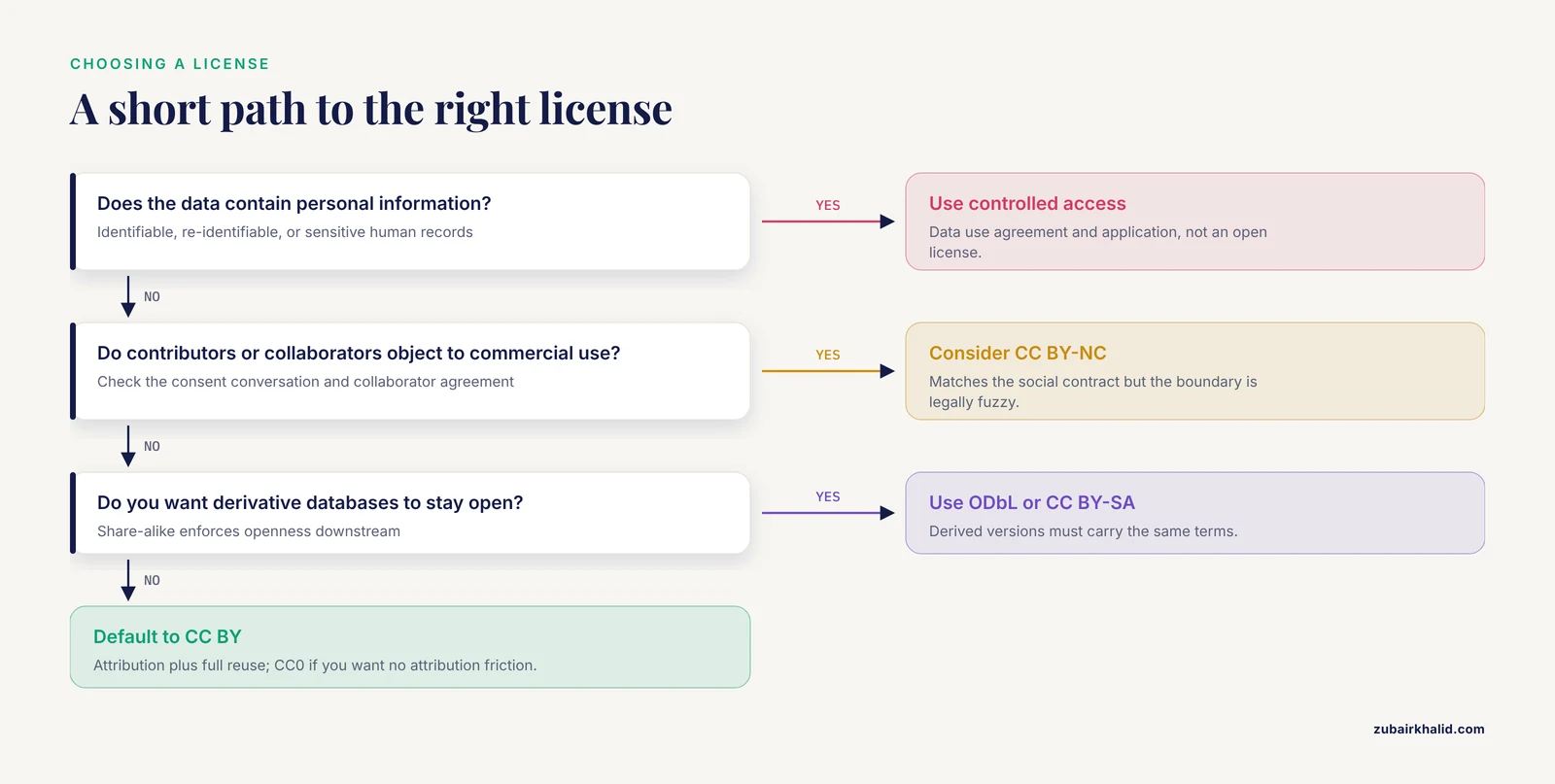
Four questions resolve almost every real decision.
Does the data contain personal information? If yes, an open license is likely off the table. Move to controlled access and let governance, not licensing, do the work. If the data are fully de-identified aggregate or non-human data, proceed.
What does your funder and publisher require? Many funders mandate machine-readable formats, persistent identifiers, and open licenses where lawful. Read the data management plan requirements before deposit, not after, because changing a license later is awkward.
Do your contributors or collaborators object to commercial use? If the consent conversation or a collaborator agreement explicitly excluded commercial exploitation, CC BY-NC may match the social contract, accepting the fuzziness that comes with it. Otherwise default to CC BY or CC0.
Do you want derivative databases to stay open? If yes, share-alike terms (ODbL or CC BY-SA) enforce that. If you prefer to leave downstream choices free, attribution-only or CC0 fits better.
Worked Scenarios
Scenario 1: A machine learning benchmark on non-human imaging data. A team builds a curated dataset of annotated microscopy images and wants maximum reuse in model training. No personal data are involved. CC0 or CC BY is appropriate. Because reproducible pipelines increasingly ship as shareable configuration files that encode the full preprocessing workflow, an open license on both data and code lets others rerun the entire analysis without legal friction [3]. CC BY is the safer default when the team wants guaranteed attribution norms.
Scenario 2: A cohort database with viral sequences. A longitudinal cohort study accumulates years of next-generation sequencing data with strict confidentiality obligations to participants [7]. Even heavily processed, consensus-level viral sequences can carry re-identification risk when linked to metadata such as collection dates and transmission clusters. The correct choice is controlled access with a documented application process, not an open license. The database can still publish aggregate summaries and documentation openly so prospective users understand what exists and how to request it.
Scenario 3: A secondary analysis of a public database. A researcher draws on a large open public health database to produce many published analyses. Open licensing makes this trivially easy, which is a feature, but volume and quality control become concerns. In one bibliometric investigation of 713 full-text articles based on a widely used public health database, reviewers checked whether articles reported software versions, code availability, and data availability, and found that mass-produced secondary analyses were a plausible driver of the surge in output [8]. The lesson for anyone reusing openly licensed data is that openness removes legal barriers, not scientific ones. Your reproducibility checklist, discussed next, is what separates rigorous secondary analysis from data mining.
Licenses, Documentation, and Reproducible Research
A license makes reuse legal. Documentation makes reuse possible. The two go together, because the strongest argument for open licensing is that others can verify and extend your work, and verification requires knowing exactly how raw data became published results.
Effective data management spans organization, documentation, storage, sharing, and preservation, and well-documented data enable validation and cumulative discovery [1]. In experimental biomedicine, where protocols are intricate and metadata are extensive, careful management addresses variation and error in raw data quality, especially for low-throughput experiments where a single mishandled sample matters [1].
Use this reproducibility checklist whenever you deposit data:
- Attach an explicit license to every deposited file set, chosen by the criteria above.
- Version the dataset and give it a persistent identifier so citations point to a stable record.
- Document every processing step from raw machine output to final result, including software versions and parameters, because transitions between data layers can change final outcomes [5].
- Share the analysis code in a workflow system or container so the pipeline itself is reproducible and portable [9].
- Record the license compatibility of every input if your resource combines existing datasets.
- State the terms under which others may redistribute derivatives, which the license itself should already answer.
- Archive the raw data, not only processed results, so future methods can re-derive everything [1].
Automated pipelines make this easier to sustain. A reproducible R workflow for air quality sensor data, for example, standardized timestamps, harmonized sensor signals with activity logs, and produced diagnostics that let other researchers rerun the whole integration, demonstrating that a scripted, documented pipeline and a clear data release reinforce each other [10]. Workflow engines such as Snakemake paired with containers deliver repeatability and portability from raw data download through to cleaned output files [9], and structured data representations have released openly available, annotated datasets on public repositories where they accumulated thousands of downloads [11].
Provenance tracking extends this chain. Emerging electronic lab notebook frameworks consolidate data, code, and documentation in one auditable system, using cryptographically signed records to certify authorship and research activity over the project lifecycle [12]. You do not need blockchain tooling to benefit from the principle: an unbroken, timestamped record of what was done, when, by whom, and under which license.
Common Mistakes and Limitations
Applying a CC license to human data. Licenses govern copyright and database rights. They do not waive the privacy interests of the people described in the records. Use controlled access and data use agreements for anything containing personal information.
Choosing CC BY-ND for a dataset. Analysis creates derivatives. A no-derivatives license contradicts the purpose of sharing. If your concern is misuse or misinterpretation, documentation and clear readme files address that better than ND terms.
Assuming "non-commercial" is unambiguous. NC clauses leave room for dispute about what counts as commercial activity, and that uncertainty itself deters reuse by industry-adjacent academic collaborators. Pick NC only when contributor expectations genuinely require it.
Mixing incompatible licenses silently. If you merge three datasets under three different licenses, the combined resource inherits a tangle of obligations. Check each input's terms before integration and record them in the readme.
Depositing data without a license at all. The default copyright position in most jurisdictions is "all rights reserved," which means an unlicensed dataset is legally unusable regardless of how open the repository appears.
Treating a license as a substitute for consent. Participants consent to specific uses. UK focus group evidence on health data sharing showed that people weigh who the data custodian is, how anonymization is handled, and what the data will be used for [2]. A permissive license cannot expand what consent covered.
Confusing openness with quality. Openly licensed public databases attract high volumes of secondary analysis, and not all of it is rigorous. Reported software versions, available code, and declared data availability are the observable markers of careful reuse [8]. Individual cases, especially in clinical or regulated contexts, always need review by the appropriate professional or ethics body.
Frequently Asked Questions
Which license is best for sharing research data?
CC BY is the best default for most shareable, non-personal research data because it permits any use, including commercial use and derivatives, while requiring attribution. Use CC0 when you want zero attribution friction, controlled access for any human or sensitive data, and share-alike licenses only when you specifically want derivatives to remain open.
Does CC0 mean nobody has to credit me?
Correct. CC0 places the data in the public domain, so no legal attribution requirement exists. Scientific norms still encourage citing the dataset's persistent identifier, and most researchers do, but you are relying on community practice rather than the license.
Can I put a Creative Commons license on human participant data?
You should not. CC licenses were designed for creative works and cannot waive participants' privacy rights. For identifiable, re-identifiable, or sensitive human data, use a controlled access repository with a data use agreement instead of an open license.
Do these licenses cover code and software the same way?
No. Code is typically licensed under software licenses such as MIT, GPL, or Apache, which have their own terms, rather than the CC suite intended for creative and database content. You can and should license data and code separately, often with CC BY or CC0 on the data and a standard software license on the analysis scripts.
Can I change the license after I have shared a dataset?
Generally no. Once data are distributed under an open license, users who received them keep the rights that license granted, and downstream derivatives retain those terms. You can apply a different license to future versions or additions, which is another reason to choose carefully before the first deposit.
What license do I need to satisfy funder data sharing requirements?
Most funders that mandate open sharing expect a permissive license such as CC BY or CC0 for non-personal data, with recognized exceptions where privacy or third-party rights prevent openness. Check your specific funder's data management plan guidance before deposit, and document any justified exception in your plan.
Sources
- Best practices for data management and sharing in experimental biomedical research.
- Public perceptions of health data sharing for artificial intelligence research: a qualitative focus group study in the UK.
- TRaP: An Open-source, Reproducible Framework for Raman Spectral Preprocessing across Heterogeneous Systems.
- Big data approaches to bovine bioacoustics: a FAIR-compliant dataset and scalable ML framework for precision livestock welfare.
- The long way from raw data to NAM-based information: Overview on data layers and processing steps.
- A roadmap to artificial intelligence (AI): Methods for designing and building AI ready data to promote fairness.
- Addressing data management and analysis challenges in viral genomics: The Swiss HIV cohort study viral next generation sequencing database.
- Paper mill or paper mine? A tentative answer to the sharp increase in research papers based on the Global Burden of Disease database.
- ILIAD: a suite of automated Snakemake workflows for processing genomic data for downstream applications.
- A reproducible R workflow for harmonizing indoor air quality sensor data and cleaning activity logs in school-based field campaigns.
- Meta-EEGs: A structured approach for processing high-volume EEG data.
- IntegriLAB: a blockchain-enabled electronic lab notebook for reproducible neuroimaging research.