Avoiding Common Pitfalls When Choosing a Data Repository
By Dr. Zubair Khalid, DVM, MS, PhD ·

The single most common data repository submission problem is a metadata failure. Your files upload fine, but the descriptions of what the data are, how they were produced, and under what conditions they can be reused are incomplete, nonstandard, or missing entirely. Curators then reject the submission or park it in a queue, your publication deadline keeps moving, and the dataset ends up online in a form nobody can actually reuse. The first thing to check, before you touch any submission form, is whether the repository you picked publishes an explicit metadata checklist and whether your records satisfy it line by line.
A survey of more than 700 microbiome researchers found exactly this pattern across a whole field. Respondents were impeded by difficulties with metadata records, challenges with processing and bioinformatics, and problems with data repository submissions, and the bioinformatics and data processing steps were estimated to be the most time consuming part of reuse [1]. Those three failure points trace directly back to decisions made at repository selection time, often months before the first file was ever uploaded.
This article walks through those failure points in order of how often they bite researchers, explains the mechanism behind each one, gives you a short diagnostic sequence to run when a submission stalls, and closes with prevention practices you can adopt for your next project.
Why Repository Choice Determines Reuse
Research data sharing only works if a stranger can find your dataset, understand it, and rerun an analysis on it without emailing you. A repository is the infrastructure that makes that possible, but repositories differ enormously in what they validate, what standards they enforce, and how they govern access. Choosing one without checking those properties is the upstream cause of most downstream submission pain.
The reuse side of the problem is well documented. In metabolomics, a team assembling a spectral library across three major repositories had to invest in harmonized pan-repository metadata precisely because each repository describes datasets differently, and even then most of the collected spectra remained structurally unassigned [2]. In population screening research, a global analysis could only include 93 countries and territories with complete core data after harmonizing two large repositories, meaning the countries with patchy data simply dropped out of the evidence base [3]. In microarray research, the value of vast public repositories depends on methods that can make sense of the deposited data, which motivated a systematic benchmark of deconvolution algorithms across data preparation scenarios [4].
The lesson from all three cases is the same. The choices a depositor makes, and the choices a repository makes about what to accept, determine whether the data is an asset or shelfware.
The Most Common Pitfall: Treating Metadata as an Afterthought
Metadata means the structured descriptions that accompany your data, including sample identifiers, experimental conditions, instrument settings, protocol versions, and provenance. This problem is old, well characterized, and entirely preventable.
In sequence-based research, studies are conducted around the globe and submitted to the public repositories of the International Nucleotide Sequence Database Collaboration, yet the context in which the studies were conducted often gets lost because experimental data and environmental information are rarely submitted alongside the sequences. When contextual metadata is missing, comparison and analysis across studies and habitats is hampered or even impossible [5]. Community standards bodies responded by promoting checklists that specify the contextual data that should accompany a submission, and tools like CDinFusion were built to integrate contextual and sequence data before submission rather than after curation [5].
The mechanism is simple. A repository can validate file formats automatically, but it cannot infer what a column called "value_2" means or whether a sample was collected before or after treatment. Only structured metadata carries that information, and only standards-based metadata lets another machine parse it. Free-text descriptions in a README file help humans but fail automated checks.
The fix is procedural, not technical. Before submission, pull the repository's metadata template or required standard, fill it in as you collect data rather than at the end, and validate it with any checker the repository provides. Fields you cannot fill in honestly should be flagged as missing with a stated reason, never silently left blank or filled with placeholder text.
Troubleshooting Table: Symptoms, Causes, Confirmation, and Fixes
The table below is the core diagnostic tool for this article. Find the symptom your submission is showing, confirm the likely cause, and apply the fix.
| Symptom | Likely cause | How to confirm | Fix |
|---|---|---|---|
| Submission returned with "incomplete metadata" or sits in curation queue for weeks | Metadata records incomplete or nonstandard | Diff your records against the repository's published checklist field by field | Complete every required field using the repository's template or the relevant community standard, then resubmit [5][1] |
| Validator rejects file format or reports parsing errors | Data not in the repository's required format or standard | Run the repository's validator or format checker on the exact files you intend to submit | Convert files to the required format, for example European Data Format parsing with channel harmonization in sleep research [6], and revalidate before upload |
| Curator reports the data cannot be linked to samples or subjects | Identifiers between data files and metadata do not match | Spot check five random records across files and confirm IDs resolve consistently | Rebuild a master identifier table, remap every file to it, and document the mapping in the metadata itself |
| Repository refuses the dataset on privacy grounds | Consent terms, de-identification level, or governance plan do not match repository policy | Read the repository's access tiers and data use policies against your consent documents and IRB protocol | Choose a controlled-access repository or restricted study environment that matches your governance requirements [6][7] |
| Reviewer or journal says the deposited dataset is unusable | Data quality was never verified before deposition | Attempt a fresh analysis from the deposited files alone, with no help from your lab | Run quality control checks before deposition, the way platforms like NeuroStage let researchers inspect quality reports before committing compute resources [7][8] |
| Dataset is online but receives no downloads or citations | Poor discoverability, weak metadata indexing, or wrong repository for your field | Search for your dataset using terms a stranger would use, outside your own institution | Add standardized keywords, ontology terms, and cross-links, or redeposit in a domain repository where your community actually searches |
| Version confusion, stale copies, or contradictory derived data circulating | No version pinning or provenance tracking | Check whether the repository assigns versioned identifiers and preserves prior versions | Deposit in a repository that versions datasets and preserves provenance, and cite the exact version you used [9][10] |
| Access request approved but data cannot be transferred securely | Repository lacks secure transfer protocols or your environment lacks the required controls | Confirm the repository's documented transfer mechanism and your institution's requirements | Use a repository with documented secure transfer and, where required, a secure study environment for analysis [6][7] |
Data Repository Submission Problems, From Most Common to Rarest
1. Metadata gaps and nonstandard descriptions
Already covered above as the leading failure mode, and worth restating as a selection criterion. If a repository does not enforce a named metadata standard or checklist, your data will be findable in name only. The microbiome survey evidence is unambiguous that metadata records are one of the top three community-wide impediments to reuse [1].
2. Format and standardization mismatches
Every measurement modality has its own standardization problems. In sleep research, building a scalable repository required European Data Format parsing, channel harmonization across devices, and metadata validation as explicit pipeline components, because polysomnography, home sleep apnea testing, and consumer wearables each produce differently structured signals [6]. In neuroimaging, routine MRI data acquired for research had to be organized using the Brain Imaging Data Structure (BIDS), a community format that arranges images and their descriptions in a predictable folder and file naming scheme, before automated processing became reliable [7]. In proteomics, a laboratory-scale repository used the PEDRo standardization requirements to govern what minimum data set could be transferred into the public database [11].
The mechanism behind this pitfall is that raw instrument output is rarely submission-ready. Converting it takes time and domain knowledge, and depositors discover the conversion requirement only after choosing a repository that cannot accept their native format. Confirm format expectations during repository selection, not during submission week.
3. Choosing the wrong repository type
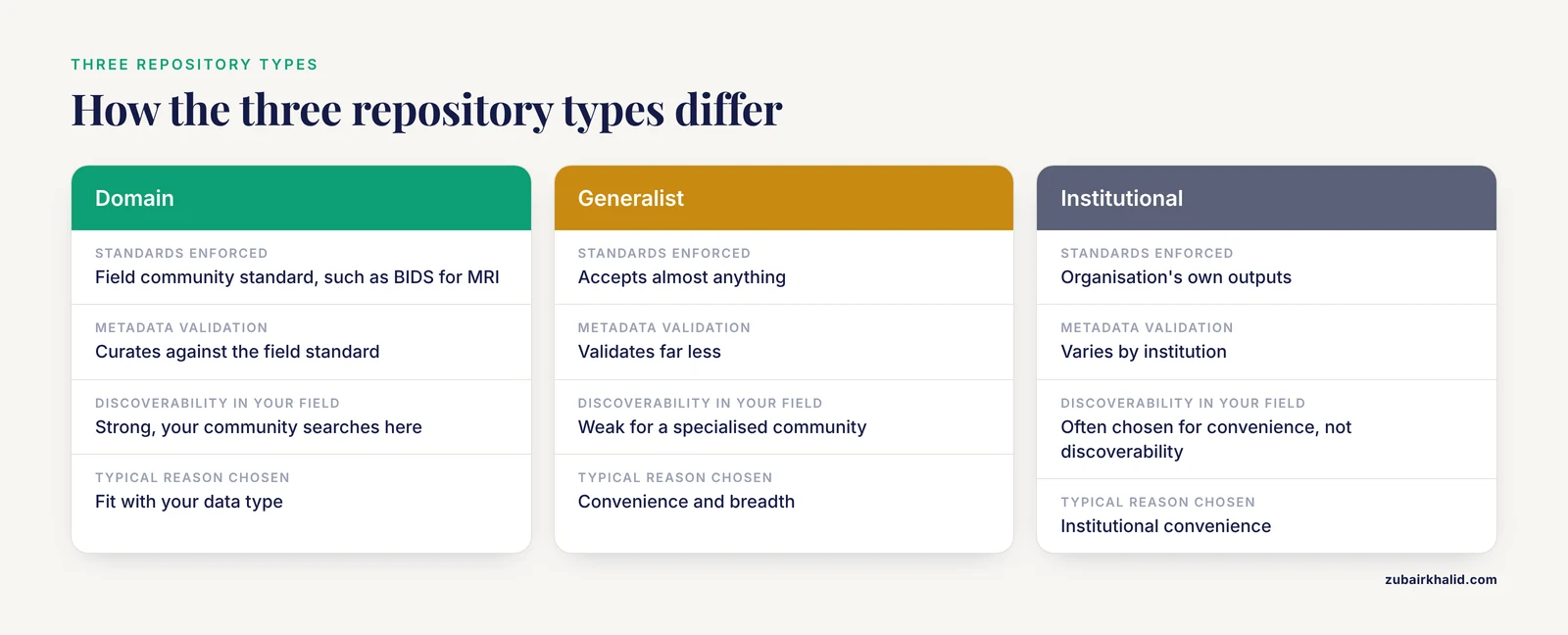
There are three broad types. Domain repositories curate data for a specific field and enforce community standards. Generalist repositories accept almost anything but validate less. Institutional repositories store data for an organization's outputs and are often chosen for convenience rather than discoverability. Depositing a proteomics dataset in a generalist repository with no proteomics curation produces a result functionally similar to not depositing at all, because your community will not find it.
A useful reference point is the annotation-heavy dataset published to IEEE DataPort and Mendeley Data, where the depositors documented inter-annotator agreement statistics, including a direct Cohen's kappa of 0.6164 between two annotators with 80.11 percent observed agreement, so reusers could judge annotation reliability before building on the data [12]. That level of self-documentation is characteristic of repositories and depositors who plan for reuse. Note also that annotation quality itself was uneven, with one annotator achieving a kappa of 0.9093 against the reference and the other 0.5585, a reminder that even well-documented deposits carry quality variance a reuser must weigh [12].
4. Governance and access mismatches
Human data brings consent, privacy, and regulatory obligations that constrain where data can live. A framework for building a large-scale sleep data repository explicitly organized its design around governance principles for compliant data use across multiple regulatory environments, including centralized storage with secure study environments for analysis [6]. NeuroStage took a complementary approach for MRI data, supporting deployment in the cloud or locally so that protected health information could be processed with the same user experience as open data [7].
The pitfall here is depositing data in an open repository that your consent forms, institutional review board protocol, or funder terms do not permit. Confirm the access tier during selection. Controlled-tier repositories exist precisely for this situation, and large curated resources such as the National Institutes of Health All of Us program operate a controlled tier with a versioned curated data repository that researchers access under defined terms [9].
5. Waiting until publication week to start
Submissions fail mechanically when started late. Curation queues at major repositories can run for weeks. Standards conversions take time. Consent clarifications take institutional signatures. None of these compress to 48 hours. Treat repository selection and dry-run submission as milestones in your analysis plan, not as a formality after acceptance.
6. Provenance and integrity failures, including AI-generated content
The rarest but most serious category is depositing data whose origin cannot be established. A recent analysis of genomic knowledge bases describes how generative artificial intelligence, operating under publish-or-perish incentives, can produce outputs that are internally coherent yet empirically untethered, and traces three layers of integrity failure: inadvertent contamination through hallucination, deliberate fraud made cheaper, and epistemic blurring, the progressive loss of provenance that erodes transparency. The proposed remedy is infrastructure-embedded governance, meaning accountability mechanisms built into databases, repositories, journals, and indexing platforms, including auditable computational notebooks, reproducibility metrics, and trust-weighted indexing [10].
For a depositor, the practical implication is to preserve provenance deliberately. Record which software versions, parameters, and pipelines produced each deposited file. A repository that supports linked code, computational environments, and version identifiers makes this feasible, and citing an exact repository version in your manuscript, as studies of versioned curated repositories do [9], is the reuse-side mirror of that discipline.
7. Cell and sample identity problems in underlying material
If your dataset derives from biological material, the deposit inherits any problems with that material. Estimates based on submissions to major cell repositories over a decade suggest that between 18 and 36 percent of cell lines may be contaminated or misidentified, and over-passaged cultures exhibit altered function that no longer represents the original source [13]. A repository cannot fix a mislabeled line, so authentication belongs in your pre-deposit quality checklist.
A Short Diagnostic Sequence for a Stalled Submission
Run these steps in order when a submission is stuck, rejected, or silent.
- Read the exact rejection or hold reason. Curator comments usually name the failing field or file. Resist the urge to resubmit unchanged.
- Diff your metadata against the repository's published checklist or standard. Mark every field that differs in structure, vocabulary, or completeness.
- Run the repository's format validator on your actual files, not a cleaned test copy. Conversion errors hide in edge cases such as channel naming and header information [6].
- Verify that every identifier in your data files resolves to exactly one row in your metadata table. Mismatched identifiers are the most common silent failure.
- Recheck governance. Confirm the access tier, consent language, and de-identification level match the repository's written policy [7].
- If everything passes and the submission is still held, contact the curation team with your submission identifier and a one-paragraph summary of what you believe was fixed. Documented, specific inquiries get faster responses than resubmissions.
- If the repository structurally cannot host your data type, cut your losses, select a domain repository that enforces your field's standard, and redeposit once rather than negotiating indefinitely.
How to Compare Repositories Before You Commit
A disciplined data repository comparison uses written criteria, not familiarity. Score candidates on the following points, in roughly this order of importance.
Standards enforcement. Does the repository require or strongly recommend a named community standard for your data type, such as BIDS for MRI [7] or community checklists for sequence context data [5]?
Metadata validation. Does it validate metadata at submission, or accept anything? Validation at deposit is the single strongest predictor of smooth curation.
Access model fit. Does it offer open, controlled, and restricted tiers, and secure transfer, matching your consent and regulatory constraints [6][7]?
Discoverability in your field. Where do researchers in your subfield actually search? A pan-repository perspective helps here. Teams assembling cross-repository resources, such as the expanded bile acid spectral library built from three major metabolomics repositories, demonstrate how much value comes from deposits that are findable and harmonizable across sources [2].
Integration with measurement standards. Repositories that interoperate with established measurement frameworks make cross-study comparison possible. The PhenX Toolkit, a knowledgebase of 1010 consensus measurement protocols for genomic, clinical, translational, and epidemiological research, explicitly collaborates with data standards such as LOINC and data repositories to promote interoperability [14]. Depositing data collected with such standardized protocols makes your records comparable across studies by construction.
Versioning and preservation. Does the repository assign persistent, versioned identifiers and preserve superseded versions? Version clarity is what allowed a whole-genome sequencing study to state precisely that it used version 8 of a curated data repository with a dated release code [9].
Quality control before commitment. Some platforms build in checks that prevent wasted effort downstream. NeuroStage, for example, provides interactive viewers so researchers can inspect data organization and quality control reports before preprocessing begins, preventing wasted computation on low-quality data [7]. The analogous habit at submission time is verifying your dataset's usability the way a reuser would, before you deposit. Large-scale health data research reinforces the same principle from the analysis side, holding that understanding the purpose of a dataset and the quality of the data collected are paramount to determining the reliability of any result [8].
Sustainability and governance. Who funds and operates the repository, what happens on retirement, and does it participate in integrity mechanisms such as retractability or reproducibility reporting [10]?
Prevention Practices That Eliminate Most Submission Problems
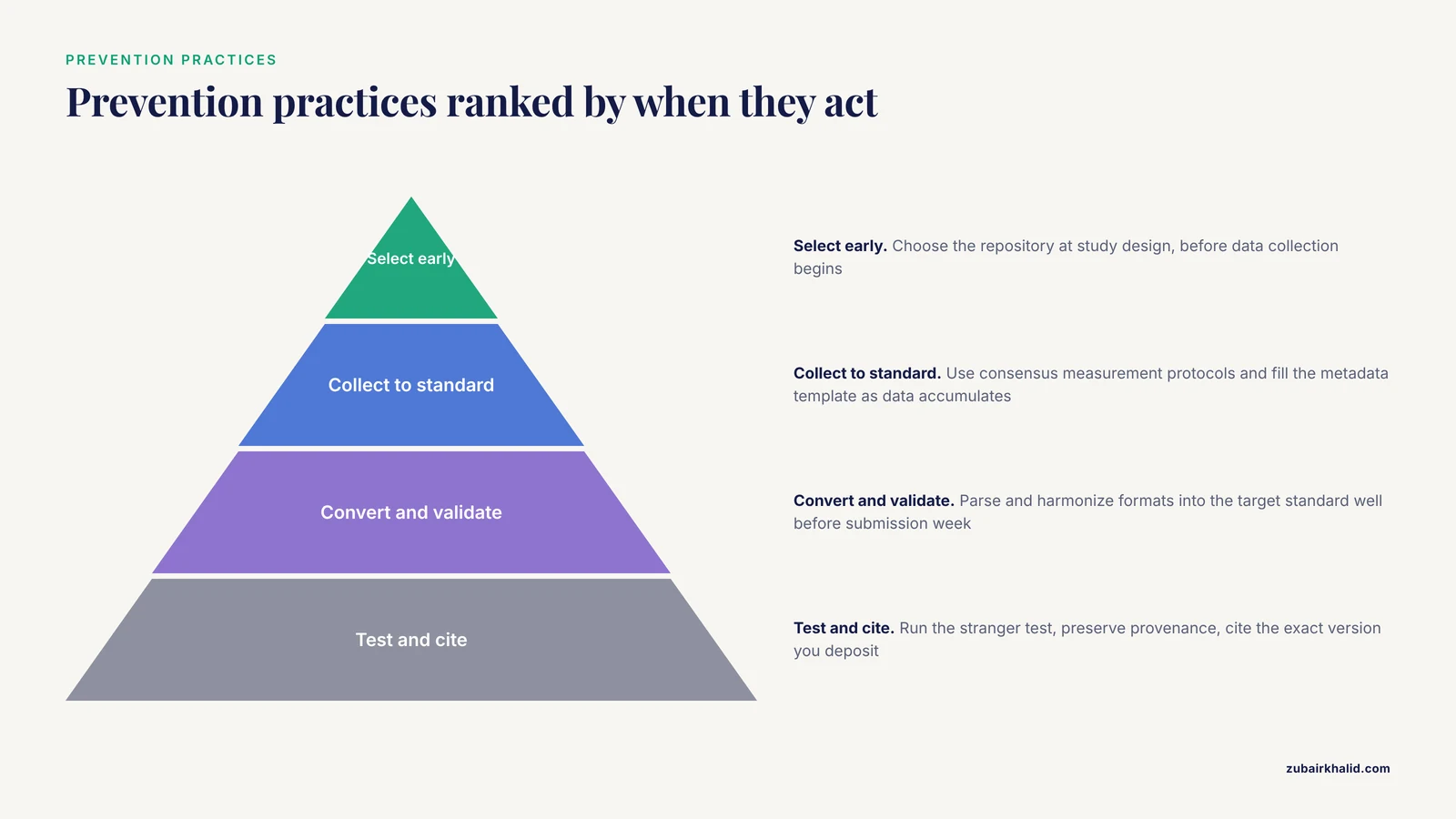
These practices, adopted early, prevent nearly every failure mode described above.
- Select the repository at study design, not at submission. Your choice determines required formats, metadata standards, and consent language from day one.
- Collect against a standard protocol. Using validated, consensus-based measurement protocols improves rigor, transparency, reproducibility, and comparability, and eases later deposit [14].
- Maintain metadata continuously. Fill the target repository's metadata template as data accumulates. Metadata written months later is the primary source of submission errors [1].
- Convert and validate formats early. Parse, harmonize, and validate signal or image data into the target standard well before submission week [6][7].
- Automate repetitive transformations. Where your project involves heterogeneous sources, configurable transformation and de-identification pipelines exist specifically to make consistent loading into target repositories reliable rather than manual [15].
- Keep a laboratory information backbone. Larger laboratories route all post-processed results through a central system so that what reaches the public database is a defined, quality-checked minimum data set, an approach demonstrated in high-throughput proteomics [11].
- Document everything a reuser needs. Data files plus anomaly or event descriptions plus figures, as the SHoRT-CA smart home repository did for its contextual anomalies, set a good baseline for self-explanatory deposits [16].
- Run a stranger test. Hand your prepared package to a colleague outside the project and ask them to load and analyze it using only the deposited files and documentation. Whatever they ask you about is a metadata defect.
- Preserve provenance explicitly. Record software versions, parameters, and pipeline steps, and prefer repositories that support linked code and auditable records [10].
- Cite the exact version you deposit. This closes the loop between your paper and your data.
Common Mistakes and Limitations
- Depositing in the repository your institution or colleague happens to use rather than the one your field searches. Convenience is not discoverability.
- Assuming a generalist repository's acceptance means your data meets community standards. Acceptance is a floor, not an endorsement.
- Filling metadata fields with guesses to satisfy validation. Fabricated metadata corrupts the knowledge base for everyone downstream and is an integrity failure, not a workaround [10].
- Depositing processed results without the parameters that produced them. Reusers cannot reproduce what they cannot re-derive.
- Treating privacy compliance as a submission-time question. Consent scope must shape repository selection from the start, because governance across regulatory environments is a design property, not a patch [6].
- Over-relying on automated preparation. Even with automatic upload and format organization available in modern platforms, human inspection of classification and quality reports before final deposit remains necessary [7].
- Expecting a repository to certify scientific validity. Curation checks structure and completeness. The reliability of conclusions drawn from a dataset depends on the purpose and quality of the underlying data, which is the depositor's responsibility [8].
- This article describes general practice. Your specific project may involve funder mandates, journal policies, or institutional requirements that override the general guidance here, so confirm your own obligations in writing.
Frequently Asked Questions
What are the most common data repository submission problems?
Incomplete or nonstandard metadata is the most common problem, followed by file format and standardization mismatches, wrong repository choice, and governance or consent conflicts. A survey of over 700 microbiome researchers confirmed that metadata difficulties and repository submission problems are among the top community-wide barriers to reuse [1].
What causes data repository submission problems?
Most causes are upstream decisions made before submission, including choosing a repository without checking its standards, writing metadata at the last minute, and converting formats only after a rejection. The formats and operational rules of data in fields like genomics are highly divergent and can change rapidly, which makes unmanaged, manual submission error-prone by default [15].
How do I fix a rejected repository submission?
Read the curator's stated reason, diff your metadata against the repository checklist, run the format validator on your real files, verify identifier consistency, and recheck the access tier against your consent terms. Then resubmit once with all fixes applied rather than in piecemeal updates.
When should I choose a data repository in a project's lifecycle?
At study design, before data collection begins. The repository determines your required formats, metadata standards, consent language, and protocol choices, so deciding late forces expensive retrofitting that is a leading cause of failed submissions.
What is the difference between domain-specific and generalist repositories?
Domain repositories curate data for a specific field and enforce that field's standards, such as BIDS for neuroimaging [7]. Generalist repositories accept nearly any data type but validate far less, which means weaker discoverability and curation for your community.
How much metadata is enough?
Enough to satisfy the repository's required checklist or your field's community standard, with every required field completed honestly and missing values explicitly flagged. Community checklists developed by standards bodies exist precisely to define this minimum, and tools can integrate contextual data with your sequences before submission [5].
How do I handle human data privacy requirements when depositing?
Match your consent documents and regulatory obligations to a repository with a suitable access model, such as a controlled tier or a secure study environment, rather than forcing open deposit. Frameworks for large health data repositories build governance and compliant data use across regulatory environments into their architecture from the start [6][7].
Do all data repositories charge fees for deposition?
No. Many long-established public repositories are free for standard-sized deposits, and some platforms are explicitly designed around low-cost open access [7]. Check the repository's published deposit policies for your data volume and any enhanced curation services, and budget for those during grant writing rather than at submission.
Sources
- A cost and community perspective on the barriers to microbiome data reuse.
- The Evolving Bileome: A Pan-Repository Landscape of Expanded Bile Acid and Related Steroidal Signatures.
- Breast cancer screening effectiveness and mortality/case-fatality burden: global associations and optimisation pathways based on GBD 2021 and CanScreen5 data.
- Benchmarking of cell type deconvolution techniques for microarray data.
- CDinFusion--submission-ready, on-line integration of sequence and contextual data.
- Building a Sleep Data Repository: Architecture, Data Sources, and Governance.
- Democratizing data sharing and processing of routine MRI data acquired for neuroimaging research.
- 'Big data' reporting guidelines: how to answer big questions, yet avoid big problems.
- Sickle Cell Trait and Incident Ischemic Stroke Risk: A Whole-Genome Sequencing Study in the All of Us Research Program.
- Scientific slop: generative AI, research incentives, and the integrity of the genomic knowledge base.
- Assembling proteomics data as a prerequisite for the analysis of large scale experiments.
- The ethical PROMISE NFR dataset: data for ethical concern classification in software requirements.
- The costs of using unauthenticated, over-passaged cell lines: how much more data do we need?
- PhenX Toolkit: a knowledgebase that enables consistent data collection and facilitates cross-study analysis and data reuse.
- A new approach to configurable primary data collection.
- SHoRT-CA: Smart home data repository of time series with contextual anomalies.