10 Key Features to Look for in a Research Data Repository
By Dr. Zubair Khalid, DVM, MS, PhD ·

By the end of this article, you will be able to evaluate any research data repository in about 30 minutes, score it against a 10-point checklist, and decide whether it is the right home for your data or a trustworthy source for your next project. You need nothing installed to follow along. A browser and a spreadsheet are enough. If you want to run the worked scoring example in this guide, any Python 3 installation will do.
Why Repository Choice Matters for Research Data Sharing
A research data repository is a curated, persistent store for datasets, paired with metadata, quality control records, and access tools. It differs from a lab server or a journal supplement in one essential way. A repository is built so that strangers can find, understand, validate, and reuse your data years later, without you in the room.
The payoff for choosing well is concrete. When investigators in the Urban Environment and Childhood Asthma study shared their birth cohort data with other NIH-funded programs, collaborators pooled datasets, built a new DNA methylation array and geospatial exposure estimates, and produced findings on asthma incidence, redlined census tracts, and air pollution that no single cohort could have delivered alone [1]. That kind of cumulative science depends on repositories doing several jobs at once, and doing them well.
The problem is that repositories look similar from the outside. A polished website can hide weak metadata, undocumented quality control, or access rules that will stall your paper's compliance review. The checklist below gives you a systematic way to look under the hood.
The Data Repository Features Checklist
Score each feature from 0 (absent) to 2 (fully met). The table at the end of this section summarizes the whole rubric, and the step-by-step section shows how to turn it into a number.
1. A Clear Access Model With Tiered Permissions
Every repository should state plainly who can see what, under what conditions, and how quickly access is granted. The most useful repositories support multiple tiers under one roof. The All of Us Research Program's Curated Data Repository illustrates this pattern. It publishes versioned, curated data tiers in which sensitive elements such as whole-genome sequencing sit in a Controlled Tier, alongside curated electronic health record and survey data, so researchers can select the access level their approval actually covers [2]. Sleep data repositories take a related approach, pairing centralized storage with secure study environments where analysis happens under supervision rather than on downloaded copies [3].
What to verify. Look for three things on the access page. First, the tier structure, meaning which datasets are open, which require registration, and which require a data use agreement or institutional review. Second, the turnaround time for controlled access decisions. Third, whether the access tier is documented per dataset, not just per repository.
Red flag. A repository that describes itself as open but requires individual email approval for every file, with no published service standard.
2. Support for Community Data Standards
Data deposited in a proprietary layout is data trapped. Strong repositories require or generate data in community standards, which makes uploads machine readable and reusable without translation work.
The pattern repeats across fields. In neuroimaging, the NeuroStage platform organizes MRI uploads automatically into the Brain Imaging Data Structure (BIDS), a community convention for naming and arranging imaging files, before any processing begins [4]. In immunology, the Immune Epitope Database (IEDB) rebuilt its pipeline to compute V, D, and J gene names compliant with IUIS and IMGT nomenclature and to export data directly in the Adaptive Immune Receptor Repertoire (AIRR) format, which lets its records plug into cross-repository resources such as the AIRR Knowledge Commons [5]. In sleep research, repositories standardize on European Data Format (EDF) parsing and channel harmonization so recordings from different devices can be pooled [3].
What to verify. Find the repository's submission guidelines and check whether they name a standard, a controlled vocabulary, or a required file format. If the guidelines only describe a generic upload folder, the burden of standardization falls on every future user of your data.
3. Rich, Validated Metadata
Metadata is the structured description of a dataset, covering what was measured, how, on whom, and under what conditions. Without it, a dataset is a pile of files. The strongest repositories do not just collect metadata, they validate it.
The sleep repository framework makes metadata validation a first-class requirement alongside EDF parsing and channel harmonization [3]. In the CRCS-K stroke imaging repository, every collected sequence passes through centralized processing that includes sequence classification, so downstream users know exactly what imaging modality each file represents before they touch it [6].
What to verify. Download or preview a sample record. Can you tell, from the metadata alone, the measurement platform, the sample type, the experimental conditions, and any processing already applied? A quick test is to ask whether you could write the methods paragraph of a paper using only the repository metadata, without emailing anyone.
4. Documented Quality Control With Visible Results
Quality control (QC) is the set of checks that separates usable data from artifacts. The best repositories make QC results visible to users before they invest analysis time, and document the QC protocol itself.
NeuroStage shows interactive viewers that let researchers inspect BIDS classification results and quality control reports before preprocessing starts, which prevents wasted computation on low-quality inputs [4]. The GICPIdb pathology image archive had every image annotated by board-certified pathologists following standardized protocols, and built quality control into its web platform as one of its core interactive modules [7]. The CRCS-K imaging repository applied centralized quality verification to every one of the 225,159 imaging sequences collected from 20,792 patients across 18 stroke centers before release [6].
What to verify. Look for a stated QC protocol, evidence that QC results accompany the data (dashboards, flags, or reports), and information about who performed the checks and to what standard.
Red flag. A repository that says "data were quality checked" without saying how, by whom, or where the results are stored.
5. Deidentification and Privacy Workflow
For any dataset touching human participants, the repository should run or verify deidentification centrally, not leave it to each depositor. Centralized deidentification, meaning a single trained pipeline strips identifiers from all incoming data, is exactly how the CRCS-K imaging repository handled patient CT, MRI, and angiography studies from 18 centers [6]. Where human data must be analyzed in place, repositories increasingly pair the data with privacy-protected computing. The glaucoma procedural data study, for example, ran large language model extraction inside HIPAA-compliant containers, and a prostate cancer risk model was trained and validated on a locally deployed system specifically to keep data in a privacy-protected closed loop [8][9]. Sleep repository frameworks likewise treat governance for compliant data use across multiple regulatory environments as a core design component [3].
What to verify. A named deidentification workflow, a statement of which identifier standard it follows, and clarity on whether derivatives (for example, reconstructed imaging volumes) are covered by the same process.
6. Provenance and Reproducibility
Provenance is the record of where data came from and every transformation applied to it. Repositories that support reproducibility attach this record to the data, or ship working code alongside it.
An allostatic load workflow published its entire measurement process, including the reasoning behind each processing decision and an R script that regenerates the analysis datasets from three national data sources, as a companion repository [10]. The MeTime R package goes further for longitudinal metabolomics. Its central data container retains all intermediate results and provenance through every analysis step, and it automatically generates reproducible HTML and PDF reports, so a reviewer can trace exactly how each figure was produced [11]. At the software level, the MultiSpaceNet spatial omics method archived its source code alongside the paper so results can be independently rerun [12].
What to verify. Does the repository store processing scripts, container images, or environment files alongside data? Is there a version history showing how the dataset changed over time?
7. Usable Search, Browsing, and Export
A repository is only as good as your ability to get data out of it. The IEDB expanded its web interface so that receptor searches sit directly on the homepage, support filtering by V and J gene and by species, and end in direct data export in the AIRR format [5]. GICPIdb offers interactive modules for browsing, retrieval, visualization, and downloading across its 2,863 pathologist-annotated images from 2,655 patients [7]. The APDB aptamer structure database wraps its catalog of more than 150,000 annotated RNA aptamers in an interactive, scalable platform rather than a flat file dump [13].
What to verify. Run a real search on the repository with a query you care about. Check three things. Can you filter by the metadata fields that matter in your field? Can you preview a record before downloading? Can you export in a standard format, in bulk, without a manual step per file?
8. Cross-Study Comparability
Data reuse lives or dies on comparability. Datasets collected on different platforms, at different centers, with different processing histories are hard to pool unless the repository or its community has solved alignment.
In metabolomics, the X-Align framework addressed this directly. It produced a cross-center feature repository containing 1,402 aligned features and 60,688 MS/MS spectra from public plasma datasets, achieving 99.6 percent accuracy at 52.3 percent coverage in its controlled benchmark, so that features measured on different instruments could be compared without prior structural annotation [14]. At the study level, the URECA investigators developed shared methods, including a common DNA methylation array and common geospatial exposure definitions, specifically so pooled cohort analyses would be valid [1]. The breast cancer screening work harmonized program data from the IARC CanScreen5 repository with Global Burden of Disease 2021 estimates before computing any cross-country index [15].
What to verify. If you plan to combine repository data with your own, check whether the repository documents platform versions, processing pipelines, and any harmonization already applied, and whether other groups have published pooled analyses using the same resource.
9. Integrated Processing and Analysis Tools
The gap between raw deposit and analysis-ready data is where many projects stall. Repositories that close this gap save enormous time.
NeuroStage provides a single platform that carries MRI data from scanner upload through anonymization, BIDS organization, and standard preprocessing pipelines, ending with validated data ready for statistical testing, all without programming skills [4]. GICPIdb offers five web modules covering data uploading, quality control, feature extraction, online annotation, and AI-based prediction within the same interface [7]. The design principle behind both is the one behind the Emzing metabolomics suite, which integrates end-to-end analysis in one environment so users do not have to shuttle data between fragmented tools [16].
What to verify. Distinguish between repositories that merely host files and repositories that process or precompute standardized outputs. If the repository offers derived data products (quantified lesion volumes, extracted image features, aligned feature tables), check that the method for each is documented and citable.
10. Active Curation, Updates, and Longevity
Repositories are living systems. Gene nomenclature changes, file standards evolve, and errors surface years after deposit. The IEDB illustrates what sustained curation looks like. Its records were curated from 3,879 references spanning decades, and when heterogeneity in gene nomenclature and CDR delimitation became a barrier to analysis, the team rebuilt the standardization and validation pipeline and flagged 822 references for re-curation [5]. Repository frameworks for sleep medicine likewise define ongoing data intake, processing, and external data integration as structural components, not one-time setup tasks [3].
What to verify. Check the repository's most recent update date, its stated curation model (who fixes errors, and how you report one), and its funding or institutional backing. A repository with no visible update in several years is a storage risk for your data, even if the files themselves are intact.
Checklist Summary Table
| # | Feature | What to verify | Red flag |
|---|---|---|---|
| 1 | Access model | Tiered permissions, service standards, per-dataset rules | Undefined approval process |
| 2 | Data standards | Named community formats and vocabularies | Generic upload folders only |
| 3 | Metadata | Validated, sample-level detail | Metadata you cannot write methods from |
| 4 | Quality control | Documented protocol, visible QC results | Unspecified "quality checked" claims |
| 5 | Privacy | Central deidentification, compliant computing | Depositor-only deidentification |
| 6 | Provenance | Scripts, versions, transformation history | No record of processing steps |
| 7 | Search and export | Fielded search, bulk export, standard formats | Download one file at a time |
| 8 | Comparability | Harmonization and platform documentation | Silent cross-platform differences |
| 9 | Integrated tools | Processing pipelines or derived products | Raw files with no tooling |
| 10 | Curation | Recent updates, error reporting channel | Years without maintenance |
Data Repository Features Checklist Step by Step
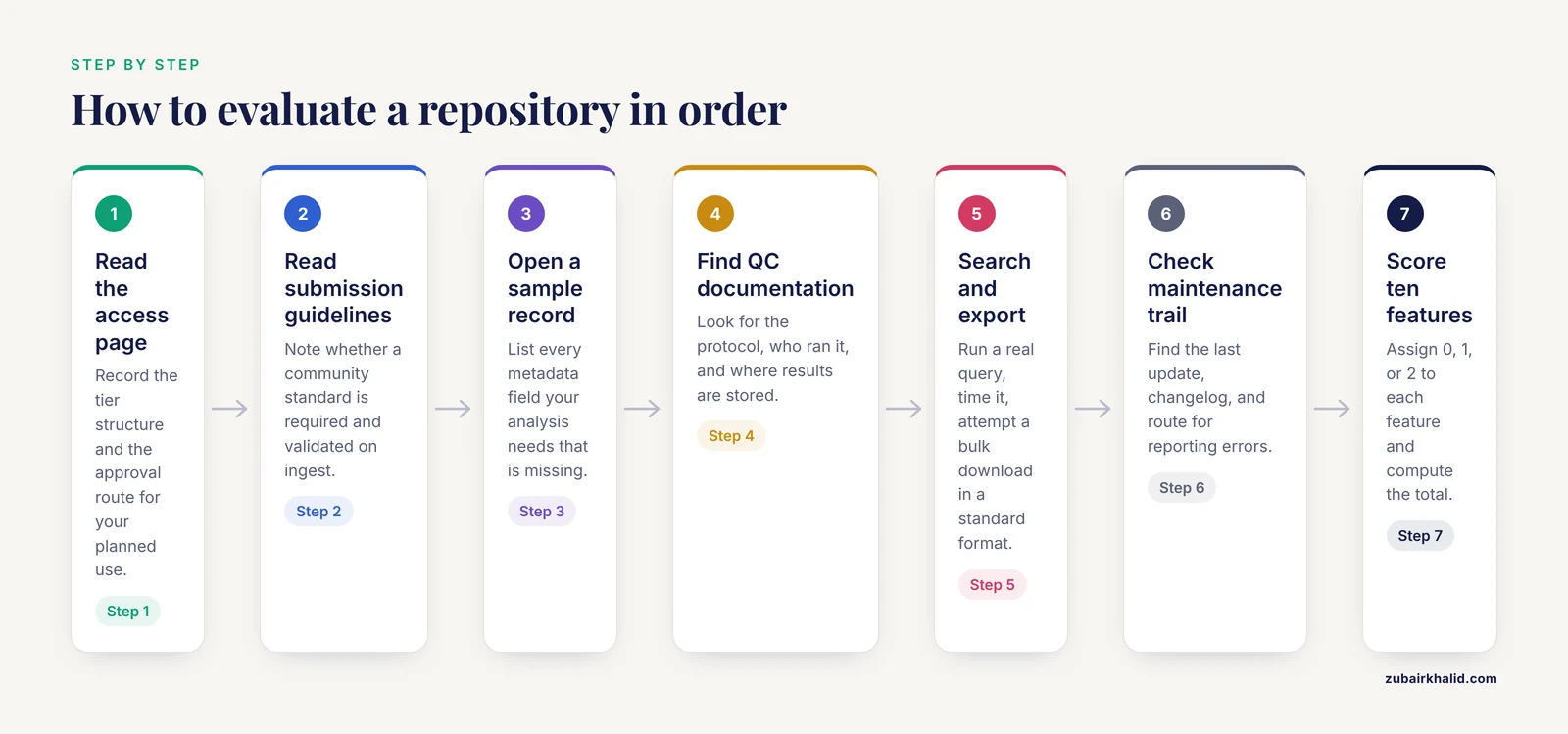
Here is a practical procedure, in order, for evaluating a candidate repository. Steps 1 through 6 use the repository website and a sample record. Step 7 converts your findings into a score.
Step 1. Read the access page. Record the tier structure and the approval route for your planned use. If your data contain identifiable human information, confirm the repository supports controlled access or secure in-place analysis, as in the All of Us controlled tiers [2] and secure study environments for sleep data [3].
Step 2. Read the submission guidelines. Note whether a community standard is required (BIDS for imaging [4], EDF for sleep recordings [3], AIRR for immune receptor data [5]) and whether the repository validates compliance on ingest.
Step 3. Open one full sample record. Check the metadata against the test in Feature 3. Write down every field you would need for your analysis that is missing.
Step 4. Find the QC documentation. Look for the protocol, the personnel or pipeline involved, and where QC results are stored, following the standard set by repositories that surface QC reports before analysis [4][6][7].
Step 5. Run a real search and a real export. Use a query tied to your actual project. Time it. Attempt a bulk download in a standard format [5][7].
Step 6. Check the maintenance trail. Find the last update, the changelog or news page, and the contact route for reporting errors.
Step 7. Score it. Assign 0, 1, or 2 to each of the 10 features and compute the total.
# Score a candidate repository against the 10-point checklist.
# Each feature receives 0 (absent), 1 (partial), or 2 (fully met).

features = {
    "access_model":               2,
    "community_standards":        2,
    "metadata_validation":        1,
    "quality_control":            2,
    "deidentification":           2,
    "provenance":                 1,
    "search_export":              2,
    "cross_comparability":        1,
    "integrated_tools":           0,
    "curation_updates":           1,
}

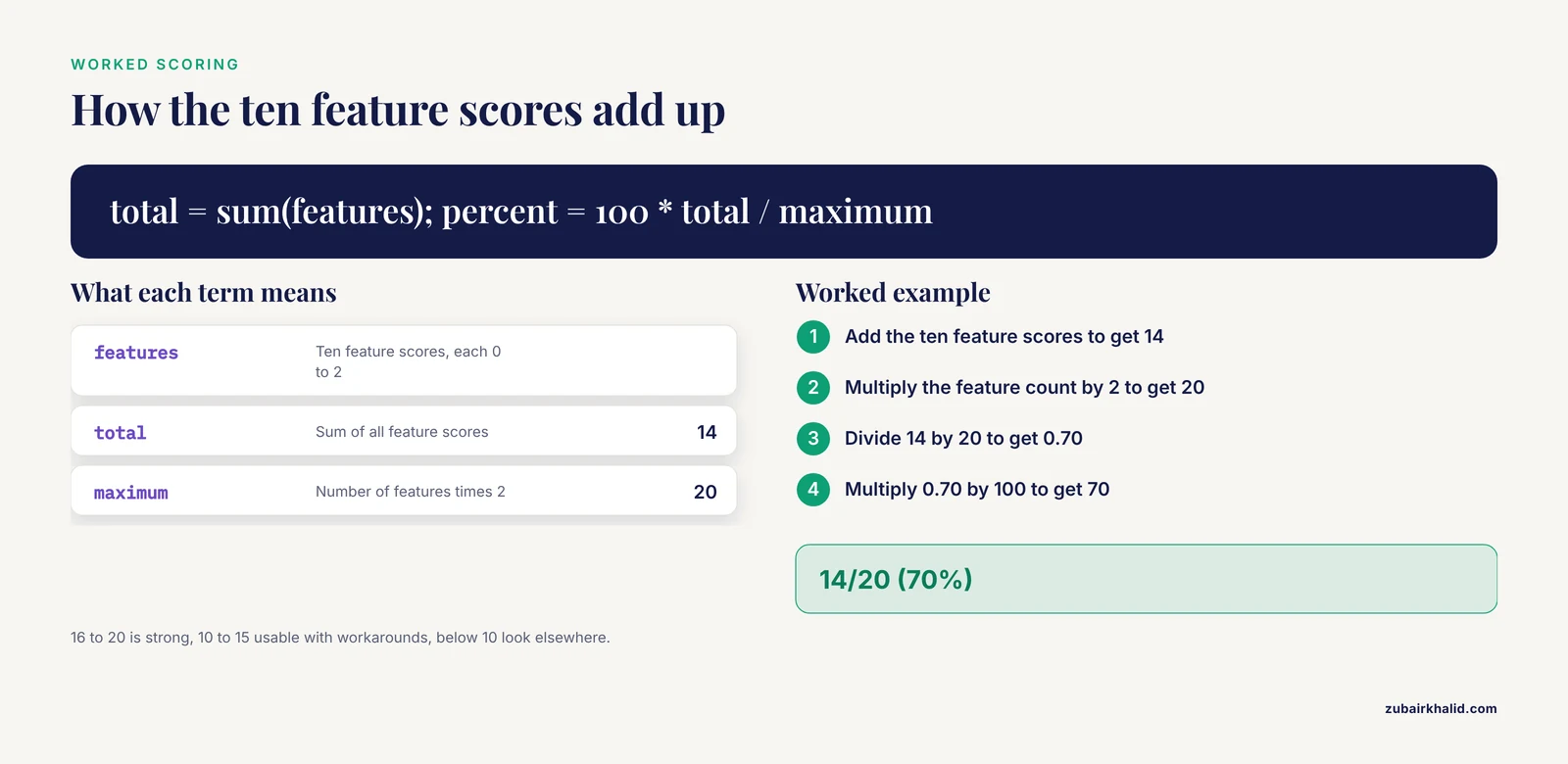
total = sum(features.values())
maximum = len(features) * 2
print(f"{total}/{maximum} ({100 * total / maximum:.0f}%)")
Expected output:
14/20 (70%)Step 8. Interpret the score. As a working rubric, 16 to 20 means the repository is strong enough for primary deposits and reuse. 10 to 15 means usable, but plan workarounds for the weak features, for example exporting data and running your own QC. Below 10 means look for an alternative before committing data or basing a study on the resource.
Step 9. Document your decision. Save your scorecard with the date and the URLs you checked. Reviewers, data management plans, and collaborators will all ask why you chose a given repository, and a dated checklist answers that in one line.
A worked example makes this concrete. Suppose you are depositing 200 whole-slide pathology images. On GICPIdb-style platforms you would find standard annotation protocols (Feature 4, score 2), pathologist-annotated sample records (Feature 3, score 2), and built-in annotation and prediction modules (Feature 9, score 2). If the platform lacked a provenance record for processing steps, that feature drops to 0 and your total falls by two points, which is the difference between a strong and a middling score. This is precisely the kind of gap that reproducible companion repositories, such as the R-script workflow for allostatic load measurement, are built to fill [10].
Common Mistakes and Limitations
Mistake 1. Judging a repository by its homepage. Polished design says nothing about metadata validation or curation. The features that matter, such as QC protocols and deidentification workflows, are documented three or four clicks deep [4][6].
Mistake 2. Assuming one repository fits all data types. A data repository comparison should start with your data type. Imaging, sleep recordings, immune receptor sequences, metabolomics spectra, and pathology slides each have their own standards and their own domain repositories, from BIDS-organized imaging platforms [4] to EDF-based sleep archives [3] to AIRR-format immune databases [5]. A generalist repository that accepts anything usually validates nothing.
Mistake 3. Confusing size with quality. GICPIdb's value comes not from holding the most images but from holding 2,863 uniformly processed, pathologist-annotated ones [7]. A smaller, curated, standardized collection frequently outperforms a larger, heterogeneous one for real analyses.
Mistake 4. Ignoring access model until submission day. Researchers discover controlled-access requirements when a journal or funder asks about them, then lose weeks. Check the tier structure first, as in the All of Us controlled tier design [2].
Mistake 5. Depositing without provenance. Data without a record of processing cannot be safely reused, which is why provenance-retaining designs [11] and script-sharing repositories [10] exist. If your repository does not capture provenance, deposit your processing code alongside the data.
Mistake 6. Treating QC as the depositor's problem alone. Centralized QC catches problems individual depositors miss, which is why multicenter repositories route all files through one verification and deidentification step [6].
A final limitation. Any checklist is a snapshot. Repositories change their interfaces, standards, and access policies, so rescore a repository each time you start a new project that depends on it. Individual deposits also carry their own terms of use, which you should read separately from the repository-level policy.
Frequently Asked Questions
What is a research data repository?
A research data repository is a curated, persistent store for datasets that pairs files with validated metadata, quality control records, and tools for search and retrieval. Its purpose is to make data findable, understandable, and reusable by people who were not involved in the original study.
How do I run a data repository comparison quickly?
Score candidates against a fixed checklist rather than comparing features ad hoc. Work through access model, standards, metadata, QC, privacy, provenance, search, comparability, tooling, and curation in that order, then compare total scores. The 10-point rubric and scoring code in this article are built for exactly that purpose.
What is the difference between a repository and a journal data supplement?
A supplement is a static bundle attached to one paper, usually with minimal curation and no update path. A repository validates metadata, applies quality control, supports search and export, and maintains the data over time so later studies can build on it.
How much metadata is enough?
Enough that you could write the methods section of a paper using the metadata alone. Practically, that means measurement platform, sample type, experimental conditions, processing history, and any applied standards, each recorded in controlled fields rather than free text.
Can I deposit human subject data in an open repository?
Often yes, but usually not as fully open files. Human data commonly require deidentification, controlled access tiers, or secure in-place analysis environments. Confirm the repository's privacy workflow and access tiers before you plan the deposit, not after.
Do I need a DOI or persistent identifier for my dataset?
For publication and citation, yes in nearly all cases. A persistent identifier means your dataset can be cited unambiguously and its version history tracked, which is what journals and funders expect from a deposit.
What is the fastest way to check a repository before depositing?
Open one full sample record, run one real search, attempt one bulk export, and check the date of the last update. Those four actions expose metadata quality, search function, export capability, and curation activity in under 15 minutes.
How do repositories handle updates and version changes?
Well-run repositories version their datasets and document changes, as seen in versioned curated data releases [2] and in pipelines rebuilt and re-curation flags issued when standards evolve [5]. Check for a changelog or version history, and cite the specific version you used in any analysis.
Sources
- Scientific advances from sharing Urban Environment and Childhood Asthma study data in collaborative analyses.
- Sickle Cell Trait and Incident Ischemic Stroke Risk: A Whole-Genome Sequencing Study in the All of Us Research Program.
- Building a Sleep Data Repository: Architecture, Data Sources, and Governance.
- Democratizing data sharing and processing of routine MRI data acquired for neuroimaging research.
- The Immune Epitope Database (IEDB) in 2026: updates of immune receptor data.
- CRCS-K Imaging Repository: Architecture, Data Characteristics, and a Proof-of-Concept Analysis of Pretreatment Imaging Workflow.
- GICPIdb: an archival repository of multimodal data focusing on pathological images for gastrointestinal cancers.
- [[Research on screening, validation and risk prediction of key biomarkers for prostate cancer].](https://pubmed.ncbi.nlm.nih.gov/43012194/)
- Beyond Billing Codes: An Agentic Large Language Model Pipeline for Extracting Glaucoma Procedural Data from Free-Text Clinical Notes.
- Allostatic (over) load measurement: Workflow and repository.
- MeTime: an R package for reproducible longitudinal metabolomics data analysis.
- MultiSpaceNet: graph-based joint representation learning for paired spatial transcriptome-proteome data.
- APDB: A Large-Scale Repository of Predicted 2D and 3D Aptamer Structures.
- X-Align: annotation-independent cross-platform alignment of untargeted metabolomics features.
- Breast cancer screening effectiveness and mortality/case-fatality burden: global associations and optimisation pathways based on GBD 2021 and CanScreen5 data.
- Emzing: A Deep Learning-Enabled Software Suite for End-to-End Analysis of High-Resolution LC-MS Metabolomics Data.