CoreTrustSeal Certification for Data Repositories Explained
By Dr. Zubair Khalid, DVM, MS, PhD ·

CoreTrustSeal certification is an independent, review-based endorsement that a data repository manages, preserves, and serves research data in a trustworthy way. A repository earns the certificate by completing a self-assessment against a published set of requirements and passing review by CoreTrustSeal, a community-governed non-profit organization that lists certified repositories publicly for a fixed term.
For anyone building a career in the life sciences, the certificate answers a practical question: when you deposit a dataset or reuse someone else's, can you rely on the organization holding it? This guide covers data repository certification with CoreTrustSeal from the ground up, including what the requirements demand, how review works, how to read a certificate, and how to weigh certification in a data repository comparison before you commit your data.
What Does Data Repository Certification with CoreTrustSeal Mean?
A data repository is a service that stores, documents, and distributes research datasets. A trusted digital repository goes further. It holds a formal mandate to preserve digital objects over the long term and can demonstrate the governance, staffing, and infrastructure needed to do that through staff turnover, format obsolescence, and funding shifts. CoreTrustSeal certification is the most widely used lightweight route for a repository to demonstrate that status.
The organization behind the certificate formed in 2017 by harmonizing two earlier trust frameworks: the Data Seal of Approval, created by the Dutch data archive DANS, and the certification requirements of the World Data System (WDS). The aim was a single set of requirements, a single self-assessment format, and a single review path that any repository could use, regardless of size, budget, or discipline.
In practice, data repository certification with CoreTrustSeal means that reviewers judged the repository's documented governance, workflows, and infrastructure against the published CoreTrustSeal Trustworthy Data Repositories Requirements [1]. The certificate describes the organization and its processes. It is not a quality stamp on every dataset the repository holds, and it does not replace your own judgment of any individual dataset.
Three ideas sit behind the whole scheme. Trust must rest on evidence rather than reputation. The evidence should be public, in the form of a completed self-assessment that anyone can inspect. And trust expires, so certification runs on a renewal cycle rather than lasting forever. Those ideas explain most of what follows, from the structure of the requirements to the way reviewers work.
Why Trustworthy Repositories Matter for Research Data Sharing
Research data sharing has moved from a courtesy to an expectation. Funders ask for data management plans, journals ask where data will be archived, and the National Institutes of Health has highlighted community resources such as the PhenX Toolkit, a knowledgebase of consensus measurement protocols, in its implementation plan "Leading in Gold Standard Science" as an example of efforts to advance reproducible biomedical research [2]. None of that machinery works if the destination of shared data is unreliable.
The reuse value of well-run repositories is easy to demonstrate. Public archives of microarray data hold decades of experiments, and a recent benchmarking of ten cell type deconvolution algorithms concluded that greater precision in these methods would unlock the full potential of the vast repositories of microarray data in public domains [3]. In metabolomics, researchers assembled a pan-repository spectral library of 640,141 mass spectrometry spectra drawn from three major public repositories, work that was only possible because those repositories exposed their holdings and metadata, meaning the descriptive information that makes data findable and usable, in a form that could be harmonized [4]. In cancer control research, the International Agency for Research on Cancer's CanScreen5 repository supplied harmonized screening program data from 93 countries, which investigators combined with Global Burden of Disease estimates to quantify global screening inequities [5]. At the largest scale, the National Institutes of Health's All of Us Research Program maintains a versioned Curated Data Repository that supports entire secondary studies, including a whole-genome sequencing analysis of 414,830 participants examining sickle cell trait and stroke risk [6].
Trust is also becoming a governance problem in its own right. As generative AI accelerates the production of machine-generated scientific content, researchers have argued that accountability mechanisms must be embedded directly in databases, repositories, journals, and indexing platforms, through ideas such as credibility ledgers, reproducibility metrics, and provenance tracking, meaning the documented history of where data came from and how they were processed [7]. The argument is that existing self-governance institutions are structurally mismatched to AI-generated epistemic risk [7]. Certification is one of the few established mechanisms that already audits exactly these properties in a repository: documented provenance practices, preservation commitments, and accountability structures.
The CoreTrustSeal Requirements at a Glance
CoreTrustSeal publishes a Requirements and Guidance document that groups its criteria into three areas. Earlier versions listed 14 requirements, and the current guidance adds a dedicated requirement on equity. Each requirement comes with guidance explaining what reviewers expect and what kind of evidence satisfies them.
| Requirement area | What it covers | Representative themes |
|---|---|---|
| Organizational infrastructure | The repository as an institution | Governance and transparency, licenses, data integrity and authenticity, data quality, workflows |
| Digital object management | How the data themselves are handled | Discovery and identification, preservation, continuity planning, security of holdings |
| Technical infrastructure | The systems underneath | Data collection and ingest, quality assurance, curation and preservation quality assurance, technology sustainability |
A repository does not need a perfect answer to every requirement. Reviewers look for honest, evidence-backed descriptions and credible plans for known weaknesses. A small domain repository with a handful of staff can certify if it documents its governance, preservation strategy, and security arrangements convincingly. A large center can fail if it cannot show evidence for the claims it makes. The same framework scales from a two-person archive to a national infrastructure because it asks for documented reality, not for a fixed organizational size.
The requirements also function without certification. The crosswalk study discussed below describes these assessment approaches as self-assessment tools that repositories can use to benchmark the maturity of their data holdings, highlight gaps in their practices, and improve their sustainability, with formal certification as one possible outcome [1]. Many repositories run an internal self-assessment against the CoreTrustSeal guidance purely as a gap analysis and never submit it for review.
How the Certification Process Works
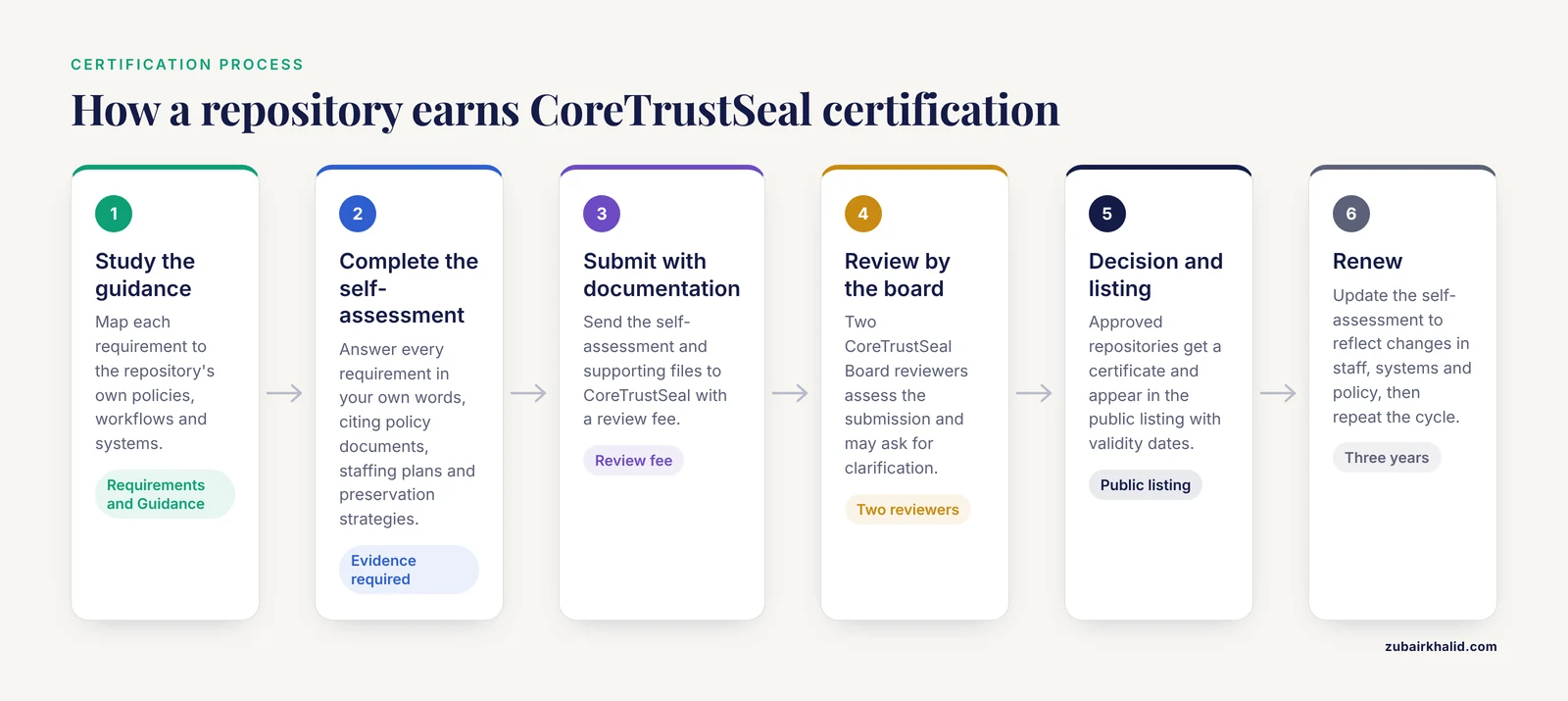
The process is designed so that a repository of almost any size can complete it.
- Study the guidance. The repository reads the Requirements and Guidance document and maps each requirement to its own policies, workflows, and systems.
- Complete the self-assessment. Staff answer every requirement in their own words, citing concrete evidence such as policy documents, workflow descriptions, staffing plans, retention schedules, and preservation strategies.
- Submit with documentation. The completed self-assessment and its supporting files go to CoreTrustSeal, together with a review fee.
- Review by the board. Two reviewers from the CoreTrustSeal Board assess the submission against the guidance and may request clarification before a decision.
- Decision and listing. Approved repositories receive a certificate, and the public listing shows the certified entity and its validity dates.
- Renewal. The certificate lasts three years. To renew, the repository updates its self-assessment to reflect changes in staff, systems, and policy, and the review cycle repeats.
The renewal cycle is deliberate. Trust is time-limited because staff leave, funding streams end, and technology shifts, so a review that reflected reality five years ago may not reflect reality today. Renewal also gives repositories a scheduled moment to correct drift, which many use as a periodic internal audit even before resubmission.
CoreTrustSeal Compared with Other Trust Frameworks
Certification does not exist in isolation, and you will meet several overlapping frameworks in data management guidance.
FAIR stands for Findable, Accessible, Interoperable, Reusable. The FAIR principles describe what makes datasets and other digital objects ready for reuse, and they address data producers and stewards rather than repositories as organizations. The TRUST principles, Transparency, Responsibility, User focus, Sustainability, and Technology, describe what makes a repository itself trustworthy. Certification frameworks turn these high-level ideas into checkable requirements.
Other formal options exist. ISO 16363 is an international standard for the audit and certification of trustworthy digital repositories, built on the OAIS reference model, the Open Archival Information System framework for long-term preservation. It is far more extensive than CoreTrustSeal and is typically pursued by large archives with dedicated audit budgets. The German standard DIN 31644 underpins the nestor Seal for trustworthy digital archives, and World Data System membership remains a separate community mechanism with its own criteria.
Because repositories often face several frameworks at once, researchers have mapped how they relate. A crosswalk study compared the CoreTrustSeal requirements with the Data Stewardship Maturity Matrix (DSMM), a framework that grades stewardship practices in progressive maturity levels, and with the FAIR Guiding Principles [1]. The study found strong correlations across data discovery, accessibility, interoperability, and usability, driven by overlapping requirements in digital object management, and it found that the complexity of the approaches produces a large variety of inferred crosswalks, so no clean one-to-one mapping exists between frameworks [1].
| Approach | Primary target | Typical use |
|---|---|---|
| CoreTrustSeal Requirements | The repository as an organization | Self-assessment that can lead to formal certification [1] |
| Data Stewardship Maturity Matrix | Stewardship practices, graded in maturity levels | Benchmarking maturity and locating gaps [1] |
| FAIR Guiding Principles | The datasets themselves | Designing and evaluating data for reuse [1] |
The practical takeaway is that FAIR compliance and repository certification answer different questions. A dataset can be FAIR while sitting in an uncertified repository, and a certified repository can hold datasets with thin metadata because depositors supplied little. Strong institutions work on both fronts.
How to Interpret CoreTrustSeal Certification for a Data Repository
Reading a certificate correctly matters more than recognizing one. Five points cover most situations.
First, check the scope and dates. The public listing identifies the certified entity and shows the validity period. A certificate that lapsed tells you the repository was reviewed once, not that it is reviewed now.
Second, understand what was reviewed. Assessors examined the repository's self-assessment and supporting evidence against each requirement. The certificate therefore reflects documented processes at a point in time, not a continuous surveillance program.
Third, know the limits of the claim. Certification evaluates the organization. It does not certify the scientific validity of individual datasets, and it cannot compensate for sparse metadata that depositors supplied. When you evaluate a dataset inside a certified repository, you still judge the study design, the collection methods, and the documentation yourself.
Fourth, do not treat absence of certification as evidence of poor quality. Certification consumes staff time and money, and many excellent domain repositories, especially in smaller fields or at lower-resource institutions, have not completed the process. A missing certificate often reflects capacity, not trustworthiness.
Fifth, use the underlying self-assessment when it is public. Many certified repositories publish their completed assessments, which give a detailed picture of how they handle ingest, meaning the controlled intake of new data, along with preservation, security, and takedown requests, meaning requests to remove data for legal or ethical reasons. That document is often more informative than the certificate itself, because it shows where the repository admitted gaps and how it planned to close them.
What Good Practice Looks Like in Working Repositories
The language of requirements becomes concrete when you look at what active repositories and data platforms actually do. Each example below maps to a cluster of CoreTrustSeal requirements.
Transparency and quality control in neuroimaging
NeuroStage, a web-based platform for sharing routine MRI data in neuroimaging research, targets five barriers its developers identified: technical complexity, cost, lack of transparency, scattered infrastructure, and limited computational resources [8]. The platform organizes images in the Brain Imaging Data Structure (BIDS), a community standard for structuring neuroimaging data, supports anonymization and automatic upload, and provides interactive viewers that let researchers check classification and quality control reports before preprocessing begins, preventing wasted computation on low-quality data. It also runs a collaborative repository with secure transfer protocols [8]. Discoverability, documented quality assurance, and secure handling are exactly what the digital object management and technical infrastructure requirements ask a repository to demonstrate.
Governance across regulatory environments in sleep research
A practical framework for building large-scale sleep data repositories describes the components a trustworthy biomedical repository is expected to document: data intake and processing, centralized storage, external data integration, and secure study environments [9]. Its standardization steps include European Data Format (EDF) parsing, the standard file format for sleep and biosignal recordings, channel harmonization across recording devices, and metadata validation [9]. The framework also sets out governance principles for compliant data use across multiple regulatory environments [9], which speaks directly to the governance and legal-context requirements in certification.
Documentation that supports reuse
The SHoRT-CA repository, which publishes multivariate time series of indoor air quality from a smart home, pairs its data files with anomaly descriptions and figures that highlight induced contextual anomalies, deviations that only stand out within a temporal context [10]. A user can understand and reuse the data without contacting the authors, which is the practical test of adequate documentation.
Reported reliability and legal grounding
An annotated dataset of 3,677 software requirement statements, published on IEEE DataPort and Mendeley Data, reports its annotation reliability with Cohen's kappa, a statistic describing agreement between annotators beyond chance, with direct inter-annotator agreement of kappa = 0.6164, and grounds its annotation taxonomy in the General Data Protection Regulation and the European Union AI Act [11]. This is the kind of quality assurance evidence and legal framing that reviewers expect a repository to describe in its self-assessment.
Shared measurement standards
The PhenX Toolkit provides 1,010 consensus measurement protocols for genomic, clinical, translational, and epidemiological research and collaborates with data collection tools, terminology standards such as LOINC, and data repositories to promote interoperability [2]. Standardized measurement sits upstream of everything a repository does, because data collected consistently are far easier to curate, harmonize, and preserve.
Choosing a Repository: A Practical Data Repository Comparison
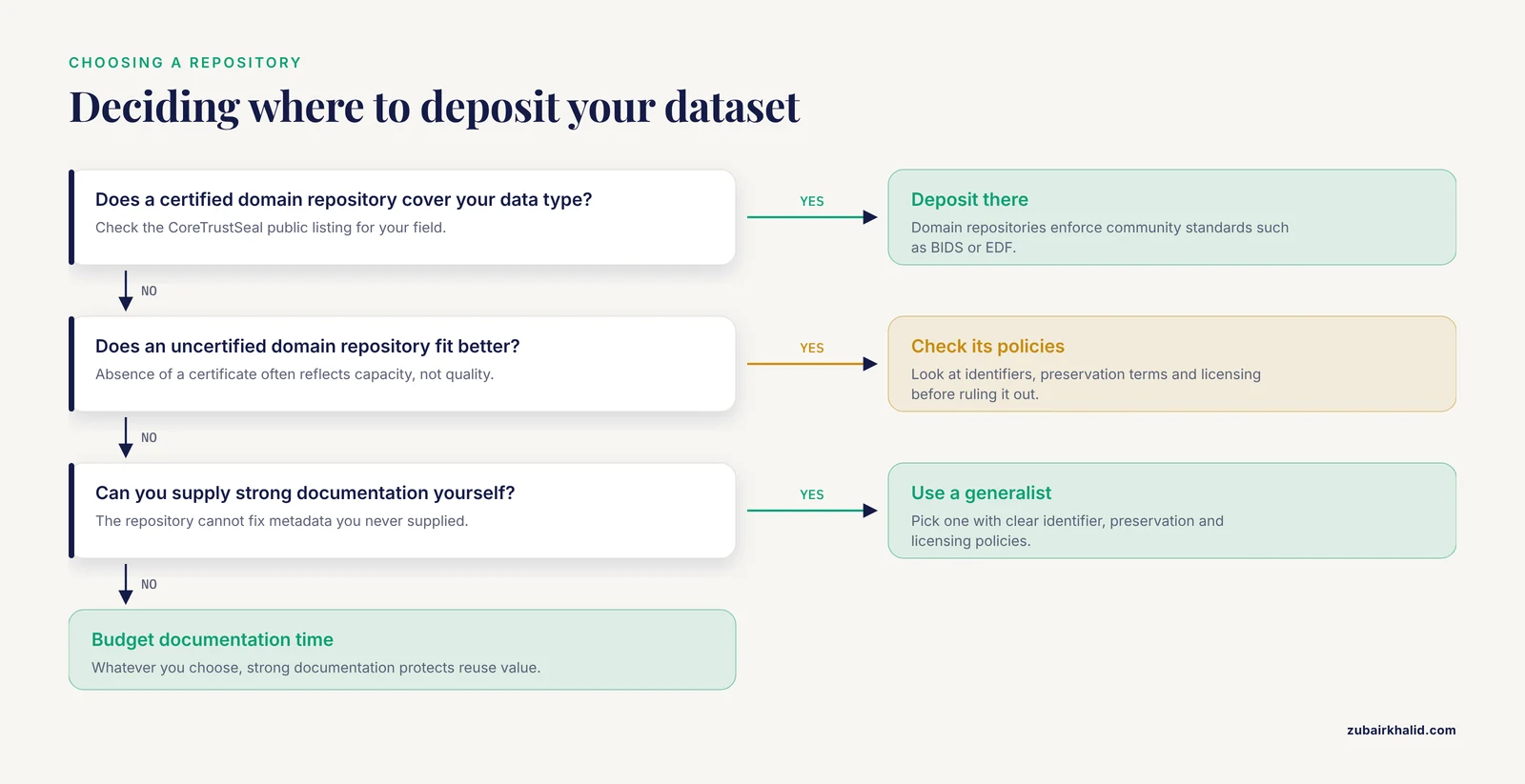
When you choose where to deposit, certification status is one criterion among several. A workable comparison covers the following points.
- Trust status. Check the CoreTrustSeal public listing, World Data System membership, or ISO 16363 audit status. Certification is the strongest single signal, but it is not the only one.
- Persistent identifiers. The repository should mint DOIs, digital object identifiers that resolve to the dataset permanently, so the dataset can be cited independently of any paper.
- Metadata and format standards. Domain repositories usually enforce community standards, such as BIDS for neuroimaging [8] or EDF for sleep recordings [9]. Enforced standards protect reuse value.
- Access and governance model. Sensitive human data often require controlled access tiers, as in the All of Us Curated Data Repository, which releases data in curated, versioned tiers [6].
- Preservation commitments. Look for stated retention periods, format migration plans, and succession plans describing what happens if the host organization dissolves.
- Versioning and change records. Versioned releases make analyses reproducible and citable, which is why large curated platforms number their releases explicitly [6].
- Cross-repository discoverability. Harmonized metadata increasingly determines whether your data can be combined with others, a lesson from pan-repository metabolomics work that harmonized metadata across three major repositories [4].
- Licensing and reuse terms. Clear licenses tell downstream users what they may do, which raises citations and reuse.
Domain repositories serve one field and usually enforce its standards, while generalist repositories accept almost any data type and lean more heavily on the depositor's documentation. A reasonable default: prefer a certified domain repository when one covers your data type. If none exists, choose a generalist repository with strong identifier, preservation, and licensing policies, and compensate with excellent documentation. Whatever you choose, the repository cannot fix metadata you never supplied, so budget time for documentation before upload.
Common Mistakes and Limitations
Mistake: treating the certificate as a dataset quality stamp. The review evaluates the organization. A certified repository can host a poorly documented dataset, and an uncertified one can host an excellent one.
Mistake: equating FAIR compliance with certification. FAIR describes the data objects, certification describes the holding organization, and the crosswalks between them are approximate rather than one-to-one [1].
Mistake: assuming certification is permanent. Certificates run on a three-year cycle. Check the validity dates rather than relying on a badge on the repository's homepage.
Mistake: dismissing uncertified repositories. Cost and staffing explain most gaps in coverage. Evaluate the repository's actual policies before ruling it out.
Mistake: writing a self-assessment without evidence. Reviewers ask for documentation behind every claim, and thin evidence stalls applications. Repositories that treat the self-assessment as marketing copy tend to fail, while those that treat it as an honest gap analysis tend to pass and improve.
Mistake: comparing repositories on certification alone. Domain fit, enforced metadata standards, access models, and preservation terms often matter more for your specific dataset than the presence of a certificate.
Limitation: repository choice for regulated or sensitive human data depends on institutional policy and applicable law. Involve your institutional data steward or compliance office early rather than after data collection, and do the same for any deposit with unusual constraints, where a conversation with an experienced data manager will surface issues no checklist covers.
What Is Still Uncertain
Three areas remain in motion. First, crosswalks between frameworks are not standardized. The comparison of CoreTrustSeal, the Data Stewardship Maturity Matrix, and the FAIR principles found that the complexity of the approaches produces a wide variety of inferred crosswalks, so institutions should expect to do their own mapping rather than rely on a canonical table [1].
Second, equity is the newest requirement area, and reviewer expectations around it are still settling as repositories experiment with what adequate evidence looks like.
Third, governance for AI-era science is unfinished. Proposals such as credibility ledgers, trust-weighted indexing, reproducibility metrics, and system-level retractability describe mechanisms that could be built into repositories and indexing platforms, but they remain proposals under discussion rather than standard practice [7]. How certification frameworks will absorb these ideas is an open question.
Frequently Asked Questions
What does data repository certification with CoreTrustSeal mean?
It means reviewers judged that the repository meets published requirements for governance, data management, and technical infrastructure. The certificate describes the organization, not the quality of each dataset it holds.
How long does a CoreTrustSeal certificate last?
Three years. The repository must update its self-assessment and re-apply before the term ends to stay listed.
Is CoreTrustSeal the same as FAIR?
No. FAIR principles describe what makes datasets findable, accessible, interoperable, and reusable, while CoreTrustSeal certifies the repository that holds them. The two overlap but answer different questions.
How is CoreTrustSeal different from ISO 16363?
CoreTrustSeal is a lighter, self-assessment-based certification open to repositories of almost any size. ISO 16363 is a longer, audit-based standard that large archives with dedicated budgets typically pursue.
Who runs CoreTrustSeal?
A community-owned, non-profit organization based in the Netherlands. It formed from the merger of the Data Seal of Approval and the World Data System requirements into one framework.
Does certification guarantee that the datasets are high quality?
No. It certifies the repository's processes. Dataset quality still depends on depositors and on the repository's quality assurance workflows.
How can I check whether a repository is certified?
Search the public list of certified repositories on the CoreTrustSeal website. The listing shows the certified entity and the certificate's validity dates.
Should I deposit my data in a certified repository?
Prefer one when a suitable domain repository exists. If your field has no certified option, a generalist repository with clear identifier, preservation, and licensing policies is a reasonable choice, and strong documentation matters in either case.
Sources
- Crosswalks among stewardship maturity assessment approaches promoting trustworthy FAIR data and repositories.
- PhenX Toolkit: a knowledgebase that enables consistent data collection and facilitates cross-study analysis and data reuse.
- Benchmarking of cell type deconvolution techniques for microarray data.
- The Evolving Bileome: A Pan-Repository Landscape of Expanded Bile Acid and Related Steroidal Signatures.
- Breast cancer screening effectiveness and mortality/case-fatality burden: global associations and optimisation pathways based on GBD 2021 and CanScreen5 data.
- Sickle Cell Trait and Incident Ischemic Stroke Risk: A Whole-Genome Sequencing Study in the All of Us Research Program.
- Scientific slop: generative AI, research incentives, and the integrity of the genomic knowledge base.
- Democratizing data sharing and processing of routine MRI data acquired for neuroimaging research.
- Building a Sleep Data Repository: Architecture, Data Sources, and Governance.
- SHoRT-CA: Smart home data repository of time series with contextual anomalies.
- The ethical PROMISE NFR dataset: data for ethical concern classification in software requirements.