Data Paper vs. Research Article: What's the Difference?
By Dr. Zubair Khalid, DVM, MS, PhD ·

A research article reports an answer to a scientific question, while a data paper describes a dataset itself so that other researchers can find, access, and reuse it. The rule of thumb is simple: if your main contribution is an interpretation, write a research article. If your main contribution is the data, write a data paper.
Both are peer-reviewed publications. Both count as citable scholarly work. But they are reviewed against different standards, structured differently, and used differently by the people who read them. This article explains each format on its own terms, compares them side by side, walks through real decision scenarios, and covers the mistakes that cost early-career researchers the most time.
What Is a Research Article?
A research article (sometimes called an original research paper or primary research article) presents a complete scientific argument. It states a question or hypothesis, describes the methods used to address it, reports the results, interprets those results, and places them in the context of prior work. Peer reviewers evaluate whether the conclusions are justified by the evidence.
The classical structure is the IMRaD format: Introduction, Methods, Results, and Discussion. A typical research article in the life sciences runs a few thousand words and condenses months or years of laboratory work into a concise narrative. Zimmerman and colleagues describe this tradition plainly in their account of modern structural biology: the traditional method of data reduction is to summarize results in peer-reviewed publications, which contain a concise compilation of the most important findings, an interpretation of the experiments, and a comparison with the results of other scientists [1].
That condensation is the format's strength and its weakness at the same time. A research article is optimized for persuasion and synthesis, not for data transfer. Details get compressed. In high-volume fields, descriptions of experimental methodology, and sometimes even primary results, are pushed into supplementary materials that may not be reviewed as thoroughly as the main body of the manuscript [1].
A research article can take several forms beyond the standard hypothesis-driven study. Review articles synthesize published literature. Meta-analyses statistically combine results from multiple studies, such as a systematic review and meta-analysis of pathogen prevalence in raw milk that pooled data from twenty studies identified through PubMed, Embase, and Web of Science [2]. Position papers, like the multi-part framework developed by German allergology societies for evaluating artificial intelligence in clinical practice, present structured expert consensus rather than new experiments [3]. Bibliometric analyses map trends in a field's publication output, such as an analysis of more than 2,600 publications on artificial intelligence in echocardiography published between 1984 and 2025 [4]. What all of these share is that the citable contribution is an argument or synthesis, never the raw data alone.
What Is a Data Paper?
A data paper is a scholarly publication whose primary contribution is a description of a dataset. The paper itself does not usually test a hypothesis or advance a new interpretation. Instead, it documents what the data are, how they were collected, how they were processed, what quality controls were applied, what the known limitations are, and where the data permanently live.
The dataset is stored in a public repository and assigned a persistent identifier, most commonly a DOI (digital object identifier), which is a permanent alphanumeric link managed through registration agencies. The data paper then cites that repository deposit, and researchers who use the dataset cite the data paper in return. This two-part structure separates the description (the paper) from the storage (the repository) and gives the dataset a stable scholarly identity of its own.
A data paper typically includes:
- An overview of the dataset, including its purpose, scope, and size.
- Detailed metadata, meaning structured information about the data such as collection dates, instruments, variables, and units.
- Methods describing how the data were generated, recorded, and validated.
- Quality assessment and known limitations.
- A link or accession reference pointing to the deposited data.
- Usage notes that help reusers avoid common errors.
Some data papers also describe the engineering behind a dataset. For example, a study on handwritten digit segmentation constructed a standardized, category-balanced dataset covering all 100 two-digit combinations from "00" to "99," with controlled overlap ratios and random misalignment to simulate realistic character adhesion, and presented that dataset alongside a new segmentation method [5]. In that case, the dataset construction was a deliberate scholarly contribution that other researchers could benchmark against.
Journals dedicated to data descriptions have grown substantially over the past two decades, and many conventional journals now accept data papers as a distinct article type. The key point is that the peer review for a data paper asks a different question than review for a research article. Reviewers do not judge whether the data support an interesting conclusion. They judge whether the description is accurate, complete, and sufficient for someone else to reuse the data correctly.
Side-by-Side Comparison
| Criterion | Research Article | Data Paper |
|---|---|---|
| Primary contribution | An interpretation, hypothesis test, or scientific claim | A documented, reusable dataset |
| Central question answered | "What do these results mean?" | "What are these data and how can they be reused?" |
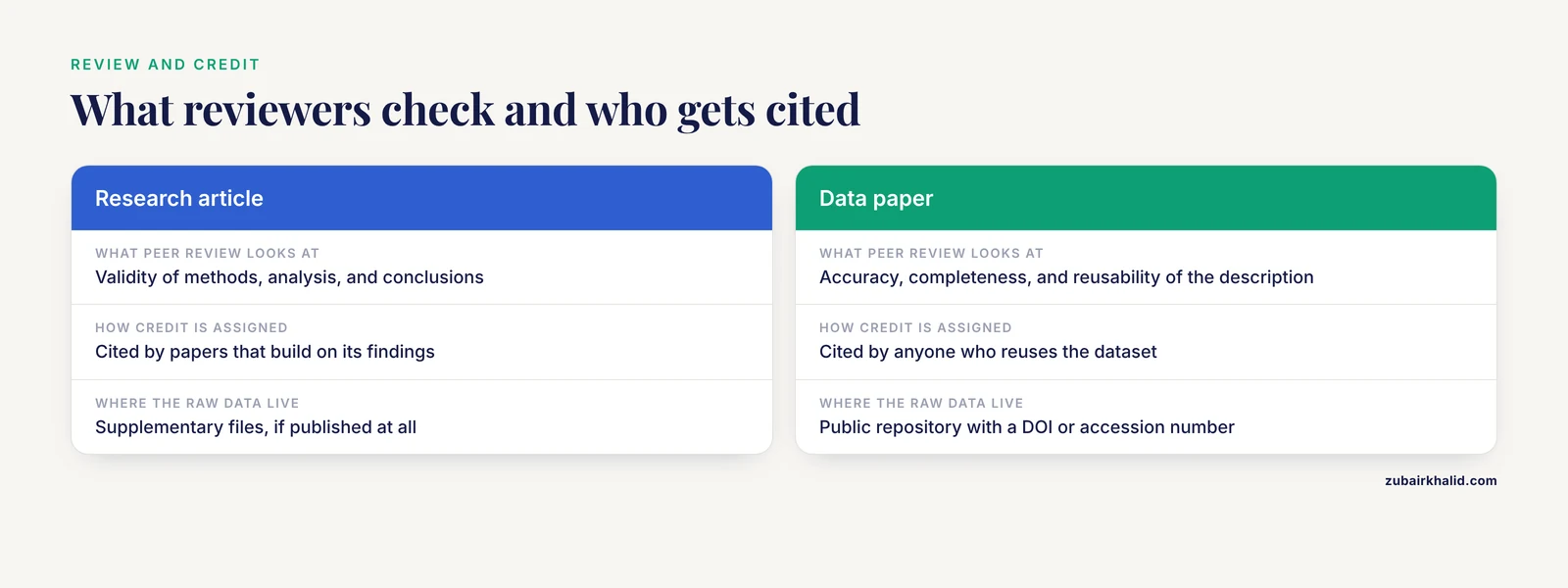
| Peer review focus | Validity of methods, analysis, and conclusions | Accuracy, completeness, and reusability of the description |
| Typical structure | IMRaD (Introduction, Methods, Results, Discussion) | Dataset overview, metadata, collection methods, quality notes, repository link |
| Where the data live | Often in supplementary files, if published at all | In a public repository with a persistent identifier (DOI or accession number) |
| Citation role | Cited for its findings and claims | Cited by anyone who reuses the dataset |
| Interpretation | Central to the paper | Minimal, limited to describing the data |
| Reuse value | Indirect, through reported summaries | Direct, others can reanalyze the raw data |
| Best suited for | Novel findings, tests of hypotheses, syntheses | Large datasets, benchmark datasets, monitoring series, negative results with valuable data |
Key Differences Explained
What gets peer reviewed
The difference between a data paper and a research article is sharpest at the review stage. For a research article, reviewers evaluate the full argument: whether the methods justify the results and whether the results justify the conclusions. For a data paper, reviewers evaluate the dataset description: whether the metadata are complete, whether the methods of collection are documented well enough for reuse, and whether the link to the deposited data works and matches the description.
This distinction matters because of a structural blind spot in traditional publishing. As Habibzadeh notes in a guide for journal editors, editors do not have access to the raw data behind a submitted manuscript and must rely on clues and internal consistency checks within the manuscript itself [6]. Reviewers are in the same position. A research article can be peer reviewed and published while no reviewer ever inspects the underlying numbers. A data paper, by contrast, puts the data itself at the center of the scholarly record.
How credit is assigned
A research article earns citations from other papers that build on its findings. Historically, this meant that the researchers who generated valuable datasets but did not publish a high-profile analysis of them received little formal credit. The data paper format was created in large part to fix this. When a dataset has its own paper, every downstream user who cites the dataset routes credit back to the people who produced it.
This credit structure also changes behavior. Reidpath and Allotey conducted a prospective study in which 29 corresponding authors of original research articles in a medical journal were contacted with requests to share their data. Researchers who received specific requests for their data were less likely and slower to respond than those who received general requests, and only one researcher ultimately released data [7]. The authors concluded that many researchers were more concerned with losing an advantage than with advancing science. A publication system in which the dataset itself earns citable credit removes part of that disincentive, because sharing no longer means giving away your only scholarly asset.
What happens to the raw data
The fate of raw data is the deepest practical difference between the two formats. Scientific literature, as Torres-Espín and Ferguson argue, does not really contain data at all, but rather narratives about and summaries of data [8]. When the underlying data are never released, they become what that paper calls "dark data," inaccessible to anyone who wants to verify, reanalyze, or pool the results. Meta-analyses based only on published summaries can produce biased conclusions because of publication bias and the lack of transparency in how data were collected [8].
The problem is field-wide and long-standing. In chemical research, original NMR (nuclear magnetic resonance) data, specifically the raw Free Induction Decays (FIDs) from which spectra are processed, contain a wealth of information but are rarely made accessible alongside published results, which undermines structural verification and reproducibility [9]. In structural biology, high-throughput laboratories produce vast amounts of raw experimental data, and trouble arises when results conflict with those of other laboratories, because resolving the conflict requires reexamining raw data or repeating experiments from sometimes incomplete published descriptions [1]. The debate over whether raw DNA sequence data release should be required of the scientific community, published in Science in 1996, shows that tensions over raw data release are as old as large-scale genomics itself [10].
A data paper is one structured answer to this problem. It makes the dataset, not just the summary, part of the permanent record.
Where each format is published
Research articles appear in tens of thousands of journals across every subspecialty. Data papers appear in dedicated data journals and as designated article types in conventional journals. In both cases, the paper points to a repository. The choice of repository is a real decision, covered below, because repositories differ in discipline coverage, access controls, and long-term stewardship.
Why the Distinction Exists: The Case for Research Data Sharing
The separation of data publication from results publication did not emerge from nowhere. It grew out of repeated, documented failures of the traditional model to preserve and transmit data.
Digital communication changed what publication could mean. As Bloom observed for neuroscience publishing, innovative means to share raw data, validate observations, and disseminate scientific information were emerging alongside the traditional journal system, though no system serves the community well unless the ethical behavior of scientists is maintained and appropriately rewarded [11].
Several fields built infrastructure to act on this. The Functional Magnetic Resonance Imaging Data Center (fMRIDC), established in 1999, created a publicly accessible repository of raw data from peer-reviewed neuroimaging studies so that the community could perform secondary meta-analyses and develop new analytical tools against shared data [12]. Its founders documented the practical difficulties of large-scale databasing, from formatting heterogeneity to policy questions about who may request data, and their experience illustrates that data sharing requires as much infrastructure and governance as the original experiments [12].
Medicine approached the same problem from the direction of clinical trials. Hrynaszkiewicz and Altman, working with the journal Trials, examined best practice for publishing raw clinical trial data and found that funding agencies increasingly required open access to results and, in some cases, raw data, but that agreed policies for handling patient privacy and data ownership were largely absent from existing guidance [13]. They outlined alternatives to full journal publication, including restricted access repositories, which remain a standard compromise for sensitive human data [13].
More recently, the FAIR principles (findable, accessible, interoperable, and reusable) have become the dominant framework for governing the research data lifecycle [8]. FAIR provides the vocabulary that data papers now rely on: a well-executed data paper is essentially the descriptive layer that makes a repository deposit findable and reusable.
When to Use a Data Paper
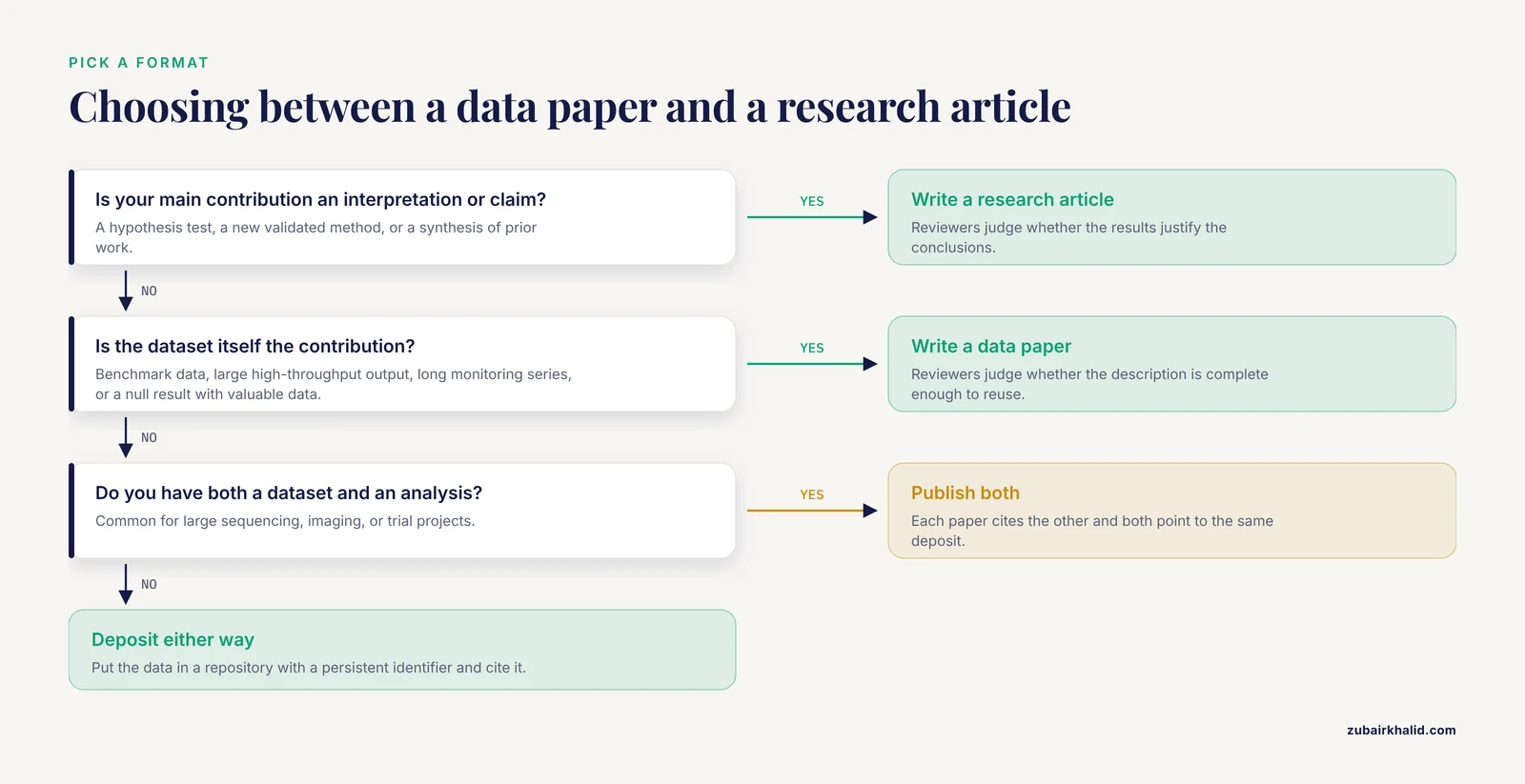
Choose a data paper when the dataset itself is the contribution. The following situations call for it:
- You built a benchmark or reference dataset. A carefully constructed, balanced dataset that others can use to evaluate algorithms is a contribution even without a headline result. The two-digit touching digit dataset described with its controlled overlap ratios and misalignment parameters is exactly this kind of contribution [5].
- Your data are too large or too rich to summarize. High-throughput structural biology, genomics, and neuroimaging produce far more data than any single paper can present [1]. A data paper documents the whole resource and lets reusers query it directly.
- Your study produced a null result with valuable data. A hypothesis that failed still yields measurements that the community can use. A research article reporting a null result can be difficult to publish, but the underlying dataset may be genuinely valuable. A data paper preserves it.
- You ran long-term monitoring. Environmental, ecological, and epidemiological time series accumulate value with each additional year. A data paper establishes the series in the literature and can be updated as the deposit grows.
- Funder or journal policy requires data availability. Funding agencies increasingly require open access to results and, in some cases, the raw data generated from funded research [13]. A data paper linked to a repository deposit is a clean way to satisfy these mandates.
- You want your dataset to be citable and credited. If you expect others to use your data, a data paper with a DOI gives them a standard way to cite you.
When to Write a Research Article Instead
Choose a research article when you have an interpretation to defend. The following situations call for it:
- You tested a hypothesis and have a result to report. The core purpose of a research article is to present a claim and the evidence for it.
- Your contribution is a new method with validation. If you developed a technique and demonstrated that it outperforms existing approaches, as the graph-theoretic segmentation framework for touching handwritten digits did when compared against the Vertical Projection Method, the Watershed algorithm, and a deep supervised baseline [5], the analysis and comparison are the contribution. A research article is the right vehicle, with the data deposited alongside it.
- Your contribution is a synthesis. Systematic reviews, meta-analyses, position papers, and bibliometric analyses all present arguments built from prior evidence, not new datasets [2][3][4].
- The dataset alone would not interest your field. If your data are small, routine for the technique, or fully described in a few tables, embedding them in a research article (with a repository deposit for the raw files) is usually simpler than a separate data paper.
Data Paper or Research Article? Worked Scenarios
Scenario 1: You sequenced 500 microbial genomes during a regional surveillance project. You also performed one focused analysis of antimicrobial resistance genes. The analysis alone is a modest research article, but the genome collection is a resource the whole field can mine. Best practice is a research article for the resistance analysis and a companion data paper describing the genome dataset, sampling scheme, sequencing protocols, and quality controls. Both link to the same repository deposit.
Scenario 2: You ran a clinical trial and the trial is over. Your primary research article reports efficacy results. The raw individual participant data raise privacy and ownership questions that current guidance often leaves unresolved, which is why restricted access repositories exist as an alternative to open publication [13]. A data paper describing the dataset, its structure, and its access conditions can accompany a controlled deposit, giving the dataset a citable identity while protecting participants.
Scenario 3: You built a neuroimaging pipeline and processed a large set of existing scans. Your contribution is the processed dataset and the harmonized representation of it, not a single clinical finding. Be aware of the harmonization-information trade-off: the level of granularity you choose when harmonizing data from different sources determines how much information is lost, so the trade-offs you made deserve explicit documentation [8]. A data paper is the natural format, because the reuser needs to know exactly what was harmonized and what was discarded.
Scenario 4: You completed a small undergraduate thesis experiment. One experiment with a few dozen measurements does not need its own data paper. Publish the research article (or deposit the thesis appropriately) and upload the raw data to an institutional or generalist repository with a DOI, citing it in the manuscript.
Choosing a Repository: A Practical Comparison
The data paper is only half the system. The repository is the other half, and data repository comparison is a real skill. The main categories are:
- Disciplinary repositories. These serve one field, enforce community-specific formats and metadata standards, and are curated by specialists. The fMRIDC model, in which a field-specific center stores raw data from peer-reviewed studies to enable meta- and mega-analyses, is the classic template [12]. Sequence, structure, and imaging communities each maintain long-standing archives of this kind.
- Restricted access repositories. For human data with privacy constraints, controlled access is a recognized alternative to open publication, with data requests reviewed before release [13]. Choose this category when consent, privacy, or regulatory obligations limit open sharing.
- Generalist repositories. These accept data from any discipline, assign DOIs, and are useful when no disciplinary archive fits. They provide fewer field-specific validation services, so the burden of good documentation falls more heavily on the data paper itself.
The guiding standard across all three is FAIR: the deposit should be findable, accessible, interoperable, and reusable [8]. In practice, that means rich metadata, standard file formats, a persistent identifier, and a license that states clearly what reusers may do.
Common Mistakes and Limitations
Treating supplementary files as data publication. Supplementary materials attached to a research article are hosted by the journal, lack independent identifiers in many cases, and may not be reviewed as thoroughly as the main manuscript [1]. They are not a substitute for a repository deposit with a persistent identifier.
Describing data in a paper without depositing it. A "data availability on request" statement shifts all burden onto future requesters. Empirical evidence shows how this fails in practice: when researchers were asked directly for their data, most were reluctant to release them, and only one of 29 contacted authors did so [7]. Deposit the data and cite the deposit.
Citing the research article when you mean the dataset. If you reused someone's data, cite the dataset (and its data paper if one exists), not just the analysis paper built on top of it. This preserves the credit chain that makes data publication work.
Assuming reviewers verified your numbers. Editors and reviewers typically do not have access to raw data and must rely on internal consistency and reporting quality in the manuscript itself [6]. Whether you write a research article or a data paper, the accuracy of the numbers is the authors' responsibility, and careful statistical reporting, including appropriate measures of dispersion and confidence intervals for main outcomes, is part of that responsibility [6].
Underestimating privacy and ownership constraints. For clinical and human-subjects data, patient privacy unless explicit consent for publication is obtained, and questions of data ownership, are the two most common obstacles to raw data release [13]. Address consent and access terms before you write either kind of paper, not after.
Ignoring the cost of harmonization. If your dataset pools data from multiple sources, document the harmonization decisions explicitly, because every harmonization choice trades information away at some level of granularity [8].
Expecting either format to substitute for the other. A data paper will not earn you credit for a scientific claim, and a research article will not make your data reusable. For large or distinctive datasets, the two formats work as a pair.
One general limitation applies to everything in this article: journal policies, funder mandates, and repository requirements change over time, so always check the current author guidelines of your target journal and the deposit terms of your target repository before committing to a format.
Frequently Asked Questions
Can one project produce both a data paper and a research article?
Yes, and for large datasets this is often the best arrangement. The research article reports the analysis and interpretation, and the data paper describes the dataset, its metadata, and its repository location. Each paper cites the other and both point to the same deposit.
Are data papers peer reviewed?
Yes. Data papers are peer reviewed, but the review criteria differ. Reviewers check whether the dataset description is accurate, complete, and sufficient for reuse, rather than whether the data support a novel scientific conclusion.
Does a data paper count for career credit?
It depends on the institution, but a data paper is a legitimate peer-reviewed publication that receives citations whenever the dataset is reused. As funder data sharing mandates have expanded, data papers have gained wider recognition as citable scholarly contributions.
Is a data paper the same as supplementary material?
No. Supplementary material is an attachment to a research article, often without its own identifier or dedicated review. A data paper is an independent, peer-reviewed publication linked to a repository deposit that carries a persistent identifier such as a DOI.
Do I need a data paper to share my data?
No. Depositing data in a repository with a persistent identifier satisfies most data sharing requirements on its own. A data paper adds a formal description layer and a citable scholarly object, which matters most for large, complex, or benchmark datasets.
What is the difference between a data paper and a methods paper?
A methods paper presents and validates a new experimental or analytical technique, and its contribution is the procedure. A data paper presents a dataset, and its contribution is the data itself. A study that introduces both a new segmentation framework and a new benchmark dataset can legitimately contribute to both literatures, with the method described in a research article and the dataset described in a data paper [5].
Sources
- Data management in the modern structural biology and biomedical research environment.
- Prevalence of Listeria monocytogenes, Salmonella spp., Shiga toxin-producing Escherichia coli, and Campylobacter spp. in raw milk in the United States between 2000 and 2019: A systematic review and meta-analysis.
- Artificial intelligence in allergology: A Position Paper of the German Society of Allergology and Clinical Immunology (DGAKI), German Academy of Allergy, Clinical Immunology and Environmental Medicine (AeDA) and German Society of Pediatric Allergology and Environmental Medicine (GPA): Part 1.
- Global research trends of artificial intelligence in echocardiography (1984-2025): a bibliometric analysis.
- Research on graph theory segmentation method and dataset construction for connected handwritten digits.
- Statistical Data Editing in Scientific Articles.
- Data sharing in medical research: an empirical investigation.
- Harmonization-Information Trade-Offs for Sharing Individual Participant Data in Biomedicine.
- Dissemination of original NMR data enhances reproducibility and integrity in chemical research.
- Should non-peer-reviewed raw DNA sequence data release be forced on the scientific community?
- Publishing (whatever that means) neuroscience in the new millennium.
- The Functional Magnetic Resonance Imaging Data Center (fMRIDC): the challenges and rewards of large-scale databasing of neuroimaging studies.
- Towards agreement on best practice for publishing raw clinical trial data.