The Role of Data Access Committees in Multi-Institutional Projects
By Dr. Zubair Khalid, DVM, MS, PhD ·

By the end of this article, you will be able to explain what a data access committee (DAC) does in a multi-institutional research project, draft the core documents a new DAC needs, run a request intake and decision workflow with realistic turnaround targets, and choose between centralized and federated governance models for your consortium. Before you start, have three things on hand: your project's data use agreement, the consent language used with participants or the terms attached to the source datasets, and your institutions' data classification policies. If your consortium has not written any of these yet, that is your first finding, and the steps below will help you fix it.
What a Data Access Committee Is and Why Consortia Need One
A data access committee is a standing group within a research consortium that reviews, approves, conditions, and logs requests to use shared data. It sits between the people who contributed the data and the people who want to analyze it. In a single-institution study, a data steward or the principal investigator can handle this informally. In a multi-institutional project, at least three things change. Data contributors and data users come from different organizations with different policies. Consent terms, ethics approvals, and export rules differ across sites. And no single institution can unilaterally speak for the whole group.
The core insight from the collaboration literature is timing. A review of multi-national, multi-institutional genomic collaborations found that international guidelines were largely silent on data sharing questions that arise inside a consortium, such as who may analyze preliminary results and when data must be released to partners, and concluded that a data sharing policy should be negotiated and concluded between collaborators as early as possible [1]. A DAC is the standing body that makes that policy operational after it is signed.
The committee's work falls into five recurring functions:
- Eligibility review. Deciding whether a requester, whether inside the consortium or external, meets the access criteria defined in the data use agreement.
- Purpose and scope review. Checking that the proposed analysis fits the consent under which the data were collected and the approved aims of the project.
- Security and handling review. Confirming the requester's environment meets agreed controls before data or credentials move.
- Provenance and audit logging. Recording who received what, when, under which approval, so every downstream result can be traced back to a decision.
- Return and publication oversight. Managing data return to source sites, authorship norms, and the timing of public release.
Each function maps to a real failure mode seen in published consortia, which the next sections describe.
The Problems DACs Solve in Practice
Slow, opaque, and inconsistent access processes
A qualitative survey of 35 investigators at a large pediatric research institute ranked the barriers to research data sharing by both frequency and impact. The top three were lengthy turnaround time before data access (reported by 51 percent of respondents), inconsistent and opaque access processes (46 percent), and inability to identify or access existing datasets [2]. These are exactly the failure modes a DAC is designed to prevent, and they are also the metrics a DAC should measure about itself. A committee that takes months to answer a request, or that makes similar requests through different informal channels get different answers, destroys the trust that data sharing depends on.
Internal consortium disputes that no external rulebook covers
Singh and Daar catalogued the practical problems that arise within genomic consortia, especially between investigators in higher-income and lower-income countries. Who may use data from partner sites for secondary analyses. Whether local investigators at the site of collection get priority. How data are transferred and stored. Because international guidelines were silent on these intra-consortium questions, they recommended prospective negotiation and detailed guidance from sponsors, noting that the lack of guidance threatened to undermine crucial research ventures [1]. The DAC is where those negotiations get written down and enforced.
Heterogeneous data that no one can actually combine
Multi-institutional projects routinely discover that the same clinical concept is recorded differently at every site. A multinational analysis of clinical decision support systems at 20 institutions in 4 countries identified 131 data elements in active use and showed how widely information models and terminologies diverge, which is the core barrier the HL7 Virtual Medical Record standard project set out to address [3]. A DAC alone cannot harmonize terminology, but a governance committee can require that each site document its mappings and can approve the common data model before any pooling happens. The BigMouth dental data repository illustrates the mechanism: a multi-stakeholder committee developed a data governance framework that encouraged sharing while letting contributors retain control, and the platform mapped each institution's records to a common reference terminology on the i2b2 warehousing platform, launching in August 2012 with data on 1.1 million patients [4].
Silent quality drift across sites
Pooling data from many sites multiplies every site's recording errors. The Pediatric Cardiac Critical Care Consortium (PC4) made auditing a formal DAC-adjacent duty: over the first 39 site audits after a database version change, 2,219 encounters were audited, overall accuracy was 99.4 percent, and the passing standard required overall accuracy above 97 percent with a major discrepancy rate below 1.5 percent, which 38 of 39 sites met [5]. Fields with the highest discrepancy rates were arrhythmia type, cardiac arrest count, and current surgical status. A consortium that never audits cannot know whether its pooled analysis measures biology or documentation habits. Diagnostic code validation studies make the same point in claims data, reporting sensitivity, specificity, and predictive values for specific ICD-9-CM and ICD-10-CM codes rather than assuming codes mean what they say [6]. Biomarker studies show the same effect at the laboratory level, where a global scoring method for Ki67 in breast cancer improved inter-laboratory consistency in real-world multi-institutional data [7].
Consent and equity obligations that persist after collection
The Human, Heredity, and Health in Africa (H3A) consortium established a Data and Biospecimen Access Committee with an explicit dual mandate, facilitating medical progress while fostering bioinformatics capacity at Africa-based institutions, and published its committee's lessons on evaluating access under broad consent [8]. This example matters because it shows that a DAC is not only a gatekeeping body. It can carry affirmative obligations, such as steering access decisions toward capacity building in the populations that contributed the data.
Step-by-Step: Data Access Committee Best Practices for Multi-Institutional Projects
The following walkthrough takes a new consortium from zero to an operating DAC. Each step lists the artifact you produce, not just the activity, so you can tell when the step is done.
Step 1. Negotiate the data sharing policy before the first dataset moves
Schedule the data sharing negotiation during grant writing, not after enrollment begins. The output is a signed policy covering at minimum: who owns what, who may access what, transfer and storage conditions, secondary use rules, prepublication data release timelines for internal partners, and dispute resolution. The recommendation to conclude this policy as early as possible comes directly from documented failures in multi-national genomic consortia [1]. If your consortium spans countries with different export rules, write the policy to name the strictest applicable requirement as the consortium floor.
Step 2. Charter the committee with named roles
Write a one-page charter that names the chair, one voting representative per contributing institution, a data security member, a member representing participant or community interests where human data are involved, and a secretary who keeps the decision log. Define quorum, decision rules (majority, consensus, or chair tie-break), and a recusal rule for members whose own requests are under review. Set a service-level target now. The published barrier data suggest turnaround time is the single most damaging failure, so a consortium that commits to, for example, an initial response within five business days and a final decision within 20 has a defensible, measurable standard [2].
Step 3. Define access tiers and the request template
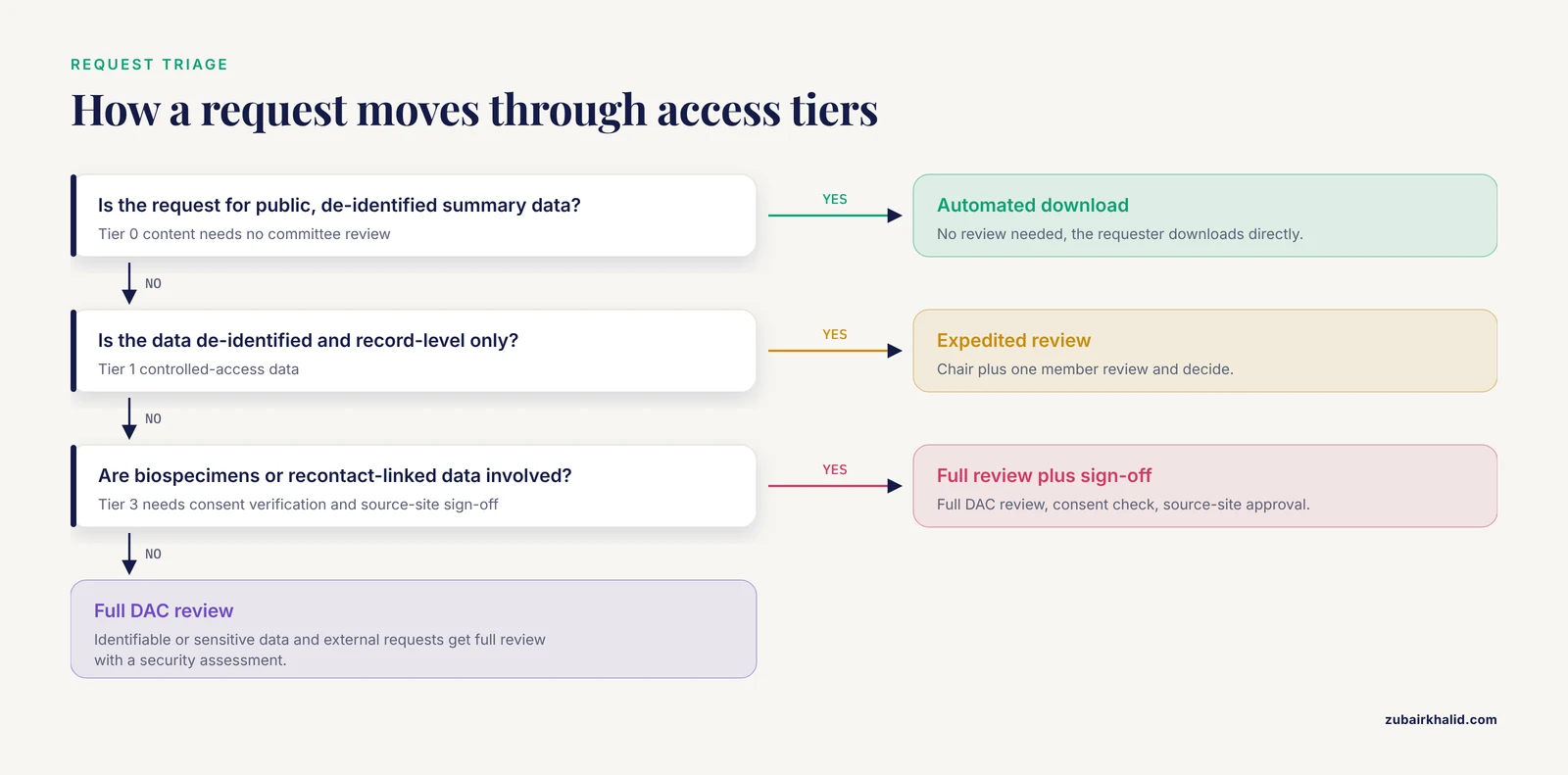
Create a tiered access model so the committee spends its time on hard cases. A common structure:
| Tier | Example content | Review depth |
|---|---|---|
| , - | , - | , - |
| Tier 0 | Public, de-identified summary data | None, automated download |
| Tier 1 | Controlled-access de-identified record-level data | DAC expedited review, chair plus one |
| Tier 2 | Identifiable or sensitive data, or external requests | Full DAC review with security assessment |
| Tier 3 | Biospecimens or data linked to recontact | Full review plus consent verification and source-site sign-off |
Every request, regardless of tier, uses the same template. At minimum it captures requester identity and affiliation, named institution and site principal investigator, proposed analysis and research question, data elements and sites requested, security environment description, and planned outputs including publications and data deposit intentions.
Step 4. Stand up a decision log you can actually measure
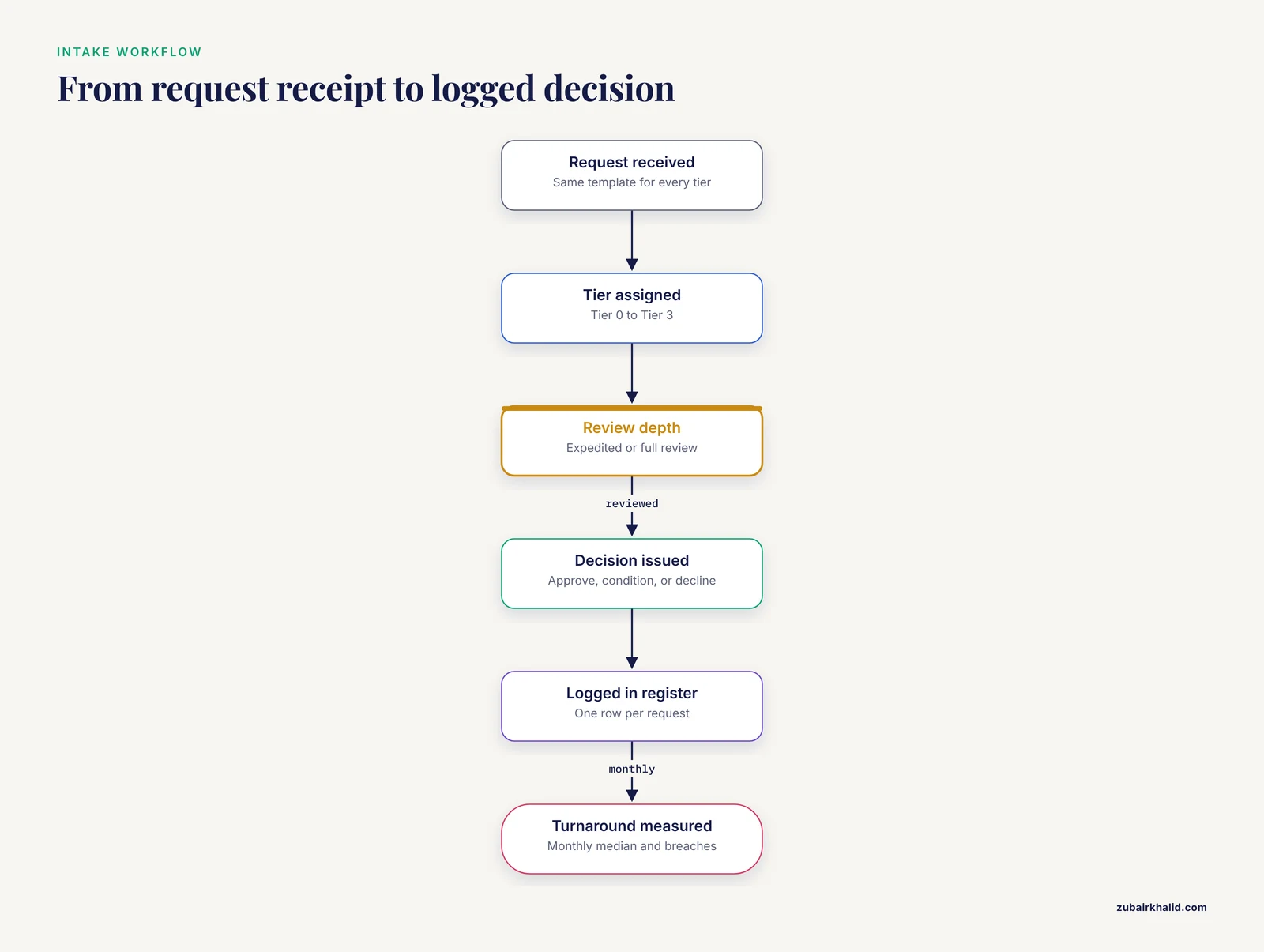
Track every request from receipt to decision in one register. A simple version is a CSV or spreadsheet with one row per request. The point is not the tool, it is the ability to compute your own turnaround statistics, which directly addresses the opacity barrier investigators report [2]. Here is a worked example using a Python script that reads a request log and reports monthly median decision times:
import csv
from datetime import date
from statistics import median

# requests.csv columns: request_id, received, decided, tier, outcome
rows = []
with open("requests.csv", newline="") as f:
    for r in csv.DictReader(f):
        received = date.fromisoformat(r["received"])
        decided = date.fromisoformat(r["decided"])
        rows.append({
            "id": r["request_id"],
            "days": (decided - received).days,
            "tier": r["tier"],
            "outcome": r["outcome"],
        })

for tier in sorted({r["tier"] for r in rows}):
    tier_rows = [r["days"] for r in rows if r["tier"] == tier]
    print(f"Tier {tier}: n={len(tier_rows)}, "
          f"median days={median(tier_rows)}, max={max(tier_rows)}")

breaches = [r for r in rows if r["days"] > 20]
print(f"Requests exceeding 20-day target: {len(breaches)} of {len(rows)}")
With a small real log, the expected output looks like this:
Tier 1: n=14, median days=9, max=18
Tier 2: n=6, median days=17, max=31
Tier 3: n=2, median days=26, max=34
Requests exceeding 20-day target: 3 of 22
A log like this turns an abstract complaint ("access takes too long") into a specific, fixable number ("Tier 3 requests take a median of 26 days, driven by missing source-site sign-off"). Re-run it monthly and put the result in the committee's own reporting.
Step 5. Approve the common data model and harmonization plan before pooling
Before any analysis across sites, the DAC or a sister data standards committee signs off on the common data model, per-site mapping documentation, and a validation plan. The multicenter informatics literature describes six generic steps in any distributed multi-institutional comparative effectiveness project: data identification, extraction, modeling, aggregation, analysis, and dissemination [9]. The DAC's checkpoints sit at the transitions: approval of what is identified and extracted, approval of the model and aggregation method, and approval of dissemination. Diagnostic code validation, such as the glaucoma codes study that quantified sensitivity and positive predictive value for specific ICD codes before using them [6], is the template for the validation plan. When sites measure the same concept with an instrument known to vary, such as Ki67 scoring in breast pathology, the harmonization plan should specify the scoring method up front, because method choice measurably changes inter-laboratory consistency and the fraction of cases classified in intermediate risk groups [7].
Step 6. Schedule per-site data audits
Write auditing into the consortium's operations calendar, not as a one-time onboarding event. PC4's model, initial audit followed by routinely scheduled follow-up audits of every participating site, produced 99.4 percent overall accuracy across 2,219 audited encounters and let the consortium identify exactly which fields drifted, such as arrhythmia type and cardiac arrest count [5]. Audit findings should go back to the DAC as a standing agenda item, because a site that fails audit may need restricted access until revalidation.
Step 7. Choose the data movement architecture with the committee at the table
Governance and architecture are not separable decisions. The committee should choose among at least three models, compared below.
| Feature | Centralized repository | Federated analysis | Blockchain-assisted governance |
|---|---|---|---|
| , - | , - | , - | , - |
| Where data live | One warehouse, mapped to common terminology [4] | Data stay at each source institution [10] | Ledger records access and consent, data typically off-chain [11] |
| Who controls access | DAC plus repository administrators | Each site controls its own data, DAC coordinates | Smart contracts enforce consent and access rules automatically [11] |
| Main strength | Simple queries, one security perimeter | No bulk data transfer, sites keep ownership [10] | Tamper-evident provenance and consent enforcement [11] |
| Main watch-out | Single point of failure, contributor control concerns | Model-based results only, coordination overhead | Complexity, needs mature engineering support |
| Fit | Consortia of similar institutions with strong trust | Privacy-sensitive patient data across institutions | Multi-omics sharing across jurisdictions with consent-tracking needs |
Three published examples anchor this comparison. BigMouth shows the centralized pattern, four dental schools contributing EHR-derived data to a shared i2b2 warehouse under a multi-stakeholder governance framework [4]. Federated learning shows the distributed pattern: in a 10-institution medical imaging collaboration, models trained by distributing computation to each data owner and aggregating results reached 99 percent of the model quality achieved with centrally pooled data, while avoiding bulk data movement [10]. The same architectural logic appears in preprocessing tools built for privacy-preserving multi-institutional neuroimaging, where algorithms must generalize across sites precisely so scans never need to leave them [12]. On the cryptographic end, a proposed six-layer framework for multi-omics sharing combines a permissioned blockchain ledger, smart-contract consent enforcement, privacy-preserving cryptography such as zero-knowledge proofs and homomorphic encryption, decentralized identity, off-chain storage, and interoperability with HL7 FHIR electronic health records [11].
For attribute-level control within a shared repository, privacy-enhanced schemes exist that hide the access policy itself and support dynamic policy updates, which matters when access rules change over a long project. These are engineering options your DAC should know exist, not requirements, and the committee should resist adopting technology it cannot operate and audit.
Step 8. Decide the release path and public deposit plan
The DAC's last recurring decision is what happens when the science is done. Options include returning results to source sites, depositing data in a public repository under controlled access, or full open release. The CHLSOC soil carbon database shows the open-release end state: an unprecedented national multi-institutional effort under the Global Soil Partnership framework compiled 13,612 data points, many previously unpublished or difficult to access, and released the database freely to registered users with a persistent identifier [13]. Release decisions interact with consent, so route them through the same committee that approved collection and access, using the policy you negotiated in Step 1 [1].
The Role of Data Access Committees in Multi-Institutional Projects, Summarized Across Project Stages
Reading the functions above against project stages clarifies the committee's full arc:
- Design stage. DAC exists on paper, data sharing policy negotiated early, access tiers defined [1].
- Collection stage. Site onboarding, common data model sign-off, first audits scheduled [9][5].
- Active analysis stage. Request intake, decision log, turnaround measurement, harmonization disputes resolved.
- Advanced methods stage. Approval of federated or cryptographic architectures where data movement is restricted [10][11].
- Dissemination stage. Publication oversight, repository deposit decisions, long-term access governance [13][8].
Across all five stages, one principle recurs in the literature: governance decided after data exist is governance that arrives too late.
Common Mistakes and Limitations
Writing the data sharing policy after data collection starts. The most consistent recommendation in the consortium literature is prospective negotiation, and the documented harms of skipping it include stalled collaborations and disputes that no external guideline resolves [1].
Letting the DAC become a bottleneck instead of a service. With lengthy turnaround the highest-impact barrier researchers report [2], a committee that adds months to every request will drive members to informal side channels, which destroys the audit trail. Set, publish, and measure turnaround targets as shown in Step 4.
Treating all requests identically. A tiered model keeps the committee's attention on genuinely risky requests. Committees that review every dataset extract at full depth burn out and default to blanket denial or blanket approval.
Assuming pooled data are clean because each site trusted its own data. The PC4 experience shows that even a mature quality improvement consortium must audit every site repeatedly, and that specific fields, not sites in general, are where discrepancies concentrate [5]. Code-level validation before analysis, as done for diagnostic codes [6] and pathology scoring [7], belongs in the plan, not after publication.
Choosing a technical architecture the committee cannot govern. Federated learning can preserve privacy without meaningful model quality loss in suitable settings [10], and cryptographic schemes can enforce fine-grained, evolving policies, but both add operational complexity. Blockchain-based frameworks add ledger and smart-contract maintenance obligations on top [11]. Adopt only what your consortium can staff, audit, and retire.
Confusing the DAC's job with the ethics board's job. The committee governs access to and use of shared data within the approved scope of the project. It does not replace institutional review board approval, which remains each institution's separate obligation.
Ignoring equity obligations embedded in the data's origin. Where contributors or communities were promised capacity building or benefit, the DAC is the body that operationalizes those promises in access decisions, as the H3A committee's experience demonstrates [8].
One limitation applies to this whole article: committee structures vary with funder requirements, legal jurisdiction, and data sensitivity, so treat the steps here as a baseline to adapt, not a checklist that replaces your institutions' own policies. Individual studies also need their own ethics and privacy review by the appropriate bodies at each institution.
Frequently Asked Questions
What does a data access committee actually decide?
It decides who may access shared consortium data, for what purpose, under which conditions, and it logs every decision. It also oversees data quality audits, harmonization approvals, and release plans.
Does a small multi-institutional project need a DAC?
If data move between institutions at all, yes, even if the committee is three people with a one-page charter. Scale the formality, not the function.
When should data sharing rules be negotiated?
Before data collection begins. Published analyses of multi-national genomic collaborations recommend concluding the data sharing policy between collaborators as early as possible [1].
How does federated learning change the committee's job?
Bulk data transfer disappears, but the committee still governs who may join the federation, what models may be trained, and how results are aggregated and released [10].
What belongs in a data access request?
Requester identity and affiliation, the proposed research question, specific data elements and sites requested, the security environment, and planned outputs including publications and deposits.
How fast should a DAC respond to requests?
Fast enough that researchers do not route around it. Turnaround time is the highest-impact barrier reported in published surveys of data access practice [2], so set a written target, such as an initial response within five business days, and measure it.
How is cross-site data quality checked?
Through scheduled per-site audits against a numeric passing standard, plus validation of specific fields or codes before analysis, following the model of consortia that audit every site on a recurring calendar [5].
What is the difference between a DAC and an ethics board?
An ethics board approves the research and protects participants before and during the study. A DAC governs who may use the resulting shared data and under what conditions, within the scope the ethics board already approved.
Sources
- Intra-consortium data sharing in multi-national, multi-institutional genomic studies: gaps and guidance.
- Data Access and Usage Practices Across a Cohort of Researchers at a Large Tertiary Pediatric Hospital: Qualitative Survey Study
- Multi-National, Multi-Institutional Analysis of Clinical Decision Support Data Needs to Inform Development of the HL7 Virtual Medical Record Standard.
- BigMouth: a multi-institutional dental data repository
- Assessing data accuracy in a large multi-institutional quality improvement registry: an update from the Pediatric Cardiac Critical Care Consortium (PC4)
- Validation of Diagnostic Codes to Identify Glaucoma in Taiwan’s Claims Data: A Multi-Institutional Study
- Global scoring method of Ki67 immunohistochemistry in breast cancer demonstrates improved concordance using real-world multi-institutional data
- Responsible governance of genomics data and biospecimens in the context of broad consent: experiences of a pioneering access committee in Africa
- A survey of informatics platforms that enable distributed comparative effectiveness research using multi-institutional heterogeneous clinical data
- Federated learning in medicine: facilitating multi-institutional collaborations without sharing patient data
- Big Data Governance for Multi-Omics Data Sharing: A Blockchain, Smart Contract, and Off-Chain Storage Framework
- Brain extraction on MRI scans in presence of diffuse glioma: Multi-institutional performance evaluation of deep learning methods and robust modality-agnostic training
- CHLSOC: the Chilean Soil Organic Carbon database, a multi-institutional collaborative effort