How to Create a Revision Timeline That Actually Works
By Dr. Zubair Khalid, DVM, MS, PhD ·

By the end of this article you will be able to turn a decision letter and a stack of reviewer comments into a dated, day-level plan that carries your manuscript from "major revision" to resubmission without a final-week panic. You will build a comment tracker, run a load calculation that tells you whether your deadline is realistic, and draft a reviewer response letter skeleton that grows alongside the revision instead of being written in a rush at the end.
To follow the walkthrough you need four things on hand: the decision letter and all reviewer files, access to your data and analysis code, a shared calendar that shows when co-authors are actually available, and either a spreadsheet or Python 3 installed on your machine. Nothing else is required. Every command in this article runs in a plain Python interpreter or a standard spreadsheet.
What a Revision Timeline Has to Compete With
A revision is not a second draft. It is a negotiated project with a hard external deadline, several independent workers (you, co-authors, possibly a statistician or lab staff), and an audience of two to four reviewers who each have their own model of what the paper should be. Timelines fail for predictable reasons: people plan in calendar days instead of working days, they treat every comment as equal effort, they sequence writing before experiments, and they leave no buffer for the slowest person on the author list.
The fix is mechanical, not motivational. You count the comments, you weight them, you count the days, and you do the arithmetic before you promise anything to your co-authors or the editor. The rest of this article walks through that arithmetic.
Step-by-Step: How to Create a Revision Timeline for a Manuscript
The seven steps below take roughly two hours of planning on the day the decision arrives. That two hours is the highest-leverage time you will spend in the entire revision.
Step 1: Inventory Every Comment Before You Plan Anything
Open the decision letter and every reviewer file, and copy each discrete comment into a tracker with one row per comment. A spreadsheet with these columns works well:
| Column | What goes in it |
|---|---|
| ID | Reviewer number and comment number, for example R2-C3 |
| Comment | The verbatim reviewer text, quoted in full |
| Section affected | Methods, Results, Discussion, Figures, Data availability |
| Effort category | Trivial, analysis, rewrite, or new data (Step 2) |
| Owner | The co-author who will handle it |
| Done means | The concrete artifact that closes the comment |
Two rules make the tracker usable. First, quote the comment verbatim, never paraphrased, because you will paste it into the reviewer response letter later and paraphrasing invites disputes about what was asked. Second, split compound comments. A comment like "The statistics are unclear and Figure 2 needs error bars" is two rows, R1-C4a and R1-C4b, because the statistic check and the figure fix have different owners and different effort weights.
A realistic major revision generates 15 to 30 discrete comments across reviewers. If your list has 60 rows, you are probably splitting too finely. If it has 6, you are probably merging comments that reviewers will expect to see answered individually.
Step 2: Sort Comments by Effort, Not by Reviewer
Reviewers do not write comments in order of difficulty. A reviewer who opens with a polite framing paragraph may bury a request for six months of new experiments in comment nine. Sort the tracker by what closing the comment actually requires.
| Effort category | Typical comments in it | Planning weight | What "done" looks like |
|---|---|---|---|
| Trivial | Typos, missing abbreviations, a clarifying sentence | 0.5 day | Text changed and located in the response letter |
| Analysis | Re-run a model, add a sensitivity analysis, fix a statistical test | 2 days | Updated numbers in the manuscript and a checkable script |
| Rewrite | Restructure a section, sharpen the claim, reconcile two paragraphs | 3 days | Revised text circulated to the full author team |
| New data | New experiment, new patient cohort, new measurement | 5 days minimum, often more | New result with methods text and a figure or table |
These weights are planning heuristics, not measured constants, and you should adjust them to your field. The point of weighting is that it converts 24 comments of wildly different sizes into a single number you can compare against the days you actually have.
One category deserves a caution flag. Before you accept any "new data" comment at face value, check whether the request is feasible at all. Sometimes the requested measurement was never collected and cannot be collected retrospectively. Step 6 covers how to handle that case in the response letter, and the worked example later in this article shows what a defensible alternative looks like.
Step 3: Count Real Working Days and Subtract a Buffer
Count working days between the day after the decision letter and the journal's stated due date, then subtract the holidays and any planned absences. Most journals state a revision window in the decision letter, and the window is usually enforced by the submission system, so treat the stated date as fixed unless you negotiate an extension early.
Subtract a buffer of at least five working days. The buffer exists because of a structural fact of revisions: the response letter and the revised manuscript must be signed off by every co-author, and the slowest co-author sets the date. A five-day buffer absorbs one round of late feedback. If your senior author is traveling during the window, add days rather than hoping.
Step 4: Run the Load Calculation
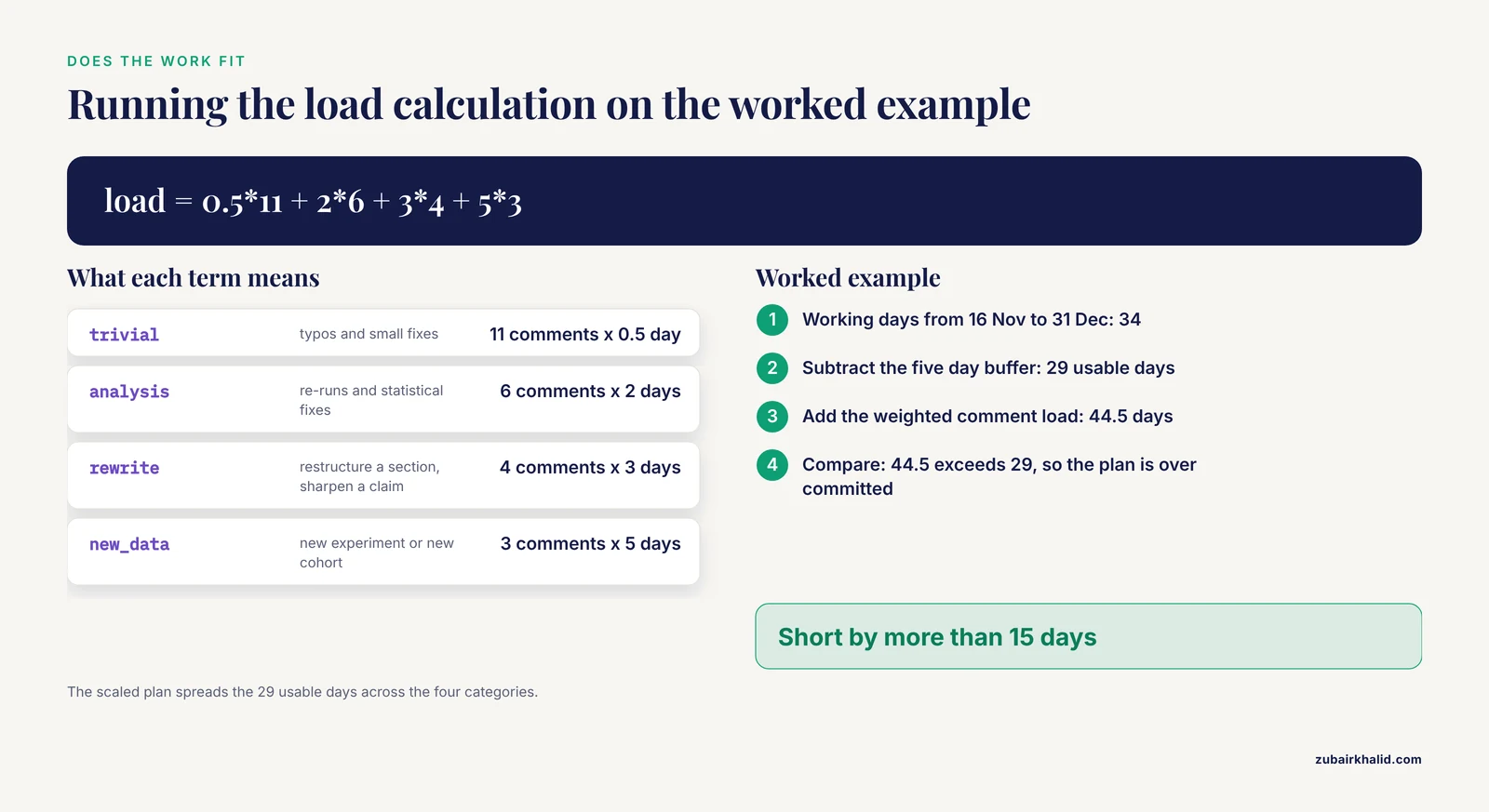
With the tracker filled in and the working days counted, run one calculation that answers the only question that matters: does the work fit? Here is a complete, runnable script.
from datetime import date, timedelta

def working_days(start, end):
    days = 0
    d = start
    while d <= end:
        if d.weekday() < 5:      # Monday through Friday
            days += 1
        d += timedelta(days=1)
    return days

start    = date(2026, 11, 16)    # day after the decision letter
deadline = date(2026, 12, 31)    # journal due date
buffer_days = 5

# effort weights from Step 2
weights = {"trivial": 0.5, "analysis": 2, "rewrite": 3, "new_data": 5}
counts  = {"trivial": 11, "analysis": 6, "rewrite": 4, "new_data": 3}

total  = working_days(start, deadline)
usable = total - buffer_days
load   = sum(weights[k] * counts[k] for k in weights)

print(f"Working days available: {total}")
print(f"Usable after buffer:    {usable}")
print(f"Estimated comment load: {load} days")

if load > usable:
    scale = usable / load
    plan = {k: round(weights[k] * counts[k] * scale, 1) for k in weights}
    print("Over committed. Scaled plan (days per category):", plan)
else:
    print("Plan fits. Spare capacity:", round(usable - load, 1), "days")
Running it produces this output:
Working days available: 34
Usable after buffer:    29
Estimated comment load: 44.5 days
Over committed. Scaled plan (days per category): {'trivial': 3.6, 'analysis': 7.8, 'rewrite': 7.8, 'new_data': 9.8}
Read the numbers carefully. In this example the author promised the editor a revision inside a window that contains 34 working days, but the comments need an estimated 44.5 person-days of effort. After the buffer, the plan is short by more than 15 days. That gap is exactly the information most authors discover in the final week, when it is useless.
Three parameters drive the result, and each has a distinct fix:
- Buffer size. Raising the buffer protects you from co-author delay but shrinks the working plan. Never set it to zero to make the numbers fit.
- Weights. If your lab can parallelize experiments across staff, the "new data" weight drops. If you are a single author, it rises.
- Counts. The counts are the only inputs you can negotiate. Some "new data" comments can be converted into "analysis" comments with a well-argued response letter, which is why the response letter belongs inside the timeline (Step 6).
If the load exceeds the usable days, you have exactly three honest options: start the extension conversation with the editor now, convert unfeasible requests into transparent partial responses, or cut the buffer and accept the risk. Ignoring the arithmetic is the fourth option, and it is the one that produces withdrawn manuscripts.
A spreadsheet version works the same way. Put the start date in cell A2, the deadline in B2, and compute working days with =NETWORKDAYS(A2,B2)-1, then subtract holidays by listing them in a range and passing it as the third argument. If Excel shows #VALUE!, one of the date cells contains text rather than a date, and the fix is to re-enter the date or use DATEVALUE() on the text cell.
Step 5: Sequence the Work Around the Longest-Lead Item
The common sequencing error is starting with the writing. Writing feels productive, but every "new data" comment is a dependency for at least one Results paragraph, one Methods paragraph, and one figure, so any prose written before the new results exist will be written twice.
Sequence in this order:
- Start every new-data item on day one, because wet-lab work, ethics amendments, and patient follow-up have lead times no timeline can compress.
- Run the analysis items in parallel, ideally by handing each to the co-author who owns the underlying data.
- Draft the reviewer response letter as each answer becomes known, not at the end.
- Do the rewrites last, once the new numbers are stable, so the narrative absorbs the new results in one pass.
- Save trivial items for low-energy slots. They are the correct task for a Friday afternoon.
Mark dependencies in the tracker. If R1-C2 ("add multivariable adjustment") depends on the analysis in R2-C1, the second row inherits the first row's finish date as its start date.
Step 6: Draft the Reviewer Response Letter in Parallel, Not at the End
The reviewer response letter is the document the editor actually reads first, and it is where the revision is argued rather than merely performed. A letter written in the final 48 hours reads like it was written in 48 hours, and reviewers notice.
Use a strict point-by-point structure with three elements per comment: the reviewer's words verbatim, your response, and the exact location of every change.
Reviewer 2, Comment 3: "The authors should clarify how eyes with
missing postoperative refraction measurements were handled."

Response: We agree this required clarification. Postoperative
manifest refraction was not systematically captured for all
patients in our registry. We now state this limitation explicitly
in the Methods (page 8, lines 12-15) and we performed a
pre-specified surrogate analysis, described in the Results
(page 12, Table 4), combining pre-enhancement corrected distance
visual acuity with observed postoperative uncorrected distance
visual acuity. We have added this to the Limitations paragraph.
That example pattern, substituting a transparent surrogate analysis and stating the limitation openly when a directly measured variable is unavailable, mirrors how working papers handle the problem in practice. A large keratorefractive surgery registry study recently published in Graefes Archive for Clinical and Experimental Ophthalmology faced exactly this situation: postoperative corrected distance visual acuity and manifest refraction were not systematically captured, so the authors ran an exploratory surrogate analysis combining pre-enhancement corrected distance visual acuity with observed postoperative uncorrected distance visual acuity, and they said so plainly in the abstract [1]. Reviewers generally respect a clearly labeled surrogate far more than a silent gap, and a clearly labeled partial response takes two days of effort instead of an unfeasible new cohort.
Write the letter's skeleton on day one, with every comment pasted in and the response fields left as placeholders. Filling placeholders is fast. Composing from a blank page under deadline is not.
Step 7: Build In Two Gates and a Final Read
A timeline that runs straight from "comments done" to "submit" fails at the last step, because the assembled manuscript is never the sum of its parts. Schedule two review gates:
- Gate one, at roughly 70 percent of the working days: the full revised manuscript circulates to all authors with the response letter attached. Comments at this gate change results and arguments, so it must come before the final polish.
- Gate two, three days before submission: the corresponding author checks the submission requirements, the point-by-point letter maps one-to-one onto the tracker with no orphaned comments, and every change in the letter is marked or quoted in the manuscript exactly where the letter says it is.
The one-to-one check matters more than it sounds. Editors routinely check whether every reviewer comment received a numbered response, and a single unanswered comment can send the manuscript back before review even starts.
What Reviewers Actually Probe: Two Worked Examples
Understanding what reviewers look for helps you estimate effort honestly in Step 2, because methodological comments are almost never trivial even when they are short.
The first pattern is scrutiny of the statistical plan, especially when events are rare or follow-up is uneven. A recent pediatric surgery study in Pediatric Surgery International comparing open versus laparoscopic treatment of hepatic hydatid disease reported its recurrence analysis with multivariable Firth logistic regression, a penalized method used when event counts are too small for standard logistic regression to behave reliably, and because the two surgical groups had different follow-up durations the authors additionally expressed recurrence per 100 patient-years and ran a 12-month landmark analysis with Kaplan-Meier curves and log-rank testing [2]. If a reviewer had asked for any one of those refinements, the honest planning weight would have been "analysis" or higher, since each requires rerunning models, regenerating figures, and rewriting the Statistics subsection.
The second pattern is scrutiny of what to do when a requested variable does not exist. The keratorefractive registry study cited above shows the full move: state what was not captured, justify the substitute, label the substitute as exploratory, and carry the caveat into the limitations [1]. Both patterns have the same lesson for your timeline. Comments that contain the word "clarify" can be trivial, and comments that contain the words "the authors should" can be a week of statistical work. Read for the verb, then weigh the comment.
Deciding Which Comments to Accept, Push Back On, or Escalate
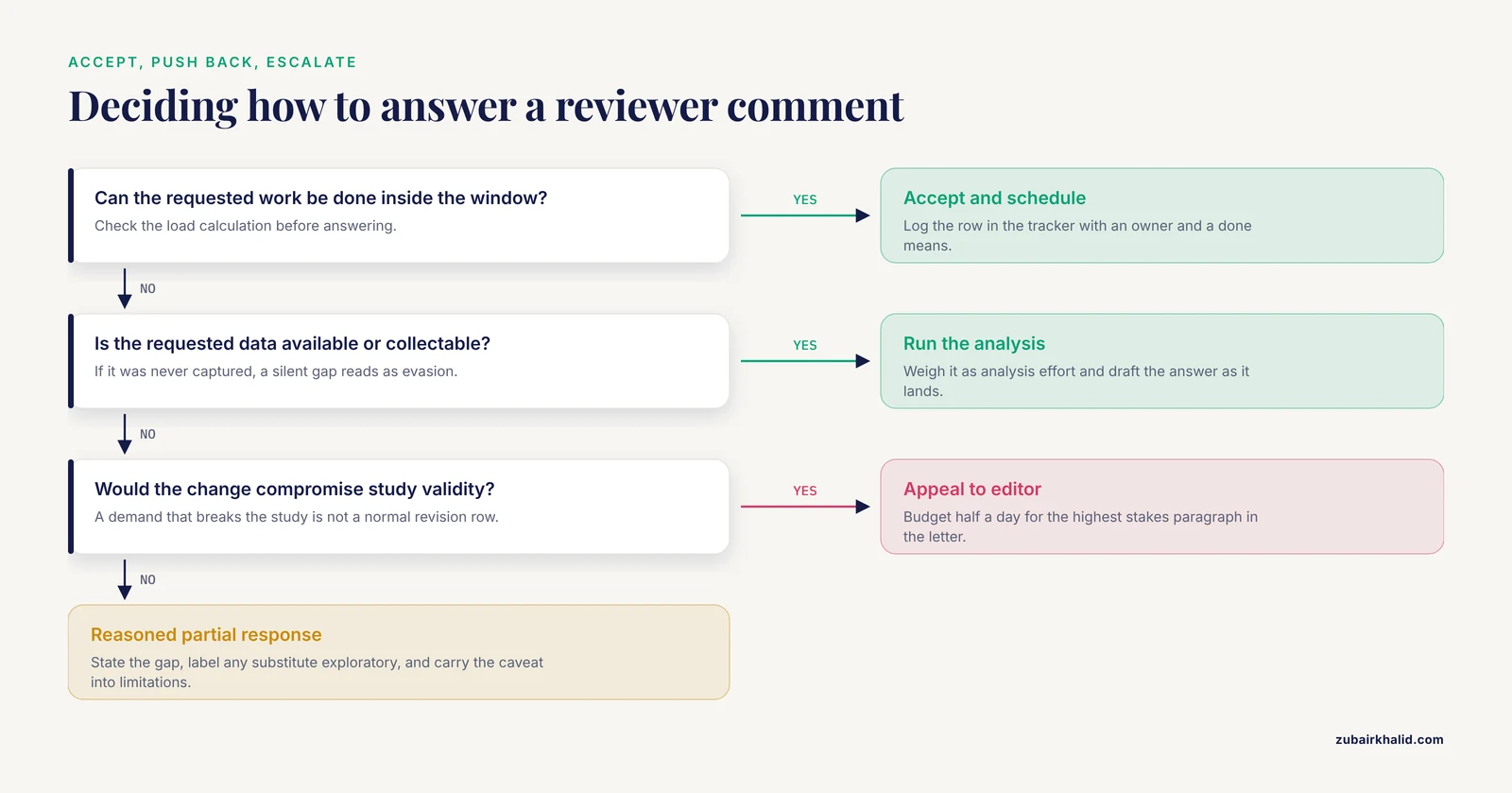
Not every reviewer request deserves acceptance, and a workable timeline depends on deciding early which rows in your tracker are fights. A useful lens comes from decision theory rather than from publishing guides. The Accountability for Reasonableness framework, developed for fair priority-setting in healthcare management, holds that a legitimate decision process requires transparency about the reasons, relevance of those reasons to the people affected, opportunities for revision and appeal, and a mechanism for enforcement [3]. A recent paper in Cureus builds on that framework and emphasizes that real decisions are made under resource constraints and competing stakeholder interests, with consequences that unfold on different time horizons [3].
Map that onto a revision and the correspondence is direct. Tell the editor transparently which comments you are declining and why, so the reasons are visible and appealable rather than buried in silence. Weigh the reviewer's request against your resource constraints honestly, because accepting an unfeasible demand helps nobody and produces either a broken study or a broken deadline. And give the reviewers a path to push back on your refusals by writing refusals as reasoned positions, with citations, rather than as flat refusals. This framing also tells you when to escalate: if a reviewer demands a change that would compromise the scientific validity of the study, the appeal path runs through the editor, not through an argument in the response letter. Budget a half day for drafting that kind of appeal, because it is the highest-stakes paragraph in the letter.
Common Mistakes and Limitations
These are the specific errors that derail revisions, in roughly descending order of frequency.
- Planning in calendar days. A 30-calendar-day window contains about 22 working days, and fewer once holidays and absences come out. Run the working-day count in Step 3 every time.
- Treating all comments as equal. One "new data" comment can outweigh ten typos. Weigh before you schedule.
- Starting with the prose. Any section rewritten before the new analyses land will be rewritten again. Sequence around the longest-lead item.
- Writing the response letter last. Draft the skeleton on day one and fill it as answers solidify. A rushed letter is the most visible artifact of a rushed revision.
- Skipping the author sign-off gate. The slowest co-author sets the submission date, and discovering a senior author's objections on day 29 of a 30-day window has no fix.
- Accepting unfeasible requests silently. If the requested data were never collected, say so with a labeled surrogate analysis or a reasoned refusal, as in the examples above. Silence reads as evasion.
- Missing the system deadline. Submission systems enforce the stated window. If the arithmetic in Step 4 shows an overrun, email the editor for an extension in week one, when it is routine, not in the final week, when it is an apology.
- Assuming one template fits all. Journals differ in how they enforce windows, whether they allow marked-up manuscripts, and whether they want changes tracked or listed. Read your journal's revision instructions before finalizing the plan, because a single generic timeline cannot capture every journal's rules, and individual cases differ.
One limitation of any timeline deserves a plain statement. No plan survives contact with a reviewer who asks for a new cohort, and no amount of scheduling substitutes for an honest early conversation with your co-authors about what is possible. The timeline's job is to surface that conversation in week one instead of week four.
Next Steps
Once the revision is submitted, archive the tracker. It becomes the input for the next round if the paper returns with minor comments, and it is the fastest way to answer a co-author who asks what happened to a specific request. If the paper is accepted, the tracker doubles as the raw material for the "Response to Reviewers" summary some journals request at proof stage. If you are building this process for a lab rather than a single paper, turn the tracker columns and the effort weights into a shared template, so the load calculation in Step 4 becomes a five-minute routine instead of a project.
Frequently Asked Questions
How long should I give myself for a major revision?
Give yourself exactly the window the journal allows, counted in working days, minus a buffer of at least five days for co-author sign-off. If the weighted load from Step 4 exceeds that number, request an extension in the first week.
How do I respond to peer reviewers who contradict each other?
Quote both comments in your letter and explain your resolution to each reviewer separately, noting that you chose one approach for a stated scientific reason. Never tell one reviewer that the other is wrong without evidence.
What goes in a reviewer response letter?
A point-by-point list containing each reviewer comment quoted verbatim, your specific response, and the exact page, line, and section location of every change in the revised manuscript.
What if I cannot do the experiment a reviewer asked for?
State plainly that the data were not collected and cannot be generated, then offer the strongest defensible alternative, such as a labeled surrogate analysis or an added limitation. Label any substitute as exploratory.
Should I respond to every comment, even trivial ones?
Yes. Every comment gets a numbered response, even if the response is one sentence confirming the change and its location. Unanswered comments are the fastest way to earn a second round.
How do I handle a reviewer comment I think is wrong?
Answer with evidence rather than authority, citing published methods or showing an analysis that demonstrates the point, and write the rebuttal as a reasoned position the reviewer can respond to. If the request would compromise the study's validity, appeal to the editor.
What if I miss the revision deadline?
Contact the editor immediately, before the system closes the submission, and ask whether a short extension is possible. Journals treat late requests very differently from silent lapses.
How many buffer days should a revision timeline include?
Plan on a minimum of five working days to absorb one round of co-author feedback, and add more if a key author is traveling or if the journal requires formal approval from a research ethics board before any text change.
Sources
- Incidence, timing, refractive patterns, and management of enhancement after keratorefractive lenticule extraction (KLEx): A 3,396-eye single-center registry study.
- Evolution of surgical management for pediatric hepatic hydatid disease: open versus standardized laparoscopic approach.
- Ethical Pragmatism in Healthcare Management: A Multidimensional Framework for Responsible Decision-Making Under Real-World Constraints.