Why Was My Data Deposit to a Controlled Access Repository Rejected?
By Dr. Zubair Khalid, DVM, MS, PhD ·

In most cases, a controlled access repository submission rejected by curators comes down to a single root problem: the repository could not verify that your deposit has a valid ethical and legal basis for sharing. The single most frequent trigger is consent documentation that does not clearly permit deposit and secondary use of the data. The first thing to check, before touching any files, is the rejection notice itself and the consent and ethics paperwork behind your study. Read the notice line by line. Curators usually state the exact failing item, such as a missing approval number, identifiers found in a file, or consent language that does not cover data sharing.
This guide walks through the causes in order of how often they occur, explains the mechanism behind each failure, gives you a diagnostic sequence, and ends with prevention practices for your next deposit.
What a Controlled Access Repository Actually Checks
Data sharing in biomedical research sits on a spectrum. At one end are fully open aggregate datasets anyone can download. At the other end are controlled access repositories, where approved researchers apply to a data access committee before they can download anything. Between those poles sit federated analysis models, where data stay at the source institution and only approved queries are run, and synthetic data, where artificial records stand in for real patients [1].
When you submit to a controlled access repository, the curation team checks several things before accepting your files:
- Whether the data have documented consent for deposit and future secondary use
- Whether a research ethics committee or institutional review board approved the study and the sharing plan
- Whether the files contain direct identifiers or information that could re-identify participants
- Whether the described purpose of the deposit matches the repository's scope
- Whether the submitter is authorized to act for the data-generating institution
- Whether files pass the repository's technical validation, including format, metadata, and data dictionary checks
A rejection is not a judgment about your science. It is a governance control. Health data are uniquely sensitive, and curated access exists precisely because unrestricted openness of patient-level data carries privacy and re-identification risks that consent and law have to address [1].
Troubleshooting Table: Symptom, Cause, Confirmation, Fix
The table below covers the failure patterns curators report most often. Work down it after reading your rejection notice.
| Symptom in the rejection notice | Likely cause | How to confirm | How to fix |
|---|---|---|---|
| "Consent does not permit sharing" or "authorization for secondary use not documented" | Consent scope too narrow for deposit and reuse | Compare the signed consent form and participant materials against the repository's consent policy | Contact your IRB or ethics committee, restrict the deposit to what consent covers, or seek a waiver or re-consent where lawful [2] |
| "No ethics approval or IRB protocol referenced" | Missing approval document or approval expired | Locate the protocol number and approval letter, check expiry dates | Upload current approval letters and renewal documents, or obtain them from your ethics office |
| "Potential identifiers detected in file X" | Direct or quasi-identifiers left in data or free text | Rerun de-identification review on dates, geography, and text fields | Remove or generalize identifiers, resubmit cleaned files |
| "Dataset does not meet criteria for controlled access" | Deposit filed under the wrong access tier or wrong repository | Compare your data type against repository scope guidance | Redeposit to the correct tier or an open repository if the data are non-identifiable aggregate results [1] |
| "Files failed validation" or "metadata incomplete" | Format errors, missing data dictionary, broken file structure | Run the repository's validation tools before resubmission | Correct formats, complete the metadata template, add the data dictionary |
| "Legal basis for transfer not established" | Missing data transfer agreement or undefined processing purpose | Check whether a data transfer agreement exists between institutions | Draft and sign an agreement, define purpose and legal basis explicitly [2] |
| "Purpose of processing unclear" | Vague or overly broad purpose statement in the deposit | Reread your stated purpose against the consent language | Rewrite the purpose so it is specific and consistent with the original consent [2] |
| "Institutional accountability not demonstrated" | No named responsible party or governance contact | Check whether a data steward or PI is named in the submission | Add named accountable individuals and governance contacts [1] |
The Most Common Causes, Most Frequent to Rarest
1. Consent scope does not cover the deposit
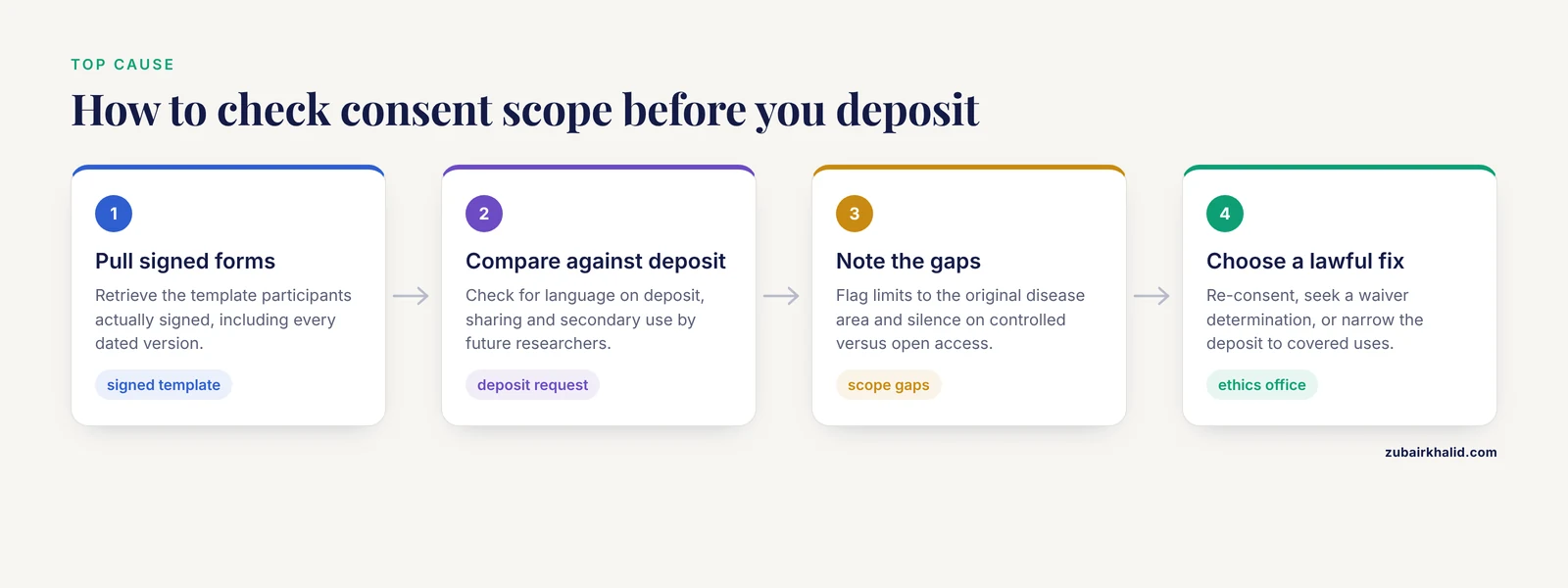
This is the top cause of a controlled access repository submission rejected at curation. The mechanism is simple. Consent is legally the anchor for processing sensitive personal data, and European data protection law requires a clearly defined purpose and legal basis before secondary use of genomic data is permitted [2]. If your participants consented to "this specific study" but the consent form never mentioned deposit into a shared repository or use by unspecified future researchers, the curator cannot lawfully accept the files.
Consent language fails in predictable ways:
- The form mentions "research use" but not data sharing or deposit
- The form limits use to the original disease area, and your deposit includes samples or data outside that scope
- The form predates current sharing practice, so it never anticipated repository models at all
- The form is silent on controlled access versus open access, and the repository needs an explicit statement
The fix starts with the signed consent forms, not with the repository. Pull the template participants actually signed, including any dated versions, and compare it against the deposit request. If the language is insufficient, your realistic options are re-consent where participants can be contacted, a research ethics committee determination that a waiver applies, or narrowing the deposit to the data elements and uses the consent does support. European-level rules interact with national rules in each member state, and that diversity complicates cross-border sharing, so a solution lawful in one country may not transfer cleanly to another [2]. Your institutional legal or ethics office, not the repository, resolves this question.
2. Missing or expired ethics approval and institutional authorization
Curators need proof that a recognized research ethics committee reviewed the study and that the person submitting is authorized to act for the generating institution. This is part of the basic legal framework for secondary use of sensitive data, which requires compliance with both overarching European legislation and the national rules of individual countries [2].
Common failure patterns:
- The submission references a protocol number that does not match the data being deposited
- The approval letter expired before the deposit date and no renewal is attached
- A postdoc submits without a documented delegation of authority from the principal investigator
- The generating institution differs from the submitting institution, and no agreement shows who is responsible
The fix is documentary. Attach the current approval letter, the protocol identifier, and a short statement of who is authorized to deposit on the institution's behalf.
3. Re-identification risk in the files themselves
Controlled access reduces but does not eliminate re-identification risk, and curators screen for it. Genomic data are inherently identifiable in a way that few other data types are, which is why genomic sharing raises privacy and confidentiality issues even when names and addresses are stripped [2].
Review your files for:
- Direct identifiers such as names, medical record numbers, and email addresses, including in file names and headers
- Precise dates of service that can be linked to public records
- Fine-grained geography, down to zip code or village, especially for rare conditions
- Free-text clinical notes, which frequently contain identifiers that structured-field scrubbing misses
- Rare combinations of attributes, such as a small number of participants sharing an uncommon diagnosis in a small region
A review of open data practice in biomedical research found that data on human subjects and samples were shared far less frequently than genomic sequence data, reflecting exactly this concern about identifiability [3]. If curators flag identifiers, rerun your de-identification process with attention to text fields and quasi-identifiers, document what you changed, and resubmit.
4. Wrong repository or wrong access tier
A data repository comparison matters before you deposit, not after. Deposits get rejected because the data do not fit the repository's scope or because the submitter chose an access tier inconsistent with the data's sensitivity. The spectrum of sharing arrangements is broader than open versus controlled. Options include public aggregate datasets, controlled access to patient-level data, federated analysis where data never leave the source, and synthetic datasets generated to preserve privacy [1]. Aggregate summary statistics with no individual-level information may belong in an open repository. Individual-level genomic and clinical data with broad consent typically belong in controlled access.
Before resubmitting, ask two questions. First, do the data contain information at the individual level that could identify a person even indirectly? If yes, controlled access is the appropriate tier. Second, does the repository's stated scope match the data type? Image data, genomic sequence data, and survey data are frequently handled by different repositories, and depositing to a mismatched one produces a rejection regardless of how well the submission is documented.
5. Technical validation failures
Rejections on technical grounds are the easiest to fix but still stall projects for weeks. Repositories validate file formats, check that metadata fields are populated, and confirm that a data dictionary explains each variable. Failures at this step usually trace to files exported in nonstandard formats, missing descriptions of variables, or compression and naming conventions the pipeline cannot parse.
Fragmented and poorly integrated information systems, limited access to digital infrastructure, and incomplete digitalization of data collection are documented weaknesses in health data ecosystems more broadly, and they show up at deposit time as files that cannot be validated or metadata that cannot be reconciled [4]. The fix is procedural. Run whatever validation tools the repository provides before submission, complete every required metadata field, and supply the data dictionary. If a variable in your dictionary does not match a column in your data file, resolve that mismatch before resubmitting rather than after another rejection.
6. Missing legal basis for cross-border transfer
If your institution and the repository sit in different legal jurisdictions, curators may reject the deposit until a lawful transfer mechanism exists. European legislation on genomic data secondary use is often described as counterintuitive and subject to different legal interpretations, and national rules in individual European Union countries add further specifications on top of the supranational framework [2]. The practical consequence for submitters is that "we have consent" is not always sufficient. Effective sharing requires a defined purpose, a defined legal basis for processing, and often a data transfer agreement between the sending and receiving institutions [2].
If the rejection notice cites legal basis or transfer terms, involve your institution's contracts or legal office. The data transfer agreement should name the parties, describe the data, state the permitted purposes, and assign responsibility for security and breach notification.
7. Governance and accountability gaps
Some rejections cite the absence of clear accountability rather than any single missing document. A narrative review of open data governance across biomedical research, healthcare, and public health concluded that durable progress in data sharing depends less on unrestricted openness than on calibrated access, privacy-preserving architectures, clear accountability, and sustained public engagement [1]. In practice, curators look for named data stewards, a stated access committee, and a description of how requests will be evaluated. A deposit with no identifiable responsible party gives the repository no one to hold accountable if access is misused.
The fix is organizational. Name the principal investigator, the data steward, and the contact for access requests. Describe who reviews access applications and on what criteria.
8. Privacy-preserving alternatives that carry their own hurdles
When patient-level deposit is rejected or inappropriate, two alternatives appear. Each has its own acceptance criteria.
Synthetic data replace real records with artificially generated ones that preserve statistical patterns. They can support research and method development while reducing privacy exposure, but quality assessment is not optional. A critical appraisal of synthetic data in healthcare showed that fidelity and utility scores evaluated at the aggregate level often miss weaknesses confined to specific patient subgroups, illustrated with a lung cancer case study, so a synthetic dataset can look sound overall while failing for a clinically meaningful subgroup [5]. If you deposit synthetic data, document how you assessed quality, including subgroup-level checks, or expect questions from curators.
Encryption-based and federated approaches keep raw data at the source. Research frameworks combining homomorphic encryption, secure multi-party computation, and differential privacy demonstrate that data can be aggregated for analysis without exposing individual measurements, at measurable costs in computation time and accuracy [6]. These architectures generally require institutional agreements about where computation runs, so expect a longer negotiation with the repository even though no files change hands.
A Diagnostic Sequence You Can Follow
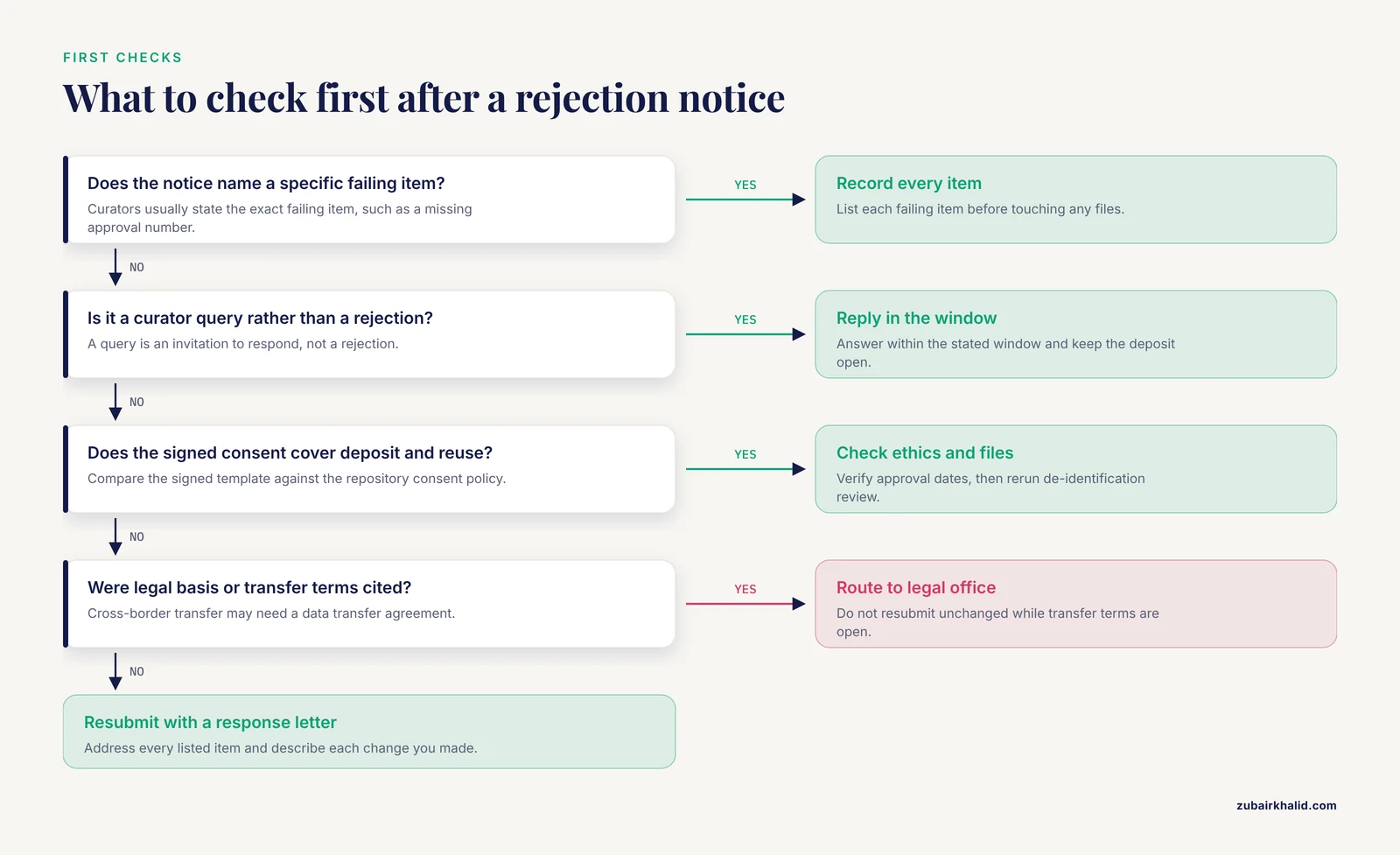
When your controlled access repository submission rejected notice arrives, work through these steps in order:
- Read the rejection notice fully and record every specific failing item. Most notices list multiple.
- Distinguish formal rejection from a curator query asking for clarification. A query is an invitation to respond, not a rejection. Reply within the stated window.
- Pull the signed consent template and check for language covering deposit, sharing, and secondary use. This single check resolves the most common cause.
- Verify that your ethics approval is current and matches the deposited data.
- Rerun de-identification review on the actual files, including free-text fields, dates, and geography, with re-identification risk as the standard.
- Confirm the repository and access tier match the data type and identifiability level [1].
- Run the repository's technical validation tools and fix every flagged file before resubmission.
- If legal basis or transfer terms were cited, route the issue to your contracts or legal office rather than resubmitting unchanged [2].
Resubmit only after every listed item is addressed. A partial fix produces a second rejection, and repeated cycles burn curator goodwill that you will need for the eventual acceptance.
How Journals and Funders Shape Your Deposit Timing
Deposits often happen under deadline pressure from a journal or funder, and that pressure produces avoidable rejections. A longitudinal study of data-sharing practices in biosciences found that publications sharing all relevant data rose from 7 percent in 2014 to 45 percent in 2023, and that the presence of a data availability statement correlated with more complete and more reusable sharing [3]. Translated into practice, this means you should treat the data availability statement as a planning document. Decide early which repository and access tier your data require, because genomic sequence data, image data, and human-subject data face different acceptance pathways [3].
Prevention Practices for Your Next Deposit
- Draft consent forms with deposit and secondary use language from the start, and have your ethics committee review that language before recruitment [2]
- Archive dated copies of every consent version actually used, alongside ethics approval letters and renewals
- Build de-identification review into the analysis pipeline, not the week before submission
- Complete the repository's metadata template and data dictionary while the project is active, when you still remember what each variable means
- Run a data repository comparison during study planning so the chosen repository's scope, tier, and submission requirements are known before data collection ends
- Name a data steward and document institutional accountability in the study plan [1]
- If you plan synthetic or federated alternatives, plan subgroup-level quality assessment at the same time, because aggregate-level checks alone miss subgroup failures [5]
Safety Note on Handling Identifiable Data
Working with patient-level data before de-identification carries real risk to participants, though not a physical hazard to you. Keep identifiable files on institutional encrypted systems only, never on personal devices or removable media, and never email them to repository staff. If you discover identifiers in files you already shared informally with collaborators, treat that as a potential privacy incident and notify your institutional data protection contact. Curators and data access committees exist to prevent exactly this exposure, and a rejected deposit that protects participants is the system working as designed [1].
Common Mistakes and Limitations
- Treating de-identification as anonymization. De-identified data can often be re-linked, especially genomic data, which is inherently identifiable and subject to privacy and confidentiality law even after identifiers are removed [2]. Anonymization is a higher and rarely achieved standard.
- Assuming old consent covers new sharing. Consent obtained years before current repository models may not mention deposit or reuse at all. Check the signed language, not your memory of the study design.
- Resubmitting without fixing the listed items. Curators reject repeat submissions that arrive unchanged. Address each item and describe your changes in the resubmission note.
- Waiting for manuscript acceptance. Deposits started at revision stage collide with deadlines, and the pressure leads to skipped validation. Start when the data are final.
- Chosing a repository by convenience rather than fit. A mismatch between data type and repository scope guarantees rejection regardless of documentation quality.
- Over-relying on synthetic data as an escape hatch. Synthetic datasets need documented quality assessment, including subgroup-level checks, before they are a defensible substitute [5].
One limitation of this guide: repository policies differ, and the right resolution for an individual deposit depends on your consent language, your jurisdiction, and your institution's rules, so confirm specifics with your ethics committee, legal office, and the repository's own submission guidance.
Frequently Asked Questions
Does a rejection mean the repository thinks my data are bad?
No. A rejection means the deposit did not meet governance, consent, or technical requirements. The scientific quality of the data is usually not in question, and most rejected submissions are accepted after documentation or file fixes.
Can I resubmit after my submission is rejected?
Yes. Resubmission is normal and expected. Fix every item listed in the rejection notice, document what you changed, and include a short response letter addressing each point when you resubmit.
Why do I need consent language specifically about data sharing if the data are de-identified?
Because de-identified data, particularly genomic data, remain re-identifiable and remain protected as sensitive personal data under applicable law. Sharing is a form of secondary processing, and that processing requires a defined purpose and legal basis tied to the original consent [2].
What should I do if my original consent form never mentioned data sharing?
Contact your research ethics committee. Depending on your jurisdiction and the study, options may include re-consent of participants, a waiver determination, or restricting the deposit to uses the existing consent covers.
What is the difference between open and controlled access repositories?
Open repositories let anyone download deposited data. Controlled access repositories require researchers to apply, justify their purpose, and receive approval from a data access committee before download. Both sit on a broader spectrum that includes federated analysis and synthetic data [1].
Can I deposit synthetic data instead of real patient data?
Often yes, and it can reduce privacy exposure, but repositories and downstream users expect documented quality assessment. Aggregate fidelity metrics alone can miss failures in specific patient subgroups, so assess synthetic data at the subgroup level too [5].
Who decides who can access my data after acceptance?
In a controlled access model, a data access committee evaluates each request against the consent and the permitted purposes you declared. Naming an accountable steward and describing your review criteria during submission reduces later friction.
How do I choose between repositories before I submit?
Compare candidate repositories on scope, required access tier, metadata standards, validation tools, and access governance, and match those against your data type and identifiability level. The sharing landscape includes public aggregate datasets, controlled access, federated models, and synthetic data, and each fits different data differently [1].
Sources
- Ethical Governance of Open Data Across Biomedical Research, Healthcare, and Public Health: Privacy, Equity, Trust, and Controlled Access.
- Basic legal prerequisites for secondary use of genomic data for scientific purposes.
- The rise of open data practices among bioscientists at the University of Edinburgh.
- Strengthening Data Systems and Use for Infectious Outbreak Preparedness in Uganda.
- Quality assessment of synthetic data in healthcare: a critical appraisal with a focus on subgroup bias.
- An integrated privacy preserving data aggregation framework for IoT networks using homomorphic encryption and secure computation.