How to Choose a Controlled Access Repository for Sensitive Human Data
By Dr. Zubair Khalid, DVM, MS, PhD ·

A controlled access repository for sensitive data stores your human research datasets behind a formal approval process, so that only vetted requesters who agree to specific data use terms can download or analyze the files, while an open repository lets anyone download them without asking. The rule of thumb for choosing is simple: match the repository to the identifiability of your data, the consent language your participants signed, and the legal framework that applies to you. If your data are fully de-identified aggregate results with no individual-level information, open sharing is usually fine. If your data are individual-level human measurements, especially genomic, proteomic, clinical, or imaging data, controlled access is the default responsible choice.
This article walks through the main repository options, compares them side by side on the criteria that actually decide real deposit decisions, works through three realistic scenarios, and lists the mistakes that most often cause rejected data submissions or delayed publications.
What Controlled Access Actually Means
Data sharing in the life sciences sits on a spectrum. At one end are fully open, public aggregate datasets. At the other end are tightly restricted arrangements such as federated analysis, where data never leave the institution that collected them. Between those extremes sit controlled-access repositories, which release individual-level data only after a formal request and approval process, and synthetic data, which are artificially generated datasets designed to preserve statistical properties without containing real patients [1].
Controlled access emerged as a practical response to a real privacy problem. Modern human datasets, particularly genomic and transcriptomic data, can in principle be re-identified even after names and identifiers are stripped away. That risk led to formal processes that control who may access the data, which is exactly what researchers mean by "controlled access" [2]. The model spread from genomics into other omics fields as researchers recognized that clinical proteomics data, for example, carry similar identifiability risks [2].
Three ideas recur across every well-run controlled-access system:
- Vetted requesters. Access is granted to researchers whose identity, affiliation, and institutional approval have been checked, often requiring a data access agreement or data use certification.
- Defined data use terms. Each dataset carries machine-readable statements about what the data may and may not be used for, such as disease-specific research only or no commercial use.
- Accountability. Requesters agree to conditions, and repositories or data access committees can audit or revoke access when those conditions are violated.
The ethical argument behind this design is that durable progress in research data sharing depends less on unrestricted openness than on calibrated access, privacy-preserving architectures, and clear accountability [1]. In other words, controlled access is not a failure to be open. It is a deliberate middle position that keeps data reusable while honoring the promises made to participants.
Controlled Access Repository for Sensitive Data: Your Main Options
There are four practical options for depositing sensitive human data, plus one hybrid approach worth knowing about. Each solves a different problem.
Domain-specific controlled-access repositories
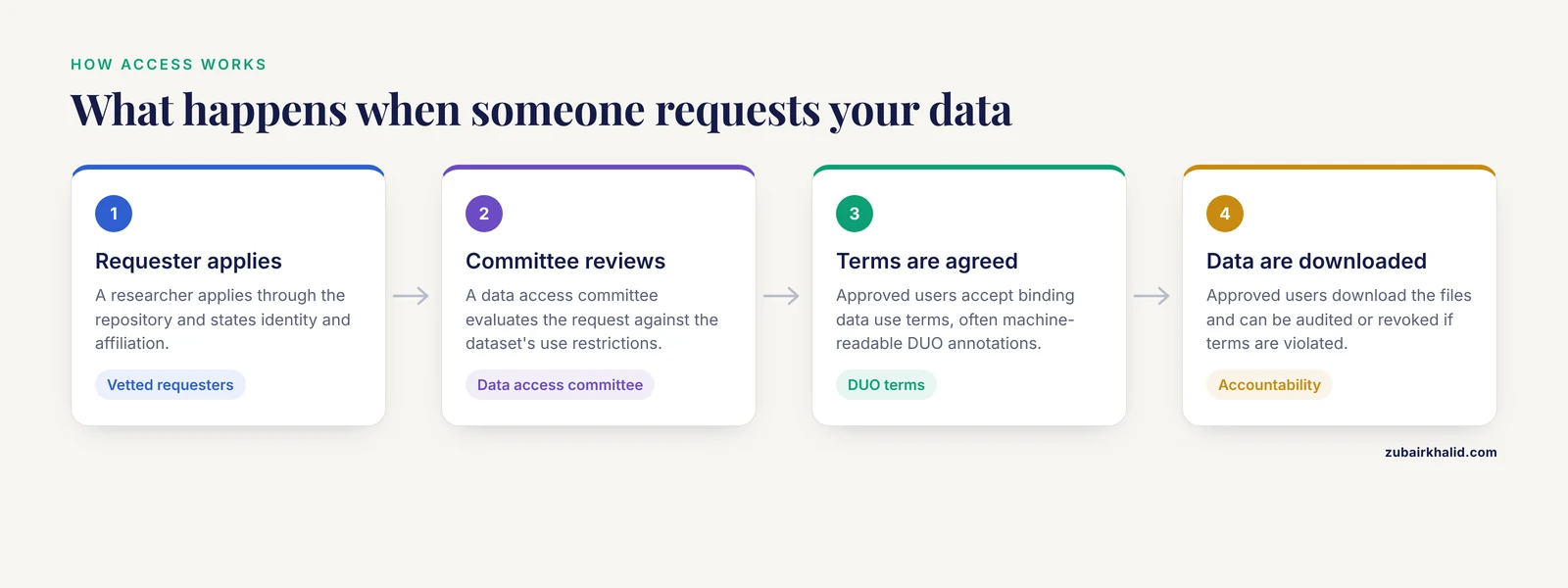
These are public repositories dedicated to a data type, with a built-in access control layer. The access process is standardized: requesters apply through the repository, a data access committee evaluates the request against the dataset's use restrictions, and approved users download data under binding terms. This model is well established in genomics and transcriptomics, where privacy standards for publicly released research data led directly to controlled-access processes [2].
The strengths are discoverability and standardization. Your dataset sits alongside thousands of others in the same format, annotated with consistent metadata, which is what makes secondary reuse possible. A concrete standard to look for here is the Data Use Ontology (DUO), developed by the Global Alliance for Genomics and Health. DUO is a hierarchical vocabulary of human- and machine-readable data use terms that represents a dataset's allowable uses consistently and unambiguously. It has been implemented by major international stakeholders and is used to annotate more than 200,000 datasets worldwide. DUO annotations increase the FAIRness of datasets, meaning they become more Findable, Accessible, Interoperable, and Reusable, and they support data linkages across studies that share common data use profiles [3].
Generalist and institutional repositories with access controls
Not every dataset fits a domain repository. Institutional platforms fill the gap for pre-publication assets and heterogeneous file types that no public repository was designed to handle. One published example is MetaServe, an open-source governance and delivery layer for pre-publication research omics data. It registers heterogeneous assets, including sequencing files, processed matrices, imaging data, analysis-ready objects, tabular files, and documents, without requiring repository-grade standardization. Its design combines role-based controls, explicit file-level sharing, path-constrained delivery, and operational traceability to support controlled institutional access [4].
The tradeoff is audience. An institutional system controls access well inside your organization, but it does not make your dataset discoverable to the worldwide research community the way a public domain repository does. These systems are best understood as internal governance layers rather than publication venues.
Metadata catalogs for data that cannot move
Some data, such as material from biobanks or clinical studies, may for legal and privacy reasons not be stored in public repositories at all. A published approach to this problem is the eGenVar data management system. Instead of moving files, eGenVar catalogs metadata about them: file information, file provenance and data lineage, and content descriptions. The files remain in their original locations with their existing access-control mechanisms in place, while the catalog provides descriptions of their contents and relationships, giving researchers a common framework for locating both public and private data [5].
This option matters when the constraint is legal rather than technical. If a consent agreement or national rule prevents the data from leaving a certain environment, a catalog lets other researchers discover that the data exist and request access through the appropriate channel, without the data ever being copied to a shared location [5].
Secure processing environments
A secure processing environment, sometimes called an analytics workspace, inverts the usual model. Instead of bringing data to the researcher, it brings the researcher to the data. The CHAIMELEON Repository is a published example from cancer imaging research. It is a secure, GDPR-compliant, cloud-based environment integrating model development, evaluation, and resource monitoring, designed to share large-scale medical, clinical, and molecular imaging datasets across Europe. In an open competition run on the platform, 482 participants from 29 countries registered, 162 downloaded datasets, and participants executed thousands of batch jobs across GPU- and CPU-based queues, all inside the controlled environment [6].
The advantage is that researchers work with real individual-level data without ever downloading it. The disadvantage is infrastructure. Someone must operate the environment, and analysis is limited to the tools the environment provides.
Synthetic data as a complement, not a replacement
Synthetic datasets, generated to mimic the statistical structure of real data, are increasingly proposed as a privacy-friendly way to share sensitive healthcare information. They can expedite research and support method development while safeguarding sensitive patient information. But a critical appraisal of synthetic data quality in healthcare found that current fidelity and utility metrics often fail to capture weaknesses that appear in specific patient subgroups. The authors demonstrated these blind spots with a lung cancer case study and concluded that synthetic datasets must be assessed not only at the aggregate level but also across clinically meaningful subgroups to ensure reliability and fairness in downstream applications [7].
The practical takeaway: synthetic data is a useful addition to a sharing plan, often as an open "sandbox" version that lets users test their code before requesting controlled access to the real dataset. It does not replace controlled access for analyses that need real patient-level values.
Data Repository Comparison: Side-by-Side
The table below is a data repository comparison across the five arrangements described above. Use it to shortlist before you dig into any single platform's documentation.
| Criterion | Domain-specific controlled-access repository | Institutional repository with access controls | Metadata catalog (data stays local) | Secure processing environment | Synthetic data release |
|---|---|---|---|---|---|
| Where the data physically live | Central repository servers | Your institution's infrastructure | Original collection site | Provider's compliant cloud | Public, since data are artificial |
| Who approves access | Repository data access committee | Local roles and project leads | Data held by source institution | Environment administrators | Nobody, data are open |
| Data use terms enforced | Yes, often machine-readable (DUO) [3] | Varies by implementation | Source institution's terms | Configurable per project [6] | Not applicable |
| Discoverability to outside researchers | High | Low to moderate | Moderate, via metadata [5] | Moderate, via platform catalogs | High |
| Re-identification risk after access | Managed through vetting and agreements [2] | Managed locally | Unchanged, data never move | Minimal, no downloads [6] | Low but not zero, subgroup bias is a documented weakness [7] |
| Best suited for | Publication-ready human omics and clinical datasets [2] | Pre-publication and mixed-format institutional assets [4] | Biobank and clinical data barred from leaving site [5] | Large imaging and multimodal cohorts [6] | Software testing, tutorials, method development [7] |
| Main limitation | Access approval adds time and friction [1] | Not a public dissemination venue | Depends on source-site controls [5] | Requires operator infrastructure [6] | Quality checks must go beyond aggregate metrics [7] |
No single row wins on every criterion. The best controlled access repository for sensitive data in your situation depends on which limitation you can least afford.
Pros and Cons of Controlled Access
The controlled access repository for sensitive data pros and cons deserve their own honest accounting, because the model involves real tradeoffs rather than a strict improvement over open data.
Advantages:
- Privacy risk is managed rather than ignored. Controlled access exists because identifiability risks in human data are genuine, and the genomics community's experience with these risks produced the access-control processes now spreading to other fields [2].
- Consent terms become enforceable. Machine-readable data use annotations such as DUO let a data access committee check every request against what participants actually agreed to, and they increase dataset FAIRness at the same time [3].
- Reuse still happens. The point of calibrated access is to keep data flowing to qualified researchers, supporting reproducibility, machine learning, and more efficient research, rather than locking data away indefinitely [1].
- Legal compliance becomes tractable. European legislation on genomic data processing is often counterintuitive, and national rules in individual EU countries add further requirements, which complicates international cooperation. Effective sharing requires compliance with European and national legislation, including a clear definition of the purpose and legal basis of processing [8]. A repository with a formal access process gives you an auditable structure for meeting those obligations.
Disadvantages:
- Access takes time. Vetting, agreements, and committee review add latency between a requester's interest and their first analysis. Barriers to access inevitably reduce reuse and can delay discoveries [2].
- Governance is uneven across repositories. Experience across pandemic data sharing, genomic initiatives, population registries, patient-led rare disease infrastructures, and regional data spaces shows that outcomes depend on clear accountability and sustained public engagement, which not every platform provides equally [1].
- De-identification is never perfect. Stripping direct identifiers does not eliminate re-identification risk in high-dimensional human data, which is why the community moved to controlled access in the first place [2].
Decision Criteria That Actually Matter
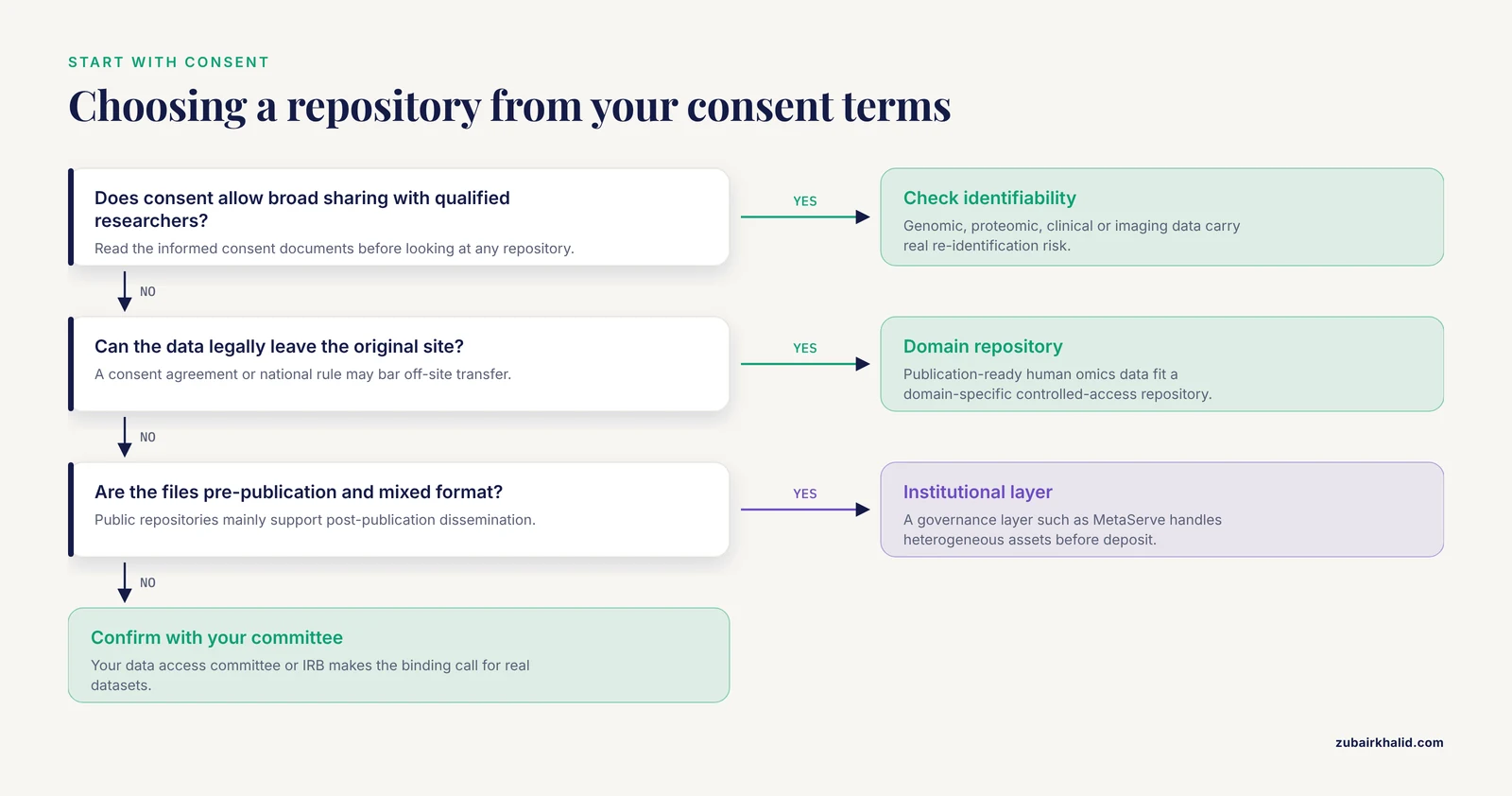
When researchers compare options in practice, five criteria do most of the work.
1. Consent language. Read the informed consent documents before you look at any repository. If participants consented to broad sharing with qualified researchers, a domain-specific controlled-access repository is usually the right home. If consent was narrow or silent on sharing, your options narrow sharply, and a metadata catalog that keeps data in place may be the only compliant route [5]. The legal foundation matters just as much as the wording, since secondary use of sensitive data requires a defined purpose and legal basis under applicable law [8].
2. Identifiability of the data type. Genomic sequences carry high inherent identifiability. Clinical proteomics data also carry real, still-being-assessed identifiability risks, and the proteomics community has been urged to be proactive about managing them while keeping a careful balance, since erecting barriers to open access will reduce reuse and could delay critical discoveries [2]. Ask what your own data type's risk profile is before assuming that removing names solves the problem.
3. Machine-readable use restrictions. If your dataset may only be used for a specific disease area, or may not be used commercially, that restriction should be encoded, not buried in a PDF. DUO exists precisely to represent allowable uses consistently and unambiguously, and it works together with the GA4GH Passport standard for researcher identities [3]. A repository that supports DUO annotation will make your dataset easier to discover and safer to combine with other datasets later.
4. Where analysis happens. If your data are too sensitive to download at all, a secure processing environment is the option that still permits real research. The CHAIMELEON platform demonstrates the model at scale, with competition participants developing and validating cancer imaging models entirely within a GDPR-compliant cloud workspace [6].
5. FAIRness and discoverability. Data sharing practices in the biosciences have improved markedly, with one university-wide analysis finding that the fraction of publications sharing all relevant data rose from 7 percent in 2014 to 45 percent in 2023, and that the presence of a data availability statement correlated with more and better sharing. Notably, data involving human subjects or samples were shared less frequently than genomic sequence or image data [9]. Choosing a repository with strong metadata standards, including data use annotations, is the single easiest way to make your dataset part of that improving trend rather than an exception [3].
Worked Scenarios
Scenario 1: A clinical proteomics study with 200 patient plasma samples. Individual-level protein measurements from patients are potentially sensitive, and the field's own position is that privacy risks of sharing proteomics data need to be properly assessed and managed rather than ignored, while avoiding unnecessary barriers [2]. The reasonable choice is a domain-specific controlled-access repository that supports standardized request workflows and machine-readable use terms. Annotate the dataset with DUO terms reflecting the consent, for example disease-specific research use, so that requesters and the data access committee share an unambiguous understanding of what is permitted [3].
Scenario 2: Pre-publication multi-omics data inside a university core facility. Nothing is published yet, files are heterogeneous, and public repositories mainly support post-publication dissemination. This is the exact gap institutional governance layers were built for. A system like MetaServe registers and delivers heterogeneous assets under role-based controls, file-level sharing, and path-constrained delivery, providing controlled institutional access before the dataset is ever ready for public deposit [4]. Plan the transition: when the paper is accepted, migrate publication-ready components to a domain repository under controlled access if they are sensitive.
Scenario 3: Biobank samples whose consent prohibits off-site data transfer. The data legally cannot be uploaded anywhere. The eGenVar model addresses this directly by cataloguing file information, provenance and data lineage, and content descriptions while files remain in their original locations under existing access-control mechanisms [5]. Outside researchers discover the dataset through the catalog, then request access from the source institution, which keeps the legal chain of custody intact [8].
A fourth pattern is worth noting for large consortia. Projects distributing medical imaging across many countries increasingly favor secure processing environments, because participants can run thousands of analysis jobs on real clinical data without any downloads occurring, as the CHAIMELEON open competition demonstrated across five cancer types [6].
Common Mistakes and Limitations
Treating de-identification as sufficient on its own. Removing direct identifiers does not remove identifiability risk in high-dimensional human data. The entire rationale for controlled access in genomics, and the emerging concern in proteomics, rests on this fact [2].
Choosing a repository before reading the consent forms. The consent agreement and the applicable legal framework determine your realistic options. Researchers who deposit first and check terms later frequently face takedown requests or renegotiations. The legal analysis of secondary use is clear that a defined purpose and legal basis of processing are essential before sharing occurs [8].
Assuming one repository serves every data type. Domain-specific repositories, institutional systems, catalogs, and secure environments each optimize for different assets. Human-subjects data is already shared less often than other data types in the biosciences [9], so picking a poor-fit venue that cannot handle your files compounds the problem.
Confusing institutional access control with public controlled access. A role-based internal system such as MetaServe solves pre-publication governance, but it will not make your dataset citable and discoverable to the research community [4]. These are sequential steps, not substitutes.
Trusting aggregate metrics for synthetic data. If you release a synthetic version alongside real controlled-access data, evaluate it across clinically meaningful subgroups, not just overall fidelity scores. Documented blind spots in subgroup performance can make a synthetic dataset misleading for exactly the populations that matter most in clinical research [7].
Overestimating what any repository can promise. Even well-designed systems depend on governance beyond technology: calibrated access rules, privacy-preserving architectures, clear accountability, and sustained public engagement. Reviews of experience across biomedical, healthcare, and public health data sharing emphasize these human and institutional elements as the true determinants of durable success [1].
Finally, a general limitation for every scenario described here: decisions about real datasets with real participants involve institutional, legal, and ethical review specific to your study. This article explains the options and criteria. Your data access committee, IRB, or equivalent body makes the binding call for individual cases.
Frequently Asked Questions
What is a controlled access repository for sensitive data?
It is a public or shared data repository where individual-level human research datasets are stored behind a formal access process. Researchers must apply, demonstrate eligibility, and agree to data use conditions before they can obtain the data. The approach grew out of genomics, where privacy standards for publicly released data led to processes controlling who may access it [2].
What is the best controlled access repository for sensitive data?
There is no single best option, because the right choice depends on your data type, consent terms, and legal constraints. For publication-ready human omics data, domain-specific controlled-access repositories with machine-readable use annotations offer the strongest combination of discoverability and compliance. For data that cannot legally move, a metadata catalog or a secure processing environment is usually more appropriate than any central repository [1], [5].
What are the pros and cons of controlled access repositories?
The main advantages are managed privacy risk, enforceable consent terms through standards such as DUO, continued research reuse, and an auditable structure for legal compliance [2], [3], [8]. The main disadvantages are added approval latency, uneven governance quality across platforms, and the fact that de-identification alone never eliminates re-identification risk [1],.
Do I need controlled access if my data are de-identified?
Often yes. De-identification removes direct identifiers but does not eliminate re-identification risk in high-dimensional genomic, transcriptomic, proteomic, or clinical datasets. That residual risk is precisely why controlled-access processes were created in genomics and why other fields are adopting them [2].
What is the Data Use Ontology and why should I care?
DUO is a hierarchical vocabulary of human- and machine-readable data use terms, developed by the Global Alliance for Genomics and Health, that states a dataset's allowable uses consistently and unambiguously. It is used to annotate more than 200,000 datasets worldwide, increases FAIRness, and enables safe linkage of datasets that share common data use profiles [3].
Can I just publish synthetic data instead of using controlled access?
Synthetic data can complement controlled access, for example as an open test version, but it does not replace access to real data for most analyses. Reviews of synthetic data quality in healthcare show that fidelity and utility metrics often miss weaknesses in specific patient subgroups, so synthetic datasets require subgroup-level quality assessment before anyone relies on them [7].
Sources
- Ethical Governance of Open Data Across Biomedical Research, Healthcare, and Public Health: Privacy, Equity, Trust, and Controlled Access.
- Data Management of Sensitive Human Proteomics Data: Current Practices, Recommendations, and Perspectives for the Future.
- The Data Use Ontology to streamline responsible access to human biomedical datasets.
- MetaServe: a lightweight, metadata-aware governance and delivery layer for pre-publication research omics data.
- The eGenVar data management system--cataloguing and sharing sensitive data and metadata for the life sciences.
- Experiences on using the CHAIMELEON secure processing environment in an open competition addressing five AI challenges.
- Quality assessment of synthetic data in healthcare: a critical appraisal with a focus on subgroup bias.
- Basic legal prerequisites for secondary use of genomic data for scientific purposes.
- The rise of open data practices among bioscientists at the University of Edinburgh.