How to Choose a Data Sharing Platform for Your Research Team
By Dr. Zubair Khalid, DVM, MS, PhD ·

A general-purpose cloud drive stores files for your own team, while a research data sharing platform stores data so that outsiders can find, understand, and reuse it with proper access control. The rule of thumb is simple: match the platform to the sensitivity of your data, the standards of your field, and the way your team actually works, in that order. Teams that pick a platform by price or convenience alone usually pay later in lost time, failed audits, or data that nobody else can reuse.
This guide walks through the main options for research data sharing, compares them side by side on the criteria that decide real choices, and gives worked scenarios for common lab situations.
What a Data Sharing Platform Actually Does
A data sharing platform is more than a place to park files. It bundles several functions that matter differently depending on your team:
- Storage and organization of raw and processed data, often with enforced folder structures or metadata templates.
- Access control, from fully open to encrypted spaces where only approved users can see anything.
- Metadata and standards support, so a stranger can interpret your files years later.
- Persistent identifiers, usually a DOI or accession, that let others cite a specific dataset version.
- Analysis or processing tools, in some platforms, so collaborators work on the data where it lives instead of copying it around.
The FAIR principles, meaning data that are Findable, Accessible, Interoperable, and Reusable, are the shared vocabulary across most modern platforms. Schemas described with structured modeling languages such as LinkML are one way platforms enforce interoperability, because a defined schema tells every contributor exactly which fields exist and how they relate [1].
One clarification that saves teams a lot of confusion: social media and reference managers are communication tools, not data sharing platforms. A survey of 1,977 academics across 24 African countries cataloged 20 digital tools used for research sharing and found that researchers spread their activity across many platforms, including depositing deidentified survey data into the Mendeley database for retrieval [2]. That kind of deposit is a real data sharing decision. Posting a paper link on LinkedIn is not, even though both feel like "sharing" [3].
The Main Options, With Pros and Cons
When you evaluate choose data sharing platform for lab options, most real-world choices fall into six categories. Each solves a different problem.
General-purpose cloud storage
Services such as institutional cloud drives and commercial sync folders are the default for many labs because they are already paid for and everyone knows the interface.
Pros. Fast to set up. Good internal versioning. Fine for day-to-day collaboration within the team.
Cons. No persistent identifiers, weak or generic metadata, and no field-specific standards. Files shared through a link rot the moment someone changes a permission. Reviewers and journals increasingly will not accept "data available on request" backed by a shared drive folder. Cloud storage is a working space, not a publication venue for data.
Disciplinary and public data repositories
These are open or controlled databases built for a specific data type, with community-accepted formats. SquiDBase is a clean example: a dedicated, open-access repository for raw Oxford Nanopore sequencing data from microbes, with linked processed data and metadata, built because raw signal data were previously scattered and lacked standardized infrastructure [4]. The team even shipped a Nextflow pipeline, SquiDPipe, that automatically removes human reads from raw nanopore data before release [4].
Pros. Your data become findable where your field already looks. Formats and metadata follow community standards, which makes reuse realistic. Persistent identifiers come standard.
Cons. Coverage is uneven. If no repository exists for your data type, you cannot use this option without building one. Highly sensitive data usually cannot go here at all. Some repositories accept only specific raw formats, which is exactly why SquiDBase exists for nanopore signals that general sequence archives handle poorly [4].
Institutional repositories
Universities and institutes increasingly run their own repositories that collect, curate, archive, and disseminate data across many projects. The C-BIG Repository at the Montreal Neurological Institute-Hospital is an institutional biospecimen and clinical data repository that collects imaging, genetic, and clinical data from patients and healthy controls, designed as a scalable model for other institutions [5]. It exists because the institute declared itself an Open Science organization in January 2016, which required infrastructure covering governance, ethics, computational resourcing, and training, not just individual scientists releasing files [5].
Pros. Professional curation, established ethics and governance pipelines, and help with compliance. Good middle ground for sensitive-but-shareable data.
Cons. Your institution has to have one, and scope varies widely. Discovery outside the institution is weaker than in a major disciplinary repository.
Workflow and analysis platforms with built-in sharing
Some platforms combine data storage with the tools to analyze it, which removes the copy-everywhere step. The Microbiology Galaxy Lab (MGL) integrates over 315 tool suites and 115 curated workflows for metabarcoding, genomics, transcriptomics, and proteomics analysis in a FAIR-aligned environment, supported by more than 35 tutorials, and it is free and globally accessible [6]. In neuroimaging, NeuroStage handles the full path from scanner to processed, validated data, with automatic upload, anonymization, organization into the Brain Imaging Data Structure (BIDS) format, and interactive viewers that let researchers check quality control before preprocessing runs [7].
Pros. Reproducibility by design, because the workflow, parameters, and data travel together. Lowers the skill barrier for teams without dedicated programmers, which is the explicit goal of both MGL and NeuroStage [7] [6].
Cons. You commit to that platform's toolset and formats. Sharing data is possible, but these are analysis environments first, so long-term archival is usually better delegated to a repository.
Trusted research environments and federated platforms
When data are sensitive, meaning patient records, genomic data linked to identities, or protected health information, the safest model keeps the data in place and moves the analysis to it. The Human Intracerebral EEG Platform (HIP) is a cloud-based Trusted Research Environment (TRE) built around six specifications: secure access to sensitive datasets, standardized data organization under BIDS-iEEG, controlled access through a secure web interface, bundled analysis software, formal data sharing agreements between institutions, and FAIR alignment. It hosts 34 institutions and 10 ongoing projects [8].
The federated version goes further. The FERES stroke registry initiative connects five national registries from Austria, Greece, Ireland, Italy, and Switzerland, harmonizes their datasets through a Common Data Elements model, runs analyses locally within each registry, and shares only aggregated, non-identifiable outputs. In its validation, 149,772 patient events from two registries were queryable in federated mode [9].
Pros. The strongest privacy posture available. Enables multinational collaboration on data that could never be pooled in a single open repository. GDPR-compliant designs like FERES show how the model handles strict data protection constraints [9].
Cons. Heavier governance. Formal agreements, onboarding, and infrastructure mean slower startup. NeuroStage makes a related point from the other direction: it can be deployed locally so protected health information can be processed with the same user experience as in the cloud, but that flexibility required deliberate engineering [7].
Consortium and challenge repositories
For method comparison, a shared benchmark dataset with a common evaluation framework beats everyone testing on private data. The Consortium for Electrocardiographic Imaging built a data sharing repository plus a platform for comparing algorithms on the same datasets, precisely because studies varied too much in modeling choices and validation metrics to compare otherwise [10]. The ISBI 2015 longitudinal multiple sclerosis lesion segmentation challenge released 82 datasets with expert delineations, eleven teams submitted results against common metrics, and the data remain downloadable as a community resource [11].
Pros. Direct, fair comparison of methods. Community building. High reuse value.
Cons. Narrow purpose. Someone has to organize and curate the challenge, and that is substantial work.
Side-by-Side Comparison
| Platform type | Best for | Access control | Key strengths | Main drawbacks |
|---|---|---|---|---|
| General cloud storage | Day-to-day team work | Team-level, link sharing | Fast setup, familiar tools | No persistent IDs, weak metadata, not citable |
| Disciplinary repository | Data your field actively reuses | Open or controlled | Community standards, DOIs, discoverability | Uneven coverage, may reject sensitive data |
| Institutional repository | Sensitive-but-shareable institutional data | Managed by institution | Curation, ethics, governance pipelines | Availability varies, weaker external discovery |
| Workflow platform with sharing | Collaborative analysis, reproducibility | Project and team level | Bundled tools, workflows, tutorials [6] | Not a long-term archive, tool lock-in |
| Trusted research environment | Human data, clinical records | Controlled, per user and agreement | Strongest privacy, formal governance [8] | Slow setup, heavy administration |
| Federated platform | Multinational sensitive data | Data never leaves source | Aggregated outputs only, GDPR-compatible [9] | Complex to join, requires harmonized data models |
| Challenge/benchmark repository | Method comparison | Registered participants | Fair evaluation, shared metrics [10] [11] | Narrow scope, curation burden |
How to Actually Choose: The Criteria That Decide
Once you know the option types, the best choose data sharing platform for lab decision comes down to six questions. Ask them in this order.
1. How sensitive is the data?
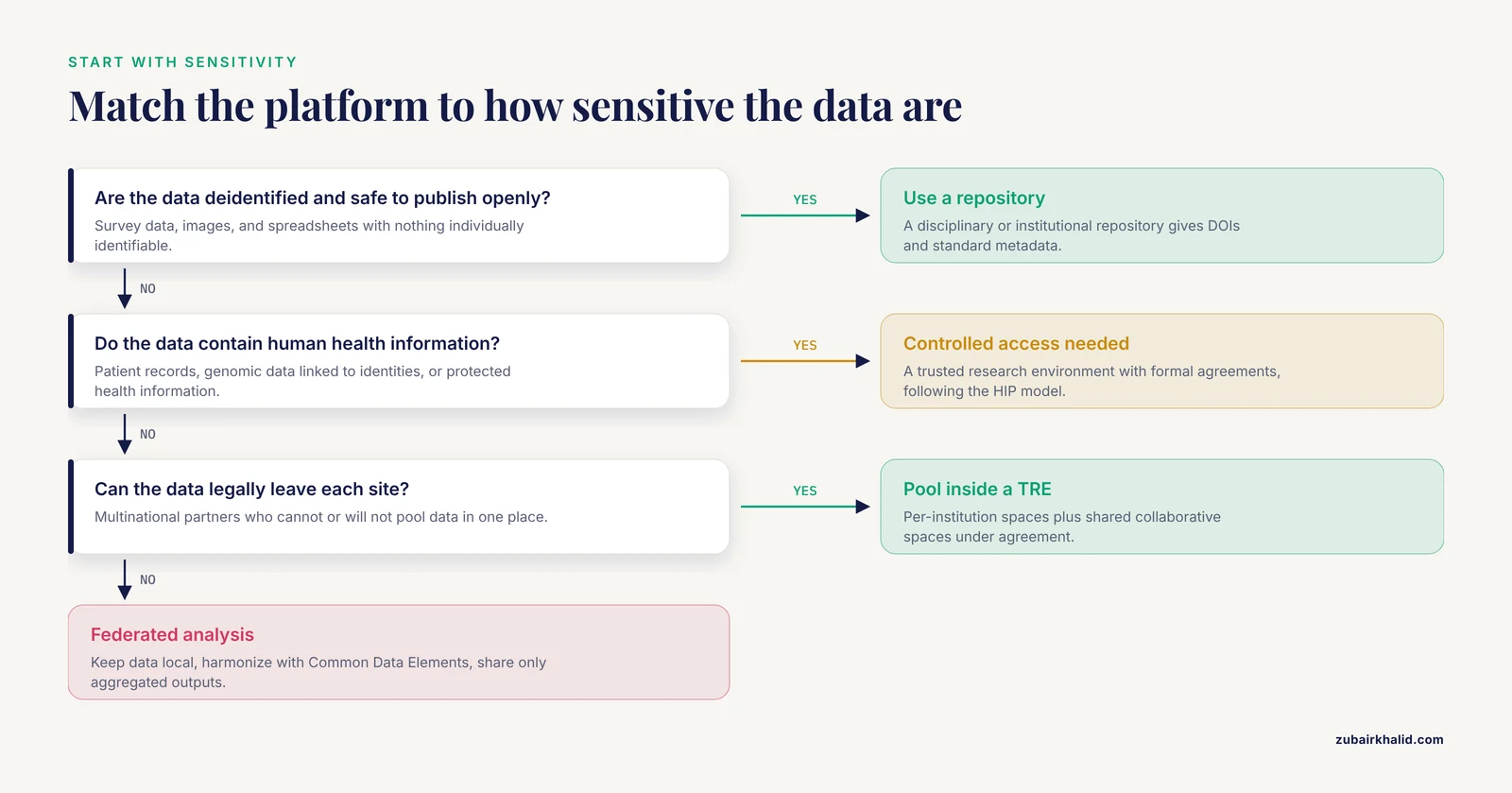
This question eliminates options fastest. If your data are deidentified and safe to publish openly, a disciplinary repository is usually right. If your data contain human health information, you need controlled access at minimum. The HIP platform treats "secure access to sensitive datasets" as its first design specification, not an add-on [8]. For data that cannot be moved at all, federated analysis that shares only aggregated outputs is the emerging standard, as FERES demonstrates with stroke registries [9].
2. Do standards exist for your data type, and does the platform enforce them?
A platform that accepts anything in any format creates reuse problems you inherit. BIDS for neuroimaging and BIDS-iEEG for intracranial EEG are examples of standards that make data interoperable across institutions [7] [8]. On the schema side, frameworks such as LinkML let a consortium define stable, ontology-aligned data models once and reuse them, reducing the proliferation of single-use formats that make integration painful [1]. When you evaluate a platform, ask what happens if a user uploads a malformed file. A platform with validation and standardized terminology, like the PHENOM neurohealth platform's automated pipelines and metadata templates [12], will catch errors early.
3. Who needs to find and reuse the data?
If the audience is your field, publish where the field looks. If the audience is a defined set of collaborators under agreement, a TRE or federated setup is more appropriate. If the audience is future reviewers and funders checking your outputs, you need a persistent identifier regardless of platform.
4. Does your team have the computational skills the platform assumes?
This is one of the most underweighted factors. MGL was built explicitly because complex tools and limited computational resources were blocking microbiologists from analyzing their own data [6]. NeuroStage similarly removes the need for programming skills in MRI preprocessing [7]. A powerful platform your postdoc cannot use is worse than a simpler platform the whole team uses correctly.
5. What does the governance look like?
For multi-institution work, governance decides whether the collaboration survives. HIP requires formal data sharing agreements and gives each institution private spaces plus shared collaborative spaces [8]. FERES harmonized heterogeneous national registries by agreeing on a Common Data Elements model before any analysis ran [9]. If your project spans institutions, choose a platform whose governance model matches how your partners can legally operate.
6. What infrastructure do you actually have?
An honest inventory matters. Wastewater surveillance practitioners faced the same reckoning when national programs tried to standardize sequencing-based pathogen monitoring: the constraints were not just protocols but skilled staff, suitable platforms, and robust IT infrastructure [13]. Large sequencing projects face the same arithmetic, since the sheer volume of NGS output demands serious storage and compute, alongside ethical constraints on sharing and equitable access [14]. A platform that exceeds your infrastructure creates a bottleneck, not a capability.
Worked Scenarios
Scenario A: A small wet lab with qPCR, microscopy, and survey data
A five-person lab produces spreadsheets, images, and a questionnaire-based dataset. Nothing is individually identifiable. The team needs internal collaboration plus one citable home for published datasets.
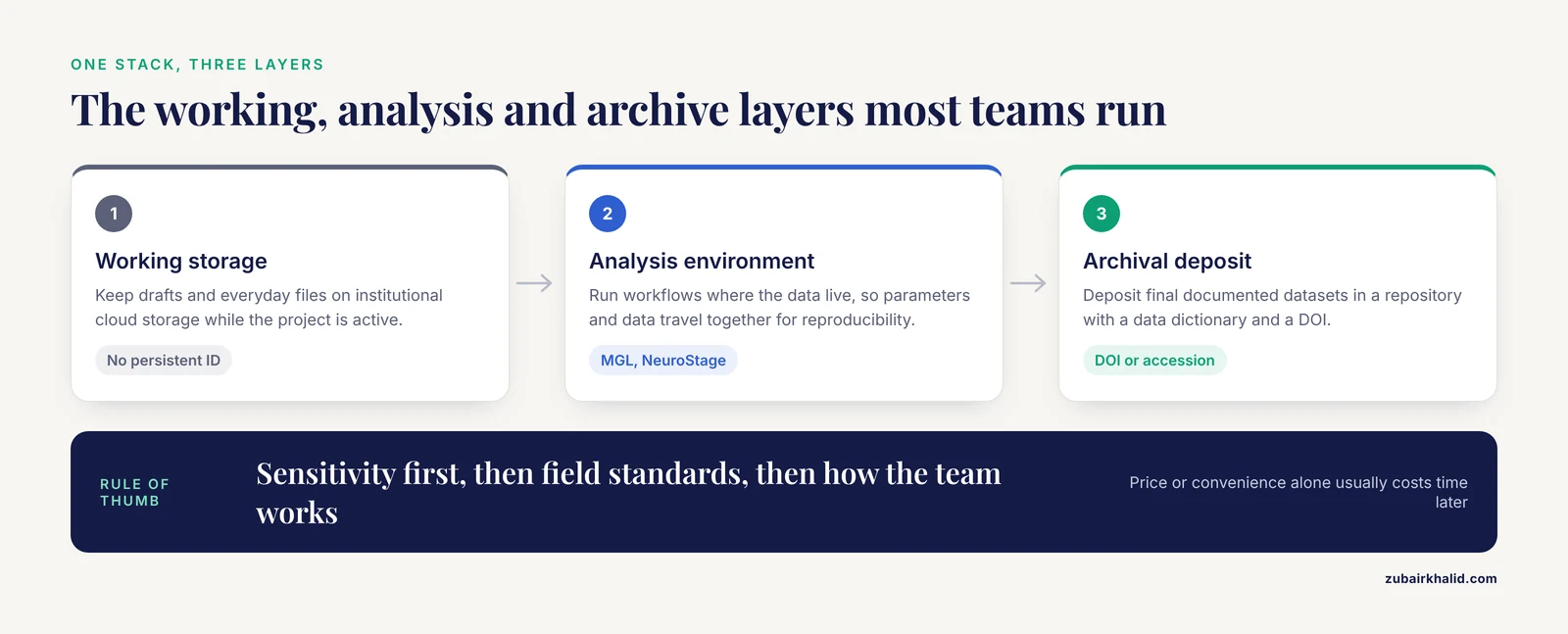
Reasonable choice. Keep working files on institutional cloud storage. Deposit final, documented datasets in a generalist repository or the institutional repository, with a data dictionary and a persistent identifier. The academic survey dataset described earlier did exactly this, uploading deidentified data to Mendeley for retrieval with the questionnaire included as extended material [2]. That two-tier pattern, working space plus archival deposit, fits most small labs.
Scenario B: A microbiology genomics team without a dedicated bioinformatician
The team generates nanopore and Illumina reads and wants collaborators to rerun analyses.
Reasonable choice. Use a workflow platform as the analysis hub, because MGL-style environments bundle curated workflows and tutorials so bench scientists can run analyses themselves [6]. Deposit raw reads in the appropriate sequence repository, and for nanopore signal data specifically, a specialized resource such as SquiDBase preserves the raw layer that general archives lose, with privacy screening handled by pipelines like SquiDPipe [4]. Archive the final workflow and metadata alongside the publication.
Scenario C: A clinical neuroscience consortium across countries
Multiple hospitals collect intracranial EEG and stroke data on patients. Data cannot leave each site.
Reasonable choice. A trusted research environment with per-institution spaces and formal data sharing agreements, following the HIP model, with BIDS-based standardization so datasets align [8]. If partners cannot or will not pool data even inside a TRE, adopt a federated design with a harmonized Common Data Elements model and only aggregated outputs crossing borders [9]. Budget real months for governance before the first analysis.
Scenario D: A methods group wanting fair algorithm comparison
A community develops competing segmentation or imaging methods and wants a definitive comparison.
Reasonable choice. Organize a challenge with a shared annotated dataset and predefined metrics, then release the data permanently. Both the ECGI consortium's repository-plus-comparison-platform approach [10] and the MS lesion segmentation challenge's 82 expert-delineated datasets [11] show the template. The lasting value comes from keeping the resource downloadable after the event [11].
Common Mistakes and Limitations
- Choosing the platform before classifying the data. Teams pick a tool, then discover their human-subject data cannot legally go there. Sensitivity classification comes first, every time.
- Treating a shared drive as data sharing. A sync folder with links is a working space. It provides no persistent identifier, no standard metadata, and no access audit trail. Reviewers and funders increasingly distinguish between the two.
- Ignoring metadata until the end. Metadata is the difference between a dataset and a pile of files. Platforms with template-driven metadata and controlled vocabularies, such as the PHENOM lakehouse design [12] or LinkML-defined schemas [1], prevent the drift where every lab member invents their own column names.
- Underestimating governance time in multi-institution projects. The HIP and FERES models both run on formal agreements and standardized data models [8] [9]. If you budget zero time for that paperwork, the technical platform will sit idle.
- Assuming one platform fits everything. Most productive teams run a combination, working storage plus an analysis environment plus an archival repository. The question is not which single platform wins but which stack fits your data lifecycle.
- Forgetting that reuse depends on standards others recognize. A beautifully organized private archive in a proprietary format fails the interoperability test. Adopt the format your community already uses, whether that is BIDS [7] or a defined schema language [1].
- Assuming access control is a single switch. Real platforms layer it, for example CanVar-UK keeps its variant-level resources accessible while restricting its diagnostic discussion forum to registered diagnostic scientists [15]. Decide which layers you need before you commit.
One limitation applies to this whole guide. Platform ecosystems change quickly, and specific services, pricing, and feature sets evolve, so verify current capabilities and your institution's data policies with the platform provider and your compliance office before committing sensitive data.
Frequently Asked Questions
What is the difference between a data repository and a data sharing platform?
A repository is built to archive and publish finished datasets with persistent identifiers and standard metadata. A data sharing platform can also include working spaces, access management, and analysis tools for data still in active use. Many labs need both, one for the project and one for the archive.
Can we just use Google Drive or Dropbox for research data sharing?
For internal drafts and everyday collaboration, yes. For anything you publish, cite, or share outside the team, no, because cloud drives lack persistent identifiers, enforced metadata, and the access controls sensitive data require. Use them as a working layer, not a sharing layer.
How do I know if a platform is FAIR compliant?
Check whether it gives datasets persistent identifiers, exposes structured metadata, uses community-accepted formats, and documents access conditions. Platforms built on defined schemas and standardized terminologies, such as those using LinkML-style data models [1], make FAIR compliance easier to verify than platforms that accept arbitrary file dumps.
What should a lab with human patient data use?
A trusted research environment with controlled access, formal data sharing agreements, and standardized data organization, following models like the HIP platform [8]. If partners cannot pool data at all, a federated approach that keeps data local and shares only aggregated results is the current best practice [9].
Do we need different platforms for raw data and analyzed data?
Often yes. Raw data have different storage, format, and privacy requirements than processed outputs. SquiDBase exists precisely because raw nanopore signals need dedicated infrastructure with linked processed data and metadata [4]. Plan the raw and processed layers deliberately rather than letting them pile up in the same folder.
How much does a good data sharing platform cost?
Costs vary widely across open-access, subscription, and institutional models, and specific pricing is not fixed across platforms. Some major community platforms, such as the Microbiology Galaxy Lab, are free and globally accessible [6], while trusted research environments carry infrastructure and governance costs that depend on your institution. Get a written quote from any candidate platform and check whether your institution already covers access.
Sources
- LinkML: an open data modeling framework.
- Dataset of the adoption of digital tools for research sharing among academics in African Varsities during the COVID-19 pandemic in 2020.
- Beyond Traditional Publishing: Social Media as a Catalyst for Biomedical Research Dissemination and Collaboration.
- SquiDBase: a community resource of raw nanopore data from microbes.
- The C-BIG Repository: an Institution-Level Open Science Platform.
- Microbiology Galaxy Lab: a community-driven gateway for reproducible and FAIR analysis of microbiological data.
- Democratizing data sharing and processing of routine MRI data acquired for neuroimaging research.
- The Human Intracerebral EEG Platform: A Cloud-Based Trusted Research Environment for Collaborative SEEG Research in Epilepsy and Neuroscience.
- Federating European REgistries for Stroke: Principles, Data Model and Future Perspectives for a Federated Analysis of Multiple Prospective Stroke Registries.
- Overcoming Barriers to Quantification and Comparison of Electrocardiographic Imaging Methods: A Community-Based Approach.
- Longitudinal multiple sclerosis lesion segmentation: Resource and challenge.
- A proposed organization of multifaceted knowledge in data repositories: structuring record collections and evidence sets for data lakehouses and moonshots.
- Toward a unified approach: Considerations for bioinformatic and sequencing activities & data in wastewater surveillance of biologic public health threats.
- Transformative Applications and Innovations in Next-Generation Sequencing Data Analysis.
- CanVar-UK: A collaborative platform for germline interpretation in cancer susceptibility genes.