How to Choose a Data Repository for Your Data Paper
By Dr. Zubair Khalid, DVM, MS, PhD ·

A data paper publishes the dataset itself as the scholarly contribution, and the repository you choose becomes the permanent home that reviewers, reusers, and indexers will judge. The rule of thumb is simple. Deposit in a discipline-specific repository when one exists and accepts your data type, fall back to a reputable generalist repository when it does not, and use a controlled-access route whenever your data carry privacy, consent, or contractual restrictions.
This guide walks through each repository option, compares them on the criteria that actually decide real submissions, and works through concrete scenarios so you can match your dataset to the right home before you write a single line of the data paper.
What a data paper is, and why the repository is half the paper
A data paper is an article whose main output is a described, citable dataset rather than a new hypothesis test. Peer review focuses on whether the data are complete, accurately described, and reusable by others. The repository record carries the persistent identifier, usually a DOI or an accession number, and the article points to it. The two are inseparable. If the repository loses the files, changes access terms, or buries the data behind a broken request process, the article stops doing its job.
The tension between publishing conclusions and releasing underlying data is old. In 1996, Adams and Venter debated in Science whether raw DNA sequence data should be forced into public release before analysis, a dispute that shaped genomics data-sharing policy for decades [1]. Around the same period, editors of neuroscience journals were wrestling with how digital communication would change the way raw data are shared, validated, and disseminated, and whether any publishing system could work without appropriate incentives for ethical behavior by scientists [2].
The case for depositing raw data is straightforward. Publications summarize and interpret data, they do not contain the data themselves. When results conflict between laboratories, verification requires going back to the original raw measurements, and a large fraction of academic experiments are difficult to repeat from a published description alone [3]. A repository record is what makes that verification possible.
The culture has not always supported this. In one prospective study, 29 corresponding authors of original research articles in a medical journal were contacted for their data. Only one released the data, and most respondents were reluctant, with some requesting clarification, additional information, or authorship in exchange [4]. Repositories exist precisely to remove the friction and ambiguity that make ad hoc requests fail. A good deposit replaces an email negotiation with a stable, licensed, documented record.
How to choose a data repository for your data paper
Work through five questions in order. The first question that produces a binding constraint usually decides the answer.
- Where will reusers already be looking? If your community has a repository for your data type, that repository wins by default. Sequencing reads belong in the Sequence Read Archive, protein structures in the Protein Data Bank, and so on. A domain repository puts your data where search habits, community tools, and format expectations already live.
- Is any part of the data restricted? Human data, patient-level data, and any material collected under consent terms that do not cover open publication need a controlled-access route. Privacy and consent are the two most common obstacles to publishing raw clinical trial data, and restricted-access repositories are a recognized alternative to open release [5]. European frameworks such as Article 89 of the GDPR and the emerging European Health Data Space provide legal bases for secondary use of health data for research, but governance, pseudonymization, and access approval remain the researcher's responsibility [6].
- Does the repository assign a persistent identifier and commit to preservation? A data paper needs a citable, stable record. A DOI or a community accession number, backed by an institution with a preservation mandate, satisfies this. A personal website, a lab page, or a shared drive does not.
- What metadata and license does it require, and what do you have? FAIR principles, meaning findable, accessible, interoperable, and reusable, guide data lifecycle management, and metadata quality is what makes a dataset findable and reusable rather than merely downloadable [7]. Some repositories enforce rich, validated metadata. Others accept whatever you type. The stricter option usually produces the better data paper.
- What does your funder and target journal mandate? Many funders require open access to results and raw data from funded research, and journals increasingly implement their own data policies [5]. Check both policies before you deposit, because an embargo, a license choice, or a repository name may be prescribed for you.
Answer these five questions and you will almost always land on a single defensible choice. The rest of this article fills in the pros and cons behind each option.
The main repository options, side by side
| Criterion | Domain-specific repository | Generalist repository | Institutional repository | Journal supplementary files | Controlled-access repository |
|---|---|---|---|---|---|
| Typical examples | Sequence Read Archive, GenBank, Protein Data Bank, clinical trial data platforms such as CSDR, YODA, and Vivli | Zenodo, Dryad, Figshare, OSF | University library systems | Supplementary material attached to the article | Repositories with data access committees and request workflows |
| Access model | Open by default, format-enforced | Open, licenses chosen at upload | Open or local access | Open, tied to the article | Restricted, reviewed requests [5] |
| Curation | Strong, community standards | Variable, self-service | Variable | Weak to none | Strong on governance |
| Persistent identifier | Accession number or DOI | DOI | DOI or handle | Rarely a separate DOI | Study or dataset ID |
| Best for | Data types the community has agreed on | Mixed or interdisciplinary datasets, software, negative results | Meeting funder mandates | Small datasets inseparable from one article | Human data with consent limits [5] |
| Main trade-off | Narrow scope | Less domain validation | Less visible to your field | Fragile, poorly reviewed [3] | Slower access for reusers [8] |
Domain-specific repositories
These are repositories built around a data type or a research community. They enforce formats, controlled vocabularies, and minimum metadata, which is why they remain the default answer to the question of choosing a data repository for a data paper in genomics, structural biology, and neuroimaging.
The neuroimaging field offers a useful historical case. The Functional Magnetic Resonance Imaging Data Center was established in 1999 to create a mechanism for sharing functional neuroimaging data from peer-reviewed studies, and its founders documented both the rewards, such as enabling meta-analyses and secondary analyses, and the practical difficulties of large-scale databasing, from submission workflows to policy questions about who may request data [9]. The lesson generalizes. Domain repositories succeed when the community agrees on formats and access norms, and they struggle when those norms are contested.
For clinical trial data, the major platforms now operating under controlled-access models include CSDR, the YODA Project, and Vivli. A matched comparison of 89 published reuses of randomized clinical trial data from these three repositories against control articles in the same journals found median Altmetric Attention Scores of 5.9 for reuses versus 2.8 for controls, a difference that was not statistically significant, and median citation counts of 3 versus 4, also not significant [8]. Two lessons follow. First, these platforms demonstrably support real secondary research, including secondary analyses, meta-analyses, and re-analyses. Second, depositing data in a repository does not guarantee a citation or attention windfall, so choose a repository because reuse is the right thing to enable, not because you expect a bibliometric payoff.
Generalist repositories
Generalist repositories accept any data type and are the workhorses of research data sharing for interdisciplinary work, software, small datasets, and outputs that no domain repository wants. Zenodo is a prominent example, and tooling is now being built directly around it. The eData toolkit for environmental exposure data, which combines a structured FAIR data reporting format with automated extraction, exports finished datasets to Zenodo through a dedicated upload module, cutting data extraction time per paper from more than three hours to roughly one hour while passing 85 percent of format validation checks [10].
Generalist repositories have three advantages for data papers. They issue DOIs, they accept versioned updates, and they impose few format restrictions, which matters when your dataset combines tables, images, code, and documents. The trade-off is curation. Nobody at a generalist repository will tell you that your column names are ambiguous or your units are missing.
Institutional repositories
Most universities operate a repository through the library, and these exist partly to satisfy funder data-sharing mandates. They issue persistent identifiers and preserve content, but their discovery reach within a research subfield is usually weaker than a domain or generalist repository. They work best as a mandated or supplementary deposit location rather than as the primary home for a data paper aimed at external reusers.
Journal-integrated and supplementary data
Attaching data as supplementary files to the article is the default in many fields, and it is the weakest option for a data paper. Structural biologists have documented the problem directly. As manuscript volume has grown, descriptions of experimental methodology and even results have been pushed into online supplementary materials that may not be reviewed as thoroughly as the main manuscript, and trouble arises when results conflict and someone needs the original raw data [3]. Supplementary files lack their own persistent identifier, are tied to the article's lifetime, and are frequently not versioned. Treat this as a last resort, acceptable only when the dataset is tiny and inseparable from one specific article.
Controlled-access repositories
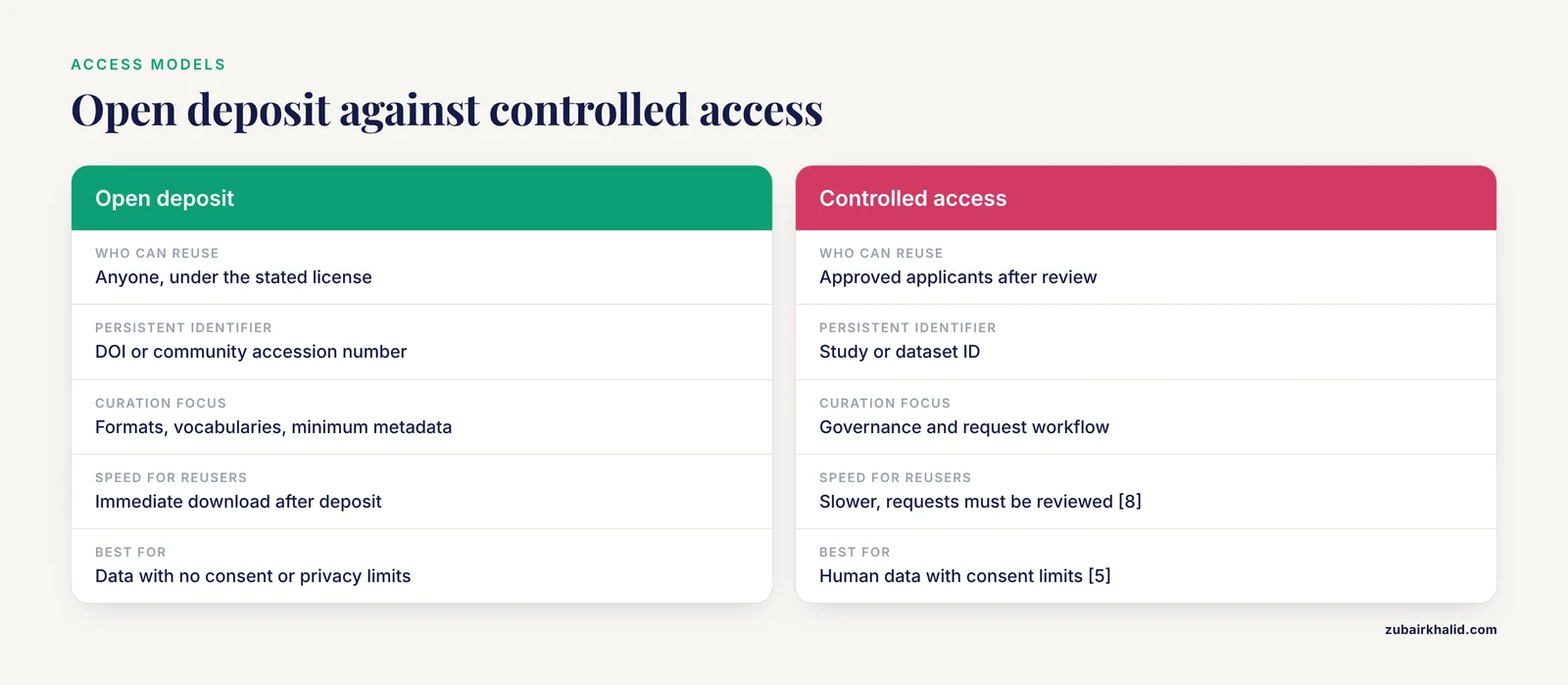
When data contain personal information, or when consent covers only specific secondary uses, a controlled-access repository is the correct choice rather than a compromise. The clinical trial literature lays out the issues clearly. Publishing raw trial data raises patient privacy problems unless explicit consent for publication exists, along with ownership questions, and current mandates often fail to address these concerns, which is why restricted-access repositories with defined request procedures are proposed as best practice [5]. Modern governance thinking pushes in the same direction, arguing for transparency in data management processes over security through obscurity, and for privacy-by-design principles built into research infrastructure [6].
Community and commercial data sites
Sites such as Kaggle host public datasets that support genuine research. A published benchmarking study of ensemble machine learning for heart disease prediction, for example, built its entire analysis on a publicly available cardiovascular dataset from the Kaggle repository containing 1,190 instances and 11 clinical features [11]. These platforms are fine for reuse and teaching, but as a deposit location for a data paper they have limits. Dataset pages are typically not versioned with DOIs in the way journal-grade repositories are, curation depends on the uploader, and provenance can be murky. If you reuse such data in your own work, document the exact source and version, and if you deposit your own derived dataset, prefer a repository with stronger preservation guarantees.
Comparing the options on the criteria that decide real choices
Discoverability and reuse
The single biggest argument for domain repositories is that reusers start there. But discoverability is not just about where files sit, it is about data quality once found. An assessment of invasion dynamics for the Pacific oyster used 6,693 occurrence records spanning 56 years drawn from online data repositories, and found that repository records were spatially biased and sparse in the early invasion history compared with peer-reviewed literature, even though both sources yielded broadly similar estimates of spread [12]. The practical implication is that repository data accumulate gaps and biases, and the more your repository attracts uncurated contributions, the more a data paper must document coverage limitations honestly.
Preservation and persistence
Ask three questions of any candidate repository. Does it assign a persistent identifier, does it commit to long-term preservation, and what happens if funding ends? Domain repositories backed by international infrastructure and generalist repositories run by established organizations generally answer these well. A lab website answers none of them.
Curation and quality control
Curation quality varies more than any other feature. Domain repositories validate formats and required fields. Generalist repositories mostly do not. This matters because your data paper's reviewers will often evaluate metadata quality, and because downstream users will judge your dataset by its documentation.
Quality control also matters before deposit, not just after. Editors and reviewers who do not have access to raw data must rely on clues within the manuscript, such as consistency checks on reported statistics, to identify probable errors [13]. A well-documented deposit changes that situation, letting reviewers and readers verify summaries against the underlying numbers. For synthetic or simulated data, formal data-quality assessment frameworks exist that test whether datasets meet assumptions appropriate for the intended research use before anyone builds on them [14]. Borrow that mindset. Assess your own dataset against the assumptions a reuser will make.
Licensing and credit
A data paper needs an unambiguous license so reusers know what they may do. Generalist repositories let you select licenses at upload. Domain repositories often operate under community default terms. Whichever applies, state the license in the data paper itself. Credit flows through the DOI and the data citation, and a growing set of journals index data citations explicitly.
Cost
Some repositories charge deposition fees, others are free at the point of use, and institutional repositories are typically free to affiliates. Because specific current fees are not standardized across the ecosystem, check the repository's published fee schedule at the time you deposit rather than relying on secondhand figures.
Sensitive data handling
Human data deserve their own decision path. If participants consented only to controlled sharing, an open repository is not an option at any price. Image data are a growing edge case, because photographs can identify people even after text records are de-identified. One multicentre initiative building a clinically annotated penile lesion image repository for artificial intelligence development collected about 7,000 images from 1,125 participants, pseudonymized the images, and processed annotations inside a secure, containerized annotation environment under local ethics approvals [15]. That architecture, pseudonymization plus a controlled processing environment plus explicit consent, is the template to follow when your data paper involves identifiable images or records.
FAIR principles, metadata, and the harmonization trade-off
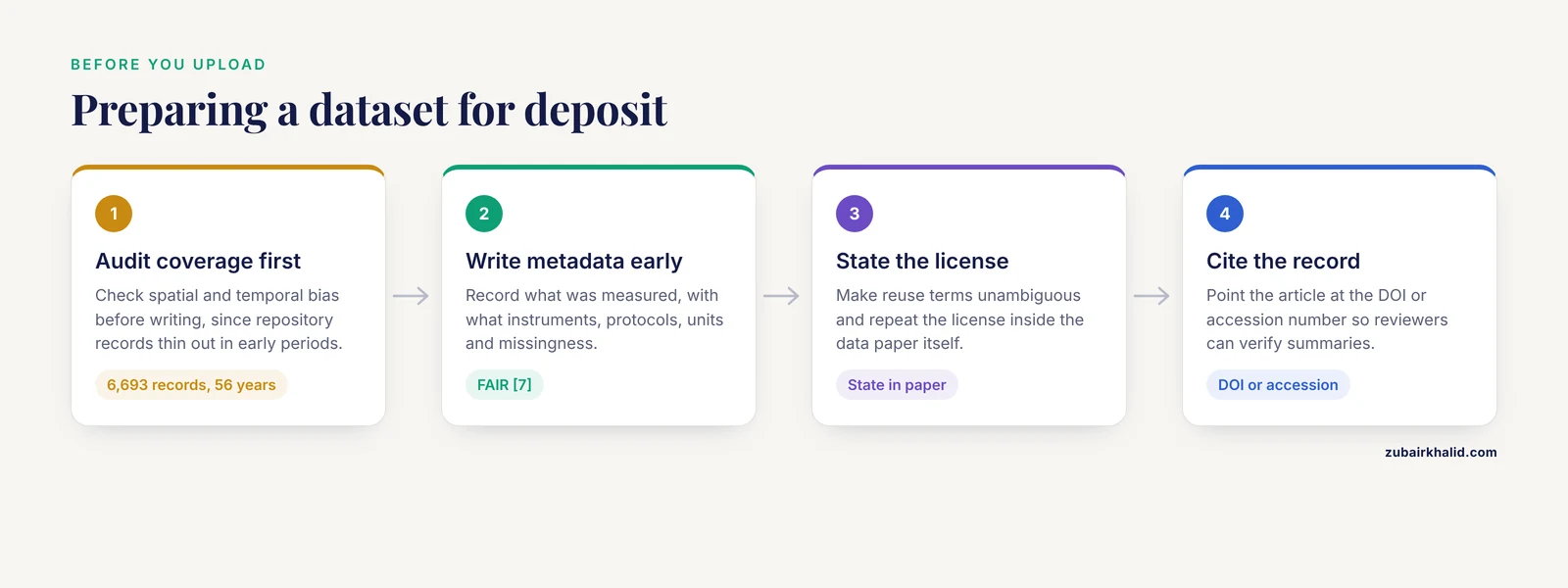
FAIR stands for findable, accessible, interoperable, and reusable, and it is the framework most repositories and funders now use to evaluate data practices [7]. In practice, FAIR compliance for a data paper means four concrete things. A persistent identifier exists. Access conditions are stated and machine-readable. The data use standard formats and vocabularies so other datasets can be combined with them. And the license plus documentation make genuine reuse legal and practical.
Metadata deserves most of your effort. Before uploading, prepare a descriptor of what was measured, with what instruments, under what protocols, with what missingness, and in what units. Automated tooling can help. The eData format mentioned above pairs a validated reporting structure with checks that catch schema violations before publication [10], and similar discipline-specific checklists exist across the sciences.
One FAIR subtlety matters for biomedical data papers. When your dataset will be pooled with others, harmonization carries a cost. The harmonization-information trade-off states that the level of granularity used to harmonize variables determines how much information is lost, so co-analysis of individual participant data requires balancing interoperability against analytical richness [7]. Document your variable definitions at whatever granularity you preserve, so future reusers know exactly what trade-offs your dataset embodies.
Worked scenarios
Scenario 1, raw sequencing reads plus a processed table. Deposit the raw reads in the appropriate archive such as the Sequence Read Archive with full sample metadata, then deposit the processed count matrix, code, and documentation in a generalist repository such as Zenodo with a DOI. The data paper cites both. This pattern follows the long-standing norm in genomics, where the raw-versus-processed release question has been argued since the forced release debates of the 1990s [1].
Scenario 2, individual participant data from a randomized trial. Consent and privacy rule out open deposit [5]. Route the dataset through a controlled-access platform such as CSDR, the YODA Project, or Vivli, with a data access committee and a documented request process [8]. In the data paper, describe the access procedure precisely so reusers know what they must apply for and how long approval takes.
Scenario 3, ecological occurrence records across decades. If you are compiling historical observations, audit them for spatial and temporal bias before writing the data paper, because repository-sourced occurrence data are known to be spatially biased and to thin out in early time periods [12]. State the coverage gaps explicitly. Deposit the curated dataset in a biodiversity or ecological archive, or a generalist repository if none fits.
Scenario 4, clinical images for model development. If your institution is building a dedicated image collection, follow the model of pseudonymized capture, structured metadata, a secure annotation environment, and explicit ethics approval described for clinical image repositories [15]. Publish the protocol paper describing the collection framework, and plan the eventual deposit into a repository whose access model matches the consent obtained.
Scenario 5, a benchmark dataset for machine learning. If your contribution is a curated dataset used to benchmark methods, deposit it with versioning and a DOI in a generalist repository, document every preprocessing step such as missing-value handling, outlier removal, and class balancing, and describe any data-quality assessment you performed so reusers can judge fitness for their own models [9][10].
Common Mistakes and Limitations
Treating a lab website or shared drive as a repository. These lack persistent identifiers, preservation commitments, and access documentation. A data paper pointing to one is effectively unverifiable.
Uploading first and documenting later. Metadata written after the fact is thinner and less accurate than metadata captured during the project. The FAIR framework exists precisely because undocumented data cannot be found, understood, or combined [7].
Choosing openness where consent does not allow it. Open mandates do not override participant consent. For trial data, privacy and consent are recognized as the central obstacles, and restricted access is the accepted alternative [5].
Assuming a repository deposit guarantees visibility. The matched comparison of clinical trial data reuses found no significant difference in Altmetric scores or citations relative to matched control articles [8]. Share data because reuse is right and often mandated, not for a citation bonus.
Ignoring the data quality your repository record reveals. Repository-derived datasets in ecology show spatial bias and historical gaps [12], and editors who cannot see raw data rely on internal consistency to catch errors [13]. Audit your own dataset before others audit it for you.
Confusing reuse sites with preservation repositories. A public dataset on a commercial platform can support research, as Kaggle datasets demonstrably do [11], but that does not make the platform an archival home for a data paper.
One limitation applies to every choice here. Repository policies, fee schedules, and funder requirements change, so verify the current terms of your chosen repository and your funder's data policy at the time of deposit, and for any project involving human subjects, confirm the access model with your ethics board before you commit.
Frequently Asked Questions
What is a data paper and how is it different from a regular research article?
A data paper's primary contribution is the dataset itself, described in enough detail for others to reuse, while a regular research article's primary contribution is an analysis or finding. In a data paper, the peer review focuses on the completeness and quality of the data and metadata, and the repository record with its persistent identifier is the core deliverable.
Do I have to make my data fully open to publish a data paper?
No. When consent, privacy law, or contracts restrict sharing, a controlled-access repository with a documented request procedure is the accepted route, and patient privacy and consent are recognized as the central issues in raw clinical data publication [5]. Your data paper should then describe the access procedure and the criteria for approval.
Which repository do funders and journals accept?
Funders and journals typically name acceptable repositories or require one when a domain repository exists. Many funding agencies now require open access to results and raw data from funded research [5], so check your funder's data policy and your target journal's instructions before depositing, and follow any named or mandated repository.
What metadata do I need before I upload?
At minimum, prepare what was measured, how, with what instruments and protocols, in what units, with what known limitations. FAIR principles require that the data be findable, accessible, interoperable, and reusable, and rich metadata is what makes that possible [7]. Structured formats with validation checks can catch schema problems before publication [10].
Can I use GitHub or Kaggle as my data repository for a data paper?
Kaggle and similar platforms support genuine research reuse, and published studies have been built entirely on public Kaggle datasets [11]. GitHub handles code versioning well. Neither, however, replaces a repository that issues a DOI, commits to preservation, and documents access terms, so use them for collaboration and host the archival copy in a formal repository.
Does sharing data in a repository increase citations of my work?
The best available matched comparison found no significant difference in citations or Altmetric attention between published reuses of clinical trial data and matched control articles [8]. Share data because reuse benefits science and often satisfies mandates, and treat any citation benefit as a possibility rather than a promise.
Sources
- Should non-peer-reviewed raw DNA sequence data release be forced on the scientific community?
- Publishing (whatever that means) neuroscience in the new millennium.
- Data management in the modern structural biology and biomedical research environment.
- Data sharing in medical research: an empirical investigation.
- Towards agreement on best practice for publishing raw clinical trial data.
- [[Position paper on the processing of personal data in clinical and outcomes research.].](https://pubmed.ncbi.nlm.nih.gov/42831711/)
- Harmonization-Information Trade-Offs for Sharing Individual Participant Data in Biomedicine.
- Social media attention and citations of published outputs from re-use of clinical trial data: a matched comparison with articles published in the same journals.
- The Functional Magnetic Resonance Imaging Data Center (fMRIDC): the challenges and rewards of large-scale databasing of neuroimaging studies.
- eData: A tool and format for rapid extraction of exposure data from scientific articles.
- Comparative Evaluation of Ensemble Machine Learning Approaches for Heart Disease Prediction.
- Science paper or big data? Assessing invasion dynamics using observational data.
- Statistical Data Editing in Scientific Articles.
- Method for Data Quality Assessment of Synthetic Industrial Data.
- The PENIMA project: artificial intelligence decision-support tool for penile lesions - protocol paper and invitation to participate.