Printable Biology Study Planner vs. Digital Apps
By Dr. Zubair Khalid, DVM, MS, PhD ·
A printable biology study planner is a fixed paper or PDF layout you fill in by hand, while a digital app is a reactive system that reminds, reschedules, and searches for you. The rule of thumb is simple: print on paper when the material itself is the work (memorizing pathways, sketching structures, recording bench data), and go digital when the schedule is the work (deadlines, rotating assignments, shared lab tasks). Most biology students and early-career researchers end up needing both, because the two formats fail in opposite ways. This article explains what each option actually does, compares them on the criteria that decide real choices, walks through worked scenarios, and lists the mistakes that cost students the most time.
What a Study Planner Actually Does in the Life Sciences
A study planner is any structured layout that converts your coursework or research goals into scheduled, checkable units. In biology, that usually means four distinct jobs bundled together:
- Term planning. Mapping lecture modules, lab sessions, assignment deadlines, and exam windows onto a week or semester grid.
- Content study planning. Scheduling retrieval practice for dense material, such as the citric acid cycle, the complement cascade, or the taxonomy of a phylum.
- Project planning. Breaking a research project into stages, from literature screening through data collection to analysis and writing.
- Record keeping. Documenting experiments as they happen, which is where a lab notebook template pdf earns its place.
The last job separates biology from many other subjects. A research template is a pre-formatted document, printable or digital, that prompts you for the entries good scientific practice expects: a dated title, a short objective, the exact reagents and concentrations used, the raw observations, and a sign-off line. Good laboratory practice across the life sciences rests on contemporaneous, dated, legible records that a stranger could later follow, and that standard shapes how a biology planner should be built whether it lives on paper or in software.
The difference between a biology study planner printable and a digital app, then, is not paper versus pixels. It is a difference in behavior. A printable page waits for you and never interrupts you. A digital app pushes notifications, recalculates dates when something slips, and indexes everything you type. Those behaviors produce different failure modes, which the rest of this article examines.
The Printable Biology Study Planner
What Goes Into a Printable Planner
A useful printable planner for biology coursework typically contains a small set of pages, each with one job:
- A semester overview grid, one row per module or course, with columns for assessment type, weight, and date.
- A weekly spread with time blocks, so lab sessions, lectures, and study blocks are visible against each other.
- A content tracker per module, listing topics with columns for first pass, practice questions, and self-tested recall. The third column matters. Retrieval practice, meaning self-testing from memory rather than rereading, is one of the most consistently supported study techniques in educational research, and a paper tracker is an easy place to log it.
- A lab notebook template pdf with numbered pages, a date field, an experiment title, an objective line, a methods section with space for lot numbers and concentrations, an observations area, and a signature line. Many programs provide these as standard downloads, and a printable template keeps the format identical every session.
- A reading and reference log listing papers with full citation details, one-line summaries, and the specific figure or result you needed from each.
Because a printable page is static, its power comes from what you write on it. The act of handwriting a mechanism, drawing a labeled diagram of a chloroplast, or sketching a gel layout engages motor and visual channels that typing does not. For visual, spatially organized biology content, that is a genuine advantage rather than nostalgia.
When to Use a Biology Study Planner Printable
The clearest answer to the question of when to use a biology study planner printable is whenever the planner page doubles as study material. Concrete cases:
- Diagram-heavy revision. Drawing anatomical structures, metabolic maps, or phylogenetic trees by hand, repeatedly, is itself the study method. A printable page holds the drawings.
- The bench. Paper survives a cold room, a fume hood, and a glove-covered hand in ways a touchscreen does not. Many working labs still require paper or printout records at the bench for exactly this reason, with entries transcribed or scanned into electronic systems afterward.
- Exam periods with fixed deadlines. During a three-week stretch before finals, the plan rarely changes. A printed weekly grid on the desk does the whole job without a single notification.
- Situationers with unreliable connectivity or device access. A printed planner never runs out of battery in the middle of a field course.
- Free-form annotation. Arrow, circle, margin note, doodle of the life cycle. Paper accepts all of it instantly.
The costs are equally concrete. A printable planner has no alarms, so a forgotten page is a forgotten task. It cannot be searched, so retrieving the week you recorded a critical observation means flipping pages. It cannot be backed up, so a lost notebook is a lost record. And every reschedule requires physical rewriting, which discourages the replanning that honest weekly review demands.
Digital Apps for Biology Study Planning
Digital planners fall into a handful of functional categories, and it helps to name them because most products blend two or three:
- Calendar applications handle fixed time commitments, from lectures to instrument booking slots.
- Task managers handle deadlines and dependencies, with reminders, recurring tasks, and re-dating when plans slip.
- Spaced repetition and flashcard systems schedule review of individual facts at expanding intervals, which suits the large factual load of biology, from enzyme names to drug mechanisms.
- Note databases store searchable lecture notes, linked by concept, so the pathway you learned in cell biology can be linked to its pharmacology consequences two years later.
- Reference managers organize the literature you read, attach PDFs, and format citations.
- Learning management systems, the institutional portals most universities run, publish deadlines and grades from the institution's side.
The evidence on digital tools in biology education is genuinely encouraging, with two qualifications. In a technology-assisted integrative learning model for pre-service biology teachers at three universities in Kazakhstan, students who combined traditional pedagogy with virtual laboratories, augmented reality, and project-based assignments scored 23% higher on tests and produced project work rated 31% better than control students taught conventionally, alongside higher reported satisfaction and motivation [1]. Separately, video tutorials have been evaluated as supporting tools for teaching laboratory skills in undergraduate biology, addressing the well-known problem that live demonstrations of techniques are seen once, at speed, and cannot be replayed at the moment of need [2].
The qualifications come from a multi-course evaluation of digital escape rooms, an active learning format, across four compulsory biology courses spanning years one to four, in which 123 students rated the experience positively on every measured dimension, including educational impact, interactivity, and motivation [3]. Yet the differences between courses were substantial. Histology students gave the highest scores of the four courses, first-year Cell Biology students the lowest, and the qualitative themes the students themselves raised included technical issues that needed clearer guidance, a workload they felt was high relative to the assessment weight, and group dynamics that varied widely between teams [3]. In other words, digital formats work well when the digital medium matches the content, and they add friction when they do not.
A second advantage of digital systems is durability of the record. Notes typed into a searchable database accumulate value over a whole degree, because second-year immunology questions can be answered from first-year notes in seconds. A paper planner from two semesters ago is effectively archived.
Side-by-Side Comparison
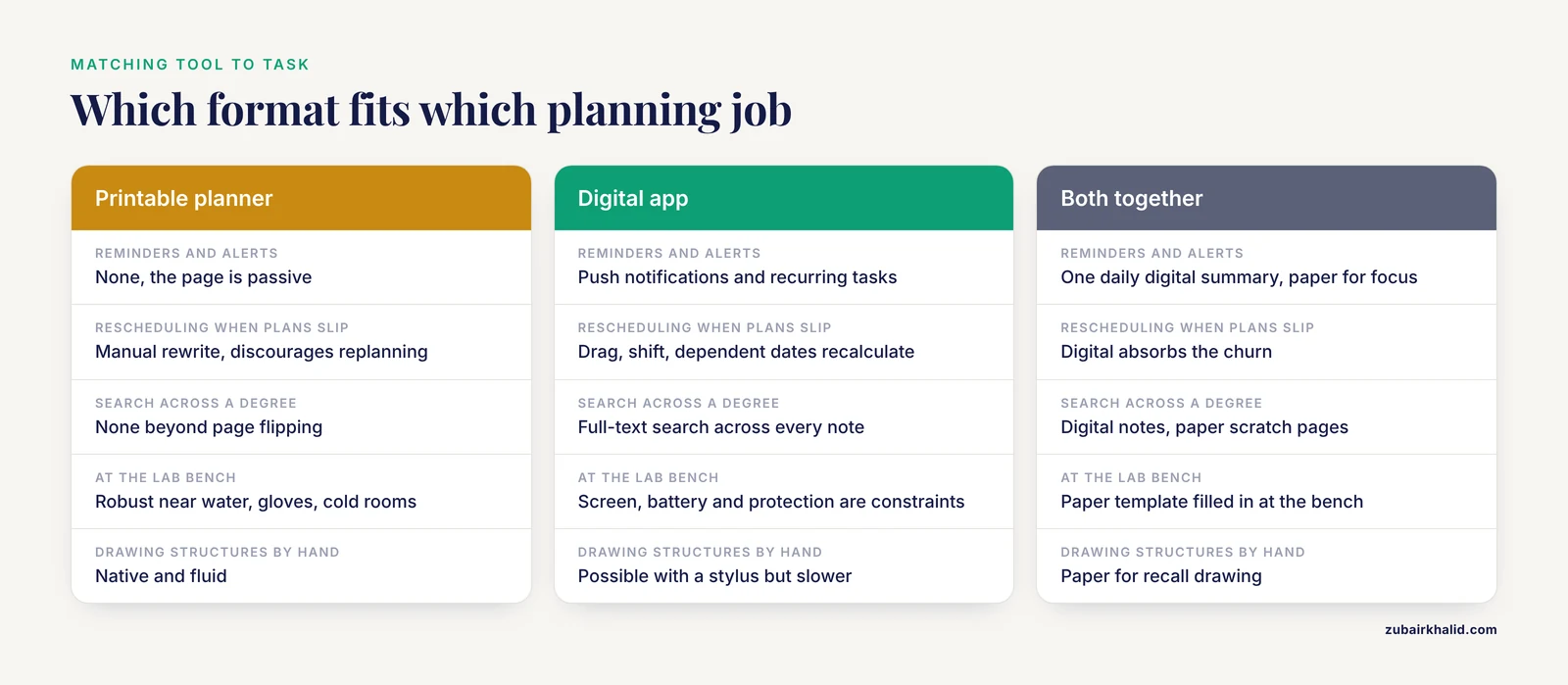
| Criterion | Printable planner | Digital app |
|---|---|---|
| Setup | Print pages, fill by hand, minutes | Account setup, structure building, hours at the start |
| Reminders and alerts | None, the page is passive | Push notifications, recurring tasks, automatic rescheduling |
| Rescheduling | Manual rewrite, which discourages replanning | Drag, shift, and the app recalculates dependent dates |
| Search | None beyond page flipping | Full-text search across every note and task |
| Handwriting and drawing | Native, supports sketching structures and mechanisms | Possible with a stylus but slower and less fluid |
| At the lab bench | Robust near water, gloves, and cold rooms | Screen, battery, and device protection are real constraints |
| Backup and loss | A lost notebook is gone | Cloud sync preserves the record |
| Sharing and collaboration | Photocopy or photograph, slow | Native sharing, comments, and shared checklists |
| Storage over a degree | Piles of paper, hard to revisit | Compact, indexed, and revisitable |
| Notification load | Zero, but also zero prompting | Constant potential distraction from the same device |
| Schema flexibility | You design each page, so it fits your course exactly | Templates exist, but rigid fields can fight your workflow |
| Best suited for | Diagram-heavy revision, bench records, fixed exam sprints | Deadline management, spaced repetition, literature, teamwork |
The Criteria That Actually Decide the Choice
Comparing a printable biology study planner with a digital app is itself a small exercise in the comparative evaluation that biology as a discipline does constantly, and the pattern of those published comparisons is instructive. When plant pathology researchers transferred an established quantitative PCR assay for citrus canker into a droplet digital PCR format, neither method simply won. Quantitative PCR kept the broader dynamic range, while droplet digital PCR delivered higher sensitivity and a lower coefficient of variation at low target concentrations, with the two methods correlating strongly overall (Pearson correlation = 0.8633) [4]. When metrology institutes compared one-step and two-step reverse transcription digital PCR workflows on a certified reference material, the two-step results agreed with the assigned value while one-step results ran about 27% lower, and the largest sources of random error were the assay itself (3 to 12% relative standard deviation) and the laboratory performing the work (7%) rather than the instrument [5]. And when three commercial single-cell spatial transcriptomics platforms were run side by side on the same formalin-fixed tumor samples, every platform was broadly concordant, yet tissue age and probe design turned out to determine data quality, so the right platform depended on the sample and the question [6].
The lesson for study planning is the same one those studies teach about laboratory methods. There is no universally superior tool. There is only a tool matched to the task, the conditions, and the user, judged against explicit criteria. Applied to planners, four criteria do most of the deciding work.
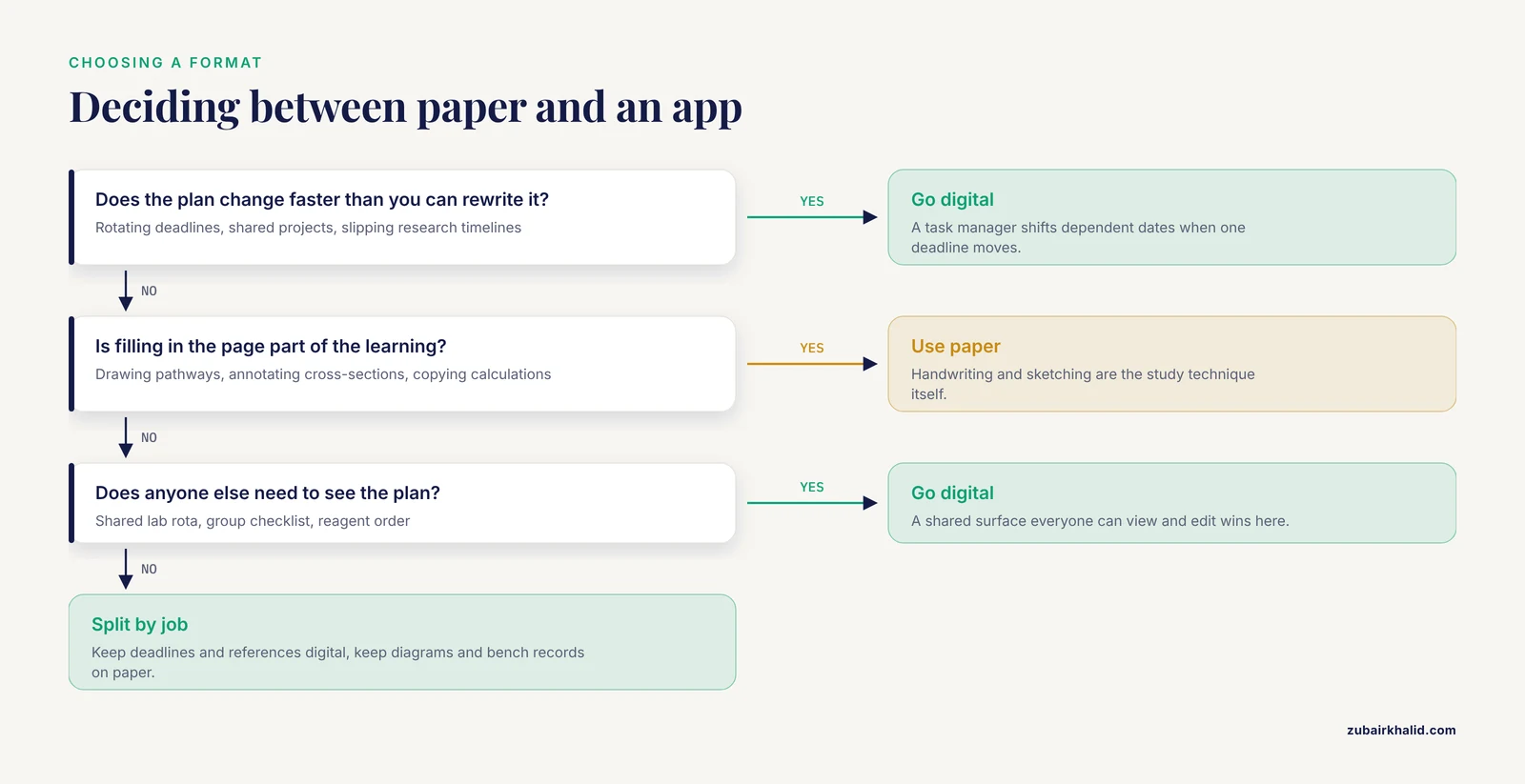
Criterion 1: Does the plan change faster than you can rewrite it? Coursework with weekly rotating deadlines, shared group projects, and research projects whose timelines slip generates constant replanning. A digital task manager absorbs that churn, because shifting one deadline automatically moves everything downstream. A printable weekly page handles a fixed exam sprint perfectly but makes weekly replanning feel like a chore, and chores get skipped.
Criterion 2: Is the act of filling in the planner part of the learning? If writing the planner page means drawing the Krebs cycle from memory, annotating a cross-section, or copying out a dilution calculation, the printable format wins because handwriting and sketching are the study technique. If filling in the planner means typing task titles and dragging calendar blocks, the medium contributes nothing to learning and the digital version saves time.
Criterion 3: Where does the planner need to physically be? In a teaching lab, at a bench, on a boat, or at a field site, paper wins on durability and hygiene. In a library or at a desk with a laptop already open, the digital app wins on convenience because you are already carrying the device.
Criterion 4: Does anyone else need to see the plan? A shared lab rota, a group project checklist, or a lab-wide reagent order needs a digital surface that everyone can view and edit. A personal revision plan needs an audience of exactly one, and privacy plus zero distraction favors paper.
A fifth, quieter criterion deserves mention because students underestimate it. The tool must survive contact with your actual behavior, not your idealized behavior. The printable planner fails for students who lose single sheets. The digital app fails for students who open it, see three notifications, and lose forty minutes. Choosing honestly against your own habits matters more than any feature list.
Worked Scenarios
Scenario 1: Second-year undergraduate, four modules, one lab course, eight weeks to finals. The deadline structure is fixed and published. The dominant study work is visual and factual, from histology slides to metabolic pathways. Here the printable planner is the core. A weekly grid on the desk, a content tracker per module with a self-testing column, and a stack of blank diagram pages for active recall drawing. The single digital supplement worth adding is a spaced repetition app for the sheer volume of terms, because interval scheduling of flashcards is exactly the kind of repetitive bookkeeping software does better than a human. This is the classic answer to "when to use a biology study planner printable."
Scenario 2: Final-year research project with a supervisor, a shared lab, and a thesis deadline. The dominant work is project management and record keeping. Experiments fail and get repeated, so the plan changes weekly. Here the digital side carries the load. A shared task board with the supervisor visible, a reference manager for the literature review, and a calendar synced to instrument booking. The research template still earns a place as a printed lab notebook template pdf or its approved electronic equivalent, filled in at the bench, because contemporaneous dated records are the professional standard a stranger must be able to follow, and because a device that cannot safely sit next to a staining tray is the wrong tool for that moment.
Scenario 3: Graduate student juggling coursework, teaching, and a dissertation. The plan changes daily and the record needs to last years. Almost everything goes digital. Search across three years of notes is worth more than any sketch, and automatic rescheduling absorbs the chaos. The printable element shrinks to a single purpose, a scratch page per study session for working out problems by hand, which can be a plain sheet rather than a structured template.
Scenario 4: A cohort revising together for a licensing or comprehensive exam. Group accountability changes the calculus. Digital wins, because shared checklists, visible progress, and a common flashcard deck remove the coordination overhead that sinks study groups. The evaluation of digital active learning in biology found group dynamics to be a real variable, with some groups functioning well and others poorly, so the tool helps most when the group already has norms about who does what [3]. A shared digital planner makes those norms explicit.
How to Build Either Version Well
Whichever format you pick, the same design principles produce a planner you will still be using in week ten rather than week two.
- One page or one view per purpose. A semester grid, a weekly spread, and a content tracker are three different artifacts. Cramming them into one layout makes every layout worse.
- Record the study event, not just the intention. A row that says "Krebs cycle, drew from memory, missed succinyl-CoA step, redrew" is worth ten rows that say "study biochem."
- In the lab template, capture what you would need to repeat the experiment. Reagent lot numbers, concentrations, instrument settings, deviant observations, and the date. If the template does not prompt for it, you will not remember it later.
- In digital systems, default to fewer notifications. One daily summary beats thirty pings. The distraction cost of a poorly configured app can exceed its organizational benefit, and the technical friction students reported with digital learning tools in the biology course evaluation is a reminder that setup quality drives adoption [3].
- Review weekly on a fixed day. Whichever medium you use, a planner that is never reviewed is decoration. The weekly review is the mechanism that turns either tool into a system.
Common Mistakes and Limitations
Choosing the format before naming the job. Students pick an app because it looks impressive, or print a template because it looks aesthetic, without asking whether their bottleneck is deadlines, memorization, bench records, or all three. Decide the job first.
Treating the lab notebook template pdf as optional. The most expensive mistake in research training is sloppy or retrospective record keeping. Entries made hours or days after the experiment lose the details that made the result interpretable. Fill the record in as you work, date it, and keep the format consistent.
Letting the digital planner become a distraction device. The same device that carries your task manager carries everything else. If you cannot open the app without falling into other tabs, that is a decisive point for the printable format for your study sessions, with the digital system reserved for deadline capture you check once a day.
Confusing template collection with studying. Downloading a dozen research templates and planning printables feels productive and is not. One working system beats five abandoned ones, and the evidence that digital learning tools help comes from structured, actually-completed activities, not from tool accumulation [1].
Expecting the tool to do the thinking. No planner, paper or digital, schedules your recall practice for you or draws your diagrams. In the multi-course biology evaluation, students rated the digital activity positively while still reporting that its workload felt high relative to its assessment weight, a reminder that any tool adds work as well as structure [3].
Assuming the comparison is permanent. The right answer in first year is often wrong in graduate school. Revisit the choice when your workload structure changes, the same way a working scientist re-evaluates a method when the sample or the question changes.
One final limitation applies to everything above. Programs differ in their documentation requirements, courses differ in their assessment structures, and individual circumstances vary, so for decisions that carry formal consequences, such as thesis record-keeping rules or institutional lab documentation policies, confirm the specific requirements with your advisor or program handbook rather than relying on any general guide.
Frequently Asked Questions
What is the main difference between a biology study planner printable and a digital app?
A printable planner is a static page you fill in by hand, which suits sketching, bench-side records, and fixed exam sprints, while a digital app actively reminds, reschedules, searches, and syncs, which suits changing deadlines, shared work, and long-term searchable notes.
When should I use a printable biology study planner instead of an app?
Use a printable planner when filling in the page is itself the study work, such as drawing pathways and structures from memory, when you need robust records at the lab bench, or when your deadlines are fixed enough that replanning is rare.
Can a lab notebook template PDF replace a paper lab notebook?
A lab notebook template pdf is a printable format for a paper notebook, not a replacement for one, and it standardizes entries like the date, objective, reagent details, observations, and sign-off, though some institutions accept electronic equivalents and set their own documentation rules.
Do digital study tools actually improve results in biology courses?
Controlled evaluations suggest they can, with a technology-assisted model combining virtual laboratories, augmented reality, and project work raising test scores by 23% and project quality by 31% against conventional instruction, but digital formats also drew complaints about technical issues and workload, so the tool must fit the content.
What should a printable biology study planner include?
At minimum, a semester grid with assessment dates and weights, a weekly time-block spread, a per-module content tracker with a self-testing column, and a dated lab notebook template pdf for practical sessions.
Can I use a printable planner and digital apps together?
Yes, and most experienced students do, typically keeping deadlines, references, and shared tasks in digital tools while keeping revision diagrams, daily scratch work, and bench records on paper, with the split following the criteria of task stability, location, and whether handwriting aids learning.
Sources
- Integrative Technology-Assisted Learning for Future Biology Teachers: Enhancing Theoretical Knowledge, Practical Competence, and Professional Readiness through Virtual Laboratories and Augmented Reality
- An Evaluation of the Use of Video Tutorials as supporting Tools for teaching Laboratory Skills in Biology
- Digital Escape Rooms as Active Learning Tools in Biomedical Sciences: A Multi-Course Evaluation in Undergraduate Biology Education
- Comparison of Droplet Digital PCR and Quantitative PCR Assays for Quantitative Detection of Xanthomonas citri Subsp. citri
- Investigating Factors Influencing RNA Enumeration: Trilateral Evaluation and Benchmarking Using One- and Two-Step Reverse Transcription-Digital PCR with a Certified Reference Material
- Comparison of imaging-based single-cell resolution spatial transcriptomics profiling platforms using formalin-fixed, paraffin-embedded tumor samples