Biology Mnemonics for Terminology: How to Generate Your Own
By Dr. Zubair Khalid, DVM, MS, PhD ·

By the end of this article you will be able to take any list of biology terms (the taxa in a classification hierarchy, the intermediates of a metabolic cycle, the phases of mitosis) and turn it into a personal mnemonic in under five minutes, using a repeatable procedure rather than luck. You will also know how to pair those mnemonics with retrieval practice so the terms survive past exam day, and how to spot the situations where a mnemonic is the wrong tool.
To follow along, you need three things on hand: a current list of terms from your course (10 to 30 terms is a good batch), a Greek and Latin root reference (a printed prefix and suffix chart works fine), and a notebook or a plain text file. If you want to run the worked generator in this article, you need Python 3 installed. You can run every example with nothing more than a text editor and a terminal.
Why Mnemonics Work for Biology Terminology, and When They Do Not
Biology is unusually vocabulary-heavy. An introductory cell biology or botany course can present hundreds of technical terms in a single semester, and much of that vocabulary descends from Greek and Latin roots that most students were never taught [1]. Researchers who study how professionals and students master technical vocabulary keep finding the same pattern: people who rely on a single strategy (rereading a glossary, highlighting a textbook) learn slower and forget faster than people who combine strategies, especially strategies that force active recall [2], [3].
Three findings from the terminology-learning literature shape everything in this article.
First, memory research applied to vocabulary training shows that searching for associations between a mental image and textual information, and using mnemonic and metacognitive strategies together, measurably improves how well learners reorganize and retain specialized terminology [4]. A mnemonic is not a passive label. It is an association you deliberately build, and the act of building it is itself a form of deep processing.
Second, retrieval practice (pulling a term out of memory from a cue, instead of rereading it) is one of the highest-impact strategies available for biology vocabulary. In a classroom action study with Grade 8 students learning biology terminology in a second language, formative testing with closed books (retrieval) produced better summative vocabulary outcomes than formative testing with open books, although the measured effect was small [5]. The practical lesson: a mnemonic you never test yourself on is a mnemonic you will lose.
Third, mnemonics are most durable when the term has already been decoded. Students who receive explicit instruction in morphological analysis (breaking multisyllabic technical words into roots and affixes) outperform students who only receive regular vocabulary teaching. In one controlled comparison of grade-ten biology students against university biotechnology students, the morphological-analysis group closed the gap and finished with up to a 5.9-point higher mean gain on vocabulary tests [6]. Similarly, fill-in-the-blank exercises built around figures and sentence contexts help college students master abstract terms because the terms are anchored to visual and written context rather than floating free.
So the order of operations matters. Decode the term first, anchor it to a figure or context second, and only then add a mnemonic as a retrieval handle. A mnemonic bolted onto a word you do not understand is a trap. It lets you reproduce the word in an exam while knowing nothing about the concept, which is exactly the kind of imprecise thinking that working scientists warn against when terminology is used loosely.
Decode Before You Memorize: The Morphology Pass
Most biology terminology is composite. Before building any mnemonic, spend two minutes breaking the term into its parts. This step alone eliminates the need for mnemonics on a large fraction of terms.
| Component | Meaning | Examples in biology |
|---|---|---|
| hydro-, aqua- | water | hydrophilic, aquatic |
| -lysis | loosening, breakdown | hydrolysis, lysosome |
| hyper-, hypo- | above, below | hypertension, hypotonic |
| -itis | inflammation | dermatitis |
| photo- | light | photosynthesis, phototropism |
| -cyte, -cyto- | cell | erythrocyte, cytoplasm |
| mono-, di-, poly- | one, two, many | monosaccharide, diploid, polymer |
| -troph- | nourishment | autotroph, heterotroph |
A learner who knows that "hyper" means above and "tonic" relates to concentration can work out "hypertonic" on the spot, without a mnemonic at all. This is also why historical languages matter: surveys of hospital professionals learning medical vocabulary found that their top difficulties came from Greek and Latin borrowings and difficult word structure, and that self-directed strategies were needed to cope [8]. Structured courses such as a remote special course in Latin for botany terminology exist precisely because the Latin layer of biology vocabulary is large enough to justify dedicated instruction [9].
Run the morphology pass like this. Write the term, underline every root or affix you recognize, and write the meaning above each part. For example, "glycocalyx" becomes "glyco" (sweet, sugar) plus "calyx" (cup, covering), which points to the sugar coat on a cell surface. Terms that fully decode, and whose meaning you can now reconstruct, need no mnemonic. Set them aside. Terms that still resist (arbitrary names, eponyms, look-alike pairs) are your mnemonic candidates.
The Biology Mnemonic Generator: A Step-by-Step Method
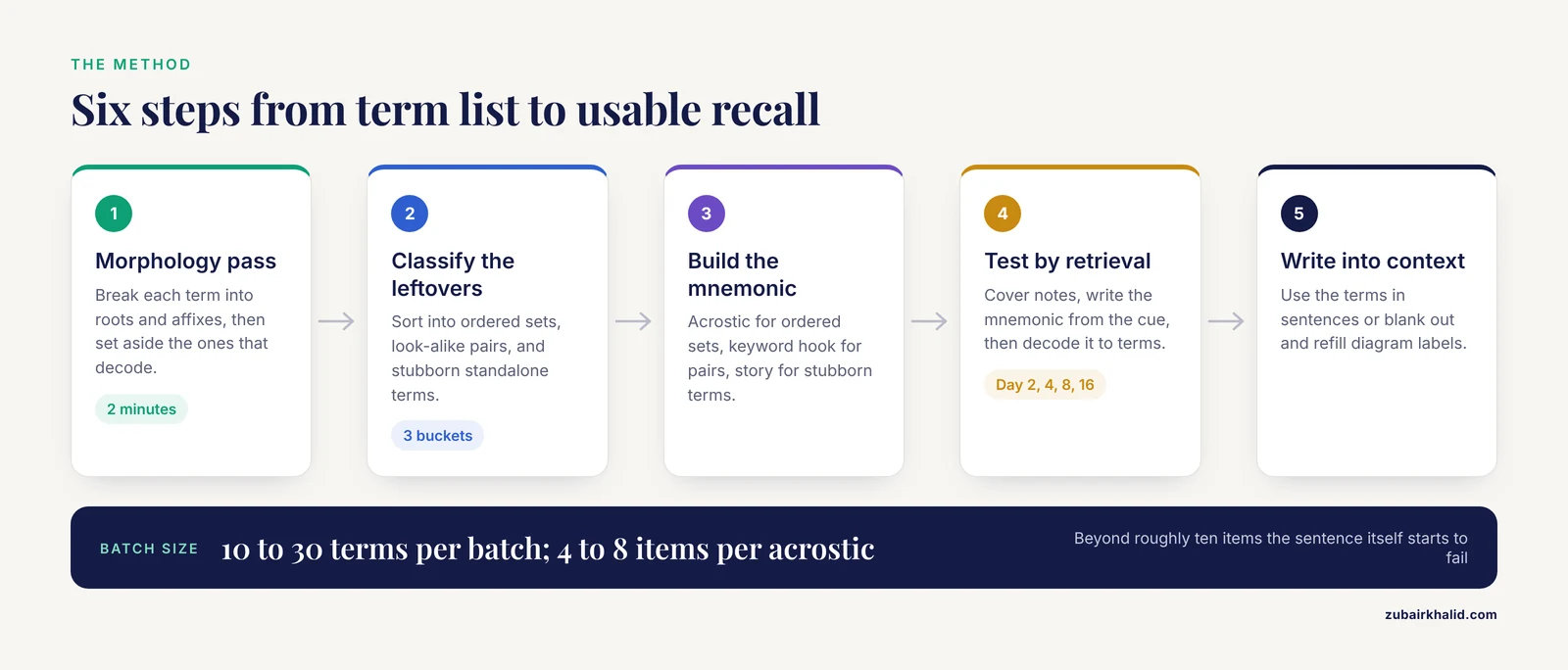
The phrase "the biology mnemonic generator" usually refers to a website that spits out canned acronyms. Treat it instead as a procedure you can run yourself, because self-generated mnemonics outperform borrowed ones. When you invent the image, you do the processing that builds the memory. Here is the full procedure, with a worked example at each step.
Step 1: Collect and classify the term list
Write down the terms you must know. Sort them into three buckets:
- Ordered sets (things with a fixed sequence). Examples: taxonomy ranks, phases of mitosis, the intermediates of the citric acid cycle.
- Look-alike or sound-alike pairs (terms you confuse with each other). Examples: mitosis versus meiosis, anabolism versus catabolism, antibody versus antigen.
- Standalone stubborn terms (words that resisted the morphology pass). Examples: eponyms such as Golgi, or irregular spellings.
Ordered sets get acrostics. Look-alike pairs get keyword and image mnemonics. Stubborn terms get keyword or story mnemonics. Matching the mnemonic type to the problem is the single biggest quality lever in this whole method.
Step 2: For ordered sets, build an acrostic
Take the first letter of each item in order. Then write a vivid, slightly absurd sentence using those letters in sequence.
Worked example, the classification hierarchy: Domain, Kingdom, Phylum, Class, Order, Family, Genus, Species gives you D K P C O F G S. A standard classroom acrostic is "Dear King Philip Came Over For Good Soup". Notice the properties that make it work: the sentence is grammatical, the image (a king wanting soup) is concrete, and the first-letter mapping is one to one.
Now generate your own version rather than reusing someone else's. Take the letters and write a sentence about something from your own life. "Dogs Keep Planting Carrots On Friday, Growing Spinach." The absurdity and personal connection are the point. A sentence about your own dog will beat a sentence about a generic king.
For the citric acid cycle intermediates in order (citrate, isocitrate, alpha-ketoglutarate, succinyl-CoA, succinate, fumarate, malate, oxaloacetate), the first letters are C I A S S F M O. Build a sentence: "Cats In Alaska Sip Sweet Fizzy Mountain Orange-juice." Check it against the list: every letter maps, the order holds, and the fizzy-drink image fits the fact that the cycle is about oxidative reactions. If you drop or add a letter, regenerate rather than patching.
Step 3: For look-alike pairs, build a keyword hook
Find a sound-alike word in the term, then attach a distinguishing image to that hook.
Worked example: mitosis versus meiosis. "Mitosis" contains "toes," so picture toes dividing into two identical sets. "Meiosis" you can hook to "my, oh sis" with a sister splitting one wardrobe four ways (meiosis produces four genetically different cells from one starting cell). The hooks are silly on purpose. Silly is memorable.
Worked example: anabolism versus catabolism. Hook "ana" to "anabolic steroids," which build tissue, so anabolism builds. Catabolism, by elimination and by the hook "cat" tearing something apart, breaks down. One strong hook per pair is enough if the other member is defined as the opposite.
Step 4: For stubborn standalone terms, build a story or image
Take the sound or spelling of the term and build a one-scene image that encodes the meaning, not just the word. For "glycocalyx," if the morphology alone did not stick, picture a cup (calyx) filled with sugar (glyco) sitting on a cell. The image must contain the meaning, or you have created a keyword with no payload, which is one of the classic failure modes described below.
Step 5: Test by retrieval, not by rereading
This step is where most students fail, and it is the step the evidence supports most strongly. Cover your notes and write the mnemonic out from the cue alone. Then, more importantly, write out the actual terms the mnemonic decodes to. A mnemonic you can recite but cannot decode is worthless. The classroom retrieval-practice study cited above used exactly this distinction: closed-book formative testing beat open-book testing for later vocabulary performance [5].
Build the retrieval loop into your biology study methods from day one. Day 1: build the mnemonic and decode it once. Day 2: retrieve from the cue only. Day 4: retrieve again, add any term you dropped. Day 8 and day 16: spot-check. Expanding intervals like this are standard practice in vocabulary training programs across technical fields,.
Step 6: Write the terms into context
The final step converts recall into usable knowledge. Take the retrieved terms and write them into sentences or label them on a diagram. The fill-in-the-blank strategy developed for college cell biology, where students complete a 20 to 30 blank paragraph attached to a textbook figure using a supplied term bank, works because abstract terms are mastered when they appear in figures and extended written contexts. You can make a personal version in ten minutes: take a diagram from your notes, blank out the labels, and fill them in from memory, using your mnemonics only when you get stuck.
A Worked Example: Running a Simple Generator Script
If you want to speed up step 2, a short script can propose pronounceable acrostic words from your letter string. This is a genuinely useful "biology mnemonic generator" you own yourself. Save the following as mnemonic.py:
from itertools import permutations

VOWELS = set("aeiou")

def pronounceable(word):
    """Rough heuristic: no three consonants in a row, no three vowels in a row."""
    runs = 1
    for i in range(1, len(word)):
        same_class = (word[i] in VOWELS) == (word[i-1] in VOWELS)
        runs = runs + 1 if same_class else 1
        if runs >= 3:
            return False
    return True

def suggest(letters, n=12):
    letters = letters.lower().replace(" ", "")
    results = []
    for perm in permutations(letters):
        word = "".join(perm)
        if pronounceable(word) and word not in results:
            results.append(word)
        if len(results) >= n:
            break
    return results

if __name__ == "__main__":
    print(suggest("DKPCOFGS"))
Run it from a terminal:
python3 mnemonic.pyExpected output (order will vary because permutations enumerate in input order):
['dakopigo', 'kopediga', 'godapika', 'pakidoga', 'dopigako', 'gapodeki',
 'kagopido', 'digapoko', 'padokigo', 'godepika', 'kopediga', 'dakopigo']
The script is a syllable proposes, not a sentence writer. You take a pronounceable chunk such as "dakopigo" and hang real words on it ("Dad Kicks Pine Cones Off Friday, Grinning Silently"). The script only removes the mechanical step of checking whether a letter order can be pronounced. It cannot judge imagery, personal relevance, or accuracy, and those are the parts that determine whether the mnemonic survives.
Parameters that matter in the script: the input string (your first letters, in the exact order of the biological sequence, since scrambling the order defeats the purpose) and n, the number of candidates to print. If the output is empty, the heuristic rejected everything, which usually means the letter string is vowel-poor or consonant-poor. Loosen the threshold from runs >= 3 to runs >= 4 and rerun.
A Summary Table of Mnemonic Types
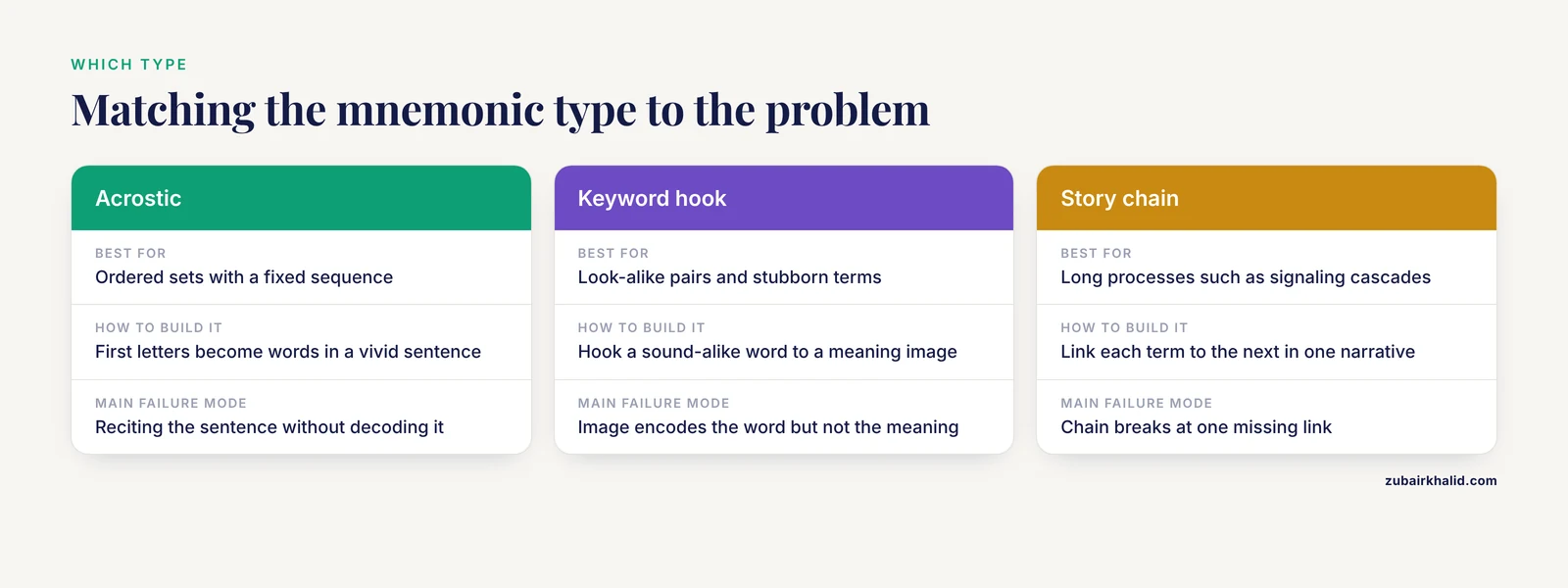
| Type | Best for | How to build it | Main failure mode |
|---|---|---|---|
| Acrostic sentence | Ordered sets | First letters become words in a vivid sentence | Reciting the sentence without decoding it |
| Acronym (pronounceable word) | Short ordered sets (3 to 6 items) | Rearrange first letters into a word, use a script if needed | Forgetting which letters map to which terms |
| Keyword sound-alike | Look-alike pairs, stubborn terms | Hook a sound-alike word to a meaning-bearing image | Image encodes the word but not the meaning |
| Story chain | Long processes (signaling cascades) | Link each term to the next through one narrative | Chain breaks at one missing link and the rest is lost |
| Root-association map | Morphologically regular terms | Connect new terms to roots you already know | Applying a root rule where an exception exists |
| Fill-in-the-blank text | Terms tied to figures and processes | Blank out labels and captions, refill from memory | Making the blanks so short they become pattern matching |
Biology Mnemonics for Terminology: Tips That Raise Quality
These are the refinement tips that separate a mnemonic that lasts from one that evaporates in a week.
Anchor to a picture whenever possible. Terms learned alongside figures and sentence frames are mastered more reliably than terms learned as isolated strings. If your mnemonic for "phospholipid bilayer" is purely verbal, redraw the bilayer and place your mnemonic characters inside it.
Use your own life as raw material. The association-searching techniques documented in vocabulary training research work because the learner forges the link between mental image and text [4]. A borrowed mnemonic is someone else's link. Spending sixty seconds to make the image yours pays for itself many times over.
Batch by topic, not by course. Build mnemonics for all the ordered sets in one chapter in a single session. Mixing topics fragments your review schedule. Group-based vocabulary study, including shared review through simple phone applications, is a documented strategy in technical vocabulary courses and adds an accountability loop [10].
Keep a vocabulary notebook anyway. In surveys of how engineering students learn technical vocabulary, keeping a vocabulary notebook was the least used strategy, even though the same students relied heavily on passive strategies like watching media [3]. A notebook of your mnemonics, with the decode key written under each one, is the cheapest quality-control tool available. Write the mnemonic on the left page and the full term list it decodes to on the right, so you can always test the mapping.
Use the terms out loud within 24 hours. Vocabulary programs that force learners to activate passive vocabulary in speech, even through daily short reports on current material, show better retention than purely written review [11]. Explaining a pathway to a classmate using your mnemonic is both retrieval practice and active use.
Pair mnemonics with problem situations. Where your course allows, work case-style problems that force you to use the terminology in context. Problem-based approaches activate technical vocabulary through discussion and case analysis rather than recognition alone, and task-based approaches that put terminology into realistic communicative situations produce usable professional language rather than passive recognition. A mnemonic gets the word out of memory. A problem set teaches you where the word belongs.
How to Verify Your Mnemonics Are Correct
Build these three checks into your review cycle.
Check one: the decode test. Cover everything, look only at the mnemonic, and write out the full terms. Score yourself. Any dropped or swapped item means the mnemonic has a structural weakness, usually a letter that maps ambiguously. Fix it immediately by regenerating, not by trying to remember harder.
Check two: the meaning test. For each retrieved term, write one sentence using it correctly. If you cannot, you have stored the label without the concept. Return to the figure or paragraph where the term lives, and only then re-anchor the mnemonic.
Check three: the cross-check against your course materials. Mnemonics drift. Verify each item against the textbook glossary, because casual misuse of technical terms is a recognized problem even among professionals, and the fix is codifying shared meanings rather than trusting recall. If your mnemonic encodes a wrong definition, you have built a highly memorable error, which is worse than no mnemonic at all.
Common Mistakes and Limitations
Mistake 1: Mnemonics without meaning. The most common failure. You can recite "Dear King Philip" and still not explain what a phylum is. Mnemonics store order and labels. They do not store understanding, and terminology competence requires understanding [1], [12]. Always pair the mnemonic with a figure or a written context before you count the term as learned.
Mistake 2: Too many mnemonics. If every term gets a mnemonic, the mnemonics themselves become a memorization burden and start interfering with each other. Reserve them for ordered sets, confusable pairs, and terms that survived the morphology pass without decoding. Students with access to structured vocabulary-strategy instruction learn to select strategies selectively rather than uniformly [13].
Mistake 3: Mnemonics that encode errors. A wrong but catchy mnemonic is durable and dangerous. Verify every decoded item against your course glossary before you rehearse the mnemonic, since imprecise terminology undermines communication in the field itself.
Mistake 4: Building mnemonics before decoding. If you skip the morphology pass, you will build mnemonics for terms such as "hydrolysis" that a two-second root analysis would have made self-explanatory [1]. Morphology-based decoding has measurable effects on technical vocabulary acquisition [6].
Mistake 5: No retrieval, only rehearsal. Rereading a mnemonic feels like studying and does almost nothing for retention. The evidence from classroom trials favors closed-book recall over open-book review, even though the measured effect was modest in that setting [5]. Schedule retrieval sessions, spaced over days, the way structured vocabulary courses schedule consolidation and repetition,.
Limitation 1: Mnemonics fade without spaced review. Every mnemonic decays. Treat them as scaffolding. The long-term goal is that the terms become directly retrievable and the scaffold can fall away, which is how vocabulary consolidation is handled in formal terminology-training programs [2].
Limitation 2: Mnemonics are individual. A mnemonic that works for one student can be meaningless to another, which is a reason group sharing of mnemonics helps some members and confuses others. Use group sessions to compare, not to adopt wholesale [10].
Limitation 3: Field terminology keeps evolving. Subfields such as genomics actively work to codify and correct their terminology [7], and professional vocabularies are large enough that no mnemonic system covers them. Mnemonics are one tool inside a broader set of biology study methods that includes morphological analysis, contextual practice, and field or laboratory exposure [12],.
Frequently Asked Questions
How do I start making biology mnemonics for terminology if I have never made one before?
Start with one ordered list from your current chapter, take the first letter of each item, and write a silly sentence that uses the letters in order. Test yourself the next day by decoding the sentence back into terms.
What is the best step-by-step order for the biology mnemonic generator method?
Decode the terms into roots first, classify the leftovers into ordered sets, look-alike pairs, and stubborn terms, then build an acrostic, keyword hook, or story for each bucket, and finish with spaced retrieval and fill-in-the-blank practice.
How many terms should go into a single mnemonic?
Four to eight items is the practical range for an acrostic. Beyond roughly ten items, recall of the sentence itself starts to fail, so split long lists into two or three linked mnemonics.
Are self-made mnemonics better than ones I find online?
Yes, in most cases, because inventing the image or sentence performs the associative processing that builds the memory trace. Borrowed mnemonics are still useful as a fallback when you are stuck or short on time.
How long do mnemonics last before I need to review them?
Expect noticeable decay within days without review, so schedule retrieval sessions at expanding intervals, roughly at day 2, day 4, day 8, and day 16 after building the mnemonic.
Can mnemonics help me tell apart confusable terms like mitosis and meiosis?
Yes, sound-alike keyword hooks are the standard tool for confusable pairs. Give each term a distinct image tied to its actual meaning, such as identical toes for mitosis, so the pair can never collapse into one memory.
Do I still need to understand a term if my mnemonic works?
Absolutely. A mnemonic stores the label and order, not the concept, and biology courses test concepts. Always pair each mnemonic with a labeled figure or a written sentence using the term correctly.
What are the most common mistakes students make with biology mnemonics?
The big four are mnemonics without meaning, building mnemonics for terms that would decode through roots anyway, rehearsing by rereading instead of testing recall, and never checking the decoded terms against the course glossary for accuracy.
Sources
- Simplifying Biology Vocabulary via Morphology
- Effective Teaching Methods and Ways of Mastering Legal vocabulary by Students of Universities of Law
- Vocabulary Learning Strategies: Learning Engineering Terminology among Engineering Majors for Industry 4.0 Readiness
- Preparation of Cadets of Higher Military Educational Institutions in Ukraine for Teaching (Perception) of Professional Vocabulary (Terminology) in English Classes
- Retrieval Practice Action Research to Develop Middle School Students’ Knowledge of Biology Terminology
- Enhancing Technical Vocabulary Through Morphological Analysis Instruction For Biology-majored Students
- Mastering Genomic Terminology
- Difficulties in Mastering and Using English for Specific Purpose (Medical Vocabulary): A Linguistic Analysis of Working Saudi Hospital Professionals
- REMOTE SPECIAL COURSE «LATIN. BOTANY TERMINOLOGY» AS A MEANS OF BECOMING A PROFESSIONAL AND TERMINOLOGICAL COMPETENCE OF BIOLOGY TEACHER
- Group Learning and Teaching of Vocabulary, Terminology and Reading Comprehension Strategies by the Use of Cellphone Applications in ESP Courses
- MODERN MILITARY VOCABULARY IN TEACHING ENGLISH: LINGUISTIC AND SOCIAL ASPECTS OF MASTERING
- Terminology Work of Future Biology Teachers During the Field-Based Training in Botany
- The Effect of Explicit VLS Instruction on the Vocabulary Learning Behaviors of Biology Majors