Biology Exam Prep Template with Examples
By Dr. Zubair Khalid, DVM, MS, PhD ·

By the end of this article you will be able to build a complete biology exam prep template, fill it in with a real worked example from a general biology course, convert old exam questions into a multi-format practice set, and check whether your prep is actually working before test day. You need three things on hand: your course syllabus and learning objectives, a copy of every exam or quiz question you have already seen in the unit, and a place to store the template, such as a plain text file, a word processor document, or a spreadsheet.
What a Biology Exam Prep Template Is
A biology exam prep template is a reusable document with fixed fields that you fill in for each exam. Instead of rereading chapters and hoping for the best, the template forces you to list the learning objectives, define the key terms, draw the processes, and write practice questions in the same formats your instructor uses.
This structure matters because biology exams reward organized retrieval, not passive review. Students often say they do not know what will be on the exam. A recent teaching study in the Journal of Microbiology and Biology Education described a method that turns that panic into structured prep, using pre-prepared multiple-choice questions from unit examinations as the basis for study guides that highlight key terms and concepts [1]. The same study showed that those guides can be transformed into questionnaires with several question formats, giving students varied practice that reinforces understanding and promotes active learning [1]. A template does the same organizing job by hand, and you can layer the AI-assisted method on top of it, which this article walks through step by step.
The template also scales. The study authors note that the strategy is scalable and can help adjunct instructors support student learning, improve study efficiency, and enhance exam preparedness [1]. That scaling logic works for one student with one notebook or for a study group sharing a single file.
The Biology Exam Prep Template Format
Here is the full biology exam prep template format. Copy this block into any text editor. Every field is explained in the next section, and a filled-in example follows.
BIOLOGY EXAM PREP TEMPLATE
=========================
Course and section:
Instructor:
Unit or exam name:
Exam date:
Days remaining:
Daily study block (minutes):

1. LEARNING OBJECTIVES
   - Objective 1 (copied or paraphrased from syllabus):
   - Objective 2:
   - Objective 3:

2. KEY TERMS
   | Term | Definition in my own words | Textbook page or slide |

3. PROCESSES AND STRUCTURES TO DRAW
   - Process 1: (name, what goes in, what comes out, where it happens)

4. OLD QUESTIONS TO MINE
   - Source of MCQs (quizzes, unit exams, homework):
   - Topics the questions covered:

5. PRACTICE QUESTION BANK
   - Multiple choice: (question, four options, correct answer, why wrong options fail)
   - Short answer:
   - Diagram labeling:
   - Data interpretation:

6. WEAK SPOT LIST
   - Weak spot 1: (topic, why it is weak, planned fix)

7. REVIEW LOG
   | Date | Minutes | What I tested | Result (correct / total) |
Field-by-Field Notes
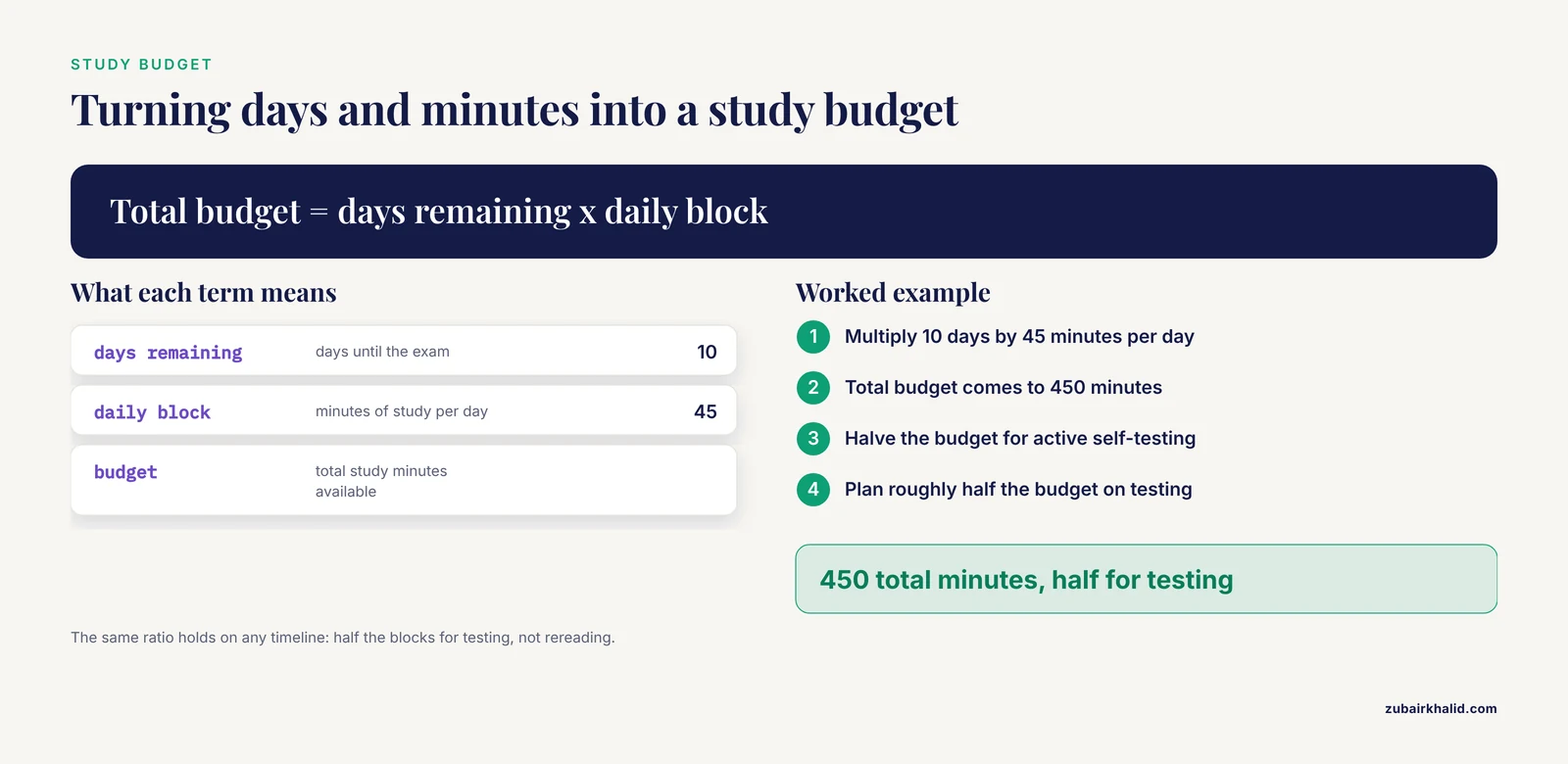
Days remaining and daily study block. These two fields drive everything else. Multiply them to get your total study budget. If the exam is in 10 days and you can study 45 minutes a day, your budget is 450 minutes. Plan on spending roughly half of that budget on active self-testing from the question bank, not on rereading.
Learning objectives. Most biology syllabi list objectives written with action verbs such as "describe," "compare," "predict," or "calculate." Each objective becomes a line in your template. If your syllabus has no objectives, write one yourself for each major heading in the assigned chapters.
Key terms. Biology is vocabulary heavy. Terms such as "mitosis," "cytokinesis," "sister chromatid," and "centrosome" appear in nearly every intro cell division unit. Write each definition in your own words before checking the textbook. The definition column stays blank until you have attempted the answer from memory.
Processes to draw. Biology exams routinely ask you to reproduce a process. For each one, note the inputs, the outputs, and the location. Mitosis, for example, starts with one diploid cell, produces two genetically identical diploid daughter cells, and happens in somatic cells.
Old questions. This field connects directly to the published method. In the study, pre-prepared multiple-choice questions from unit examinations served as the starting material for the study guides [1]. Your old quizzes and unit exams are the highest-value material you own, because they show the instructor's phrasing and level of detail.
Weak spot list. Every wrong practice answer generates a weak spot entry. A weak spot is not "chapter 4" but something specific, such as "cannot predict the chromosome number at the end of meiosis I versus meiosis II."
Building Your Template in Five Steps
Follow these steps in order. Each step shows the input you type and the output you should see.
Step 1. Create the file and header
Open a plain text editor or word processor and paste the template block above. Fill the header with your course details.
Input example:
Course and section: BIO-101, Section 03
Instructor: Dr. Alvarez
Unit or exam name: Unit 3, Cell Division
Exam date: March 14
Days remaining: 10
Daily study block (minutes): 45
Expected result: a header that tells you, at a glance, that you have 450 total study minutes (10 days times 45 minutes).
Step 2. Extract the learning objectives
Copy the objectives from the syllabus or the chapter opening page into section 1. Paraphrase each one so you can read it as a question.
Input example:
1. LEARNING OBJECTIVES
   - Compare mitosis and meiosis in terms of starting cell, ending cells, and chromosome number.
   - Name the [phases of mitosis](/blog/guides/phases-of-mitosis) in order and state one key event per phase.
   - Predict chromosome number in daughter cells after mitosis or after meiosis I and II.
Expected result: three to eight objectives. If you end up with more than ten, you are copying chapter headings instead of objectives. Split the unit across two template pages.
Step 3. Build the key terms table
List every bolded term from the assigned pages, then attempt each definition from memory before checking the book.
Input example:
2. KEY TERMS
   | Term              | Definition in my own words                          | Page |
   | diploid (2n)      | two full sets of chromosomes, one from each parent   | 214  |
   | haploid (n)       | one set of chromosomes, as in gametes                | 214  |
   | sister chromatids | two identical copies of one replicated chromosome    | 216  |
   | crossing over     | exchange of segments between homologous chromosomes  | 224  |
Expected result: 15 to 30 terms for a typical intro unit. Anything above 40 usually means you listed phrases from the glossary that will never be tested directly.
Step 4. Mine your old questions
Collect every multiple-choice question you have already answered in this unit. Write down the topic each question tested. Then, following the published method, use these questions as the basis for a study guide that lists the key terms and concepts each question targets [1].
Input example:
4. OLD QUESTIONS TO MINE
   - Source: Quiz 1 (10 MCQs), Quiz 2 (10 MCQs), homework set 3 (8 MCQs)
   - Topics covered: phases of mitosis (7 questions), chromosome number (6),
     [meiosis stages](/blog/guides/meiosis-stages) (8), crossing over (3), errors in cell division (4)
Expected output: a ranked topic list. Whatever holds the most questions is what the instructor emphasizes.
Step 5. Write the question bank in multiple formats
Now expand your mined questions into a multi-format bank. The published method specifically transformed MCQ-based study guides into questionnaires with diverse formats to reinforce understanding, promote active learning, and enhance student engagement [1]. Your four working formats are multiple choice, short answer, diagram labeling, and data interpretation.
Input example:
5. PRACTICE QUESTION BANK
   - MCQ: During which phase of mitosis do sister chromatids separate?
     A) Prophase  B) Metaphase  C) Anaphase  D) Telophase
     Answer: C. B fails because alignment, not separation, happens at metaphase.
   - Short answer: Explain why meiosis I is called reductional division.
   - Diagram labeling: Draw a cell in anaphase II and label the poles, spindle,
     and a chromatid.
   - Data interpretation: A cell has 2n = 12. Give the chromosome number in
     each daughter cell after mitosis and after meiosis.
Expected output: at least 20 questions across the four formats, with answers written down where a future you can check them without opening the textbook.
Worked Example: A Complete Filled Template
Here is the biology exam prep template example, filled in for a cell division unit. Use it as a model for length and specificity.
BIOLOGY EXAM PREP TEMPLATE
=========================
Course and section: BIO-101, Section 03
Instructor: Dr. Alvarez
Unit or exam name: Unit 3, Cell Division
Exam date: March 14
Days remaining: 10
Daily study block (minutes): 45

1. LEARNING OBJECTIVES
   - Compare mitosis and meiosis (start, products, chromosome number).
   - Name mitosis phases in order, one key event each.
   - Predict chromosome number after mitosis, meiosis I, meiosis II.
   - Explain how crossing over increases genetic variation.

2. KEY TERMS
   | Term              | Definition in my own words                     | Page |
   | diploid (2n)      | two chromosome sets, one per parent            | 214  |
   | haploid (n)       | one chromosome set, found in gametes           | 214  |
   | sister chromatids | identical copies joined at the centromere      | 216  |
   | homologous pair   | one maternal, one paternal chromosome, same    | 215  |
   |                   | genes, possibly different alleles              |      |
   | crossing over     | segment exchange between homologs in prophase I| 224  |

3. PROCESSES AND STRUCTURES TO DRAW
   - Mitosis: 1 diploid cell in, 2 identical diploid cells out, somatic cells.
   - Meiosis: 1 diploid cell in, 4 genetically unique haploid cells out.
   - Spindle apparatus: poles, spindle fibers, kinetochores.

4. OLD QUESTIONS TO MINE
   - Source: Quiz 1 (10 MCQs), Quiz 2 (10 MCQs), homework 3 (8 MCQs)
   - Top topics: meiosis stages (8), mitosis phases (7), chromosome number (6)

5. PRACTICE QUESTION BANK
   - 12 MCQs, 5 short answer, 3 diagram labels, 2 data problems (see Step 5).

6. WEAK SPOT LIST
   - Weak spot 1: chromosome number after meiosis I (n, still replicated)
     Fix: draw meiosis I twice from memory on March 8 and March 10.
   - Weak spot 2: distinguishing metaphase I from metaphase II
     Fix: label both from memory, check against figure on page 222.

7. REVIEW LOG
   | Date  | Minutes | What I tested            | Result     |
   | Mar 5 | 45      | key terms, all 20        | 17 / 20    |
   | Mar 6 | 45      | MCQ bank, all 12         | 9 / 12     |
   | Mar 7 | 45      | diagram draws, all 3     | 2 / 3      |
   | Mar 8 | 45      | weak spot 1 and 2 drills | 4 / 5      |
The math in this example is simple but worth doing deliberately. A 450-minute budget split into 10 blocks of 45 minutes gives you room for one full pass through the question bank, two weak-spot drill sessions, and two full practice reviews in the final three days.
Question Formats and When to Use Each
The multi-format approach is the core of the published method, because diverse practice formats reinforce understanding and increase engagement compared with one format alone [1]. Use this table to decide what to write for each objective.
| Format | What it tests | Best for objectives that say | Example prompt |
|---|---|---|---|
| Multiple choice | Recognition and discrimination | define, identify, classify | "Which phase follows prometaphase?" |
| Short answer | Recall and explanation | explain, describe, why | "Why does crossing over matter for variation?" |
| Diagram labeling | Spatial and structural knowledge | identify structures, trace | "Label the spindle, poles, and kinetochores." |
| Data interpretation | Application and calculation | predict, calculate, interpret | "Given 2n = 12, what is n after meiosis I?" |
A balanced bank converts each old MCQ into at least one other format. A question that asks you to recognize anaphase becomes a diagram-drawing prompt, and a chromosome number question becomes a data problem with a numeric answer you must show your work for.
Adding an AI-Assisted Study Guide to Your Template
You can speed up Steps 4 and 5 with the exact workflow described in the teaching literature. In that method, pre-prepared multiple-choice questions from unit exams were used as the basis for AI-generated study guides that highlighted key terms and concepts, and those guides were then converted into multi-format questionnaires offering diverse practice opportunities [1]. The materials were supplemented for one section of general biology at Metropolitan Community College in Omaha, and informal student feedback was positive [1].
Here is a walkthrough you can run with any AI assistant.
Step 1. Paste your mined questions into the prompt
Use only questions you have already answered in the course, exactly as the published method does [1]. Include the correct answers if you know them.
Step 2. Ask for a key terms study guide
Example prompt:
Here are 12 multiple-choice questions from my biology unit exam.
Create a study guide that lists every key term and concept these
questions test, grouped by topic, with a one-line definition of
each term written at an introductory biology level.
[questions pasted here]
Expected output: a grouped list of terms, such as a mitosis group containing prophase, prometaphase, metaphase, anaphase, telophase, and spindle apparatus. Paste this directly into section 2 of your template and check each definition against your textbook.
Step 3. Ask for multi-format questions
Example prompt:
Using the same 12 questions as a basis, write

## Finishing the AI-Assisted Study Guide Workflow

The article's walkthrough picks up at the point where you ask the assistant to write new questions. Here is how to complete that step and verify the output.

### Step 3 continued. Ask for multi-format questions

Example prompt:
Using the same 12 questions as a basis, write for me:
- 6 new multiple-choice questions in the same style, each with four options, a correct answer, and one sentence explaining why each wrong option is wrong.
- 4 short-answer questions at the level of "explain" or "predict."
- 2 diagram-labeling prompts I can answer on paper.
- 2 data-interpretation problems with numeric answers.
Keep all questions within the topics covered by the originals.
Expected output: a formatted question set you can paste into section 5 of your template. The published method describes exactly this conversion, in which MCQ-based study guides become questionnaires with diverse formats that reinforce understanding and promote active learning [1].
### Step 4. Verify before you trust
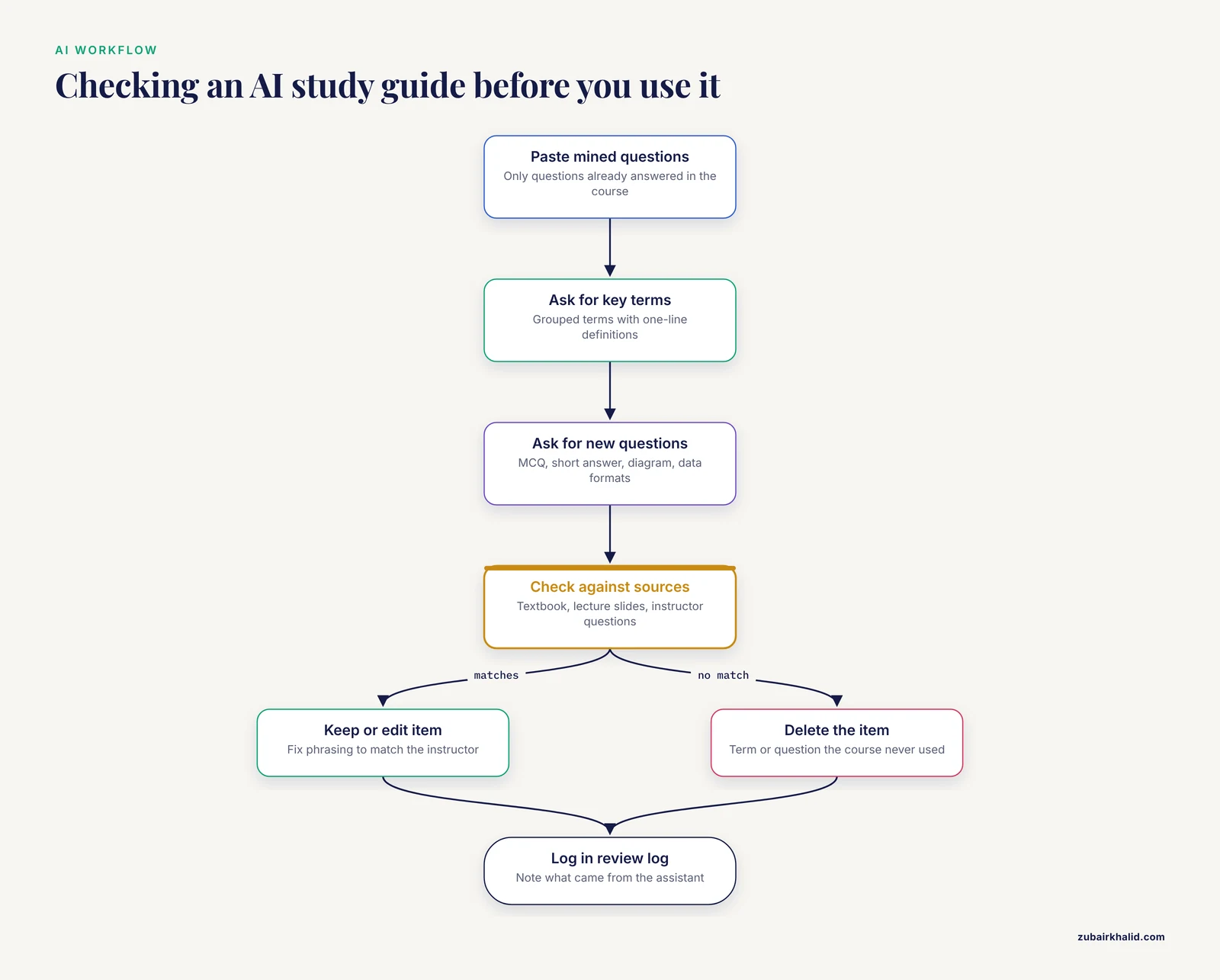
AI output is a draft, not a source of truth. Check every generated item against three things you already own: your textbook, your lecture slides, and your instructor's original questions. Verification takes the form of a simple pass:
1. Confirm each key term in the study guide actually appears in your assigned pages. Delete terms the assistant invented from general knowledge but that your instructor never used.
2. Answer each generated question yourself before looking at the provided answer. If you disagree with an answer, resolve the disagreement with the textbook, not the assistant.
3. Rewrite any question that uses phrasing your instructor would never use. The whole point of mining old questions is matching the instructor's style, and generated questions drift toward generic textbook style unless you edit them.
This verification step is not optional busywork. The published study supplemented AI-generated materials for a general biology section and reported positive informal feedback, but the materials were built from the instructor's own pre-prepared questions, which anchored them to the course [1]. Your textbook check plays the same anchoring role.
### Step 5. Log what the assistant produced
Add one line to your review log noting which sections of the template came from the AI workflow and which you wrote by hand. Two weeks later, when you know which questions actually helped, this note tells you where to spend effort next time. If hand-written data problems predicted exam questions better than generated ones, write more of those yourself next unit.
## A Ten-Day Study Schedule Built From the Template
The header fields give you a total budget, but a budget without a schedule is a wish. Here is how to convert the worked example, 450 total minutes across 10 days, into a day-by-day plan. The schedule assumes one principle supported by the teaching literature behind the template: active self-testing from a question bank does more for exam preparedness than passive review [1].
| Day | Block focus | Template section used | Output at end of block |
|-|-|-|-|
| 1 | Set up: objectives and key terms, first memory pass | Sections 1, 2 | Terms table filled from memory, gaps marked |
| 2 | Textbook check of terms, start question mining | Sections 2, 4 | Corrected terms, topic ranking of old questions |
| 3 | Write question bank, formats one and two | Section 5 | Six or more MCQs and short-answer items |
| 4 | Write question bank, formats three and four | Section 5 | Diagram prompts and data problems written |
| 5 | First full self-test | Section 7 log | Score recorded, weak spot list started |
| 6 | Weak spot drills only | Section 6 | Each weak spot retested once |
| 7 | Second full self-test, all formats | Section 7 log | Score recorded, compare with day 5 |
| 8 | Drawing day: every process redrawn from memory | Section 3 | All drawings checked against figures |
| 9 | Final weak spot drills and timed question run | Sections 5, 6 | One timed pass through the bank |
| 10 | Light review of log only, early night | Section 7 | No new material introduced |
Three rules make this schedule work. First, never spend a block rereading unless the review log shows a term-level failure, because the log is the only honest record of what you actually know. Second, front-load question writing, since a bank you finish on day 9 is useless for practice. Third, keep day 10 light. Cramming new material the night before displaces consolidated knowledge and does not generate a single new log entry.
If your exam falls on a different timeline, keep the ratios rather than the dates: roughly half the blocks for writing and first passes, a quarter for weak-spot drills, a quarter for full reviews.
## Adapting the Template Across Biology Course Types
The template format stays constant, but the fields fill differently depending on the kind of biology you are studying. The structure is deliberately portable, and the published method was designed to scale across courses and instructors, including settings where adjunct faculty teach large sections [1]. Here is how to adapt it.
### Anatomy and physiology
The key terms table becomes an anatomical structure table, and the processes section dominates. For each physiological process, record four things in the processes field: the structures involved, the sequence of events, the regulatory signals, and what happens when the process fails. Data interpretation questions become case-style prompts, such as predicting what a hormone imbalance does to a measured variable. Old questions from an A&P course are especially valuable because instructors tend to reuse clinical framing.
### Genetics
Add a fifth question format: pedigree and cross problems. Each objective such as "predict offspring ratios" becomes a worked problem you must solve on paper, not just recognize. The weak spot list in a genetics course often contains calculation errors, so the fix column should name the exact step you get wrong, such as "forget to account for linkage when estimating recombination frequency."
### Ecology and evolution
Diagram labeling expands to include graphs, food webs, and phylogenetic trees. Data interpretation becomes the dominant format, because ecology exams center on interpreting population curves, diversity indices, and tree topology. When mining old questions, group them by the kind of figure they referenced, since figure style predicts exam figure style better than topic alone.
### Microbiology and molecular biology
The processes section should list every pathway with inputs, outputs, location, and energetic accounting. Data interpretation questions should include reading gel diagrams, growth curves, and plate results. Key terms are dense in these courses, so enforce the 15 to 30 term guideline from the original walkthrough and merge near-synonyms.
## Template Format Compared: Spreadsheet, Document, Notebook, and Flashcard Apps
You can store a biology exam prep template in several formats, and the right choice depends on how you study. Since the template is free and only requires fields you copy once, there is no reason to pay for anything; the comparison below is purely about mechanics.
| Storage format | Strengths | Weaknesses | Best when |
|-|-|-|-|
| Plain text or word processor | Fastest to set up, prints cleanly, tables render anywhere | No automatic sorting or scoring | You study from one place and want zero setup friction |
| Spreadsheet | Review log sums minutes and scores automatically; weak spots can be filtered by status | Tables for terms and questions feel cramped | You like tracking numbers and want the log to do math for you |
| Paper notebook | Drawing processes is fastest on paper; no screen distraction | Not searchable, hard to reorder, question banks get messy | Your course is diagram-heavy, such as anatomy or [cell biology](/blog/careers/cell-biology) |
| Flashcard app | Good for the key terms table only | Poor fit for diagram prompts, data problems, and multi-format questions | You want a mobile supplement for terms between blocks |
The most common workable combination is a document for the main template plus paper for the diagram-drawing section, with the review log kept wherever you will actually update it. A flashcard app is a legitimate supplement, but do not mistake a term deck for the full template. The multi-format practice, the weak spot list, and the old-question mining exist only in the template, and those are the parts the published method credits for improving study efficiency and exam preparedness [1].
One practical rule applies to all formats: keep the template in a single file per exam, named with the course code and exam date, so that before the next exam you can copy the previous file and reuse everything that transferred well.
## Common Misconceptions About Exam Prep Templates
**Misconception 1: The template is a summary of the chapter.** A summary organizes the textbook. A prep template organizes your retrieval practice around what the instructor asks. If your filled template looks like compressed lecture notes, you skipped the question bank, which is the load-bearing section.
**Misconception 2: More terms means better coverage.** A 40-term table you cannot recall is worth less than a 20-term table you can. Definitions written in your own words, attempted from memory before checking, are the working currency. Copying glossary definitions into the table produces familiarity, and familiarity is a poor predictor of exam performance on short-answer and data questions.
**Misconception 3: Old questions are cheating or obsolete.** Old questions are the highest-value material you own, and the published method is built directly on reusing pre-prepared MCQs from prior unit examinations as the foundation for study guides [1]. Unless your instructor prohibits distributing them, mining your own answered questions is simply studying the course as it is actually taught.
**Misconception 4: Practice questions are only for multiple-choice exams.** Recognition, explanation, drawing, and calculation map onto every exam format. Essay exams still draw on short-answer practice, and lab practicals still draw on diagram-labeling practice. The formats differ; the preparation overlaps almost entirely.
**Misconception 5: The template replaces reading.** It restructures reading. You still read assigned pages, but you read them with a purpose: checking definitions you attempted from memory, confirming process inputs and outputs, and resolving disagreements between your answers and the book. Reading without a retrieval purpose is the habit the template exists to break.
**Misconception 6: A wrong practice answer means you should reread.** A wrong answer means you should generate a specific weak spot entry and a targeted fix. Rereading the whole section is the least efficient response available. The weak spot format, one narrow topic plus one planned fix, exists precisely to prevent that reflex.
## Troubleshooting Guide: When the Template Is Not Working
Most template failures fall into a small number of patterns. Diagnose yours here.
**Problem: My practice scores are not improving between self-tests.** First, check that you are actually writing answers down before checking, not thinking them and moving on. Second, check the weak spot fixes: a fix like "review chapter 4" is too vague to execute, while "draw meiosis I twice from memory and check chromosome number at each stage" is executable. Third, check question difficulty. If your bank is entirely recognition questions, you are practicing the easiest skill and the harder formats will keep exposing you.
**Problem: I have no old questions for this course.** Substitute in this order: homework problems, end-of-chapter questions your instructor assigned, questions from lecture slides, and questions you write yourself from the learning objectives. Self-written questions are weaker than instructor questions because they miss the instructor's phrasing, but the mining-and-conversion process still works, and building the multi-format bank still delivers the active-learning benefit the method describes [1].
**Problem: The template takes longer to fill in than studying would.** This almost always means you are writing the terms table and question bank from scratch while reading. Reverse the order: attempt everything from memory first, mark gaps, then use reading only to fill the marked gaps. A template filled entirely after reading is a transcription exercise, not a prep tool.
**Problem: I run out of study blocks before finishing the plan.** Cut in this order: drop the second full self-test, then merge the two weak-spot drill sessions into one, and never cut the first full self-test or the question-writing blocks. The first self-test is what generates your weak spot list, and without it the drills have no targets.
**Problem: My weak spot list keeps growing instead of shrinking.** Your fixes are probably passive. Every fix should end in an action you can score, such as a redraw, a re-answer, or a timed set. If a weak spot survives two scored fix attempts, break it into two narrower spots. "Meiosis" is not fixable; "chromosome number after meiosis I" is.
**Problem: I did well on practice but poorly on the exam.** Compare the exam questions to your bank. If the topics matched but the phrasing did not, your mined question set was too small or too old. If the topics did not match, your learning objectives were incomplete, which usually means the syllabus objectives were thin and you should have written one per lecture heading instead of per chapter.
## Extending the Template Into a Lab Notebook Template
Biology students face a second assessment format that exam prep alone does not cover: the lab practical and the graded notebook. The same field logic that structures the exam prep template structures a good [lab notebook](/knowledge/molecular-biology/lab-notebook), and many programs ask students to submit notebooks as portable documents, which is where a lab notebook template PDF becomes useful.
A workable lab notebook template carries these fields, filled in before, during, and after each session:
LAB NOTEBOOK TEMPLATE ===================== Session number and date: Lab title and course section: Objective (one sentence, from the lab handout): Hypothesis or prediction (before data collection): Materials and setup (with a labeled sketch): Procedure notes (only deviations from the handout): Raw data (tables drawn before collection begins): Observations (anything unexpected, dated): Calculations and analysis (show every step): Interpretation (what the data mean in one paragraph): Errors and limitations (what could have skewed results): Questions for the TA or next session:
Three habits separate a graded notebook from a transcript. Draw your data tables before you collect data, because an empty table forces you to decide what you will measure. Record deviations from the written procedure the moment they happen, because reconstructed deviations are the first thing graders question. Write the interpretation before checking the expected results, then compare, because the gap between your prediction and the expected result is exactly what a practical exam tests.

To produce a portable version, type the template once in a word processor or spreadsheet, fill it per session, and export each session as its own PDF. This gives you a lab notebook template PDF you can submit, reprint, and, importantly, mine during exam prep. Lab data interpretation questions on exams are frequently modeled on the exact calculations and graphs from your own sessions, so the notebook becomes raw material for section 5 of your exam prep template, the same way old quizzes do. This closes the loop between the two templates: the research template you use in lab feeds the question bank you use before the exam.

## From Exam Prep Template to Research Template

The field structure you learned for exam prep transfers directly to research work, which matters if you are planning a career in the life sciences. A research template is the same idea applied to a project: fixed fields that force you to state what you know, what you are testing, and what evidence would change your mind.

A minimal research template for a course project or early undergraduate research looks like this:
RESEARCH TEMPLATE ================= Working question (one sentence, answerable): Why it matters (two sentences, cite what you read here): Background terms I must define first: Predicted result if my hypothesis is true: Predicted result if it is false: Data I will collect and how: Analysis plan (what calculation or test, and on what table): What existing literature says (one entry per source): Open questions after my first pass: Revision log:
Notice the shared DNA with the exam prep template. Learning objectives become the working question. Key terms become the background definitions. The question bank becomes the predicted-results pair, which forces you to commit to what would count as evidence. The review log becomes the revision log, tracking what changed and why.

Two habits transfer without modification. First, write definitions in your own words before checking sources, because paraphrase is where understanding forms. Second, record results with dates, because both templates are tools for detecting change over time: one in your knowledge, one in your project. Students who keep both templates usually find that the second feels natural, and the skill of organizing unknowns into fixed fields is one of the most portable things a biology education produces.

## Grading Yourself and Reading the Review Log

The review log is the template's feedback engine, but only if you read it diagnostically. After each self-test, ask three questions of the score.

**Which formats lost points?** If your MCQ score is strong but diagram draws are weak, your recognition is ahead of your spatial knowledge, and the next block belongs to section 3, the drawing section. If short answers are weak, you may know terms without being able to connect them, and the fix is writing explanations aloud in full sentences.

**Which topics lost points?** Cross-reference misses against the topic ranking from section 4. A miss on a heavily mined topic is urgent; a miss on a topic your instructor asked once, months ago, may be safely deprioritized.

**Are misses fast or slow?** A miss you answered slowly and wrongly is a knowledge gap. A miss you answered fast and wrongly is a confident misconception, and confident misconceptions are the highest-priority weak spots because they survive passive review. Flag them separately in the weak spot list.

Also watch the log's trend rather than single scores. A score that rises across self-tests says the system works. A flat score across three tests says your fixes are passive or your questions are too easy. A falling score late in the schedule usually means fatigue or that you added new material too late, and the correct response is to trim the plan, not push through.

Finally, use the log minutes column honestly. Rounded-up estimates defeat the purpose. The whole method exists because structured prep beats unstructured prep, and an honest log is the only instrument that can show you whether yours is actually structured [1].

## Study Group Version of the Template

The published study emphasizes that the underlying strategy scales, and one of its stated benefits is supporting learning in settings with many students and limited instructor time [1]. A study group can capture that scaling directly by sharing one template.

The workable arrangement is a division of labor with shared verification. Each member owns one question format and writes the bank items for it, which prevents duplicate effort and forces each member to learn one question style deeply. Everyone fills their own terms table and weak spot list individually, because those reflect private gaps. The group then meets for a single block per week with three agenda items: swap and answer each other's bank items, debate any question where two members disagree about the answer, and merge disputed items into a shared "contested questions" list to resolve against the textbook.

The disputed list is the most valuable output of a group version. A question that two students answer differently reveals either a genuine ambiguity in the material or a misconception in one of them, and resolving it against the textbook produces stronger learning than either student would get alone. Keep the shared file read-only except for the designated owner of each section, because templates edited by five people simultaneously become unusable within two weeks.

For groups in large sections taught by different instructors, compare topic rankings from section 4 across groups. Convergent rankings across sections signal genuinely central material, which is precisely the kind of signal that makes a scalable, shared prep method worth the coordination cost [1].

## Test-Day Checklist and Final Review

On the last day before the exam, run this checklist against your template rather than rereading anything new.

1. Every learning objective in section 1 has at least one practice question in section 5. Any objective without a question is untested coverage, and untested coverage is where surprises live.
2. Every weak spot in section 6 shows a scored fix in the log. An unfixed weak spot on the eve of an exam should be triaged: either drill it once now or consciously accept it, but do not leave it ambiguous.
3. Every process in section 3 has been drawn from memory at least once. Drawing from memory, checked against the figure, is the rehearsal that matches the exam task.
4. Your review log shows an upward or stable trend across self-tests. A flat or falling trend on day 9 is a signal to sleep and review the log only.
5. Your mined topic ranking and the exam's stated scope agree. If the instructor announced excluded topics, cross them off section 4 now to protect your final hours.

Pack in advance whatever your course allows, and plan your arrival time so the first question on the paper meets you rested rather than rushed. During the exam, the template's habits still apply: answer the recognition questions fast, budget real time for diagram and data questions, and when a question stalls you, write what you know in outline form, because partial short-answer credit is earned by structured recall, the exact skill the template trained.

## Quick-Start Checklist

If you are setting up your first template tonight, this is the minimum viable version.

1. Copy the template block into any text editor and fill the header with a real exam date.
2. Multiply days remaining by your daily block to get your budget, then halve it to see how much time you have for active testing.
3. Write three to eight learning objectives, paraphrased as questions.
4. List 15 to 30 key terms and attempt every definition from memory before opening the book.
5. Collect every old MCQ you have and rank the topics by question count.
6. Write at least one question in each of the four formats per objective, answers included.
7. Run one full self-test, record the score, and start the weak spot list from whatever you missed.
8. Schedule your remaining blocks so that roughly half go to drills and reviews, and keep the log updated every single block.

That is the complete system: fixed fields, mined questions, multi-format practice, and an honest log. Everything else in this article is elaboration on those eight moves.

## Sources

1. [Turning "what is on the exam" panic into prep: AI-generated study guide and multi-format questions in biology.](https://pubmed.ncbi.nlm.nih.gov/42429683/)