Best Flashcard App for Biology Vocabulary: Anki vs Quizlet
By Dr. Zubair Khalid, DVM, MS, PhD ·

Anki uses a spaced repetition algorithm that schedules each card for review right before you would forget it, while Quizlet gives you a simple, fast card-making tool with a menu of study games and quiz modes. The rule of thumb is simple. If you are memorizing hundreds of terms that must survive an entire semester or feed into an exam like the MCAT, choose Anki. If you need to learn vocabulary for a quiz next week and want something you can start using in five minutes, choose Quizlet. Brainscape sits between the two, rating your confidence on each card to set the review schedule.
Biology is one of the most vocabulary-heavy sciences taught at any level. A single introductory cell biology unit introduces terms like endosymbiosis, plasmolysis, chemiosmosis, and cytoskeleton. Anatomy and physiology courses can run past a thousand terms per semester. Genetics adds genotype, phenotype, pleiotropy, epistasis, and dozens of others. That vocabulary load is exactly the kind of problem flashcards solve well, because retrieval practice, the act of pulling an answer out of memory rather than rereading it, is one of the most consistently supported techniques in cognitive psychology, and spacing reviews over days multiplies the benefit. This article compares the three apps most students actually choose between, Anki, Quizlet, and Brainscape, explains the strengths and weaknesses of each, and shows how flashcards fit into the wider set of biology study methods.
Why Biology Vocabulary Needs a Memory System, Not Just a List
Biology vocabulary has three properties that make it hard to learn by rereading a glossary.
First, the terms are dense. A term like "semiconservative replication" packs a whole mechanism into three words, and you are expected to know the mechanism, not just the label. Second, many terms look or sound alike. Mitosis and meiosis, glycogen and glucagon, artery and arteriole, codon and anticodon. Rereading a list of confusable pairs feels productive while doing almost nothing, because recognition of the page is not the same as recall of the term. Third, the vocabulary is cumulative across weeks and courses. The root words and prefixes you learn in week one, like hydro-, -lysis, and cardio-, keep paying off in every later chapter.
Research on learning has repeatedly found two effects that matter here. The testing effect shows that actively retrieving an answer produces stronger, longer-lasting memory than rereading the same material. The spacing effect shows that reviews spread across days produce better retention than reviews massed into one session. Spaced repetition software, often abbreviated SRS, automates the scheduling side. The app tracks how well you knew each card, predicts when you are about to forget it, and shows it to you at that moment. This is why a serious answer to "how to study biology" for vocabulary almost always includes an SRS-backed flashcard workflow alongside lectures, diagrams, and practice problems.
The catch is that different apps implement these ideas very differently, and the difference between them changes how much biology you actually retain at exam time.
Choosing the Best Flashcard App for Biology Vocabulary: The Criteria That Decide It
The best flashcard app for biology vocabulary is the one that matches your timeline and workload, not the one with the most features. Four criteria separate the real contenders.
- Scheduling quality. Does the app decide when you see each card again, and how well does it decide?
- Card creation cost. Biology cards often include definitions, structures, and images. How long does it take to build a good deck, and can you use someone else's?
- Study modes. Do you need games and practice tests for a Friday quiz, or single-file long-term review for a cumulative final?
- Sustainability. Will you still be using this app in week twelve, when the deck has eight hundred cards in it?
Keep those four in mind for everything that follows.
Side-by-Side Comparison Table
| Feature | Anki | Quizlet | Brainscape |
|---|---|---|---|
| Core method | Algorithmic spaced repetition, card by card | Study modes and games, largely self-scheduled | Confidence-rated spaced repetition |
| Scheduling algorithm | Fully automatic, based on your Ease/Hard/Good/Again rating per card | Traditional mode is manual, the Learn mode adds limited automated review | Automatic, based on your 1 to 5 confidence rating per card |
| Card creation | Rich editor, supports images, audio, cloze deletions, HTML, LaTeX for formulas | Fast and simple, easy image upload, simple two-sided cards | Simple two-sided cards with structured attributes |
| Shared content | Enormous library of free shared decks, including pre-made anatomy and MCAT decks | Large public library of user decks, variable quality | Smaller library of user and publisher decks |
| Web, desktop, mobile | Windows, Mac, Linux, Android, web, iOS | Web, iOS, Android | Web, iOS, Android |
| Cost structure | Free on desktop, web, and Android, paid iOS app | Free tier with limits, paid subscription for advanced features | Free tier with limits, paid subscription for full features |
| Best for | Long-term cumulative memorization, large decks, exam prep spanning months | Quick quizzes, collaborative class decks, short timelines | Learners who want structure without Anki's complexity |
| Weakest point | Steep learning curve, plain interface | Weak long-term scheduling, some key features behind subscription | Smaller community, fewer shared decks |
Anki, Explained on Its Own Terms
Anki is a free, open-source spaced repetition program available for Windows, Mac, Linux, and Android, with a web version and a paid iOS app. The name comes from the Japanese word for memorization. Its entire design assumes one thing: you will be reviewing the same cards for months.
How Anki scheduling works
When you review a card in Anki, you grade your own recall. The standard buttons are Again (you did not know it), Hard, Good, and Easy. The algorithm then schedules the card's next appearance. A card you rated Good today might reappear in three days, then in a week, then in three weeks, stretching out each time you recall it successfully. A card you rated Again returns within minutes and resets part of its schedule. Newer versions of Anki support the FSRS algorithm, a modern scheduler that can tune intervals to your actual performance. The result is a deck where each card costs you only seconds and the total daily workload stays manageable even when the deck holds thousands of terms.
Why Anki suits biology specifically
Three Anki features map directly onto biology vocabulary.
Pre-made decks. Because Anki decks are files that users share freely, there is a huge library of community decks for anatomy, histology, pharmacology, the MCAT, and introductory biology. A student starting an anatomy course can download a deck tagged by body system and add or delete cards to match their syllabus. This can save dozens of hours of card-writing, which is the single biggest cost of a serious flashcard habit.
Image support. Biology vocabulary is often spatial. Terms like hilum, foramen, or the parts of a mitochondrion are much easier to learn on a labeled image. Anki handles image occlusion, where you hide labels on a diagram and reveal them one at a time, either natively in recent versions or through well-known community add-ons.
Cloze deletion. A cloze card turns a sentence into a fill-in-the-blank question. Instead of a flat card asking "What is osmosis?", you can write "Osmosis is the diffusion of water across a [...] membrane" and Anki generates a card testing "selectively permeable." This lets one sentence become several focused cards, which fits the way biology definitions work.
The honest downsides of Anki
The interface is plain and the settings are technical. Deck options include phrases like "new cards per day," "retention," and "learning steps," and many students give up during the first hour of configuration. The mobile app on iPhone costs a one-time fee. Most importantly, Anki's power only pays off if you review every day. Skipping a week with a large deck produces a backlog that discourages many new users. Anki rewards a small daily commitment and punishes binge studying.
Quizlet, Explained on Its Own Terms
Quizlet is a web and mobile study platform built around speed and variety. You type a term and a definition, or import a two-column list from a spreadsheet, and you have a working deck in minutes. Where Anki is a single, focused review engine, Quizlet is a suite of study modes built on top of the same card set.
What Quizlet does well
Multiple study modes. From one deck you can flip through traditional flashcards, run a Learn mode that adapts and repeats cards you missed, take an auto-generated multiple-choice practice test, or play Match, a timed game where you drag terms onto their definitions. For vocabulary you need by Friday, this variety keeps study sessions fresh and targets different angles on the same terms.
Near-zero setup time. There is no algorithm to configure and no settings tree to learn. A student can hear a term in lecture at 2 p.m. and have a studyable deck by 2:05.
Class and collaboration features. Teachers and study groups can share sets easily, and searching an existing public set for your textbook chapter ("Campbell Biology chapter 6") often finds a deck someone already made.
The honest downsides of Quizlet
Scheduling is the weak point. Traditional Quizlet study is manual: you decide what to review and when, which means most students end up restudying cards they already know and under-reviewing cards they are quietly forgetting. The Learn mode introduces automated re-testing, but it is not a true spaced repetition engine in the Anki sense, and its behavior has changed over the years as Quizlet adjusted its product. Several useful features, including advanced study modes and expanded set limits, sit behind a paid subscription. Long-form biology definitions also strain Quizlet's simple two-sided card format, and the public deck library is littered with sets containing typos and wrong definitions, because anyone can publish anything.
For a student deciding between the best flashcard app for biology vocabulary options, the pattern is clear. Quizlet wins the short race and loses the long one.
Brainscape, Explained on Its Own Terms
Brainscape is a web and mobile flashcard platform whose distinguishing feature is confidence-based repetition. After seeing a card, you rate your confidence from 1 (no idea) to 5 (certain). The app shows low-confidence cards more often and high-confidence cards less often, so the review schedule reflects your self-assessed mastery rather than a graded interval.
This design has two practical consequences. It is easier to understand than Anki, because "how confident am I?" is an intuitive question, and it produces a middle ground between Anki's strict scheduling and Quizlet's manual review. Brainscape also offers curated, publisher-quality decks for subjects like anatomy and physiology, some free and some paid, alongside user-created content.
The trade-offs mirror the design. The free tier limits how many cards you can study and how many features you can use, so a student with a full semester of vocabulary often ends up needing a subscription. The shared-deck community is much smaller than Anki's, so pre-made coverage for a niche course topic may simply not exist. For learners who want algorithmic scheduling but bounce off Anki's interface, Brainscape is a reasonable landing spot.
Head-to-Head: Anki vs. Quizlet vs. Brainscape on the Criteria That Matter
Long-term retention
Anki is the strongest by a wide margin. Its card-by-card intervals are the point of the software, and a deck maintained through a semester behaves like a cumulative memory of the course. Brainscape's confidence ratings produce genuine spacing but with coarser control. Quizlet's default modes do not space review in a rigorous way, which is fine for a weekly quiz and costly for a cumulative final.
Setup effort versus payoff
Quizlet asks for the least effort. Anki asks the most. Brainscape sits in between. A fair way to think about it: Quizlet has a low floor and a low ceiling, Anki has a high floor and a high ceiling, and Brainscape trades some ceiling for a friendlier floor.
Pre-made content
For biology, Anki's shared-deck ecosystem is unmatched, particularly for anatomy and medical admissions exam prep. Quizlet's library is larger in raw volume but less reliable in quality, since there is no curation and no way to know whether a deck's definitions match your instructor's usage. Brainscape's curated decks are more consistent but cover fewer topics.
Exam format
If your biology course tests with written definitions, labeling diagrams, and cumulative finals, Anki's format matches. If your course tests with frequent short quizzes, matching questions, and multiple-choice items, Quizlet's test and Match modes align well with what you will see. Brainscape's drills resemble Quizlet's Learn mode more than either extreme.
Cost and platforms
Anki is free on desktop, web, and Android, with a paid one-time iOS app. Quizlet and Brainscape both use free tiers with paid subscriptions unlocking the fuller feature set. If cost is the deciding factor, Anki's desktop and Android versions cost nothing for unlimited cards.
Worked Scenarios: Which App for Which Student
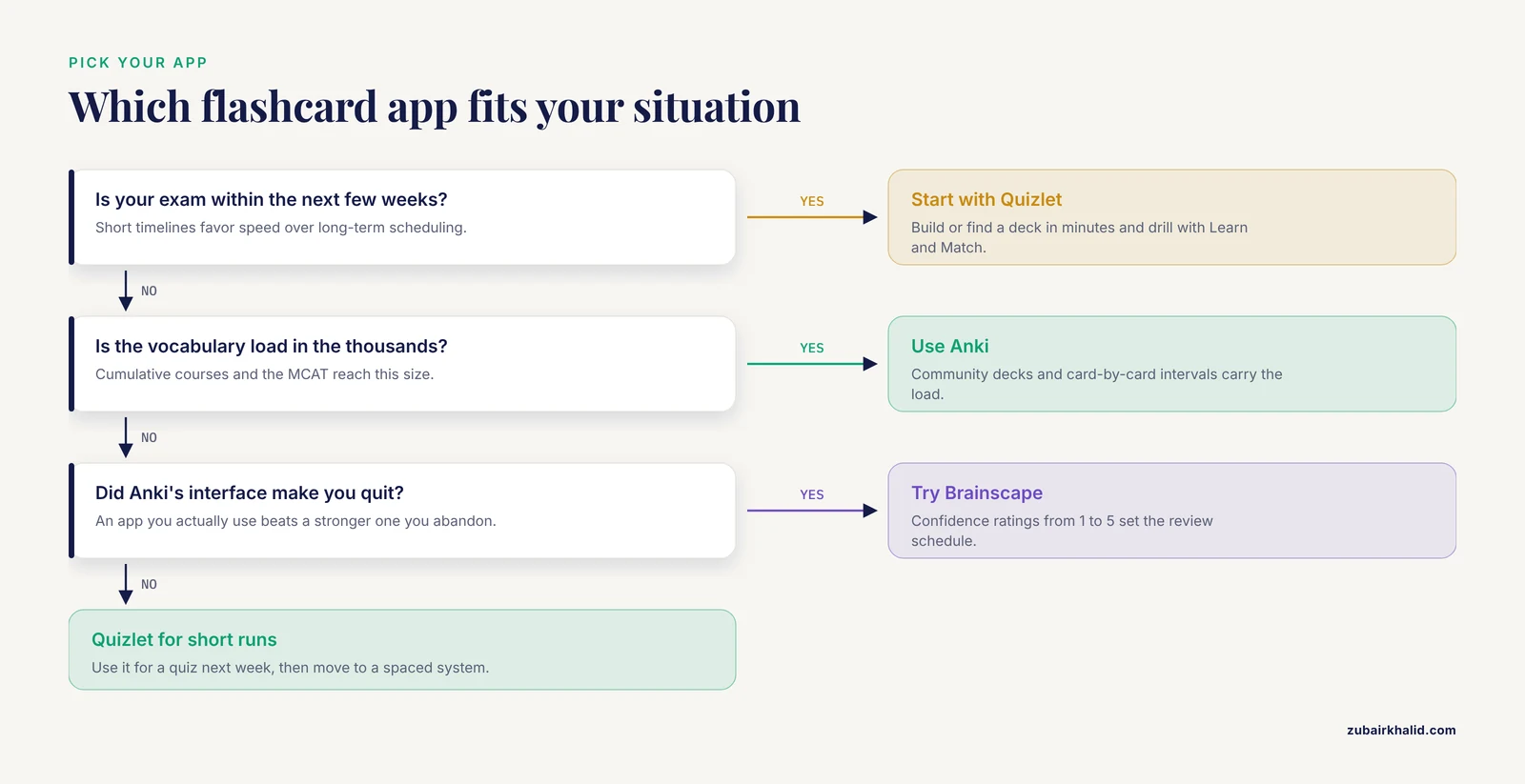
Scenario 1: First-year undergraduate, Introductory Biology, midterm in three weeks. Quizlet is the better tool here. The vocabulary list is manageable, the exam is close, and you benefit more from Quizlet's Learn mode and practice tests than from building an Anki configuration. Search for a public deck for your textbook chapter, verify a sample of definitions against your lecture notes, and drill.
Scenario 2: Pre-med student, two semesters of anatomy and physiology, plus the MCAT ahead. Anki is the better tool. The vocabulary count is in the thousands, the exams are cumulative, and community decks already exist for the exact systems you are studying. Commit to a fixed daily review slot of 20 to 30 minutes, add new cards in modest batches, and the deck will carry the material to the MCAT without a second full relearning effort.
Scenario 3: Student who tried Anki, hated the interface, and quit. Brainscape. You lose some scheduling precision and pay a subscription for a full load, but an app you actually use beats a more powerful app you abandon. The confidence-rating loop is easy to sustain.
Scenario 4: Study group of four students splitting card-writing duties. Quizlet, for its easy sharing and collaboration, or a shared Anki deck if at least one member is comfortable distributing deck files. The group should agree on a definition source (lecture notes or the textbook glossary) so all four decks use consistent wording.
How to Write Biology Flashcards That Actually Work
The app matters less than the cards. Poorly written cards on a perfect algorithm still fail. These practices come from standard guidance on effective card-making and the known properties of memory.
- One fact per card. "What are the three components of the cytoskeleton?" is a weak card. Three separate cards, one per component with its function, are strong. Small cards are easier to schedule and easier to fail honestly.
- Write prompts, not pairings. A card should force retrieval. "Osmosis: define" is fine. A card that lets you recognize the answer from context is not.
- Test both directions for confusable terms. Make "What is mitosis?" and also "Cell division producing two genetically identical diploid daughter cells: what is the term?" Direction-reversed cards matter enormously for pairs like codon and anticodon.
- Add images for anything spatial. A card for "hilum of the kidney" without an image teaches a word but not a location.
- Include a memory hook in the definition field. "Endocytosis, the cell takes material IN" costs two words and prevents a common mix-up with exocytosis.
- Delete or suspend bad cards. If a card repeatedly fails, the card is the problem, not you. Rewrite it smaller or drop it.
Where Flashcards Fit Among Biology Study Methods
Flashcards are one tool inside a complete answer to how to study biology, and they are a poor stand-in for the others.
Vocabulary cards get terms into memory. They do not teach processes. For processes, biology study methods should include drawing and labeling pathways by hand, such as sketching the electron transport chain from memory, explaining mechanisms aloud in your own words, and working practice problems. A student who can define every term in the genetics chapter but cannot predict the offspring ratios in a dihybrid cross has confused vocabulary knowledge with understanding.
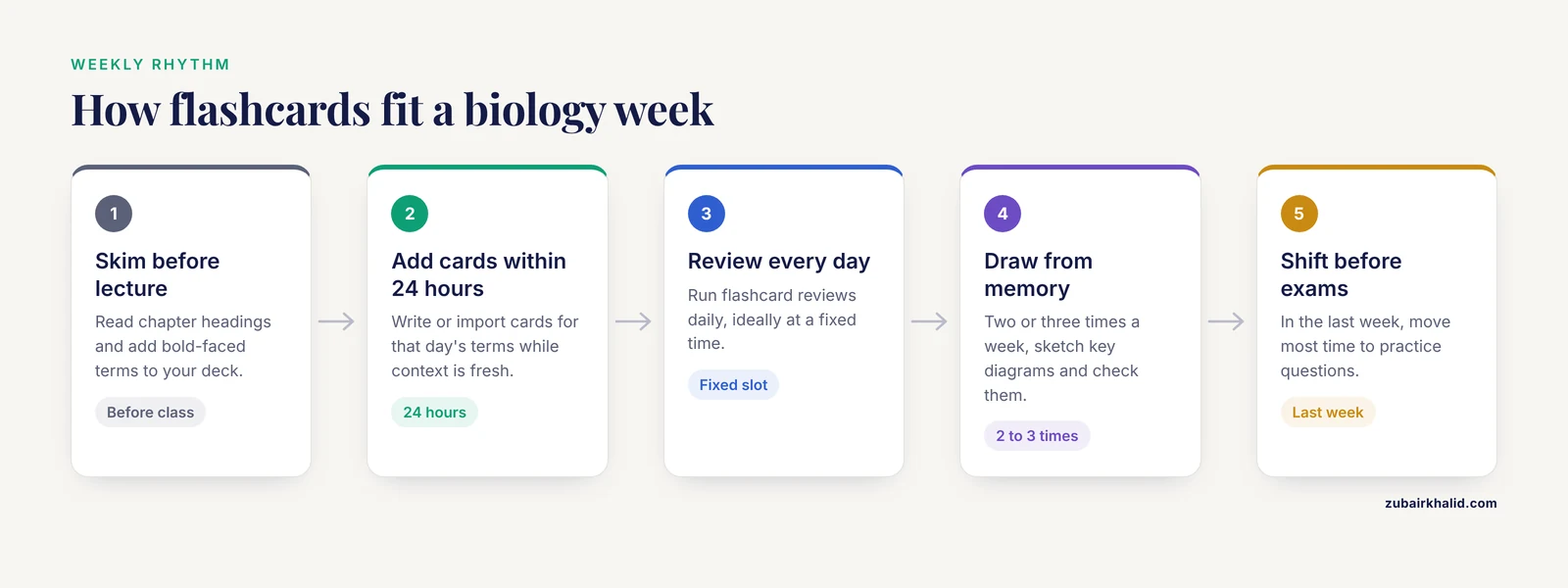
A practical weekly rhythm for a biology course looks like this. Before lecture, skim the chapter headings and add any bold-faced terms to your deck. Within 24 hours of lecture, write or import cards for that day's new terms, while the context is fresh. Run your flashcard reviews daily, ideally at a fixed time. Two or three times per week, close the book and draw the key diagrams or pathways from memory, checking against the source afterward. In the last week before an exam, shift most time to practice questions and use flashcards for the terms still rating poorly. This structure pairs retrieval practice with the elaboration and problem-solving that biology genuinely requires.
Common Mistakes and Limitations
These are the errors that most often sink a flashcard-based study plan.
- Making cards for everything. A student who converts every sentence of the textbook into cards builds a deck they will dread. Prioritize bold-faced terms, definitions the instructor emphasized, and items from past quizzes.
- Downloading a shared deck and never checking it. Community decks can contain errors or use different terminology than your course. Verify definitions against your own syllabus and delete cards your course does not cover.
- Reviewing in one weekly binge. Spaced repetition works because of the spacing. A two-hour Sunday session does not replace ten-minute daily reviews, and it produces the classic crash-and-cram retention curve.
- Confusing recognition with recall. Flipping through a deck thinking "yes, I know that" is not the same as producing the answer. Answer aloud or in writing before revealing each card.
- Skipping cards that feel hard. Rating a difficult card Easy to clear it from today's queue defeats the entire scheduling system. Grade honestly, even when it hurts.
- Using flashcards as the only method. Cards build vocabulary. Understanding comes from drawing, explaining, and problem-solving. A limitations note applies to all study apps: individual retention rates vary, and students with specific learning differences or memory concerns should consult their campus academic support office for individualized strategies.
Frequently Asked Questions
Is Anki or Quizlet better for memorizing biology vocabulary?
Anki is better for large vocabulary loads that must last a full semester or longer, because its spaced repetition algorithm schedules each card near the point of forgetting. Quizlet is better for short-term quizzes and for students who value speed and variety of study modes over long-term retention.
Is Anki really free?
Yes, on the web, on Windows, Mac, Linux, and Android. The iPhone and iPad app is a paid one-time purchase, but you can use the free web version on any device including an iPhone.
Does Quizlet have spaced repetition?
Only in a limited sense. Quizlet's Learn mode retests missed cards automatically, but it does not apply a true card-by-card spaced repetition schedule the way Anki and Brainscape do, so it is weaker for cumulative long-term review.
Are pre-made decks a good idea for biology courses?
Yes, with verification. Pre-made anatomy and exam-prep decks can save many hours, but you should check definitions against your own lecture notes and delete any cards covering material your course skips.
How many new flashcards should I add per day?
Enough to cover your course material without flooding tomorrow's reviews. For a typical undergraduate course, adding roughly 10 to 30 new terms per day keeps daily review time sustainable, and you should reduce the number when your review queue grows.
Can flashcards replace other biology study methods?
No. Flashcards build vocabulary and definitions efficiently, but understanding processes and applying them to problems requires drawing pathways, explaining mechanisms in your own words, and working practice questions.