Aligning Institutional Policies Across Partner Sites: A Framework
By Dr. Zubair Khalid, DVM, MS, PhD ·

Multi-site research lives or dies on its rules as much as on its science. The one-sentence difference at the heart of policy alignment is this. Full harmonization replaces each partner site's local rules with one shared policy set, while a policy crosswalk keeps local rules in place and documents where each one matches a common standard. The rule of thumb follows directly. Harmonize when the partnership must pool data, run a single protocol, or answer to a regulator as one group. Use a crosswalk when each site keeps its own deliverables and you mainly need evidence that different local rules reach the same standard. Most long-running partnerships land on a tiered hybrid, a small harmonized core covering ethics, data protection, and research integrity, plus a crosswalk for everything else.
This article turns that choice into a working framework for aligning institutional policies across partner sites in multi-site research. It defines the terms, walks through five phases from stakeholder mapping to ongoing monitoring, compares three alignment options side by side, works through three realistic scenarios, and closes with the mistakes that most often derail alignment efforts.
What Policy Alignment Means in Multi-Site Research
Multi-site research is any study or program carried out at two or more institutions, each with its own administration, review boards, and financial systems. Institutional policy means the written rules an institution applies to research. Those rules cover human subjects protection, animal care and use, data security and sharing, intellectual property, authorship, conflict of interest, procurement, and research integrity.
Alignment does not require identical text at every site. It requires that every partner can demonstrate three things. First, its rules cover the same risks with the same strength. Second, every rule has a named owner at every site. Third, changes to any rule reach the whole partnership before they cause damage.
The seams between sites are where projects leak. A multi-site qualitative study of two schools in the Al-Jam'iyatul Washliyah network found that both institutions had solid policies aligned with institutional values, yet data governance remained inconsistent between them [1]. Research integrity creates the same exposure. A working group of senior research integrity officers and journal editors converged on the same starting point, identify the proper contacts at each institution and agree in advance what information can move between them [2].
A Five-Phase Framework for Aligning Policies Across Partner Sites
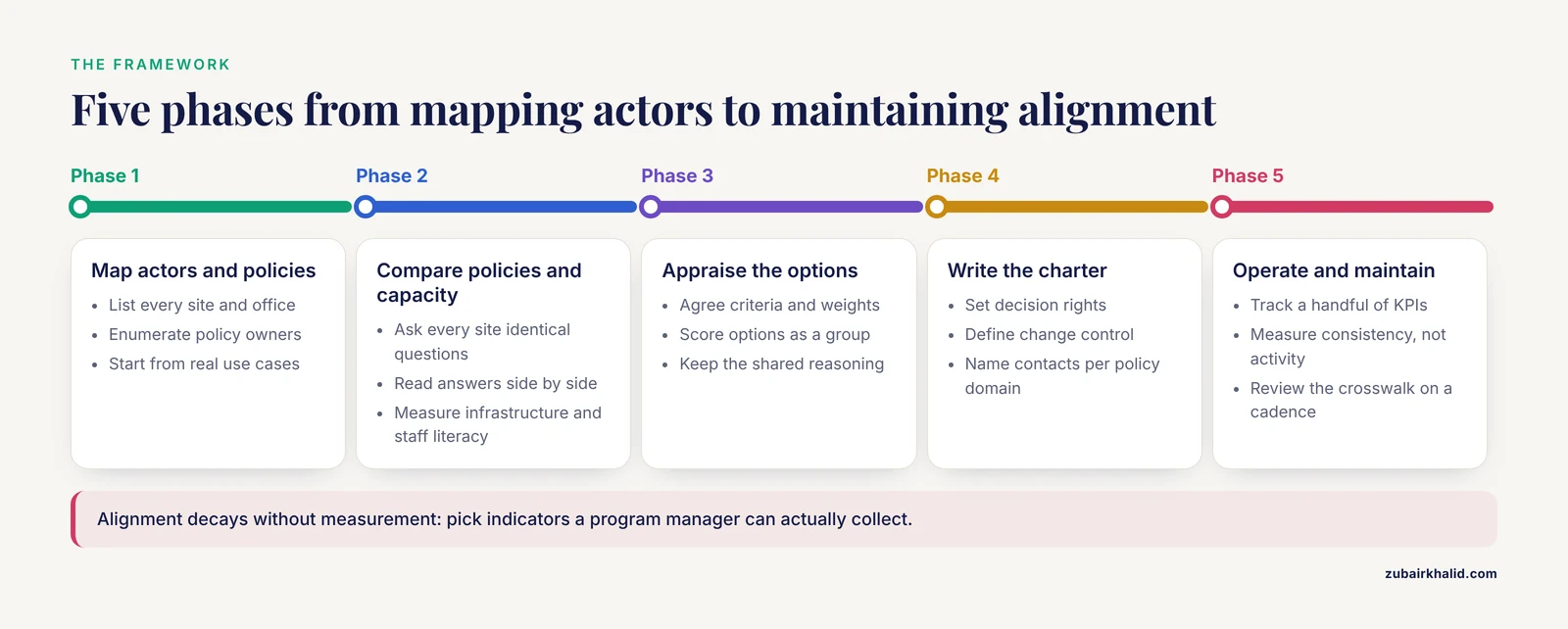
Treat policy alignment as a managed project with a lifecycle, not a one-time signing ceremony. Research on multi-actor research partnerships for sustainable food systems found that partnerships pass through distinguishable development and operational phases, each with its own success factors and management needs. The five phases below follow that arc.
Phase 1: Map the Actors and the Policies
List every site, every office, and every policy that touches the project before you change anything. The STRIPE project, built to capture lessons from the Global Polio Eradication Initiative, offers a tested method for complex, multi-institutional partnerships. It defined the target population of all polio-related actors, enumerated a source population of specific individuals at standard organizational and operational levels, and applied the approach at the global level and across seven countries [3]. Borrow the logic at your own scale. Define the universe of actors, enumerate them, then engage them.
Real use cases reveal stakeholders faster than org charts. One university team developing guidelines for social media recruitment of research participants started from actual use cases at their institution, which surfaced seven representatives from five institutional offices and 15 subject-matter experts across five content areas [4]. The people who gate each step, not the people who appear on the chart, own the policies you need to align.
Phase 2: Compare Policies and Site Capacity
Put the policies side by side with a structured instrument. A comparison of culinary medicine training across five Osher Centers used a 22-item survey to characterize each program's structure and format, then grouped open-ended responses thematically to surface common themes and practical innovations [5]. The same design works for policies. Ask every site identical questions about ethics review, data storage, incident reporting, authorship, and data sharing, then read the answers side by side.
Capacity matters as much as policy text. A CIPP evaluation, an assessment model that examines Context, Input, Process, and Product, of regional financial information systems across three Indonesian provinces found that policy goals were well aligned but execution varied with digital infrastructure and staff literacy [6]. Before you ask every site to meet one standard, measure whether each site can.
Phase 3: Appraise the Options With Stakeholders
Choose the alignment model openly, with the people who must live under it. Social Multi-Criteria Evaluation (SMCE) combines participatory methods with multi-criteria analysis (MCA), the practice of scoring options against several weighted criteria rather than a single metric. A systematic review of 54 empirical applications across 20 countries found the approach flexible enough for diverse policy fields, though implementations were often partial and adjusted to local context [7]. A light version fits most partnerships. List the options, agree on criteria such as speed, regulatory strength, and site autonomy, weight them as a group, and score each option. The scores matter less than the shared reasoning behind them.
Phase 4: Write the Governance Charter
Codify the agreement before the first conflict arrives. Expert-driven research on managing multi-actor research partnerships identified adaptability, trust, transparency, consensus, and proactiveness as the guiding principles that keep partnerships inclusive and sustainable. A charter translates those principles into specifics. Decision rights, meaning who can change which policy. Change control, meaning how amendments are proposed, approved, and published. Escalation paths for disagreements. Named contacts for ethics, integrity, and data questions at every site, with explicit rules for what information moves between institutions.
Multi-level structure deserves explicit attention. Management research on multinational subsidiaries shows that center-versus-site questions are inherently multi-level, and that performance depends on how well the center and its sites manage their interfaces [8]. Your charter should state exactly which decisions sit at the consortium level and which stay local.
Phase 5: Operate, Measure, and Maintain
Alignment decays without measurement. The same partnership research recommends key performance indicators (KPIs), measured signals tracked over time, covering continuous coordination, monitoring and reporting, and coherent communication. Pick a handful that a program manager can actually collect. Percentage of sites current on each core policy. Time to onboard a new site. Time to implement an amendment at the slowest site. Count of protocol deviations traced to policy gaps.
Measure consistency, not just activity. A multi-site study of international classes across eight Indonesian universities quantified its inconsistencies precisely, finding that 70 percent of observed sessions ran in Bahasa Indonesia despite English-language policy and 65 percent relied on lecture-based teaching [9]. The lesson generalizes to any consortium. Practice drifts from policy quietly, and unmeasured drift stays invisible until it becomes a dispute.
Options for Aligning Institutional Policies in Multi-Site Research
Three options cover nearly every real case. The table compares them on the dimensions that decide actual choices, and the sections after it explain each on its own terms.
| Dimension | Full harmonization | Policy crosswalk | Tiered hybrid |
|---|---|---|---|
| Core idea | One shared policy set, adopted by every site, replaces local rules for the project | Local rules stay in force, a mapping table documents where each matches the consortium standard | A small harmonized core (ethics, data protection, integrity) plus a crosswalk for the rest |
| Best fit | Pooled data, single protocols, one regulatory submission | Strong existing site policies, site-specific outputs, legal autonomy needs | Mixed portfolios, uneven site capacity, long-lived consortia |
| Main advantage | One standard, one audit trail, directly comparable results | Fastest to start, respects local law and culture, easy to add sites | Proportionate effort that matches how partnerships actually grow |
| Main drawback | Slowest to negotiate, requires real authority at every site | Equivalency disputes, many rule sets to check, drift as local policies change | Two systems to maintain, recurring fights over what counts as core |
| Governance burden | High at the start, low once running | Low at the start, continuous thereafter | Moderate and permanent |
| Typical timeline | Longest, often many months for large consortia | Shortest, weeks to a few months | Moderate, staged with the core first |
| Common failure mode | Sites sign but never implement | Stale crosswalk after local policies change | The core expands until it swallows the crosswalk |
Option 1: Full Harmonization
Full harmonization means every partner adopts one master policy set, or one master protocol with shared standard operating procedures (SOPs), the documented step-by-step instructions that make a process repeatable across sites. Local rules remain in force for everything outside the project, but inside it the master set governs.
Choose it when the science demands uniformity. Pooled datasets, multi-site clinical trials, and any study that reports a single combined result need identical rules for consent, data capture, and safety reporting. The data side shows what successful harmonization looks like. Researchers building a multi-institutional sleep research resource proposed harmonization schemas, formal specifications of what data fields exist and how they are structured, that imposed unified structural specifications across eight publicly available polysomnography datasets, the overnight recordings used to diagnose sleep disorders. The integrated dataset held stable demographic and clinical distributions under repeated sampling [10]. Policies behave the same way. Uniform specifications produce comparable outputs.
Pros:
- One standard simplifies training, quality assurance, and audits.
- Cross-site results are directly comparable.
- New staff learn one rulebook instead of one per site.
Cons:
- Negotiation is slow and requires authority each site can actually exercise.
- A single standard can override legitimate local obligations and dampen site-level experimentation.
- Every future amendment must be ratified everywhere before it takes effect.
Option 2: Policy Crosswalk
A policy crosswalk keeps every site's local policies in force and builds a mapping table instead. Each row pairs a consortium requirement with the local policy that satisfies it, notes gaps, and records agreed equivalencies. Auditors and new partners read the crosswalk to confirm that different texts reach the same standard.
Benchmarking makes crosswalks credible. The university team behind the social media recruitment guidelines ran a scoping review of publicly available policies at 19 peer institutions and 2 federal agencies, then used four themes from that review as the basis for their own procedures [4]. A crosswalk built the same way shows reviewers that equivalency claims rest on evidence rather than assertion.
Pros:
- Fastest option, because nothing must be rewritten before work starts.
- Preserves local legal compliance and institutional ownership.
- Onboarding a new site means mapping its policies, not rebuilding them.
Cons:
- Every audit must check many rule sets.
- Local policies change on their own schedules, so the crosswalk goes stale without maintenance.
- Equivalency disputes arise when texts differ in wording but not in effect, or the reverse.
Option 3: Tiered Hybrid
A tiered hybrid harmonizes a minimum core and crosswalks the rest. The core usually covers human subjects protection, data security and sharing, research integrity, and authorship. Everything else, including procurement, hiring, and facilities, stays local with a crosswalk entry.
The tiered structure lets the core tighten as the partnership matures while local flexibility persists at the edges, which suits consortia whose activities grow more interdependent over time.
Pros:
- Proportionate, effort follows risk.
- Scales from two sites to dozens.
- Survives mixed portfolios where some activities pool data and others do not.
Cons:
- Boundary disputes, because sites will disagree over what belongs in the core.
- Two systems to maintain, so both need owners.
- Without discipline the core expands until the hybrid becomes harmonization by accretion.
How to Choose: The Criteria That Decide Real Cases
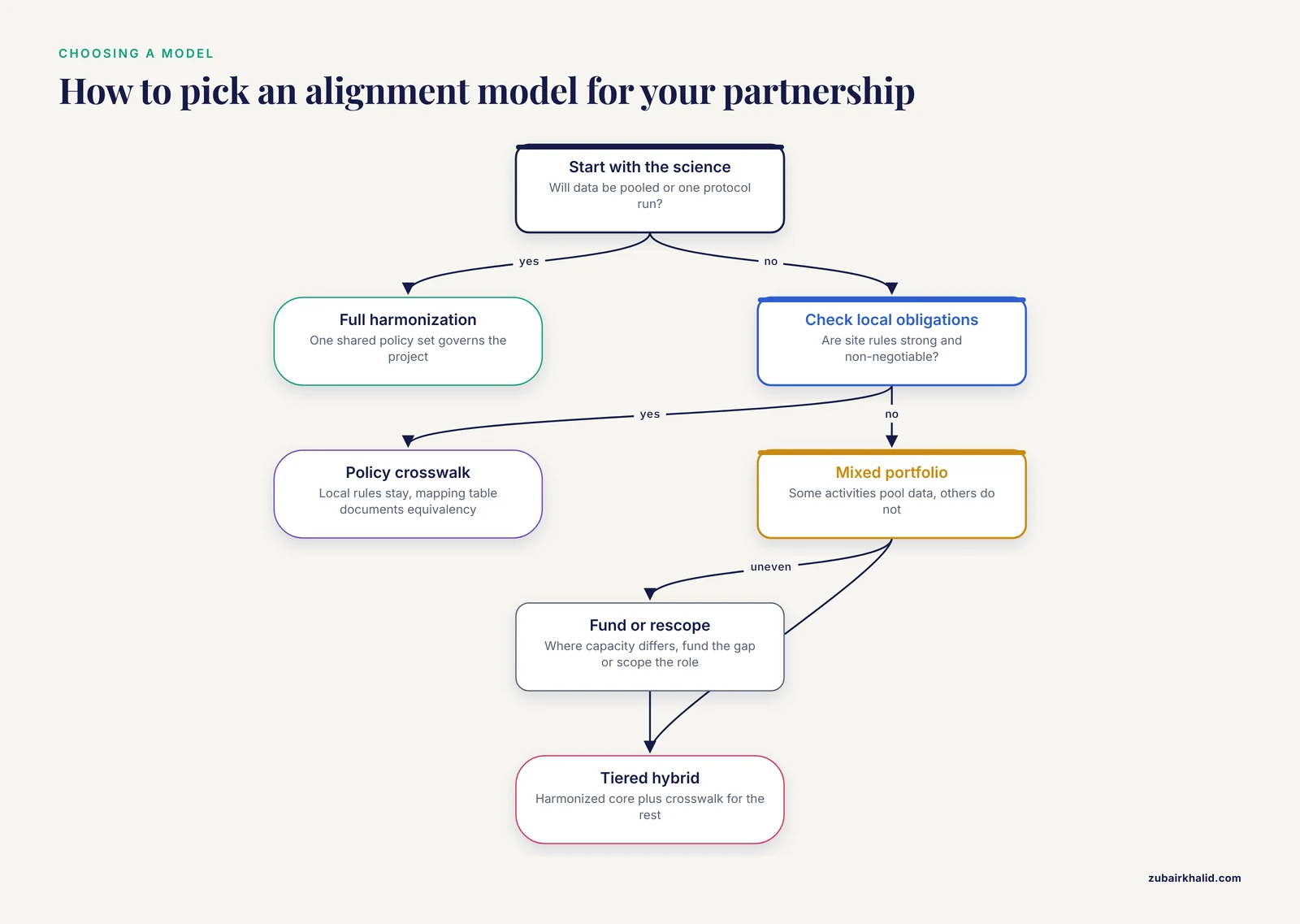
Five criteria separate the options in practice.
Data pooling. If data will be combined and reanalyzed as one dataset, harmonize data governance and security. Heterogeneous structures raise preprocessing burden and limit reproducible validation, so the rules that produce the data need one standard.
Regulatory exposure. Human subjects research, investigational drugs, and controlled materials push the relevant rules into the harmonized core. In hospital trials, pharmacy departments handling investigational medicinal products, the drugs being tested, must align their processes with other research teams in a transparent and standardized way [11].
Site autonomy and governing law. Sites answer to their own boards, states, and accreditors. Where local obligations are strong and non-negotiable, crosswalk rather than replace.
Capacity asymmetry. Sites differ in infrastructure and staffing. Where capacity differs, either fund the gap or scope that site's role to match what it can sustain.
Timeline and turnover. Grant start dates, staff turnover, and late-arriving sites all favor the crosswalk's fast start, followed by staged harmonization of the core.
Governance philosophy matters too. A comparison of Chinese and US research universities found that top-down approaches mobilize large-scale resources quickly for defined priorities, while bottom-up approaches better support originality and site-level initiative [12]. Match the model to the mission rather than to habit.
Worked Scenarios
Scenario 1: A Multi-Site Clinical Trial Network
Six hospitals launch a trial of an investigational drug. The science requires one protocol, one consent process, and one safety dataset, so the harmonized core covers ethics through a single IRB of record, the one review board that approves the study for all participating sites, plus pharmacy handling of the investigational product and adverse event reporting. A service evaluation of the EDGE research management system at a UK hospital trust showed what standardization looks like in practice, four pharmacy-specific workflows covering expression of interest and feasibility, amendment implementation, and trial setup, tracked from 2022 through 2025 [11]. Procurement and human resources stay local, mapped into a crosswalk. The charter names a pharmacist lead and a governance lead at each site, and amendment requests flow through the shared system rather than through email.
Scenario 2: A Multi-University Data Consortium
Five universities pool genomic and clinical data. No site will surrender its own data governance policy, so the consortium harmonizes only three things, the data use agreement, the security tier for shared storage, and the breach notification rule. Everything else runs through a crosswalk onto a shared data schema. Every site's variables are mapped to the common schema before any data moves, which is what makes later integration and reanalysis possible without renegotiation. New sites join by mapping their policies and fields, not by adopting five universities of history.
Scenario 3: A Community Health Program Across Many Sites
A foundation funds healthcare quality improvement in 16 communities, each with different local conditions, so full harmonization is impossible from the start. The Aligning Forces for Quality initiative took the hybrid path, a common programmatic framework paired with an independent evaluation that assessed overall effectiveness, impact in specific programmatic areas, and how each local alliance was positioned for the future [13]. The policy lesson transfers directly. Harmonize the measurement core, the definitions and data every site must report. Crosswalk the implementation policies, because local hiring, contracting, and outreach rules differ and should.
Research Collaboration Tools That Keep Policies Aligned
Scientific collaboration now crosses institutions by default, so the administrative layer decides whether that collaboration compounds or frays. Tools do not align policies by themselves, but they make the framework enforceable.
Research management platforms. The Request Management System (RMS), an informatics platform built for cross-institutional biomedical collaboration, categorizes experts and their knowledge areas, runs a role-based workflow across the project lifecycle, and has tracked over 1,500 investigators and more than 4,800 tasks [14]. The same architecture fits policy work. Each policy owner holds a role, each amendment becomes a tracked task, and completion dates accumulate into an audit trail.
Workflow systems for regulated processes. Systems such as EDGE standardize trial setup steps and give governance staff one place to see status and turnaround across departments [11].
Shared schemas and data dictionaries. Where policies govern data, the policy artifact is a schema. Publishing one dictionary of field names, formats, and definitions turns a data governance policy into something a database can enforce.
Benchmarking libraries. Keep the peer policies collected during gap analysis. A curated library of peer institution and agency policies becomes the reference layer for every future crosswalk and every new site's onboarding.
KPI reporting. Whatever platform you choose, it should produce the Phase 5 indicators automatically, because sustained coordination depends on continuous monitoring, reporting, and coherent communication.
Common Mistakes and Limitations
- Treating a signature as adoption. The provincial systems evaluation documented staff keeping shadow manual bookkeeping alongside a mandated digital system, the policy existed while daily practice continued unchanged [6]. Budget for implementation support, not just approval.
- Ignoring capacity asymmetry. A standard that some sites cannot meet is a schedule slip in disguise. Assess infrastructure and skills during Phase 2, then either fund the gap or scope the site's role to match its capacity.
- Copying peer policies without adaptation. The SMCE review found frequent partial implementation driven by context-specific adjustments [7]. Borrowed text that ignores local context produces paper compliance.
- Letting the crosswalk go stale. Local policies change on their own schedules. Assign an owner, set a review cadence, and tie the crosswalk to the KPIs so staleness surfaces in a dashboard rather than in a dispute.
- Assuming one office speaks for the site. The research integrity working group found that institutions must identify proper contacts and clarify how need-to-know criteria, the rules governing when confidential information may be shared, are interpreted [2]. Map contacts by policy domain, not by institution.
- Measuring nothing. Without baseline and follow-up metrics, no one can show whether alignment helped. The eight-university study produced useful findings precisely because it quantified its inconsistencies instead of describing them vaguely [9].
A final limitation belongs in plain language. Every partnership also sits under local law, funder terms, and institutional counsel, so treat this framework as a planning map rather than legal advice and route final policy language through each site's own review process.
Frequently Asked Questions
What does aligning institutional policies across partner sites involve?
It involves mapping each site's policies and policy owners, comparing them against a consortium standard, choosing an alignment model, writing decision rights into a charter, and monitoring compliance over time. The work is mostly organizational coordination rather than legal drafting.
Which approach is best for aligning institutional policies in multi-site research?
No single approach wins in every case. Harmonize when the partnership pools data or runs one protocol, crosswalk when sites keep separate outputs, and use a tiered hybrid when the portfolio mixes both, which describes most long-running consortia.
What are the pros and cons of harmonization versus a policy crosswalk?
Harmonization delivers one standard, one audit trail, and directly comparable results, at the cost of slow negotiation and high startup effort. A crosswalk starts fast and respects local law, but needs continuous maintenance and makes audits more complex.
How long does policy alignment take across partner sites?
A crosswalk can begin within weeks because nothing has to be rewritten first. Full harmonization usually takes many months for large consortia, since every site must review, approve, and implement the shared set. Hybrids stage the work, core first, crosswalk next.
What research collaboration tools support policy alignment?
Research management platforms with role-based workflows, shared data schemas and dictionaries, policy benchmarking libraries, and KPI dashboards. The common feature is one tracked place where policy owners, tasks, and documents live, so amendments and attestations leave an audit trail.
Who should lead policy alignment in a multi-site partnership?
A small governance group with one empowered representative per site, chaired by a neutral lead. Each representative needs authority over their site's policies or a direct line to the person who holds it.
Sources
- Human Resource Transformation at Al-Jam'iyatul Washliyah Educational Institution: Multi-site Research
- Enhancing Partnerships of Institutions and Journals to Address Concerns About Research Misconduct: Recommendations From a Working Group of Institutional Research Integrity Officers and Journal Editors and Publishers.
- Sampling method for surveying complex and multi-institutional partnerships: lessons from the Global Polio Eradication Initiative
- Engaging Institutional Stakeholders to Develop and Implement Guidelines for Recruiting Participants in Research Studies Using Social Media: Mixed Methods, Multi-Phase Process
- 5 Osher Centers, One Mission: A Multi-Institutional Programmatic Comparison of Culinary Medicine Health Professional Training
- Optimizing Regional Financial Information Systems in Indonesia: A CIPP Evaluation Approach to Institutional Capacity Asymmetry
- Appraising Policies Through Social Multi-Criteria Evaluation: Lessons From a Systematic Review of Applications
- Managing the MNE subsidiary: Advancing a multi-level and dynamic research agenda
- Developing a Learner-Centered International Class Model for Institutional Globalization: Multi-Site Evidence from Indonesian Universities
- Polysomnography harmonization schemes: A multi-institutional sleep research resource
- (ID: 262) Utilising research management technology to streamline and integrate pharmacy clinical trial processes within a multi-disciplinary research team: a service evaluation
- INSTITUTIONAL COMPARISON AND PRACTICAL PATH SELECTION FOR INTERDISCIPLINARY DEVELOPMENT IN CHINESE AND US RESEARCH UNIVERSITIES
- Evaluating a complex, multi-site, community-based program to improve healthcare quality: the summative research design for the Aligning Forces for Quality initiative.
- RMS: a platform for managing cross-disciplinary and multi-institutional research project collaboration