How to Combine Agile and Lean for Research Projects
By Dr. Zubair Khalid, DVM, MS, PhD ·

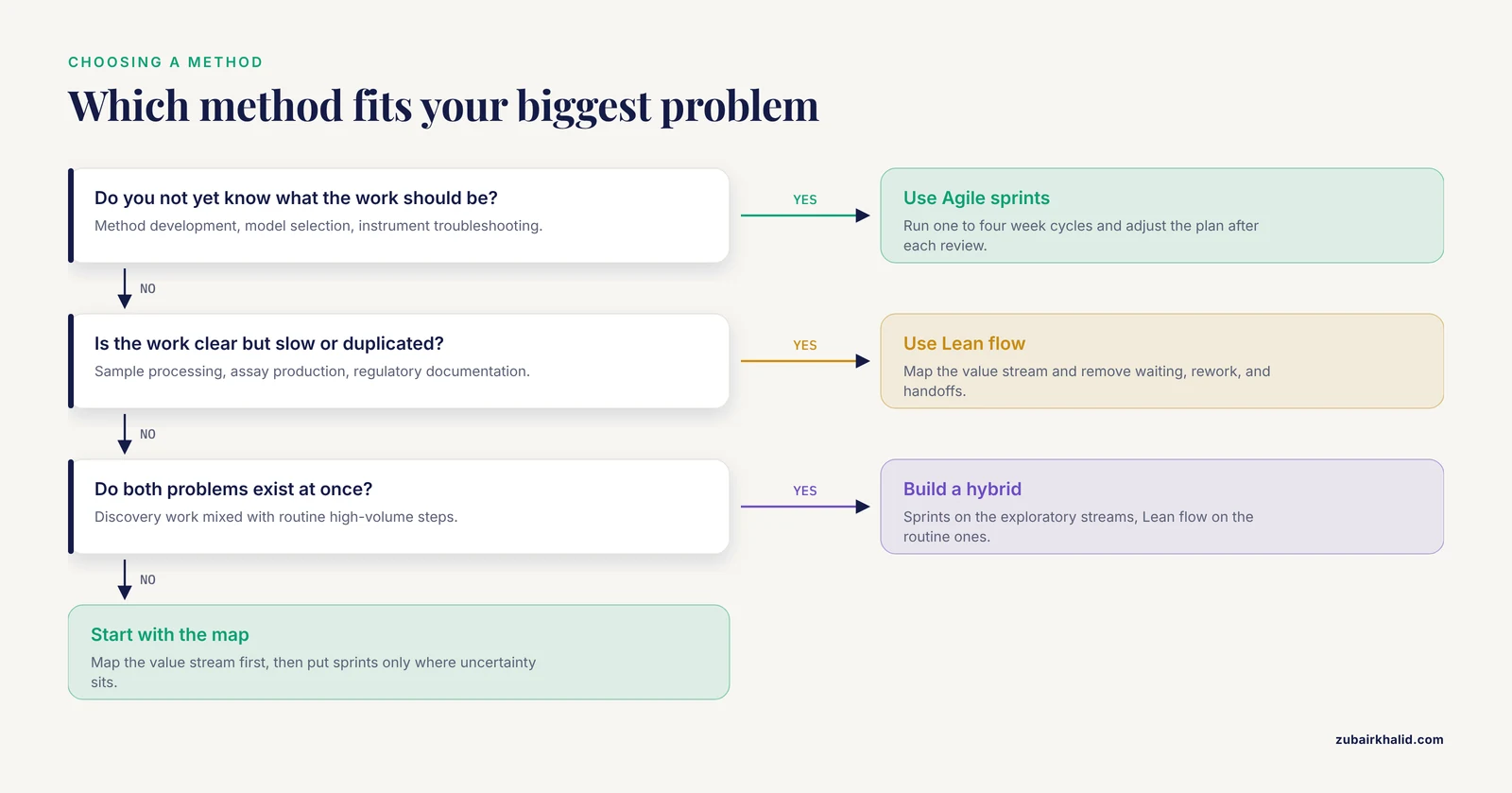
Agile manages uncertainty through short, repeated cycles of work and feedback, while Lean removes waste from a process so that every step adds value. The rule of thumb for choosing between them is simple. If your biggest problem is that you do not yet know what the work should be, use Agile. If your biggest problem is that the work is clear but slow, duplicated, or poorly resourced, use Lean. If both problems exist at once, which is the normal condition of scientific research, combine them.
This guide explains how to combine Agile and Lean for research projects in a way you can actually run with a small lab, a core facility, or a multi-investigator consortium. It covers the definitions you need, a side-by-side comparison, the main hybrid options with their pros and cons, a step-by-step combination method, a research project plan template, and worked scenarios.
What Agile and Lean Actually Mean
Agile is a family of project management methods built on iterative delivery. Instead of planning an entire multi-year study up front, the team works in short cycles called sprints, typically one to four weeks, and adjusts the plan after each cycle based on what was learned. Scrum, the most widely used Agile framework, assigns three roles: a Product Owner who decides what matters most, a Scrum Master who removes obstacles, and the development team that does the work. Kanban, a second Agile method, visualizes all work on a board and limits how many tasks can be in progress at once [1].
Lean is a process improvement philosophy that originated in manufacturing. Its central idea is the elimination of muda, the Japanese term for waste, meaning any activity that consumes resources without adding value. Lean practitioners map the entire value stream, the full sequence of steps from request to delivered result, and then remove waiting, rework, overprocessing, and handoffs that create no value. Standard work, root cause analysis, and continuous small improvements called kaizen are its main tools [1].
The two methods answer different questions. Agile answers "how do we adapt when we cannot predict everything?" Lean answers "how do we deliver the same value with fewer wasted steps?" Comparative analyses of flexible methods show that Agile emphasizes adaptability and team collaboration while Lean emphasizes process discipline and defect prevention, and that the right choice depends on the project context rather than on any universal winner [2][1].
Side-by-Side Comparison
| Criterion | Agile | Lean | Hybrid (Agile + Lean) |
|---|---|---|---|
| , - | , - | , - | , - |
| Core question | How do we adapt to unknowns? | How do we remove waste? | How do we adapt fast without wasting effort? |
| Unit of progress | Working increment per sprint | Flow through a value stream | Iterations that also feed process improvement |
| Feedback loop | Sprint review, 1 to 4 weeks | Value stream metrics, continuous | Both, sprint-level and process-level |
| Main tools | Scrum, Kanban, backlogs, standups | Value stream mapping, 5 Whys, kaizen, standard work | Sprint boards on a mapped value stream, MoSCoW prioritization, retrospective-driven kaizen |
| Best fit in research | Exploratory phases, method development, software and instrument pipelines | Core facilities, sample processing, assay production, regulatory documentation | Projects that mix discovery work with routine high-volume steps |
| Weak spot | Can drift without strategic control | Can ossify a process that needs to change | Requires more discipline and management attention than either alone |
| Failure mode | Endless pivots, unfinished work | Optimizing a step that should be deleted | Methodological chaos if roles are not defined [3] |
Why Research Projects Need Both
Traditional project management, built on sequential planning, often fails against the volatility and uncertainty that are intrinsic to scientific research, and adaptive frameworks are needed to secure project success [4]. A meta-analysis of 25 peer-reviewed studies in technical fields found that iterative approaches with continuous feedback loops consistently outperform plan-driven ones on stakeholder satisfaction and adaptability to changing requirements, while plan-driven approaches keep their advantage on predictability in fixed-scope work with well-defined requirements [5].
At the same time, pure Agile leaves waste untouched. A research group that runs perfect two-week sprints can still lose weeks to reagent ordering delays, duplicated data cleaning, or instrument queues. Lean addresses exactly those losses. Reviews of high-technology development recommend integrating Lean principles into Agile practice to streamline work, eliminate waste, and foster continuous improvement [6].
The evidence for combining them is growing across sectors. A survey study of nonprofit organizations concluded that a hybrid strategy combining Agile and Lean approaches is necessary to handle diverse project situations, and noted that awareness itself is a barrier, since only 40 percent of surveyed project staff knew about Lean methodology and only 36 percent knew about the Agile approach [7]. A comparative case study of two real projects in a multinational technology company found that Agile delivered superior adaptability, collaborative communication, and responsiveness, while Lean Six Sigma provided stronger goal alignment, process control, error minimization, and regulatory compliance, and that methodological effectiveness is context-dependent rather than universal [2]. In pharmaceutical operations, a survey of 375 professionals found that Lean Six Sigma had a stronger direct effect on competitive advantage than Agile project management, but that organizational adaptability significantly mediated the relationship between both methods and outcomes, meaning the combination works best when the organization can actually absorb change [8].
For research specifically, one action-research study developed a framework for a small academic group of about 20 workers and recommended a lean-hybrid implementation model, combining waterfall, Agile, and Lean principles, together with a transformational leadership style [4].
Agile Lean Hybrid Research Project Management Options
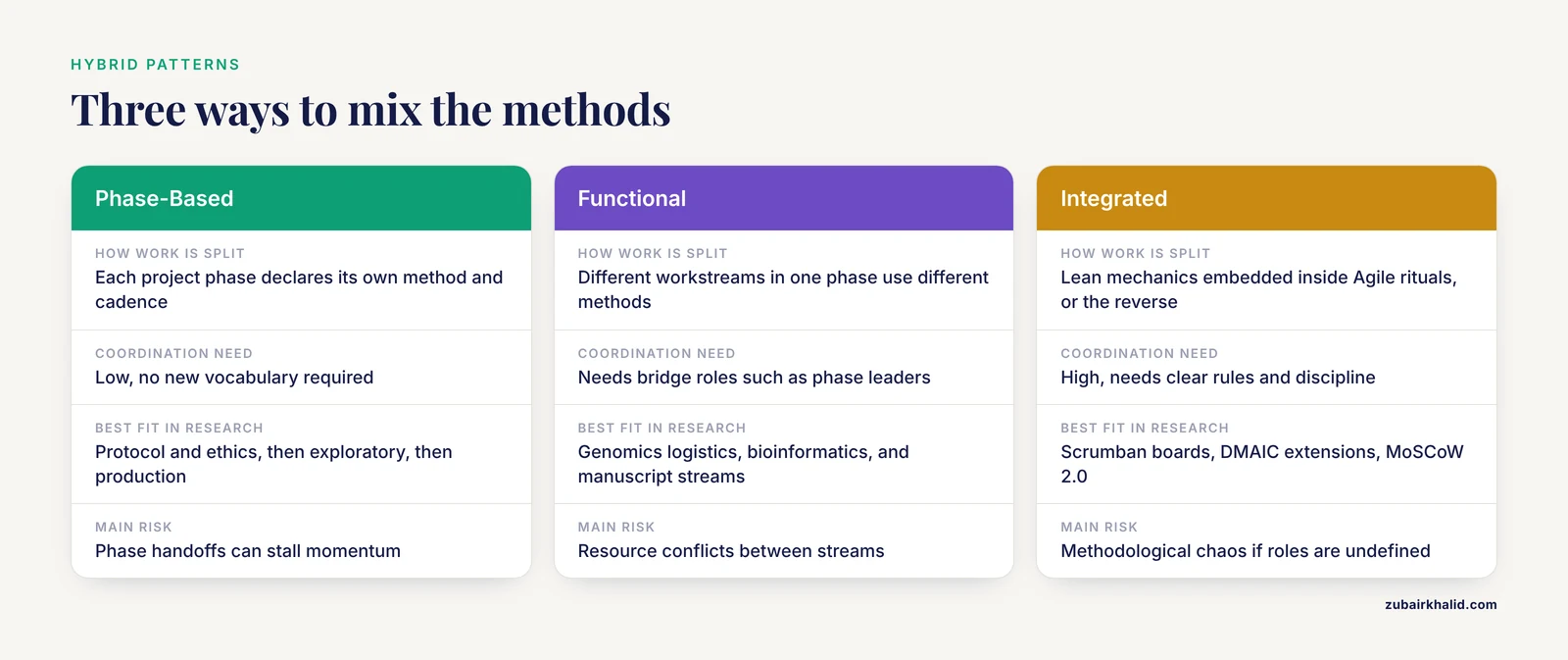
There is no single canonical hybrid. Studies across industries describe three recurring patterns, and research teams can mix elements from each. Surveys of global project professionals show that hybrid models integrate the strengths of both frameworks and that Agile and hybrid approaches significantly outperform traditional ones on team dynamics and long-term adaptability [9].
Phase-Based Hybrid
In a phase-based model, each project phase uses the method that suits its nature. A typical research project might run a plan-driven protocol and ethics approval phase, an Agile exploratory phase for assay development and pilot experiments, and a Lean-stabilized production phase once the protocol is locked and samples flow at scale. Logistics research describes this pattern formally, recommending traditional methods for capital-intensive phases, Agile for IT and process-oriented initiatives, and hybrid models for complex projects that combine both [3].
This is the easiest hybrid to start with because it does not require anyone to change vocabulary. Each phase simply declares its method, its cadence, and its definition of done.
Functional Hybrid
In a functional model, different workstreams in the same phase use different methods. A genomics project might run sample logistics under Lean flow management, bioinformatics pipeline development under Scrum, and manuscript preparation on a simple Kanban board. The logistics literature identifies this functional split as one of three core hybrid models, balancing predictability for stable streams with flexibility for dynamic ones [3].
Functional hybrids need a coordination layer. Telecom case research found that companies resolve this by creating explicit bridge roles, such as phase leaders who connect Agile teams with conventional project managers and help mitigate resource conflicts and regulatory constraints [10].
Integrated Hybrids
Integrated hybrids embed Lean mechanics directly inside Agile rituals, or the reverse. Named examples include the following.
- Scrumban combines Scrum ceremonies with Kanban flow limits. In a small-business software case, a Scrumban implementation produced a stable software version by the fifth sprint, reduced defects by 10 percent, cut lost tasks to 4 to 6 percent, and raised satisfaction with operational processes by 43 percent [11].
- Lean Six Sigma hybrid frameworks extend the DMAIC cycle, meaning define, measure, analyze, improve, control, with added steps and decision tools. One manufacturing case added select and sustain steps plus a DEMATEL decision model and a kaizen framework, raising the process sigma level from 3.3 to 4.3 and improving cycle time by 12 percent [12].
- Construction research combined Scrum iteration with the Last Planner System, a Lean production planning method, and a shared digital platform, using a dynamic prioritization mechanism called MoSCoW 2.0, an extension of the must-have, should-have, could-have, will-not-have scheme, to manage shifting priorities in a complex project [13].
User-Centered Design Plus Agile for Research Systems
When the deliverable is a research management tool rather than a dataset, a documented hybrid pairs user-centered design, which studies users first through interviews, with Agile software development. A pediatric heart institute built a Clinical Research Project Management System this way, running interviews to map bottlenecks in Phase 0, developing project management and budgeting features in Phase 1, and a dashboard and intake section in Phase 2. The Phase 1 build reached an average System Usability Scale score of 88.65, a strong result on this standard 0 to 100 usability instrument, while still surfacing 126 usability issues that were then triaged by severity [14].
Agile Governance With Centralized Strategy
Large consortia and public-sector research programs often fail with pure Agile because coordination across many groups collapses. Benchmarking of Agile practice across five countries found Agile works best when centralized strategic oversight is combined with modular, flexible delivery at the working level, and proposed hybrid arrangements that pair ministerial-level coordination with Agile execution [15].
Pros and Cons of the Hybrid Approach
Advantages
- You get adaptation where uncertainty lives and discipline where waste lives. Comparative evidence shows hybrid models balance strategic planning with flexible adaptation better than either classical or Agile models alone [16].
- Team dynamics and future preparedness improve. Data from 227 project professionals showed Agile and hybrid methodologies significantly outperform traditional approaches on team impact and long-term adaptability [9].
- Periodic progress recording catches problems early. Survey research found that Agile and Lean implementation in project management allows progress and teamwork performance to be recorded periodically, which shows whether a project is on plan or needs remedial action [7].
- Conscious combination improves both effectiveness and product quality. In-depth interviews with experienced project managers found that flexible, deliberate mixing of methodologies contributes to greater team effectiveness and better delivered quality, especially when teams maintain internal good practice guides and standardized reporting [17].
Disadvantages
- Integration is technically and culturally hard. Identified barriers include the complexity of combining frameworks, high staff training and digital tool costs, and employee resistance to change [16].
- Resistance is real even where the fit is good. A case study of three Brazilian construction design firms found little current adoption of Lean product development and Agile project management practices and noted that interviewee reception of the concepts was mostly pessimistic, reflecting resistance to changing established processes [18].
- Awareness gaps undermine adoption. Because many project staff are unfamiliar with one or both methods, hybrid efforts can stall before they start, which the nonprofit study identified as a primary cause of failure [7].
- Hybrid adds administrative burden. Logistics research warns of methodological chaos, increased administrative load, and coordination difficulties when hybrids are introduced without clear rules [3].
How to Combine Agile and Lean for Research Projects Step by Step
The best hybrid setup is the one matched to where uncertainty and waste actually sit in your project. Use this sequence to build that setup.
- Map your value stream first. Before any sprint starts, draw the path from funding or question to published result. For a wet lab project this might read grant milestone, protocol design, reagent procurement, pilot runs, data capture, analysis, QC, writeup. Mark every wait, rework loop, and approval gate. This Lean step tells you where time actually goes.
- Set a stable strategic frame. Define the project objective, budget envelope, regulatory deliverables, and hard milestones at the top level, and leave them fixed. This is the waterfall or plan-driven shell that keeps the project accountable, mirroring the pattern of centralized oversight with flexible delivery [15][5].
- Choose an iteration cadence for uncertain work. Anything exploratory, such as method optimization, model selection, or instrument troubleshooting, goes into sprints. Two weeks is a common starting sprint length. Each sprint ends with a review against the fixed strategic frame.
- Prioritize with MoSCoW or an equivalent scheme. Classify backlog items as must have, should have, could have, or will not have, and revisit the ranking every sprint. The construction hybrid study showed that a dynamic priority mechanism of this kind keeps shifting requirements under control in complex projects [13].
- Run routine steps as Lean flow. Sample processing, data cleaning, and document production are not exploratory. Manage them with Kanban boards, explicit work-in-progress limits, and standard operating procedures so they neither starve the sprints nor accumulate queues [1].
- Attach kaizen to every retrospective. At the end of each sprint, ask the two Lean questions, which step created no value, and which wait was longest. Turn one answer per sprint into a small process change. This is how the hybrid stays hybrid rather than drifting back to pure Agile [6].
- Assign bridge roles. Name one person who owns the backlog and one who owns process health. Explicit phase-leader roles reduce resource conflicts and the regulatory friction that otherwise derails hybrid teams [10].
- Write it down and standardize reporting. Teams that codify their own hybrid in a short internal guide, with a fixed reporting format and a cyclical review mechanism, adapt the model as conditions change instead of abandoning it [17].
A Research Project Plan Template
Use this template as the skeleton of your hybrid project plan. It fits a two-page document or a wiki page.
| Section | Content | Method origin |
|---|---|---|
| , - | , - | , - |
| Objective and success criteria | The fixed strategic goal, target metrics, and regulatory or funder deliverables | Waterfall shell |
| Value stream map | Every step from request to result, with wait times and rework loops marked | Lean |
| Work breakdown by stream | Exploratory, production, and administrative streams listed separately | Functional hybrid |
| Sprint cadence and calendar | Sprint length, review dates, retrospective dates | Agile |
| Prioritized backlog | Items ranked must, should, could, will not have, re-ranked each sprint | Agile, MoSCoW |
| Standard work for routine steps | SOPs, checklists, work-in-progress limits for flow work | Lean |
| Bridge roles | Backlog owner and process owner, named individuals | Hybrid governance |
| Metrics | Sprint velocity or completed items, plus process metrics such as cycle time and defect or rework rate | Both |
| Retrospective actions | One kaizen change per sprint, with an owner and a review date | Both |
| Risk and compliance register | Ethical approvals, biosafety, data protection items tracked outside the sprint loop | Waterfall shell |
Fill the template once at project start, then revise the value stream map and backlog sections at every sprint boundary. The strategic sections stay stable.
Worked Scenarios
Scenario 1, A Discovery-Driven Wet Lab Project
A university lab is screening compounds for an enzyme inhibitor. The screen itself is uncertain, so it runs in two-week sprints, each sprint committing to a defined compound batch and ending with a review of hits and assay quality. Sample plating and data ingestion, which are repetitive, run as Lean flow with a Kanban board and a work-in-progress limit so plates never queue behind a distracted analyst. The grant milestones and biosafety approvals form the fixed shell. Each retrospective asks where the longest wait occurred. After three sprints the team discovers that compound ordering is the largest wait and switches to batch ordering, a classic Lean intervention delivered through an Agile retrospective.
Scenario 2, A Core Facility Serving Many PIs
A sequencing core has predictable demand and a defined process, so Lean dominates. The facility maps its value stream from sample receipt to data delivery, removes redundant QC handoffs, and sets standard work. However, the facility's LIMS development work is uncertain, so that stream runs in Scrum sprints with the facility manager as Product Owner. This functional split follows the zoning logic recommended for complex operations, matching method to workstream type [3].
Scenario 3, A Clinical Research Management System Build
A research institute needs an internal project management application for trials. The team pairs user-centered design with Agile development, interviewing staff first to find process bottlenecks, then building features in staged phases and testing usability each time. The phased build in the pediatric institute case reached a high usability score in its first assessed phase while still identifying and triaging dozens of usability issues, showing how staged iteration surfaces problems a single big launch would bury [14]. Here Lean contributes the workflow analysis that precedes any code, and Agile delivers the increments.
Common Mistakes and Limitations
- Adopting the vocabulary without the mechanics. Calling a monthly meeting a sprint, with no backlog, no review, and no retrospective, is the most common failure. If the feedback loop does not change decisions, nothing Agile is happening.
- Skipping the value stream map. Teams that go straight to sprints inherit their existing waste into every iteration. The Lean mapping step is what tells the hybrid what to fix.
- Letting exploratory work absorb the whole team. Routine production work still needs standard work and flow control. If everyone works only on sprint items, queues of samples and data builds up silently.
- No bridge roles. Without a named backlog owner and process owner, hybrid teams replay the conflicts between Agile teams and conventional project managers documented in industry case research [10].
- Underestimating training cost and resistance. Budget real time for method training, and expect skepticism, since resistance to change is a documented barrier even in settings with good methodological fit [18][16].
- Ignoring awareness gaps in your own team. A majority of project staff in one survey did not know either methodology by name, so a brief onboarding session is not optional [7].
- One person cannot run both systems alone. The evidence consistently ties hybrid success to active management involvement and periodic evaluation mechanisms [17].
- Remember that methodology is context-dependent. The same hybrid that accelerates one lab can burden another, and success factors such as clearly defined objectives, stakeholder engagement, systematic monitoring, and team competence matter more than the label on the method [2].
Frequently Asked Questions
What is the difference between Agile and Lean in one sentence?
Agile organizes work into short, feedback-driven cycles to handle uncertainty, while Lean removes non-value-adding steps from a process to cut waste.
Can I use Agile and Lean at the same time in one research project?
Yes, and that is the standard recommendation when a project contains both uncertain exploratory work and stable routine work, which most research projects do.
Which method should a small academic lab start with?
Start with Lean value stream mapping to see where time is lost, then apply Agile sprints only to the exploratory streams the map reveals, following the lean-hybrid pattern developed for small academic research groups.
How long should a sprint be in a research project?
One to four weeks is the standard range, and two weeks is a practical starting point for most lab teams because it matches common reagent ordering and instrument scheduling rhythms.
What tools do I need to run a hybrid research project?
A shared backlog or board for sprints, a value stream map for the Lean side, a prioritization scheme such as MoSCoW, and a fixed reporting format, none of which require specialized software.
Is a hybrid approach worth the extra overhead?
For projects mixing discovery and routine work, yes, because hybrid models balance strategic planning with flexible adaptation and improve team dynamics, but the overhead is real and grows with team size and regulatory load [9][16].
Sources
- Flexible Project Management Methods: Types, Analysis, and Comparison
- Managing Projects Effectively: Lean Six Sigma and Agile Methodologies Through the Eyes of Project Managers
- Hybrid project management methodologies in logistics
- Project Management for Scientific Research: Strategy, Leadership, and Implementation
- Agile vs. Traditional Project Management: A Comparative Study of Project Success Factors in the Tech Industry.
- Optimizing agile project management methodologies in high-tech software development
- A Critical Analysis of Agile and Lean Methodology to Fulfill the Project Management Gaps in Nonprofit Organizations (NPOs)
- Strategic Integration of Lean Six Sigma and AgileProject Management in PharmaceuticalMarketing Operations in The US:A Hybrid Framework forCompetitive Advantage
- Evaluating the Impact of Project Management Approaches on Project Success: A Comprehensive Analysis of Traditional, Agile, and Hybrid Models
- Analysis of Hybrid Agile Project Management in the Telecommunications Industry
- Implementation of Agile Methodology in Software Development Project Management in Power Industry Small Business
- Developing a Hybrid Approach for Lean Six Sigma Project Management: A Case Application in the Reamer Manufacturing Industry
- Application of Lean-Agile Hybrid Methods in Complex Construction Project Management
- Agile User-Centered Design of a Clinical Research Project Management System in a Pediatric Health Institute
- BENCHMARKING THE APPLICATION OF AGILE PROJECT MANAGEMENT METHODS IN PUBLIC ADMINISTRATION
- THE USE OF HYBRID PROJECT MANAGEMENT MODELS IN THE IMPLEMENTATION OF HOTEL PROJECTS
- HYBRID PROJECT MANAGEMENT IN IT PROJECTS
- Lean product development and agile project management in the construction industry