AlphaGenome Explained: Google DeepMind DNA Model and 9-Billion-Variant Atlas
By Dr. Zubair Khalid, DVM, MS, PhD ·
Key Takeaways
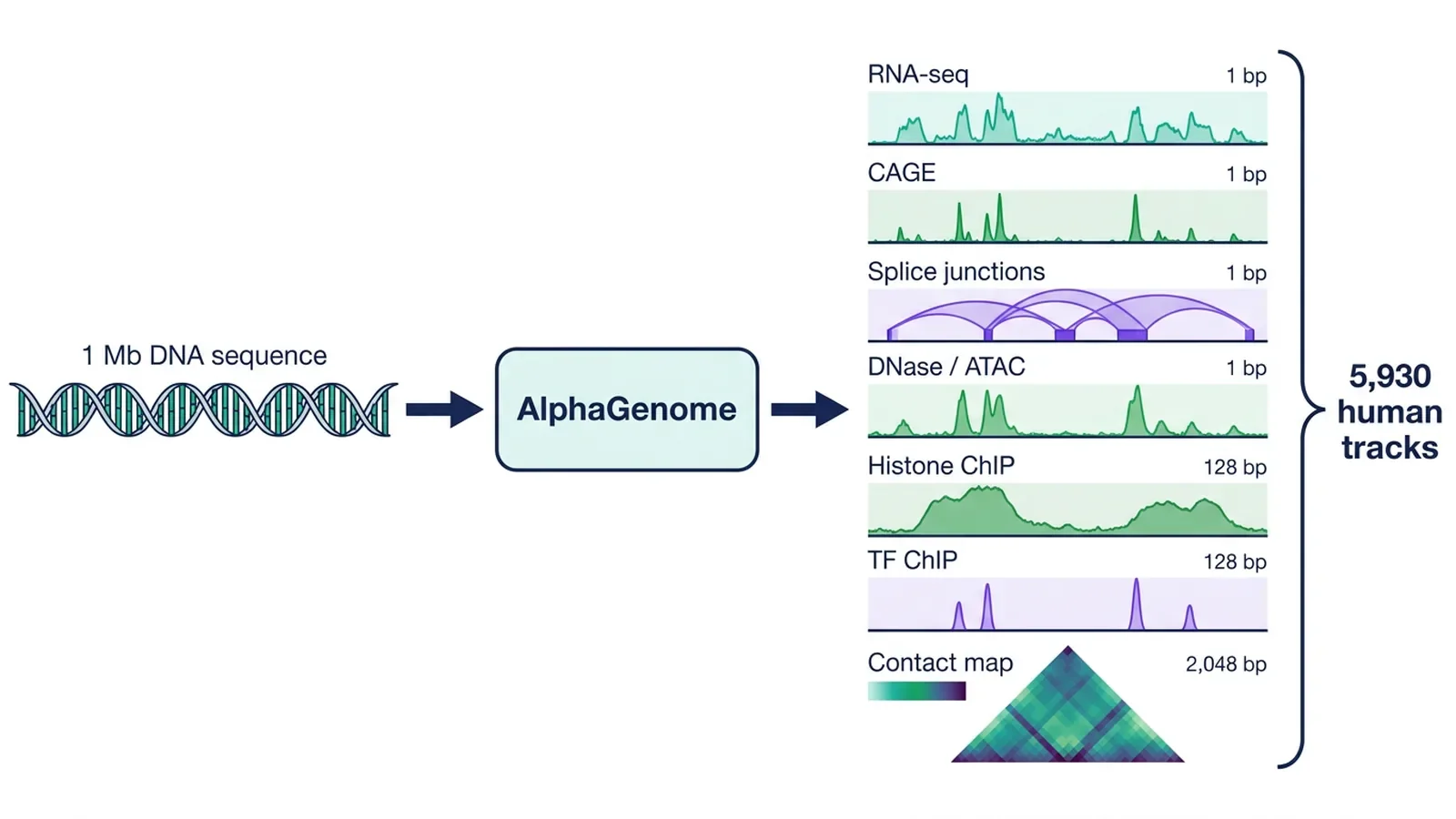
- AlphaGenome takes 1 megabase of DNA sequence as input and returns thousands of functional genomic tracks at up to single-base-pair resolution, covering 5,930 human tracks or 1,128 mouse tracks across 11 modalities [1][2].
- The peer-reviewed paper appeared in Nature on 28 January 2026 (volume 649, pages 1206-1218), led by Žiga Avsec and Natasha Latysheva, with Pushmeet Kohli among the senior authors [1][7].
- AlphaGenome matched or beat the strongest external models in 25 of 26 variant effect evaluations, and improved eQTL effect direction prediction from auROC 0.75 to 0.80 [1].
- The AlphaGenome Atlas, released 8 September 2026, holds precomputed predictions for all roughly 9 billion possible single-nucleotide variants in the human genome, about 1 petabyte of data and roughly 30 times larger than the AlphaFold database [3][5].
- The AVI (AlphaGenome Variant Impact) score combines non-coding predictions with AlphaMissense protein-coding predictions, so any variant gets one prioritisation number [3][4].
- Training a single model took about four hours and half the compute budget used to train the original Enformer [2].
About 98% of the human genome does not encode protein. That number has been known for years, but knowing it and being able to read it are different things. Most variants that genome-wide association studies flag as disease-associated sit in that non-coding majority, and their effects are awkward to interpret because they act through enhancers, promoters, splicing or the way chromatin folds, with no amino acid changed [1]. A variant that shifts a transcription factor binding site by one base pair can matter more than a missense change, and until recently there was no single model that could look at all of those layers at once from sequence alone.
On 25 June 2025, Google DeepMind announced AlphaGenome with a preprint and a free API for non-commercial research. The peer-reviewed version followed on 28 January 2026 in Nature. Then on 8 September 2026 came the AlphaGenome Atlas: precomputed predictions for every possible single-nucleotide substitution in the human genome, roughly 9 billion of them, wrapped in a web portal that needs no coding to use. This article walks through what the model does, how it scores variants, where it beats earlier tools, and where it still falls short.
The problem AlphaGenome is built to solve
Sequence-to-function models have been around for a while. Enformer and Borzoi predict regulatory activity from DNA. SpliceAI handles splicing. ChromBPNet predicts chromatin accessibility. Orca predicts 3D contacts. Each of them works, and each of them was built around a compromise.
The compromise is between how much DNA a model can take in and how finely it can predict. A model with a wide receptive field can see an enhancer and its target gene at the same time, but it tends to blur the output into coarse bins. A model with fine resolution can call a single base pair, but it cannot see far enough to connect a distal element to the promoter it regulates. That trade-off is the reason non-coding variant prediction has stayed difficult. You either get context or you get detail [1].
Non-coding variants are also heterogeneous in a way that protein-coding variants are not. A single substitution might alter an enhancer, break a splice donor, change how tightly a transcription factor binds, or shift a contact between two regions of the chromosome. Predicting one of those outcomes is a modelling problem. Predicting all of them from the same sequence, in the same pass, is a different problem. AlphaGenome was designed for that second problem.
How AlphaGenome works
One megabase in, thousands of tracks out
The input is 1 megabase of DNA sequence, 1 million base pairs. The output is thousands of functional genomic tracks, and the resolution depends on which track you are reading. Eleven modalities are covered: gene expression (RNA-seq, CAGE, PRO-cap), splice sites, splice site usage, splice junctions with coordinates and strength, DNase-seq and ATAC-seq accessibility, histone modifications, transcription factor binding, and chromatin contact maps [1][2].
| Output type | Resolution | Example assays |
|---|---|---|
| Gene expression | 1 bp | RNA-seq, CAGE, PRO-cap |
| Splice sites and splice junctions | 1 bp | Splice site and junction tracks |
| Chromatin accessibility | 1 bp | DNase-seq, ATAC-seq |
| Histone modifications | 128 bp | H3K27ac |
| Transcription factor binding | 128 bp | TF ChIP-seq, CTCF |
| Chromatin contact maps | 2,048 bp | Hi-C, Micro-C |
The resolution split is not arbitrary. Expression, accessibility and splicing are base-level events, so they get base-level bins. Histone marks and ChIP-seq are inherently blurrier because the assays themselves are, so 128 bp bins are enough. Contact maps describe the physical proximity of regions that may be hundreds of kilobases apart, and 2,048 bp bins match the scale at which those contacts are meaningful [1].
Architecture: convolutions, transformers and a U-Net shape
The backbone is U-Net-inspired. Convolutional layers at the front detect short local sequence patterns, the kind of thing a motif scanner would find. Transformer blocks then pass information across the whole megabase, which is what lets the model relate a distal enhancer to a promoter. Output heads convert the learned representation into each modality [1][2].
flowchart LR
    A["1 Mb DNA sequence"] --> B["Convolutional encoder"]
    B --> C["Transformer blocks"]
    C --> D["U-Net decoder"]
    D --> E["1 bp tracks"]
    D --> F["128 bp tracks"]
    D --> G["2048 bp contact maps"]
Handling a 1 Mb sequence in one pass is a memory problem as much as a modelling problem. DeepMind used sequence parallelism across eight TPU v3 devices to fit one 1 Mb sequence through the network [2].
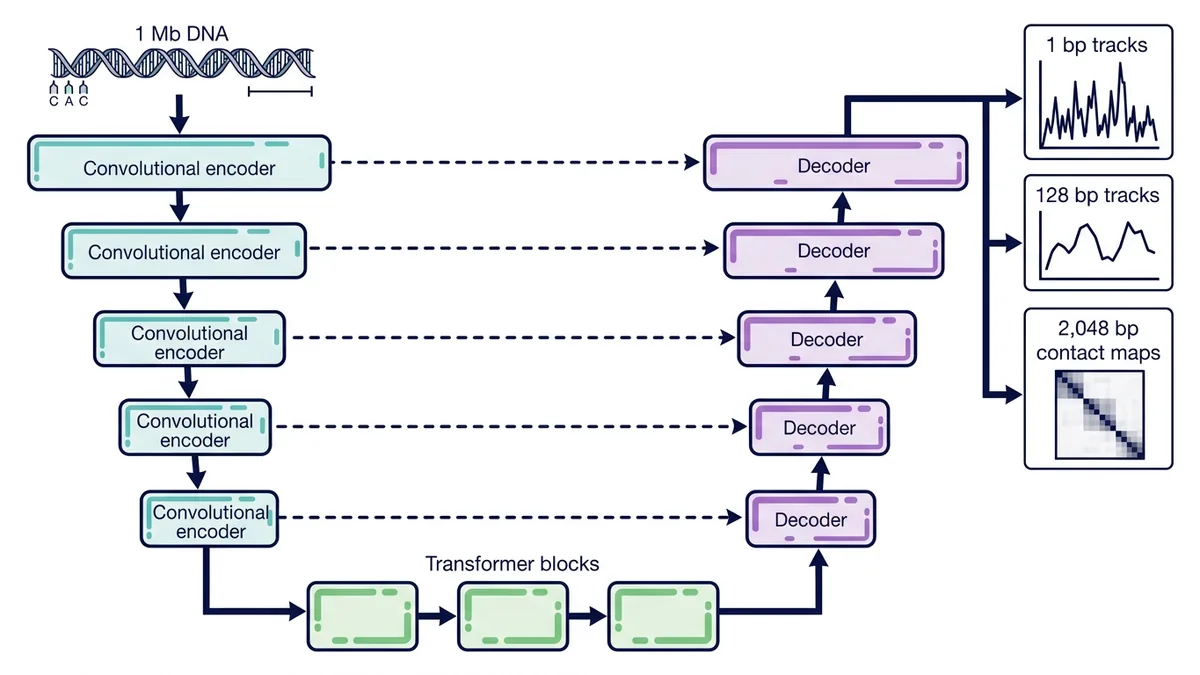
Figure 1. AlphaGenome's U-Net-style architecture: convolutional encoder, transformer blocks and decoder, with output heads at 1 bp, 128 bp and 2,048 bp [1]. Simplified schematic, AI-assisted illustration.
Training: teachers, a student and four hours of compute
Training ran in two stages. The first stage was pretraining with 4-fold cross-validation, which produced a set of "teacher" models, some trained on individual folds and some on all the data. The second stage distilled those teachers into a single "student" model, trained with random sequence augmentation and mutational perturbation. The point of distillation is speed: one model that scores variants quickly is more useful to a working lab than four models that score them slowly [1].
The training data came from public experimental measurements: ENCODE, GTEx, 4D Nucleome and FANTOM5, covering hundreds of human and mouse cell types and tissues [1]. By the numbers DeepMind published in June 2025, training a single model took about four hours and half the compute budget used to train the original Enformer [2].
How AlphaGenome scores a variant
Variant effect prediction with AlphaGenome is conceptually simple. Run the model on the reference allele. Run it again on the alternative allele. Compare the two sets of predictions across all modalities, and summarise the differences with modality-specific scores [1]. Because the model produces expression, splicing, accessibility, histone and contact outputs in the same pass, one comparison yields a profile of what the variant does, where older tools gave a single number for one assay.
flowchart TD
    A["Reference allele sequence"] --> C["AlphaGenome predictions"]
    B["Alternative allele sequence"] --> C
    C --> D["Compare per modality"]
    D --> E["Expression score"]
    D --> F["Splicing score"]
    D --> G["Accessibility score"]
    D --> H["Contact map score"]
    E --> I["Prioritised variant"]
    F --> I
    G --> I
    H --> I
Splice junction modelling deserves a separate mention. AlphaGenome predicts where RNA is spliced and how much, directly from sequence, which connects it to diseases where the defect is a splicing decision and the protein sequence is untouched. Spinal muscular atrophy and some forms of cystic fibrosis are the standard examples [2]. The broader biology of mRNA splicing is where a lot of non-coding variant interpretation ends up.
The TAL1 leukaemia example
The clearest worked example in the paper is TAL1. In T-cell acute lymphoblastic leukaemia, small non-coding insertions upstream of the TAL1 oncogene create a binding motif for the transcription factor MYB. That new motif forms a fresh enhancer, and the enhancer switches TAL1 on. Scoring the variants across all modalities at once, AlphaGenome recapitulated the mechanism: new MYB binding, gain of active histone marks and accessibility, and increased TAL1 expression [1].
What makes the example useful is that it is not a single-track prediction. The model had to get the binding event, the chromatin consequence and the expression change right together. That is the kind of multi-layer readout that a GWAS follow-up study usually has to assemble from several separate experiments.
Benchmarks: how AlphaGenome compares with Enformer, Borzoi and others
The Nature paper reports results across genome track prediction and variant effect prediction. The headline numbers are in the table below [1].
| Task | Comparison model | Result |
|---|---|---|
| Genome track prediction | 24 tasks | Best on 22 of 24 |
| Variant effect prediction | Strongest external models | Matched or beat in 25 of 26 evaluations |
| Cell-type-specific gene expression fold changes | Borzoi | +14.7% |
| eQTL effect direction (sign) prediction | Previous best | auROC improved from 0.75 to 0.80 |
| Fine-mapped splicing QTLs | Splicing benchmarks | State of the art on 6 of 7 |
| Chromatin accessibility QTLs | ChromBPNet | +8.0% across five datasets |
| Contact maps | Orca | +6.3% Pearson correlation |
One detail to flag: the June 2025 preprint reported 24 of 26 variant effect evaluations, and the peer-reviewed paper reports 25 of 26. The number moved between preprint and publication, which is normal. Cite the published figure [1][2].
The eQTL sign result is the one I find most interesting. Direction of effect is a harder problem than magnitude, because it requires the model to learn which way a regulatory change pushes expression. Going from auROC 0.75 to 0.80 on that task is a meaningful step [1].
AlphaGenome Atlas: 9 billion variants you can look up in a browser
The AlphaGenome Atlas was released on 8 September 2026. It contains precomputed predictions for all roughly 9 billion possible single-nucleotide variants in the human genome, which is every position multiplied by the three possible substitutions. The total is about 1 petabyte of predictions. Scientific American reports it is about 30 times larger than the AlphaFold database [3][5].
Each variant carries thousands of molecular effect predictions across hundreds of human and mouse cell types and tissues. The Atlas also maps more than 2,500 DNA sequence motifs to their genomic locations [3][4].
Pushmeet Kohli, VP of Science at Google DeepMind, framed the access point this way: "This represents the first time that any researcher in the world can access a comprehensive map of the human genome and its variations by simply opening a browser." [4]
What the AVI score does
The AVI (AlphaGenome Variant Impact) score is the Atlas's organising idea. It combines AlphaGenome's non-coding predictions with AlphaMissense predictions for protein-coding changes, so any variant, coding or not, gets a single prioritisation score. AVI feature attributions then show which process is disrupted, for example splicing or expression [3][4].
That second part matters as much as the score itself. A high AVI score tells you to look. The attributions tell you what to look at. Žiga Avsec, Genomics lead at Google DeepMind, described the intended use: "If somebody is studying a disease, and they don't have any idea about what cell types to look for... starting with an AVI score... is a great starting point to help you prioritize variants." [5]
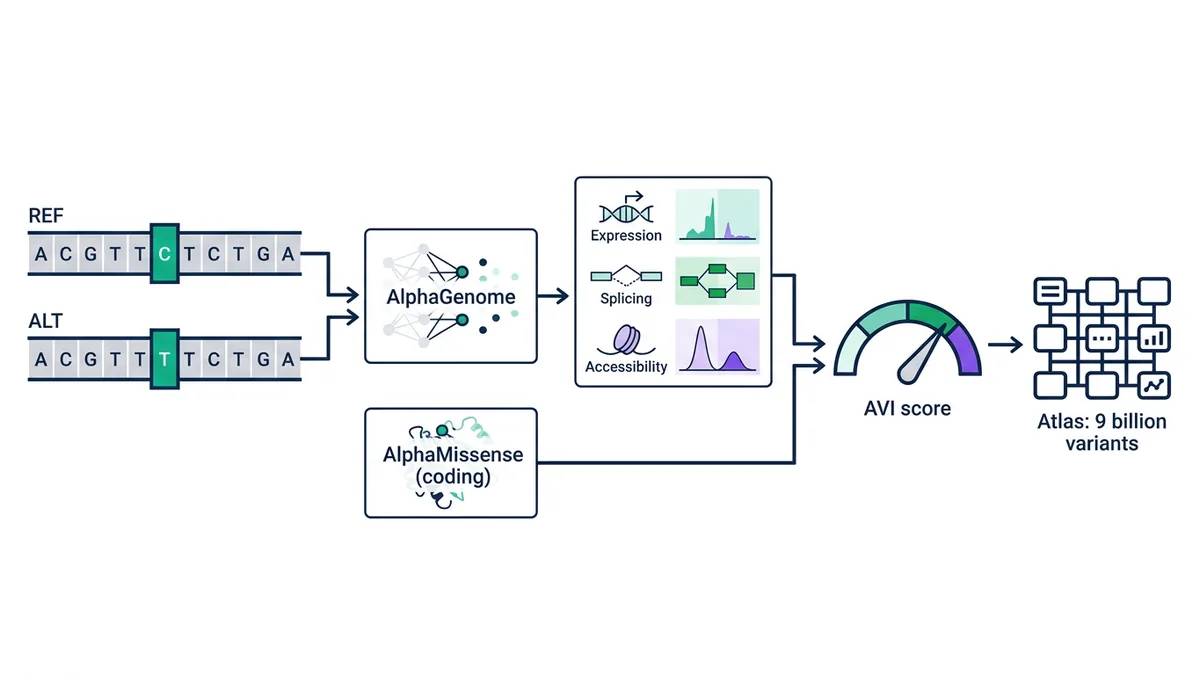
Figure 2. How a variant gets an AVI score: AlphaGenome compares REF and ALT sequences, AlphaMissense scores coding changes, and the combined result is precomputed in the Atlas [3][4]. Schematic, AI-assisted illustration.
Early results from Broad, Exeter and Stowers
Three groups used the Atlas early, and their reports are the most concrete evidence so far that the approach works outside a benchmark.
At the Broad Institute, Laura Covill and Anne O'Donnell-Luria, working with the GREGoR Consortium, used the AVI score to identify a variant in the DNM1 gene that resolved an unsolved case of epileptic encephalopathy [3][5].
Gareth Hawkes at the University of Exeter, working with data from more than 54,000 UK Biobank participants, found 22% more non-coding genetic associations and 19 genetic regions linked to body mass index [3][5].
Julia Zeitlinger and Melanie Weilert at the Stowers Institute used the motif data to categorise how transcription factors act [3][5].
Jonathan Sebat, a psychiatric geneticist at UC San Diego, described the practical effect on his group: "Our own workflows in the lab can be streamlined quite a bit because we don't actually have to compute anything. We literally can just look up everything." [5]
Access and licensing
| Access route | Who it is for | Cost and licence |
|---|---|---|
| Web portal at alphagenome.google/atlas | Academic and non-commercial researchers | Free, no coding needed |
| Base model via GitHub and the AlphaGenome API | Academic and non-commercial researchers | Free for non-commercial use |
| Google Antigravity skill | Developers working in Antigravity | Available as a skill |
| Google Cloud Model Garden | Commercial users | Licence required, announced as forthcoming |
The licensing split is a real difference from AlphaFold. The AlphaFold database is open to commercial users. The AlphaGenome Atlas is not: commercial users must license it [3]. For a biotech or a diagnostic company, that changes the build-versus-buy calculation.
Limitations researchers should keep in mind
The paper and DeepMind's own materials list the failure modes plainly, and they deserve a careful read before you build a pipeline around the model [1][2][3].
Accuracy decays for regulatory elements far from their target gene. Capturing elements more than 100,000 bp away remains difficult. Cell-type and tissue-specific patterns are harder to predict than the average case, and tissue-specific alternative splicing needs refinement. The model was not designed or validated for predicting a person's genome as a whole, and it does not model how development and environment shape complex traits. Training leaned on reference cell lines and healthy tissues, which may limit disease-specific use. Only human and mouse were used, so performance in other species is untested. And it is not validated or approved for any clinical use.
Scientific American adds a useful framing note: the Atlas is "far less accurate" than AlphaFold's database and is best treated as a starting point [5]. The Nature Structural & Molecular Biology News & Views piece by Dennis Gankin and Pedro Beltrao of ETH Zurich and the Swiss Institute of Bioinformatics called AlphaGenome "the largest multimodal DNA sequence model for non-coding regions so far" while stating that "opportunities for further improvement remain" [6].
Where AlphaGenome goes next
The Atlas covers single-nucleotide variants. Insertions, deletions and structural variants are not precomputed, so they still need the model to be run. That is not a small gap, because the TAL1 example is precisely a case of small non-coding insertions creating a new enhancer. If your variant of interest is an indel, you are back to running the API [1][3].
The species gap is the one I watch most closely, because much of this site's readership works on animals. AlphaGenome was trained on human and mouse only. Whether a human-trained regulatory model transfers to a chicken, pig or dog genome is an open question, and no published evaluation answers it yet. Building a comparable model for dog breeds, cattle or poultry would need equivalent functional genomics data, and that data is far sparser outside the human and mouse reference sets. Projects like FAANG (Functional Annotation of Animal Genomes) are the obvious source to build from. Cross-species transfer from AlphaGenome itself is untested, and I would not assume it works.
The clearest technical gaps are the same ones the paper names: distal enhancers beyond 100 kb, and cell-type specificity. Both are open research problems, and neither looks like something more compute alone will fix.
On the clinical path, AlphaGenome needs prospective validation before it can inform a diagnosis. Today it is a prioritisation tool for rare-disease teams and for GWAS follow-up, and that is already a useful role. It is not a diagnostic.
Pairing with protein models is a natural direction. AVI already folds in AlphaMissense, so the regulatory and structural sides are connected at the scoring layer. Linking regulatory predictions more directly to structure resources like the AlphaFold Database looks like a sensible next step. A companion article on this site covers the AlphaFold Database adding viral protein complexes in September 2026, and the two threads are converging on the same idea: one query, multiple layers of biology.
The licensing difference matters commercially. A diagnostic company that wants to ship an AVI-based prioritisation step has to license through Google Cloud Model Garden instead of pulling from an open database. That is a business decision as much as a scientific one, and it will shape who builds products on top of the atlas.
How to start using AlphaGenome in your lab
- Check whether your variant is a single-nucleotide change. If it is, look it up in the Atlas portal first. No code, no compute, no queue.
- Read the AVI attributions as well as the score. The attributions tell you whether the signal is coming from splicing, expression, accessibility or contacts, and that determines what experiment you run next.
- For indels and structural variants, run the base model through the AlphaGenome API or the GitHub release. The Atlas does not cover them.
- Use the model as a hypothesis generator, then validate. MPRA, CRISPR perturbation and reporter assays are the standard confirmations, and none of them are replaced by a prediction.
- Check the cell types in your prediction against the cell types in your disease. If the model has no relevant tissue in its training data, treat the output as weak evidence.
- Do not put AlphaGenome output into clinical reporting. It is not validated or approved for clinical use.
- If you work on a non-human, non-mouse species, treat any output as exploratory until someone validates cross-species transfer. For livestock and companion animals, FAANG-style annotation data is the place to start building something comparable.
For background on what the non-coding outputs represent biologically, start with the notes on non-coding RNA and enhancer RNA.
Frequently Asked Questions
What is AlphaGenome?
AlphaGenome is a deep learning model from Google DeepMind that takes 1 megabase of DNA sequence as input and predicts thousands of functional genomic tracks at up to single-base-pair resolution. It covers 11 modalities including gene expression, splicing, chromatin accessibility, histone modifications, transcription factor binding and contact maps. The peer-reviewed paper appeared in Nature on 28 January 2026 [1][2].
What is the AlphaGenome Atlas?
The AlphaGenome Atlas is a precomputed resource released on 8 September 2026 containing predictions for all roughly 9 billion possible single-nucleotide variants in the human genome. It is about 1 petabyte of data, roughly 30 times larger than the AlphaFold database, and it is accessible through a web portal that requires no coding [3][5].
What is an AVI score?
AVI stands for AlphaGenome Variant Impact. It combines AlphaGenome's non-coding predictions with AlphaMissense predictions for protein-coding changes, giving any variant a single prioritisation score. AVI feature attributions then indicate which process is disrupted, such as splicing or expression, so you know what kind of follow-up experiment makes sense [3][4].
How does AlphaGenome compare with Enformer?
AlphaGenome was trained with about half the compute budget used for the original Enformer, and training a single model took roughly four hours. On benchmarks it was best on 22 of 24 genome track prediction tasks and matched or beat the strongest external models in 25 of 26 variant effect evaluations [1][2].
Can AlphaGenome predict non-coding variant effects accurately?
It performs well on benchmark tasks, including a +8.0% improvement over ChromBPNet on chromatin accessibility QTLs and state-of-the-art results on 6 of 7 fine-mapped splicing QTL benchmarks. Accuracy still decays for regulatory elements more than 100,000 bp from their target gene, and cell-type-specific patterns remain harder to predict [1].
Is AlphaGenome free to use?
The web portal and the base model are free for academic and non-commercial research. Commercial use requires a licence through Google Cloud Model Garden, which was announced as forthcoming. This differs from the AlphaFold database, which is open to commercial users [3].
Can I use AlphaGenome for clinical diagnosis?
No. AlphaGenome is not validated or approved for any clinical use, and it was not designed or validated for predicting a person's genome as a whole. It is a prioritisation tool for research, including rare-disease case resolution and GWAS follow-up, and any finding needs prospective validation before it could inform a diagnosis [1][3].
Related Articles
- AlphaFold Database adds viral protein complexes: what NVIDIA, EMBL-EBI and Glasgow built
- Transcription factors
- mRNA splicing
- Making a GWAS Manhattan plot in R
References
- Avsec Z, Latysheva N, et al. Advancing regulatory variant effect prediction with AlphaGenome. Nature 649, 1206-1218 (2026).
- AlphaGenome: AI for better understanding the genome. Google DeepMind, 25 June 2025 (updated January 2026).
- AlphaGenome Atlas: molecular predictions for 9 billion human DNA variants. Google DeepMind, 8 September 2026.
- Kohli P, Avsec Z. AlphaGenome Atlas: a high-resolution map of human DNA. Google Blog, 8 September 2026.
- New Google DeepMind atlas could transform our understanding of genetic diseases. Scientific American, 8 September 2026.
- Gankin D, Beltrao P. The AlphaGenome deep learning model predicts effects of non-coding variants. Nature Structural & Molecular Biology 33 (2026).
- AlphaGenome predicts the impact of DNA variations. Nature Portfolio press release, 29 January 2026.
- Avsec Z, et al. Advancing regulatory variant effect prediction with AlphaGenome (PubMed record). PubMed 41606153