Three Domains of Life: Bacteria, Archaea and Eukarya
By Dr. Zubair Khalid, DVM, MS, PhD ·
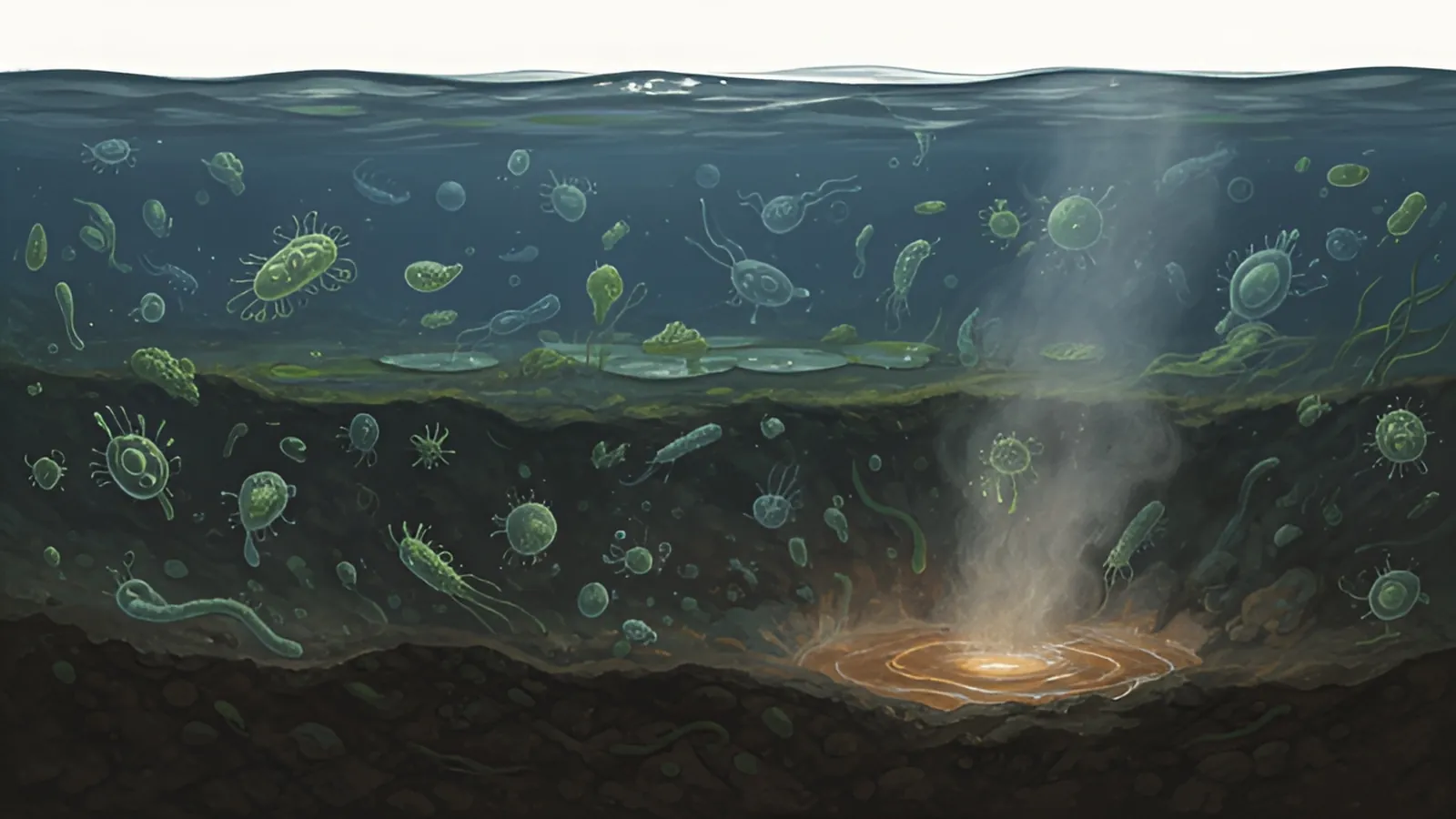
The three domains of life are Bacteria, Archaea and Eukarya, the highest rank used to classify all cellular organisms. Carl Woese, Otto Kandler and Mark Wheelis introduced the system in 1990, splitting the organisms then called archaebacteria away from Bacteria as a separate domain (Three). The grouping rests on differences in ribosomal RNA sequences, together with membrane lipid structure and sensitivity to antibiotics (1.3: Classification/Unit_1%3A_Introduction_to_Microbiology_and_Prokaryotic_Cell_Anatomy/1%3A_Fundamentals_of_Microbiology/1.3%3A_Classification_-_The_Three_Domain_System)).
Bacteria and Archaea are prokaryotes: their cells have no nuclear membrane, and the DNA sits in a protein-nucleic acid structure called the nucleoid (The Three Domains of Life). Eukarya are the organisms whose cells enclose their DNA in a nucleus, a group covering animals, plants, fungi and protists. All three domains are generally traced back to a last universal common ancestor, and the question of whether Eukarya should instead sit inside Archaea is still argued (1.3: Classification/Unit_1%3A_Introduction_to_Microbiology_and_Prokaryotic_Cell_Anatomy/1%3A_Fundamentals_of_Microbiology/1.3%3A_Classification_-_The_Three_Domain_System); Three).
Key Points
- Woese argued from differences in 16S rRNA genes that bacteria, archaea and eukaryotes each arose separately from an ancestor with poorly developed genetic machinery, often called a progenote (Three).
- The term "domain" was adopted in 1990, replacing Woese's earlier use of "kingdom" for the three primary phylogenetic groupings.
- Archaea were first classified as bacteria because they share the rod, spiral and marble-like cell shapes of bacteria, yet their DNA differs substantially and they carry genes shared with eukaryotes along with many unique genes (The Three Domains of Life).
- Salvador Luria and Ernst Mayr objected to splitting the prokaryotes, and growing supporting data led the scientific community to accept Archaea by the mid-1980s.
- A two-domain alternative holds that eukaryotes evolved from an archaeal host with affinities to living Asgard archaea, in combination with an endosymbiont belonging to or closely related to Alphaproteobacteria.
- rRNA is a useful comparison tool because the molecule carries out the same function in all cells and its structure changes very little over time, so sequence similarities indicate relatedness (1.3: Classification/Unit_1%3A_Introduction_to_Microbiology_and_Prokaryotic_Cell_Anatomy/1%3A_Fundamentals_of_Microbiology/1.3%3A_Classification_-_The_Three_Domain_System)).
At a Glance
| Domain | Cell type | Distinctive features | Examples |
|---|---|---|---|
| Bacteria | Prokaryotic | No nucleus; peptidoglycan in many cell walls (Three) | E. coli, soil bacteria, gut microbes (In defence of the three-domains of life paradigm; 1.3: Classification/Unit_1%3A_Introduction_to_Microbiology_and_Prokaryotic_Cell_Anatomy/1%3A_Fundamentals_of_Microbiology/1.3%3A_Classification_-_The_Three_Domain_System)) |
| Archaea | Prokaryotic | No nucleus; ether-linked membrane lipids; distinct rRNA and genes | Methanogens, halophiles, thermophiles (The Three Domains of Life; In defence of the three-domains of life paradigm) |
| Eukarya | Eukaryotic | Nucleus; membrane-bound organelles; multicellular forms (The Three Domains of Life) | Animals, plants, fungi, protists |
The three domains divide cellular life by cell structure, membrane chemistry and genetic sequence data (Three; 1.3: Classification/Unit_1%3A_Introduction_to_Microbiology_and_Prokaryotic_Cell_Anatomy/1%3A_Fundamentals_of_Microbiology/1.3%3A_Classification_-_The_Three_Domain_System)). All three share DNA, ribosomes and cell membranes, which indicates common ancestry (1.3: Classification/Unit_1%3A_Introduction_to_Microbiology_and_Prokaryotic_Cell_Anatomy/1%3A_Fundamentals_of_Microbiology/1.3%3A_Classification_-_The_Three_Domain_System)).
What Are the Three Domains of Life?
The three domains of life are Bacteria, Archaea and Eukarya. A domain is the highest taxonomic rank used for cellular organisms, above kingdom (Three). Every cellular organism is placed in one of these three groups (1.3: Classification/Unit_1%3A_Introduction_to_Microbiology_and_Prokaryotic_Cell_Anatomy/1%3A_Fundamentals_of_Microbiology/1.3%3A_Classification_-_The_Three_Domain_System)). The domains are treated as primary lines of descent, not as steps on a ladder.
A rank above kingdom
Earlier classifications used kingdom as the top rank. The three-domain system adds a level above kingdom, so each domain can contain one or more kingdoms (Three). Carl Woese and colleagues introduced the system after comparing ribosomal RNA genes, and the term domain was adopted in 1990. Woese initially used the word kingdom for the three primary groupings; domain became the accepted term later.
What separates the domains
Three kinds of evidence separate the domains: ribosomal RNA sequence, cell structure and membrane lipid chemistry (1.3: Classification/Unit_1%3A_Introduction_to_Microbiology_and_Prokaryotic_Cell_Anatomy/1%3A_Fundamentals_of_Microbiology/1.3%3A_Classification_-_The_Three_Domain_System)). Bacteria and Archaea both have prokaryotic cells, which lack a nucleus (The Three Domains of Life). Eukarya have eukaryotic cells, with a nucleus and other membrane-bound structures. Archaea can look like bacteria under a microscope, with rod, spiral and round shapes, but their DNA and genes differ from bacterial DNA and genes.
A worked example: placing a new microbe
Suppose a single-celled organism is isolated from a hot spring. Shape alone is weak evidence, because archaea and bacteria share many shapes (The Three Domains of Life). A more reliable step is to sequence its 16S rRNA gene and compare it with known sequences (Three; 1.3: Classification/Unit_1%3A_Introduction_to_Microbiology_and_Prokaryotic_Cell_Anatomy/1%3A_Fundamentals_of_Microbiology/1.3%3A_Classification_-_The_Three_Domain_System)). If the sequence falls within the archaeal group and the membrane lipids are ether-linked, the organism is placed in Archaea (Three). If it has bacterial rRNA and peptidoglycan in the cell wall, it is placed in Bacteria. If the cell has a nucleus and organelles, it is placed in Eukarya. The domain assignment follows the strongest combined evidence, not shape alone.
Shorthand and its limits
Prokaryote is a structural term, not a domain name. It describes cells without a nucleus and applies to both Bacteria and Archaea (The Three Domains of Life). The three-domain system does not use Prokarya as a rank because Bacteria and Archaea are separate lines (Three). In teaching, "prokaryote" remains useful for cell structure, but it does not replace a domain name.
Why the rank matters
Domain names frame comparisons across all life. A laboratory worker who identifies an organism as Archaea expects differences from Bacteria in membrane lipids, rRNA and genetics (Three; The Three Domains of Life). A student who identifies a cell as Eukarya expects a nucleus and organelles (The Three Domains of Life). The rank also sets the top level for phylogenetic trees. The three domains give a common starting point for classification, from clinical isolates to soil samples (1.3: Classification/Unit_1%3A_Introduction_to_Microbiology_and_Prokaryotic_Cell_Anatomy/1%3A_Fundamentals_of_Microbiology/1.3%3A_Classification_-_The_Three_Domain_System)).
Why the Three-Domain System Replaced the Five Kingdoms
The five-kingdom system divided life into Animalia, Plantae, Fungi, Protista and Bacteria (The Three Domains of Life). Those kingdoms were generally grouped into two broad categories, Eukarya and Prokarya. That arrangement put all prokaryotes in one kingdom and made the nucleus the main divide between cell types. New molecular data showed that the single prokaryotic group contained two very different kinds of cells.
The five-kingdom arrangement
In the five-kingdom view, bacteria were the prokaryotic kingdom, and the other four kingdoms were eukaryotic (The Three Domains of Life). Animals, plants, fungi and protists all have cells with a nucleus that holds DNA. Bacteria lack that nuclear membrane, and their DNA sits in a nucleoid region. The system was practical for visible anatomy and cell structure, but it did not resolve relationships among microbes.
Ribosomal RNA changes the picture
Carl Woese compared ribosomal RNA genes across organisms (Three). rRNA molecules carry out the same function in all cells and change slowly over time, so sequence differences are useful for judging relatedness (1.3: Classification/Unit_1%3A_Introduction_to_Microbiology_and_Prokaryotic_Cell_Anatomy/1%3A_Fundamentals_of_Microbiology/1.3%3A_Classification_-_The_Three_Domain_System)). The comparisons showed that methanogenic microbes differ fundamentally from bacteria such as Escherichia coli or Bacillus subtilis (In defence of the three-domains of life paradigm). Archaea also share some genes with eukaryotes and have many genes that are unique (The Three Domains of Life). This evidence split the old prokaryotes into two separate groups, Bacteria and Archaea.
What the three-domain system changed
The three-domain system adds a rank above kingdom and recognizes three primary lines of descent (Three). It separates the two prokaryotic groups instead of treating them as one kingdom (In defence of the three-domains of life paradigm). It also keeps Eukarya as a separate domain. Acceptance was slow. Prominent biologists, including Salvador Luria and Ernst Mayr, objected to splitting the prokaryotes. Growing data led the scientific community to accept Archaea by the mid-1980s, and few scientists today accept a unified Prokarya.
The two-domain challenge
Some scientists argue for two domains because eukaryotes may have evolved from an archaeal host with affinities to Asgard archaea, combined with an endosymbiont related to Alphaproteobacteria (Three). Under that view, Eukarya is a clade within Archaea, so a separate Eukarya domain overstates the split (Three; Dispatch Evolution: Two Domains of Life or Three?). Defenders of three domains argue that the eukaryotic lineage is distinct in cell structure, genetics and evolutionary history (In defence of the three-domains of life paradigm). The debate continues, but the three-domain model remains a standard framework in many textbooks and teaching resources.
Why the change persisted
The three-domain system gave biologists a way to place microbes that looked alike but differed in rRNA, lipids and genes (The Three Domains of Life; 1.3: Classification/Unit_1%3A_Introduction_to_Microbiology_and_Prokaryotic_Cell_Anatomy/1%3A_Fundamentals_of_Microbiology/1.3%3A_Classification_-_The_Three_Domain_System)). It also explained why some archaea live in harsh conditions that resemble early Earth (The Three Domains of Life). The five kingdoms still help with visible groups such as animals and plants, but they do not capture the deepest split among prokaryotes (Three; In defence of the three-domains of life paradigm).
Domain Bacteria: The Familiar Prokaryotes
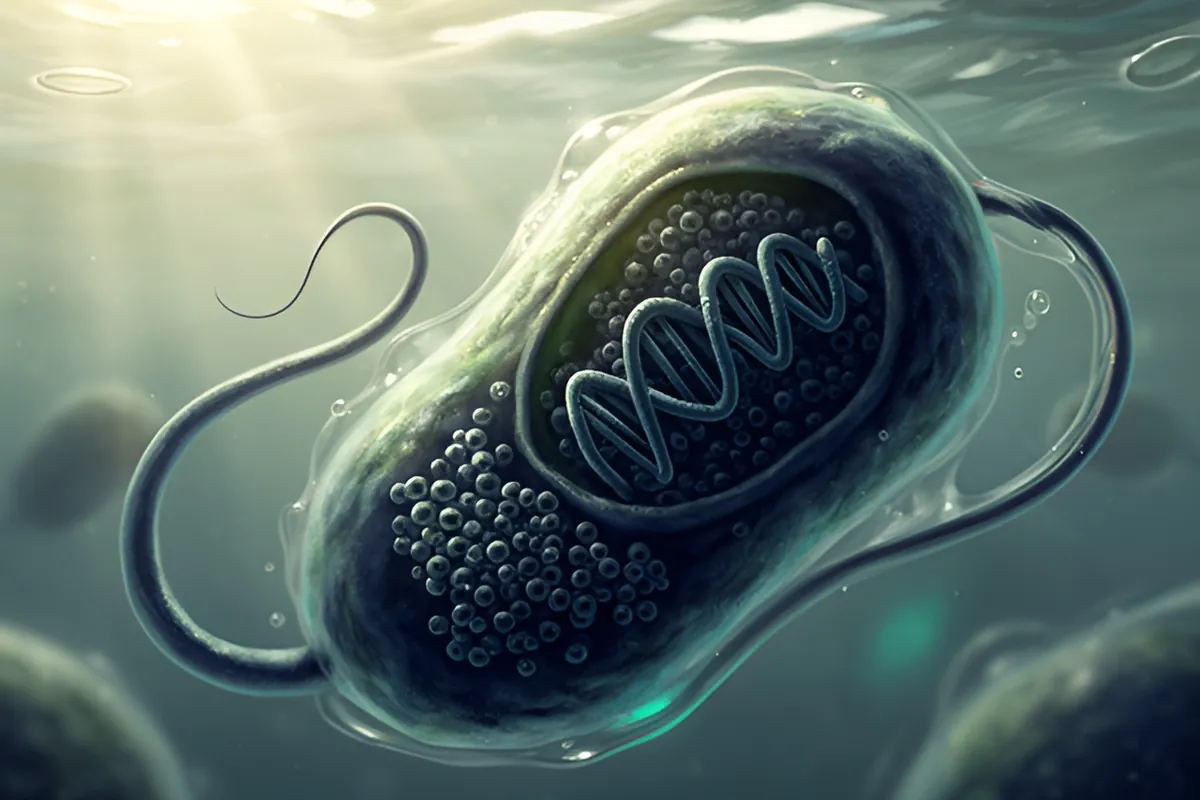
Bacteria are single-celled prokaryotes. Their cells lack a nucleus, and their DNA is not enclosed by a nuclear membrane (Three; The Three Domains of Life). Bacteria are the prokaryotes most often encountered in daily life: food spoilage, fermented foods, infections, soil communities and laboratory cultures. The domain is large and diverse, but its cell plan is consistently prokaryotic.
Cell plan
A bacterial cell has a cell membrane, cytoplasm, ribosomes and DNA (The Three Domains of Life). The DNA sits in a nucleoid region instead of a nucleus. Many bacteria have a cell wall, and the wall often contains peptidoglycan (Three). That polymer contributes to shape and strength. Some bacteria also have capsules, pili or flagella, though these structures vary by species.
Shape and cell wall
Bacteria appear as rods, spirals and round cells, the same range of shapes seen among archaea (The Three Domains of Life). Shape is useful for a first look under the microscope, but it does not define a domain. Cell wall chemistry is more informative. Peptidoglycan in the wall is a bacterial feature, and it is absent from archaeal walls (Three). The wall also reacts differently to stains, which is why Gram staining remains a common first step in microbiology.
Metabolism and ecology
Bacteria use diverse energy sources: sunlight, chemical reactions and organic matter (1.3: Classification/Unit_1%3A_Introduction_to_Microbiology_and_Prokaryotic_Cell_Anatomy/1%3A_Fundamentals_of_Microbiology/1.3%3A_Classification_-_The_Three_Domain_System)). Cyanobacteria use sunlight. Soil bacteria break down organic material and recycle nutrients. Gut microbes live in digestive tracts and affect nutrition and health. Some bacteria are pathogens that cause disease in humans, animals or plants (1.3: Classification/Unit_1%3A_Introduction_to_Microbiology_and_Prokaryotic_Cell_Anatomy/1%3A_Fundamentals_of_Microbiology/1.3%3A_Classification_-_The_Three_Domain_System)). The same domain includes organisms that fix nitrogen, ferment food and survive in extreme environments.
Reproduction and genetic change
Bacteria reproduce by binary fission, a simple division that produces two daughter cells (Three). Reproduction can be fast when conditions are favorable. Bacteria also exchange DNA by horizontal transfer, which can move genes for antibiotic resistance between cells. That horizontal movement is one reason bacterial populations can adapt quickly to new pressures.
Why bacteria matter
Bacteria are central to nutrient cycling, food production, disease and biotechnology (1.3: Classification/Unit_1%3A_Introduction_to_Microbiology_and_Prokaryotic_Cell_Anatomy/1%3A_Fundamentals_of_Microbiology/1.3%3A_Classification_-_The_Three_Domain_System)). In a veterinary clinic, bacterial infections are common reasons for treatment. In a laboratory, bacteria are workhorses for genetics and molecular biology. In a farm soil sample, bacteria drive decomposition and nitrogen availability. The domain Bacteria is familiar, but its metabolic range is wide (1.3: Classification/Unit_1%3A_Introduction_to_Microbiology_and_Prokaryotic_Cell_Anatomy/1%3A_Fundamentals_of_Microbiology/1.3%3A_Classification_-_The_Three_Domain_System)).
Domain Archaea: The Other Prokaryotes
Archaea are prokaryotes. Their cells have no nucleus, and their DNA sits in a nucleoid region, as in bacteria. For much of the twentieth century they were treated as a subgroup of bacteria and carried the name archaebacteria. Comparisons of ribosomal RNA showed that the two prokaryotic groups are only distant relatives, and Woese, Kandler and Wheelis placed Archaea in a domain of its own in 1990 (Three).
Membrane Lipids and Cell Walls
The membrane chemistry of archaea sets them apart from every other cell. Bacterial and eukaryotic membranes use ester-linked fatty acids, while archaeal membranes use ether-linked lipids built from branched isoprenoid chains (Three). That linkage changes how the membrane holds together under heat, salt and acid, and it gives a laboratory a quick chemical test for the domain.
Archaeal cell walls do not contain peptidoglycan, the mesh polymer that gives bacterial walls their strength (Three). Some archaea build walls from other polymers or from protein layers, and some have no wall at all. Antibiotics that block peptidoglycan assembly do not act on archaea, and sensitivity to antibiotics is one of the traits used to compare the domains (1.3: Classification/Unit_1%3A_Introduction_to_Microbiology_and_Prokaryotic_Cell_Anatomy/1%3A_Fundamentals_of_Microbiology/1.3%3A_Classification_-_The_Three_Domain_System)).
Genes That Resemble Eukaryotic Ones
Under a microscope an archaeon can look like a bacterium, with the same rod, spiral and marble shapes (The Three Domains of Life). The resemblance stops at the molecular level. Many archaeal genes and enzymes, including parts of the machinery for copying DNA and for reading genes into proteins, are closer to their eukaryotic counterparts than to bacterial ones. Archaea also carry many genes found nowhere else. This mix of shared and unique genes is part of why the group was so hard to place at first.
Where Archaea Live
Archaea are known for extreme habitats: hot springs, salt lakes, and deep sea vents (The Three Domains of Life). Some tolerate conditions close to those of the early Earth, which was hot, volcanic, and low in oxygen. The name comes from a root meaning ancient, a nod to that early-Earth connection.
The extreme label is incomplete. Archaea are also common in ordinary soils, in ocean water, and in the human microbiome (1.3: Classification/Unit_1%3A_Introduction_to_Microbiology_and_Prokaryotic_Cell_Anatomy/1%3A_Fundamentals_of_Microbiology/1.3%3A_Classification_-_The_Three_Domain_System)). Methanogens, the methane-producing archaea, are a well-studied example of the group doing routine chemistry in ordinary settings; ribosomal RNA work showed that these organisms differ fundamentally from bacteria such as Escherichia coli and Bacillus subtilis (In defence of the three-domains of life paradigm).
A Domain With a Moving Border
The place of archaea in the tree of life is still argued over. Evidence points to eukaryotes arising from an archaeal host with affinities to living Asgard archaea, combined with a bacterial endosymbiont (Three). On that basis some researchers propose folding Eukarya into Archaea as a two-domain system. Defenders of the three-domain model reply that the eukaryotic lineage is distinct from both Archaea and Bacteria in too many fundamental ways to be treated as a branch of either (In defence of the three-domains of life paradigm). Both views accept that Archaea is a real, deep split among cells.
Domain Eukarya: Cells With a Nucleus
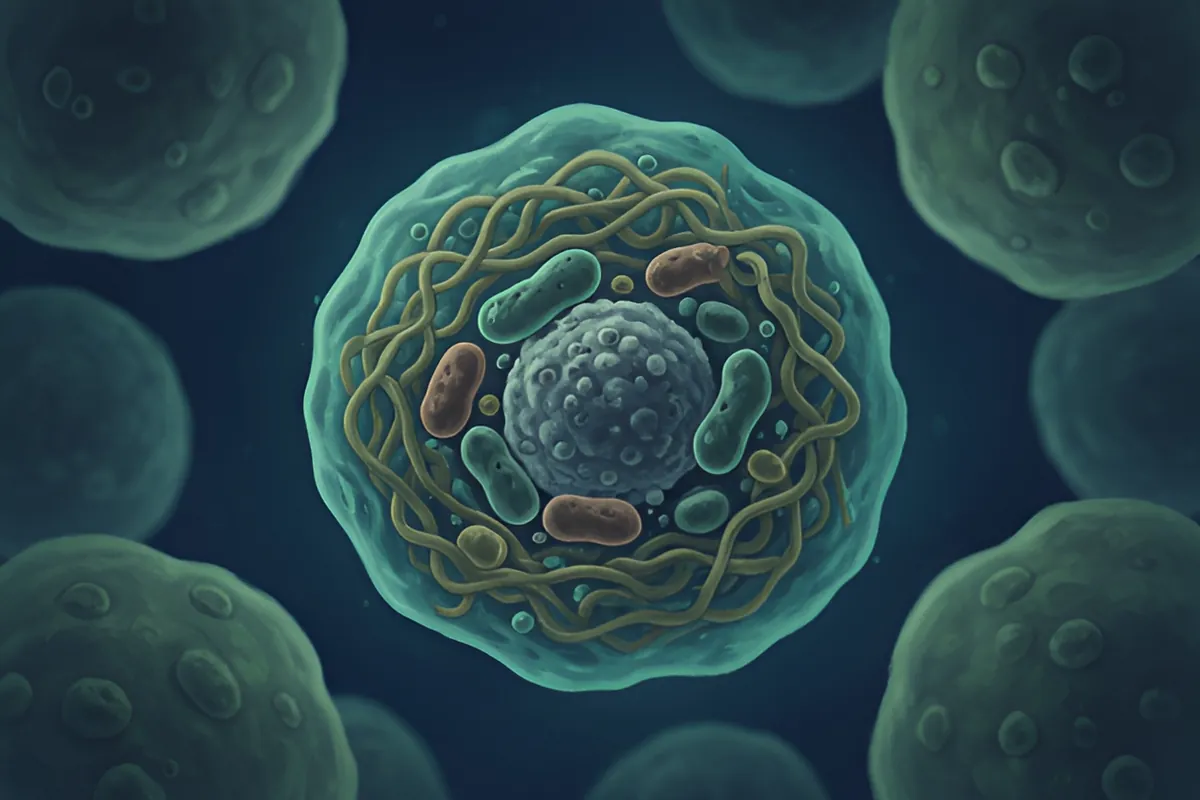
Eukaryotic cells keep their DNA inside a true nucleus, enclosed by a nuclear membrane, and they contain membrane-bound organelles such as mitochondria, the endoplasmic reticulum and the Golgi apparatus (Three). That internal compartmentalization is the single feature that separates Eukarya from the two prokaryotic domains, and it underlies the size and complexity of everything from a yeast cell to a redwood tree.
Four Groups, One Domain
Domain Eukarya takes in protists, fungi, plants and animals (1.3: Classification/Unit_1%3A_Introduction_to_Microbiology_and_Prokaryotic_Cell_Anatomy/1%3A_Fundamentals_of_Microbiology/1.3%3A_Classification_-_The_Three_Domain_System)). The four groups differ in nutrition and body plan, but they share the nuclear envelope and the organelle set. Protists are a practical catch-all category for eukaryotic organisms that do not fit the other three, and they include single-celled hunters, photosynthetic algae and large seaweeds.
| Group | Familiar members | Cell organization |
|---|---|---|
| Protists | Amoebae, ciliates, diatoms, kelps | Mostly single-celled; some colonial or multicellular |
| Fungi | Yeasts, molds, mushrooms | Single cells or filaments; walls of chitin |
| Plants | Mosses, ferns, grasses, trees | Multicellular; cellulose walls; chloroplasts |
| Animals | Sponges, insects, fish, mammals | Multicellular; no cell wall; food taken in whole |
Eukaryotes may be single-celled or multicellular (Three). A yeast is a complete organism built from one eukaryotic cell, while a mammal contains trillions of cells dividing labor among tissues.
Organelles With Bacterial Roots
Mitochondria and chloroplasts descend from bacterial ancestors (The Three Domains of Life). The standard account runs as follows: an archaeal host cell took in a bacterial partner that became the mitochondrion, and a later capture of a photosynthetic bacterium gave rise to chloroplasts in algae and plants (Three). The endosymbiont that produced mitochondria belongs to, or is closely related to, the Alphaproteobacteria. Both organelles still keep their own DNA and ribosomes, leftovers of their free-living past.
Reproduction and Life Cycles
Sexual reproduction is common across the domain (1.3: Classification/Unit_1%3A_Introduction_to_Microbiology_and_Prokaryotic_Cell_Anatomy/1%3A_Fundamentals_of_Microbiology/1.3%3A_Classification_-_The_Three_Domain_System)). Many protists, fungi, plants and animals alternate between a diploid phase and a haploid phase, with meiosis and cell fusion linking the two. Asexual reproduction also occurs widely, from budding in yeast to runners in strawberry plants. The combination gives eukaryotes a flexible route to genetic variety that bacteria and archaea reach by other means.
The Boundary That Moves
Where Eukarya begins is unsettled. Findings that eukaryotes arose within Archaea, close to Asgard archaea, have led some researchers to propose a two-domain tree (Three). Others argue that the eukaryotic lineage differs from Archaea and Bacteria at so many fundamental levels, from cell structure to genetic organization, that a separate domain remains the accurate description (In defence of the three-domains of life paradigm). Either way, the nucleus remains the practical marker students can see.
Key Differences Between Bacteria, Archaea and Eukarya
Three features carry most of the weight when the domains are compared: the nucleus, the chemistry of the membrane, and the sequence of ribosomal RNA.
| Feature | Bacteria | Archaea | Eukarya |
|---|---|---|---|
| Nucleus | Absent (Three) | Absent | Present |
| Membrane lipids | Ester-linked fatty acids | Ether-linked isoprenoid chains | Ester-linked fatty acids |
| Cell wall | Peptidoglycan present | No peptidoglycan; other polymers or none | Cellulose, chitin, or no wall |
| Ribosomal RNA | One distinct type | A second distinct type | A third distinct type (The Three Domains of Life) |
| Membrane-bound organelles | None | None | Present |
| Typical cell size and complexity | Small, simple | Small, simple | Usually larger and more complex (1.3: Classification/Unit_1%3A_Introduction_to_Microbiology_and_Prokaryotic_Cell_Anatomy/1%3A_Fundamentals_of_Microbiology/1.3%3A_Classification_-_The_Three_Domain_System)) |
| Familiar examples | E. coli, Bacillus subtilis (In defence of the three-domains of life paradigm) | Methanogens, Asgard archaea (Three; In defence of the three-domains of life paradigm) | Yeasts, plants, animals (1.3: Classification/Unit_1%3A_Introduction_to_Microbiology_and_Prokaryotic_Cell_Anatomy/1%3A_Fundamentals_of_Microbiology/1.3%3A_Classification_-_The_Three_Domain_System)) |
The Nucleus Line
The nucleus is the easiest feature to teach and the clearest to score. Bacteria and archaea both keep DNA in a nucleoid with no surrounding membrane, while eukaryotes wrap DNA in a nuclear envelope and divide it by mitosis (Three). A cell with a visible nucleus is eukaryotic; a cell without one belongs to Bacteria or Archaea, and the next two features decide which.
Lipids and Walls
Membrane lipids split the prokaryotes. Bacteria make ester-linked fatty acids; archaea make ether-linked lipids with branched chains (Three). Cell wall chemistry adds a second line of evidence. Peptidoglycan is a bacterial signature, and its absence in archaea was one of the first chemical clues that the two groups were unrelated. Eukaryotic walls vary by group: chitin in fungi, cellulose in plants, none in animals.
The Ribosome Record
Ribosomal RNA sorts the domains more finely than shape ever could. Woese built his case on differences in small subunit ribosomal RNA genes, which led him to treat bacteria, archaea and eukaryotes as three primary lines of descent (Three). The three rRNA types remain distinct, and that separation is the main evidence for three domains (The Three Domains of Life).
What the Table Does Not Show
The table presents tidy categories, but the biology is messier. Archaea share genes with eukaryotes as well as with bacteria, and they hold many genes unique to themselves (The Three Domains of Life). Horizontal gene transfer moves DNA between lineages, so a single gene can point the wrong way. Classification rests on many genes and many traits together, not on one row of the table.
How Scientists Classify Organisms into Domains
Assigning an organism to a domain is a sequence of comparisons, not a single measurement. Each step adds evidence, and the final call rests on the pattern across all of them.
Step 1: Compare Small Subunit Ribosomal RNA
The small subunit ribosomal RNA gene is the workhorse of domain-level classification (The Three Domains of Life). The molecule performs the same job in every cell, so its structure changes slowly, and sequence differences track evolutionary distance (1.3: Classification/Unit_1%3A_Introduction_to_Microbiology_and_Prokaryotic_Cell_Anatomy/1%3A_Fundamentals_of_Microbiology/1.3%3A_Classification_-_The_Three_Domain_System)). A new isolate's sequence is aligned against reference sequences from the three domains, and the closest matches point to the domain.
Step 2: Examine Membrane Lipids and Cell Walls
Chemistry comes next. Ether-linked isoprenoid lipids point to Archaea, ester-linked fatty acids point to Bacteria or Eukarya, and peptidoglycan in the wall points to Bacteria (Three). These are quick tests that a laboratory can run before sequencing finishes.
Step 3: Sequence Genomes and Build Trees
Whole genome sequencing adds thousands of genes to the comparison. Phylogenetic trees built from those genes show relationships among organisms and place new isolates on branches with their relatives (1.3: Classification/Unit_1%3A_Introduction_to_Microbiology_and_Prokaryotic_Cell_Anatomy/1%3A_Fundamentals_of_Microbiology/1.3%3A_Classification_-_The_Three_Domain_System)). The aim is shared ancestry: organisms grouped together are ones that descend from a common ancestor, judged on genetic data (In defence of the three-domains of life paradigm).
Step 4: Place the Domain Above the Kingdom
Domain is a rank above kingdom in the taxonomic hierarchy (Three). The three-domain system added that level to the older five-kingdom arrangement, so a full classification now runs domain, kingdom, phylum, class, order, family, genus, species.
| Rank | Example |
|---|---|
| Domain | Eukarya (1.3: Classification/Unit_1%3A_Introduction_to_Microbiology_and_Prokaryotic_Cell_Anatomy/1%3A_Fundamentals_of_Microbiology/1.3%3A_Classification_-_The_Three_Domain_System)) |
| Kingdom | Animalia (1.3: Classification/Unit_1%3A_Introduction_to_Microbiology_and_Prokaryotic_Cell_Anatomy/1%3A_Fundamentals_of_Microbiology/1.3%3A_Classification_-_The_Three_Domain_System)) |
| Phylum | Chordata |
| Class | Mammalia |
| Order | Primates |
| Family | Hominidae |
| Genus | Homo |
| Species | Homo sapiens |
A Worked Example
Suppose a lab isolates a microbe from a hot spring. The cells are rod-shaped and have no nucleus. The membrane contains ether-linked isoprenoid lipids, and the wall has no peptidoglycan. Sequencing of the small subunit ribosomal RNA places the isolate inside the archaeal branch, alongside cultivated thermophiles.
| Observation | What it indicates |
|---|---|
| No nucleus | Prokaryote: Bacteria or Archaea (Three) |
| Ether-linked isoprenoid lipids | Archaea |
| No peptidoglycan in the wall | Archaea |
| rRNA matches archaeal references | Domain Archaea (The Three Domains of Life) |
No single row settles the case. The nucleus rules out Eukarya, and the lipid and wall chemistry rule out Bacteria, so the rRNA result confirms what the chemistry already suggested. A soil isolate with a peptidoglycan wall and bacterial rRNA would run the same path toward Bacteria (Three; The Three Domains of Life).
Evidence for Three Domains: Ribosomes, Lipids and Genes
The three-domain system rests on molecules, not on shape or size. Carl Woese and colleagues compared ribosomal RNA sequences and found that organisms previously grouped together as bacteria fell into two deeply separated groups (Three). Later work added membrane lipids, DNA replication proteins and whole genomes to the case.
Ribosomal RNA Sequences
Ribosomes build proteins in every cell, and the RNA they contain performs the same job across all life. That constancy means the molecule changes slowly over time, so differences in its sequence are a reasonable measure of how long two lineages have been apart (1.3: Classification/Unit_1%3A_Introduction_to_Microbiology_and_Prokaryotic_Cell_Anatomy/1%3A_Fundamentals_of_Microbiology/1.3%3A_Classification_-_The_Three_Domain_System)). Comparisons of small-subunit rRNA genes show sharp differences among Bacteria, Archaea and Eukarya, with each domain forming its own cluster (The Three Domains of Life). Woese argued from these differences that the three groups arose separately from an ancestor with poorly developed genetic machinery, a form he called a progenote (Three).
Membrane Lipids: Ether Bonds and Ester Bonds
Membrane chemistry separates the domains as clearly as rRNA does. Archaeal membrane lipids join glycerol to their hydrophobic chains with ether bonds, while bacterial and eukaryotic lipids use ester bonds (Three). The chains differ too: archaeal chains are branched isoprenoids, and bacterial chains are usually straight fatty acids. These differences affect how a membrane behaves at high temperature, at low pH and under high salt, which is part of why archaeal membranes hold up in harsh settings.
DNA Replication Proteins
The machinery that copies DNA and reads genes gives a third line of evidence. Several archaeal replication and information-processing proteins resemble their eukaryotic counterparts more closely than they resemble the bacterial versions (The Three Domains of Life). If archaea were simply a branch of bacteria, that pattern would be hard to explain. It fits the view that Archaea and Eukarya share parts of their information-processing toolkit.
Horizontal Gene Transfer
Genes move between organisms, sometimes across domain boundaries. This movement blurs single-gene trees and can make one gene suggest a relationship that the rest of the genome does not support (Dispatch Evolution: Two Domains of Life or Three?). The disagreement over whether life has two domains or three partly reflects this noise, since some analyses place eukaryotes inside Archaea (Three; Dispatch Evolution: Two Domains of Life or Three?).
What the Core Genome Shows
Despite the noise, most core genes, the ones involved in ribosome function, transcription and translation, group the same way in most analyses, and that consistency supports the three-domain split (In defence of the three-domains of life paradigm). Supporters of the model argue that the eukaryotic lineage arose from a merger between an archaeal host and a bacterial symbiont and remains distinct from both Archaea and Bacteria in many fundamental ways.
| Feature | Bacteria | Archaea | Eukarya |
|---|---|---|---|
| Ribosomal RNA | Distinct bacterial signature | Distinct archaeal signature | Distinct eukaryotic signature |
| Membrane lipid bond | Ester-linked | Ether-linked | Ester-linked |
| Lipid chains | Straight fatty acids | Branched isoprenoids | Straight fatty acids |
| DNA replication proteins | Bacterial type | Resemble eukaryotic versions | Eukaryotic type |
Common Misconceptions About the Three Domains
A handful of errors show up repeatedly in class notes, quiz answers and popular summaries. Most come from mixing up cell structure with taxonomy.
Misconception 1: Archaea Are a Type of Bacteria
Archaea were once called archaebacteria and were classified with bacteria, largely because they look alike under a microscope: rods, spirals and small spheres (The Three Domains of Life). The name was dropped because the molecules inside are different. Archaea form a separate domain, treated as completely different organisms from bacteria (Three).
Misconception 2: Prokaryote Is a Domain
"Prokaryote" describes a cell type: a cell without a nucleus. It is not a taxonomic rank. The three domains are Bacteria, Archaea and Eukarya (1.3: Classification/Unit_1%3A_Introduction_to_Microbiology_and_Prokaryotic_Cell_Anatomy/1%3A_Fundamentals_of_Microbiology/1.3%3A_Classification_-_The_Three_Domain_System)). Two domains contain prokaryotic cells and one contains eukaryotic cells, so the word cuts across the classification instead of matching it. Today very few scientists accept a unified group called Prokarya (Three).
Misconception 3: Eukarya Means Animals and Plants
Eukarya covers every organism whose cells have a nucleus, which includes four of the five traditional kingdoms: animals, plants, fungi and protists (The Three Domains of Life). Many eukaryotes are single-celled protists, and many are microscopic. A kelp forest, a mushroom, a cow and a Paramecium all sit in the same domain.
Misconception 4: Three Domains Means Three Levels of Complexity
The domains are three primary lines of descent, not three rungs on a ladder (Three). Bacteria and archaea are not primitive versions of eukaryotes; each lineage has been evolving for the same span of time since the last universal common ancestor. Complexity is a separate question from branching order. Some microbiologists argue that eukaryotes should sit inside Archaea, which would leave two domains, and that debate is about branching, not about rank (Three; Dispatch Evolution: Two Domains of Life or Three?).
Misconception 5: Archaea Only Live in Extreme Places
Archaea were first studied in hot springs, salt lakes and other harsh sites, and that history created the impression that they are extremophiles only (The Three Domains of Life). They also live in ordinary settings, including seawater, soil and the digestive tracts of animals. The extreme examples are memorable, but they are a sample of the domain, not its limit.
| Common claim | Correction |
|---|---|
| Archaea are bacteria | Archaea are a separate domain (Three) |
| Prokaryote is a domain | Prokaryote is a cell type; the domains are Bacteria, Archaea and Eukarya (1.3: Classification/Unit_1%3A_Introduction_to_Microbiology_and_Prokaryotic_Cell_Anatomy/1%3A_Fundamentals_of_Microbiology/1.3%3A_Classification_-_The_Three_Domain_System)) |
| Eukarya means animals and plants | Eukarya also includes fungi and protists (The Three Domains of Life) |
| Three domains are three complexity levels | Domains are lines of descent, not ranks of complexity |
| Archaea live only in extreme places | Extreme sites were the first place they were found, not the only place they occur |
Where the Three Domains Live and Why It Matters
Bacteria: Soil, Water, Air and Hosts
Bacteria occupy soil, water, air and the inside of larger organisms (1.3: Classification/Unit_1%3A_Introduction_to_Microbiology_and_Prokaryotic_Cell_Anatomy/1%3A_Fundamentals_of_Microbiology/1.3%3A_Classification_-_The_Three_Domain_System)). They are the most abundant cells in many environments, and microbial life as a whole is still the dominant form of life on the planet. The total number of microbial cells on Earth has been estimated at about $2.5 \times 10^{30}$, which makes microbes the most numerous cells on Earth (1.3: Classification/Unit_1%3A_Introduction_to_Microbiology_and_Prokaryotic_Cell_Anatomy/1%3A_Fundamentals_of_Microbiology/1.3%3A_Classification_-_The_Three_Domain_System)). Microbial life appeared between 3.8 and 3.9 billion years ago, and roughly 80 percent of Earth's history was exclusively microbial (1.3: Classification/Unit_1%3A_Introduction_to_Microbiology_and_Prokaryotic_Cell_Anatomy/1%3A_Fundamentals_of_Microbiology/1.3%3A_Classification_-_The_Three_Domain_System)).
Archaea: Extreme Sites and the Deep Ocean
Archaea are well known from hot springs, salt lakes and other environments that resemble the early Earth, which was hot, volcanic and low in oxygen (The Three Domains of Life). They are also abundant in the deep ocean, where they take part in the chemistry of the water column. Methane-producing archaea live in wetlands, rice paddies and the rumen of cattle, and ammonia-oxidizing archaea are common in soils and seawater.
Eukarya: Forests, Reefs and Animal Bodies
Eukarya build the visible living world: forests, coral reefs and the bodies of animals (Three). The domain also includes fungi, algae and single-celled protists, many of which are the primary producers in lakes and oceans. Every plant, animal and fungus carries microbial partners, so eukaryotic habitats are also habitats for the other two domains.
Nutrient Cycles and Ecosystem Function
The three domains together drive the nutrient cycles that keep ecosystems running (1.3: Classification/Unit_1%3A_Introduction_to_Microbiology_and_Prokaryotic_Cell_Anatomy/1%3A_Fundamentals_of_Microbiology/1.3%3A_Classification_-_The_Three_Domain_System)). Bacteria and archaea fix nitrogen, decompose organic matter, oxidize ammonia and produce methane. Eukaryotes graze on microbes, and their waste returns nutrients to the microbial loop. Remove one group and the cycles slow or change direction.
Why the Framework Matters in Practice
Knowing which domain an organism belongs to guides practical decisions. Antibiotics that target bacterial ribosomes or cell walls act on Bacteria, and they generally miss Archaea and Eukarya because the targets differ (1.3: Classification/Unit_1%3A_Introduction_to_Microbiology_and_Prokaryotic_Cell_Anatomy/1%3A_Fundamentals_of_Microbiology/1.3%3A_Classification_-_The_Three_Domain_System)). In farming, domain-level identification separates the nitrogen-fixing bacteria in a soil sample from the methane-producing archaea in a rumen. In ecology, surveys of rRNA genes tell researchers which domains are present in a water or soil sample without culturing anything (1.3: Classification/Unit_1%3A_Introduction_to_Microbiology_and_Prokaryotic_Cell_Anatomy/1%3A_Fundamentals_of_Microbiology/1.3%3A_Classification_-_The_Three_Domain_System)). In medicine, the same approach identifies pathogens that do not grow on standard plates.
| Domain | Typical habitats | Ecological roles |
|---|---|---|
| Bacteria | Soil, water, air, host tissues (1.3: Classification/Unit_1%3A_Introduction_to_Microbiology_and_Prokaryotic_Cell_Anatomy/1%3A_Fundamentals_of_Microbiology/1.3%3A_Classification_-_The_Three_Domain_System)) | Decomposition, nitrogen fixation, disease |
| Archaea | Hot springs, salt lakes, deep ocean, wetlands (The Three Domains of Life) | Methane production, ammonia oxidation |
| Eukarya | Forests, reefs, lakes, animal bodies (Three) | Primary production, grazing, hosting symbionts |
Related Guides
- Archaea vs Bacteria: Key Differences
- Prokaryotic vs Eukaryotic Cells: Key Differences With Diagram
- Eukaryotic Cells: Structure, Organelles and Examples
- Kingdom Definition Biology
- Classification Biology
- Endosymbiotic Theory: Evidence and Explanation
- Phylogenetic Tree of Life: Construction, Interpretation, and Pitfalls
- 16S rRNA Gene Sequencing for Bacterial Identification
- Bacterial Cell Anatomy: Structures and Staining
- Cilia and Flagella: Structure, Function and Differences
Frequently Asked Questions
What are the three domains of life?
The three-domain system groups all cellular life into Archaea, Bacteria and Eukarya. Carl Woese, Otto Kandler and Mark Wheelis introduced it in 1990 (Three). Each domain is a primary line of descent, ranked above the kingdoms used in older schemes. Bacteria and Archaea are single-celled prokaryotes whose DNA lies in a nucleoid without a nuclear membrane, while Eukarya have cells with a true nucleus holding their DNA (The Three Domains of Life). The three domains are thought to descend from a last universal common ancestor, often called LUCA (1.3: Classification/Unit_1%3A_Introduction_to_Microbiology_and_Prokaryotic_Cell_Anatomy/1%3A_Fundamentals_of_Microbiology/1.3%3A_Classification_-_The_Three_Domain_System)).
What is the difference between bacteria and archaea?
Both are prokaryotes, but their cells differ fundamentally. Woese showed through ribosomal RNA analysis that methanogenic microbes are entirely distinct from bacteria such as Escherichia coli or Bacillus subtilis (In defence of the three-domains of life paradigm). Archaea and bacteria share some genes and similar shapes, yet archaeans also carry genes shared with eukaryotes and many genes unique to themselves (The Three Domains of Life). Their membrane lipids and antibiotic sensitivities differ as well (1.3: Classification/Unit_1%3A_Introduction_to_Microbiology_and_Prokaryotic_Cell_Anatomy/1%3A_Fundamentals_of_Microbiology/1.3%3A_Classification_-_The_Three_Domain_System)). The three-domain system treats this split as the deepest division among prokaryotes, replacing the old grouping of all prokaryotes into one empire (Three).
Are archaea a type of bacteria?
No. Archaea were once called archaebacteria and classified as bacteria because they look alike, sharing rod, spiral and marble-like shapes (The Three Domains of Life). Molecular work changed that. Ribosomal RNA sequences showed that archaea and bacteria form two entirely distinct groups of cells (In defence of the three-domains of life paradigm). Woese split the prokaryotes into Eubacteria, now called Bacteria, and Archaebacteria, now called Archaea, and placed them alongside Eukarya as three domains.
References and Further Reading
- Three, en.wikipedia.org
- 1.3: Classification/Unit_1%3A_Introduction_to_Microbiology_and_Prokaryotic_Cell_Anatomy/1%3A_Fundamentals_of_Microbiology/1.3%3A_Classification_-_The_Three_Domain_System), bio.libretexts.org
- The Three Domains of Life, astrobiology.nasa.gov
- In defence of the three-domains of life paradigm - PMC, pmc.ncbi.nlm.nih.gov
- Dispatch Evolution: Two Domains of Life or Three?, sciencedirect.com