Specific Heat: Formula, Units
By Dr. Zubair Khalid, DVM, MS, PhD ·

Specific heat, also called specific heat capacity, is the amount of heat needed to raise the temperature of one kilogram of a substance by one kelvin, or one degree Celsius, at constant pressure. It is an intensive property, so the value does not change when you take a larger or smaller sample.
Specific heat matters because it connects heat input to temperature change. That link appears in water baths, calorimetry, protein stability, food processing, soil heat storage, and clinical thermal analysis. A student who understands the formula and units can solve quantitative problems and read lab data without confusing specific heat with heat capacity, latent heat, or thermal conductivity.
What Specific Heat Means and What It Does Not Mean
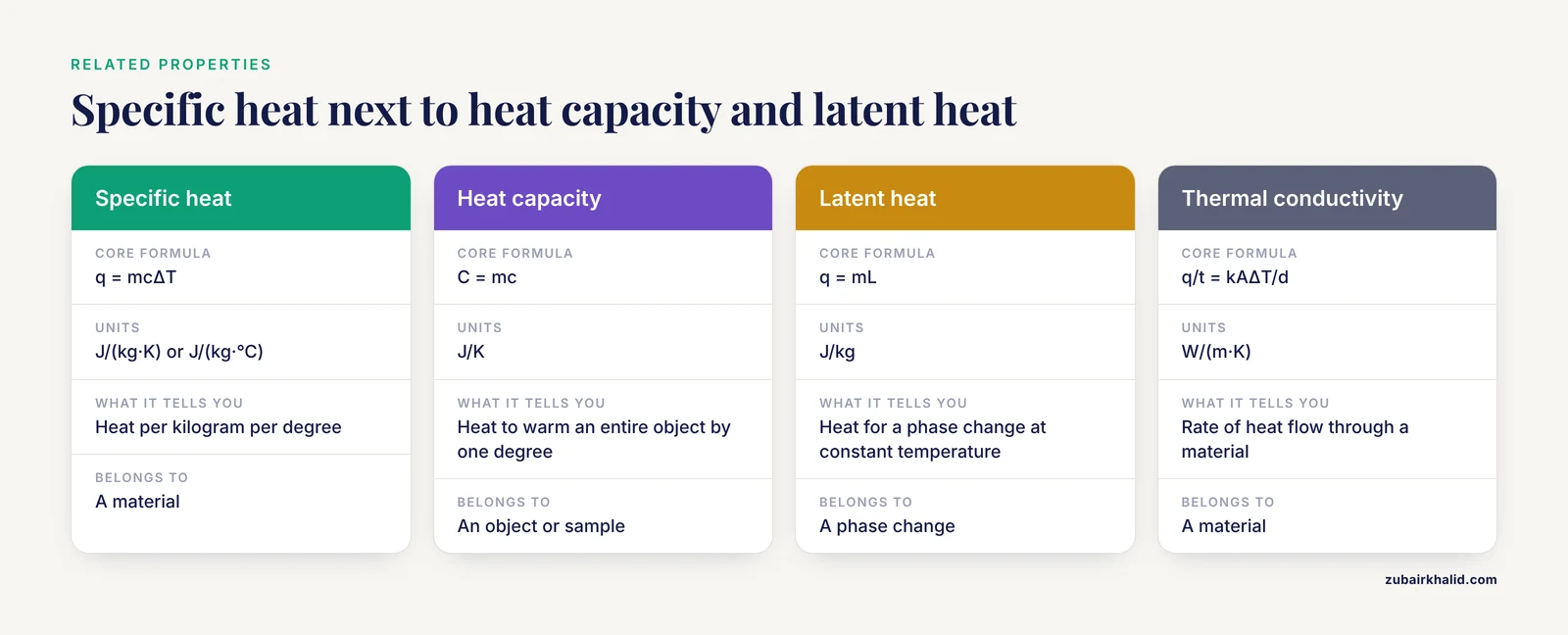
The specific heat definition is simple: it is heat energy per unit mass per unit temperature change. The word "specific" means per unit mass, not "special" or "unique." A material with a high specific heat needs more heat to warm up, and it releases more heat when it cools, compared with a material of the same mass and a lower specific heat.
Specific heat is not the same as heat capacity. Heat capacity belongs to an object or a sample. Specific heat belongs to a material. A cup of water and a bathtub of water have the same specific heat near room temperature, but the bathtub has a much larger heat capacity because it contains more mass. The bridge between the two is the formula C = mc, where C is heat capacity, m is mass, and c is specific heat capacity.
Specific heat is also not latent heat. Latent heat is the heat that changes phase without changing temperature, such as melting ice or boiling water. During a phase change, q = mcΔT does not describe the full energy flow because the temperature may stay constant. Specific heat describes heating within a single phase, such as warming liquid water from 20°C to 30°C.
Thermal conductivity is another separate property. Thermal conductivity measures how readily heat moves through a material. Specific heat measures how much energy a material stores for a given temperature rise. Copper has a low specific heat and high thermal conductivity. Water has a high specific heat and much lower thermal conductivity. The two properties often appear together in engineering, but they answer different questions.
| Term | Symbol | Core formula | Units | What it tells you |
|---|---|---|---|---|
| Specific heat capacity | c | q = mcΔT | J/(kg·K) or J/(kg·°C) | Heat needed per kilogram per degree of temperature change |
| Heat capacity | C | C = mc | J/K | Heat needed to warm an entire object by one degree |
| Molar heat capacity | Cm | Cm = cM | J/(mol·K) | Heat needed per mole per degree, where M is molar mass |
| Latent heat | L | q = mL | J/kg | Heat needed for a phase change at constant temperature |
| Thermal conductivity | k | q/t = kAΔT/d | W/(m·K) | Rate of heat flow through a material |
The table shows why unit labels matter. A value in J/(kg·K) is numerically one thousand times smaller than the same material value in J/(g·K). The number alone does not tell you which unit system a textbook or calculator is using.
The Specific Heat Formula and Units
The specific heat formula is:
q = mcΔT
Here, q is the heat added or removed, measured in joules. m is mass in kilograms. c is specific heat capacity in joules per kilogram per kelvin. ΔT is the final temperature minus the initial temperature, measured in kelvin or degrees Celsius. The two temperature scales differ by an offset, not by a scale factor, so a temperature change of 10°C equals a temperature change of 10 K.
The formula can be rearranged for any unknown:
c = q / (mΔT)
m = q / (cΔT)
ΔT = q / (mc)
Tfinal = Tinitial + q / (mc)
The same equation works with grams and J/(g·°C) as long as the mass unit matches the specific heat unit. Many chemistry classes use calories per gram per degree Celsius. One thermochemical calorie equals 4.184 joules, so 1 cal/(g·°C) equals 4.184 J/(g·°C), which equals 4184 J/(kg·K). Choosing the right row of units is more important than memorizing a single number.
Worked Example: Heating Water
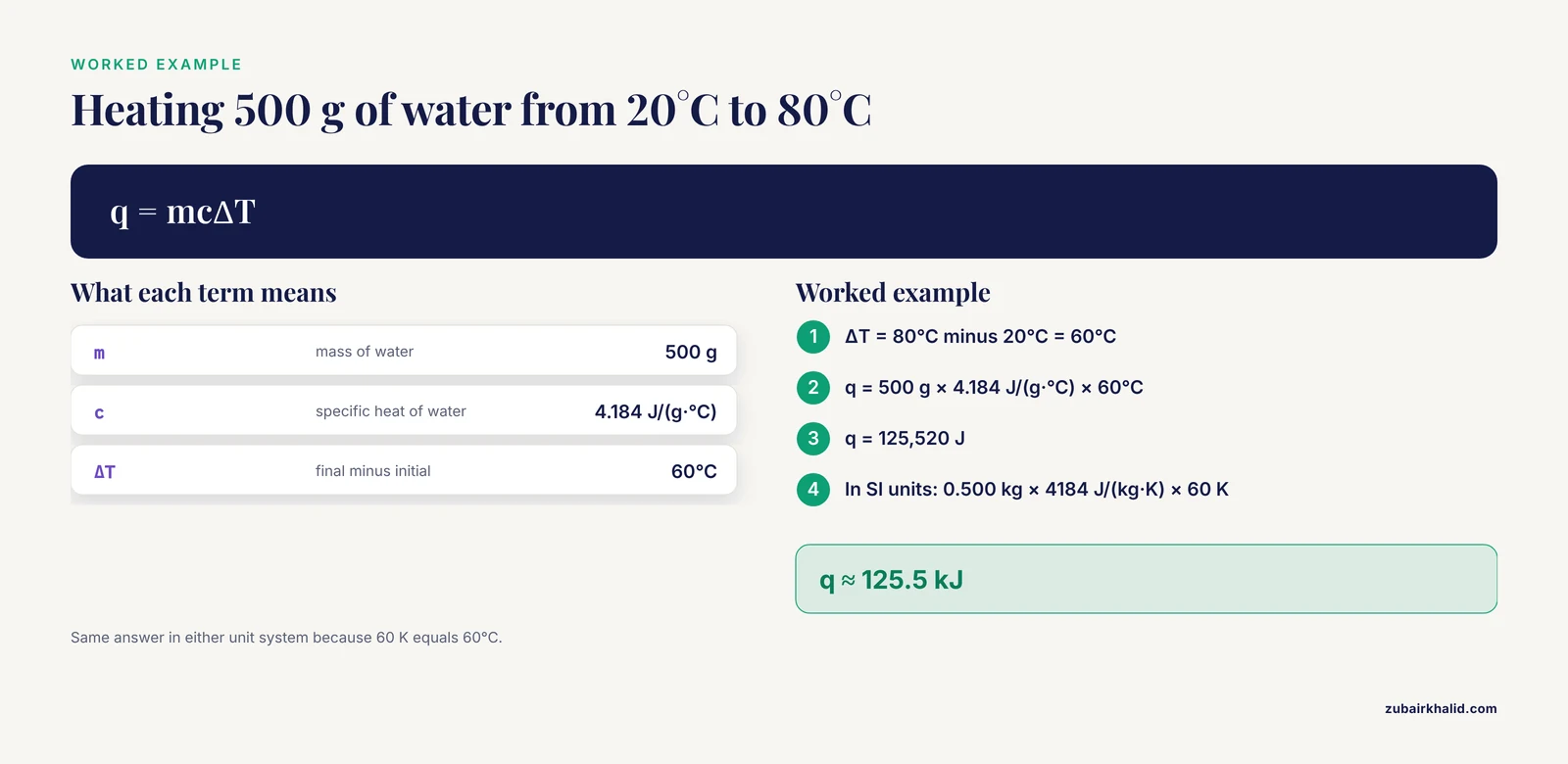
Suppose you heat 500 g of liquid water from 20°C to 80°C. The specific heat of liquid water near room temperature is about 4.184 J/(g·°C). The temperature change is 80°C minus 20°C, or 60°C. The heat added is:
q = 500 g × 4.184 J/(g·°C) × 60°C
q = 125,520 J
q ≈ 125.5 kJ
The same calculation in SI units uses 0.500 kg and 4184 J/(kg·K). The result is the same because 60 K equals 60°C.
Worked Example: Finding an Unknown Specific Heat
A 250 g sample absorbs 9,000 J of heat and its temperature rises by 40°C. The specific heat is:
c = 9,000 J / (250 g × 40°C)
c = 9,000 / 10,000 J/(g·°C)
c = 0.900 J/(g·°C)
In SI units, that is 900 J/(kg·K). A value near 0.90 J/(g·°C) is in the range of aluminum, which is a useful check when a lab result looks plausible or suspicious.
Unit Conversions That Prevent Errors
Specific heat units come in several common forms. J/(kg·K) is the SI form. J/(kg·°C) is numerically identical because the degree size is the same. J/(g·°C) is one thousand times larger as a number than J/(kg·°C). cal/(g·°C) is also common in older chemistry texts. Convert calories to joules before mixing data from different sources.
Use these conversions:
1 cal = 4.184 J
1 kg = 1000 g
1 J/(g·°C) = 1000 J/(kg·°C)
1 cal/(g·°C) = 4.184 J/(g·°C)
1 J/(kg·K) = 0.001 J/(g·K)
A calculator may ask for mass in grams or kilograms. It may label specific heat as J/kgK, J/kg°C, J/gK, or kJ/kgK. Match every input to the label. If the calculator asks for kilojoules, divide joules by 1000 before entering the value. If it asks for grams, do not enter kilograms.
Using a Specific Heat Calculator
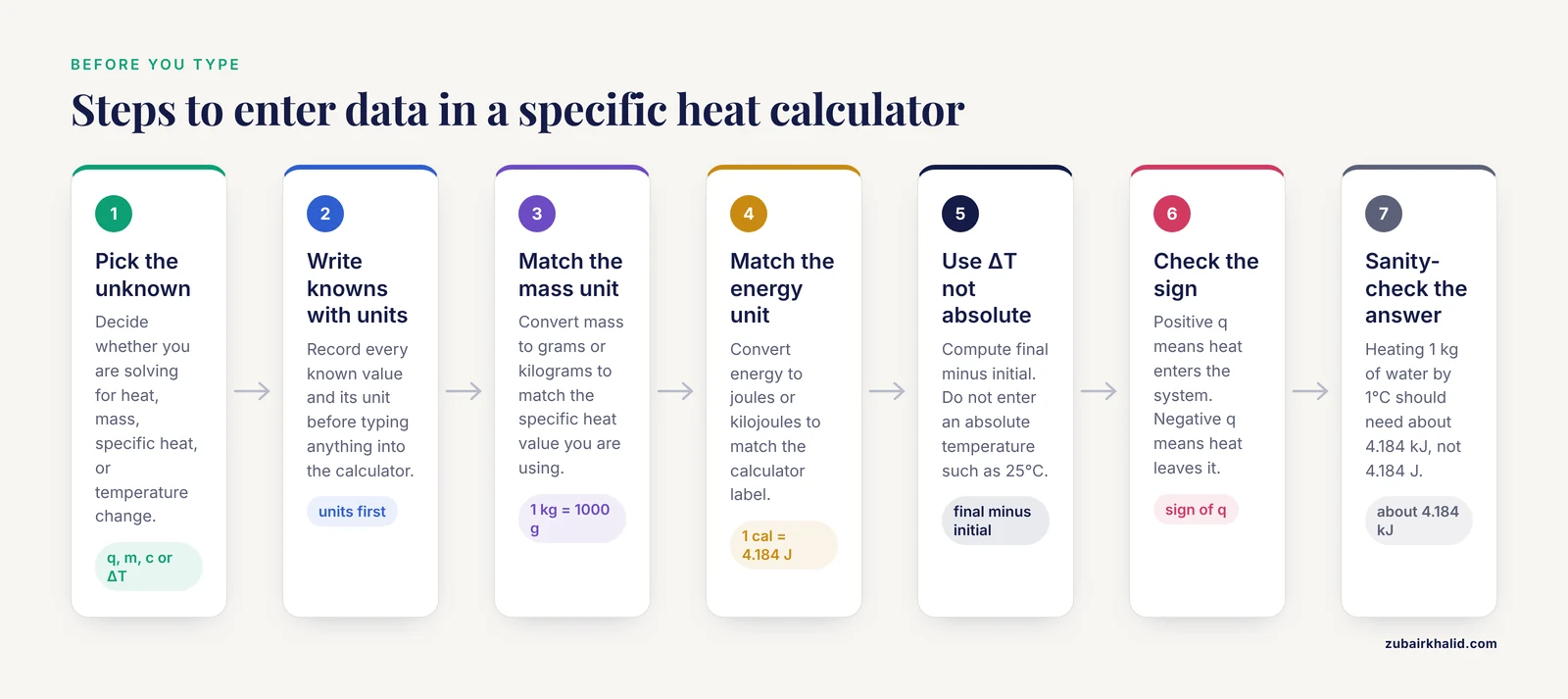
A specific heat calculator is only as good as its unit handling. Follow this sequence:
- Decide whether you are solving for heat, mass, specific heat, or temperature change.
- Write down the known values with units before typing anything.
- Convert mass to the unit used by the specific heat value.
- Convert energy to joules or kilojoules to match the calculator.
- Compute ΔT as final minus initial. Do not enter an absolute temperature such as 25°C in place of a temperature change.
- Check the sign. Positive q means heat enters the system. Negative q means heat leaves the system.
- Sanity-check the answer. Heating 1 kg of water by 1°C should require about 4.184 kJ, not 4.184 J and not 4184 kJ.
A calculator cannot decide whether a phase change occurs. If the sample crosses a melting or boiling point, you need a latent heat term as well as the specific heat term.
Why the Specific Heat of Water Matters
The specific heat of liquid water is about 4.184 J/(g·°C), or 4184 J/(kg·K), near 25°C. This value is high compared with most metals. Copper is about 0.385 J/(g·°C), iron is about 0.449 J/(g·°C), and aluminum is about 0.897 J/(g·°C). Water stores much more heat for the same mass and temperature rise.
That storage matters in living systems because cells, blood, lymph, and extracellular fluid are mostly water. A high specific heat lets a tissue absorb metabolic heat with a smaller temperature rise than a low-specific-heat material would show. It also means a tissue releases considerable heat as it cools. The effect is not unlimited. Organisms still depend on circulation, evaporation, behavior, and environmental conditions to manage heat.
Water's high specific heat is often confused with its high heat of vaporization. Sweating cools the body mainly through evaporation, which uses latent heat. Drinking cold water can absorb some heat, but the volume and temperature difference limit that effect. The specific heat value explains thermal buffering within a phase. The latent heat value explains the energy carried away during a phase change.
Water content also changes the specific heat of biological and engineered materials. In molecular dynamics simulations of poly(L-lactic acid), specific heat capacity increased after 6 mass percent water, reaching an 11% increase at 12 mass percent water [1]. In composite phase change material and sand backfill for ground heat exchangers, thermal conductivity, specific heat capacity, and thermal storage coefficient all increased with rising moisture content and phase change material dosage [2]. In micro-pressure stewing of chicken, lower specific heat capacity and water activity were associated with enhanced lipid transformations and aroma development [3]. These examples show a practical rule: water content and material structure both shape the measured specific heat.
At very small scales, water can depart from bulk behavior. In water clusters, heat capacity features near melting can be assigned to specific local minima, and quantum effects can suppress premelting and produce a convex intruder in the octamer microcanonical caloric curve that is absent in the classical treatment [4]. For ordinary biology problems, bulk water values are the right starting point. For nanoscale or phase-transition research, the simple constant value is only an approximation.
Specific Heat Examples in Biology, Food, and Materials
Specific heat examples appear across life science, not just in physics problem sets. The values below show how the same concept is used in different systems.
Skeletal Muscle
Differential scanning calorimetry of skinned skeletal muscle in a rigor solution revealed an extra basal heat capacity of about 0.4 J per kelvin per gram of evaporable weight in the 10°C to 25°C range [5]. Removing or denaturing actin diminished that extra heat capacity, while removing myosin increased it, and myosin denaturation had little effect [5]. The authors concluded that actin is a fundamental source of the extra basal heat capacity, partly suppressed by the thermally stable region of myosin under rigor conditions [5]. This is a clear biology example of why specific heat and heat capacity are not just constants in a table. They reflect molecular structure, bound water, and protein state.
Protein Binding and Heat Capacity Change
Isothermal titration calorimetry of the affibody pair ZTaq and anti-ZTaq revealed a large negative heat capacity change, ΔCp [6]. The change was attributed mainly to conformational transitions, especially disruption of a molten-globule-like state of anti-ZTaq above 303 K [6]. In protein science, ΔCp is the change in heat capacity upon binding or unfolding. It is not the same as the specific heat of a pure protein solution, but it uses the same underlying property. A negative ΔCp often signals burial of nonpolar surface, changes in hydration, or a conformational shift.
Hydrated Polymers and Soil Materials
The poly(L-lactic acid) simulation is a biomaterials example. Adding water changed chain contacts, density, thermal expansion, and specific heat capacity. The specific heat capacity rose by 11% at 12 mass percent water [1]. In ground source heat pump systems, adding a phase change material to sand increased specific heat capacity and thermal storage, and the 10 weight percent formulation was selected as optimal in that study [2]. These are engineering examples, but the principle is the same one that applies to a cell: water and composite structure change the heat needed for a given temperature rise.
Food Processing
In chicken stewing under micro-pressure, the authors reported that lower specific heat capacity and water activity enhanced lipid transformations and contributed to aroma development [3]. The specific heat value affects how quickly a food matrix heats, how heat distributes, and how reactions proceed. A food scientist may measure specific heat to model heating rate, but the final aroma also depends on lipid chemistry, water activity, and time.
Clinical and Analytical Samples
Serum differential scanning calorimetry in aneurysmal subarachnoid hemorrhage showed decreased heat capacity changes, ΔCp, in patients with severe clinical conditions and unfavorable outcomes in a small pilot cohort [7]. The finding is preliminary and not a stand-alone diagnostic test. It does show how heat capacity behavior can become a readout of proteome-level thermodynamic patterns. Clinical thermal analysis uses the same concepts as a classroom specific heat problem, but the sample is a complex mixture and the signal reflects many proteins at once.
How Specific Heat Is Measured
Differential scanning calorimetry is the most direct common method. A DSC instrument heats a sample and a reference through a controlled temperature program and measures the difference in heat flow. Specific heat capacity is derived from the baseline heat flow signal. Endothermic peaks can reveal melting, protein denaturation, or other transitions. In skinned muscle, the baseline increase was separated from ice melting and protein denaturation peaks [5]. In serum, the albumin transition appeared near 65°C to 66°C, and disease-related thermogram reorganization included changes in ΔCp [7].
Fast scanning calorimetry extends DSC to very high heating and cooling rates. In branched polyglycerol networks cross-linked by reversible enamine bonds, conventional DSC detected a single broad specific heat step, while fast scanning calorimetry separated two thermal events, a glass transition and a vitrimeric transformation [8]. The lesson is that a specific heat step can hide overlapping events when the thermal protocol is too slow or too coarse.
Isothermal titration calorimetry measures heat released or absorbed during binding at a controlled temperature. Running the same binding experiment across a temperature range gives ΔCp [6]. This is different from scanning temperature continuously, but it uses the same thermodynamic definition. Calorimetry is the general term for measuring heat flow, and both DSC and ITC are calorimetric methods.
Common Mistakes and Limitations
Specific heat problems fail most often because of unit mismatch, not because the algebra is hard. A value in J/(kg·K) paired with mass in grams gives an answer one thousand times too small. A value in cal/(g·°C) paired with energy in joules gives an answer that is off by a factor of 4.184. Write units on every line until the conversion becomes automatic.
Mixing specific heat with heat capacity is another common error. If a question asks for the heat needed to warm an entire object, you can use q = CΔT when C is given. If it gives c, you must multiply by mass first. A 10 kg block and a 1 kg block of the same material have the same specific heat but different heat capacities.
Using absolute temperature in place of temperature change is a frequent mistake. A sample warmed from 20°C to 30°C has ΔT = 10°C, not 30°C. The same sample warmed from 293 K to 303 K has ΔT = 10 K. The numbers match because the kelvin and Celsius scales have the same size degree.
Phase changes break the simple formula. During melting, added heat changes the phase without a temperature rise. You need a latent heat term, q = mL, in addition to q = mcΔT for the sensible heating before and after the transition. A calculation that ignores melting will underpredict the energy needed to warm a frozen sample.
Assuming a perfectly constant specific heat over a wide temperature range is another limitation. Specific heat can change with temperature, pressure, and phase. Near a glass transition, a broad specific heat step may appear [8]. Near protein unfolding, peaks and baseline shifts can overlap [5]. Near a melting transition in a finite water cluster, even negative heat capacity features can appear in a microcanonical caloric curve [4]. These are not ordinary classroom conditions, but they show why measured specific heat depends on the temperature range and the method.
Biological samples are heterogeneous. Muscle contains water, actin, myosin, collagen, lipids, and ions. A measured heat capacity reflects all of them plus their interactions and bound water [5]. A polymer-water system changes specific heat as water content changes [1]. A soil backfill changes specific heat as moisture and phase change material dosage change [2]. For a pure substance, a single table value may be enough. For a tissue, food, or composite, the value is a sample-specific measurement.
Pressure matters more for gases than for liquids and solids. The symbol Cp means specific heat at constant pressure. Cv means specific heat at constant volume. In biological systems, constant pressure is the usual assumption because cells and tissues are not sealed rigid gas containers. For gases, Cp and Cv differ substantially, so the label matters.
Sign conventions can confuse cooling problems. If heat leaves the system, q is negative. If the temperature falls, ΔT is negative. A negative q divided by a negative ΔT gives a positive specific heat. That is correct. Specific heat capacity itself is not negative for a stable bulk material.
Finally, specific heat is not a diagnosis or a stand-alone clinical test. Serum DSC changes in a small pilot cohort [7] are research findings, not a substitute for clinical evaluation. Individual clinical or veterinary samples need a qualified clinician or veterinarian, not a formula alone.
Quick Review
- Specific heat capacity is heat per unit mass per degree of temperature change. The SI unit is J/(kg·K).
- The core formula is q = mcΔT. Rearrange it to solve for c, m, or ΔT.
- Specific heat belongs to a material. Heat capacity belongs to an object or sample.
- The specific heat of liquid water is about 4.184 J/(g·°C), or 4184 J/(kg·K), near room temperature.
- Match mass units and energy units to the specific heat units before calculating.
- Phase changes need latent heat. Temperature-dependent transitions can make a single specific heat value incomplete.
- Calorimetry, especially DSC and ITC, is how specific heat and heat capacity changes are measured in research samples.
Heating Curves and Multi-Step Calorimetry Problems
A heating curve plots temperature against heat added at constant pressure. Sloped regions show single-phase heating, where q = mcΔT applies. Flat plateaus show phase changes, where temperature stays constant and q = mL applies. The plateau temperature identifies the transition: 0°C for melting ice, 100°C for boiling water at 1 atm. The plateau length depends on the latent heat and the mass, not on the specific heat.
To solve an ice-to-steam problem, break the path into segments. For water, the usual segments are: warm ice from its starting temperature to 0°C, melt ice at 0°C, warm liquid water from 0°C to 100°C, boil water at 100°C, and warm steam to the final temperature. Each segment uses one formula. Use the specific heat of the phase actually present; ice, liquid water, and steam each have different c values. Add the segment energies to get the total.
Worked example: How much heat is needed to convert 10 g of ice at -10°C to steam at 120°C? Use c_ice = 2.09 J/(g·°C), c_water = 4.184 J/(g·°C), c_steam = 2.01 J/(g·°C), L_f = 334 J/g, L_v = 2260 J/g.
- Warm ice: 10 × 2.09 × 10 = 209 J
- Melt ice: 10 × 334 = 3340 J
- Warm water: 10 × 4.184 × 100 = 4184 J
- Boil water: 10 × 2260 = 22,600 J
- Warm steam: 10 × 2.01 × 20 = 402 J
- Total: 30,735 J ≈ 30.7 kJ
Cooling problems use the same segments in reverse. Compute each magnitude with the appropriate c or L, then assign a negative sign to q because heat leaves the system. Do not change the sign of c or L; the sign belongs to q.
Two errors cause most lost points. Double-counting happens when a phase change is treated as a temperature change, or when latent heat is added during a sloped segment. Skipping happens when a segment is forgotten, especially warming ice below 0°C or warming steam above 100°C. A quick check: if the final state is steam, the total must include all five segments. If the sample starts as ice and ends as liquid water, only the first three segments apply.
Classroom Lab: Measuring Specific Heat by Calorimetry
A coffee-cup calorimeter measures the specific heat of an unknown metal by tracking heat exchange between a hot metal sample and cool water. The metal is heated in boiling water until it reaches a known temperature, then transferred quickly into an insulated cup containing a measured mass of water. The final equilibrium temperature gives the heat lost by the metal and gained by the water.
Setup
Use two nested Styrofoam cups as the calorimeter, with a lid, a thermometer, and a stirrer. Measure the mass of water in the cup. Heat a metal sample in a boiling water bath for several minutes so its initial temperature equals the boiling water temperature. Record the water temperature before transfer, then add the metal, stir gently, and record the highest stable temperature.
Data Table
| Quantity | Value |
|---|---|
| - | - |
| Mass of water, m_w | ... g |
| Mass of metal, m_m | ... g |
| Initial water temperature, T_iw | ... °C |
| Boiling water temperature, T_im | ... °C |
| Final equilibrium temperature, T_f | ... °C |
Calculation
The heat gained by the water is q_w = m_w c_w (T_f - T_iw), with c_w = 4.184 J/(g·°C). Assuming no heat loss, the heat lost by the metal equals q_w. The metal's temperature change is T_im - T_f, so:
c_m = m_w c_w (T_f - T_iw) / [m_m (T_im - T_f)]
Heat-Loss Correction
The simple equation assumes perfect insulation. To reduce error, start with water a few degrees below room temperature so the average of T_iw and T_f is near room temperature. This makes heat gained from the room roughly cancel heat lost to the room. For better accuracy, record temperature every 15 seconds before and after mixing, plot the curve, and extrapolate both lines to the mixing time to estimate the true T_f without heat exchange. An electrical-heater variant avoids the hot-metal transfer: place an immersion heater in the water, supply a measured electrical energy q = V·I·t, and compute c_w from the temperature rise. The same heat-loss correction applies.
Practical Checks
- Measure the boiling water temperature with a thermometer; at high altitude it is below 100°C.
- Include the calorimeter's own heat capacity by calibrating with a known hot water sample if high precision is needed.
- Use metals that do not react with water, such as aluminum or copper.
- Use tongs and goggles; boiling water and hot metal cause burns, and an immersion heater must stay submerged.
Thermal Mass in Real Systems: Buildings, Cooking, and Climate
Specific heat becomes thermal mass when combined with density and volume: a high-specific-heat material resists temperature change, stabilizing temperatures but also slowing response.
Buildings
Concrete has a specific heat near 0.88 kJ/(kg·K) and a density near 2400 kg/m³, giving a volumetric heat capacity around 2.1 MJ/(m³·K). Wood stores roughly half as much heat per cubic meter. A concrete wall absorbs solar heat by day and releases it at night, damping indoor temperature swings. In ground-source heat pump systems, backfill with added phase change material raises specific heat and thermal storage [2]. The cost is slow response: a massive building warms slowly after a cold period.
Cooking
Cookware shows why high specific heat is not always desirable. A cast iron pan has moderate specific heat but large mass, so it stays hot when cold food is added, giving even browning. An aluminum pan heats quickly but also cools quickly. Water's high specific heat keeps a pot of blanching water near boiling when vegetables are added. In micro-pressure stewing of chicken, lower specific heat and water activity were linked to enhanced lipid transformations and aroma development [3].
Water Heating and Car Cooling
A hot water tank stores heat because water holds about 4.2 kJ per kg per kelvin. Heating the tank costs energy, but the stored water stays hot longer. Engine coolant uses the same principle: water absorbs engine heat with a modest temperature rise. Adding antifreeze lowers the freezing point but also lowers specific heat, so more volume must circulate to carry the same heat.
Oceans and Climate
Oceans are the largest thermal mass on Earth. Water's high specific heat lets the ocean absorb summer heat and release it in winter, moderating coastal climates. Continental interiors swing through much larger seasonal ranges.
Heating 1 kg of water by 10°C requires about 41.8 kJ; heating 1 kg of iron requires about 4.5 kJ. Water stores about nine times more heat per kilogram. That stabilizes temperatures, but water also takes about nine times longer to heat with the same power. High specific heat is a tradeoff, not a free benefit.
Related Guides
- Unit Conversion Calculator for Lab Work: Unit conversion calculator helps avoid specific-heat unit mismatches
- How to Calculate the Specific Activity of an Enzyme: Formula and Examples: Enzyme activity formula example for lab-specific calculations
- Dog Heat Cycle: How to Track Your Dog's Season
Frequently Asked Questions
What is specific heat in simple terms?
Specific heat is the heat needed to raise the temperature of one kilogram of a substance by one kelvin. A high specific heat means the material warms slowly and cools slowly for a given amount of heat.
What is the specific heat formula?
The specific heat formula is q = mcΔT, where q is heat, m is mass, c is specific heat capacity, and ΔT is the change in temperature. Rearranged forms let you solve for c, m, or ΔT.
What are the units of specific heat?
The SI unit is J/(kg·K), which is also written J/(kg·°C) because the degree size is the same. Common chemistry units are J/(g·°C) and cal/(g·°C).
What is the specific heat of water?
The specific heat of liquid water is about 4.184 J/(g·°C), or 4184 J/(kg·K), near 25°C. The value changes with temperature and phase, so ice and steam have different values.
How do I use a specific heat calculator?
Enter mass in the unit used by the specific heat value, enter temperature change rather than an absolute temperature, and match joules or kilojoules to the calculator label. Check that heating 1 kg of water by 1°C gives about 4.184 kJ.
What is a good specific heat worksheet exercise?
A good exercise gives a sample mass, an initial and final temperature, and a specific heat value, then asks for heat. A second problem gives heat, mass, and temperature change, then asks for specific heat. Include one cooling problem with a negative q and one phase change problem that requires latent heat.
Sources
- Molecular Dynamics Simulations of the Structural and Thermodynamic Properties of Poly(l-lactic acid) in the Presence of Water.
- CPCM/OSS Backfill Materials: Enhanced Thermal Properties and Heat Transfer Performance for Ground Heat Exchangers in Ground Source Heat Pump Systems.
- Effect of micro-pressure stewing technology on the presence of key aroma compounds in chickens: New insight from lipidomics and heat transfer analysis.
- Quantum Enhancement of Microcanonical Negative Heat Capacity Features in the Melting of Water Clusters.
- Basal Heat Capacity of Skinned Skeletal Muscle with Selective Removal and Denaturation of Myoproteins: A Study with Differential Scanning Calorimetry.
- Affibody Complex Formation: An In-Depth Thermodynamic Analysis Using Isothermal Titration Calorimetry.
- Pilot Exploratory Study of Serum Differential Scanning Calorimetry in Aneurysmal Subarachnoid Hemorrhage Reveals Preliminary Outcome-Related Proteome-Level Thermodynamic Patterns.
- Vitrimeric Behavior Revealed by Fast Scanning Calorimetry in Branched Polyglycerol Networks Cross-Linked by Reversible Enamine Bonds.