Unit Conversion Calculator for Lab Work
By Dr. Zubair Khalid, DVM, MS, PhD ·

By the end of this guide you will be able to convert any concentration, volume, mass, or reaction rate you meet at the bench, verify the result against values you already know, and extend a working lab unit conversion calculator written in about 60 lines of Python. To follow along, you need Python 3 installed on any computer, the molecular weight of your analyte whenever a conversion crosses between mass units and mole units, and a notebook or spreadsheet for recording the factors you used.
A unit conversion calculator for lab work is less a single formula than a set of habits. The same quantity reaches you in different units because different fields grew different conventions. Clinical laboratories often report organic analytes as mass per volume, research journals usually require molar units, and analytical chemistry papers report rates as micromoles per gram per hour. Every one of these converts with the same method, and this article turns that method into code you can keep, test, and hand to the next person on the bench. Students, new lab staff, and experienced researchers cleaning up old datasets all use the same core moves.
Why Unit Conversion Errors Matter in the Lab
Conversion errors are dangerous because they are silent. The arithmetic produces a plausible number, the number gets recorded, and nothing in the record looks wrong. A study published in 2026 in The Journal of Applied Laboratory Medicine examined triiodothyronine (T3) uptake, a thyroid function test reported as a percentage, and found that result accuracy was significantly impacted by unit conversion and by reference interval change [1]. A correct measurement can still support a wrong conclusion when the units, or the reference interval that travels with them, are handled carelessly.
The same risk applies at the research bench. A buffer described as 50 mM that is actually prepared at 50 M is wrong by a factor of 1,000. A rate whose denominator changes from grams to milliliters in transcription is off by three orders of magnitude before anyone runs an assay.
Errors enter at three points. A factor gets inverted, such as dividing by 10 when the chain requires multiplying. A prefix gets dropped, such as reading μmol as mmol. Or a number gets recorded without its unit at all, which makes later reconstruction a guess. The calculator and the checking routine below are designed to catch all three at the bench rather than in print.
The Unit Families You Will Meet at the Bench
Most lab quantities fall into one of six families. Recognizing the family tells you which conversion rules apply.
SI prefixes. The International System of Units (SI) attaches decimal prefixes to base units. The set below covers nearly everything at the bench.
| Prefix | Symbol | Multiplier | Bench example |
|---|---|---|---|
| nano | n | 10⁻⁹ | nM (nanomolar) |
| micro | μ, often typed u | 10⁻⁶ | μL, μmol |
| milli | m | 10⁻³ | mL, mM |
| centi | c | 10⁻² | cm |
| deci | d | 10⁻¹ | dL |
| kilo | k | 10³ | kg, kPa |
One caution belongs here. In strict SI, an uppercase M means mega, a multiplier of one million. In bench shorthand, M means molar, which is moles per liter. The calculator below keeps the two apart by handling molar units in dedicated functions rather than through the prefix table.
Mass per volume. Units such as mg/dL, g/L, and μg/mL describe how much mass is dissolved in a given volume. They dominate clinical reporting and reagent recipes. The deciliter survives in clinical work because its 100 mL basis matches the percent w/v basis, so a value in mg/dL and the same value in percent w/v differ only by a factor of 1,000 in mass units.
Molar concentration. A mole is 6.022 × 10²³ formula units, a count known as Avogadro's number. Molarity (M) is moles of solute per liter of solution, so 1 mM is exactly 1 mmol/L and 1 μM is 1 μmol/L.
Percent. Three bases exist and they are not interchangeable. Percent weight per volume (w/v) is grams per 100 mL, so 0.9% w/v saline holds 0.9 g of sodium chloride per 100 mL. Percent volume per volume (v/v) is mL per 100 mL, so 70% ethanol means 70 mL of ethanol brought to 100 mL of solution. Percent weight per weight (w/w) is grams per 100 g, common for concentrated stocks.
Parts per. For dilute aqueous solutions, 1 ppm corresponds to about 1 mg per liter, because a liter of water weighs about 1 kg. Parts per billion corresponds to about 1 μg/L.
Activity and rates. International Units (IU) describe biological activity and are defined per analyte, so no prefix table converts them to mass. Mass normalized rates such as μmol g⁻¹ h⁻¹ (micromoles per gram per hour) and gas fractions such as vol% (mL of a gas per 100 mL of mixture) need compound unit handling, covered in Step 4.
Dimensional Analysis: The Method Behind Every Calculator
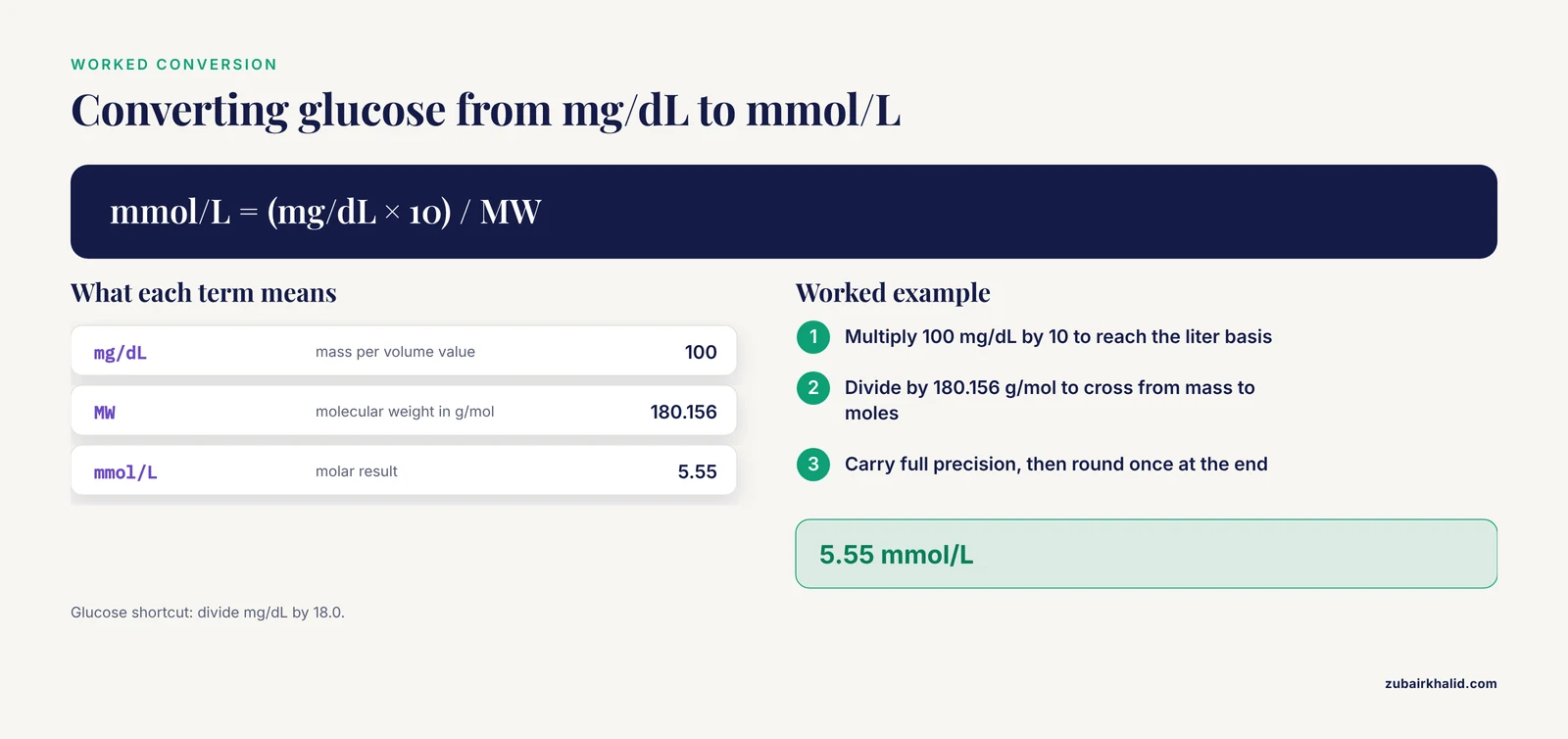
Every correct conversion multiplies by one. A conversion factor is a fraction that equals 1, such as (10 dL / 1 L), because the top and the bottom describe the same volume. Write the starting quantity with its unit, multiply by factors arranged so the unwanted units cancel, and what remains is the answer.
Convert 100 mg/dL of glucose (molecular weight 180.156 g/mol) to mmol/L:
(100 mg / dL) × (10 dL / L) × (1 g / 1000 mg) × (1 mol / 180.156 g) × (1000 mmol / mol)
= 100 × 10 × 1000 / (1000 × 180.156) mmol/L
= 5.55 mmol/L
Two rules make this reliable. First, cancel units on paper before touching numbers, because a failed cancellation exposes an inverted factor immediately. Second, respect the limits of the method. Pure multiplication works for units that differ by a scale factor. It fails for offset scales such as temperature, where °C converts to K by adding 273.15, not by multiplying. Any calculator built on multipliers alone needs a separate function for offset scales.
The table below collects the formulas you will use most often.
| Conversion | Formula | Worked example |
|---|---|---|
| mg/dL → mmol/L | multiply by 10, divide by MW (g/mol) | glucose: divide mg/dL by 18.0 |
| mg/dL → μmol/L | multiply by 10,000, divide by MW | creatinine: multiply mg/dL by 88.4 |
| g/dL → g/L | multiply by 10 | hemoglobin 14 g/dL → 140 g/L |
| % w/v → mol/L | multiply by 10, divide by MW | 5% w/v NaCl → 0.86 M |
| ppm → mg/L | multiply by 1 (dilute water only) | 10 ppm → 10 mg/L |
| mM → mol/L | multiply by 0.001 | 10 mM → 0.01 M |
| μmol g⁻¹ h⁻¹ → mmol kg⁻¹ h⁻¹ | multiply by 1 | the prefix factors cancel |
| °C → K | add 273.15 | 37 °C → 310.15 K |
Build a Lab Unit Conversion Calculator Step by Step
The walkthrough below builds a lab unit conversion calculator in Python. Each step adds one capability and shows the expected output. The full script uses only the standard library, so nothing needs to be installed beyond Python itself.
Step 1: Encode the SI Prefixes
The calculator needs two small tables: the prefixes, and a mapping from each dimension (length, mass, volume, amount of substance) to its base unit. The dimension mapping is the safety catch that later prevents nonsense such as converting grams to milliliters.
PREFIXES = {
    "n": 1e-9,
    "u": 1e-6,
    "m": 1e-3,
    "c": 1e-2,
    "d": 1e-1,
    "k": 1e3,
}

BASE_UNITS = {
    "length": "m",
    "mass": "g",
    "volume": "L",
    "amount": "mol",
}
Step 2: Write the Core Conversion Function
The function converts the input to the base unit of its dimension, then divides by the target unit expressed in that same base. Dividing by to_base(1.0, unit_to, dimension) is what lets any prefix pair work without a giant lookup table of every unit against every other unit. The parameters are the numeric value, the starting unit, the target unit, and the dimension, which must match both units.
def to_base(value, unit, dimension):
    base = BASE_UNITS[dimension]
    if unit == base:
        return value
    prefix, stem = unit, unit[1:]
    if stem != base:
        raise ValueError(
            f"'{unit}' is not a {dimension} unit "
            f"(expected something ending in '{base}')"
        )
    if prefix not in PREFIXES:
        raise ValueError(f"unknown SI prefix '{prefix}' in '{unit}'")
    return value * PREFIXES[prefix]

def convert(value, unit_from, unit_to, dimension):
    return to_base(value, unit_from, dimension) / to_base(1.0, unit_to, dimension)
Test it across three dimensions:
print(convert(250, "mL", "L", "volume"))
print(convert(5, "g", "mg", "mass"))
print(convert(1.5, "mmol", "umol", "amount"))
Expected output:
0.25
5000.0
1500.0
Step 3: Add Concentration Helpers That Need Molecular Weights
Mass per volume and molar units describe the same solution in different languages, and the bridge is the molecular weight (MW), the mass in grams of one mole of the substance. This is the one input the calculator cannot look up for you, because the same chemical is sold as an anhydrous powder, a hydrate, or a salt, and each form carries a different MW. Standard references list the value on the reagent label and the certificate of analysis. The helpers take MW as an argument called mw_g_per_mol, and it must match the form you actually weighed.
def mg_per_dL_to_mmol_per_L(value, mw_g_per_mol):
    """mg/dL and mmol/L share the 100 mL basis."""
    return value * 10.0 / mw_g_per_mol

def percent_wv_to_mmol_per_L(percent, mw_g_per_mol):
    """Percent w/v means grams per 100 mL."""
    return percent * 10.0 / mw_g_per_mol * 1000.0
print(f"{mg_per_dL_to_mmol_per_L(200, 386.66):.2f} mmol/L cholesterol")
print(f"{percent_wv_to_mmol_per_L(5, 180.156):.0f} mmol/L dextrose")Expected output:
5.17 mmol/L cholesterol
277 mmol/L dextrose
Step 4: Convert Compound Units Like Reaction Rates
Compound units such as μmol g⁻¹ h⁻¹ need each dimension converted separately. Write the chain as explicit multiplications so the order is visible, and watch for cancellations: 1 μmol/g equals 1 mmol/kg, because the micro-to-milli factor of 1,000 cancels the gram-to-kilogram factor of 1,000.
rate = 12.0                        # umol g^-1 h^-1, practice value
rate_mmol_kg_h = rate              # prefixes cancel, number unchanged
rate_mol_kg_s = rate * 1e-6 * 1e3 / 3600

print(f"{rate_mmol_kg_h} mmol kg^-1 h^-1")
print(f"{rate_mol_kg_s:.3e} mol kg^-1 s^-1")
Expected output:
12.0 mmol kg^-1 h^-1
3.333e-06 mol kg^-1 s^-1
Step 5: Test the Calculator With Known Anchors
A conversion without a check is a guess. Assert results you know by heart, then feed the calculator a deliberate dimension mismatch to confirm it fails loudly instead of returning a number.
assert convert(1, "L", "mL", "volume") == 1000
assert abs(mg_per_dL_to_mmol_per_L(200, 386.66) - 5.17) < 0.01

convert(5, "mg", "mL", "mass")
The first two lines pass silently. The last line raises the error the design intends:
Traceback (most recent call last):
  ...
ValueError: 'mL' is not a mass unit (expected something ending in 'g')
Two other failures are predictable. A missing or zero molecular weight raises ZeroDivisionError: float division by zero, which means the mw_g_per_mol argument was never supplied. Passing the value as quoted text, as in convert("5", "g", "mg", "mass"), eventually raises TypeError: unsupported operand type(s) for /: 'str' and 'float', which means a number arrived as a string. In both cases the fix is to correct the input, never to catch the error and continue.
Worked Examples With Published Numbers
Published numbers make good practice material because they arrive exactly as messy as bench data. The three examples below come from clinical chemistry, photocatalysis, and chemical engineering, which shows how far the same method reaches.
Clinical reporting. A basic metabolic panel reports creatinine in mg/dL in US laboratories. Convert 1.2 mg/dL to μmol/L with MW 113.12 g/mol. The factor is 10,000 ÷ 113.12 = 88.4, so 1.2 × 88.4 = 106 μmol/L. The same panel reports sodium directly in mmol/L, which is why a single report can mix unit families and why each line needs its own conversion.
A catalytic rate. A photocatalysis study of a bimetallic oxide semiconductor reported converting CO2 to CO at 25.5 μmol g⁻¹ h⁻¹ with nearly 100% selectivity under focused sunlight [2]. The same rate reads 25.5 mmol kg⁻¹ h⁻¹, because the prefix factors cancel exactly as in Step 4. Dividing the hour into 3,600 seconds gives 7.08 × 10⁻⁶ mol kg⁻¹ s⁻¹, and a per-minute figure is 25.5 ÷ 60 = 0.425 μmol g⁻¹ min⁻¹. All four expressions describe one measurement, and a reviewer should be able to move among them without a calculator of their own.
Gas fractions and percent decrease. A chemical engineering study of CO2 capture examined desorption columns where the gas phase reached 75 vol% CO2 and measured an 82% decrease in total amine concentration along the column [3]. Convert the fraction first: 75 vol% is 0.75 L of CO2 per liter of mixture, which at 1 atm total pressure corresponds to a CO2 partial pressure of 0.75 × 101.325 = 76 kPa. Then handle the decrease: a fall of 82% leaves 18% of the starting value, so a stream entering at 2.0 mol/L would leave at 0.36 mol/L. Both results are the same arithmetic the calculator automates, applied one dimension at a time.
Practical Tips for Daily Bench Work
The most useful lab unit conversion calculator tips are recording habits, because most conversion failures are really documentation failures.
- Write the unit next to every number, in the notebook, in the spreadsheet header, and in code variable names. A value of 5 without a unit is unusable six months later.
- Convert once, at the boundary. Keep raw data in native units and convert on output, so a wrong factor is fixed in one place instead of hunted across a dataset.
- Type μ as u in code and spreadsheet formulas and say so in a comment, because some tools mangle the Greek character.
- Keep a reagent table that lists the exact molecular weight and hydrate state of every chemical you stock.
- Chain conversions one factor per line. With one factor per line, an inverted factor is visible at a glance.
- Round once, at the end, to the precision of the input. A measurement of 1.2 mg/dL supports 106 μmol/L, not 106.08.
- Learn a handful of anchor values cold so a wrong order of magnitude jumps out on sight. The checking section below lists them.
Common Mistakes and Limitations
These are the lab unit conversion calculator common mistakes that show up repeatedly at the bench, each with its fix.
- Reading m and M as the same prefix. Lowercase m is milli (10⁻³). Uppercase M in bench shorthand is molar (mol/L). Route molar units through dedicated functions, never through a prefix table, because a prefix table will read M as mega.
- Dropping the deciliter. mg/dL and mg/L differ by a factor of 10. Recording 100 mg/dL as 100 mg/L understates the concentration tenfold.
- Using the wrong molecular weight. Anhydrous copper sulfate has a MW of 159.61 g/mol, the pentahydrate (CuSO4·5H2O) 249.69 g/mol. To prepare 500 mL of 0.5 M CuSO4 you need 0.25 mol, which is 39.9 g of the anhydrous salt or 62.4 g of the pentahydrate. Weighing 39.9 g of pentahydrate delivers 0.16 mol, about 64% of the target concentration.
- Using percent without a basis. w/v, v/v, and w/w differ, and percent changes need a named comparator. A study of CO2 capture solvents reported 66% less aerosol formation relative to the reference solvent MEA [3], a claim that only holds against that specific baseline. Drop the comparator and the number means nothing.
- Rounding intermediate results. Each rounded step compounds the error. Carry full precision through the chain and round once at the end.
- Treating activity units as SI. IU are defined per analyte as amounts of biological activity. Converting IU to mass requires an analyte specific factor from the manufacturer or the applicable standard, never a decimal prefix.
- Separating units from reference intervals. The T3 uptake study found that reference interval change, alongside unit conversion, significantly impacted accuracy [1]. When a result is converted, the reference interval and any decision limits must be converted by the same factor in the same step.
- Applying multipliers to offset scales. K equals °C plus 273.15. Multiplying 37 by 273.15, an error that appears in real lab notebooks, produces a physically meaningless temperature.
A calculator handles arithmetic, not context. It cannot choose the correct molecular weight, decide whether a percent is w/v or v/v, or interpret a patient or experimental result. Individual clinical and research decisions belong with qualified professionals who can see the full assay context, and every converted value should be recorded with the factor used so a second person can retrace it.
How to Check a Conversion Before You Trust It
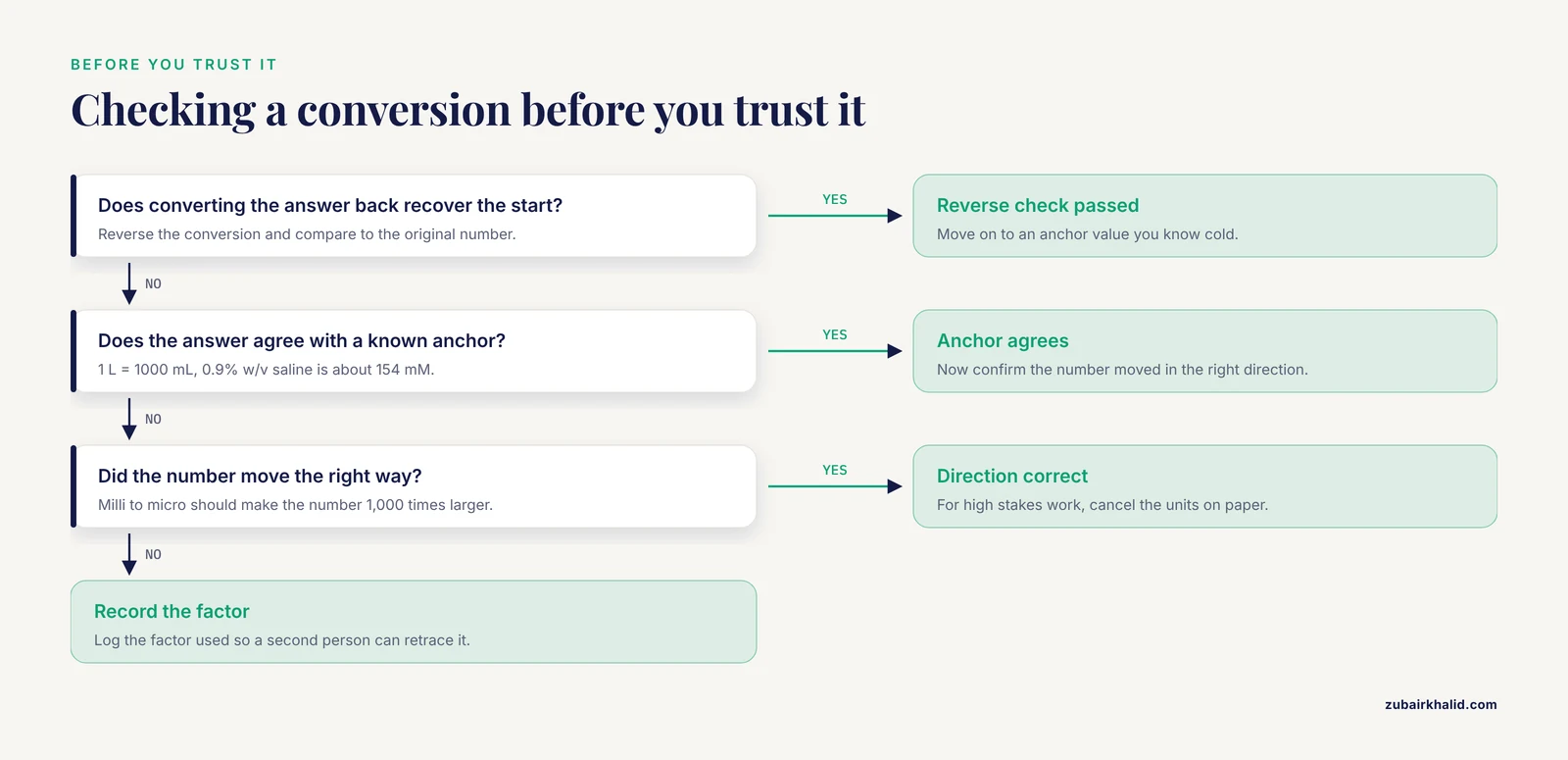
Run four checks, from fastest to strongest.
- Reverse it. Convert the answer back to the original unit. You should recover the starting number to within rounding.
- Compare with an anchor. Keep a short list you know cold: 1 L = 1000 mL, a liter of water weighs about 1 kg, 0.9% w/v saline is about 154 mM, and 1 M = 1000 mM. If your answer contradicts an anchor, stop and retrace.
- Check the direction of movement. Converting milli to micro makes the number 1,000 times larger. If your number shrank, a factor is inverted.
- Cancel on paper. For one-off, high stakes conversions, write the factor chain and strike through the units. A leftover uncanceled unit marks the missing or extra factor.
Where to Go Next
Three extensions make the calculator durable.
First, turn the assertions into a test file and run it after every edit:
# test_converter.py
from converter import convert

def test_liter_to_milliliter():
    assert convert(1, "L", "mL", "volume") == 1000
Running python -m pytest test_converter.py should end with 1 passed.
Second, add offset scale handling as its own function, with a comment warning that multipliers cannot touch it. The Fahrenheit bridge is K = (°F + 459.67) × 5/9, and it belongs in its own function for the same reason.
Third, extend the same molecular weight bridge to sequence work. A bioinformatics calculator takes a DNA or RNA sequence, estimates molecular weight from an average of about 330 g/mol per nucleotide for single stranded DNA or about 660 g/mol per base pair for double stranded DNA, and converts between mass concentration (μg/mL) and molar concentration (μM). Protein quantitation, oligo resuspension, and enzyme kinetics all reduce to the same pattern, which is why most biology calculator tools bundle them on one page. Whatever tool you adopt, record the conversion factor next to the result so a reviewer can retrace it.
Frequently Asked Questions
What is a lab unit conversion calculator?
A lab unit conversion calculator is any tool, script, or table that converts a measured quantity from one unit to an equivalent in another, such as mg/dL to mmol/L or mL to L. Unlike a generic converter, it must also handle molecular weights, percent bases, and compound units such as μmol g⁻¹ h⁻¹.
How do I convert mg/dL to mmol/L?
Multiply the mg/dL value by 10 and divide by the molecular weight in g/mol, which gives mmol/L. For glucose, with a molecular weight of 180.156 g/mol, the shortcut is to divide mg/dL by 18.0.
Are mM and mmol/L the same unit?
Yes. One millimolar (1 mM) is exactly one millimole per liter (1 mmol/L). The identity holds down the prefix ladder, so 1 μM equals 1 μmol/L.
How do I convert a percent concentration to molarity?
For percent weight per volume, multiply the percent by 10 to get grams per liter, then divide by the molecular weight. For 10% w/v sodium chloride, 100 g/L divided by 58.44 g/mol gives about 1.71 M.
Why do US clinical labs report mg/dL while journals use mmol/L?
Historical convention, not chemistry. US clinical laboratories conventionally report many organic analytes as mass per volume, while research journals standardize on SI molar units, so the same sample appears in both systems and conversion is required to compare them.
How do I convert a rate such as μmol g⁻¹ h⁻¹?
Convert each dimension separately: micromoles to moles, grams to kilograms, hours to seconds. A useful identity is that 1 μmol/g equals 1 mmol/kg, because the two prefix factors cancel.
Which molecular weight do I use for a hydrated compound?
Use the molecular weight of the form actually in the bottle, water of hydration included. Copper sulfate pentahydrate (249.69 g/mol) and anhydrous copper sulfate (159.61 g/mol) differ by more than 50%, so the wrong choice shifts every downstream calculation.
Can I trust an online unit conversion calculator for lab work?
For simple prefix conversions, yes, provided you verify the direction and spot check one known value. Be cautious with concentration converters that silently assume a molecular weight or a percent basis, and confirm clinical results against your laboratory's own reference intervals.
Sources
- Accuracy of T3 Uptake Was Significantly Impacted by Unit Conversion and Reference Interval Change.
- Periodic Frustrated Lewis Pairs on Bimetallic Oxide Semiconductors for CO(2) Adsorption and Photocatalytic Conversion.
- Perspectives and Mitigation Methods for Underappreciated Amine Escape from CO2 Desorption.