Seed Bug vs Conifer Seed Bug: Identification
By Dr. Zubair Khalid, DVM, MS, PhD ·
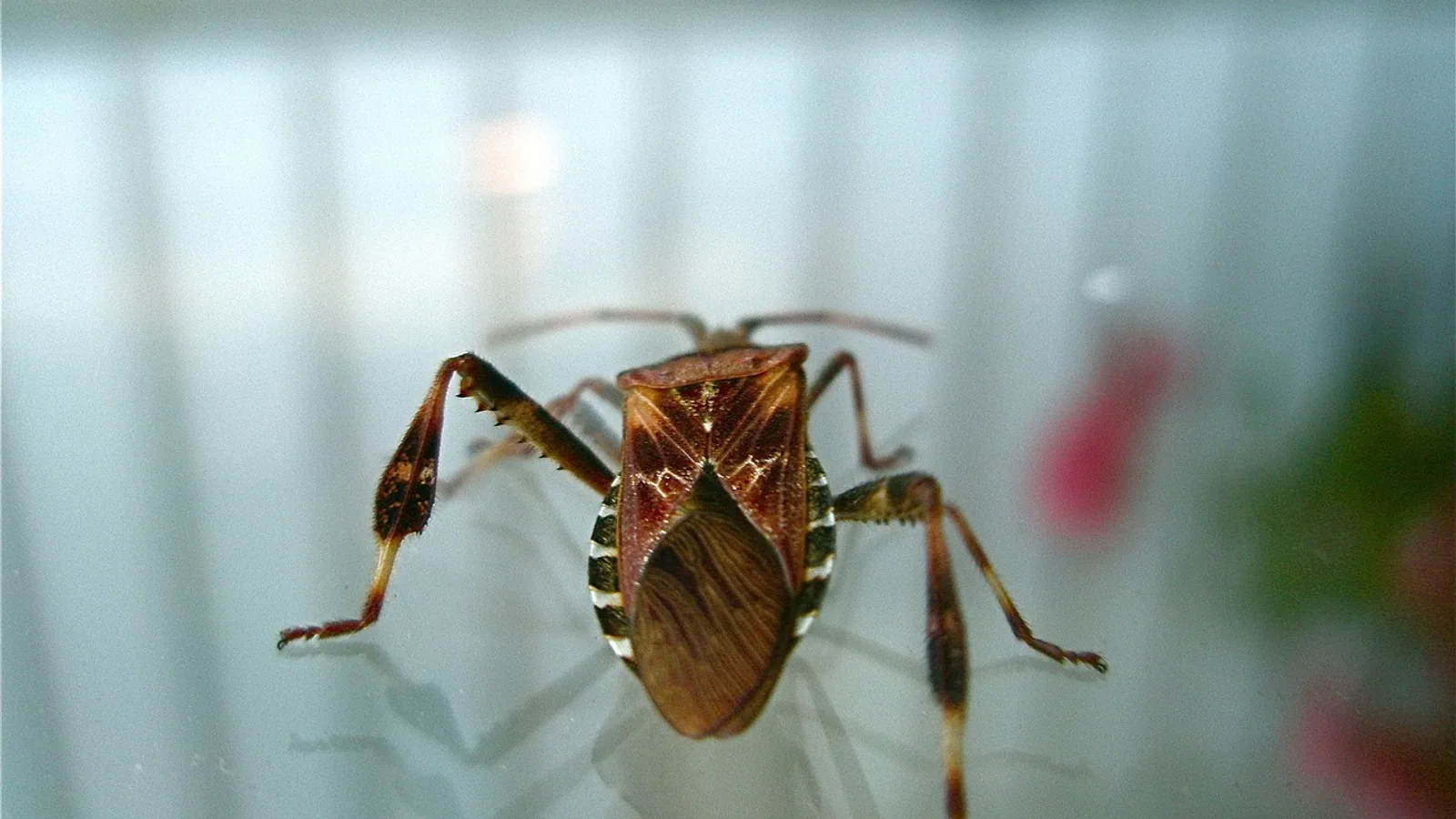
A seed bug is any true bug in the family Coreidae or a related family that feeds on plant seeds with piercing-sucking mouthparts, while the conifer seed bug is one specific member of that group, the western conifer seed bug (Leptoglossus occidentalis), a brown, leaf-footed bug that specializes on the seeds of pine, fir, spruce, and other conifers. The distinction matters because "seed bug" is a broad category that includes dozens of harmless outdoor species, and the western conifer seed bug is the one that most often walks into American homes in autumn, gets mistaken for a kissing bug or a stink bug, and generates panicked identification requests to extension offices and museums [1].
This guide gives you a repeatable identification method. It covers body shape, antennae, leg banding, size, and habitat, then compares the western conifer seed bug against its most common lookalikes: the boxelder bug, the squash bug, the brown marmorated stink bug, and the blood-feeding triatomine bugs that transmit Chagas disease. It also explains what the insect actually does for a living, because the feeding biology is what separates a minor forest pest from a household nuisance.
What "Seed Bug" Actually Means
The term seed bug is used loosely in everyday speech, but in entomology it describes true bugs (order Hemiptera) that feed on the developing or mature seeds of plants. The largest and most familiar group is the family Coreidae, the leaf-footed bugs and their relatives. Coreids have piercing-sucking mouthparts bundled into a beak, or rostrum, that they insert into plant tissue to draw out fluids and dissolved nutrients.
The western conifer seed bug is a coreid in the genus Leptoglossus. The genus contains 61 described species and one subspecies, and it is defined largely by the flattened, leaf-like expansions on the hind legs that give the group its common name [2]. Within the genus, L. occidentalis is the species that has become globally famous as an invader. It is native to western North America and has been introduced to Europe, Asia, Africa, and South America, where it now breeds in conifer forests far from its original range [3][4].
The practical consequence is that a person in the United States may encounter two very different kinds of "seed bug" in the same week: an outdoor coreid on a garden plant, and an indoor western conifer seed bug crawling up a bedroom wall in October. They look similar enough that identification requires more than a glance.
Why Identification Matters
Getting the identification right changes what you do next. The western conifer seed bug is a nuisance invader. It does not bite to feed on people, it does not transmit disease, it does not damage wood, and it does not reproduce indoors. It is also a genuine agricultural pest in conifer seed orchards, where its feeding reduces the yield and viability of pine nuts and Douglas-fir seed [5][6].
That combination, harmless in the house and damaging in the orchard, is exactly why misidentification causes problems in both directions. Homeowners who think they have kissing bugs may overreact. In Chile, a single invasive population of L. occidentalis generated 74 alleged kissing bug reports in about a year, and 63 of those, roughly 85 percent, turned out to be western conifer seed bugs [7]. At the same time, orchard managers who dismiss every brown bug on a cone may miss real feeding damage that reduces seed harvest.
Identification also protects the insects themselves. Western conifer seed bugs are harmless to people and play a role in conifer ecosystems as seed predators. Killing them indoors is unnecessary for safety, and the more useful response is exclusion, meaning sealing the gaps they use to enter.
The Western Conifer Seed Bug: Core Identification
Body Shape
The western conifer seed bug has an elongated, narrow, parallel-sided body that is longer than it is wide. Adults are brown, with a mottled or speckled pattern of lighter and darker tones across the wings and pronotum, the shield-like plate behind the head. The abdomen edges often show alternating dark and pale markings that create a banded look along the sides.
The hind legs are the giveaway feature. Each hind tibia, the lower segment of the leg, flares into a broad, flattened, leaf-like expansion. This "leaf foot" is a hallmark of the genus Leptoglossus and is visible from above and from the side [2]. No boxelder bug, squash bug, or stink bug has this structure.
Antennae
The antennae are long, slender, and four-segmented, and they are typically held out from the head rather than tucked underneath. The outermost antennal segment is often paler than the rest, and the whole antenna is longer relative to the body than the short, thick antennae of stink bugs. Antennal structure is one of the characters used in formal keys to the genus [2].
Leg Banding
The legs carry contrasting bands. The hind tibia, in addition to being flattened, usually shows a pale or whitish band or zigzag marking against a darker background. This banding is a reliable field character when you have the insect in hand or in a clear photograph.
Size
Adults measure roughly 15 to 20 millimeters in body length, which places them in the medium-to-large range for a true bug. For scale, that is about the length of a paperclip, noticeably larger than a boxelder bug and comparable to a large stink bug but slimmer in profile.
Habitat and Seasonal Behavior
Western conifer seed bugs live in and around coniferous forests, plantations, and ornamental conifers. They feed on the seeds of many conifer species, with a documented ability to use up to about 40 different conifers and a strong preference in Europe for Pinus pinea, the stone pine grown for pine nuts [8]. In autumn, adults leave the trees and seek protected overwintering sites, which is when they enter buildings through cracks, vents, and gaps around windows and doors.
In early spring, before cones mature, the bugs gather on male pine cones. A thermoregulation study measured the temperature and spectral reflectance of pine organs and found that male cones were significantly warmer and more reflective than female cones and needles, which likely attracts the bugs and gives them a heat reward [9]. That is a useful field clue: a cluster of these bugs on male cones in early spring is normal behavior, not a sign of an outbreak.
Identification Table: Western Conifer Seed Bug vs Lookalikes
| Feature | Western conifer seed bug (Leptoglossus occidentalis) | Boxelder bug (Boisea trivittata) | Squash bug (Anasa tristis) | Brown marmorated stink bug (Halyomorpha halys) | Kissing bug (Triatoma spp.) |
|---|---|---|---|---|---|
| Body shape | Elongated, narrow, parallel-sided | Elongated oval, flatter | Elongated oval, robust | Shield-shaped, broad | Oval, flattened, with a distinct head |
| Color | Mottled brown with pale speckling | Black with red-orange lines | Gray-brown to black | Marbled brown-gray | Dark brown to black, often with red-orange markings |
| Antennae | Long, slender, four-segmented | Medium, slender | Short, thick | Short, banded | Long, slender, inserted near the eyes |
| Leg banding | Pale bands on hind tibia, plus leaf-like flare | Red-orange legs, no leaf flare | No leaf flare | Banded legs, no leaf flare | No leaf flare |
| Size | About 15 to 20 mm | About 11 to 14 mm | About 15 to 17 mm | About 12 to 17 mm | About 20 to 30 mm |
| Hind leg | Flattened leaf-like expansion | Simple, slender | Simple, slender | Simple, slender | Simple, slender |
| Habitat | Conifers, seed orchards, overwintering indoors | Boxelder and maple trees, overwintering indoors | Cucurbits and garden vines | Many crops and ornamental plants, overwintering indoors | Rodent nests and rural dwellings, blood-feeding |
| Feeding role | Conifer seeds, minor orchard pest | Plant sap, nuisance | Plant sap, garden pest | Plant and fruit pest | Blood feeder, disease vector |
The single most decisive character is the leaf-like hind leg. If the bug has a broad, flattened, leaf-shaped expansion on the hind tibia, it is a leaf-footed bug in the genus Leptoglossus, not a boxelder bug, not a squash bug, not a stink bug, and not a kissing bug.
How to Work Through an Identification Step by Step
- Look at the hind legs first. A flattened, leaf-like flare on the hind tibia points to Leptoglossus. If the hind legs are simple and slender, move to a different group.
- Check the antennae. Long, slender, four-segmented antennae held away from the head support a coreid identification. Short, thick, banded antennae suggest a stink bug.
- Measure or estimate size. A body around 15 to 20 millimeters fits the western conifer seed bug. A smaller bug around 11 to 14 millimeters with red-orange markings is more likely a boxelder bug.
- Note the color pattern. Mottled brown with pale speckling and a pale band on the hind tibia fits L. occidentalis. Black with red-orange lines fits the boxelder bug.
- Consider where you found it. Indoors in autumn near a window, in a region with conifers, fits the western conifer seed bug. On a boxelder tree in summer fits the boxelder bug. In a cucurbit patch fits the squash bug.
- Rule out medical significance. Kissing bugs have a distinct, slender head and feed on blood. The western conifer seed bug has a broader head and feeds on plants. If you are unsure whether a bug could be a triatomine, treat it as a public health question and contact your state or local health department or a university extension office.
Why the Western Conifer Seed Bug Is Confused with Kissing Bugs
The confusion is understandable and well documented. Both insects are brown, both are true bugs with piercing-sucking mouthparts, and both can appear indoors. The difference is diet and anatomy. Kissing bugs in the subfamily Triatominae feed on vertebrate blood and are the vectors of Trypanosoma cruzi, the parasite that causes Chagas disease. The western conifer seed bug feeds on conifer seeds and has no role in disease transmission.
The overreaction has been studied directly. In Chile, researchers received 74 alleged kissing bug reports over roughly a year and confirmed that 63, about 85 percent, were actually L. occidentalis [7]. The same paper documented the first human bite case for the species and noted that the bug can inflict a painful bite but does not transmit any disease [7]. A separate report described the human-biting potential of the western conifer seed bug in Europe, where it has expanded its range rapidly [10]. The takeaway is that a bite is possible but incidental and not a sign that the insect is a blood feeder.
This is the point where students most often go wrong. They read "can bite humans" and assume the insect is dangerous. The correct framing is that many plant-feeding bugs with piercing mouthparts can occasionally probe human skin, and that probing is not feeding and carries no known disease risk from this species.
What the Western Conifer Seed Bug Does in a Conifer Forest
The feeding biology explains both the orchard damage and the seasonal movements. Western conifer seed bugs insert their mouthparts into developing seeds inside cones and withdraw the contents. A study on Douglas-fir found that late-season feeding by nymphs and adults, and feeding by nymphs at all three stages of cone development, significantly reduced the lipid and crystalloid protein content of harvested seeds, by up to 78 and 97 percent respectively [5]. Seeds with light to moderate damage on radiographs did not lose soluble matrix protein, which suggests the bug targets specific storage reserves [5].
The same research group showed that feeding damage can be detected biochemically. A polyclonal antibody raised against the bug's salivary gland extracts identified residual salivary proteins on western blots of damaged Douglas-fir seeds, correctly classifying 100 percent of undamaged control seeds, 97 percent of unfilled or aborted seeds, and 98 percent of seed-bug-damaged seeds in a single blind test [11]. This is how researchers distinguish natural seed abortion from insect feeding, a problem that had previously made damage estimates unreliable [6].
The economic stakes are real. Feeding by females on caged cones for two weeks during late-season development reduced the proportion of full seeds by about 70 percent compared with controls [6]. In Europe, the species can reduce pine nut production by up to 25 percent, which is why it is treated as a serious pest of the pine nut industry [8].
The insect also has unusual internal biology. Like many coreoids, it houses Caballeronia bacteria in crypts in its posterior midgut. A study of populations from Japan, Europe, and North America found that one symbiont subclade, SBE-beta, dominated in all populations, while a third clade occupied about a quarter of tested populations [12]. Bugs without their symbionts showed high mortality, which shows how dependent the insect is on its gut bacteria [12]. Males also produce a unique sesquiterpene hydrocarbon called leptotriene, which is thought to be part of an aggregation pheromone [13].
Native Range vs Invasive Range
The western conifer seed bug is native to western North America. From there it has been introduced to Europe, Asia, Africa, and South America, and it is now described as invasive worldwide [9][4]. Distribution modeling shows that climate suitability for the species is higher in Southern Europe than in Western Europe, and that it occurs primarily near coniferous forests [3]. Land cover was the single most important variable for predicting its occurrence, with a random forest model reaching 77.1 percent accuracy [3].
The spread has consequences beyond the original species. A related leaf-footed bug, Leptoglossus clypealis, has a broader climatic niche and is expanding eastward in North America. Modelers have warned that it could follow the same trajectory as L. occidentalis and become a major pest, which is why monitoring is recommended [4].
For a reader in the United States, the practical point is that the western conifer seed bug may be native or introduced depending on where you live, but its behavior is the same. It feeds on conifer seeds in spring and summer and seeks shelter in autumn.
Nuisance, Not a Threat: What the Bug Does and Does Not Do
The western conifer seed bug is a nuisance invader in homes. It does not bite to feed, does not transmit disease, does not damage wood, does not build nests, and does not reproduce indoors. It cannot survive and multiply in a house the way cockroaches or bed bugs do. The worst outcomes are the unpleasant smell some coreids release when disturbed, staining if they are crushed against a light surface, and the simple annoyance of large numbers of insects on a wall.
The species can bite if handled roughly or trapped against skin, and that bite can be painful, but it carries no known disease [7][10]. There is no reason to use insecticide indoors for this insect, and no medical treatment is indicated for a simple bite beyond basic wound care. If a bite causes swelling, persistent pain, or signs of infection, that is a general medical question for a clinician, not a species-specific concern.
Outdoors, the same insect is a minor to moderate pest in conifer seed orchards and pine nut plantations. That is where management effort belongs, not in the living room.
Common Mistakes and Limitations
The first common mistake is treating every brown bug indoors as a kissing bug. The body shape, head shape, and leg structure separate them, and the vast majority of reported cases turn out to be western conifer seed bugs [7].
The second mistake is confusing the western conifer seed bug with the boxelder bug. Boxelder bugs are smaller, black with red-orange lines, and lack the leaf-like hind leg flare. They also tend to cluster on boxelder and maple trees rather than conifers.
The third mistake is assuming the bug is a stink bug. Brown marmorated stink bugs are shield-shaped and broader, with short banded antennae and no leaf-like hind legs.
The fourth mistake is assuming that a bite means the insect is dangerous. Plant-feeding bugs can probe skin, but the western conifer seed bug does not feed on blood and does not transmit disease [7][10].
The fifth mistake is reaching for pesticide when exclusion is the real fix. Sealing gaps around windows, doors, vents, and utility penetrations, and repairing torn screens, addresses the actual entry route.
A limitation of any visual guide is that photographs can be ambiguous. If you need a confirmed identification, a university extension office, a natural history museum with an entomology information service, or a state agriculture department can confirm it from a clear photo or a preserved specimen. Individual bites or skin reactions need a clinician, not an entomologist.
Quick Review
- Seed bug is a broad term for plant-feeding true bugs, mostly in the family Coreidae.
- The western conifer seed bug is Leptoglossus occidentalis, a leaf-footed bug native to western North America and invasive worldwide.
- The decisive identification character is the flattened, leaf-like expansion on the hind tibia.
- Adults are about 15 to 20 millimeters, mottled brown, with long four-segmented antennae and pale leg bands.
- It feeds on conifer seeds and can reduce pine nut and Douglas-fir seed yields, with documented losses up to 25 percent in pine nut production and about 70 percent of full seeds in a caged-cone trial.
- It is a nuisance invader indoors, not a biting pest or a structural destroyer, and it is not a kissing bug.
- Exclusion, not pesticide, is the practical response to indoor invasions.
Frequently Asked Questions
Is the western conifer seed bug the same as a kissing bug?
No. The western conifer seed bug is a plant-feeding coreid that eats conifer seeds, while kissing bugs are blood-feeding triatomines that can transmit Chagas disease. The two are frequently confused, and in one Chilean study about 85 percent of alleged kissing bug reports turned out to be western conifer seed bugs [7].
Does the western conifer seed bug bite humans?
It can bite if handled or trapped against skin, and the bite can be painful, but it does not feed on blood and does not transmit disease [7][10]. A bite is incidental, not a sign that the insect is a blood feeder.
How do I tell a western conifer seed bug from a boxelder bug?
Look at the hind legs. The western conifer seed bug has a flattened, leaf-like expansion on the hind tibia, while the boxelder bug has simple, slender hind legs. Boxelder bugs are also smaller and are black with red-orange lines rather than mottled brown.
What size is a western conifer seed bug?
Adults are roughly 15 to 20 millimeters long, which is comparable to a large stink bug but slimmer in profile.
Do western conifer seed bugs damage houses?
No. They do not damage wood, build nests, or reproduce indoors. They are nuisance invaders that enter homes in autumn to overwinter and are best managed by sealing entry points.
Are western conifer seed bugs pests of trees?
Yes, in seed production. They feed on developing conifer seeds and can reduce seed yield and viability, with documented losses of up to 25 percent in pine nut production and about 70 percent of full seeds in a controlled Douglas-fir trial [8][6].
Related Articles
- Can Dogs Eat Strawberries Seeds
- Can Dogs Eat Guava? Seed Hazards and Vitamin C
- Can Cats Eat Watermelon? Hydration & Seed Hazards
- Can Dogs Eat Pumpkin Seeds? Cucurbitin and Parasite Guide
- Can Dogs Eat Kiwi? Enzymes & Seed Digestibility
- Pasture Seed Mix Selection for Dairy Cows
- Asian Giant Hornet: Biology and Identification
- Can Cats Eat Apples? Safety, Seeds and Serving Tips
- Where Do Bed Bugs Come From? Sources and Spread
Sources
- "What's This Bug?" Questions from the Public Provide Relevant Information on Species Distribution and Human-Insect Interactions.
- Illustrated key for identification of the species included in the genus Leptoglossus (Hemiptera: Heteroptera: Coreidae: Coreinae: Anisoscelini), and descriptions of five new species and new synonyms.
- Spatial analysis of the occurrence of the western conifer seed bug Leptoglossus occidentalis (Heteroptera: Coreidae) in Europe based on multiple environmental variables.
- Ecological niche modeling (ENM) of Leptoglossus clypealis a new potential global invader: following in the footsteps of Leptoglossus occidentalis?
- Effect of feeding by the western conifer seed bug, Leptoglossus occidentalis, on the major storage reserves of developing seeds and on seedling vigor of Douglas-fir.
- Impact of Leptoglossus occidentalis (Hemiptera: Coreidae) on Douglas-fir seed production.
- Alien Invasion: The Case of the Western Conifer-Seed Bug (Heteroptera: Coreidae) in Chile, Overreaction, and Misidentifications.
- Characterization of Leptoglossus occidentalis Eggs and Egg Glue.
- Evaluation of thermoregulation of different pine organs in early spring and estimation of heat reward for the western conifer seed bug (Leptoglossus occidentalis) on male cones.
- The Western Conifer Seed Bug (Hemiptera: Coreidae) Has the Potential to Bite Humans.
- Specific biochemical marker-based techniques for the identification of damage to Douglas-fir seed resulting from feeding by the western conifer seed bug, Leptoglossus occidentalis Heidemann (Hemiptera: Coreidae).
- Intercontinental Diversity of Caballeronia Gut Symbionts in the Conifer Pest Bug Leptoglossus occidentalis.
- Identification and Synthesis of Leptotriene, a Unique Sesquiterpene Hydrocarbon from Males of the Leaffooted Bugs Leptoglossus zonatus and L. occidentalis.