Physical vs Chemical Change: 20 Examples
By Dr. Zubair Khalid, DVM, MS, PhD ·
A physical change alters a substance's form, state, or arrangement while its chemical identity stays the same. A chemical change converts one or more substances into different substances with new compositions and new properties.
This distinction is the first place where a learner has to reason about identity instead of appearance, and it is the foundation for chemical equations, stoichiometry, and lab safety. Students carry stable mental models of both kinds of change, and those models shape how they read every reaction they meet afterward [1]. The same idea reaches far beyond the classroom. A rusting bridge, a browning apple, a hardening concrete slab, and a bleached shirt all depend on whether a new substance has formed.
The Chemical Change Definition, Precisely
A chemical change is a process in which atoms are rearranged so that at least one new substance forms, with a composition and properties different from those of the starting materials. Atoms are conserved in the process. Nothing disappears and nothing appears from nowhere. The atoms simply end up in different combinations, held together by different bonds.
That definition turns on substance identity, not on appearance. A chemical change has happened when the product is a different compound from the reactant, even if the change looks unremarkable. Dissolving table salt in water looks dramatic enough but leaves both substances intact. Rusting a nail looks slow and dull but produces a genuinely new compound, hydrated iron(III) oxide.
Chemists look for several kinds of evidence:
- A gas forms that is not simply the boiling of a liquid, for example bubbles when vinegar meets baking soda
- A solid appears when two clear solutions are mixed, which is called a precipitate
- A color change comes from a new compound rather than from dilution or mixing
- A new odor appears
- Heat or light is released or absorbed beyond what simple mixing would explain
- The change persists after the material cools, dries, or is stirred
None of these signs is decisive alone. A color change can come from adding food dye. Bubbles can come from releasing dissolved gas. That is why the definition returns to identity. Textbook treatments of physical and chemical change emphasize these criteria in different proportions, which is one reason the topic trips up so many learners [2].
Physical vs Chemical Change: A Side-by-Side View
| Feature | Physical change | Chemical change |
|---|---|---|
| Definition | Alters form, state, or arrangement, no new substance | Produces one or more new substances |
| What molecules do | Stay intact, spacing and motion change | Break apart and recombine into new molecules |
| Bonds | Intermolecular forces change, covalent bonds usually hold | Bonds within substances break and new bonds form |
| Evidence to look for | Change of state, shape, size, or dispersion | Gas, precipitate, color change, odor, heat, or light |
| Reversibility | Often reversed by melting, boiling, filtering, or evaporating | Usually needs a different reaction to reverse |
| Mass | Conserved | Conserved, atoms are rearranged |
| Everyday examples | Ice melting, sugar dissolving, paper tearing | Iron rusting, bread baking, milk souring |
| Common confusion | Dissolving treated as a reaction | Reversibility used as the only test |
The most reliable single test is identity. Can you recover the original substance by a physical method such as filtering, evaporating, freezing, or dissolving? If yes, the change was physical. If the product is a different compound, the change was chemical, even when a later reaction can undo it.
How to Tell Them Apart in Five Steps
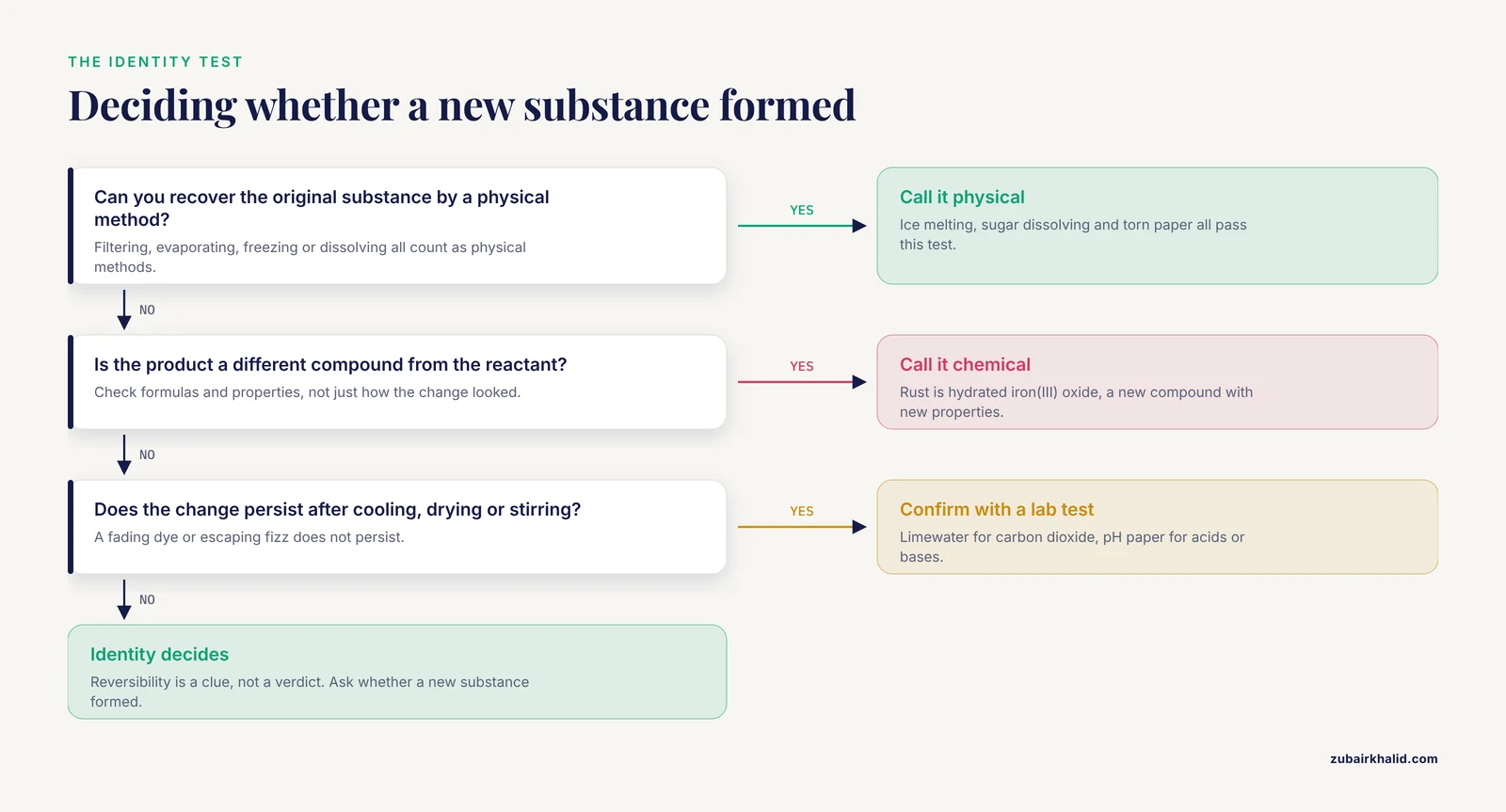
Step 1. Write down the starting materials. Name what you began with, including any water or air that took part. A candle needs oxygen, and steel wool needs water as well as oxygen.
Step 2. Look for evidence of a new substance. Check the list above: gas, precipitate, color, odor, heat, light.
Step 3. Apply the identity test, not the reversibility test. Students tend to label anything reversible as physical and anything irreversible as chemical, and research shows this criterion dominates their reasoning [3]. It fails in both directions. Water freezing is reversible and physical. A glow stick reaction is irreversible and chemical. Some chemical reactions are quite reversible under the right conditions.
Step 4. Think at the atomic level. In a physical change, molecules keep their identity. Ice, liquid water, and steam are all H2O, with different spacing and motion. In a chemical change, bonds break and new bonds form. Methane and oxygen become carbon dioxide and water, and neither product was present at the start.
Step 5. Confirm with a specific test. Bubble a gas through limewater to check for carbon dioxide. Use a pH indicator to detect an acid or base. Weigh a sealed system before and after to show that mass is conserved. Compare melting points to see whether a solid is the same substance or a new one.
Energy usually accompanies chemical change because breaking bonds absorbs energy and forming bonds releases it. When the released energy exceeds the absorbed energy, the reaction warms its surroundings, which is why steel wool rusting in vinegar feels warm and why curing concrete gives off heat.
20 Chemical Change Examples
The list below moves from kitchen and garage chemistry to classroom demonstrations to large-scale biological and industrial reactions. Each entry states the change and the evidence that a new substance has formed.
Chemical Change Examples at Home
1. Rusting iron. Iron reacts with oxygen and water to form hydrated iron(III) oxide. The orange-brown flakes are a new compound, and the metal underneath weakens and pits. Scraping the rust off is a physical change, but the rust itself formed chemically.
2. Baking soda and vinegar. Sodium bicarbonate reacts with acetic acid to produce sodium acetate, water, and carbon dioxide. The fizzing is carbon dioxide leaving the solution, and the gas will turn limewater cloudy.
3. Burning a candle. A candle shows two changes at once. The wax melts and is drawn up the wick, which is physical. Wax vapor then burns in oxygen to form carbon dioxide and water vapor, which is chemical. The burning candle is a classic case that researchers use to probe how children separate the two.
4. Baking bread and browning toast. Yeast ferments sugars and releases carbon dioxide, and oven heat sets the starch and protein network. The brown crust forms through Maillard reactions between amino acids and sugars. The new aromas and structure cannot be undone by cooling.
5. Cooking an egg. Heat disrupts the hydrogen bonds holding egg albumin in its folded shape. The proteins unfold and coagulate into a solid network. A cooked egg will not return to its raw, runny state in the refrigerator.
6. Souring milk. Bacteria convert lactose to lactic acid, the pH drops, and casein proteins clump. The sour smell, thicker texture, and curds are all signs of new products.
7. A cut apple turning brown. Polyphenol oxidase catalyzes the oxidation of phenolic compounds into brown pigments. The color appears within minutes of slicing. Lemon juice slows it by lowering the pH and by keeping oxygen away.
8. Bleaching a stained shirt. Sodium hypochlorite oxidizes the colored molecules in a stain into colorless products. The stain fades because the pigment has been chemically altered, not because it was washed away.
9. A gas stove burner. Methane reacts with oxygen to give carbon dioxide, water vapor, heat, and a blue flame. The flame color comes from the reaction itself, and the heat is the energy released as new bonds form.
10. Steel wool in vinegar. Acetic acid strips the protective oxide layer from the steel, exposing fresh iron to oxygen and water. Rust forms within hours rather than weeks, and the pad grows warm and crumbles.
Chemical Change Examples for Kids and Classrooms
11. The baking soda volcano. The same acid-base reaction as example 2, with dish soap added to trap the carbon dioxide into foam. It is a good demonstration because the gas can be collected and tested rather than only watched.
12. Elephant toothpaste. Hydrogen peroxide decomposes into water and oxygen, and a catalyst such as yeast or potassium iodide speeds the release of gas. The foam is warm because the decomposition releases energy. Use the dilute drugstore product rather than concentrated industrial peroxide, which burns skin, and wear goggles.
13. Activating a glow stick. Mixing hydrogen peroxide with a phenyl oxalate ester and a fluorescent dye produces light without much heat, a process called chemiluminescence. The light fades when the limiting reactant runs out, and the stick stays spent.
14. Red cabbage juice indicator. Anthocyanins in red cabbage change molecular structure as pH changes, so the juice turns pink-red with lemon juice and blue-green with baking soda. The color shift reflects a real chemical change in the indicator molecule, not simple dilution.
Chemical Reaction Examples in Biology, Industry, and the Environment
15. Photosynthesis. Chloroplasts use light energy to convert carbon dioxide and water into glucose and oxygen. The oxygen released comes from water, and the carbon ends up in sugar. A plant is not storing light, it is storing chemical energy in new bonds.
16. Cellular respiration. Cells oxidize glucose and release carbon dioxide, water, and usable energy. The carbon dioxide you exhale is a product of this reaction, which is why limewater turns cloudy when you breathe through it.
17. Electrolysis of water. Passing a current through water splits it into hydrogen and oxygen gas. Hydrogen collects at the negative electrode and oxygen at the positive one, in a volume ratio of about 2 to 1, which matches the formula H2O.
18. Smelting iron ore. In a blast furnace, carbon monoxide reduces iron oxide to molten iron and becomes carbon dioxide. The iron that comes out is a different substance from the ore that went in, with different properties and a different formula.
19. Ammonia synthesis. The Haber-Bosch process combines nitrogen and hydrogen over an iron catalyst at high temperature and pressure to make ammonia, the feedstock for most nitrogen fertilizers. The product is a new compound with its own boiling point and reactivity.
20. Concrete attacked by deicing salt. Concrete is not inert. Sodium chloride reacts with tricalcium aluminate and calcium monosulfoaluminate hydrate in the cement matrix to form a new solid phase at temperatures between 0 °C and 10 °C, and that phase damages the material [5]. Adding silica fume, class F fly ash, or slag reduces the amount formed.
Sunlight drives slow chemical change in materials as well. In wood, ultraviolet exposure degrades cellulose, hemicellulose, and lignin, and the extent of that change can be tracked through total phenolic content, total soluble carbohydrate content, and contact angle measurements [6].
Physical Changes That Get Mistaken for Chemical Changes
Some of the most common "chemical change examples" that students offer are not chemical at all.
- Ice melting and water boiling are changes of state. The molecules remain H2O.
- Sugar or salt dissolving in water is physical. Evaporating the water recovers the solid unchanged.
- Mentos dropped into diet soda releases dissolved carbon dioxide. The gas was already in the liquid, so this is physical, not a reaction.
- Breaking glass or tearing paper changes size and shape only.
- Mixing sand and iron filings creates a mixture that can be separated with a magnet.
- Fizzing when you open a soda bottle is dissolved gas coming out of solution under lower pressure.
Each case can be settled by asking whether a new substance formed. In all six, the answer is no.
What Research Says About Learning This Distinction
The physical versus chemical distinction is easy to state and hard to learn, and the research literature shows where the difficulty sits.
Children do not arrive with a working concept of substance identity. In a study of students aged 11 to 14, many reasoned about materials in terms of the history of a sample rather than its identity, and they preferred to describe the product of a chemical change as a mix of the original substances rather than as a new substance in its own right [7]. Basic particle models did help students notice chemical change, but a model in which each particle still carried the macroscopic properties of the substance actively blocked a scientific explanation [4]. Both findings point to the same teaching target: identity has to be taught explicitly.
Reversibility is the most seductive shortcut. In a study of grade 6 students, most paid more attention to the reversibility criterion than to any other when separating chemical from physical change, and instruction built around real-life storylines improved both understanding and achievement [3]. The same work argues that everyday examples should be connected to the chemistry concept rather than left as isolated demonstrations. A related study of 148 sixth graders identified four distinct mental models for physical change and three for chemical change, and it argued that naming those models helps teachers choose the right explanation [1].
Several classroom approaches have measurable effects. A five-phase worksheet on physical and chemical change was developed for junior students in a primary science education program and then analyzed for how students handled the concepts [8]. A word association test has been used to map the cognitive structure students build around the topic. In grade 9, a Science Writing Heuristic approach, in which students write about their laboratory reasoning, outperformed traditional instruction on chemical change and mixture concepts [9]. On a larger scale, a study involving roughly 6,000 students from 45 schools found a coherent learning progression toward understanding chemical change, which suggests the concept develops in predictable steps and that curriculum can be matched to them. Teaching these ideas to elementary children has been a subject of study since at least the 1960s [10].
Quick Review
- A chemical change produces a new substance. A physical change does not.
- Atoms are conserved in both. Only their arrangement and bonding differ.
- The identity test, not the reversibility test, separates the two.
- Evidence such as gas, precipitate, or heat supports a chemical change but does not prove it alone.
- Melting, boiling, dissolving, and breaking are physical.
- Rusting, burning, cooking, souring, and bleaching are chemical.
- Students need explicit instruction in substance identity, because reversibility and particle misconceptions pull them off course [3].
Common Mistakes and Limitations
Using reversibility as the main criterion. This is the most common error in student reasoning [3]. Freezing water is reversible and physical, while many chemical reactions can be driven backward with the right conditions.
Treating every color change or bubble as a reaction. Food coloring disperses, and carbonated drinks fizz, without any new substance forming.
Calling dissolving a chemical change. Sugar dissolving in water is physical because evaporation returns the sugar. The same logic applies to salt water.
Assuming cooking is one reaction. Baking and frying involve dozens of simultaneous and sequential reactions, including protein coagulation, starch gelatinization, Maillard browning, and caramelization. Labeling them one chemical change is a simplification, not a complete account.
Leaning on a particle model where particles keep bulk properties. If a student pictures a "soft" particle in a solid or a "wet" particle in water, that model blocks a real explanation of chemical change [4].
Mixing household chemicals to "see what happens." Bleach plus ammonia releases chloramine vapors, and bleach plus an acid releases chlorine gas. Both are dangerous in a closed room, and neither belongs in a kitchen experiment.
Forgetting that many real changes are both. A burning candle has a physical phase change and a chemical reaction occurring together [4]. A rusting car has physical flaking and chemical oxidation. The classification applies to a specific step, not always to the whole event.
Individual situations vary. For classroom questions there is usually a defensible answer. For a specific material, a medical exposure, or a child's science fair plan, ask a teacher, a chemist, or a veterinarian as appropriate. The classification framework here is general.
How to Confirm a Chemical Change with Simple Lab Tests
A chemical change is confirmed by showing that a new substance has formed. Simple lab tests detect specific products: carbon dioxide, oxygen, water, acids or bases, and insoluble solids. Each test has a clear positive result and a common student error.
Limewater test for carbon dioxide
Place a small volume of clear limewater, a calcium hydroxide solution, in a test tube. Bubble the gas through it using a delivery tube. If the gas is carbon dioxide, the solution turns milky or cloudy because calcium carbonate precipitate forms. Common errors: using limewater that has been left open to air, since it already contains calcium carbonate and looks cloudy before the test, and over-bubbling, since excess carbon dioxide converts the precipitate to soluble calcium hydrogencarbonate and clears the cloudiness. Students may then wrongly conclude that no carbon dioxide was present.
Glowing splint test for oxygen
Light a wooden splint, blow out the flame, and insert the glowing end into the gas sample. If the splint relights, the gas is oxygen or oxygen-rich. This test confirms oxygen produced by reactions such as electrolysis of water or decomposition of hydrogen peroxide. Common errors: inserting a flaming splint instead of a glowing one, and expecting a pop. A flaming splint can be extinguished by many gases, and oxygen supports combustion but does not itself burn.
Cobalt chloride paper for water
Use blue cobalt chloride paper. Add a drop of the liquid or hold the paper in the vapor. If water is present, the paper turns pink. This test confirms water as a product of combustion or dehydration reactions. Common errors: touching the paper with fingers, since skin moisture turns it pink before the test, and using the test on water that is chemically bound in a hydrate, where the paper may not respond.
pH indicators for acid or base formation
Dip a clean stirring rod into the solution and touch it to pH paper, or add a few drops of universal indicator. Compare the color to the chart. A shift from neutral to acidic or basic shows that new acidic or basic substances have formed. For example, souring milk produces lactic acid, so pH paper turns acidic. Common errors: using a contaminated stirring rod, and treating any indicator color change as proof of a chemical change. Indicators change color through their own reaction with hydrogen or hydroxide ions, so the color shift is evidence of those ions, not of the original reaction.
Precipitation tests for new solids
Mix two clear solutions in a test tube. If a solid forms and does not dissolve on shaking, a precipitate has formed. For example, mixing silver nitrate with sodium chloride gives white silver chloride. To confirm it is a new substance, filter, wash, and test its properties. Common errors: confusing a precipitate with turbidity from dirt or undissolved material, and adding too much of one reactant, which can dissolve the precipitate and make it disappear.
These five tests give direct evidence that a new substance exists. They are most useful when paired with a known reaction, because the positive result can be compared with a control sample.
Why Heat and Light Alone Don't Prove a Chemical Change
A warm test tube, a cold pack, or a bright flash can make a change look chemical. Energy transfer is real, but it is not a fingerprint of a new substance. Physical changes absorb and release heat just as chemical reactions do.
Physical Changes That Move Heat
- Dissolving ammonium nitrate in water absorbs heat. The mixture cools, which is the basis of many instant cold packs. Evaporating the water recovers the ammonium nitrate, so no new compound has formed.
- Dissolving calcium chloride releases heat. It is still a physical change.
- Freezing water releases heat as liquid water becomes ice. The product is still H2O.
- Condensation releases heat when water vapor becomes liquid droplets on a cold glass.
- Melting and evaporation absorb heat, but ice, water, and steam are the same substance.
- Crystallizing sodium acetate from a supersaturated solution releases heat. Reusable sodium acetate hot packs use this physical change. The solid that forms has the same chemical identity as the dissolved salt.
A small table makes the pattern clear.
| Process | Heat flow | New substance? |
|---|---|---|
| - | - | - |
| Ammonium nitrate dissolving | Absorbs | No |
| Water freezing | Releases | No |
| Steam condensing | Releases | No |
| Sodium acetate crystallizing | Releases | No |
Why the Energy Sign Cannot Decide
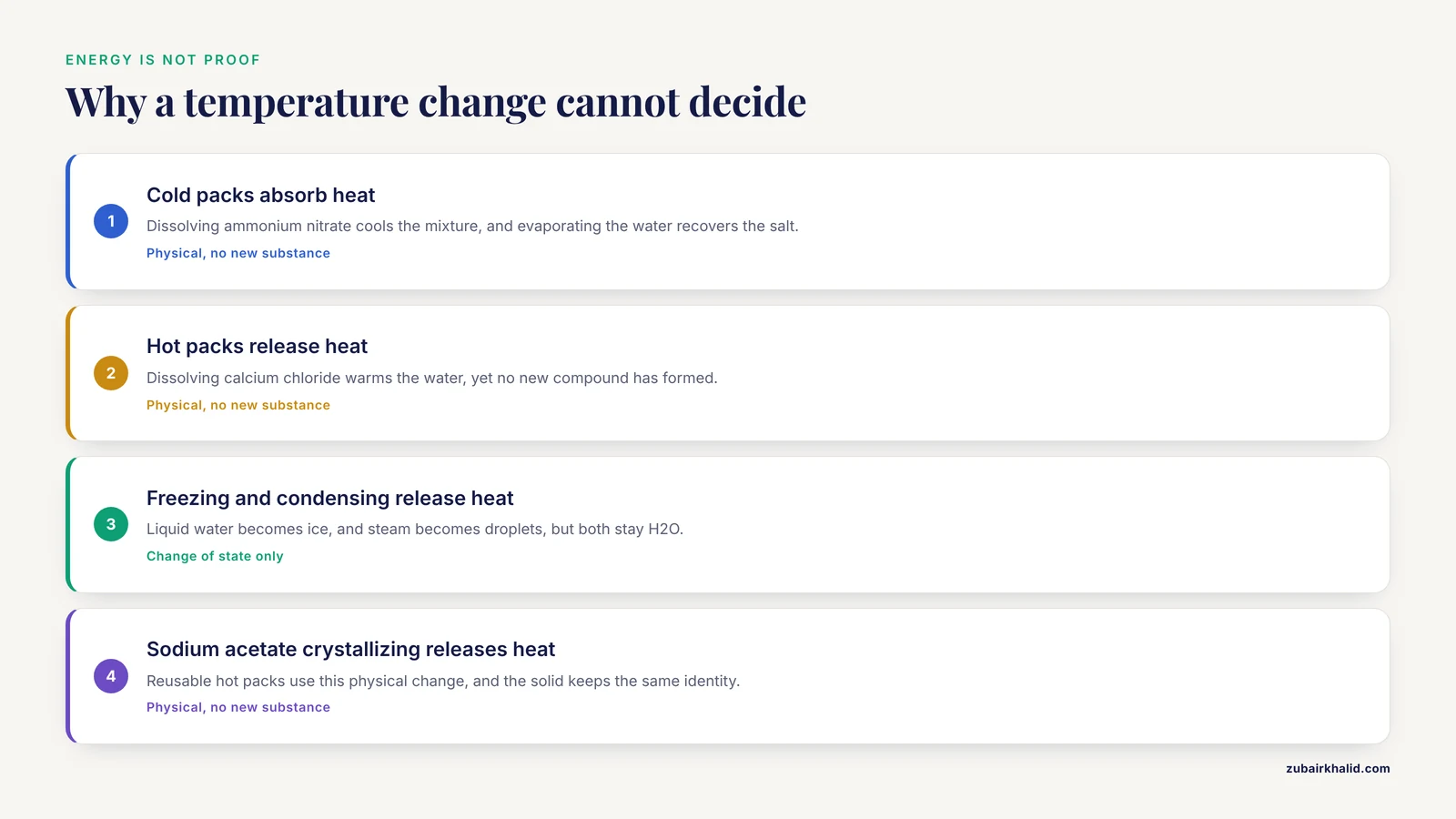
Chemical reactions also come in both thermal directions. Combustion releases heat, while photosynthesis and many thermal decompositions absorb it. Some reactions emit light, and so do physical processes. A glowing electric heater coil releases heat and visible light with no chemical reaction at all.
Heat and light show that energy has moved. They do not show what the atoms have done. A cold pack can chill a bruise and a hot pack can warm cold hands, yet the common ammonium nitrate cold pack and the reusable sodium acetate hot pack both rely on physical changes. Neither proves a reaction by its temperature change alone.
The useful question is not "Did the temperature change?" It is "Did a new substance form?" Energy transfer can prompt that question, but only a check of substance identity can answer it. A temperature change is a clue to investigate, not a verdict.
How to Write Balanced Equations for the Classic Examples
Start with correct formulas, then adjust coefficients only. State symbols record phase: (s) solid, (l) liquid, (g) gas, (aq) dissolved in water. They do not change the atom count, but they keep the equation honest about conditions.
Six Balanced Equations
| Change | Balanced equation | What to check |
|---|---|---|
| - | - | - |
| Rusting iron | 4Fe(s) + 3O2(g) + xH2O(l) → 2Fe2O3·xH2O(s) | Fe 4/4; O 6 + x/6 + x; H 2x/2x. The water is part of the product. |
| Methane combustion | CH4(g) + 2O2(g) → CO2(g) + 2H2O(g) | C 1/1; H 4/4; O 4/4. Water is usually written as gas. |
| Photosynthesis | 6CO2(g) + 6H2O(l) → C6H12O6(s) + 6O2(g) | C 6/6; H 12/12; O 18/18. Light and chlorophyll go above the arrow, not into the formula. |
| Cellular respiration | C6H12O6(s) + 6O2(g) → 6CO2(g) + 6H2O(l) | C 6/6; H 12/12; O 18/18. Energy released is not a reactant. |
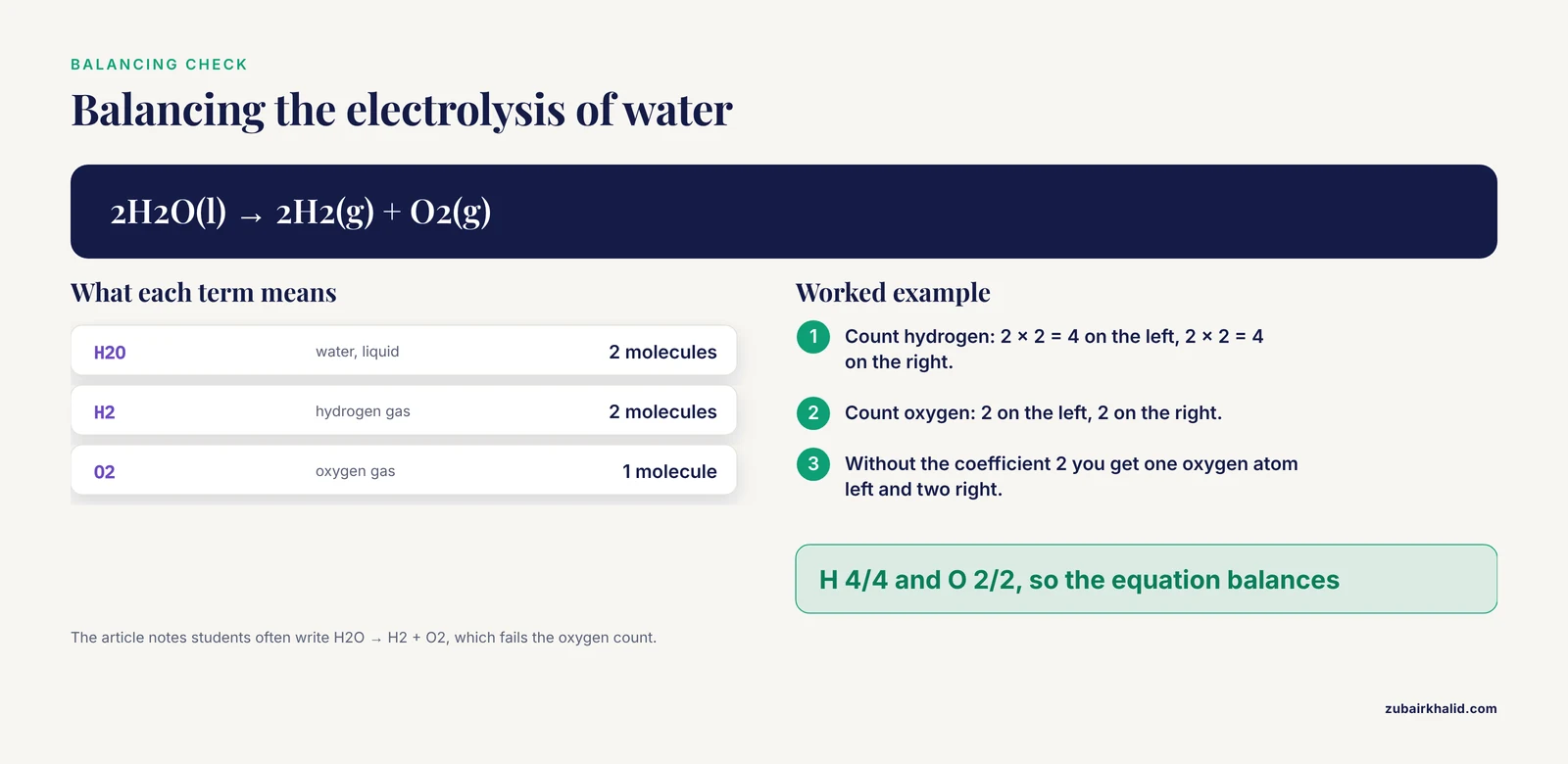
| Water electrolysis | 2H2O(l) → 2H2(g) + O2(g) | H 4/4; O 2/2. The coefficient 2 is required. |
| Baking soda and vinegar | NaHCO3(aq) + CH3COOH(aq) → CH3COONa(aq) + H2O(l) + CO2(g) | Na 1/1; C 3/3; H 5/5; O 5/5. |
For rusting, the variable x shows that the amount of water in hydrated iron(III) oxide can vary. A simplified Fe + O2 → Fe2O3 equation leaves water out and does not describe the product.
For combustion, count oxygen last because it appears in several products. For photosynthesis and respiration, the coefficients are large because one glucose molecule contains six carbon atoms. For electrolysis, students often write H2O → H2 + O2, which gives one oxygen atom on the left and two on the right.
Common Balancing Mistakes
- Changing a subscript, such as turning H2O into H2O2, instead of changing a coefficient.
- Leaving O2 or H2O with no coefficient in a combustion equation.
- Omitting water from rusting or treating hydrated rust as anhydrous Fe2O3.
- Writing light or chlorophyll as a reactant in photosynthesis.
- Forgetting the coefficient 2 in the electrolysis of water.
- Using (aq) for pure water, which should be (l), or using (l) for vinegar, which is a solution and should be (aq).
- Checking only carbon or only hydrogen. Check every element, then check charge if ions are involved.
Related Guides
- Is Environmental Science a Physical Science?: Explains physical science boundaries for students learning change concepts
- Chemical Crosslinking for Protein-Protein Interaction Analysis: Protein chemistry follow-up on bonding and molecular interaction methods
- Pipette Corrosion and Chemical Damage: Lab equipment corrosion and chemical damage safety context
- Titin: The Largest Protein and Its Famous Full Chemical Name: Notable protein chemical name example for chemistry readers
- Biological Spill Cleanup vs. Chemical Spill Cleanup: Key Differences: Safety guide for cleaning up chemical versus biological spills
- How to Store and Handle Chemical Reagents for Molecular Biology: Reagent storage and handling support safe chemistry laboratory work
- REACH Compliance for Chemicals: Chemical regulatory compliance context for industrial and lab safety
Frequently Asked Questions
What is the difference between a physical and a chemical change?
A physical change alters form, state, or arrangement without creating a new substance. A chemical change rearranges atoms into one or more new substances with different properties.
What are some chemical change examples at home?
Rusting iron, burning a candle, baking bread, cooking an egg, souring milk, browning a cut apple, bleaching a stain, and mixing baking soda with vinegar are all chemical changes you can observe at home.
Is melting a physical or chemical change?
Melting is physical. Ice, liquid water, and steam are all H2O, so the substance keeps its identity even though its state and molecular spacing change.
Is dissolving salt in water a chemical change?
No. Dissolving salt in water is physical, because evaporating the water recovers the same salt. The sodium and chloride ions separate, but no new compound forms.
How do you know a chemical change has occurred?
Look for a new substance, shown by gas production, a precipitate, a color change from a new compound, a new odor, or heat and light that simple mixing cannot explain. Confirm with a test such as limewater for carbon dioxide or a pH indicator.
Are chemical changes always irreversible?
No. Many chemical reactions can be reversed by another reaction or by changing conditions. Reversibility is a useful clue but a poor test, which is why chemists rely on substance identity instead.
Sources
- IDENTIFYING MENTAL MODELS OF STUDENTS FOR PHYSICAL AND CHEMICAL CHANGE
- Physical and chemical change in textbooks: An initial view
- THE EFFECT OF STORYLINES EMBEDDED WITHIN CONTEXT-BASED LEARNING APPROACH ON GRADE 6 STUDENTS’ UNDERSTANDING OF ‘PHYSICAL AND CHEMICAL CHANGE’ CONCEPTS
- Children's understanding of substances, Part 2: Explaining chemical change
- The effect of using supplementary cementitious materials on damage development due to the formation of a chemical phase change in cementitious materials exposed to sodium chloride
- Wettability of Wood Surface Layer Examined From Chemical Change Perspective
- Children's understanding of substances, part 1: recognizing chemical change
- Implementing of a worksheet related to physical and chemical change concepts
- Using the Science Writing Heuristic Approach to Enhance Student Understanding in Chemical Change and Mixture
- Teaching the concepts of physical and chemical change to elementary school children