Avogadro's Number: Value, Meaning and Mole Calculations
By Dr. Zubair Khalid, DVM, MS, PhD ·
Avogadro's number is 6.022 × 10^23, the number of elementary entities (atoms, molecules, ions, or other particles) in one mole of a substance. The Avogadro constant (NA) is the same quantity expressed with units of reciprocal moles, 6.02214076 × 10^23 mol⁻¹, and it is the fixed constant that defines the mole in the modern International System of Units (SI) [1].
This number matters because it is the bridge between the macroscopic world of grams and liters and the microscopic world of individual atoms and molecules. Without it, chemists could not convert a mass weighed on a balance into a count of particles, and biologists could not calculate how many protein molecules are present in a cell or how many copies of a DNA template exist in a PCR reaction.
What Is Avogadro's Number?
Avogadro's number is a count. It answers the question "how many?" Specifically, it is the number of atoms in exactly 12 grams of the carbon-12 isotope, which was the basis of the original definition of the mole. The number is so large that it is almost impossible to grasp intuitively. If you had one mole of marbles, each the size of a pea, the pile would cover the entire surface of the Earth many meters deep. If you counted one atom per second, it would take you about 19 quadrillion years, roughly 1.4 million times the age of the universe, to count a mole of atoms.
The numerical value is 6.02214076 × 10^23, which is exact in the current SI [1]. Before the 2019 revision, the value was experimentally determined and carried an uncertainty. The most precise measurements, based on silicon-28 sphere experiments, achieved a relative uncertainty of about 2 × 10⁻⁸ for the volume measurement alone [3], and the final value used for the redefinition was 6.02214076 × 10^23 mol⁻¹ exactly [1].
The number is named after Amedeo Avogadro, the Italian scientist who proposed in 1811 that equal volumes of gases at the same temperature and pressure contain equal numbers of molecules. Avogadro himself never calculated the number. The name was applied in the early 20th century, after the French physicist Jean Perrin estimated it from multiple independent methods and proposed calling it "Avogadro's number" in honor of the hypothesis.
What Is a Mole in Chemistry?
The mole (symbol: mol) is the SI base unit of amount of substance [1][2]. It is one of the seven base units of the SI, alongside the meter, kilogram, second, ampere, kelvin, and candela. The mole is a counting unit, like a dozen (12) or a gross (144), but vastly larger. One mole of any substance contains exactly 6.02214076 × 10^23 elementary entities [1].
The phrase "elementary entities" is deliberately general. It can mean atoms, molecules, ions, electrons, photons, or any other specified particle. A mole of sodium atoms contains 6.022 × 10^23 sodium atoms. A mole of sodium chloride contains 6.022 × 10^23 formula units of NaCl. A mole of electrons contains 6.022 × 10^23 electrons. The entity must be specified, because "one mole of sodium" and "one mole of sodium chloride" are very different samples.
The mole is useful because it connects the atomic scale, where masses are measured in daltons, to the laboratory scale, where masses are measured in grams. One dalton is defined as one-twelfth of the mass of a carbon-12 atom. Because the mole contains 6.022 × 10^23 entities, one mole of a substance has a mass in grams that is numerically equal to the mass of one entity in daltons. This is why the molar mass of water is 18.015 g/mol while a single water molecule has a mass of 18.015 daltons.
Before May 20, 2019, the mole was defined as the amount of substance that contains as many elementary entities as there are atoms in 0.012 kilograms of carbon-12 [2]. That definition linked the mole to the kilogram, which was itself defined by a platinum-iridium cylinder kept in a vault near Paris [4]. The link created a chain of dependencies: the mole depended on the kilogram, and the kilogram depended on a physical artifact that could be damaged, lost, or changed over time [4].
The 2019 revision of the SI broke that chain. The mole is now defined by fixing the numerical value of the Avogadro constant to exactly 6.02214076 × 10^23 mol⁻¹ [1][2]. The kilogram is now defined by fixing the numerical value of the Planck constant [5]. The mole no longer depends on the kilogram, and neither unit depends on a physical artifact [1][4].
The Distinction Between Avogadro's Number and the Avogadro Constant
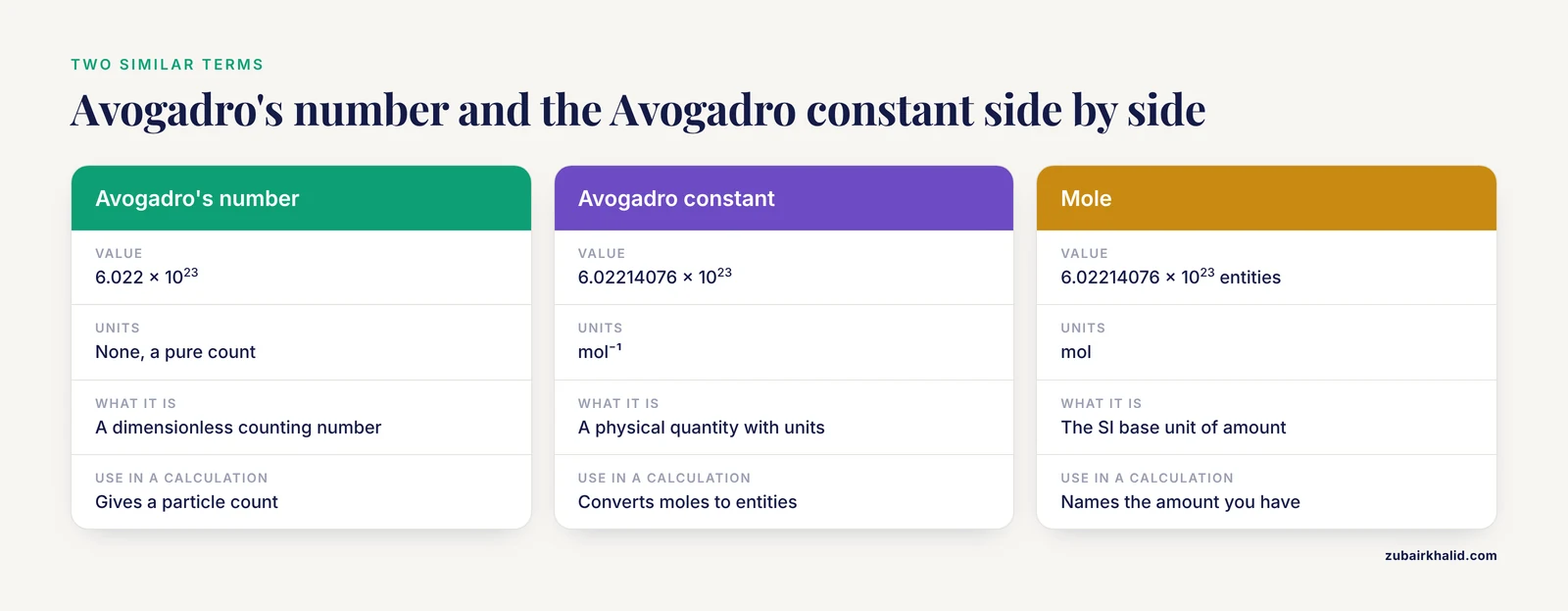
Strictly speaking, Avogadro's number and the Avogadro constant are not the same thing. Avogadro's number is a pure, dimensionless number: 6.022 × 10^23. The Avogadro constant, symbolized NA, is a physical quantity with units: 6.02214076 × 10^23 mol⁻¹ [1]. The distinction is the same as the distinction between "12" and "12 per dozen." The number counts entities; the constant relates the number of entities to the amount of substance.
Some metrologists have argued that the Avogadro constant cannot properly be called the defining constant of the mole, because the constant itself contains the unit mol⁻¹, which creates a circularity [6]. The counter-argument is that the Avogadro constant is fundamentally equal to one per elementary amount, a quantity independent of the mole, and is therefore appropriately recognized as the defining constant [7]. For practical purposes, the distinction rarely matters. What matters is that one mole contains exactly 6.02214076 × 10^23 entities [1].
| Term | Symbol | Value | Units |
|---|---|---|---|
| Avogadro's number | none | 6.022 × 10^23 | dimensionless (a pure count) |
| Avogadro constant | NA | 6.02214076 × 10^23 | mol⁻¹ |
| Mole | mol | amount of substance containing 6.02214076 × 10^23 elementary entities | mol |
| Molar mass | M | mass of one mole of a substance | g/mol |
How the Avogadro Constant Was Measured
The most precise measurements of the Avogadro constant used the X-ray crystal density (XRCD) method, carried out by the International Avogadro Coordination project [2][8]. The idea is elegant. If you have a perfect crystal of a known element, you can count the atoms by measuring the crystal's volume and dividing by the volume occupied by a single atom. The challenge is making the crystal pure enough and measuring its volume precisely enough.
The project used a crystal of silicon highly enriched in the 28Si isotope [1][8][9]. Silicon was chosen because it can be grown into large, nearly perfect single crystals, and because its crystal structure is well understood. The enrichment was necessary because natural silicon contains three isotopes (atoms of the same element with different numbers of neutrons): 28Si, 29Si, and 30Si. The precise atomic mass of natural silicon was not known well enough for the experiment. Producing the enriched silicon was a major project in itself. The 28Si isotope had to be concentrated from natural silicon on an industrial scale, and the resulting crystal had to meet extraordinary purity requirements [10].
The experiment required several independent measurements [8]:
- The molar mass of the silicon, determined by mass spectrometry.
- The lattice parameter (the spacing between atoms in the crystal), determined by X-ray interferometry.
- The mass of a silicon sphere, determined by weighing.
- The volume of the sphere, determined by optical interferometry.
The volume measurement alone required measuring the sphere's diameter in 2,175 directions [3]. The surface layers of the sphere, including oxide and contamination layers, had to be characterized by surface analysis techniques, and their effect on the diameter measurement had to be removed [3]. The purity of the silicon had to be verified at extremely low levels, because trace impurities change both the mass and the lattice parameter [10].
The result was a value of NA with a relative uncertainty small enough to support the redefinition [1]. The value 6.02214076 × 10^23 mol⁻¹ was fixed in the SI on May 20, 2019 [1].
In undergraduate laboratories, Avogadro's number is often estimated by electrolysis. Passing a measured current through an electrolytic cell for a measured time gives the total charge passed. Dividing by the elementary charge gives the number of electrons, and measuring the mass of metal deposited gives the number of atoms per mole. This classic experiment typically yields values close to the accepted value.
Mole Calculations: Worked Examples
All mole calculations reduce to one relationship: the number of entities equals the number of moles times the Avogadro constant.
Number of entities = number of moles × 6.022 × 10^23
And its companion, using molar mass:
Number of moles = mass (in grams) / molar mass (in grams per mole)
Example 1: Grams to Moles
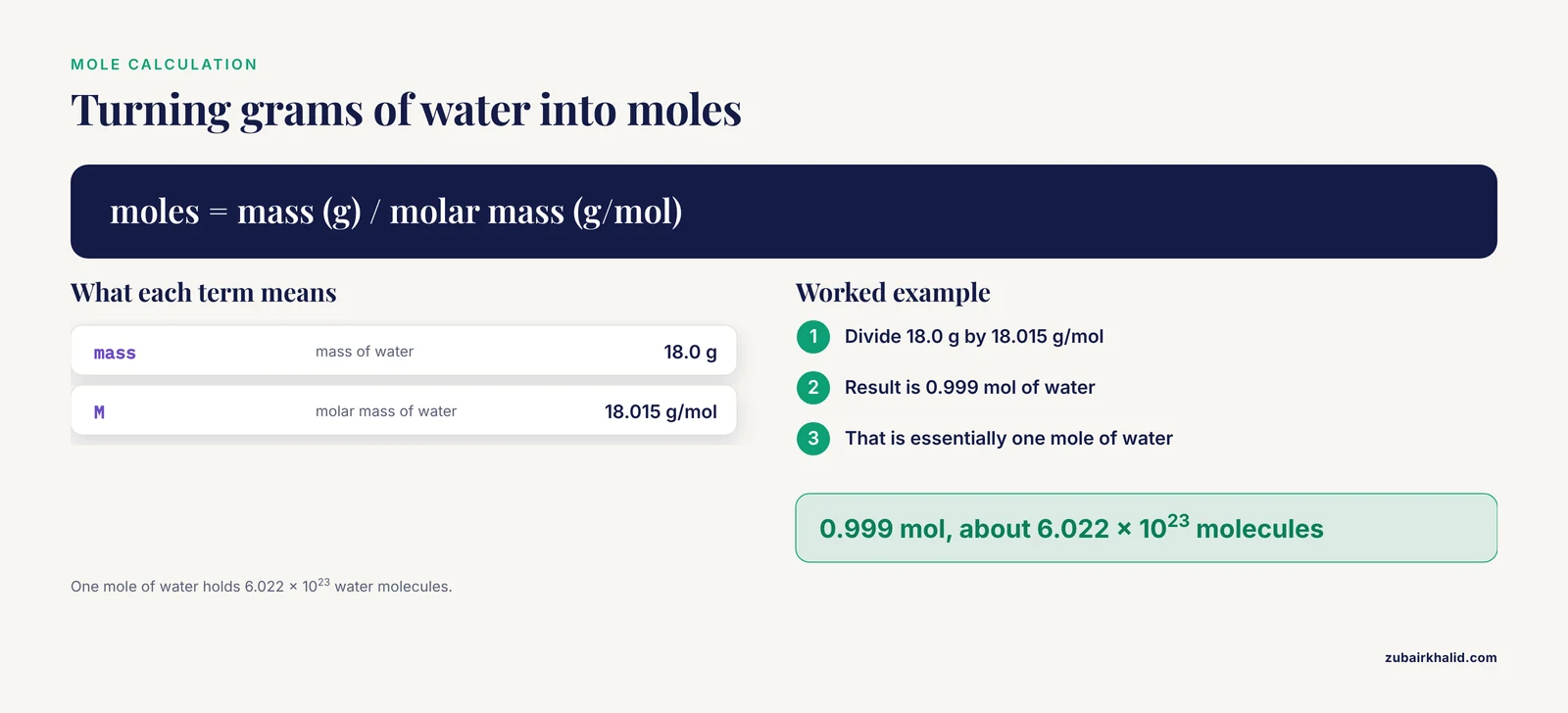
How many moles are in 18.0 grams of water? The molar mass of water (H₂O) is about 18.015 g/mol.
moles = 18.0 g / 18.015 g/mol = 0.999 mol
So 18.0 grams of water is essentially one mole of water, containing 6.022 × 10^23 water molecules.
Example 2: Moles to Number of Particles
How many carbon atoms are in 0.500 moles of carbon?
Number of atoms = 0.500 mol × 6.022 × 10^23 atoms/mol = 3.011 × 10^23 atoms
Example 3: Mass of a Single Molecule
What is the mass of one glucose molecule? The molar mass of glucose (C₆H₁₂O₆) is about 180.156 g/mol.
Mass of one molecule = 180.156 g/mol / 6.022 × 10^23 molecules/mol = 2.992 × 10⁻²² g
A single glucose molecule has a mass of about 3 × 10⁻²² grams.
Example 4: Moles in a PCR Reaction
A typical 50-microliter PCR reaction contains about 10 nanomoles of each deoxynucleotide triphosphate (dNTP). How many molecules is that?
10 × 10⁻⁹ mol × 6.022 × 10^23 molecules/mol = 6.022 × 10^15 molecules
That is about 6 million billion molecules of each dNTP in a single reaction.
Example 5: Preparing a Solution
How many grams of sodium chloride (NaCl) are needed to prepare 500 mL of a 0.150 M solution? The molar mass of NaCl is 58.44 g/mol.
moles of NaCl = 0.150 mol/L × 0.500 L = 0.0750 mol mass of NaCl = 0.0750 mol × 58.44 g/mol = 4.38 g
Dissolve 4.38 grams of NaCl in enough water to make 500 mL of solution. The solution contains 0.0750 × 6.022 × 10^23 = 4.52 × 10^22 sodium ions and the same number of chloride ions.
Avogadro's Number in Biology
Biology relies on the mole whenever it counts molecules. Concentrations of biochemicals are expressed in molarity (moles per liter), and a 1 M solution contains 6.022 × 10^23 solute molecules per liter. Most biological solutions are far more dilute. A 1 mM solution contains 6.022 × 10^20 molecules per liter, and a 1 micromolar solution contains 6.022 × 10^17 molecules per liter.
These numbers matter for experimental design. When a biochemist prepares a 10 mM stock solution of ATP, they are dissolving 6.022 × 10^21 ATP molecules per liter of solution. When a molecular biologist uses a picomole of a primer in a PCR reaction, they are working with about 6 × 10^11 primer molecules.
Avogadro's number also connects the macroscopic to the cellular. A single bacterial cell contains millions of protein molecules. To prepare a solution with the same number of a particular protein, a researcher would need roughly 10⁻¹⁷ moles, or about 10 attomoles. This is the scale of single-cell biology.
In genomics, one nanogram of human genomic DNA contains roughly 300 copies of the haploid genome. That number comes directly from the molar mass of a DNA base pair (about 650 g/mol) and Avogadro's constant.
Enzyme kinetics and binding assays depend on mole-based concentration units. The Michaelis-Menten equation, which describes how the rate of an enzyme-catalyzed reaction depends on substrate concentration, uses substrate concentration in moles per liter. Knowing how many substrate molecules are present, via Avogadro's number, allows researchers to predict whether a reaction will proceed and how fast.
In clinical chemistry, the mole is equally central. Blood glucose is reported in millimoles per liter. A blood glucose concentration of 5.5 mmol/L means 5.5 × 10⁻³ moles of glucose per liter of blood, or about 3.3 × 10^21 glucose molecules per liter. Hemoglobin concentration is reported in grams per deciliter, but the underlying calculations use moles to relate oxygen-binding sites to measured oxygen content.
Common Mistakes and Limitations
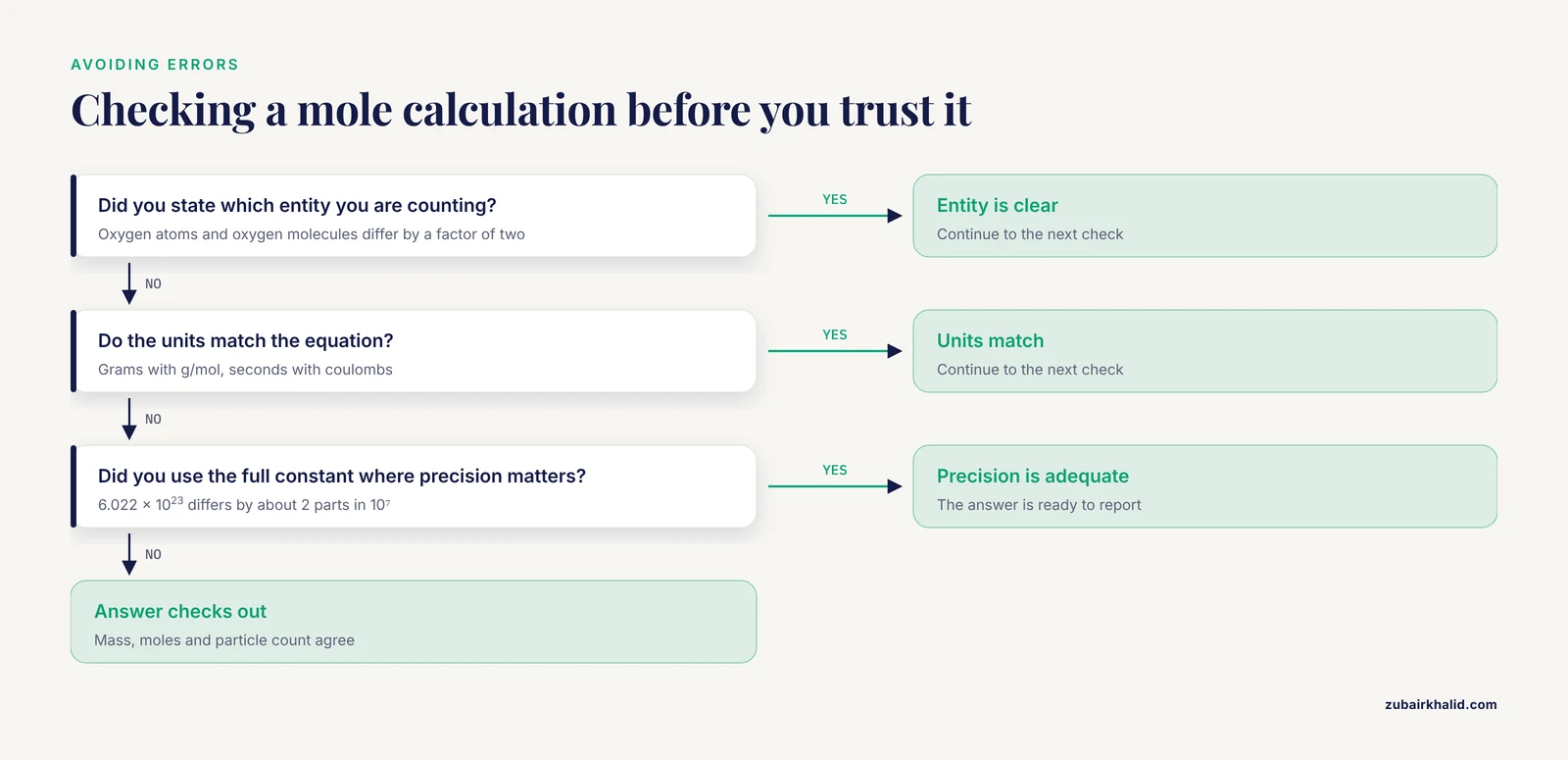
Confusing Avogadro's number with the Avogadro constant. Avogadro's number is dimensionless; the Avogadro constant has units of mol⁻¹. In calculations, the units matter. Writing 6.022 × 10^23 without units is fine for a count, but the constant must carry mol⁻¹.
Thinking a mole is a mass. A mole is a count, not a mass. One mole of hydrogen atoms has a mass of about 1 gram, while one mole of uranium atoms has a mass of about 238 grams. Both contain the same number of atoms.
Forgetting to specify the entity. "One mole of oxygen" is ambiguous. It could mean one mole of oxygen atoms (O, 16.00 g) or one mole of oxygen molecules (O₂, 32.00 g). The entity must be stated.
Using the wrong molar mass. Molar mass is the mass of one mole of a substance in grams per mole. It is numerically equal to the molecular weight in daltons, but the units are different. A molecule with a molecular weight of 18 daltons has a molar mass of 18 grams per mole.
Assuming the 2019 redefinition changed practical values. The redefinition fixed the value of NA, but it did not change the size of the mole. One mole of water still contains the same number of molecules as before. The change was in how the unit is defined, not in what it measures [1][4].
The silicon route has limits. The XRCD method required extraordinary effort: isotopically enriched silicon, spheres polished to near perfection, and measurements of volume, mass, and lattice parameter at the limits of metrology [3][8][10]. The method is a primary realization of the mole, not a routine laboratory procedure.
Precision versus accuracy in calculations. Using 6.022 × 10^23 instead of 6.02214076 × 10^23 introduces an error of about 2 parts in 10⁷. For most laboratory work, that error is negligible. For metrology, it is not.
Quick Review
- Avogadro's number is 6.022 × 10^23, the number of elementary entities in one mole.
- The Avogadro constant is NA = 6.02214076 × 10^23 mol⁻¹, exact in the 2019 SI [1].
- The mole is the SI base unit of amount of substance [1][2].
- Moles = mass / molar mass.
- Number of particles = moles × NA.
- The mole applies to any specified elementary entity: atoms, molecules, ions, electrons.
- The 2019 redefinition fixed NA and freed the mole from the kilogram [1][4].
Stoichiometry with Avogadro's Number: Converting Between Substances in a Reaction
A balanced equation gives the ratio in which particles react and form. Those coefficients are mole ratios, not mass ratios. To move from one substance to another, convert the known amount to moles, apply the mole ratio, then convert the result to the requested unit. Avogadro's number is used at the particle-count step; the ratio itself comes from the balanced equation.
| Known quantity | Convert to | Apply | Convert to |
|---|---|---|---|
| grams of A | moles of A | moles of B = moles of A × (coefficient B / coefficient A) | grams or particles of B |
| particles of A | moles of A | same mole ratio | grams or particles of B |
Worked Example
Using 2 H₂ + O₂ → 2 H₂O, how many grams of water form from 4.00 g of H₂, and how many water molecules is that?
- Convert grams of H₂ to moles. Molar mass H₂ ≈ 2.016 g/mol: 4.00 g / 2.016 g/mol = 1.98 mol H₂.
- Apply the mole ratio. The coefficients are 2 H₂ : 2 H₂O, so 1.98 mol H₂ produces 1.98 mol H₂O.
- Convert moles of H₂O to grams. Molar mass H₂O ≈ 18.015 g/mol: 1.98 mol × 18.015 g/mol = 35.7 g H₂O.
- Convert moles of H₂O to molecules: 1.98 mol × 6.022 × 10^23 molecules/mol = 1.19 × 10^24 molecules.
So 4.00 g H₂ yields about 35.7 g water, or 1.19 × 10^24 water molecules. The same path works when the known quantity is a particle count: divide by Avogadro's number to get moles, apply the mole ratio, then convert to grams or particles.
Common Mistake: Coefficients Are Not Masses
The coefficients 2, 1, and 2 do not mean 2 grams of H₂ reacts with 1 gram of O₂ to make 2 grams of H₂O. They mean 2 moles of H₂ react with 1 mole of O₂ to make 2 moles of H₂O. In mass terms, that is about 4.03 g H₂ with 32.00 g O₂ to form 36.03 g H₂O. Treating coefficients as masses breaks conservation of mass and gives incorrect product amounts. Always pass through moles before applying the ratio.
Avogadro's Number and Gases: Molar Volume and the Ideal Gas Law
Avogadro's law, that equal volumes of gases at the same temperature and pressure contain equal numbers of molecules, leads directly to a constant molar volume. One mole of any ideal gas occupies the same volume under the same conditions. At standard temperature and pressure (STP, defined as 0 °C and 1 atm), that volume is 22.4 L.
The value follows from the ideal gas law:
PV = nRT
where P is pressure, V is volume, n is the number of moles, R is the gas constant (0.08206 L·atm·mol⁻¹·K⁻¹), and T is absolute temperature. The ideal gas law combines Boyle's law, Charles's law, and Avogadro's law into one equation. At STP, with n = 1 mol:
V = nRT/P = (1 mol)(0.08206 L·atm·mol⁻¹·K⁻¹)(273.15 K) / (1 atm) = 22.4 L
The identity of the gas does not matter. One mole of helium, nitrogen, or carbon dioxide occupies 22.4 L at STP, because gas molecules at ordinary pressures are far apart and their individual sizes are negligible. The molar volume also sets the number density of any gas at STP: one liter contains 1/22.4 mol, or 2.69 × 10^22 molecules. This density is the same for all ideal gases at STP, regardless of molecular mass.
The gas constant R is itself linked to Avogadro's number through the Boltzmann constant k_B: R = NA × k_B. The ideal gas law can therefore be written in molecular form as PV = Nk_BT, where N is the number of molecules. The two forms are equivalent because n × NA = N.
Worked Example: Volume from Moles
How many liters does 2.50 mol of oxygen gas occupy at STP?
V = n × 22.4 L/mol = 2.50 mol × 22.4 L/mol = 56.0 L
Worked Example: Molecules in a Gas Sample
The ideal gas law also provides the route from a gas sample to a particle count. A 1.00 L flask contains nitrogen gas at 25 °C and 0.850 atm. How many nitrogen molecules are present?
First solve for moles:
n = PV/RT = (0.850 atm)(1.00 L) / (0.08206 L·atm·mol⁻¹·K⁻¹)(298 K) = 0.0348 mol
Then multiply by Avogadro's number:
Number of molecules = 0.0348 mol × 6.022 × 10^23 molecules/mol = 2.10 × 10^22 molecules
The same two-step procedure works for any gas sample: use PV = nRT to find moles, then multiply by NA to find the number of molecules. At STP, the first step simplifies to dividing the volume by 22.4 L/mol. For gases at very high pressure or low temperature, the ideal gas law becomes an approximation, but it remains accurate for most laboratory gases under ordinary conditions.
Avogadro's Number in Electrochemistry: Counting Electrons with Faraday's Constant
Electrochemistry applies Avogadro's number directly because it involves counting electrons, and electrons are elementary entities just like atoms or molecules. The link between the mole and electric charge is the Faraday constant, F, defined as the charge carried by one mole of electrons:
F = NA × e
where e is the elementary charge, 1.602176634 × 10⁻¹⁹ C. Using the exact SI values, F = 6.02214076 × 10²³ mol⁻¹ × 1.602176634 × 10⁻¹⁹ C = 96,485.332 C/mol, usually rounded to 96,485 C/mol. The constant is named after Michael Faraday, whose electrolysis experiments in the 1830s showed that the mass of a substance liberated at an electrode is proportional to the charge passed.
The total charge Q passed through an electrolytic cell is the product of current I and time t:
Q = I × t
Combining the two equations gives the moles of electrons:
moles of e⁻ = Q / F = I × t / F
This relationship connects the mole to the ampere, the SI base unit of electric current. A current of 1 A flowing for 96,485 s (about 26.8 hours) delivers exactly one mole of electrons.
Worked Example: Copper Deposition
How much copper is deposited when a current of 2.50 A flows through a Cu²⁺ solution for 30.0 minutes?
- Convert time to seconds: 30.0 min × 60 s/min = 1,800 s.
- Calculate charge: Q = 2.50 A × 1,800 s = 4,500 C.
- Convert to moles of electrons: 4,500 C / 96,485 C/mol = 0.0466 mol e⁻.
- Apply stoichiometry: Cu²⁺ + 2e⁻ → Cu, so 2 mol e⁻ deposits 1 mol Cu. Moles of Cu = 0.0466 / 2 = 0.0233 mol.
- Convert to mass: 0.0233 mol × 63.55 g/mol = 1.48 g.
So 1.48 g of copper is deposited.
Common Unit Pitfalls
- Time must be in seconds. Minutes must be converted by multiplying by 60.
- Current is in amperes, which are coulombs per second. A current of 1 A passing for 1 s delivers 1 C.
- The Faraday constant carries units of C/mol e⁻. Do not drop the "per mole of electrons" part.
- The stoichiometry matters. Cu²⁺ requires 2 electrons per ion; Ag⁺ requires 1; Al³⁺ requires 3. Forgetting this factor changes the answer by a factor of 2 or 3.
- Molar mass must be in g/mol, and the mass is for the metal, not the ion.
Putting Avogadro's Number to Work: Real-World Estimates and Applications
Avogadro's number turns a mass on a balance or a volume in a syringe into a count of particles. Four estimates show the method.
Atoms in a Human Body
A 70 kg body is mostly water. Treating it as water: 70,000 g divided by 18 g/mol gives about 3,900 mol of water. Each water molecule has three atoms, so the body holds roughly 11,700 mol of atoms. Multiplying by Avogadro's number gives about 7 × 10^27 atoms. The count matters in radiation dosimetry, where the number of atoms in tissue determines how many ionizing events occur per unit of absorbed energy.
Molecules in a Breath
A normal breath is about 0.5 L. Air has a density near 1.2 g/L, so one breath contains about 0.6 g of air. With an average molar mass of 29 g/mol, that is 0.021 mol, or 1.3 × 10^22 molecules. A trace gas at one part per billion is therefore about 10^13 molecules per breath, which is why sensitive detectors can identify disease markers in exhaled air.
Drug Molecules in a Tablet
A 325 mg aspirin tablet contains acetylsalicylic acid (C9H8O4, molar mass 180 g/mol). Dividing 0.325 g by 180 g/mol gives 0.0018 mol, or about 1.1 × 10^21 molecules. This count links a milligram dose to the number of molecules available to bind receptors, connecting pharmacology to molecular events.
CO2 in the Atmosphere
The atmosphere holds roughly 1.0 × 10^44 molecules. At a CO2 concentration near 420 parts per million, the number of CO2 molecules is 420 × 10^-6 times that total, about 4 × 10^40, or roughly 7 × 10^16 mol. Climate scientists use this count to track carbon fluxes and to check emission inventories against atmospheric observations.
Each estimate follows one path: measure a mass or volume, convert to moles, multiply by Avogadro's number. The results are astronomically large, yet they are finite counts of real particles, connecting everyday quantities to the molecular scale.
Related Guides
- How to Convert Moles to Grams (and Grams to Moles) with Molar Mass: Shows step-by-step mole and gram conversions using molar mass
- Troubleshooting Calculator Errors in Life Science: Helps diagnose unit and calculator mistakes in lab calculations
- How Many PCR Cycles Do You Need?: Guides PCR cycle number choices for successful amplification
Frequently Asked Questions
What is Avogadro's number in simple terms?
Avogadro's number is 6.022 × 10^23, the number of atoms, molecules, or other particles in one mole of a substance. It is a counting number, like a dozen, but on an astronomical scale.
Why is Avogadro's number 6.022 × 10^23?
The value was chosen so that one mole of a substance has a mass in grams numerically equal to its molecular weight in daltons. Historically, it was defined as the number of atoms in 12 grams of carbon-12. In the 2019 SI, the value was fixed exactly at 6.02214076 × 10^23 mol⁻¹ [1].
How do you calculate moles from grams?
Divide the mass in grams by the molar mass in grams per mole. For example, 36.0 grams of water divided by 18.015 g/mol gives 2.00 moles of water.
What is the difference between Avogadro's number and the Avogadro constant?
Avogadro's number is a dimensionless count: 6.022 × 10^23. The Avogadro constant is the same value with units: 6.02214076 × 10^23 mol⁻¹ [1]. The constant relates the number of entities to the amount of substance.
How is Avogadro's number used in biology?
Biologists use it to convert between moles and molecule counts. A 1 micromolar solution contains 6.022 × 10^17 molecules per liter, and a 1 picomole PCR primer aliquot contains about 6 × 10^11 molecules. These conversions are essential for designing experiments.
Did the 2019 SI redefinition change the value of Avogadro's number?
No. The redefinition fixed the value at 6.02214076 × 10^23 mol⁻¹, which was already the best measured value [1]. The size of the mole did not change. What changed was the definition: the mole no longer depends on the kilogram [1][4].
Sources
- The Avogadro Constant for the Definition and Realization of the Mole
- Mole, the SI Unit of Amount of Substance, and Its Re-Definition by Fixing the Numerical Value of the Avogadro Constant
- Volume Measurement of a 28Si-Enriched Sphere for a Determination of the Avogadro Constant at NMIJ
- Freeing the mole from the kilogram: How the redefinition of the kilogram shaped our definition of the Avogadro number
- The Planck Constant for the Definition and Realization of the Kilogram
- The Avogadro constant is not the defining constant of the mole
- Second Comment on ‘The Avogadro constant is not the defining constant of the mole’
- Revision of the SI: The Determination of the Avogadro Constant as the Base for the Kilogram
- Large-scale production of highly enriched 28Si for the precise determination of the Avogadro constant
- Purity of (28)Si-Enriched Silicon Material Used for the Determination of the Avogadro Constant.