Understanding the Limitations of Online Scientific Calculators
By Dr. Zubair Khalid, DVM, MS, PhD ·

Online scientific calculators deliver fast answers, and most of those answers are correct arithmetic applied to assumptions you never saw. Understanding the limitations of online scientific calculators means knowing where those assumptions enter, how browser-based math can drift from the value you actually need, and when a result needs verification before it reaches a lab notebook, a thesis, or a manuscript.
The good news is that these limitations are predictable. Once you know how the tools work, you can use them for what they do well, speed and access, and protect yourself against what they do poorly, context, transparency, and record keeping.
What "Limitations of Online Scientific Calculator" Means
An online scientific calculator is any browser-based tool that performs scientific computation. The category ranges from a one-page molarity calculator to a full bioinformatics calculator that translates a DNA sequence, estimates a protein's molecular weight, or maps restriction enzyme cut sites. The phrase "limitations of online scientific calculator" describes the specific ways such a tool can return a result that is arithmetically correct but scientifically misleading.
A useful interpretation separates the phrase into four distinct problems:
- Precision limits. The math engine inside the browser stores and rounds numbers in a particular way, so displayed digits can outrun the accuracy of the calculation.
- Hidden assumptions. The developer chose a formula, default settings, and unit conventions. You see the output, not the choices.
- Missing context. The tool computes a number. It cannot decide whether that number answers your biological question.
- Data and access risks. Inputs travel over a network, tools depend on connectivity, and the publication behind a formula may be hard to reach.
Each problem has concrete consequences for anyone using a biology calculator, and each has a practical fix covered below.
How an Online Scientific Calculator Actually Works
Most online calculators run a small script inside your browser, so the computation happens on your own device. Others send your inputs to a server and return a result. Either way, three layers are at work: an input parser that reads what you typed, a math engine that applies a formula, and an output formatter that decides how many digits to show. Limitations enter at all three layers.
Floating-Point Arithmetic in Plain Language
Computers store numbers in binary, and many everyday decimals have no exact binary form. Standard double-precision arithmetic, defined by the IEEE 754 specification, uses 64 bits per number, which provides roughly 15 to 17 significant decimal digits. Because 0.1 and 0.2 are stored as approximations, adding them in a browser can produce 0.30000000000000004 instead of 0.3.
For a single bench calculation, an error in the sixteenth decimal place is irrelevant. The problem appears when a script sums hundreds of measurements, compares two computed values for exact equality, or runs an iterative algorithm where tiny rounding errors accumulate across steps. This is why two tools can disagree in the last displayed digit, and why "the calculator said so" is not a precision guarantee.
Input Parsing and Unit Handling
Before any math happens, the parser must interpret your typing. This step is a common source of silent failure. A tool may read "1,5" as one point five or as fifteen depending on how it handles locale conventions. Scientific notation such as 1e-3, meaning 0.001, is handled cleanly by some parsers and rejected or misread by others. A stray space, a trailing unit typed into a numeric field, or a pre-filled default value you did not notice can all change the result. The calculator computes faithfully on whatever it parsed, which is not always what you meant.
Significant Figures and Rounding
Significant figures are the digits in a number that carry real measurement information. A calculator displays what its engine produces, not what your data supports. Type a concentration with two significant figures and the tool may return eight decimals. Those extra digits are noise.
Arithmetic also cannot remove measurement uncertainty. If your pipette delivers 9.98 to 10.02 mL, the downstream concentration inherits that spread no matter how many decimals the screen shows. A core habit in reading any calculator output is matching the precision of the answer to the precision of the inputs.
Where Biologists Use Online Calculators
The "biology calculator" label covers a wide range of tools, and the limitations differ by type:
- Solution preparation. Molarity (moles of solute per liter of solution), dilution using C1V1 = C2V2, serial dilution (stepwise repeated dilutions), and buffer calculators.
- Molecular biology. Oligonucleotide molecular weight, GC content (the percentage of guanine and cytosine bases in a sequence), primer melting temperature (Tm, the temperature at which half of a DNA duplex separates into single strands), restriction site finders, and open reading frame finders.
- Genetics and evolution. Hardy-Weinberg equilibrium calculators, which use p² + 2pq + q² = 1 to connect allele frequencies to genotype frequencies, and chi-square tests for count data.
- Statistics. t-tests, confidence intervals, and sample size or power calculations.
- Bioinformatics calculators and web servers. Sequence translation, alignment, phylogenetic inference, and protein property estimation.
- Signal-processing toolkits. A 2025 systematic review of online photoplethysmography (PPG, a non-invasive optical technique for cardiovascular monitoring) toolkits examined six options released between 2015 and 2025, evaluating features, ease of use, documentation, and limitations. It found open-source packages such as HeartPy, BioSPPy, and NeuroKit2 well suited to academic research, while the commercial platform LabChart offers advanced clinical-level features [1].
- Data-driven prediction tools. Machine-learning calculators increasingly sit on curated databases. The Chiral Ligand and Catalyst Database (CLC-DB), for example, holds 1,861 molecules across 32 categories with 34 types of expert-validated annotations, yet its developers note that data scarcity and model inaccuracies still challenge broader computational prediction [2].
- AI chatbots used as calculators. These add a layer of opacity on top of everything else, discussed below.
The pattern across all categories is the same. A calculator automates one step. The judgment around that step stays with you. A Hardy-Weinberg example makes the point. If 4% of a population shows a recessive trait, then q² = 0.04, so q = 0.2 and p = 0.8, and the predicted carrier frequency is 2pq = 0.32, or 32%. A calculator produces those numbers instantly, but it cannot check whether the population actually meets the equilibrium conditions of random mating, no selection, no migration, no mutation, and a large population size.
The Core Limitations of Online Scientific Calculators, Explained
Hidden Assumptions and Undocumented Formulas
Two calculators can disagree because they silently use different formulas. Primer Tm is the classic case. A quick estimate for short oligonucleotides, the Wallace rule, computes Tm as 2 °C for each A or T base plus 4 °C for each G or C base. A 12-base primer with 4 A/T bases and 8 G/C bases gets an estimated Tm of 40 °C. Salt-adjusted and nearest-neighbor methods, which account for salt concentration and stacking interactions between adjacent bases, return different values, often by several degrees. Many calculator pages never state which method they use.
Similar ambiguity appears elsewhere. Molecular weight tools may or may not include a 5' phosphate or counterions. Chi-square tools differ on whether they apply the Yates correction, an adjustment for small 2x2 contingency tables. Cell doubling-time calculators, which typically compute t × log(2) / log(Nf/Ni), assume exponential growth even when cultures enter lag or stationary phase. The standard dilution equation assumes volumes are additive, which fails for some concentrated solutions. None of this is a bug. It is the gap between a formula and the specific conditions under which that formula applies.
No Context, No Interpretation
A calculator handles intrinsic complexity, the arithmetic itself, far better than contextual complexity, the fit between the calculation and your question. A study of 93 undergraduate science majors at Michigan State University tested an online language simplification tool and found the same split. Groups using the tool simplified scientific jargon more effectively than comparison groups (p = .0364 against moderate feedback and p = .0775 against no feedback), yet the tool was less effective at addressing contextual complexity [3]. Calculators have the mirror-image profile. They nail the arithmetic and offer nothing on whether a p-value of 0.03 matches your experimental design, whether the test's assumptions held, or whether a 1.2-fold change matters biologically.
Data Quality Behind the Tool
Calculator pages pull constants, formulas, and background text from the same internet that carries errors and deliberate misinformation. Research on online scientific practice documents persistent concerns about data quality, reliability, and validity, noting that online information may contain errors or intentional misinformation [4]. A molecular weight constant copied from an unverified page propagates into every calculation built on it.
Popularity is not a proxy for correctness either. Bibliometrics, the quantitative analysis of published literature, shows that citation counts are influenced by article quality and by readers' understanding, which is why experts caution against treating raw counts as measures of scientific validity [5]. A calculator that ranks first in search results got there through search engineering, not validation.
Reproducibility and Audit Trails
A spreadsheet preserves every input. A lab notebook preserves your work. Many online calculators preserve nothing. There is often no record of which version of the tool you used, which settings you selected, or which constants sat behind the result, and sites update without announcement. Six months later a reviewer asks how you computed a value, and the page has changed.
The fix is procedural, and measurement scientists face the same problem at larger scale. When researchers evaluated the online impact of the CONSORT and SPIRIT reporting guidelines, they had to design a dedicated validation pipeline, the Debug-Validate-Access-Find (DVAF) method, because raw link counts carry technical limitations [6]. Automated web outputs require a deliberate verification step before anyone depends on them, whether the output is a link count or a dilution volume.
Privacy and Data Handling
Pasting an unpublished sequence, a patient-derived dataset, or a proprietary construct into a web form sends that material to someone else's server, where it may be logged, stored, or reused under terms you never read. Norms here are still forming. In an international survey of medical researchers, 2,452 corresponding authors responded (4.0% of 61,560 invited), 44.5% of 2,125 respondents had used AI chatbots in research, yet only 9.9% of 2,131 reported institutional policies on chatbot use, and 77.2% of 1,923 reported insufficient understanding of how these tools make decisions [7]. The same governance gap applies to any online tool that processes your scientific data.
Access, Connectivity, and the Digital Divide
No connection, no calculation. Browser-based tools fail in field stations, in teaching labs with congested wifi, and in regions with unstable infrastructure. Studies of online research note that the digital divide and uneven global access to internet infrastructure can introduce sampling bias into online studies [4], and the same unevenness determines who can reach a given calculator at all.
Verification has an access problem too. Open access, the movement to make research publications freely readable, delivers real benefits alongside real limitations, and analysts note that paywalls can hide evidence from readers whose institutions cannot afford subscriptions, leaving them with abstracts only [8]. If the formula behind a calculator was published in a paywalled journal, an independent user may be unable to check it.
Common Myths About Online Calculators
Myth 1: Many decimals mean a precise answer. Displayed digits reflect the engine, not your inputs. Precision comes from your measurements and the validity of the formula.
Myth 2: All calculators for the same quantity use the same formula. Tm, molecular weight, and statistics tools frequently differ in method, and the differences are rarely announced.
Myth 3: The tool checks my inputs for plausibility. Most accept anything parseable. A molarity calculator will happily compute a result for a negative volume.
Myth 4: Browser tools are inherently less accurate than desktop software. The arithmetic engines are comparable. The real differences are documentation, saved settings, offline availability, and audit trails.
Myth 5: AI chatbots calculate like calculators. Chatbots generate text that can sound like a calculation. Their arithmetic can be plausible and wrong, and most researchers lack a clear view of how the answer was produced.
Online Calculators, Desktop Software, and Hand Calculation
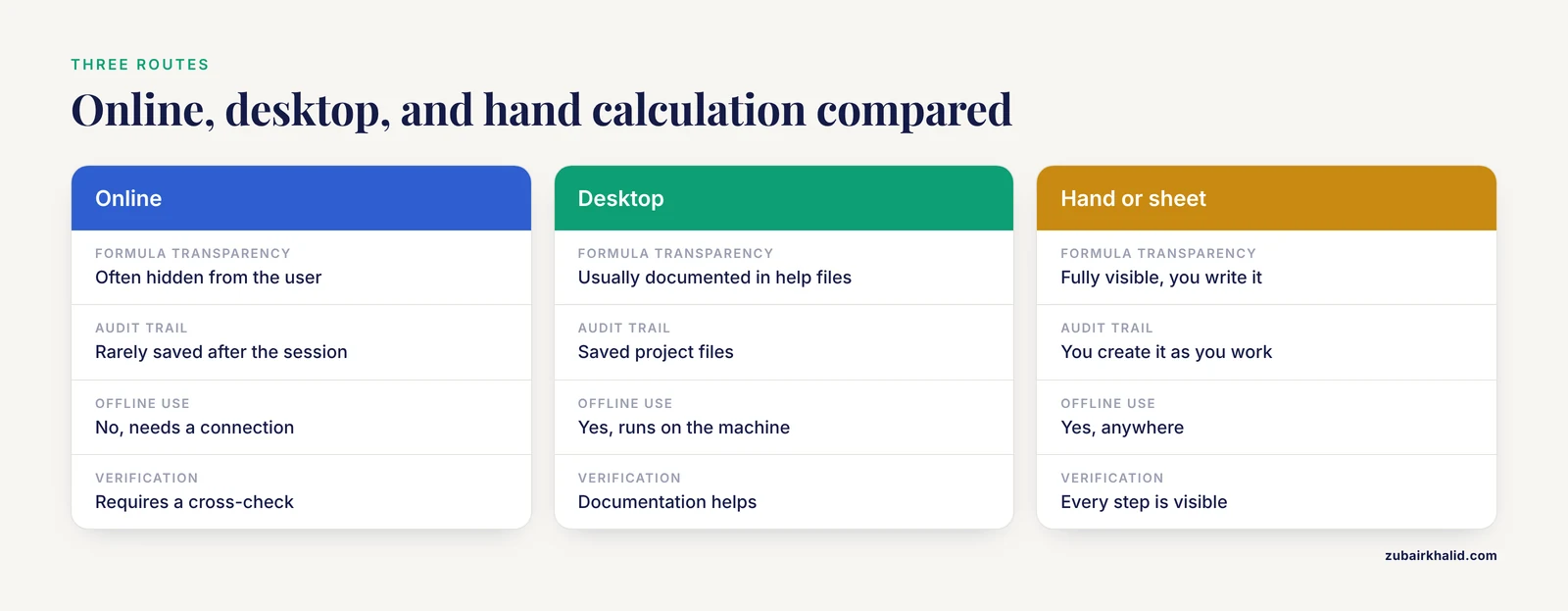
A survey of 213 researchers, paired with analysis of 27 documents, mapped what scientists want from authoring and analysis tools. Web-based tools excelled at collaboration support, while desktop tools traditionally offered more advanced features, more formatting options, and more import and export filters. The study concluded that offline desktop editors remained more popular among academics than online editors. The same tradeoff governs calculators.
| Feature | Online calculator | Desktop software | Hand calculation or spreadsheet |
|---|---|---|---|
| Access | Any device with a browser | Licensed, installed machines | Anywhere, anytime |
| Formula transparency | Often hidden | Usually documented | Fully visible, you write it |
| Audit trail | Rarely saved | Saved project files | You create it as you work |
| Advanced options | Limited to the developer's choices | Extensive | Limited by your own methods |
| Collaboration | Share a link instantly | Exchange files | Manual |
| Offline use | No | Yes | Yes |
| Verification | Requires a cross-check | Documentation helps | Every step is visible |
Education research adds a caution about substituting online tools for guided practice. A quasi-experimental study compared face-to-face and online project-based learning for scientific writing skills across two classes and found a measurable difference in average learning outcomes between the modes, with each mode carrying distinct strengths and limitations [9]. Working a dilution by hand once, on paper, builds error-checking habits that a web form never teaches.
Interpreting Calculator Output Without Overreading It
The phrase "limitations online scientific calculator interpretation" usually comes from someone staring at a result and wondering how far to trust it. Five reading rules cover most cases:
- Match precision to inputs. Two significant figures in, two significant figures out.
- Check units on every field. Most catastrophic errors are unit errors, such as mg/mL entered where g/L is expected.
- Identify the formula variant. Wallace, salt-adjusted, or nearest-neighbor. Paired or unpaired. One-tailed or two-tailed. The same dataset entered as paired versus unpaired in a t-test calculator yields different p-values, and only you know which design you used.
- Treat defaults as choices. A significance level of 0.05 and a two-tailed test are common defaults, not universal requirements.
- Separate the number from the conclusion. A calculator returns a value. Interpretation is your job.
The convenience-quality tradeoff is well documented in adjacent tools. A survey of 211 academicians across 80 universities examined online questionnaires, which offer cost, speed, and convenience, and found that method limitations can reduce data quality. Online calculators make the same trade. The fastest path to a number is not automatically the path to a defensible number.
How scientific content is framed online matters as well. An analysis of 136 online articles about screen time research found that pieces combining strong scientific framing, including explicit discussion of study limitations and placement of findings in a broader research context, earned both immediate and sustained attention [10]. When you read the page behind a calculator's formula, apply the same standard. Sources that discuss their own limitations are the ones worth trusting.
A Practical Workflow for Trustworthy Results
- Find the formula first. Look for a methods note, a citation, or a help page before you trust the number.
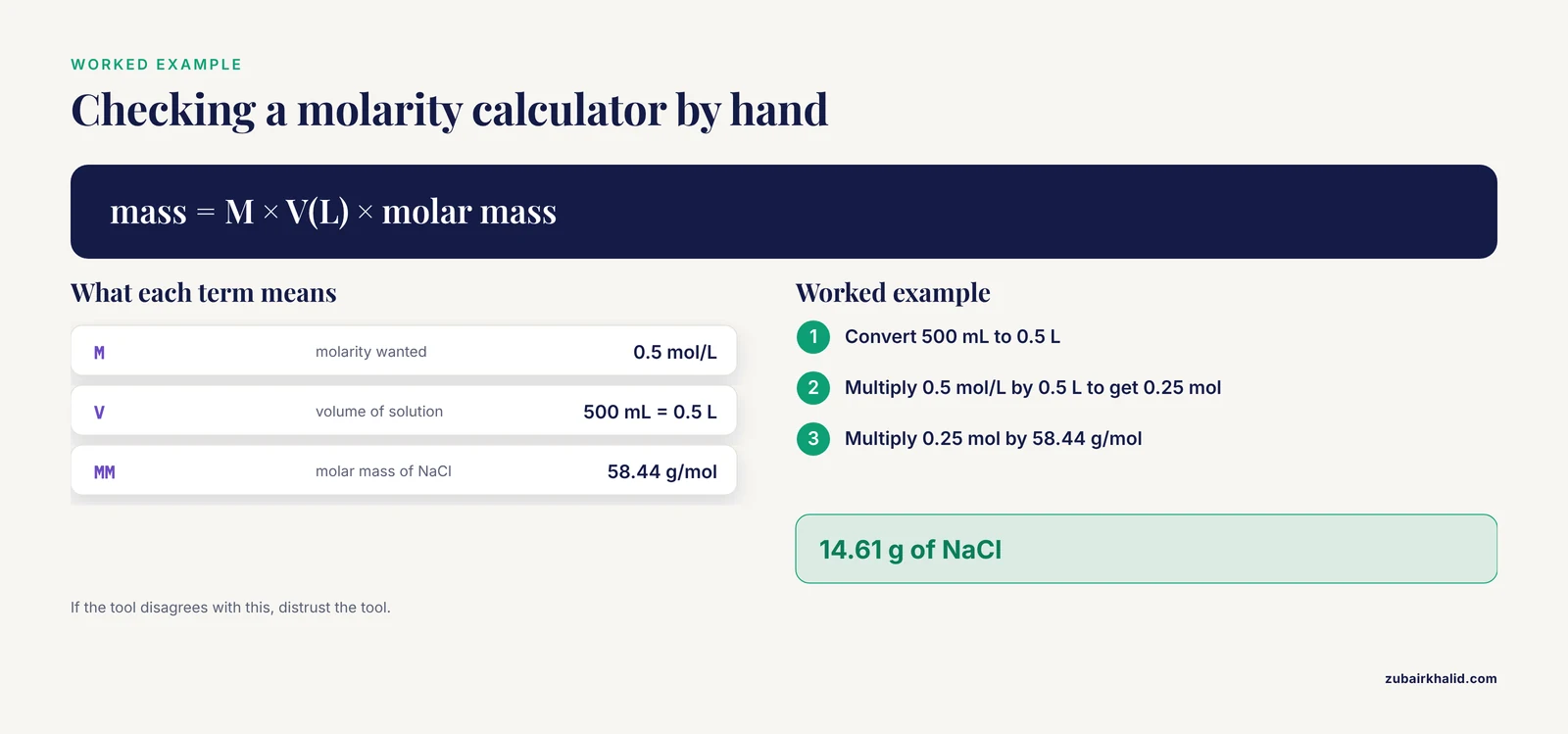
- Test the tool with a worked example you know. For molarity, compute the mass of NaCl needed for 500 mL of 0.5 M solution. Molar mass 58.44 g/mol gives 0.5 mol/L × 0.5 L × 58.44 g/mol = 14.61 g. For dilution, prepare 100 mL of 0.5 M solution from a 5 M stock: V1 = (0.5 M × 100 mL) / 5 M = 10 mL of stock plus 90 mL of water. If the tool disagrees with arithmetic you can verify by hand, distrust the tool.
- Cross-check with a second, independent tool or a spreadsheet.
- Record what you used. Tool name, URL, date, settings, and version if shown. Your methods section and anyone reproducing your work depend on this record.
- Report sane precision. Write 14.6 g, not 14.610000000000001 g.
- Keep sensitive data local when the stakes justify it, using desktop software or a script you control.
- Recheck after any site update. Silent changes are common.
Common Mistakes and Limitations
- Entering values with units into unitless fields, or selecting mg/mL when the field expects g/L. The tool computes faithfully on the wrong quantity.
- Assuming default statistics settings match your design. Sample versus population standard deviation, paired versus unpaired, and one versus two tails all change results.
- Trusting decimals beyond input precision. Eight decimal places from three significant figures is decoration.
- Pasting messy sequences. Line numbers, spaces, or header text in a sequence field produce GC content and Tm values for the wrong string.
- Using a method outside its range. The Wallace rule is intended for short oligonucleotides. Applying it to a 40-mer produces a misleading Tm with full confidence.
- Assuming constants are current. Physical constants and curated reference values get revised. A calculator does not announce that its constant is outdated.
- Skipping the record. An unrecorded tool and access date make a result impossible to reproduce.
- Equating popularity with validity. Traffic and rankings say nothing about whether a formula is right.
- Skipping the sanity check. A ten-second order-of-magnitude estimate catches most gross errors before they spread.
One boundary line stays fixed. Any calculation that supports a clinical decision, a regulatory submission, or a safety determination needs validation by a qualified professional, whatever tool produced the first draft of the number.
What Is Still Uncertain
No central registry validates online scientific calculators, and published accuracy audits of biology calculators are rare. Tools change without version notes, so accuracy measured today may not describe the same site next quarter. AI-assisted calculation is newer still, and its error rates in real research workflows are not well characterized. Reviews of online research practice continue to list data quality, reliability, and validity as open internal challenges of the digital age [4], and calculator tools sit squarely inside that open problem.
Frequently Asked Questions
What does "limitations of online scientific calculator" mean?
It refers to the specific ways a browser-based calculator can return results that are arithmetically correct but scientifically misleading, including floating-point rounding, hidden formula assumptions, missing context, and data handling risks.
How accurate are online biology calculators?
The arithmetic is usually accurate to many decimal places, but scientifically relevant accuracy depends on the formula, the constants, and your inputs, so displayed digits can far outrun the reliability of the result.
Can I use an online calculator for published research?
Yes, if you verify the formula, cross-check the result, and record the tool, URL, access date, and settings in your methods, because reviewers need to reproduce what you did.
Why do two online calculators give different answers?
They often use different formula variants, different constants, or different default settings, and many tools do not disclose which choices they made.
Are online calculators safe for confidential data?
Not automatically, because anything pasted into a web form can be transmitted and logged on someone else's server, so keep sensitive sequences and datasets in local tools.
What is a bioinformatics calculator?
It is a web tool that performs computations on biological data, usually nucleotide or protein sequences, such as GC content, melting temperature, molecular weight, translation, or restriction site mapping.
Do I still need to learn manual calculations?
Yes, because hand calculation is how you detect wrong inputs, wrong units, and wrong formulas, and no web form teaches that judgment.
How do I document calculator use in my methods section?
Name the tool, give the URL and the access date, state the formula or settings if the tool discloses them, and note the version if one is shown.
Sources
- Systematic Review of Online Photoplethysmography (PPG) Tool Kits
- Clc-db: an open-source online database of chiral ligands and catalysts
- Streamlining scientific writing for students: the role of online language simplification tools
- Exploring the potential of online scientific research to meet modern needs: international perspective
- Bibliometric Indexes - Advantages and Limitations in Practical Application, for the Scientific Validity of Authors and Their Scientific Contents - Stanford Bibliometric List: Truths and Misconceptions
- Evaluating the online impact of reporting guidelines for randomised trial reports and protocols: a cross-sectional web-based data analysis of CONSORT and SPIRIT initiatives
- Attitudes and perceptions of medical researchers towards the use of artificial intelligence chatbots in the scientific process: an international cross-sectional survey.
- Open access journal publication in health and medical research and open science: benefits, challenges and limitations
- Comparative of Face to Face Learning vs Online Learning: Analysis of Students' Scientific Article Writing Skills Through Project-Based Learning
- The interplay between sensationalism and scientific information framing: Examining the representation of screen time research online and on social media in the United States