# RAAS System: Renin-Angiotensin Pathway Explained
The renin-angiotensin-aldosterone system (RAAS) is a hormone cascade that defends blood pressure and body fluid volume. It begins when the kidney releases the enzyme renin, which converts a liver protein into angiotensin I, and ends with angiotensin II constricting blood vessels and triggering aldosterone, antidiuretic hormone (ADH) and thirst.
This article walks the pathway step by step, explains what each hormone does, maps the major drug classes onto the exact step they block, and compares how the renin-angiotensin system behaves in dogs, cats and horses.
This article is educational and is not a substitute for veterinary diagnosis or treatment.
## What the RAAS System Does
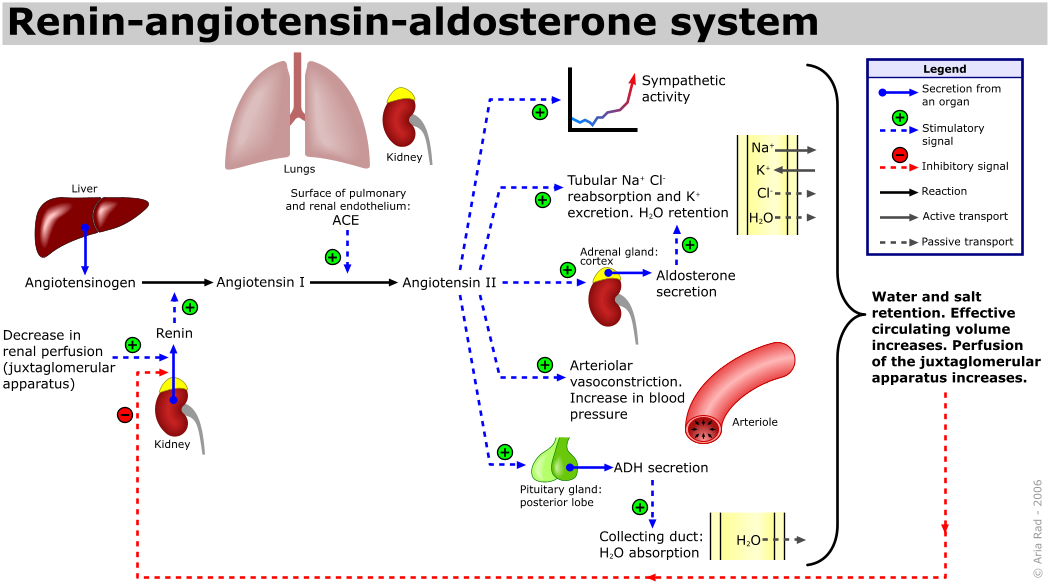
Overview of the RAAS cascade, from renin release through angiotensin II and aldosterone effects. Image: A. Rad (me), CC BY-SA 3.0, via Wikimedia Commons.
The renin-angiotensin-aldosterone system is one of the body's two great volume-control systems. The other is the ADH and thirst axis. The RAAS protects against hypovolemia (low circulating blood volume) and hypotension (low blood pressure) by doing three things at once:
1. Squeezing arterioles to raise vascular resistance.
2. Telling the kidney to keep sodium and, with it, water.
3. Telling the brain to drink.
Angiotensin II is the central effector peptide of the classical pathway. It is a potent vasoconstrictor, a stimulus to aldosterone release from the adrenal cortex, a stimulus to ADH release and thirst, and a driver of sodium reabsorption in the proximal tubule. It also promotes inflammation, fibrosis and cell growth when it is chronically elevated, which is why the same system that saves a hemorrhaging patient can damage the heart and kidney in chronic disease [1].
The RAAS is not a single linear pipe. A counterbalancing arm exists. Angiotensin-converting enzyme 2 (ACE2) trims angiotensin II into angiotensin-(1-7), which acts through the Mas receptor and produces vasodilation, natriuresis and anti-fibrotic effects that oppose angiotensin II [1][2]. Veterinary cardiology is moving toward a model in which the balance between the classical arm (ACE, angiotensin II, AT1 receptor) and the alternative arm (ACE2, angiotensin-(1-7), Mas receptor) determines whether RAAS activation is adaptive or destructive [2].
## Step 1: Renin Release from the Juxtaglomerular Cells
Renin is an enzyme, not a hormone in the classical sense, although it is often called the hormone renin because it is the rate-limiting trigger for the whole cascade. It is stored in granules inside juxtaglomerular (JG) cells, which are modified smooth muscle cells in the wall of the afferent arteriole where it meets the distal tubule. That anatomical junction is the juxtaglomerular apparatus.
Renin is released in response to three main inputs:
- **Low renal perfusion pressure.** A drop in pressure or stretch in the afferent arteriole is sensed directly by the JG cells, which behave as intrarenal baroreceptors.
- **Low distal sodium chloride delivery.** The macula densa, a plaque of specialized cells in the distal tubule, senses the chloride content of the fluid passing it. When distal chloride falls, the macula densa signal favors renin release.
- **Sympathetic beta-1 input.** Norepinephrine acting on beta-1 adrenergic receptors on JG cells increases renin secretion. This is why sympathetic activation during hemorrhage, pain or heart failure raises renin.
The chloride story has become clinically important in [veterinary medicine](/blog/careers/veterinary-medicine-careers-from-clinical-practice-to-public-health). In 147 dogs (20 healthy, 39 with preclinical heart disease and 88 with congestive heart failure), serum chloride was inversely correlated with circulating RAAS metabolites, including angiotensin I and angiotensin-(1-7) [3]. Each 5 mmol/L decrease in serum chloride corresponded to a 32% to 45% increase in angiotensin metabolites and a 39% increase in aldosterone, and hypochloremia below 100 mEq/L identified a distinct high-RAAS phenotype [3]. The takeaway is that the macula densa is watching chloride specifically, and chloride depletion from diuretic use can drive the RAAS hard.
## Step 2: Renin Cleaves Angiotensinogen to Angiotensin I
Angiotensinogen is a large globulin made mainly by the liver and released continuously into plasma. Renin does what its name implies: it is a protease that clips a ten-amino-acid fragment off angiotensinogen. That fragment is angiotensin I, a decapeptide with little biological activity of its own.
This step is the committed, rate-limiting step of the renin-angiotensin system. Circulating angiotensinogen is usually abundant, so the amount of angiotensin I produced depends almost entirely on how much renin is in the plasma. Plasma renin activity (PRA) is a laboratory measure of exactly this, the capacity of a sample to generate angiotensin I.
## Step 3: ACE Converts Angiotensin I to Angiotensin II
Angiotensin-converting enzyme (ACE) is a zinc metallopeptidase bound to the luminal surface of endothelial cells. It removes two amino acids from angiotensin I to produce the octapeptide angiotensin II. The lungs carry the largest endothelial surface area in the body, so pulmonary endothelium is the dominant site of conversion, but ACE is a widespread enzyme. It is present in vascular endothelium throughout the body, in the kidney, and in the eye, where ACE has been localized in canine ocular tissues and fluids [4].
ACE is not specific to angiotensin I. It also degrades bradykinin, a vasodilator. That dual role explains why ACE inhibitors cause cough in some patients: blocking ACE raises bradykinin in the airways. A 2026 single-center study of 199 ACE inhibitor users presenting with cough found that 76.9% had an identifiable pulmonary cause and 23.1% had no identifiable pulmonary pathology, so cough on an ACE inhibitor can reflect the drug, the lungs, or both [5]. The same mechanism is worth remembering in dogs and cats, where cough is a common presenting sign for other reasons.
## Step 4: Angiotensin II Acts on AT1 Receptors
Angiotensin II binds two main receptor subtypes. The AT1 receptor mediates most of the classical effects that raise blood pressure and retain sodium. The AT2 receptor generally opposes growth and fibrosis and is expressed more in fetal tissue and in some disease states [1].
Through AT1 receptors, angiotensin II produces:
- **Arteriolar vasoconstriction.** Systemic vascular resistance rises, and blood pressure rises with it. Constriction of the efferent arteriole also helps preserve glomerular filtration pressure when renal perfusion is low.
- **Aldosterone release** from the zona glomerulosa of the adrenal cortex.
- **ADH release** from the posterior pituitary, plus direct stimulation of thirst in the brain.
- **Proximal tubular sodium reabsorption**, partly by stimulating the sodium-hydrogen exchanger.
- **Sympathetic facilitation**, including enhanced norepinephrine release and central sympathetic outflow.
- **Growth, inflammation and fibrosis** in the heart, vessels and kidney when activation is chronic [1].
Angiotensin II is further processed into angiotensin III and angiotensin IV, which have their own receptor activity and contribute to aldosterone release and other effects [1][2].
## Step 5: Aldosterone, ADH and Thirst Finish the Job
Aldosterone acts on the distal nephron, mainly the collecting duct, to increase sodium reabsorption and potassium and hydrogen ion secretion. Water follows sodium osmotically, so the effective circulating volume expands. Aldosterone also has direct pro-fibrotic and pro-inflammatory effects in the heart and vessels, which is why aldosterone breakthrough (rising aldosterone despite ACE inhibition) matters clinically [6].
ADH, also called vasopressin, acts on V2 receptors in the collecting duct to insert aquaporin water channels, concentrating urine and retaining free water. Angiotensin II stimulates ADH release and drives thirst, so the RAAS and the vasopressin system cooperate to restore volume [7].
The net effect of full RAAS activation is a rise in blood pressure, a rise in sodium and water retention, a rise in potassium excretion, and a strong behavioral drive to drink.
```mermaid
flowchart TD
A[Low renal perfusion] --> D[Juxtaglomerular cells]
B[Low distal chloride] --> D
C[Sympathetic beta 1 input] --> D
D --> E[Renin release]
E --> F[Angiotensinogen to Angiotensin I]
F --> G[ACE in endothelium]
G --> H[Angiotensin II]
H --> I[Vasoconstriction]
H --> J[Aldosterone release]
H --> K[ADH release and thirst]
J --> L[Sodium and water retention]
K --> L
I --> M[Blood pressure rises]
L --> M
```
## Table: Drug Classes and the RAAS Step They Target
| Drug class | Example agents | RAAS step blocked | Consequence |
|--|--|--|--|
| Direct renin inhibitors | Aliskiren | Renin cleavage of angiotensinogen | Less angiotensin I formed, so less angiotensin II downstream |
| ACE inhibitors | Enalapril, benazepril, ramipril, lisinopril | ACE conversion of angiotensin I to angiotensin II | Lower angiotensin II and aldosterone, higher bradykinin, possible cough [8][5] |
| Angiotensin receptor blockers (ARBs) | Losartan, telmisartan, irbesartan | AT1 receptor binding by angiotensin II | Angiotensin II still forms but cannot signal through AT1 |
| Aldosterone antagonists | Spironolactone, eplerenone | Mineralocorticoid receptor in distal nephron | Less sodium retention, less potassium loss, less cardiac fibrosis |
| ACE2 pathway enhancers (investigational) | Various | ACE2 conversion of angiotensin II to angiotensin-(1-7) | Shifts balance toward the protective alternative arm [1][2] |
Direct renin inhibitors and ARBs are used far more in human medicine than in veterinary practice. ACE inhibitors and aldosterone antagonists are the classes most relevant to dogs and cats with heart disease.
## Species Differences: Dogs, Cats and Horses
### Dogs
Dogs are the best-studied veterinary species for RAAS profiling. Benazepril produces dose-dependent suppression of angiotensin II and ACE activity in dogs. In nine healthy dogs on a low-sodium diet, the highest benazepril dose (0.5 mg/kg) lowered time-weighted angiotensin II by 38% and the ACE activity surrogate by 59% compared with the lowest dose (0.125 mg/kg) [8]. This confirms that the renin-angiotensin system in dogs responds to ACE inhibition in a graded way.
A canine ACE gene polymorphism exists, and it affects the RAAS response to enalapril. In 21 dogs with mitral valve disease, the classical pathway was suppressed and the alternative pathway enhanced after enalapril in both genotypes, but aldosterone was significantly higher in polymorphism-positive dogs (median 92.17 pM) than in polymorphism-negative dogs (median 15.91 pM) after treatment [6]. Aldosterone breakthrough occurred in 38% of polymorphism-negative dogs and 54% of polymorphism-positive dogs despite angiotensin II suppression [6]. This is a concrete example of how individual genetics can change drug response.
Furosemide activates the RAAS in dogs. In 16 healthy hound dogs, furosemide significantly increased the urine aldosterone-to-creatinine ratio, and coadministered enalapril inhibited ACE activity but did not reduce aldosterone excretion over the 7-day study [9]. The lesson is that loop diuretics drive the RAAS, and ACE inhibition alone may not fully shut down the aldosterone limb.
The RAAS also operates inside the gut. In dogs with chronic inflammatory enteropathy, serum angiotensin I, angiotensin II and angiotensin-(1-7) were significantly higher than in healthy controls, and ileal electrolyte transporter expression was downregulated [10]. This has reframed the renin-angiotensin system as a player in intestinal fluid and electrolyte handling, not just blood pressure [11].
### Cats
Cats with cardiomyopathy show baseline RAAS activation. Compared with healthy cats, cats with cardiomyopathy had higher angiotensin I, aldosterone and plasma renin activity, and the difference held after separating untreated from furosemide-treated cats [12]. Untreated hypertensive cats showed no RAAS differences from healthy cats, but amlodipine-treated cats had higher angiotensin I, II, III, IV and 1-7, higher aldosterone and higher plasma renin activity [12].
Amlodipine itself raises renin. In 20 healthy cats given amlodipine or placebo for 14 days, amlodipine increased plasma renin concentration by a median of 44%, angiotensin I by 59%, angiotensin II by 56%, angiotensin IV by 42% and angiotensin-(1-7) by 38% compared with placebo [13]. Calcium channel blockers lower blood pressure by vasodilation, and the kidney responds by turning on renin. This is a predictable reflex, not a drug failure.
### Horses
Horses activate the RAAS with exercise and with diuretics. In 25 horses across four exercise protocols, exercise raised classical RAAS metabolites (angiotensin I from a median of 2.5 to 8.2 pmol/L, angiotensin II from 10.2 to 53.0 pmol/L, aldosterone from 83.8 to 170.6 pmol/L) and also raised alternative pathway metabolites (angiotensin-(1-7) from 1.5 to 5.1 pmol/L, angiotensin-(1-5) from 2.5 to 14.9 pmol/L) [14]. Endurance exercise produced more classical pathway activation than short high-intensity work [14].
Furosemide activates the equine RAAS too. In 14 healthy Thoroughbreds, a single 1 mg/kg IV dose raised angiotensin I to a median of 8.0 pmol/L and angiotensin II to 33.7 pmol/L [15]. Baseline angiotensin II was the only peptide reliably detectable before treatment, at a median of 7.5 pmol/L [15]. This matters because furosemide is administered on race day in many jurisdictions, and its RAAS effects are part of its pharmacology.
## Clinical Relevance, Limitations and Common Mistakes
The RAAS is the reason ACE inhibitors are a cornerstone of veterinary cardiac therapy. Blocking the conversion of angiotensin I to angiotensin II lowers vascular resistance, reduces aldosterone-driven sodium retention, and blunts the pro-fibrotic signaling that remodels the failing heart [2]. The renin-angiotensin-aldosterone system is also the reason diuretics have a built-in counterforce: every liter of urine removed tends to raise renin, angiotensin II and aldosterone, which pulls sodium and water back.
Common mistakes in thinking about the RAAS:
- **Assuming ACE inhibition shuts the system down.** It does not. Angiotensin II can be generated by non-ACE pathways such as chymase, and aldosterone can escape suppression. Aldosterone breakthrough is documented in dogs on enalapril [6] and is one reason aldosterone antagonists are added.
- **Confusing the classical and alternative arms.** Angiotensin II and angiotensin-(1-7) have opposing effects. A drug that lowers angiotensin II may also lower angiotensin-(1-7), and the net clinical effect depends on the balance [1][2].
- **Forgetting that calcium channel blockers raise renin.** Amlodipine predictably increases renin and angiotensin peptides in cats [13][12]. This is expected physiology.
- **Ignoring chloride.** The macula densa senses chloride, and hypochloremia is associated with higher RAAS activity in dogs with heart failure [3]. Diuretic-induced chloride loss can drive the system.
- **Treating the RAAS as blood-pressure-only.** It is active in the gut, the eye and the brain [1][10][4][16].
What is still uncertain: the optimal way to combine RAAS-blocking drugs in veterinary patients, the clinical significance of the canine ACE polymorphism for routine prescribing, and whether enhancing the ACE2 and angiotensin-(1-7) arm will prove safe and effective in dogs and cats [1][2]. Individual animals vary, and any decision about RAAS-targeting medication belongs with a veterinarian who knows the patient.
## Frequently Asked Questions
### What does renin do?
Renin is an enzyme released by juxtaglomerular cells in the kidney. It cleaves angiotensinogen into angiotensin I, which is the rate-limiting step of the entire renin-angiotensin-aldosterone system.
### What triggers renin release?
Three main triggers: low renal perfusion pressure sensed by juxtaglomerular cells, low distal sodium chloride delivery sensed by the macula densa, and sympathetic beta-1 stimulation of juxtaglomerular cells.
### Where is ACE found?
ACE is bound to endothelial cell surfaces throughout the body, with the pulmonary vascular bed carrying the largest surface area. It is also present in the kidney and in ocular tissues.
### What are the main actions of angiotensin II?
Angiotensin II constricts arterioles, stimulates aldosterone and ADH release, drives thirst, increases proximal tubular sodium reabsorption, facilitates sympathetic activity, and promotes inflammation and fibrosis when chronically elevated.
### How do ACE inhibitors lower blood pressure?
They block ACE from converting angiotensin I to angiotensin II, which reduces vasoconstriction and aldosterone release. They also raise bradykinin, which contributes to vasodilation and to the cough some patients develop.
### Do ACE inhibitors stop aldosterone completely?
No. Aldosterone breakthrough, a rise in aldosterone despite ACE inhibition, is well documented in dogs. This is why aldosterone antagonists such as spironolactone are sometimes added.
### Why does furosemide raise renin?
Furosemide removes sodium and chloride in the urine, which lowers distal chloride delivery to the macula densa and reduces circulating volume. Both changes trigger renin release and activate the RAAS.
### Do cats and horses have the same RAAS as dogs?
The pathway is conserved across species, but the magnitude of activation differs. Cats with cardiomyopathy and horses after exercise or furosemide show measurable RAAS activation, and drug responses vary by species and individual.
## Related Articles
- [Clinical Pathways: From Molecular Mechanisms to Systems-Level Integration](/knowledge/molecular-biology/clinical-pathway)
- [The Reactome Pathway Knowledgebase: A Comprehensive Veterinary Systems Biology Resource](/knowledge/veterinary-medicine/clinical-methods/the-reactome-pathway-knowledgebase)
- [Network Theory in Biological Pathways: Graph Theoretical Approaches for Veterinary Systems Biology](/knowledge/bioinformatics/network-theory-in-biological-pathways)
- [Metabolic pathway assembly](/knowledge/molecular-biology/metabolic-pathway-assembly-how-to-clone-multi-gene-biosynthetic-pathways-in-a-single-vector)
- [Forms of Protein Degradation: Pathways and Mechanisms](/knowledge/molecular-biology/forms-of-protein-degradation)
- [Cell Signalling: Principles, Pathways, and Mechanisms](/knowledge/molecular-biology/cell-signalling)
- [Function of Nerves: How the Nervous System Works](/knowledge/veterinary-medicine/veterinary-anatomy-physiology/function-of-nerves-how-the-nervous-system-works)
- [Brain Ventricles: Anatomy and Function of the Ventricular System](/blog/guides/brain-ventricles-anatomy-and-function-of-the-ventricular-system)
- [Purkinje System: Cardiac Conduction Explained](/knowledge/veterinary-medicine/veterinary-anatomy-physiology/purkinje-system-cardiac-conduction-explained)
## Sources
1. [The Renin-Angiotensin-Aldosterone System (RAAS): Beyond Cardiovascular Regulation.](https://pubmed.ncbi.nlm.nih.gov/40872727/)
2. [Beyond Angiotensin-Converting Enzyme Inhibitors: Modulation of the Renin-Angiotensin-Aldosterone System to Delay or Manage Congestive Heart Failure.](https://pubmed.ncbi.nlm.nih.gov/37423846/)
3. [Influence of serum chloride concentrations on the renin-angiotensin-aldosterone system in dogs with congestive heart failure.](https://pubmed.ncbi.nlm.nih.gov/42324236/)
4. [Angiotensin converting enzyme system in the normal canine eye: pharmacological and physiological aspects.](https://pubmed.ncbi.nlm.nih.gov/1648119/)
5. [Clinical analyses of angiotensin-converting enzyme inhibitor users presenting with cough to a chest diseases outpatient clinic: A single-center retrospective study.](https://pubmed.ncbi.nlm.nih.gov/42663438/)
6. [Renin-angiotensin aldosterone profile before and after angiotensin-converting enzyme-inhibitor administration in dogs with angiotensin-converting enzyme gene polymorphism.](https://pubmed.ncbi.nlm.nih.gov/32112596/)
7. [Important Role of Renin-Angiotensin System and Vasopressin System in Cardiovascular, Metabolic and Psychogenic Disorders in Pregnancy and Early Postnatal Life: A Narrative Review.](https://pubmed.ncbi.nlm.nih.gov/42653310/)
8. [Dose-response of benazepril on biomarkers of the classical and alternative pathways of the renin-angiotensin-aldosterone system in dogs.](https://pubmed.ncbi.nlm.nih.gov/36792677/)
9. [The effect of enalapril on furosemide-activated renin-angiotensin-aldosterone system in healthy dogs.](https://pubmed.ncbi.nlm.nih.gov/25771846/)
10. [Dysregulation of intestinal epithelial electrolyte transport in canine chronic inflammatory enteropathy and the role of the renin-angiotensin-aldosterone-system.](https://pubmed.ncbi.nlm.nih.gov/37720474/)
11. [Time to eRAASe chronic inflammation: current advances and future perspectives on renin-angiotensin-aldosterone-system and chronic intestinal inflammation in dogs and humans.](https://pubmed.ncbi.nlm.nih.gov/37456955/)
12. [Circulating renin-angiotensin-aldosterone system activity in cats with systemic hypertension or cardiomyopathy.](https://pubmed.ncbi.nlm.nih.gov/35285549/)
13. [Effect of amlodipine on the circulating renin-angiotensin-aldosterone system in healthy cats.](https://pubmed.ncbi.nlm.nih.gov/38334012/)
14. [Renin-Angiotensin-Aldosterone System Profiling in Horses Before and After Exercise.](https://pubmed.ncbi.nlm.nih.gov/40048547/)
15. [Effect of furosemide on comprehensive renin-angiotensin-aldosterone system activity of Thoroughbred horses.](https://pubmed.ncbi.nlm.nih.gov/39434560/)
16. [The brain angiotensin converting enzyme 2 and angiotensin-(1-7) as potential therapeutic targets for the central nervous system diseases.](https://pubmed.ncbi.nlm.nih.gov/42668022/)