# Cat Flehmen Response: Why Cats Curl Their Lips
The cat flehmen response is a normal sensory behavior in which a cat curls its upper lip, often with the mouth slightly open, to move a chemical sample from the mouth and nose into the vomeronasal organ. The lip curl is not a grimace of pain or disgust. It is part of a pumping sequence that lets the cat analyze pheromones and other fluid-borne chemical signals that the main sense of smell cannot process on its own.
Owners usually notice the behavior after a cat sniffs another cat's urine, genital area, or a spot where another cat has marked. The cat freezes, lifts its head, wrinkles its nose, and holds the lip curl for a few seconds. In cats the behavior is real but often subtle, and it appears less often than the dramatic lip curls seen in horses, cattle, and sheep.
This article is educational and is not a substitute for veterinary diagnosis or treatment.
## What the Flehmen Response Looks Like in a Cat
Flehmen (pronounced FLAY-men) is a fixed action pattern. A fixed action pattern is a stereotyped behavior that runs to completion once triggered. In a cat the sequence usually includes:
1. Close nasooral contact with the stimulus, meaning the nose and mouth are brought directly to urine, genital secretions, or a marked surface.
2. A brief pause while the cat samples the material.
3. A slight opening of the mouth and a curl or lift of the upper lip.
4. A flick of the tongue against the hard palate, the bony roof of the mouth.
5. Extension of the head and neck, which straightens the route between the mouth and the nasal cavity.
6. A short hold, usually a few seconds, while the chemical sample is drawn toward the vomeronasal organ.
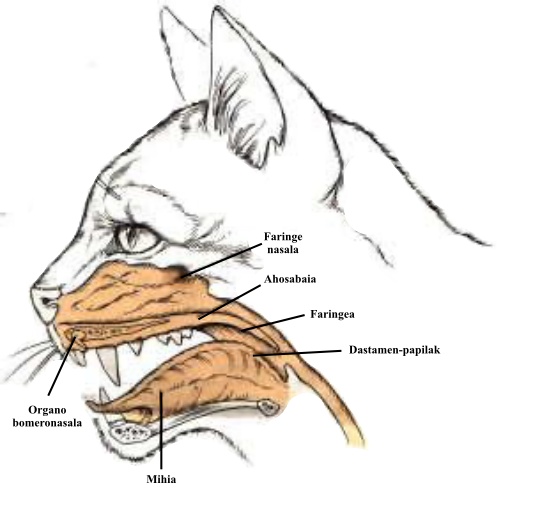
The lip curl itself does not create suction. It opens the oral and nasal passages so the tongue flick and head extension can move fluid toward the incisive duct, the small opening behind the upper incisor teeth that connects the mouth to the vomeronasal organ.
A 1987 study of domestic cats found that flehmen was virtually always preceded by nasooral contact with the stimulus material [1]. That finding supports the idea that the behavior transports fluid-borne chemical signals rather than simply sampling air. The same study found that, during heterosexual encounters, flehmen was displayed by males only, but the difference was situation specific. When cats explored a urine-marked room with no other cat present, females also performed flehmen, just less often than males. When urine was applied directly to the nasooral surface, males and females responded equally [1].
## The Vomeronasal Organ: A Second Chemical Sense
The vomeronasal organ sits above the palate, where flehmen draws scent molecules for analysis. Image: New biologyst, CC BY-SA 4.0, via Wikimedia Commons.
The vomeronasal organ (VNO) is also called the Jacobson organ. It is a paired, blind-ended tube that sits at the base of the nasal septum, the wall of cartilage and bone that divides the two nasal passages. The VNO is the sensory organ of the accessory olfactory system, a chemical detection pathway separate from the main olfactory system.
The VNO is not the same as the main olfactory epithelium. The main olfactory epithelium is the sheet of sensory tissue high in the nasal cavity that detects volatile odors, the airborne molecules that give a cat the scent of food, another animal, or a familiar person. The vomeronasal organ detects largely nonvolatile or fluid-borne chemicals, including pheromones. A pheromone is a chemical released by one animal that triggers a specific response in another animal of the same species.
The VNO is also not the trigeminal system. The trigeminal nerve provides sensation to the face and nasal lining and responds to irritants such as ammonia, smoke, or strong acids. That is the system behind the sting you feel when you sniff vinegar. The vomeronasal system is a dedicated chemosensory pathway with its own receptors, its own nerve, and its own target in the brain, the accessory olfactory bulb.
The anatomy of the VNO is well conserved across many mammals. In sheep, the VNO is a pair of blind tubes at the base of the nasal septum, lined rostrally by non-sensory epithelium and caudally by sensory epithelium, and encased by vomeronasal cartilage [2]. In pigs, the VNO is similarly encased by vomeronasal cartilages and located at the base of the nasal septum as blind-ended tubes [3]. Studies in other species, including the alpaca, the dama gazelle, and the Korean roe deer, confirm the same basic plan: a tubular organ with sensory epithelium containing receptor cells, supported by non-sensory epithelium and glands [4][5][6].
The VNO contains two main families of receptor cells in many mammals. Type 1 vomeronasal receptors (V1R) and type 2 vomeronasal receptors (V2R) detect different classes of chemicals and couple to different G proteins. In rodents these two cell populations project to separate halves of the accessory olfactory bulb, a pattern called segregated. In most carnivores and artiodactyls, the VNO contains only V1R cells that project across the whole accessory olfactory bulb, a pattern called uniform [7][8]. Cats are carnivores, so their vomeronasal system follows the uniform pattern.
The VNO is not a static structure. Its sensory neurons are replaced throughout life from a stem cell niche, and the balance of cell types is regulated by signaling molecules such as CXCR4 [9][10]. This turnover matters because it means the vomeronasal system can recover from ordinary wear, though inflammatory conditions can impair pheromone perception in some species [3].
## The Step-by-Step Flehmen Sequence
The flehmen response works as a pump. Each step moves the chemical sample closer to the vomeronasal sensory epithelium.
### Step 1: Nasooral Contact
The cat brings its nose and mouth into direct contact with urine, genital secretions, or a marked surface. This contact is the trigger. In the 1987 cat study, flehmen was almost always preceded by this kind of contact [1]. The chemical sample must be fluid or dissolved in fluid, because the VNO detects water-soluble and nonvolatile molecules.
### Step 2: Mouth Opening and Lip Curl
The cat opens its mouth slightly and curls the upper lip. This posture is sometimes called the "lip curl" or "grimace." The lip curl exposes the incisive duct and reduces the distance between the oral cavity and the nasal cavity. In cats the curl is usually small and easy to miss.
### Step 3: Tongue Flick Against the Hard Palate
The cat flicks its tongue against the hard palate. This action helps move the fluid sample across the incisive papilla, the small raised area just behind the upper incisors. In giraffes, bilateral papillae on the hard palate connect with the nasopalatine ducts, which enter the vomeronasal organ, and the giraffe's VNO has its main connection to the oral cavity through these incisive papillae [11]. The cat's anatomy follows the same general route, with the incisive duct linking the mouth to the VNO.
### Step 4: Head Extension
The cat lifts and extends its head. This straightens the nasopalatine route and uses gravity and posture to help fluid move toward the vomeronasal organ. In giraffes, the male often raises his head high in the air during flehmen after placing his muzzle and tongue in the urine stream [11]. The head lift is a consistent part of the behavior across species.
### Step 5: Drawing the Sample Into the VNO
The combination of tongue flick and head extension creates the pumping action that draws the fluid sample through the incisive duct and into the vomeronasal organ. The VNO is a blind-ended tube, so the sample enters and contacts the sensory epithelium. Receptor cells in the sensory epithelium detect the chemical and send signals along the vomeronasal nerve to the accessory olfactory bulb.
The mechanism is not identical in every species. Steller sea lions lack large venous sinuses in the VNO, and the anatomy suggests they pull substances into the organ by suction after closing a nostril [12]. Cats have their own version of the pump, driven by the tongue and head movement rather than by a nasal suction mechanism.
```mermaid
flowchart TD
A[Cat contacts urine or secretion] --> B[Nasooral contact]
B --> C[Mouth opens]
C --> D[Upper lip curls]
D --> E[Tongue flicks hard palate]
E --> F[Head extends upward]
F --> G[Fluid moves to incisive duct]
G --> H[Sample enters vomeronasal organ]
H --> I[Receptor cells detect pheromone]
I --> J[Signal travels to accessory olfactory bulb]
J --> K[Behavioral and hormonal response]
```
## Why Cats Show Flehmen Less Often Than Horses and Sheep
Flehmen is most familiar in ungulates, the hoofed mammals. Horses, cattle, sheep, and goats perform it often and dramatically. Felids are the main group of animals other than ungulates that display flehmen during sociosexual interactions [1]. Cats do it, but they do it less often and less obviously.
Several factors explain the difference.
First, the behavior is tied to the stimulus. In ungulates, flehmen is evoked readily by olfactory investigation of urine and vaginal secretions [1]. In cats, it is also triggered by urine and genital secretions, but the cat must make nasooral contact first. A cat that only sniffs the air over a marked spot may not perform flehmen.
Second, the behavior is tied to hormones. In the 1987 study, administration of testosterone propionate to spayed female cats paired with estrogen-treated females markedly increased their tendency to inspect the female partner's genital area and then perform flehmen [1]. This means the tendency to perform flehmen depends partly on circulating hormones, not just on the chemical stimulus.
Third, the behavior is tied to context. Intact males around urine or genital secretions show flehmen more often than neutered males or females in most situations. During heterosexual encounters, flehmen in cats was displayed by males only [1]. In a room marked with urine and no other cat present, females also performed flehmen, but less frequently than males [1].
The practical takeaway is that a cat that never performs flehmen is not necessarily abnormal. The behavior is subtle, context dependent, and more common in intact males.
## Species Comparison: Flehmen Frequency and Vomeronasal Anatomy
The table below compares flehmen frequency and vomeronasal anatomy across five domestic or familiar species. The comparisons draw on studies of the vomeronasal organ in cats, dogs, horses, cattle, and sheep, and on behavioral observations in felids and ungulates [1][11][2][7][8].
| Species | Flehmen frequency | Vomeronasal organ anatomy | Notes |
|--|--|--|--|
| Cat | Low to moderate, more common in intact males around urine or genital secretions | Paired blind tubes at base of nasal septum, opening via incisive duct, uniform V1R pattern | Felids are the main non-ungulate group that shows flehmen [1] |
| Dog | Low, often overlooked | VNO present, opens via incisive duct, carnivore uniform pattern | Dogs rely heavily on the main olfactory system |
| Horse | High, especially stallions around mares | Large VNO, well-developed vomeronasal cartilage, uniform pattern | Classic lip curl, often with head extension |
| Cattle | High, especially bulls around estrous cows | Large VNO, extensive sensory epithelium, uniform pattern | Flehmen used in estrus detection |
| Sheep | High, especially rams around ewes | Oval tubular VNO at base of nasal septum, sensory epithelium along medial wall, uniform pattern [2] | Flehmen common during breeding |
The table shows a clear pattern. Species that rely heavily on the vomeronasal system for reproductive signaling, such as horses, cattle, and sheep, perform flehmen often and visibly. Cats have a functional vomeronasal system but use it in a narrower range of situations, mostly involving urine and genital secretions from other cats.
## What the Flehmen Response Is Not
Flehmen is not a sign of illness. A cat that curls its lip after sniffing urine is performing a normal sensory behavior. The behavior is not vomiting, not a seizure, and not a sign of dental pain. It does not indicate nausea, and it does not mean the cat dislikes the smell.
Flehmen is also not the same as the gag reflex. A gag reflex involves the throat and is a protective response to something in the airway. Flehmen involves the upper lip, tongue, and head position, and it is directed toward chemical sampling.
Flehmen is not a sign of aggression. The lip curl can look like a snarl, but the context is different. A snarl is directed at another animal and is accompanied by other threat signals such as flattened ears, hissing, or a defensive posture. Flehmen is directed at a chemical stimulus and is usually accompanied by a still, focused posture.
Flehmen is not unique to cats. It occurs in many mammals, including horses, cattle, sheep, goats, giraffes, and other felids [1][11]. The behavior is ancient and conserved.
## Practical Implications for Cat Owners
You do not need to do anything when your cat performs flehmen. The behavior is normal and self-limiting. It usually lasts a few seconds and ends when the cat has finished sampling the chemical.
If you want to observe the behavior, watch your cat after it sniffs a spot where another cat has urinated or marked. Intact males are the most likely to perform flehmen, especially around a female in estrus. Neutered males and females can also perform it, particularly when urine is applied directly to the nasooral surface [1].
If you are managing a multi-cat household, flehmen can be a clue that cats are communicating through urine marks. A cat that performs flehmen at a marked spot is gathering information about another cat. This is normal social behavior, though it can also be a sign that marking is happening in the home. If marking is a problem, address the underlying social or environmental cause with your veterinarian.
If your cat shows a lip curl but no chemical stimulus is present, or if the behavior is accompanied by drooling, pawing at the mouth, or difficulty eating, that is a different situation. Those signs can indicate oral pain, nausea, or another medical problem. A veterinarian should evaluate them.
## Clinical Relevance, Limitations and Common Mistakes
The flehmen response has clinical relevance mainly as a normal behavior that can be confused with a medical sign. The most common mistake is mistaking flehmen for a sign of illness. A cat that curls its lip after sniffing urine is not sick. The behavior is a normal part of chemical communication.
A second mistake is assuming that a cat that never performs flehmen has a damaged vomeronasal organ. Many normal cats rarely or never perform flehmen, especially neutered females in a stable home. The behavior is context dependent and hormone dependent [1]. Absence of flehmen is not a diagnostic finding on its own.
A third mistake is confusing the vomeronasal system with the main olfactory system. A cat with a normal sense of smell can still have reduced vomeronasal function, and a cat with reduced main olfactory function can still perform flehmen. The two systems are separate.
A fourth mistake is assuming that all mammals have the same vomeronasal anatomy. Some marine mammals, including harbor seals, have lost the vomeronasal organ and replaced it with a specialized secretory structure [13]. The human VNO is present histologically but is probably vestigial and non-operational [14]. Anatomy varies across species, and behavior varies with it.
The main limitation is that most of the detailed behavioral data on cat flehmen comes from a small number of studies, and the behavior is subtle enough that it is easy to miss in a home setting. Individual cats vary in how often they perform flehmen, and the behavior depends on hormones, context, and the specific chemical stimulus. A veterinarian should evaluate any cat with signs that suggest oral pain, nausea, or neurologic disease.
## Frequently Asked Questions
### Why does my cat curl its lip after sniffing?
Your cat is performing the flehmen response, a normal behavior that moves a chemical sample from the mouth and nose into the vomeronasal organ. The lip curl opens the route to the incisive duct so the cat can analyze pheromones and other fluid-borne chemicals.
### Is the flehmen response a sign of illness?
No. Flehmen is a normal sensory behavior, not a sign of illness. It is triggered by chemical contact with urine, genital secretions, or a marked surface.
### Do female cats perform flehmen?
Yes, but less often than males in most situations. Females perform flehmen more often when urine is applied directly to the nasooral surface, and the behavior is influenced by hormones [1].
### Why do cats do flehmen less than horses?
Cats have a functional vomeronasal system but use it in a narrower range of situations. Horses, cattle, and sheep rely heavily on the vomeronasal system for reproductive signaling and perform flehmen often and visibly.
### What is the vomeronasal organ?
The vomeronasal organ, also called the Jacobson organ, is a paired blind-ended tube at the base of the nasal septum. It detects pheromones and other nonvolatile chemicals through a pathway separate from the main sense of smell.
### Is flehmen the same as smelling?
No. The main olfactory epithelium detects volatile odors, while the vomeronasal organ detects largely nonvolatile or fluid-borne chemicals. The two systems work in parallel.
### Should I stop my cat from doing flehmen?
No. The behavior is normal and self-limiting. It usually lasts a few seconds and does not require intervention.
### When should I see a veterinarian?
See a veterinarian if your cat shows mouth pain, drooling, difficulty eating, or a lip curl without any chemical stimulus. Those signs can indicate a medical problem rather than normal flehmen.
## Related Articles
- [Dog Vomiting and Licking Lips: What It Means and What to Do](/knowledge/veterinary-medicine/digestive-and-urinary-care/dog-vomiting-licking-lips)
- [Dog Keeps Licking Paws And Lips](/knowledge/veterinary-medicine/clinical-methods/dog-keeps-licking-paws-and-lips)
- [Dog Reverse Sneezing And Licking Lips](/knowledge/veterinary-medicine/clinical-methods/dog-reverse-sneezing-and-licking-lips)
- [Dog Keeps Reverse Sneezing And Licking Lips](/knowledge/veterinary-medicine/clinical-methods/dog-keeps-reverse-sneezing-and-licking-lips)
- [Cat Scratching Their Ears](/knowledge/veterinary-medicine/behavior/cat-scratching-their-ears)
- [Do Dogs Control Their Shedding](/knowledge/veterinary-medicine/clinical-methods/do-dogs-control-their-shedding)
## Sources
1. [Stimulus and hormonal determinants of flehmen behavior in cats.](https://pubmed.ncbi.nlm.nih.gov/3557332/)
2. [Morphological Structure of Vomeronasal Organ in Akkaraman, Morkaraman, and Tuj Sheep.](https://pubmed.ncbi.nlm.nih.gov/41555681/)
3. [Porcine vomeronasal system: anatomy, development, receptor repertoire, and inflammatory change.](https://pubmed.ncbi.nlm.nih.gov/41663120/)
4. [Histological evaluation of the alpaca (Vicugna pacos) vomeronasal organ.](https://pubmed.ncbi.nlm.nih.gov/38508726/)
5. [Immunohistological study of the unexplored vomeronasal organ of an endangered mammal, the dama gazelle (Nanger dama).](https://pubmed.ncbi.nlm.nih.gov/37494657/)
6. [Solitary phospholipase C β2-positive cells in the vomeronasal organs of Korean roe deer (Capreolus pygargus).](https://pubmed.ncbi.nlm.nih.gov/40903304/)
7. [Arboreal Squirrels Have a Segregated Vomeronasal System With a Regressed Type 2 Receptor (V2R)-Domain.](https://pubmed.ncbi.nlm.nih.gov/42192559/)
8. [Irregular vomeronasal system of hedgehogs is intermediate between segregated and uniform: how was type-2 receptor (V2R)-pathway in Laurasiatheria lost during evolution?](https://pubmed.ncbi.nlm.nih.gov/40974013/)
9. [Stem cell expression of CXCR4 regulates tissue composition in the vomeronasal organ.](https://pubmed.ncbi.nlm.nih.gov/39639824/)
10. [Following the p63/Keratin5 basal cells in the sensory and non-sensory epithelia of the vomeronasal organ.](https://pubmed.ncbi.nlm.nih.gov/38665067/)
11. [Flehmen, Osteophagia, and Other Behaviors of Giraffes (Giraffa giraffa angolensis): Vomeronasal Organ Adaptation.](https://pubmed.ncbi.nlm.nih.gov/36766243/)
12. [The vomeronasal system of the Steller sea lion.](https://pubmed.ncbi.nlm.nih.gov/40312139/)
13. [The vomeronasal organ and incisive duct of harbor seals are modified to secrete acidic mucus into the nasal cavity.](https://pubmed.ncbi.nlm.nih.gov/38783070/)
14. [The clinical significance of the human vomeronasal organ.](https://pubmed.ncbi.nlm.nih.gov/36759365/)