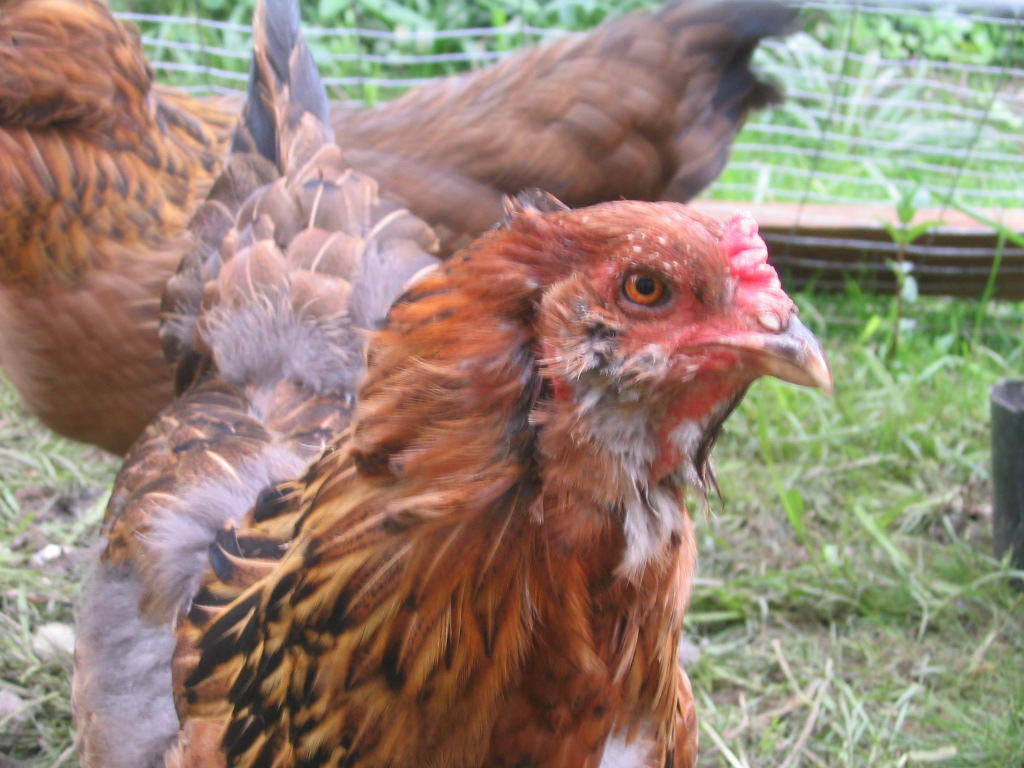
# Bad Chickens: Aggression, Pecking, and Health Signs
A chicken that suddenly pecks at flockmates, chases them off the feeder, or pulls feathers usually has a management problem, not a personality problem. The first thing to check is the environment: space, feeder and waterer access, light intensity, litter condition, and whether one bird is being singled out. The second thing to check is the bird itself. A hen that was calm last week and is aggressive this week may be in pain from an injury, a heavy lice or mite infestation, or another medical problem that has nothing to do with temperament.
This article separates normal flock behavior from the three damaging pecking patterns that owners most often call "bad chicken" behavior: feather pecking, vent pecking, and cannibalism. It gives you a symptom checklist that distinguishes a bright, active bird with a behavioral problem from a sick bird, a troubleshooting table that maps signs to likely causes and first actions, and the flock-level fixes that reduce injurious pecking over time.
This article is educational and is not a substitute for veterinary diagnosis or treatment.
## Normal Dominance Is Not a Behavior Problem
Chickens live in a peck order, and a peck order is maintained by pecking. A quick, single peck to the head or beak when a lower-ranked bird approaches food, a brief chase, or a hen that steps aside at the pop hole are all normal. These interactions are short. Both birds return to normal activity within seconds. Neither bird is wounded.
Normal social pecking has three features that problem pecking does not:
- It is brief and self-limiting.
- It is directed at the head or beak, not at the back, tail base, or vent.
- It stops when the lower-ranked bird moves away.
Domestication has shifted this balance. Red junglefowl selected for low fear of humans showed more social conflict, more crowing by males, and more time spent at a distance from groupmates than birds selected for high fear of humans [1]. In other words, tameness and social aggression travel together to some degree. A backyard flock of friendly, approachable hens can still have real social friction.
Resource guarding is the other normal behavior owners misread. A hen that stands over the feeder and pecks anyone who approaches is guarding a resource, not attacking the flock. The fix is resource distribution, not discipline. Adding feeders and waterers removes the bottleneck that makes guarding profitable.
## When Pecking Becomes a Problem
A bottom-rank hen shows feather loss from pecking, illustrating how aggression and dominance harm flock members. Image: VanTucky, CC BY 1.0, via Wikimedia Commons.
Problem pecking is defined by damage. Feather pecking is classified into gentle feather pecking and severe feather pecking. Gentle feather pecking is a non-injurious, socially mediated behavior. Severe feather pecking removes or damages feathers and, if undeterred, can develop into cannibalism [2]. That distinction matters because the two behaviors have different causes and different urgency.
### Feather Pecking
Feather pecking is a serious behavioral disorder in laying hens that leads to feather damage, skin lesions, and often cannibalism [3]. It is also common. In a French survey of commercial flocks, severe feather pecking was present in about 33 percent of furnished-cage flocks and about 24 percent of free-range flocks, while cannibalism was recorded in about 2.5 percent of furnished-cage flocks and about 8.8 percent of free-range flocks [4]. Free-range access does not protect a flock on its own.
The mechanism is not simple boredom. Feather pecking has been linked to foraging motivation, stress, gut microbiota, immune function, and genetics. Hens selectively bred for high feather pecking performed roughly ten times more pecking than hens bred for low feather pecking, and the high-pecking line had lower numbers of T helper cells and B cells, a stronger T [cell proliferation](/blog/guides/cell-proliferation) response to one mitogen, and a weaker T cell-dependent B cell response to another [3]. This does not mean your hens are immunosuppressed. It means feather pecking is a biologically grounded disorder, not a moral failing in the bird.
The gut-brain axis is part of the picture. Social stress can disrupt the intestinal microbiota, increase gut permeability, and set off a chain of neuroinflammation that ends in injurious behavior, including feather pecking, aggression, and cannibalistic pecking in chickens [5]. Practical flock stress reduction therefore has a plausible biological rationale, not just a welfare one.
### Vent Pecking and Cloacal Cannibalism
Vent pecking targets the cloaca, the single opening used for droppings and egg laying. It is the most dangerous form of pecking because the tissue is vascular and a single deep peck can cause fatal hemorrhage. Cloacal cannibalism is a distinct problem from feather pecking. In a [cohort study](/blog/guides/cohort-studies-a-practical-guide-to-design-conduct-and-interpretation) of 59 commercial flocks and more than 120,000 hens, no significant correlation was found between the prevalence of floor eggs, cloacal cannibalism, and feather pecking [6]. Treat them as separate problems with separate risk factors.
The strongest protective factor identified in that study was early access to perches. Flocks with perches available no later than the fourth week of age had a lower prevalence of cloacal cannibalism during the production period, with an odds ratio of 0.46 [6]. Early perch access also reduced floor eggs, with an odds ratio of 0.30 [6]. If you are raising pullets, this is the single most actionable finding in the literature.
### Cannibalism
Cannibalism is the end stage of injurious pecking. It can begin as feather pecking that draws blood, as vent pecking, or as pecking at an existing wound. Once birds learn that blood and tissue are available, the behavior spreads through a flock by social learning. A single injured bird can convert a stable flock into a cannibalistic one within days.
Outbreaks are often triggered by a stress event rather than a slow decline. In one rearing study, an outbreak of severe feather pecking began at week 26 and an injurious pecking outbreak began at week 30, concentrated in pens on one side of the shed. Plumage damage was more affected by side of the shed than by the experimental treatments, and the authors suggested a 13-day rainfall event in late winter predisposed the flock [7]. Environmental disruption, not just bird density, can tip a flock.
## The Core Skill: Telling Behavior From Illness
Sudden aggression can signal pain. A hen with an injured foot, a cracked keel, an impacted crop, or a heavy external parasite load may peck at anyone who crowds her. Lice and mites cause intense irritation, and the resulting restlessness and self-trauma can look like aggression toward flockmates. Any abrupt change in a previously calm bird's behavior deserves a hands-on examination before you assume a behavioral cause.
Use this checklist. A bird with a behavioral problem is bright, alert, and eating. A bird with a medical problem usually shows at least one systemic sign.
### Behavioral signs (bird is otherwise well)
- Targeted pecking at specific flockmates, often the same one or two birds
- Pecking directed at feathers, the tail base, or the vent
- Feather loss in a pattern matching pecking, with bare skin but intact, healthy-looking skin underneath
- Normal appetite, normal droppings, normal activity level
- Bright, open eyes and normal posture
- Pecking stops during rest periods and resumes during active periods
- The bird is at or near the top of the peck order and is not being pecked herself
### Illness signs (bird needs a veterinary assessment)
- Lethargy or reluctance to move
- Hunched posture with the head pulled in
- Reduced feed intake or reduced water intake
- Abnormal droppings, including diarrhea, undigested feed, or blood
- Ruffled feathers that stay ruffled when the bird is warm and resting
- Weight loss or a prominent keel bone
- Pale or discolored comb and wattles
- Labored breathing, sneezing, or nasal discharge
- Swelling of the face, eyelids, joints, or abdomen
- A wound, a prolapsed vent, or a distended crop
- A sudden change in temperament in a previously calm bird
A bird can have both. A hen with a vent wound will peck at flockmates that approach her, and flockmates will peck at her wound. Treat the wound and the behavior together.
## Troubleshooting Table: Sign, Likely Cause, First Action
| Sign | Likely behavioral cause | Likely medical cause | How to confirm | First action |
|--|--|--|--|--|
| Feather loss on the back and tail base, skin intact | Severe feather pecking by flockmates | Ectoparasites (lice, mites) causing self-trauma | Examine the bird at night for mites, check feather shafts for louse eggs | Increase fiber and enrichment, dim lights, examine all birds for parasites |
| Feather loss with broken shafts and bare skin | Feather pecking | Molt, nutritional deficiency, or parasites | Check whether loss is seasonal and symmetrical or patchy and localized | If patchy, treat as pecking. If symmetrical, review molt timing and diet with a veterinarian |
| Blood on feathers or skin | Cannibalism following an injury | Any wound, including from sharp coop edges | Inspect the flock for the injured bird | Remove the injured bird immediately, treat the wound, do not return until healed |
| Pecking at the vent area | Vent pecking, often triggered by a prolapse or a soiled vent | Prolapsed vent, vent injury, diarrhea soiling the feathers | Examine the vent of every bird in the flock | Isolate affected birds, treat the underlying vent problem with veterinary guidance |
| One bird chased and prevented from eating | Resource guarding by a dominant hen | Weakness or illness in the targeted bird | Watch the feeder for 15 minutes at peak feeding | Add feeders and waterers, spread them apart, observe again |
| Sudden aggression in a previously calm hen | Social disruption, new bird introduction, or a change in housing | Pain, lice, mites, injury, or reproductive disease | Handle the bird, examine the feet, keel, vent, and skin | Examine for parasites and injuries. If none found, review recent flock changes |
| Pecking at the head and beak only | Normal dominance establishment | None | Watch duration. Normal pecks are single and brief | No action needed unless wounds appear |
| Feather pulling at the tail of one specific bird | Feather pecking directed at a victim | The victim may be ill and not defending herself | Separate the victim and assess her health | Isolate the victim, examine her, and address the pecking behavior in the flock |
| Restless, agitated birds pecking themselves | Overcrowding or heat stress | Ectoparasites | Check the coop at night with a flashlight | Treat for parasites if found, reduce density and light intensity |
| Hens pecking at eggs | Egg eating, often learned | Calcium deficiency, thin-shelled eggs | Check shell quality and whether shells are being consumed | Collect eggs frequently, review diet with a veterinarian |
## Working Through the Most Common Causes First
### Space and Stocking Density
Crowding concentrates birds at feeders, waterers, and nest boxes. It also increases the number of social encounters per hour. Higher stocking density produced higher feather pecking frequencies and poorer feather quality in a study of Yangzhou goslings, with pecking directed most often at the back and head [8]. The same principle applies to chickens.
Space is not only floor area. Vertical space matters. Perches give low-ranked birds a way to leave the ground level where most aggression happens. Early perch access reduced cloacal cannibalism in commercial flocks [6], which suggests that giving birds somewhere to go is more protective than simply giving them more floor.
### Light Intensity and Color
Light is one of the most controllable risk factors. In a study of layer breeders in colony cages, hens under red light had the lowest frequency of severe feather pecking while hens under white light had the highest. Red and blue-green light produced better plumage condition than white and yellow-orange. Red light was also associated with higher serotonin, lower corticosterone, and a lower heterophil-to-lymphocyte ratio, and it significantly reduced mortality from cannibalism [9]. Hens under red light and low light intensity showed the best overall combination of outcomes [9].
A separate broiler study found that birds under cold white light had lower plumage scores (meaning more damage) than birds under red light, and that plumage scores on the back and wings were lower than on the tail [10]. The practical takeaway for a backyard coop is straightforward: bright white light is the worst choice for a flock with a pecking problem, and dimming the coop is a reasonable first intervention.
### Diet, Fiber, and Foraging
Feather pecking has historically been framed as redirected foraging. The evidence is more complicated. In a study comparing four enrichment types, hay groups had the least feather pecking and chaff groups tended to peck less than grain groups, but overall pecking activity was similar across treatments, and feather pecking did not reflect how much birds pecked at their enrichment [11]. The author proposed a modified hypothesis in which the behavior is not simply appetitive foraging redirected to feathers [11].
Dietary fiber does appear to matter. Hens fed increasing proportions of insoluble dietary fiber showed a dose-dependent decrease in severe feather pecking, from 0.78 pecks per 30 minutes per hen at 3 percent fiber to 0.12 at 9 percent fiber. Gentle feather pecking and aggressive pecking were unaffected, and plumage quality was consistently better with higher fiber, though it worsened over time in all groups [12]. The fact that only severe pecking responded is useful. If your flock's problem is severe feather pecking, fiber is a reasonable lever. If the problem is aggression, fiber is unlikely to fix it.
### Stress Events
Stress is a reliable trigger. In one study, hens exposed to chronic social and physical stressors (social mixing, perch removal, and litter reduction) had double the rate of severe feather pecking and triple the likelihood of severe feather damage compared with unstressed birds [13]. The same study found that a synbiotic feed supplement did not significantly reduce severe feather pecking or feather damage [13].
This has a practical implication. When you move birds, mix groups, remove perches, or strip litter, you are stacking stressors. Do these things one at a time when possible, and expect a pecking flare in the days afterward.
### Genetics and Individual Variation
Some birds peck more than others, and this has a heritable component. Survival time in flocks affected by feather pecking depends both on a hen's own genetic ability to avoid becoming a victim and on the genetic tendency of her penmates to perform feather pecking [14]. You cannot breed your way out of a management problem in a backyard flock, but you can recognize that a single persistent pecker is often the source of a flock-wide problem. Removing or separating that bird is a legitimate intervention.
One common assumption is worth correcting. Feather pecking was long thought to reflect motor impulsivity, meaning birds that peck cannot inhibit the behavior. A Go/No-Go study found that genotype, phenotype, and their interaction did not affect pre-cue responses, false alarms during No-Go cues, or task efficiency [15]. The repetitive motor action of feather pecking does not appear to reflect a lack of behavioral inhibition as measured in that task. Do not assume your pecker is simply unable to stop.
## Flock Fixes That Work
### Increase Effective Space
Add floor area where you can, and add vertical space regardless. Perches, platforms, and elevated roosts let low-ranked birds leave the aggression zone. Early perch access has documented protective effects against cloacal cannibalism [6], and there is no reason to wait until the flock is mature to install them.
### Add Enrichment
Foraging enrichment reduces feather pecking, but the type matters. Hay produced the least feather pecking in one comparison, and chaff tended to outperform grain [11]. Scattering feed into litter, hanging leafy material, and providing a pecking substrate that requires searching are all consistent with the evidence. A passionflower-containing feed additive reduced severe feather pecks from the pre-treatment phase to the treatment phase in one free-range flock case study, but gentle pecking did not decrease significantly and increased after treatment stopped, and feather scores deteriorated across the study [2]. Treat that as a single case report, not a general recommendation, and discuss any feed additive with your veterinarian before use.
### Distribute Feed and Water
Multiple feeders and waterers spread birds out and reduce the value of guarding. Place them so that a bird at one station cannot see and dominate all the others. Add stations at different heights if your flock has mixed sizes.
### Reduce Light Intensity
Dimming the coop reduces the visual contrast that appears to drive severe pecking. Red light was associated with the lowest severe feather pecking frequency and the lowest cannibalism mortality in one study [9], and cold white light was associated with worse plumage scores than red light in another [10]. If you cannot change color, reducing intensity is a reasonable step. Do not eliminate the dark period. Birds need a normal light-dark cycle.
### Increase Insoluble Dietary Fiber
Higher insoluble fiber intake reduced severe feather pecking in a dose-dependent manner without affecting gentle or aggressive pecking [12]. Discuss fiber changes with a veterinarian or poultry nutritionist before reformulating a ration, because fiber changes can affect energy intake and laying performance.
### Reduce Stacked Stressors
Social mixing, perch removal, and litter reduction together doubled severe feather pecking rates [13]. Space these events out. When you must mix groups, do it at a time when birds have the most space and the most enrichment available.
### Treat Wounds and Separate Injured Birds
A bird with an open wound must be removed from the flock immediately. Blood attracts pecking, and once a flock learns to peck at a wound, the behavior spreads. Keep the injured bird in a separate enclosure with visual but not physical contact if possible, and do not return her until the wound is fully healed and no longer red or weeping. Clean and dress wounds under veterinary guidance. If the wound is at the vent, treat it as an emergency.
## A Diagnostic Sequence You Can Follow
1. Watch the flock at peak activity for 15 minutes. Note which birds peck, which birds are pecked, and where in the coop it happens.
2. Examine the targeted bird. Look at her vent, feet, keel, skin, and feathers. Check for wounds, swelling, and parasites.
3. Examine the pecking bird. Sudden aggression in a previously calm hen warrants a hands-on exam for pain, lice, and mites.
4. Check the environment. Count feeders and waterers, measure the space per bird, note the light intensity and color, and assess litter condition.
5. Review the last two weeks. Any new birds, moves, perch changes, litter changes, weather events, or feed changes?
6. Check droppings under the roost. Abnormal droppings point toward a medical cause.
7. Act on the most likely cause first. If the bird is bright and eating, treat it as behavioral and change the environment. If the bird shows systemic signs, treat it as medical and contact a veterinarian.
## Prevention Practices
- Install perches before the pullets reach four weeks of age [6].
- Feed a ration with adequate insoluble fiber, and confirm the formulation with a veterinarian or nutritionist [12].
- Keep light intensity low and avoid bright white light in coops with a pecking history [10][9].
- Provide foraging enrichment, favoring hay and chaff-type material over scattered grain alone [11].
- Spread feeders and waterers so no single bird can guard all of them.
- Introduce changes one at a time, and expect a flare after any mixing, moving, or perch removal [13].
- Inspect birds weekly for wounds, feather damage, and parasites.
- Remove any bird with an open wound immediately.
- Watch for a persistent pecker and separate that bird before the behavior spreads.
## Limitations and When to Contact a Veterinarian
This article is educational and is not a substitute for veterinary diagnosis or treatment. Individual birds need individual assessment.
Contact a veterinarian promptly if any of the following apply:
- A bird has an open wound, a bleeding vent, or a prolapsed vent.
- A bird is lethargic, hunched, not eating, or has abnormal droppings.
- A previously calm bird becomes aggressive without an obvious environmental trigger.
- You find lice or mites and are unsure how to treat the whole flock.
- Multiple birds in the flock are affected at once.
- Feather loss is severe, widespread, or accompanied by skin lesions.
- A bird is losing weight or has a visibly prominent keel bone.
- You have tried environmental changes for two weeks and the pecking has not improved.
A veterinarian can examine the bird, check for parasites and underlying disease, and help you decide whether the problem is behavioral, medical, or both.
## Frequently Asked Questions
### Why did my chickens suddenly start pecking each other?
Sudden pecking usually follows a stress event such as mixing groups, moving birds, removing perches, or reducing litter. In one study, these stressors together doubled severe feather pecking rates and tripled severe feather damage [13]. Check what changed in the last two weeks.
### Can a chicken be a "bad chicken" by nature?
Feather pecking has a heritable component, and hens bred for high feather pecking peck about ten times more than hens bred for low feather pecking [3]. But management still determines whether that tendency becomes a flock-wide problem. A persistent pecker should be separated.
### Is feather pecking the same as aggression?
No. Feather pecking and aggressive pecking are different behaviors. Aggressive pecking is directed at the head and is part of normal dominance. Severe feather pecking targets feathers, damages plumage, and can progress to cannibalism [2].
### Why are my chickens pecking at one bird's vent?
Vent pecking often starts because something is abnormal at the vent, such as a prolapse, a wound, or soiled feathers. It is the most dangerous form of pecking. Isolate the affected bird and have her examined.
### Does more space stop feather pecking?
More space helps, but vertical space and enrichment matter too. Early access to perches reduced cloacal cannibalism in commercial flocks [6], and hay enrichment reduced feather pecking in a controlled comparison [11].
### Can diet fix a pecking problem?
Increasing insoluble dietary fiber reduced severe feather pecking in a dose-dependent way, but it did not affect gentle or aggressive pecking [12]. Diet is one lever among several. Discuss formulation changes with a veterinarian or nutritionist.
### Does red light really reduce pecking?
In one colony-cage study, hens under red light had the lowest frequency of severe feather pecking, better plumage, lower stress indicators, and reduced cannibalism mortality compared with white light [9]. Reducing light intensity is a reasonable first step if you cannot change color.
### How do I know if aggression is caused by pain?
A previously calm bird that becomes aggressive should be examined for injuries, lice, and mites. Pain and parasite irritation can both change behavior. If you find no physical cause and the environment has not changed, contact a veterinarian.
## Related Articles
- [Is Bad Breath In Dogs A Sign Of Illness](/knowledge/veterinary-medicine/dental-care/is-bad-breath-in-dogs-a-sign-of-illness)
- [Cat Bad Breath: When Is It a Sign of Illness?](/knowledge/veterinary-medicine/vet-visit-decisions/cat-bad-breath-when-to-worry)
- [Salmonella Infection in Chickens: Transmission, Clinical Signs, and Public Health Implications](/knowledge/bacteria/avian-bacteria/chicken-bacteria-infection)
- [Dog Aggression Ladder: Understanding Warning Signs Before a Bite](/knowledge/veterinary-medicine/anxiety-and-behavior-support/dog-aggression-ladder-warning-signs)
- [Chicken Respiratory Infection Signs](/knowledge/veterinary-medicine/backyard-poultry/chicken-respiratory-infection-signs)
- [Chicken Vent Gleet Signs](/knowledge/veterinary-medicine/backyard-poultry/chicken-vent-gleet-signs)
- [Cat Tongue: Papillae, Grooming, and Health Signs](/knowledge/veterinary-medicine/veterinary-anatomy-physiology/cat-tongue-papillae-grooming-and-health-signs)
- [Bantam Silkies: Breed Care and Health Guide](/knowledge/veterinary-medicine/backyard-poultry/bantam-silkies-breed-care-and-health-guide)
## Sources
1. [Selection for Reduced Fear of Humans Changes Intra-Specific Social Behavior in Red Junglefowl-Implications for Chicken Domestication.](https://pubmed.ncbi.nlm.nih.gov/35052386/)
2. [Research note: The effect of passionflower supplementation on feather pecking in laying hens.](https://pubmed.ncbi.nlm.nih.gov/40194467/)
3. [From feather pecking to immunity: Immune differences between lines selected for high and low feather pecking.](https://pubmed.ncbi.nlm.nih.gov/39674555/)
4. [Feather pecking in laying hens housed in free-range or furnished-cage systems on French farms.](https://pubmed.ncbi.nlm.nih.gov/31267768/)
5. [The Influence of Cecal Microbiota Transplantation on Chicken Injurious Behavior: Perspective in Human Neuropsychiatric Research.](https://pubmed.ncbi.nlm.nih.gov/39199404/)
6. [Effect of rearing factors on the prevalence of floor eggs, cloacal cannibalism and feather pecking in commercial flocks of loose housed laying hens.](https://pubmed.ncbi.nlm.nih.gov/10405030/)
7. [Why did severe feather pecking and cannibalism outbreaks occur? An unintended case study while investigating the effects of forage and stress on pullets during rearing.](https://pubmed.ncbi.nlm.nih.gov/29462494/)
8. [Analysis of Risk Factors of Feather Pecking Injurious Behavior in Experimentally Raised Yangzhou Goslings in China.](https://pubmed.ncbi.nlm.nih.gov/40075899/)
9. [Effects of LED Light Color and Intensity on Feather Pecking and Fear Responses of Layer Breeders in Natural Mating Colony Cages.](https://pubmed.ncbi.nlm.nih.gov/31623071/)
10. [Lighting quality evaluation on growth performance and feather pecking behavior of broilers.](https://pubmed.ncbi.nlm.nih.gov/39689479/)
11. [Feather pecking and foraging uncorrelated - the redirection hypothesis revisited.](https://pubmed.ncbi.nlm.nih.gov/34468247/)
12. [Influence of different dietary fibre contents in the diet on feather pecking, locomotor activity and performance of laying hens.](https://pubmed.ncbi.nlm.nih.gov/35543708/)
13. [Research note: Gentle versus severe feather pecking: effects of synbiotic feed supplementation under chronic stress in laying hens.](https://pubmed.ncbi.nlm.nih.gov/42096908/)
14. [Can breeders solve mortality due to feather pecking in laying hens?](https://pubmed.ncbi.nlm.nih.gov/31065706/)
15. [Chickens selected for feather pecking can inhibit prepotent motor responses in a Go/No-Go task.](https://pubmed.ncbi.nlm.nih.gov/32300207/)