# Ayam Cemani Chicken: Traits and Care Guide
The Ayam Cemani chicken is an Indonesian breed defined by one of the most striking pigmentation phenotypes in poultry. Skin, fascia, muscle, bone, comb, wattles, and feathers are black, while the blood remains normal red. This hyperpigmentation is called fibromelanosis, and it is caused by a dominant genetic trait, not by disease, diet, or mystical influence. The bird is small by commercial standards, lays a moderate number of cream or tinted eggs, and carries a calm, active temperament that suits keepers who want a distinctive flock rather than maximum production.
Ayam Cemani genetics trace to a complex structural rearrangement on chromosome 20 that raises expression of the endothelin 3 (EDN3) gene [1][2]. That rearrangement is shared with the Silkie and several other black-bone breeds, which indicates a single origin for the mutation rather than repeated independent events [1][2]. Understanding that biology matters for owners, because it explains both the breed's appearance and several of its practical husbandry challenges, including small body size, modest egg output, and fertility problems in tightly bred flocks.
This article is educational and is not a substitute for veterinary diagnosis or treatment.
## At a Glance
| Trait | Detail |
|--|--|
| Origin | Indonesia (Ayam Cemani), with fibromelanosis shared across Asian and European black-bone breeds [1][2] |
| Primary use | Ornamental and exhibition flock bird, specialty meat |
| Size | Smaller than commercial broiler and layer breeds |
| Egg color | Cream or tinted |
| Egg production | Moderate |
| Temperament | Calm and active, generally handled easily with routine contact |
| Feathering | Fully black, including black comb and wattles |
| Skin, fascia, meat, bone | Hyperpigmented (fibromelanosis) |
| Blood color | Normal red |
| Lifespan | Not established in the cited literature, manage as an adult layer with routine veterinary care |
| Grooming | Minimal, standard parasite and feather checks |
| Good with children | Depends on individual handling and supervision, not a breed guarantee |
## Origin and History
The Ayam Cemani is an Indonesian breed, and genomic work has compared it directly with the Chinese Silkie to trace the shared genetic basis of dermal hyperpigmentation [1]. In that comparison, the Cemani genome carried complex segmental duplications on chromosome 20 involving the EDN3 gene, and the arrangement was identical to the Silkie arrangement [1]. The authors concluded that the genetic cause of fibromelanosis has a single origin [1].
That single origin is older than the breeds themselves. Estimates place the emergence of the fibromelanosis phenotype at roughly 6,600 to 9,100 years ago, which predates the domestication of both the Cemani and the Silkie [1]. Intense artificial selection during domestication then fixed the trait in these populations and left a selective sweep extending in both directions from the duplicated EDN3 loci [1]. The length of that homozygous tract differs between Cemani and Silkie, which reflects their separate breeding histories after the shared mutation appeared [1].
Black-bone chickens appear across Asia and parts of Europe. The same [structural variant](/blog/guides/structural-variant) underlies dermal hyperpigmentation in breeds from both regions, and researchers have documented it in four different breeds sampled from Asia and Europe [2]. A Swedish local breed, Bohuslän-Dals svarthöna, carries the same complex rearrangement involving EDN3 as the Silkie and two other studied Asian breeds [3]. This pattern shows how a single major mutation was reused repeatedly during breed formation in domestic chickens [2].
For the Ayam Cemani specifically, the practical history is one of small, isolated populations. Breeders selected hard for uniform black pigmentation, and that selection pressure shaped the genome in ways that affect fertility and vigor today.
## Appearance and the Fibromelanosis Trait
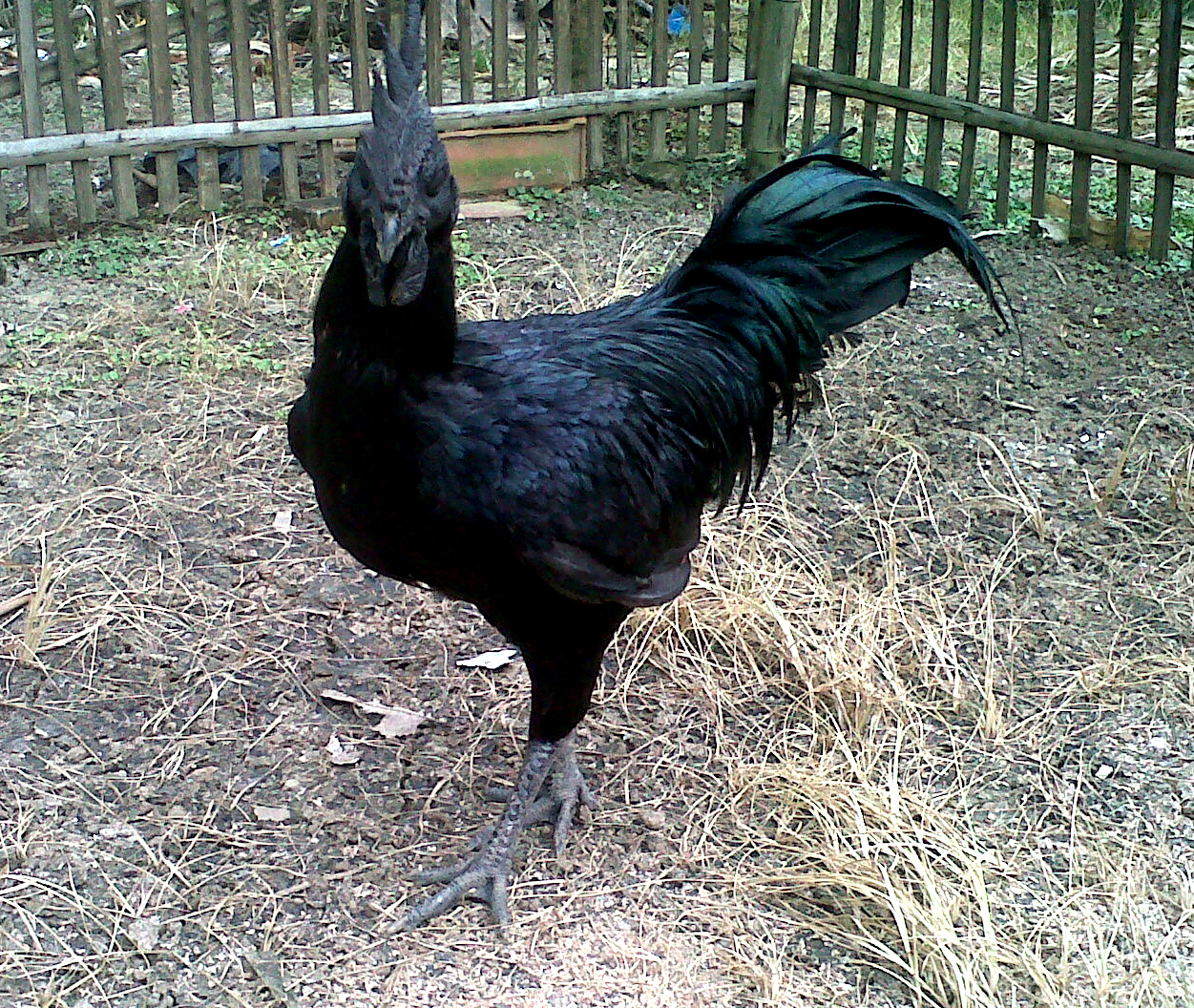
The Ayam Cemani's striking all-black appearance results from the fibromelanosis trait discussed in this section. Image: Kangwira, CC BY-SA 4.0, via Wikimedia Commons.
### What Fibromelanosis Actually Is
Fibromelanosis is extensive pigmentation of the dermal layer of the skin and most internal connective tissue [2]. The trait is dominant. A bird that inherits the fibromelanosis allele shows the phenotype, and the allele produces hyperpigmentation of skin, fascia, meat, and bone. Eumelanin accumulates in connective tissues, which is why the skin, muscles, gut, and periosteum appear black [4]. The comb, wattles, and feathers are black as well. The blood is normal red, because fibromelanosis affects melanin deposition in tissues and does not change hemoglobin or circulating blood cells.
Melanin deposition is not uniform across every tissue. In black-boned chickens, melanin pigments gradually accumulate in muscle fibers during embryonic development, and the pectoral muscle is a useful tissue for studying that process [5]. The EDN3 and EDNRB2 signaling pathways are involved in melanin deposition in muscle, and researchers have identified additional genes that may regulate the trait across different black-bone breeds [5].
### The Genetics in Plain Terms
The causal mutation is a complex chromosomal rearrangement at the fibromelanosis locus on chromosome 20 [6][2]. The rearrangement involves two large duplications, approximately 127.4 kb and 170.5 kb in size, together with inversions, and it drives upregulated expression of EDN3 [7]. EDN3 promotes melanoblast proliferation, which is the developmental reason the extra pigment appears where it does [2]. Expression of EDN3 is elevated in the developing embryo during the period when melanoblasts migrate, and higher expression is maintained in adult skin tissue [2].
The detailed organization of the duplications and inversions was debated for more than a decade. A large genomic survey of 517 fibromelanosis chickens from 44 populations resolved the arrangement and supported one specific configuration of the two large duplications [7]. That analysis also showed that the variant's origin involved an interchromosomal rearrangement that created fixed heterozygosity, because the two copies of the 127.4 kb duplication differ in sequence [7].
The two duplicated regions harbor two distinct EDN3 haplotypes in a state of permanent heterozygosity [1]. In the ancestral Red Jungle Fowl and in some domesticated breeds, those sequences remain allelic, and their divergence time is estimated at roughly 0.3 million years [1]. In Cemani and Silkie, artificial selection for the fibromelanosis phenotype has fixed the duplicated arrangement [1].
Because the trait is dominant and the rearrangement is complex, the fibromelanosis locus is also useful for verifying breed purity. Variation in the fibromelanosis region on chromosome 20 can be used to determine whether an Indonesian Cemani chicken is pure for the trait [8]. For buyers, this is the scientific basis for the DNA testing some breeders now offer.
### Pigmentation Is Not the Whole Bird
One important nuance for owners is that fibromelanosis interacts with other pigmentation genes. The sex-linked inhibitor of dermal melanin gene (ID) modifies the dermal hyperpigmentation phenotype in the Silkie, and the region linked to ID sits on chromosome Z [9]. In practice, this means that black pigmentation can vary between lines and between individual birds even when the fibromelanosis allele is present. A bird with a lighter or reddish comb may still carry fibromelanosis, and the comb color is one of the easiest visible cues that other pigmentation loci are at work [3].
There is also a documented relationship between comb color and egg production. In a Chinese blue-shelled breed selected divergently for comb color over more than 20 generations, the red comb line produced significantly more eggs than the dark comb line [10]. A genomic region on chromosome 20 containing EDN3 and BMP7 was associated with comb hyperpigmentation, and both genes have known roles in ovarian function and melanogenesis [10]. That finding indicates a pleiotropic effect linking hyperpigmentation and egg production in blue-shelled chickens [10]. Owners should treat this as a research finding about one breed rather than a rule for every Ayam Cemani, but it explains why breeders sometimes observe production differences between heavily pigmented and less pigmented lines.
## Temperament and Behavior
Ayam Cemani chickens are generally calm and handleable when they are raised with routine contact. They are active foragers and are not a sedentary breed. Temperament in any flock depends heavily on how much human contact the birds receive, how much space they have, and whether they are kept in a stable group.
Behavior problems in backyard poultry usually come from environment rather than breed. Overcrowding, sudden changes in group composition, and inadequate space to escape aggression drive most feather pecking and bullying. Provide enough room for subordinate birds to move away from dominant ones, and introduce new birds gradually.
Roosters can be territorial, and any rooster kept for breeding needs a clear management plan. Many municipalities in the United States restrict or prohibit roosters, so check local ordinances before acquiring one.
## Housing and Husbandry
### Space and Shelter
Ayam Cemani chickens are smaller than commercial broilers and commercial layer hybrids. Their smaller body size means they need proportionally less floor space than heavy breeds, but they still need protection from weather, predators, and drafts. A dry, ventilated coop with solid roofing and secure latches covers the basics. Hardware cloth rather than chicken wire is the standard recommendation for predator resistance, and buried aprons or skirt fencing reduce digging losses.
Because these birds are black and often kept for their appearance, owners sometimes underestimate how much heat load dark plumage creates in full sun. Shade is not optional in hot climates. Provide shade structures and cool water at all times.
### Biosecurity and Flock Introductions
Backyard flocks are vulnerable to introduced disease. Follow the biosecurity practices that apply to any poultry flock: quarantine new birds before mixing them, limit visitor traffic into the coop, and clean footwear and equipment between flocks. The AVMA and the USDA maintain poultry biosecurity guidance for backyard owners, and the same principles apply to a specialty breed as to a production flock.
### Parasite Control
External parasites including mites and lice, and internal parasites including coccidia and worms, affect all backyard chickens. Routine inspection of the vent area, feather bases, and coop crevices catches infestations early. The Companion Animal Parasite Council publishes parasite guidance for animals, and poultry-specific deworming decisions should be made with a veterinarian who knows your flock's history and your state's regulations on drug use in laying hens.
### Egg Withdrawal Rules
Any medication given to a laying hen can leave residues in eggs. In the United States, the Food and Drug Administration regulates drug use in food-producing animals, and extra-label drug use in poultry requires a valid veterinarian-client-patient relationship. If a hen is being treated, ask the veterinarian for the correct egg withdrawal interval rather than guessing.
## Feeding Considerations
Ayam Cemani chickens are moderate layers, so they do not need the high-energy, high-protein rations formulated for fast-growing meat birds. A complete layer ration appropriate to the bird's age and production status covers the basics. Chicks need a starter ration, growing birds need a grower ration, and hens in lay need a layer ration with adequate calcium.
Scratch grains and kitchen scraps should be a small part of the diet, not the foundation. Treats dilute the nutrient balance of a complete feed. Free-ranging birds get some nutrition from forage, but forage alone does not meet the requirements of a laying hen.
Always provide clean water. In cold weather, check waterers for ice. In hot weather, check that water stays cool and that birds have multiple access points so subordinate birds are not excluded.
## Egg Production and Reproduction
Ayam Cemani hens are moderate layers that produce cream or tinted eggs. They are not competitive with commercial layer hybrids on output.
Reproduction is where many flocks run into trouble. Black-bone breeds have passed through genetic bottlenecks, and inbreeding reduces fertility. Population [genomic analysis](/blog/guides/genomic-analysis) of Luning black-bone chickens found runs of homozygosity consistent with inbreeding in that population and in Tibetan chickens [11]. A study of two Swedish local breeds found that the mean inbreeding coefficient was considerably higher in one breed than the other, and the proportion of homozygous SNPs in individual birds was higher in the more inbred breed [3]. Small, closed populations accumulate inbreeding over generations, and that shows up as reduced hatchability and weaker chicks.
For owners who want to breed Ayam Cemani, the practical steps are to source birds from unrelated lines, to record pedigrees, and to bring in new genetics periodically rather than breeding the same small group indefinitely. Because the fibromelanosis locus can be genotyped, DNA testing can confirm that breeding stock carries the trait before birds are paired [8].
## Health and Inherited Problems
### What the Genetics Literature Shows
The fibromelanosis locus is a large structural rearrangement, and it sits near other genes. In Kadaknath black-bone chickens, researchers identified two regions near the fibromelanosis locus with signatures of selection unique to that breed [6]. Those regions contain several genes with protein-coding changes, including two Kadaknath-specific changes in the bactericidal/permeability-increasing protein-like gene within protein domains [6]. The authors concluded that these protein-coding changes hitchhiked with the fibromelanosis locus because of close physical linkage [6].
That finding is a useful caution for any black-bone breed. When breeders select hard for one dramatic trait, nearby genes travel with it. The practical consequence is that black-bone breeds can carry genetic baggage that has nothing to do with pigmentation.
### Inbreeding Depression and Fertility
The clearest documented risk in Ayam Cemani husbandry is inbreeding. Reduced genetic diversity in a closed flock lowers fertility and hatchability. The evidence for this pattern comes from population genomics across black-bone and local breeds, where small effective population sizes produced measurable homozygosity [3][11]. Owners should treat unexplained poor hatch rates as a genetics problem first and a management problem second, then evaluate both.
### Pigmentation and Production Trade-offs
The association between comb hyperpigmentation and lower egg production in a divergently selected blue-shelled breed is a documented pleiotropic effect [10]. This does not mean every dark-combed Ayam Cemani hen is a poor layer. It does mean that selection for extreme pigmentation can pull production traits along with it, and owners should set realistic expectations for egg numbers.
### General Flock Health
Beyond genetics, Ayam Cemani chickens face the same health problems as any backyard flock. Respiratory disease, Marek's disease, coccidiosis, and external parasites are common concerns. A vaccination program appropriate to your region, developed with a veterinarian, is the standard approach for backyard poultry.
### Screening and Testing
The most relevant screening tool specific to this breed is genotyping of the fibromelanosis region on chromosome 20 to confirm that breeding birds carry the trait [8]. For general flock health, a veterinarian can perform physical examinations, fecal testing for internal parasites, and postmortem examination when losses occur. Necropsy is underused in backyard flocks and often provides the fastest answer when birds die without an obvious cause.
## Grooming and Routine Care
Ayam Cemani chickens need very little grooming. Their feathers are black and fully feathered, and they do not require trimming or special coat care. Routine tasks include:
1. Checking the vent area and feather bases for mites and lice.
2. Inspecting the comb, wattles, and feet for frostbite in winter and for injuries from flock aggression.
3. Trimming overgrown toenails when needed.
4. Checking body condition by feeling the keel, since black plumage can hide weight loss.
5. Cleaning drinkers and feeders regularly to reduce pathogen buildup.
The black pigmentation makes some problems harder to see. A wound on black skin, a dark comb injury, or a blackened area from frostbite can be easy to miss. Handle birds regularly so you learn what normal looks like on your flock.
## Finding a Responsible Breeder or Rescue
Buying an Ayam Cemani chicken is different from buying a common production breed. The market includes birds of highly variable quality, and the breed's popularity has encouraged misrepresentation.
Ask for the following from any breeder:
1. Genotyping results for the fibromelanosis region on chromosome 20, since variation in that region is used to determine purity in Indonesian Cemani chickens [8].
2. Pedigree records that show unrelated lines in the breeding program.
3. Evidence of flock health management, including vaccination history and any history of respiratory disease.
4. A look at the parent birds, not just the chicks or hatching eggs.
5. Clear answers about hatch rates and fertility in the breeding flock.
Be cautious of sellers who claim health or medicinal benefits from the meat or eggs. The scientific literature on black-bone chickens focuses on pigmentation genetics, meat quality traits, and carcass characteristics, not on curative properties. One study examined collagen extract derived from Yeonsan Ogye chicken flesh in ovariectomized rats and reported effects on bone microarchitecture and osteoclast differentiation markers [12]. That is a laboratory and animal-model finding about a collagen extract, not evidence that eating Ayam Cemani meat or eggs treats disease in people. Owners should not accept marketing claims that go beyond what research supports.
Rescue is a realistic option for any chicken breed. Backyard flocks are sometimes surrendered when municipalities change rules, when owners move, or when a breeding project ends. Local poultry rescues and farm animal sanctuaries occasionally have black-bone birds available.
## Who Should Not Get This Breed
Ayam Cemani chickens are a poor fit for some keepers.
Do not choose this breed if you need high egg production. These are moderate layers, and commercial layer hybrids will outproduce them substantially.
Do not choose this breed if you want a fast-growing meat bird. Ayam Cemani chickens are smaller than commercial broilers.
Do not choose this breed if you are not prepared to manage inbreeding in a closed flock. Fertility problems are a documented risk in small black-bone populations [3][11].
Do not choose this breed if you live where roosters are prohibited and you want to breed. You will need an alternative plan for obtaining genetics.
Do not choose this breed if you are seeking a bird with proven medicinal properties. The evidence does not support those claims for the meat or eggs of this breed.
## Limitations and When to Contact a Veterinarian
This article is educational and is not a substitute for veterinary diagnosis or treatment. Individual birds need individual assessment, and a veterinarian who examines your flock can evaluate problems that cannot be judged from a description.
Contact a veterinarian promptly if you observe any of the following:
1. Labored breathing, sneezing, or discharge from the eyes or nostrils.
2. Sudden drop in egg production across multiple hens.
3. Diarrhea lasting more than a day, or blood in the droppings.
4. Weakness, reluctance to stand, or inability to walk.
5. Unexplained weight loss, which is easy to miss under black plumage.
6. Swelling of the face, comb, or wattles.
7. Wounds that are not healing, or evidence of flock aggression with open injuries.
8. Sudden death in more than one bird, which warrants a postmortem examination.
9. Persistent poor hatch rates despite adequate nutrition and management, which points toward a genetics or infectious cause.
10. Any bird that has stopped eating or drinking.
For flocks in the United States, state veterinary diagnostic laboratories accept poultry carcasses for necropsy and can identify infectious causes quickly. Your veterinarian can advise on submission.
## Frequently Asked Questions
### What makes an Ayam Cemani chicken black?
A dominant genetic trait called fibromelanosis causes hyperpigmentation of the skin, fascia, meat, and bone. It results from a complex structural rearrangement on chromosome 20 that increases expression of the EDN3 gene [7][2].
### Is Ayam Cemani blood black?
No. The blood is normal red. Fibromelanosis affects melanin deposition in tissues and does not change the color of circulating blood.
### Do Ayam Cemani chickens lay many eggs?
They are moderate layers that produce cream or tinted eggs. They do not match commercial layer hybrids for output.
### Are Ayam Cemani chickens hard to breed?
Fertility can be reduced in flocks with narrow genetics. Small closed populations accumulate inbreeding, which lowers hatchability [3][11].
### Can I test whether my Ayam Cemani is pure?
Yes. Variation in the fibromelanosis region on chromosome 20 is used to determine purity in Indonesian Cemani chickens [8].
### Do Ayam Cemani chickens have medicinal properties?
The scientific literature does not support medicinal claims for the meat or eggs of this breed. Research on black-bone chickens focuses on pigmentation genetics and meat quality, not on curative effects.
### Are Ayam Cemani chickens good with children?
Temperament depends on individual handling and supervision rather than breed alone. Calm, well-handled birds generally tolerate contact, but children should always be supervised around poultry.
### How big do Ayam Cemani chickens get?
They are smaller than commercial broiler and layer breeds. Their compact size is one reason they are kept primarily as ornamental and exhibition birds.
## Related Articles
- [Calico Cat: Fascinating Facts, Personality Traits & Complete Care Guide](/knowledge/veterinary-medicine/preventive-care/calico-cat-facts-care)
- [trait biology definition](/blog/careers/trait-biology-definition)
- [Trait Biology](/blog/careers/trait-biology)
- [trait in biology](/blog/careers/trait-in-biology)
- [traits biology definition](/blog/guides/traits-biology-definition)
- [Silkie Chicken Care Guide](/knowledge/veterinary-medicine/backyard-poultry/silkie-chicken-care)
- [Ayam Cemani Breeding: Genetics and Fertility Tips](/knowledge/veterinary-medicine/backyard-poultry/ayam-cemani-breeding-genetics-and-fertility-tips)
- [Bully Pit Mix: Breed Traits, Health, and Care](/knowledge/veterinary-medicine/breed-specific-health/bully-pit-mix-breed-traits-health-and-care)
- [ISA Brown Chicken: Breed Traits and Egg Yield](/knowledge/veterinary-medicine/backyard-poultry/isa-brown-chicken-breed-traits-and-egg-yield)
## Sources
1. [The origin and evolution of fibromelanosis in domesticated chickens: Genomic comparison of Indonesian Cemani and Chinese Silkie breeds.](https://pubmed.ncbi.nlm.nih.gov/28379963/)
2. [A Complex Genomic Rearrangement Involving the Endothelin 3 Locus Causes Dermal Hyperpigmentation in the Chicken](https://pubmed.ncbi.nlm.nih.gov/22216010/)
3. [Characterization of genetic diversity and gene mapping in two Swedish local chicken breeds](https://pubmed.ncbi.nlm.nih.gov/25741364/)
4. [Transcript expression profiling of fibromelanosis-related genes in black-bone chickens](https://pubmed.ncbi.nlm.nih.gov/34402346/)
5. [Dynamic Transcriptome Profile Analysis of Mechanisms Related to Melanin Deposition in Chicken Muscle Development](https://pubmed.ncbi.nlm.nih.gov/39335292/)
6. [Decoding the fibromelanosis locus complex chromosomal rearrangement of black-bone chicken: genetic differentiation, selective sweeps and protein-coding changes in Kadaknath chicken](https://pubmed.ncbi.nlm.nih.gov/37424723/)
7. [Population genomic analysis identifies the complex structural variation at the fibromelanosis (FM) locus in chicken](https://pubmed.ncbi.nlm.nih.gov/40102581/)
8. [Identification of variation in Fibromelanosis region on chromosome 20 for determining the purity of Indonesian Cemani chicken](https://doi.org/10.1101/2022.11.13.516295)
9. [Genomic regions associated with the sex-linked inhibitor of dermal melanin in Silkie chicken](https://doi.org/10.15302/J-FASE-2014018)
10. [Genomic Analysis Reveals Pleiotropic Alleles at EDN3 and BMP7 Involved in Chicken Comb Color and Egg Production](https://pubmed.ncbi.nlm.nih.gov/31316551/)
11. [Whole-genome resequencing reveals melanin deposition candidate genes of Luning chicken](https://pubmed.ncbi.nlm.nih.gov/39271972/)
12. [Collagen Extract Derived from Yeonsan Ogye Chicken Increases Bone Microarchitecture by Suppressing the RANKL/OPG Ratio via the JNK Signaling Pathway](https://pubmed.ncbi.nlm.nih.gov/32630655/)