# ORCID Contributor Badges and Authorship: Step-by-Step Guide
By the end of this guide you will be able to register and complete an ORCID record, attach published works to it with the correct contributor list, understand what the contributor badges next to author names actually mean, and negotiate authorship and contributor roles with collaborators before they turn into disputes. You need a web browser, your published article's Digital Object Identifier (DOI), and a free ORCID account. If your institution or funder is an ORCID member, you also want to know its name so you can connect it as a trusted organization.
## What ORCID Contributor Badges Are and How They Work
ORCID stands for Open Researcher and Contributor ID. It is a free, nonprofit-run registry that gives every researcher a persistent 16-digit identifier, written in a four-block format such as 0000-0002-1825-0097. That identifier belongs to you regardless of name changes, institutional moves, or field transitions, which solves a chronic problem in scientific collaboration: multiple researchers sharing similar names and one researcher publishing under several name variants.
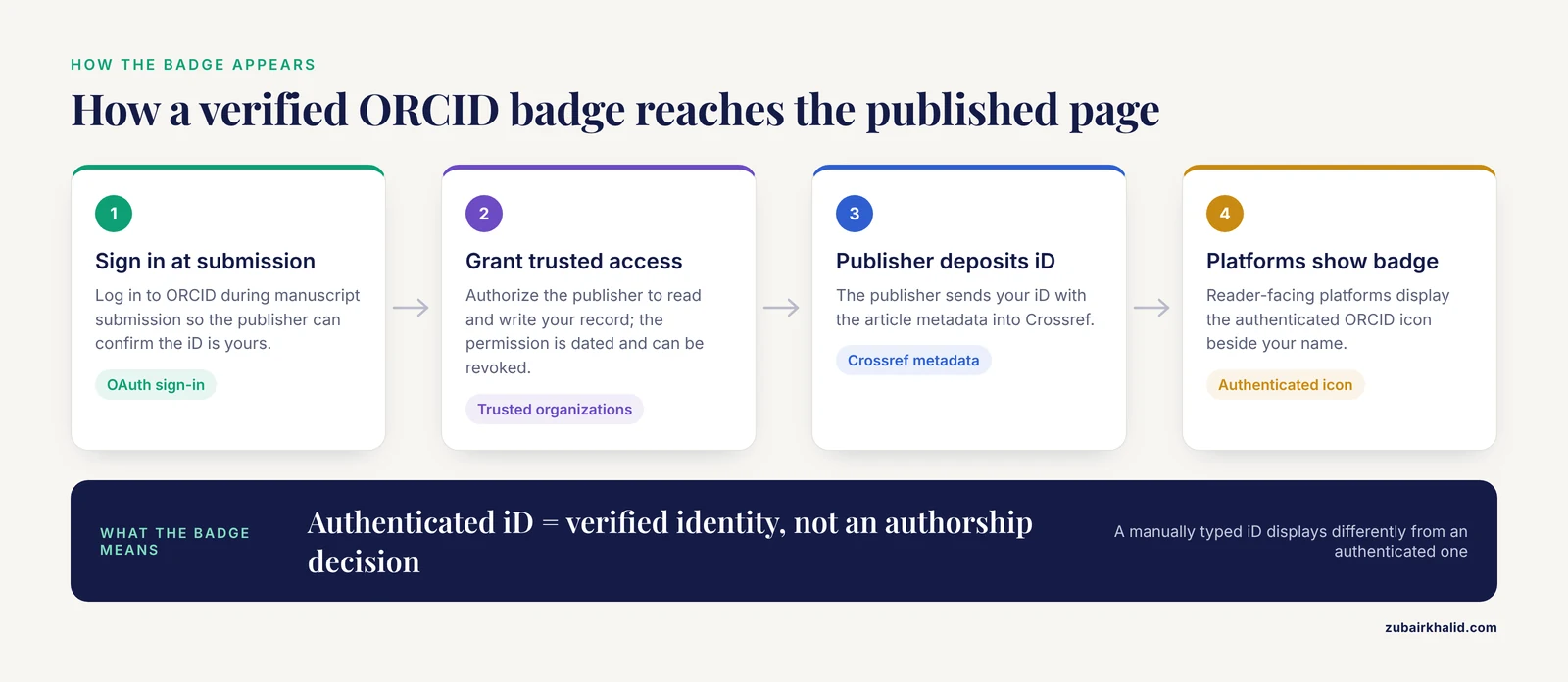
A contributor badge is the small visible indicator that appears next to a name in scholarly systems when an ORCID iD is attached and authenticated. When a journal publishes your article and you have logged in to ORCID during the submission process, the publisher deposits your iD with the article metadata. Reader-facing platforms then display the authenticated ORCID icon beside your name, which tells anyone scanning the byline that this identifier was verified as belonging to that person, not simply typed in by someone else. An unauthenticated iD, typed manually, does not carry the same trust signal.
Authorship and contributorship are related but distinct concepts. Authorship is the formal, ethical, and often legal claim to having done the work and taken responsibility for it. Contributorship describes the specific tasks each person performed. The Contributor Roles Taxonomy, known as CRediT, defines 14 contributor roles that journals increasingly ask every author to declare at submission [1]. ORCID records and publisher metadata systems carry contributor names and roles alongside the work itself, so the badge is not merely decoration. It links a verified identity to a verified contribution.
## Why This Matters for Authorship Ethics
Authorship disputes are old. A historical analysis of the Dutch anatomist Gerard L. Blaes and his mentee Daniel Gödtke shows that a single 1666 anatomy work on the spinal cord appeared in two versions, one crediting both mentor and student and one crediting only the mentor, and that the mentor used a public disputation by his student to deflect open confrontation over the credit question. The case illustrates how power imbalances between senior and junior researchers distort attribution, a dynamic the authors argue is still recognizable in modern academia [2].
Modern commentaries reach similar conclusions from different angles. Authors writing on the ethics of authorship attribution note that publications and authorship are treated as coveted academic assets, that the process of negotiating who deserves authorship is often complex and ambiguous, and that much of the negotiation happens inside a black box that newer researchers cannot see into. They propose a seven-phase process model covering pre-negotiation, direction setting, renegotiation, equity and inclusivity, the submission and revision cycle, and reflexivity, with the explicit aim of promoting transparency, accountability, and reciprocal trust. Practical guidance in the pediatric literature makes the same operational point: communication that starts early and recurs often prevents or mitigates authorship conflict, and a structured process for defining contributions awards proper credit [4].
ORCID contributor badges fit into this picture as a transparency tool. They do not decide who is an author. They make verified identity and declared roles machine-readable, which reduces ambiguity about who did what after publication. A commentary on large multicenter collaborations argues that not every contributor should be classified as an author, and that it is often more correct to diversify credit into authors, named collaborators, and acknowledgments, because authorship carries responsibility that casual contributors should not shoulder. An ORCID record can hold all three kinds of credit without inflating anyone's authorship claim.
## Step-by-Step Guide to ORCID Contributor Badges and Authorship
### Step 1. Register and Complete Your ORCID Record
Go to orcid.org and select the registration option. Provide your email, choose a password, and fill in your name. You receive an iD in the standard format.
```
Your ORCID iD will look like this:
0000-0002-1825-0097
Format: 4 digits, 4 digits, 4 digits, 4 digits, separated by hyphens.
The last digit is a check digit and can be a number or the letter X.
```
After registration, complete these fields before you do anything else:
1. Employment, with start and end dates for each position
2. Education and qualification, with institutions and degrees
3. Your public name as it appears on your publications, plus any alternate names, such as a maiden name or an anglicized spelling variant
Expected result: your record shows a completeness indicator that rises as you fill sections, and your iD is ready to use in submission systems. An incomplete record weakens the very name-disambiguation benefit the iD exists to provide.
### Step 2. Add Your Published Works by DOI
Sign in and go to the Works section of your record. The most reliable manual method is adding by DOI, the persistent string that identifies a paper.
```
Action: Works > Add works > Add DOI
Enter the DOI without a leading "https://doi.org/" prefix, for example:
10.1080/10999922.2024.2416097
Click "Fetch" and confirm the retrieved title, journal, and year are yours.
```
Expected output: the work appears in your Works list with its title, journal name, publication year, and DOI. If the retrieval brings back the wrong article, you typed the DOI incorrectly. Check the string character by character, because transposed digits are the most common manual-entry failure.
Repeat for each publication. You can also use the Search and link option, which connects to databases such as Crossref and lets you claim works found by searching your own name, then confirm which ones are yours.
### Step 3. Add Contributors and Their Roles to a Work
When you add or edit a work, the form includes a contributors section. For each collaborator, you add their name and, when known, their ORCID iD. This is the step where the contributor list on your ORCID record mirrors the author list on the paper.
The roles you declare should follow the same taxonomy the journal used. CRediT defines 14 roles, summarized here in plain language [1].
| CRediT role | What it means in practice |
|--|--|
| Conceptualization | Forming and developing the research idea |
| Data curation | Managing and maintaining the research data |
| Formal analysis | Running the statistical or computational analysis |
| Funding acquisition | Securing the financial support for the project |
| Investigation | Performing the experiments or data collection |
| Methodology | Designing the methods and study protocol |
| Project administration | Coordinating and managing the project day to day |
| Resources | Providing materials, equipment, computing, or analysis tools |
| Software | Writing or adapting code and software |
| Supervision | Overseeing and directing the research team |
| Validation | Verifying results are reproducible and correct |
| Visualization | Producing figures, tables, and data displays |
| Writing, original draft | Producing the first written manuscript |
| Writing, review and editing | Critiquing and revising the manuscript |
Publisher submission systems capture these declarations during manuscript submission, and member organizations that manage metadata through the ORCID member application programming interface can push contributor details, including verified iDs, into the ORCID records of every author who authorized the connection. A simplified view of the fields involved in such a contributor record looks like this:
```xml
https://orcid.org/0000-0002-1825-0097
J. A. Smith
author
```
You will rarely type XML by hand. This is what arrives in your record when a publisher or trusted organization deposits metadata for you. Your job is to check it for accuracy.
### Step 4. Set Visibility on Each Item
Every item in your record, and the record sections themselves, carries a visibility setting with three values:
1. Everyone, meaning the item is public
2. Trusted parties, meaning only organizations you have authorized can see it
3. Only me, meaning the item is private to you
Set works and employment to Everyone unless you have a specific reason not to. A public works list is what makes your iD useful to funders, publishers, and collaborators who are trying to confirm they are crediting the right person.
### Step 5. Connect Trusted Organizations
In the trusted organizations section of your account, you authorize institutions, funders, and publishers to read from and write to your record. When you submit a manuscript and the publisher participates in ORCID, you will be prompted to sign in to your ORCID account and grant that permission. This single authorization is what causes the authenticated badge to appear next to your name on the published version, because the iD then flows from the publisher into Crossref metadata and out to the reader-facing platforms.
Expected output: after granting access, the organization name appears in your trusted organizations list with a dated permission record. You can revoke it at any time, which is worth knowing if you change institutions.
### Step 6. Verify the Published Result
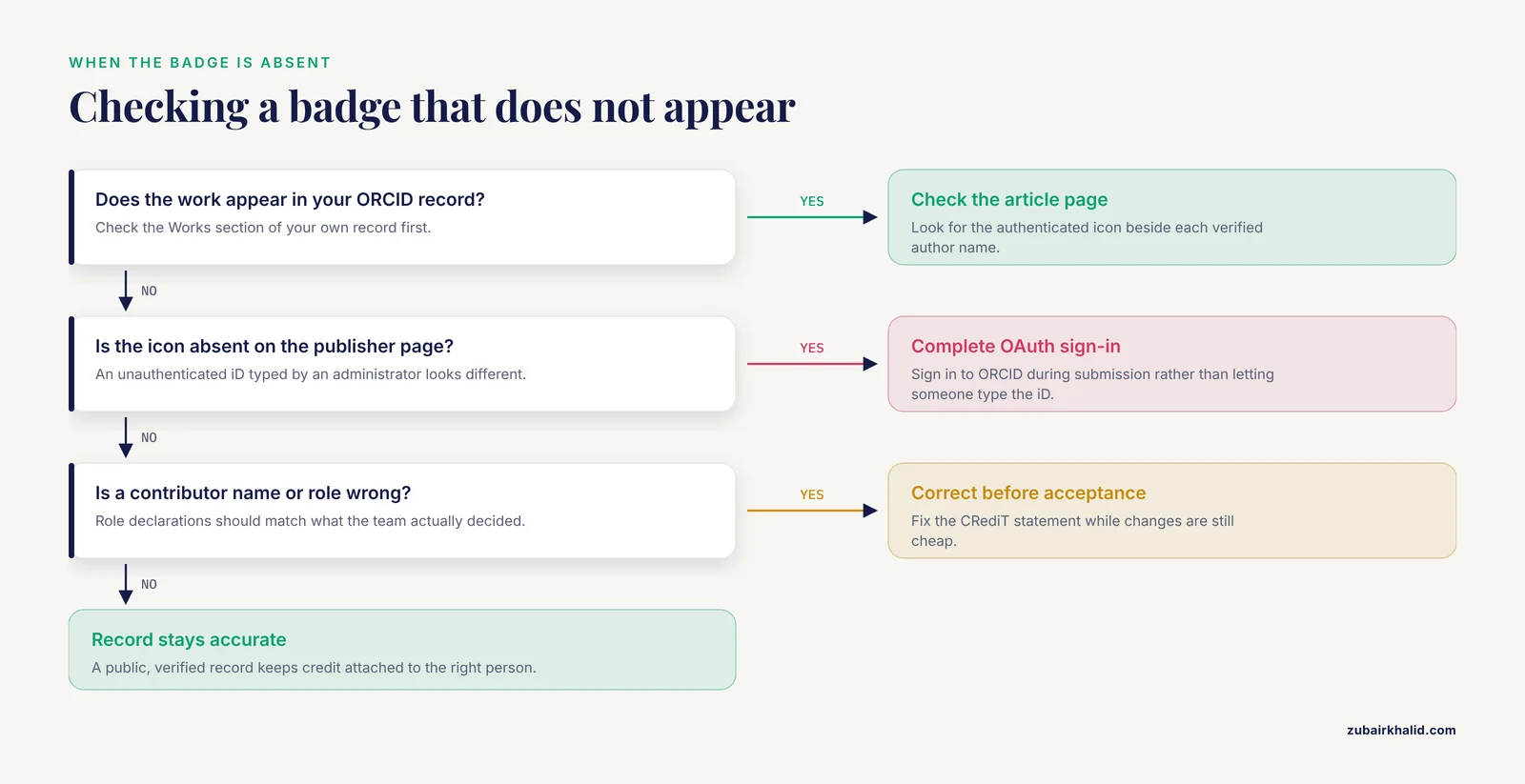
Once the article is published, check three places:
1. The publisher's own article page, where an authenticated ORCID icon should sit beside each author name that carried a verified iD through submission
2. The Crossref metadata, which you can view by resolving the DOI and inspecting the deposited record
3. Your own ORCID record, where the new work should appear automatically within days if the publisher is a member and you granted write access
If the work does not appear, add it manually by DOI using the process in Step 2. A manually added work displays the same information, it simply lacks the publisher's automated attestation.
### Step 7. Maintain the Record Through Your Career
Review your record at least twice a year. Add new works, merge duplicates, correct misspelled contributor names, and update employment. When you begin a new collaborative project, record the agreed contributor roles in your own notes at the same time you record the project plan, so that the declarations you make at submission match what the team actually decided.
## Negotiating Authorship and Roles Before the Badge Exists
The badge reflects decisions made long before submission. Getting those decisions right is a separate skill, and the research literature offers concrete structure for it.
A practical first move is distinguishing the three tiers of credit explicitly. In large collaborative studies, treating every contributor as an author creates accountability problems, because authorship implies responsibility for the integrity of the work. Splitting credit into authors, named collaborators, and acknowledged contributors keeps the author list meaningful while still recognizing everyone. The historical record shows what happens without this discipline. When Blaes chose to sidestep a public authorship confrontation with his mentee rather than resolve it openly, the result was two divergent published versions of the same anatomical work and an enduring ambiguity about individual contribution [2].
A second move is putting the negotiation in writing early. The seven-phase model for ethical collaborative research begins with problem setting and pre-negotiations, in which collaborators discuss authorship expectations before data collection, and includes explicit renegotiation points because contributions shift as projects evolve [3]. In practice this means a short written agreement at project start that names the expected authors, the expected order, the planned CRediT roles for each person, and the conditions under which the list changes. Anyone who joins or leaves triggers a renegotiation rather than an ambush.
A third move is handling disagreement with the communication practices that research on conflict resolution supports. Survey research on early-career professionals found that people who build close, trusting working relationships are more likely to use compromise and negotiation in conflicts, while trust does not predict whether someone simply avoids the conflict altogether [5]. Qualitative work on institutional conflict resolution consistently identifies open, empathetic, goal-directed communication as the foundation of resolution, and finds that collaborative approaches repair working relationships better than coercive or purely punitive ones. Applied to authorship, this favors a scheduled, face-to-face, or video-based conversation over a contested email thread, and it favors discussing contributions in terms of the CRediT categories rather than in terms of personal worth. Structured role definitions exist precisely so the conversation is about tasks, not status.
Finally, separate the discussion of authorship from the discussion of metrics. Commentary on academic publishing documents how gift authorship, in which people with minimal contribution receive authorship, and authorship inflation more broadly distort academic profiles without reflecting actual input, and it proposes transparent authorship roles as part of the remedy [6]. ORCID contributor data supports that transparency, because a verified iD attached to a declared role is harder to fabricate than a name on a byline.
## Contributor Badges in the Era of AI-Assisted Research
Generative AI tools now draft text, write code, and analyze data, which raises a direct question for contributor lists. Can a large language model be a contributor, and if not, what does the human who used it owe the record? A recent analysis frames this as a crisis of representation, in which the boundary between human and AI authorship blurs, and proposes responses that include preserving researcher voice through explicit annotation, ensuring trustworthiness through algorithmic audits, and practicing participatory transparency about where AI entered the workflow [7]. Applied to your ORCID record, the operational translation is straightforward. The iD and roles in your record describe humans. If AI tools performed substantive work in your project, the honest place to record that is the methods section and the transparency statement of the manuscript, not a fabricated contributor entry.
This matters because contributor badges derive their value from being trustworthy. A badge system built on verified identity can only support scientific collaboration if the underlying role declarations are honest about both human and machine contributions.
## Common Mistakes and Limitations
1. Treating the ORCID iD as an authorship decision. The iD verifies identity, not authorship status. Two researchers can both have authenticated iDs attached to a paper while the question of who meets authorship criteria remains a separate ethical question governed by your journal's stated criteria, such as the four ICMJE criteria covering substantial contribution, drafting or revision, final approval, and accountability.
2. Adding an iD without authentication. A manually typed iD in submission metadata displays differently from an authenticated one. Always complete the OAuth sign-in step during submission rather than letting an administrator type your iD for you.
3. Claiming works that are not yours during Search and link wizards. Automated name searches return similar names. Confirm the title, journal, and author list before checking the box, because a false claim on a verified record is exactly the kind of inflation that transparency tools are meant to prevent [6].
4. Ignoring co-authors without iDs. If a collaborator has no ORCID iD, their contributor entry can still exist in your record with a name only. Encourage them to register, but do not block publication over it.
5. Letting role declarations drift from reality. If the CRediT statement submitted to the journal says one thing and the work you actually did says another, correct it before acceptance, when changes are still cheap. Renegotiation is a planned phase of good collaboration, not a failure.
6. Assuming the badge settles disputes. Metadata records who did what as declared. It cannot by itself resolve a disagreement about whether a task deserved authorship. Structured approaches, early communication, and where necessary institutional mediation remain the tools for that [4].
7. Confusing acknowledgments with authorship. Funding, technical assistance, and material contributions belong in acknowledgments or in specific CRediT roles such as Funding acquisition or Resources, not in an author line that implies accountability for the whole paper.
8. Leaving visibility set to Only me. A private record defeats the purpose of the identifier and can cause mismatches when funders and institutions try to verify your output.
One limitation applies to the whole topic. Contributor badges make credit visible, but they operate inside a broader evaluation culture that still weighs authorship positions and citation counts heavily, with documented problems including the Matthew Effect, in which highly cited researchers accumulate citations regardless of individual contribution, and geographic bias favoring researchers at prestigious institutions [6]. An accurate ORCID record is part of a fair credit system. It is not the whole system.
## Frequently Asked Questions
### Do I need an ORCID iD to be listed as an author?
No. Journals list authors by name and affiliation, and an iD is not a requirement for authorship at most journals. The iD adds a verified, unambiguous identity layer that becomes valuable as your career and publication list grow.
### What is the difference between an author and a contributor in ORCID metadata?
An author is a contributor with a formal claim to the work and responsibility for its integrity. In ORCID and publisher metadata, the contributor list carries all named people attached to a work, and their roles distinguish authors from editors, translators, and other contributor types.
### How do I add a paper to my ORCID record if the publisher never sent it?
Add it manually using the Add DOI option in the Works section. Paste the DOI, confirm the retrieved metadata is correct, and the work appears in your list. Manually added works are fully functional, they simply lack the automated publisher attestation.
### Can I remove or correct a work that appears on my record incorrectly?
Yes. You can delete any work from your own record, and you can edit contributor details on works you added. For works deposited by a trusted organization, you can still delete or hide the item from your view, and you can revoke the organization's write access.
### What should I do if a co-author refuses to provide their ORCID iD?
Proceed without it. Their name can appear as a contributor with no iD attached. The publication does not depend on every author having an identifier, and pressuring a co-author over their own registry account is not a productive use of a collaboration.
### Do contributor badges affect citations or my h-index?
Badges improve the disambiguation of your identity, which helps citation aggregators attribute papers to the right person. The badge itself is not a metric and does not add citations. Accurate attribution is what protects your citation record from splitting across duplicate name profiles.
### Who decides whether I qualify as an author on a collaborative paper?
The journal's stated criteria, applied to the actual contributions, decide eligibility, and the author team applies them. Most medical and life science journals follow the four ICMJE criteria. Your written pre-agreement should map each person's tasks to those criteria early in the project.
### How are CRediT roles different from the author order?
Author order is a single, coarse signal that often mixes seniority with effort. CRediT roles describe the specific tasks each person performed, across 14 defined categories, which gives evaluators and readers a much more accurate picture of contribution than position on the byline [1].
## Sources
1. [Managing the "Three Cs" of Academic Literature Authorship: Contributions, Credit, and Conflict.](https://pubmed.ncbi.nlm.nih.gov/37288678/)
2. [Analysis of the ethical issues in authorship of collaborative research. Observations inspired by the historical case study of Gerard L. Blaes' (Blasius) claim to sole authorship of ‘Anatome medullae spinalis’](https://pubmed.ncbi.nlm.nih.gov/38750636/)
3. [Give Credit Where It’s Due: The Ethical Imperatives of Authorship Attribution in Collaborative Research](https://doi.org/10.1080/10999922.2024.2416097)
4. [Practical Approaches for Navigating Authorship Conflict.](https://pubmed.ncbi.nlm.nih.gov/40707013/)
5. [Generation Z: Navigating Conflict Resolution Strategies at the Workplace Through Their Intimacy Styles](https://doi.org/10.1177/09763996241280395)
6. [Challenges in Academic Authorship and Citation Metrics: Navigating Inflation, Biases, and the Rise of Evidence Synthesis](https://pubmed.ncbi.nlm.nih.gov/42125583/)
7. [Navigating the meta-crisis of generativity: adapting qualitative research quality criteria in the era of generative AI](https://pubmed.ncbi.nlm.nih.gov/41262539/)