# Monosodium Glutamate (MSG): Chemistry, Taste and Safety
Monosodium glutamate (MSG) is the [sodium salt](/knowledge/veterinary-medicine/toxicology-and-food-safety/salt-toxic-cats-garlic) of glutamic acid, a common amino acid, and it is used as a flavor enhancer that intensifies umami, the [savory taste](/blog/guides/tongue-anatomy) found naturally in tomatoes, cheese, meat and [kombu seaweed](/knowledge/veterinary-medicine/toxicology-and-food-safety/can-dogs-eat-seaweed-snacks) ([Monosodium glutamate](https://en.wikipedia.org/wiki/Monosodium_glutamate); [Questions and Answers on Monosodium glutamate (MSG)](https://www.fda.gov/food/food-additives-petitions/questions-and-answers-monosodium-glutamate-msg)). Food safety authorities regard added MSG as safe: the U.S. Food and Drug Administration lists it as generally recognized as safe (GRAS), and blinded studies have not consistently reproduced the reactions reported by people who identify themselves as MSG sensitive ([Monosodium glutamate](https://en.wikipedia.org/wiki/Monosodium_glutamate); [Questions and Answers on Monosodium glutamate (MSG)](https://www.fda.gov/food/food-additives-petitions/questions-and-answers-monosodium-glutamate-msg)).
Pure MSG is a white crystalline powder, with a molar mass of 169.11 g/mol in the anhydrous form ([Monosodium glutamate](https://en.wikipedia.org/wiki/Monosodium_glutamate)). On its own it tastes unpleasant; the savory effect appears when it is combined with the aromas of a dish, where it balances, blends and rounds the perception of other tastes. Modern production relies on fermentation of starch, sugar beets, sugar cane or molasses, and the glutamate in the finished product is chemically identical to the free glutamate released when dietary protein is digested ([Questions and Answers on Monosodium glutamate (MSG)](https://www.fda.gov/food/food-additives-petitions/questions-and-answers-monosodium-glutamate-msg)). The adverse findings in the literature come mainly from animal studies using high doses, while controlled human trials at normal food concentrations have not shown consistent effects ([A review of the alleged health hazards of monosodium ...](https://pmc.ncbi.nlm.nih.gov/articles/PMC6952072/); [Monosodium glutamate](https://en.wikipedia.org/wiki/Monosodium_glutamate)).
## Key Points
- MSG is the sodium salt of glutamic acid, formula C5H8NO4Na, listed as food additive E621 with HS code 2922.42 ([Monosodium glutamate](https://en.wikipedia.org/wiki/Monosodium_glutamate)).
- The anhydrous salt has a molar mass of 169.11 g/mol and the monohydrate 187.13 g/mol; it melts near 232 C, dissolves at about 740 g/L in water, and has an oral LD50 of 16,600 mg/kg in rats.
- Kikunae Ikeda isolated glutamate from kombu broth in 1908 and patented MSG production, with commercial manufacture starting the following year ([Monosodium glutamate](https://en.wikipedia.org/wiki/Monosodium_glutamate); [Questions and Answers on Monosodium glutamate (MSG)](https://www.fda.gov/food/food-additives-petitions/questions-and-answers-monosodium-glutamate-msg)).
- Industrial MSG is made by fermentation of starch, sugar beets, sugar cane or molasses, a process similar to that used for yogurt, vinegar and wine ([Questions and Answers on Monosodium glutamate (MSG)](https://www.fda.gov/food/food-additives-petitions/questions-and-answers-monosodium-glutamate-msg)).
- The FDA treats the addition of MSG to foods as generally recognized as safe, and the European Union permits it in specified foods subject to quantitative limits ([Monosodium glutamate](https://en.wikipedia.org/wiki/Monosodium_glutamate); [Questions and Answers on Monosodium glutamate (MSG)](https://www.fda.gov/food/food-additives-petitions/questions-and-answers-monosodium-glutamate-msg)).
- An average adult takes in roughly 13 g of glutamate each day from dietary protein, against an estimated 0.55 g per day from added MSG.
## At a Glance
| Property | Summary |
|---|---|
| Identity | Sodium salt of the amino acid glutamic acid ([Monosodium glutamate](https://en.wikipedia.org/wiki/Monosodium_glutamate)) |
| Taste | Umami, the fifth basic taste, described as savory |
| Made by | Fermentation of starch, sugar beets, sugar cane or molasses ([Questions and Answers on Monosodium glutamate (MSG)](https://www.fda.gov/food/food-additives-petitions/questions-and-answers-monosodium-glutamate-msg)) |
| Regulatory status | GRAS in the US; EU group ADI 30 mg/kg/day |
| Safety | Controlled trials do not confirm serious harm ([A review of the alleged health hazards of monosodium ...](https://pmc.ncbi.nlm.nih.gov/articles/PMC6952072/)) |
| Ingredient terms | Monosodium glutamate, E621; yeast extract and hydrolyzed protein can also supply free glutamate |
Monosodium glutamate is the sodium salt of glutamic acid and a source of free glutamate in food ([Monosodium glutamate](https://en.wikipedia.org/wiki/Monosodium_glutamate)). It provides umami taste, and regulators in the US and EU permit its use under defined conditions ([Questions and Answers on Monosodium glutamate (MSG)](https://www.fda.gov/food/food-additives-petitions/questions-and-answers-monosodium-glutamate-msg)).
## What Is Monosodium Glutamate?
Monosodium glutamate is a white crystalline powder. It dissolves freely in water, which allows it to disperse in soups, sauces, and marinades ([Monosodium glutamate](https://en.wikipedia.org/wiki/Monosodium_glutamate)). The compound is the sodium salt of glutamic acid, one of the amino acids used to build proteins. Glutamate is an amino acid that the body makes and uses in normal metabolism ([Questions and Answers on Monosodium glutamate (MSG)](https://www.fda.gov/food/food-additives-petitions/questions-and-answers-monosodium-glutamate-msg)). In water, the salt separates into free glutamate and [sodium ions](/knowledge/veterinary-medicine/toxicology-and-food-safety/salt-toxicity-in-dogs-and-cats). That separation matters for taste and for how the ingredient behaves in food.
### Physical and Chemical Identity
MSG has the formula C5H8NO4Na in its
## Where Glutamate Occurs Naturally
Glutamate is an amino acid. It is present in protein and also as free glutamate in many foods. The distinction matters for taste. Bound glutamate is part of protein chains and has little immediate taste. Free glutamate is released by ripening, fermentation, cooking, aging, or protein breakdown, and it can add savory taste before the food is eaten. MSG occurs naturally in many foods, including tomatoes and cheeses ([Questions and Answers on Monosodium glutamate (MSG)](https://www.fda.gov/food/food-additives-petitions/questions-and-answers-monosodium-glutamate-msg)).
### Rich Whole-Food Sources
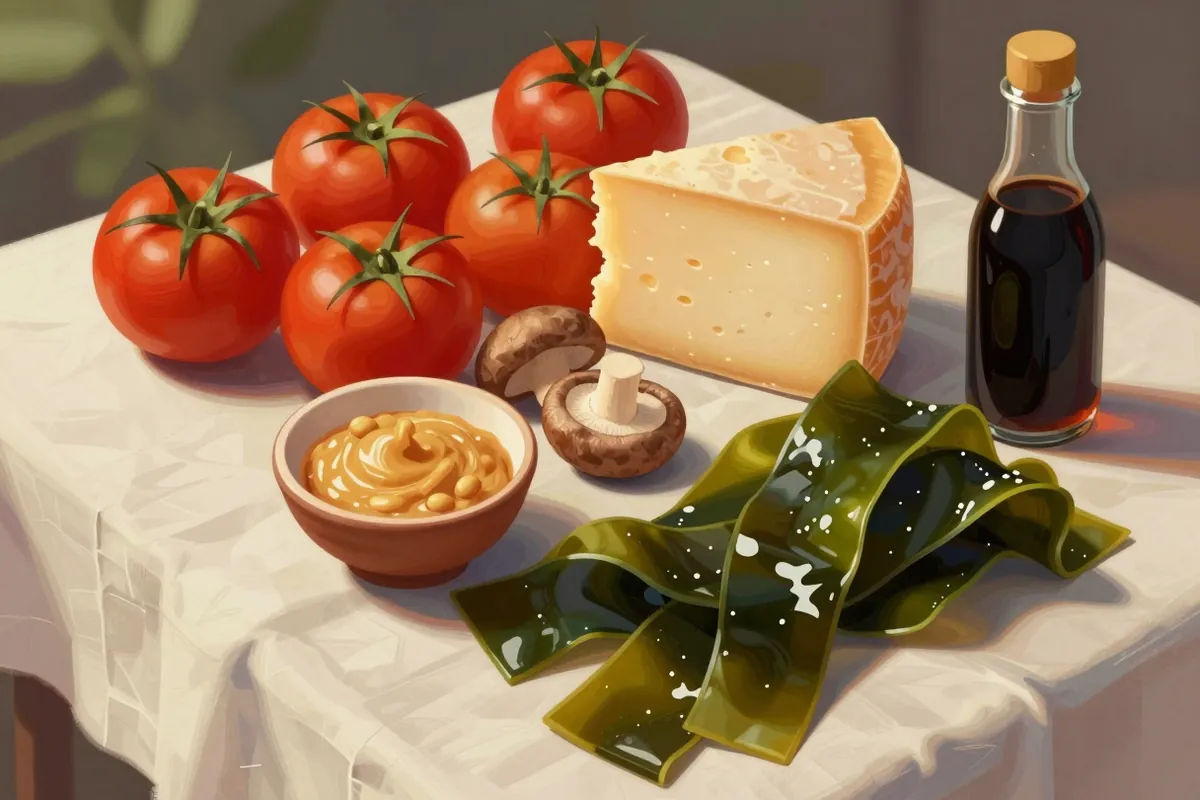
Tomatoes, Parmesan cheese, mushrooms, and seaweed are rich sources of glutamate ([A review of the alleged health hazards of monosodium ...](https://pmc.ncbi.nlm.nih.gov/articles/PMC6952072/)). These foods have a savory quality that cooks use as a base. A tomato sauce reduced with mushrooms, or a broth built on kombu, gains depth without added MSG. Parmesan and other aged cheeses also bring glutamate along with salt and aroma, so they change the overall flavor, not only the umami note.
| Food group | Examples | How glutamate becomes available |
|---|---|---|
| Vegetables | Tomatoes, mushrooms | Free glutamate rises with ripening and cooking |
| Aged cheese | Parmesan and similar cheeses | Protein breakdown during aging |
| Seaweed | Kombu and related seaweeds | Natural free glutamate in the dried material |
| Fermented seasonings | Soy sauce, fish sauce, miso | Fermentation releases free glutamate |
| Cured meats | Dry-cured ham, fermented sausage | Protein breakdown during curing |
### Condiments and Fermented Foods
Soy sauce, fish sauce, and miso carry high levels of free glutamate. These seasonings are used in small amounts because they are salty and concentrated. Their glutamate adds to the savory taste of soups, marinades, stir-fries, and dipping sauces. A small spoon of miso or a dash of fish sauce can round out a dish that tastes flat. The effect comes from glutamate plus other fermentation products, including salt and aroma compounds.
### Aged and Cured Products
Aged cheeses and cured meats develop glutamate during ripening. As proteins break down, free glutamate rises. The same process that creates flavor in dry-cured ham or aged sausage also creates a savory note. These foods are whole foods in which glutamate is one part of a complex flavor.
### Hidden Sources on Labels
Hydrolyzed vegetable protein and yeast extract supply glutamate too. They are common in stocks, soups, snacks, and sauces. Labels must declare added MSG ([Questions and Answers on Monosodium glutamate (MSG)](https://www.fda.gov/food/food-additives-petitions/questions-and-answers-monosodium-glutamate-msg)). Natural glutamate needs no listing. A product can contain tomatoes, cheese, soy sauce, or yeast extract and still carry no mention of glutamate. Foods with ingredients naturally containing free glutamate cannot claim "No MSG" or "No added MSG". This rule helps shoppers understand that natural glutamate and added MSG are chemically the same in the body. Glutamate has nothing to do with gluten.
## Taste: Umami and Flavor Enhancement
Umami is the savory taste associated with glutamate. MSG is a sodium salt of glutamic acid and is used as a flavor enhancer that intensifies umami ([Monosodium glutamate](https://en.wikipedia.org/wiki/Monosodium_glutamate)). In practice, MSG adds savory depth without a strong flavor of its own. It does not make food taste like "MSG"; it makes existing savory notes more complete. The effect is easiest to notice in bland broths, weak sauces, and vegetable dishes that lack meat or aged ingredients.
### What MSG Changes in a Dish
A small pinch lifts broths, sauces, stews, and roasted vegetables. The change is usually a fuller middle taste, less sharpness at the edges, and a longer finish. MSG can make a thin soup taste more rounded without adding fat or a new spice. It can also reduce the sense that a sauce is missing something. The powder itself can taste odd or unpleasant if tasted dry or alone ([Monosodium glutamate](https://en.wikipedia.org/wiki/Monosodium_glutamate)). That is one reason it is used in food, where aroma and other tastes provide context.
### Synergy with Nucleotides
MSG works with 5'-ribonucleotides such as inosinate and guanylate. These compounds are found in meat, fish, and fermented foods, and they strengthen the umami response. Synergy with nucleotides means less powder is needed than expected. A cook can use a modest amount of MSG in a meat broth and get a stronger savory effect because the broth already contains nucleotides. The same principle explains why MSG plus a little fish sauce or miso can do more than MSG alone. This is a qualitative effect; it is not a reason to use large amounts.
### Cooking Timing and Use
Added near the end of cooking, MSG keeps its savory effect. Long simmering may spread it evenly, but the cook can taste and adjust at the end. Start with a small pinch per portion or per pot, stir, wait a minute, and taste. If the dish already tastes savory from cheese, tomato, soy sauce, or stock, less is needed. If the dish tastes flat and salty but not savory, a small amount may help. Overuse can make food taste metallic or unbalanced; stop when the savory note is complete.
### Low Salt and Low Fat Contexts
Umami can improve the appeal of low salt and low fat dishes. When salt is reduced, savory taste can partly fill the gap. When fat is reduced, a broth or sauce can taste thin; glutamate adds body without fat. MSG contains sodium, so it is not a [salt substitute](/knowledge/veterinary-medicine/nutrition/can-dogs-eat-pickles-sodium-and-safety). A cook using MSG in a low salt dish must count its sodium against the total. The practical use is small: a pinch in a vegetable soup, a light sauce, or a grain bowl. The aim is balance, not a stronger savory flavor at any cost.
## How the Body Handles Glutamate
Glutamate is a normal part of human metabolism. It is an amino acid used in proteins and in many reactions. Food supplies glutamate, and the body also makes it. The body handles dietary glutamate through digestion, gut metabolism, and internal regulation. These processes keep glutamate within a narrow range despite large differences in intake. Most dietary glutamate is absorbed in the small intestine ([A review of the alleged health hazards of monosodium ...](https://pmc.ncbi.nlm.nih.gov/articles/PMC6952072/)).
### Digestion and Gut Fuel
Gut cells use much of it as fuel before it reaches the blood ([A review of the alleged health hazards of monosodium ...](https://pmc.ncbi.nlm.nih.gov/articles/PMC6952072/)). This first-pass use means that a meal rich in glutamate does not deliver all of its glutamate to the rest of the body at once. The intestine takes up glutamate and uses it for energy and for other metabolic tasks. The process is normal and occurs with glutamate from food, from added MSG, and from protein digestion. Proteins are made of amino acids, including glutamic acid. When proteins are digested, they release free glutamate, which is chemically the same as the glutamate in MSG ([Questions and Answers on Monosodium glutamate (MSG)](https://www.fda.gov/food/food-additives-petitions/questions-and-answers-monosodium-glutamate-msg)).
### Internal Balance
The body synthesizes glutamate and regulates its levels tightly. Glutamate participates in amino acid pools, protein synthesis, and energy pathways. Blood glutamate is kept within a range by uptake and release across tissues. A single meal does not raise blood glutamate in direct proportion to the amount eaten
## Safety Evidence and the MSG Symptom Complex
Reports of reactions to MSG began with a 1968 letter to a medical journal ([A review of the alleged health hazards of monosodium ...](https://pmc.ncbi.nlm.nih.gov/articles/PMC6952072/)). The popular label Chinese restaurant syndrome followed, and the FDA now uses the term MSG symptom complex for the reported reactions ([Monosodium glutamate](https://en.wikipedia.org/wiki/Monosodium_glutamate); [Questions and Answers on Monosodium glutamate (MSG)](https://www.fda.gov/food/food-additives-petitions/questions-and-answers-monosodium-glutamate-msg)). Described effects include headache, flushing, tingling, and nausea ([Monosodium glutamate, also called MSG: Is it harmful?](https://www.mayoclinic.org/healthy-lifestyle/nutrition-and-healthy-eating/expert-answers/monosodium-glutamate/faq-20058196)). These reports matter because they reflect real experiences, even when controlled studies fail to reproduce them.

### What controlled studies show
The central question is whether MSG causes symptoms under ordinary eating conditions. Double-blind trials rarely reproduce symptoms at ordinary doses ([A review of the alleged health hazards of monosodium ...](https://pmc.ncbi.nlm.nih.gov/articles/PMC6952072/)). In studies that gave MSG or placebo to people who identified themselves as sensitive, scientists could not consistently trigger reactions ([Questions and Answers on Monosodium glutamate (MSG)](https://www.fda.gov/food/food-additives-petitions/questions-and-answers-monosodium-glutamate-msg)). Several blinded studies show no effects when MSG is combined with food in normal concentrations; results are inconclusive when MSG is added to broth in large concentrations ([Monosodium glutamate](https://en.wikipedia.org/wiki/Monosodium_glutamate)). Large doses may trigger symptoms in a small share of people ([Monosodium glutamate, also called MSG: Is it harmful?](https://www.mayoclinic.org/healthy-lifestyle/nutrition-and-healthy-eating/expert-answers/monosodium-glutamate/faq-20058196)). This pattern fits a dose- and context-dependent response in a susceptible subgroup, not a universal reaction to restaurant food.
| Question | What the evidence shows |
|---|---|
| Do blinded trials reproduce symptoms? | Rarely at ordinary doses ([A review of the alleged health hazards of monosodium ...](https://pmc.ncbi.nlm.nih.gov/articles/PMC6952072/)); inconsistent in self-identified sensitive people ([Questions and Answers on Monosodium glutamate (MSG)](https://www.fda.gov/food/food-additives-petitions/questions-and-answers-monosodium-glutamate-msg)). |
| Is a symptom cluster recognized? | The FDA uses MSG symptom complex for reported reactions; headache, flushing, tingling, and nausea are described ([Monosodium glutamate, also called MSG: Is it harmful?](https://www.mayoclinic.org/healthy-lifestyle/nutrition-and-healthy-eating/expert-answers/monosodium-glutamate/faq-20058196)). |
| Can large doses cause symptoms? | Possibly in a small share of people. |
| Is there a consistent link to serious disease? | Reviews have not found a consistent link. |
### How to read the evidence
Reviews of preclinical and clinical literature have not established a consistent link between MSG intake and serious disease ([A review of the alleged health hazards of monosodium ...](https://pmc.ncbi.nlm.nih.gov/articles/PMC6952072/)). Preclinical studies report effects at high exposures, but reviews stress that such findings do not prove human harm at dietary levels. The FDA considers added MSG generally recognized as safe ([Questions and Answers on Monosodium glutamate (MSG)](https://www.fda.gov/food/food-additives-petitions/questions-and-answers-monosodium-glutamate-msg)). That regulatory status does not mean every person tolerates every dose; it means the evidence does not support a broad hazard at ordinary use. A person who reports symptoms after a meal deserves a careful look at the whole meal, including [sodium load](/knowledge/veterinary-medicine/toxicology-and-food-safety/can-dogs-eat-spam), other ingredients, and the amount eaten. The evidence supports caution for a sensitive subgroup, not a general ban.
## Common Misconceptions
Misconceptions about MSG often mix chemistry, labeling, and personal experience. Separating them helps cooks and readers interpret labels and symptoms without treating MSG as either a poison or a harmless seasoning for every person.
### Origin, sodium, and the brain
**Myth: MSG is synthetic.** MSG is produced by fermentation of starch, sugar beets, sugar cane, or molasses, a process similar to yogurt, vinegar, and wine production ([Questions and Answers on Monosodium glutamate (MSG)](https://www.fda.gov/food/food-additives-petitions/questions-and-answers-monosodium-glutamate-msg)). It is manufactured, but its glutamate comes from fermentation ([Monosodium glutamate](https://en.wikipedia.org/wiki/Monosodium_glutamate)). The glutamate molecule is chemically the same whether it comes from a tomato or a fermentation tank.
**Myth: MSG is as salty as [table salt](/knowledge/veterinary-medicine/toxicology-and-food-safety/can-dogs-eat-saltine-crackers).** MSG contains sodium, but by mass it has about one third the sodium of table salt ([Monosodium glutamate](https://en.wikipedia.org/wiki/Monosodium_glutamate)). The comparison is [sodium content](/knowledge/veterinary-medicine/toxicology-and-food-safety/can-cats-eat-spam), not saltiness. MSG tastes savory and can round other tastes; it does not replace salt spoon for spoon.
**Myth: MSG harms the brain.** Dietary glutamate is handled as an amino acid, and the body keeps central nervous system glutamate under tight control. Dietary glutamate barely reaches the brain. Claims of brain damage at dietary doses are not supported by consistent human evidence ([A review of the alleged health hazards of monosodium ...](https://pmc.ncbi.nlm.nih.gov/articles/PMC6952072/)).
**Myth: no MSG means no glutamate.** Foods with no added MSG can still contain free glutamate. Tomatoes, cheeses, yeast extract, hydrolyzed vegetable protein, soy extracts, and protein isolate can carry glutamate ([Questions and Answers on Monosodium glutamate (MSG)](https://www.fda.gov/food/food-additives-petitions/questions-and-answers-monosodium-glutamate-msg)). The FDA does not require labels to state that these ingredients naturally contain glutamate, and products with such ingredients cannot claim "No MSG" or "No added MSG".
### Asthma, labels, and headaches
**Myth: MSG triggers asthma.** Controlled trials do not confirm asthma triggered by MSG ([A review of the alleged health hazards of monosodium ...](https://pmc.ncbi.nlm.nih.gov/articles/PMC6952072/)). Reviews find no consistent asthma link. A person with asthma should not assume MSG is the cause of every flare, and should not ignore other triggers.
**Myth: MSG headaches are proven.** Some people report headaches after MSG. The evidence remains weak and mixed. Blinded trials rarely reproduce symptoms at ordinary doses ([A review of the alleged health hazards of monosodium ...](https://pmc.ncbi.nlm.nih.gov/articles/PMC6952072/)), and studies of self-identified sensitive people have not consistently triggered reactions ([Questions and Answers on Monosodium glutamate (MSG)](https://www.fda.gov/food/food-additives-petitions/questions-and-answers-monosodium-glutamate-msg)). Reports deserve attention, but they do not establish a universal headache trigger.
Labels require care. A product may carry glutamate-rich ingredients without saying so in plain language ([Questions and Answers on Monosodium glutamate (MSG)](https://www.fda.gov/food/food-additives-petitions/questions-and-answers-monosodium-glutamate-msg)). A cook who wants to avoid added MSG should read the full ingredient list, not only the front of the package.
## Using MSG in Cooking and Moderation
MSG is a seasoning, not a bulk salt substitute. Its useful range is small; a little goes far, especially when the dish already contains glutamate-rich ingredients. The goal is a savory note that supports the food, not a flavor that covers it.
### Practical use
Use small amounts. Start with a modest sprinkle, taste, and wait before adding more. Glutamate-rich ingredients such as tomatoes, cheese, seaweed broth, soy sauce, and yeast extract already carry savory notes, so they need less added MSG ([Questions and Answers on Monosodium glutamate (MSG)](https://www.fda.gov/food/food-additives-petitions/questions-and-answers-monosodium-glutamate-msg)).
Add MSG late in cooking. Late addition lets the cook control the amount and keeps the savory note bright instead of burying it under long simmering. MSG dissolves readily in warm liquid; distribute it evenly and taste before adjusting salt.
Pair MSG with less salt. MSG contains sodium, so it is not a free pass on sodium. By mass, it has about one third the sodium of table salt ([Monosodium glutamate](https://en.wikipedia.org/wiki/Monosodium_glutamate)). A partial swap can lower sodium only if the total sodium falls. If a dish already has soy sauce, fish sauce, cheese, cured meat, or stock cubes, added MSG raises sodium further.
### Sodium and moderation
People limiting sodium should count MSG's sodium content ([Monosodium glutamate, also called MSG: Is it harmful?](https://www.mayoclinic.org/healthy-lifestyle/nutrition-and-healthy-eating/expert-answers/monosodium-glutamate/faq-20058196)). The FDA estimates average added MSG intake at about 0.55 g per day, while average total glutamate intake from food protein is about 13 g per day ([Questions and Answers on Monosodium glutamate (MSG)](https://www.fda.gov/food/food-additives-petitions/questions-and-answers-monosodium-glutamate-msg)). Those figures describe population averages, not a personal target. For most people, added MSG is a small part of total glutamate exposure. Moderation means using MSG as one seasoning among several and keeping total sodium within the plan set by a clinician or dietitian.
### When symptoms appear
Anyone who notices symptoms can reduce or avoid added MSG ([Monosodium glutamate, also called MSG: Is it harmful?](https://www.mayoclinic.org/healthy-lifestyle/nutrition-and-healthy-eating/expert-answers/monosodium-glutamate/faq-20058196)). Reported effects include headache, flushing, tingling, and nausea. Symptoms that follow a meal have many possible causes, including other ingredients, portion size, alcohol, or individual sensitivity. A food and symptom diary can help identify patterns. Severe or persistent symptoms need medical review.
People with asthma should not assume MSG is the cause; controlled trials do not confirm asthma triggered by MSG ([A review of the alleged health hazards of monosodium ...](https://pmc.ncbi.nlm.nih.gov/articles/PMC6952072/)). Read labels with care. A product without added MSG can still contain natural glutamate ([Questions and Answers on Monosodium glutamate (MSG)](https://www.fda.gov/food/food-additives-petitions/questions-and-answers-monosodium-glutamate-msg)), and "No MSG" claims are restricted when glutamate-rich ingredients are present.
## Related Guides
- [Sources of Measurement Uncertainty in Clinical Chemistry](/knowledge/diagnostics/emerging-tech/top-10-sources-of-measurement-uncertainty-in-clinical-chemistry-and-how-to-quantify-them): Explains measurement uncertainty for chemistry values and laboratory comparisons
- [Can Dogs Eat Mayonnaise? Fat, Sodium, and Safety](/knowledge/veterinary-medicine/toxicology-and-food-safety/can-dogs-eat-mayonnaise): Reviews fat and sodium safety limits in a common human food
- [Can Cats Eat Salami? Sodium, Fat, and Safety](/knowledge/veterinary-medicine/toxicology-and-food-safety/can-cats-eat-salami): Discusses sodium and fat limits in cured meat products
- [Can Cats Eat Pretzels? Salt, Peanut Butter, and Safety](/knowledge/veterinary-medicine/toxicology-and-food-safety/can-cats-eat-pretzels): Covers salt and snack safety for pet readers
- [Can Cats Eat Peanuts? Salt, Shells and Safety](/knowledge/veterinary-medicine/toxicology-and-food-safety/can-cats-eat-peanuts): Addresses salt, shells, and peanut safety for cats
- [Can Cats Eat Bacon? Fat, Salt, and Safety Limits](/knowledge/veterinary-medicine/toxicology-and-food-safety/can-cats-eat-bacon): Explains fat and salt safety limits for cats
- [Can Cats Eat Pickles? Vinegar, Salt and Safety](/knowledge/veterinary-medicine/toxicology-and-food-safety/can-cats-eat-pickles): Reviews vinegar and salt risks in pickled foods
- [Epsom Salt Baths for Dogs: Paws, Itching and Safety](/knowledge/veterinary-medicine/skin-allergy-and-ear-care/epsom-salt-baths-dogs): Discusses Epsom salt bath safety and skin exposure
## Frequently Asked Questions
### Is monosodium glutamate bad for you?
Regulatory agencies have evaluated MSG and reached a reassuring conclusion. The U.S. Food and Drug Administration classifies the addition of MSG to foods as generally recognized as safe (GRAS), and the European Union permits it as a food additive in certain foods with quantitative limits ([Monosodium glutamate](https://en.wikipedia.org/wiki/Monosodium_glutamate); [Questions and Answers on Monosodium glutamate (MSG)](https://www.fda.gov/food/food-additives-petitions/questions-and-answers-monosodium-glutamate-msg)). That said, some reviews of preclinical literature have reported associations between high-dose MSG administration and cardiotoxicity, hepatotoxicity, neurotoxicity, and metabolic changes in animals, and question whether such findings apply to ordinary dietary intake ([A review of the alleged health hazards of monosodium ...](https://pmc.ncbi.nlm.nih.gov/articles/PMC6952072/); [Extensive use of monosodium glutamate: A threat to public ...](https://pmc.ncbi.nlm.nih.gov/articles/PMC5938543/)). The practical answer is that MSG carries no established hazard at the amounts used in cooking, while the long-term effects of very high intake remain an active research question.
### What is MSG made from?
MSG is the sodium salt of glutamic acid, an amino acid found naturally in the human body and in many foods, including tomatoes and cheese ([Monosodium glutamate](https://en.wikipedia.org/wiki/Monosodium_glutamate); [Questions and Answers on Monosodium glutamate (MSG)](https://www.fda.gov/food/food-additives-petitions/questions-and-answers-monosodium-glutamate-msg)). Kikunae Ikeda first extracted glutamate from kombu seaweed broth in 1908 and patented a method to produce it ([Monosodium glutamate](https://en.wikipedia.org/wiki/Monosodium_glutamate); [Questions and Answers on Monosodium glutamate (MSG)](https://www.fda.gov/food/food-additives-petitions/questions-and-answers-monosodium-glutamate-msg)). Modern commercial MSG is no longer extracted from seaweed. It is manufactured by fermentation of starch, sugar beets, sugar cane, or molasses, a process similar to the one used to make yogurt, vinegar, and wine ([Questions and Answers on Monosodium glutamate (MSG)](https://www.fda.gov/food/food-additives-petitions/questions-and-answers-monosodium-glutamate-msg)). The resulting glutamate is chemically identical to the free glutamate released when dietary proteins are digested.
### Does MSG cause headaches or other symptoms?
The idea that MSG triggers headaches, flushing, and discomfort became known as "Chinese restaurant syndrome," and it remains a popular belief ([Monosodium glutamate](https://en.wikipedia.org/wiki/Monosodium_glutamate)). Controlled testing has not supported it well. Several blinded studies found no such effects when MSG was combined with food at normal concentrations, and results were inconclusive when large amounts were added to broth. The FDA notes that although many people identify themselves as MSG-sensitive, studies giving such individuals MSG or a placebo have not been able to consistently trigger reactions ([Questions and Answers on Monosodium glutamate (MSG)](https://www.fda.gov/food/food-additives-petitions/questions-and-answers-monosodium-glutamate-msg)). A small number of people may still report symptoms after eating, and individual experience is worth discussing with a clinician.
### How much MSG is safe to eat per day?
No specific daily limit has been set for MSG, because the FDA considers its use in food to be generally recognized as safe ([Questions and Answers on Monosodium glutamate (MSG)](https://www.fda.gov/food/food-additives-petitions/questions-and-answers-monosodium-glutamate-msg)). For context, the agency estimates that an average adult takes in about 13 grams of glutamate each day from protein in food, while intake of added MSG is estimated at roughly 0.55 grams per day. That gap is large: most dietary glutamate comes from ordinary protein-containing foods, not from the shaker. Anyone advised to restrict sodium for medical reasons should still count MSG as a sodium source and read ingredient labels accordingly.
### Is MSG the same thing as salt?
No. Table salt is sodium chloride, and it tastes salty. MSG is the sodium salt of glutamic acid, and it provides umami, the savory taste found in stews, meat soups, and broths ([Monosodium glutamate](https://en.wikipedia.org/wiki/Monosodium_glutamate)). MSG also balances, blends, and rounds the perception of other tastes. The two do share sodium, so MSG is not sodium-free and does contribute to total sodium intake. Pure MSG is reported to taste unpleasant on its own until it is combined with a savory aroma, which is why it works in cooked and seasoned foods rather than as a standalone seasoning.
### Do foods labeled no MSG still contain glutamate?
Often they do. Free glutamate and sodium occur together naturally in ingredients such as hydrolyzed vegetable protein, autolyzed yeast, yeast extract, soy extracts, and protein isolate, as well as in tomatoes and cheese ([Questions and Answers on Monosodium glutamate (MSG)](https://www.fda.gov/food/food-additives-petitions/questions-and-answers-monosodium-glutamate-msg)). The FDA requires these ingredients to appear on the ingredient panel but does not require the label to state that they naturally contain glutamate. Foods containing such ingredients cannot legally claim "No MSG" or "No added MSG" on their packaging. So a "no MSG" label means no added monosodium glutamate, not the absence of glutamate.
## References and Further Reading
1. [Monosodium glutamate](https://en.wikipedia.org/wiki/Monosodium_glutamate), en.wikipedia.org
2. [Questions and Answers on Monosodium glutamate (MSG)](https://www.fda.gov/food/food-additives-petitions/questions-and-answers-monosodium-glutamate-msg), fda.gov
3. [A review of the alleged health hazards of monosodium ...](https://pmc.ncbi.nlm.nih.gov/articles/PMC6952072/), pmc.ncbi.nlm.nih.gov
4. [Monosodium glutamate, also called MSG: Is it harmful?](https://www.mayoclinic.org/healthy-lifestyle/nutrition-and-healthy-eating/expert-answers/monosodium-glutamate/faq-20058196), mayoclinic.org
5. [Extensive use of monosodium glutamate: A threat to public ...](https://pmc.ncbi.nlm.nih.gov/articles/PMC5938543/), pmc.ncbi.nlm.nih.gov